

A release can pass 47 QA cases at 4:00 p.m. and fail under customer traffic by midnight. The first production hour introduces dependency timeouts, malformed payloads, stale clients, duplicate jobs, and alert paths that QA never exercised. That gap turns launches into recovery programs, where a team ships code that worked in a controlled review and then spends three to six weeks stabilizing production behavior while customers see timeouts, partial writes, duplicated charges, delayed reports, and inconsistent analytics. The cost moves beyond engineering within days, as sales pauses expansion conversations it cannot defend on reliability, customer success writes incident explanations, and executives lose confidence in the release process.
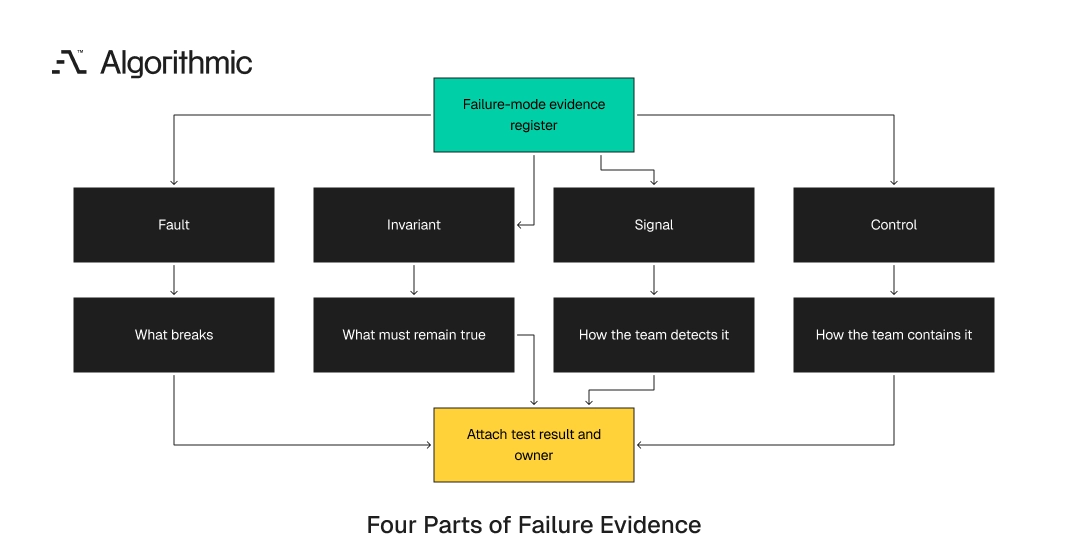
Production readiness answers this as an evidence standard, where code completeness is only one input and mature teams prove how the system fails, recovers, alerts, degrades, and rolls back before material customer load arrives. The launch-review standard we use sets four bindings for every material failure mode. The fault defines what breaks, the invariant defines what must remain true, the signal defines how the team detects the condition, and the control defines how the team contains or reverses it. A failure mode that lacks one binding stays outside production approval, because a feature whose success path is tested while its failure behavior remains an assumption turns production into the test environment with customers funding the learning cycle.
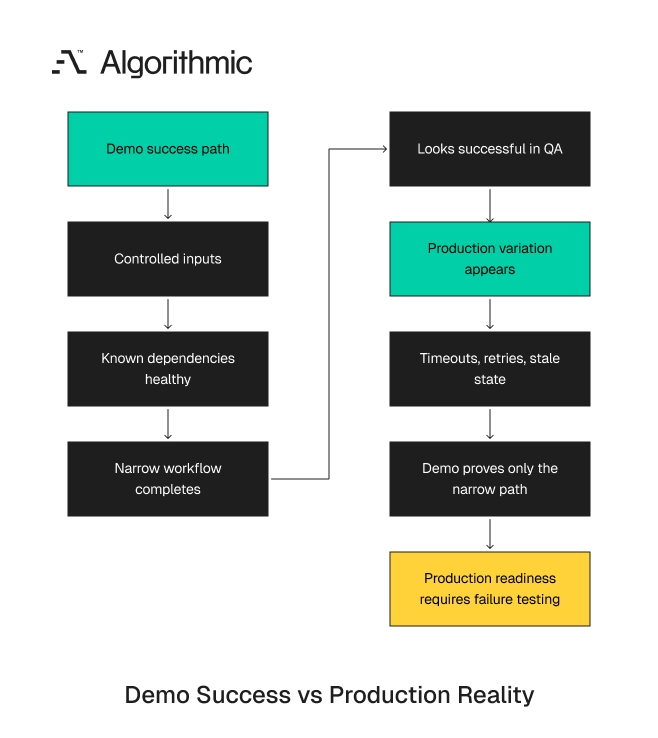
Demo success measures the narrowest path through the system
A demo proves one controlled workflow. The network is available, authentication succeeds, third-party APIs return expected payloads, the database responds within normal latency, and browser state matches server state, with background jobs running in sequence and user permissions unchanged through the workflow. Production adds uncontrolled variation, and a SaaS product with 4,000 daily active users sees expired sessions, duplicate webhook deliveries, partial file uploads, slow database reads, retry storms, and invalid states that arrive without warning and often appear in combination. A customer can submit a request from an older mobile client while a background import updates the same account, a browser extension can add unexpected fields to a form submission, and a retrying webhook can reach the API while a database replica lags behind the primary.
A machine learning workflow adds more failure paths, where feature values arrive empty, prompts contain hostile instructions, embeddings go missing, prediction pipelines receive events out of order, and a retrieval system returns outdated policy text that passed indexing three months earlier. The demo path therefore has limited evidentiary value. It proves a viable interaction model for one narrow case, while production readiness requires repeated trials, varied inputs, forced dependency failures, and verified recovery paths.
 Click to expand
 This distinction matters as AI systems enter customer workflows. ReliabilityBench, a 2025 benchmark for tool-using LLM agents, evaluates reliability across repeated execution, task changes, and infrastructure failures, and single-run success rates provide weak evidence for production behavior. A practical review therefore starts with a stricter question. What must remain true when the system fails? The invariant is no duplicate charge for payments, traceable freshness by tenant and source for analytics, no unsupported policy advice without human review for AI support, no paid feature access after cancellation for entitlement services, and no lost job after retry exhaustion for workflow automation. Those statements give engineering a testable target and give executives a release decision that does not depend on confidence language, so the review can approve, constrain, or hold a launch based on evidence.
Production readiness has four failure domains
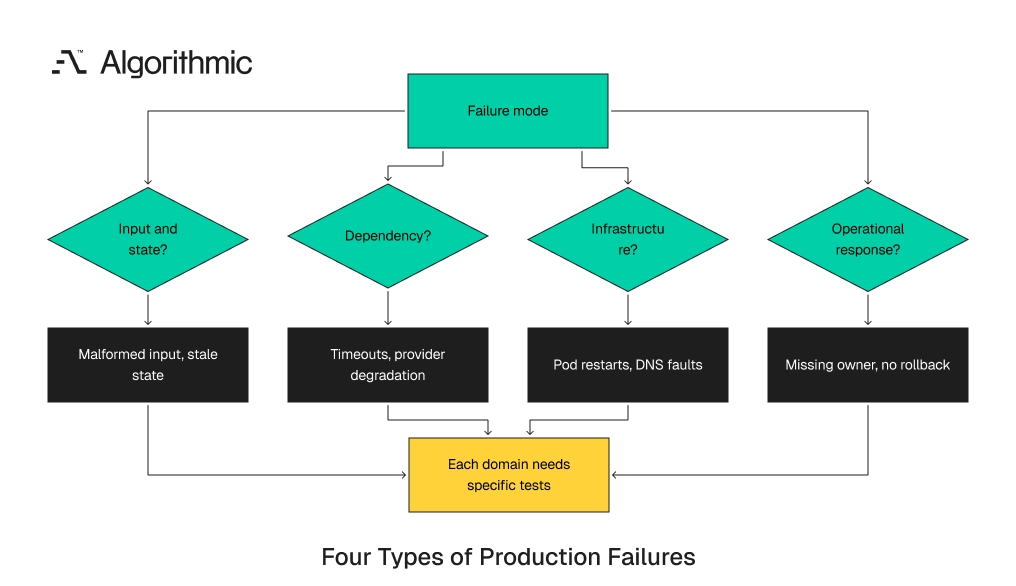
Engineering leaders need a MECE view of failure across four domains, input and state, dependencies, infrastructure and platform, and operational response, each requiring different tests, monitors, owners, and response procedures. Data failures appear inside the first three domains depending on cause, so a schema drift issue is an input contract failure, a warehouse timeout is a dependency failure, a replication lag event is a platform failure, and a missing on-call owner is an operational response failure. This separation matters during launch reviews, because a single customer-visible error can originate in request validation, a provider timeout, a Kubernetes restart, or a missing incident path, and each origin requires a different control.
 Click to expand
 1. Input and state failures
Input failures include malformed JSON, missing required fields, invalid enum values, duplicate events, expired tokens, oversized files, and unexpected user sequences. These failures occur before business logic can run safely, so the API should reject them predictably and log enough context for repair. State failures occur when the system receives valid input against invalid or stale internal state, such as a customer downgrading a plan while an invoice job is running or a user deleting a record while a background process still references it.
Older clients create a specific state risk, where a mobile app released 90 days earlier submits a payload that passes authentication and violates a new server-side assumption, and the release must handle that version or block it with a controlled customer message. Production-ready software development tests these cases directly. Contract tests validate API behavior across supported versions, and property-based tests generate input combinations beyond the written QA set.
Idempotency tests deserve direct launch-gate status. Duplicate webhook events must create no duplicate charges, messages, records, or workflow transitions, and the test result should show the idempotency key, event ID, stored state, and audit trail. A payments system provides a clear example, where a provider sends the same webhook event 25 times after a network timeout and the application must process it once, return success for duplicates, and preserve the audit trail for finance and support. The invariant is specific, since one customer intent produces one financial effect, the signal is a duplicate-event metric segmented by provider and endpoint, and the control is a reconciliation path owned by the payments engineer.
Input and state review should also include authorization changes, because a user can lose admin rights during a long-running approval workflow, so the system must recheck permissions before the final write, record the rejected action, and notify the operator. Multi-tenant systems need tenant isolation evidence, where a malformed tenant identifier never exposes another tenant’s records and the test shows rejected requests, audit entries, and data-access logs for at least two tenants.
2. Dependency failures
Modern products depend on payment processors, email providers, identity providers, LLM APIs, vector databases, data warehouses, object storage, and internal services, and each one adds a distinct failure surface that changes the customer promise. Each dependency needs a defined failure behavior. Stripe returning a 429 status differs from Stripe accepting a request and timing out before the client receives confirmation, just as an OpenAI safety refusal differs from a network timeout.
Snowflake query latency rising from 3 seconds to 45 seconds affects dashboards, scheduled reports, downstream alerting, and executive reporting, so the release plan should state which customer paths continue and which paths pause, with support staff seeing the current state without reading application logs. A mature release defines timeouts, retries, circuit breakers, backoff rules, and degradation paths for each dependency, and it defines the customer-facing behavior so support staff never guess whether a payment, email, or workflow execution completed.
The dependency plan should include owner names and thresholds. A payment timeout after charge submission should create a pending state and trigger reconciliation by provider event ID, with the payments engineer owning the alert, dashboard, and containment path. Dependency planning also needs request-path mapping, so if checkout calls Stripe, SendGrid, Segment, and an internal entitlement service, the release gate should show behavior for each failure, and a timeout in analytics tracking should never block checkout completion.
Internal dependencies deserve the same treatment as external providers, because a user service timeout can block billing, provisioning, or support workflows, and internal ownership often creates false comfort since the team can message another engineer. A release plan should state timeout budgets for every synchronous dependency. If checkout has a 1.2-second customer response target, four serial provider calls cannot each hold a 1-second timeout, and that arithmetic belongs in the design review, not the incident channel.
3. Infrastructure and platform failures
Infrastructure failures include Kubernetes pod restarts, node loss, DNS failure, queue backlogs, database failover, disk pressure, and cloud region degradation. These events expose defects that normal functional testing misses, and they test whether architecture diagrams match runtime behavior. Tests must run across layers, because a VM shutdown, database latency, a Kafka ordering fault, a Redis eviction, and a Kubernetes readiness probe misconfiguration each expose different defects even when they surface as the same user-facing error, and launch evidence should separate them.
Teams that assign reliability only to infrastructure miss cross-layer interactions, where a database read latency spike can slow a recommendation service or a delayed message can cause a model to score a stale feature vector. Application retry behavior can multiply queue pressure during a dependency outage, and a single failed provider call can become 10,000 retries in five minutes if backoff rules lack jitter and caps, converting one dependency fault into a platform incident.
AWS, Google Cloud, and Azure all provide managed services with high availability targets, but those targets do not prove application resilience, so the application still needs explicit behavior for timeouts, partial writes, stale reads, and failover windows. Platform testing should include capacity boundaries, since a queue depth of 50,000 messages has a different recovery profile than a queue depth of 500, and the test should record drain rate, oldest message age, and customer effect.
Region-level planning also needs practical limits. Some systems can fail over within minutes because state is replicated and traffic routing is tested, while others require manual reconciliation before traffic can move. A release review should state which category applies, because claiming regional resilience without a practiced failover drill creates board-level risk, and customers experience the runbook, not the architecture diagram.
4. Operational response failures
Operational failures occur when the system detects an incident and the team cannot respond with speed or confidence. The software has failed and the response process also lacks proof. Common gaps include alerts without owners, dashboards without service-level objectives, rollback scripts with no practice history, missing runbooks, and incident channels created during the outage, and these gaps turn defects that should take 15 minutes to contain into multi-hour incidents, where the delay usually comes from decision ambiguity rather than technical complexity.
Architecture reviews show the same pattern. Build and release automation is visible and well tooled, while approval gates, incident workflows, and evaluation evidence remain incomplete, which makes operational response the domain most often missing from a launch review. Operational readiness needs the same discipline as application readiness, so the team should know who declares severity, who approves rollback, who contacts customers, and who owns the repair, and those names should appear in the launch plan before traffic moves.
The operating rule is direct, since unnamed ownership is unmanaged risk. A launch plan that says “platform team” or “on-call engineer” lacks the precision needed during a customer incident, while a named owner with a named backup creates a controllable response path. Operational evidence should include the communication path, where customer success needs the customer-facing statement, affected segment, expected update cadence, and escalation owner, and engineering needs the technical timeline, decision log, and repair owner.
A severity model also needs launch-specific thresholds. A 1% error rate during normal operations can be tolerable for one service. During a canary, the same rate can justify an immediate pause.
The failure-mode evidence register
A release gate needs evidence. The most useful artifact is a failure-mode register tied to tests, monitors, rollback steps, and named owners. It turns launch acceptance from opinion into inspectable work.
| Failure mode | Test method | Expected system behavior | Monitor or alert | Rollback or containment owner |
|---|---|---|---|---|
| Payment provider timeout after charge request | Inject 30-second timeout after request submission | Mark transaction as pending; reconcile by provider event ID | Pending payment count above threshold for 10 minutes | Backend lead |
| Duplicate webhook delivery | Replay same event ID 25 times in staging | Process once; return success for duplicates | Duplicate event rate by provider | Payments engineer |
| Database read latency at p95 above 2 seconds | Add latency with proxy or fault-injection tool | Shed nonessential reads; preserve writes | p95 read latency and queue depth | Platform lead |
| LLM returns unsupported instruction | Regression evaluation with prohibited prompt set | Refuse or route to human review | Policy violation rate per model version | ML lead |
| Kafka messages arrive out of order | Reorder events in test topic | Preserve state consistency through version checks | Out-of-order event count | Data platform lead |
| Release causes elevated 500 rate | Canary deployment at 5% traffic | Stop rollout; preserve previous version | Error budget burn rate over 15 minutes | Release manager |
This artifact changes the release conversation. A team stops reporting that “the feature works” and starts proving that known failure classes have controlled outcomes and assigned response paths. The register also prevents checklist theater, because a checkbox without a reproducible test, alert, and rollback step reduces no launch risk, while a real register links every material failure class to a test result, monitor, owner, and containment action.
Evidence quality matters more than checklist length. A strong entry includes a test command, test environment, timestamp, result, dashboard link, and owner, while a weak entry says “covered by QA” or “monitored by Datadog” without showing what was tested or what action follows. The review chair should reject entries that lack the four bindings, so fault, invariant, signal, and control must appear in the row or in the linked evidence, and a release that cannot produce that evidence still carries unmanaged risk.
 Click to expand
 Google’s SRE practice formalizes this as launch readiness. Its chapter on reliable product launches at scale describes a launch coordination checklist driven by evidence rather than confidence, and most checklists cover the right categories and still fall short on evidence quality. A senior review should ask for artifacts before opinions, so the team brings fault-injection results, rollback timings, dashboard screenshots, and owner names, because status summaries belong in project meetings, not release acceptance.
The register should also capture evidence age, because a rollback drill from six months ago says little about a service with three schema changes and two new providers, and recent evidence matters as architecture and ownership change. For high-risk releases, the register should include customer exposure, so a billing change touching all enterprise accounts needs stricter proof than an internal admin screen, with the row naming the exposed segment, expected traffic, and financial effect.
Failure injection must cover every layer
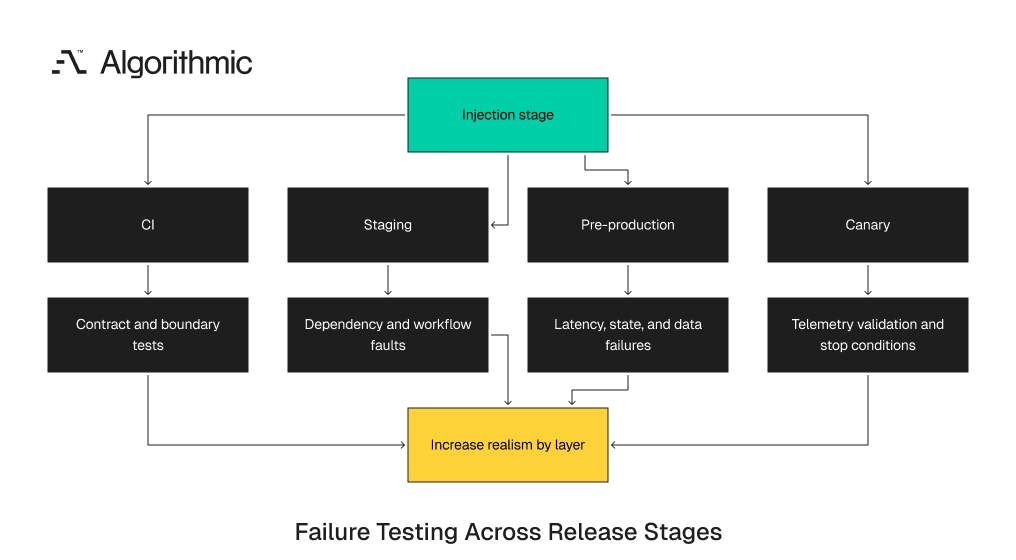
Failure injection forces controlled faults before production traffic finds them. It should run in CI, staging, pre-production, and limited production canaries, with each stage increasing realism without exposing customers to avoidable damage. The sequence matters, where CI catches contract and boundary failures, staging catches dependency, data, and workflow faults, and canary validates production telemetry, traffic shape, and operational response. A canary without stop conditions is limited exposure rather than controlled exposure, and the stop conditions must appear before traffic moves.
 Click to expand
 Application-layer injection
Application-layer tests cover malformed inputs, invalid state transitions, authorization edge cases, duplicate requests, and boundary values. These tests validate behavior where customer actions enter the system and expose the assumptions developers made during implementation. For API systems, teams should test payload size limits, missing fields, invalid content types, stale client versions, repeated calls with the same idempotency key, expired authentication tokens, and permission changes during long-running requests, since these cases account for a large share of production defects in multi-tenant SaaS systems.
For workflow systems, teams should test step failure, partial completion, retry exhaustion, and manual resume, and a workflow engine should record the last safe checkpoint, reject duplicate resumes, and expose incomplete work to operations staff, so the operator sees the failing tenant, job ID, step name, and last successful transition. For AI and ML systems, application-layer tests include prompt injection attempts, hallucination checks, low-confidence routing, empty retrieval results, embedding-store misses, and model version mismatches, and these failure classes rarely surface in standard functional QA, so they need regression tests tied to specific model and prompt versions.
An AI support agent illustrates the risk. The standard success path answers a product question from indexed documentation, while production traffic includes outdated documents, conflicting policy pages, malicious instructions, and customers asking for regulated advice. The release gate should test each class before customer exposure, the invariant should be explicit that the agent must not provide regulated advice outside approved policy, and the control should route the conversation to a human queue with the transcript and retrieval context attached. The test evidence should include the prompt set, model version, retrieval corpus version, and expected refusal behavior, along with latency and cost per request, because a safe response that takes 18 seconds can still fail the customer workflow.
Data-layer injection
Data-layer tests cover database latency, lock contention, replication lag, schema drift, missing partitions, duplicate records, and stale materialized views. These defects often appear after data volume exceeds the QA dataset and affect teams outside engineering. A customer analytics platform can pass dashboard QA with a 10,000-row test dataset and still fail when a nightly import produces 14 million rows with 2.5% malformed records, so a production-ready data pipeline includes malformed-row quarantine, data quality monitoring, lineage tracking, and backfill procedures.
The team should know which queries fail first under load and whether degraded analytics blocks operational workflows or delays reporting, since that distinction determines the severity level and the customer communication plan. Data tests should include tenant-level counts, row-level checksums, and freshness thresholds, a backfill that repairs aggregate revenue should reconcile by customer segment and billing period, and the dashboard should show the number of affected tenants before customer success sends updates.
Schema change testing deserves direct attention, because adding a required column can break older clients and renaming a field can break downstream dbt models, Looker dashboards, and scheduled CSV exports. The migration plan should prove backward compatibility across application, warehouse, and reporting layers, including before-and-after row counts, null-rate checks, dashboard smoke tests, and rollback rules, since data repair without reconciliation evidence creates accounting, customer success, and executive reporting risk.
Data ownership should be explicit, where a product engineer owns the API migration while a data platform engineer owns dbt model validation, and finance may need sign-off for billing tables and revenue reports. The release review should identify the authoritative source for every repaired value, so if a backfill rewrites invoice status the source of truth may be the payment provider event stream, and if a dashboard aggregate changes the source may be immutable transaction rows.
Infrastructure-layer injection
Infrastructure-layer tests cover pod eviction, node failure, queue saturation, DNS faults, object-store timeouts, secret rotation, and cloud service degradation. These tests verify that platform behavior matches the architecture diagram and that alerts reach the right owner. Kubernetes readiness and liveness probes deserve direct testing, because a service that accepts traffic before loading configuration creates intermittent failures during rolling deployments, and a worker that restarts without checkpointing creates duplicate jobs or lost work.
Fault tests should start small. Kill one pod, add 500 milliseconds of latency to a database read path, pause a consumer group for 10 minutes, rotate one secret in staging, or reduce a queue worker pool by 50% and observe drain time. The test has value when observers can predict system behavior and verify it with telemetry, because if the team cannot predict the result the test becomes discovery instead of validation, and discovery belongs earlier in the release cycle.
Infrastructure injection should also test access controls, where a rotated secret triggers a controlled restart or reload and an expired certificate alerts before customer traffic fails. A misconfigured service account should fail closed and provide a clear operational signal, with the alert naming the service account, affected service, environment, and last successful authentication, because a generic authentication error wastes minutes during containment.
Production canaries should include stop conditions, so a rollout can pause at 5% traffic if p95 latency exceeds 800 milliseconds for 10 minutes, and a second stop condition should monitor checkout or job completion because system metrics alone miss customer harm. Infrastructure tests should record blast radius, where a single node failure affects a known number of pods, queues, tenants, or requests, because a team that cannot name the blast radius cannot defend the canary boundary.
Rollback must become routine before launch
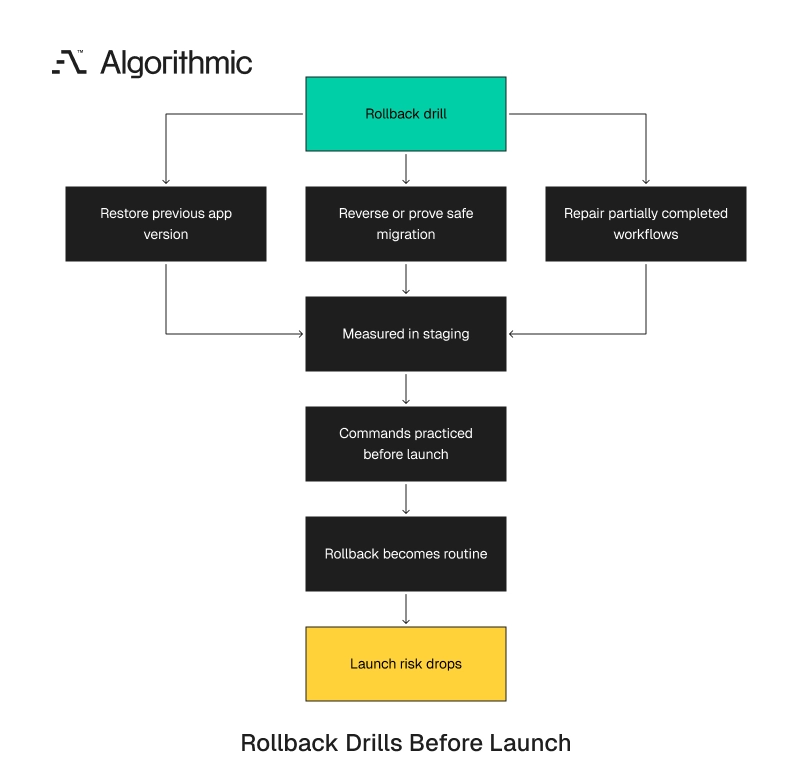
Rollback procedures fail when teams treat them as emergency documents, because a rollback path that has never run under realistic conditions is a theory, and production readiness requires practice under conditions that resemble the release. A release candidate should pass three rollback drills before launch. The first restores the previous application version, the second rolls back a database migration or proves it is backward compatible, and the third verifies data repair for partially completed workflows, because a workflow rollback without data repair leaves customers in ambiguous states that create support load, finance exceptions, and manual database edits.
 Click to expand
 Database rollback needs specific discipline, because destructive migrations, renamed columns, and background backfills create risk that application rollback cannot solve. Safer patterns include expand-and-contract migrations, dual writes during transition, shadow reads, and data reconciliation jobs with counts by tenant or customer segment. A migration plan should include the read path, write path, and cleanup path, so during the expand phase the application writes both old and new columns, and during the contract phase the team removes the old path after reconciliation proves parity.
Feature flags reduce blast radius when they are designed as control points, so a flag should disable a feature, stop background execution, and remove customer exposure without requiring a new deployment, with the owner, default state, expiry date, and kill-switch behavior appearing in the release plan. The same gating applies to changes that ship from a CMS or low-code editor rather than a pull request. Flags also need cleanup, because a stale flag becomes permanent conditional logic that increases test burden, so a launch plan should include the date when the flag will be removed and the engineer who owns the cleanup pull request.
Rollback drills should be recorded, with the record showing start time, end time, commands run, data repaired, and defects found in the runbook, because a drill that takes 38 minutes in staging rarely becomes a 10-minute action during a real outage. The drill record should also show who executed the rollback, since a process only the release architect can run is fragile, and a production rollback must work for the named incident owner under time pressure.
Rollback planning must include customer communication, so if a checkout release rolls back after partial payment attempts, support needs the list of affected customers and transaction states, and finance needs the reconciliation report, not a Slack summary. Teams should measure rollback time as a service-level property, because a release with a 15-minute rollback target needs practiced commands, permissions, and validation checks, and the target loses meaning when access requests start during the incident.
Observability must connect symptoms to decisions
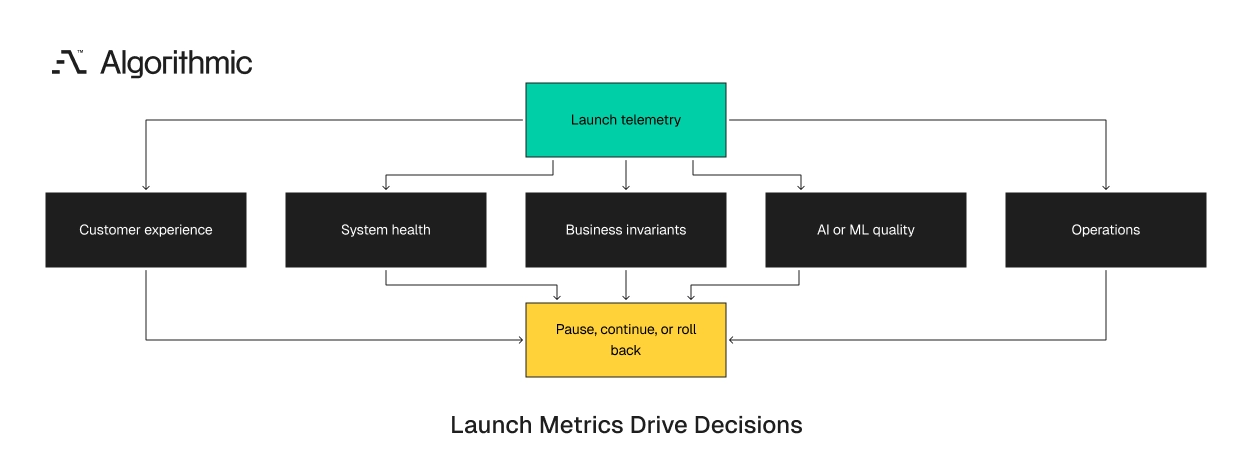
Observability is production evidence, so logs, metrics, traces, and events must tell the team whether to continue rollout, pause, roll back, or degrade service. Data without a decision path creates noise during launch.
A useful launch dashboard has five views.
- Customer experience: request success rate, p95 latency, p99 latency, user-facing error messages, checkout or workflow completion rate.
- System health: CPU, memory, queue depth, database connections, slow queries, cache hit rate, dependency latency.
- Business invariants: payments created versus payments confirmed, jobs started versus jobs completed, emails queued versus emails delivered.
- AI or ML quality: retrieval hit rate, groundedness score, refusal rate, policy violation rate, model cost per request, drift indicators.
- Operations: alert firing status, incident owner, rollback status, canary stage, error budget burn.
 Click to expand
 Each view should map to a decision, so if payment confirmations lag payment creation by more than 2% for 10 minutes the release should pause, and if model cost per request doubles after a prompt change the ML lead should review routing and retrieval behavior before more traffic moves. The most useful pattern combines quality, cost, and latency in one release decision, because AI systems can pass workflow tests while doubling token cost or raising refusal rates beyond approved thresholds, and a release gate that tracks only HTTP errors misses those failures.
AI systems inherit the operational discipline of the software systems around them, and a model deployed onto weak release engineering takes on every weakness of that release engineering. OpenTelemetry gives teams a common tracing and metrics layer across application, platform, and model calls, where a trace shows the request, retrieval query, model call, policy check, database write, and queue publish, because without that path teams argue from partial evidence during incidents.
Alerting should focus on symptoms that require action, because a CPU alert without customer effect or saturation context sends teams to the wrong problem, while an alert tied to failed checkouts, queue age, or error budget burn gives the incident owner a clearer decision. The launch dashboard should include stop conditions in the same view as metrics, so a reviewer sees the threshold, current value, owner, and action, and a tripped threshold does not become a Slack debate about the next step.
Observability also needs cardinality control, because per-tenant metrics help isolate customer effect while unbounded labels can raise costs and degrade the telemetry system, so the launch plan should specify tenant, region, provider, model, and version labels where they support decisions. Logs should carry correlation IDs across services, so a payment attempt connects API logs, provider events, database writes, queue messages, and support-visible status, and that trace reduces containment time when finance asks whether a charge completed.
Release acceptance should require evidence
CTOs and VPs of Engineering need a release gate that forces proof. The gate should be short enough to use and strict enough to stop an unready launch. Every item should produce an artifact that a senior engineer can inspect. Standing up that gate sits inside backend and reliability engineering, wired into the systems it protects.
Production readiness evidence checklist
A release should receive production approval only after the team shows the following artifacts:
- A failure-mode register covering input, dependency, infrastructure, data, and operational response failures.
- Automated tests for the top 10 failure modes by customer effect.
- Canary plan with traffic percentages, stop conditions, and owner names.
- Rollback runbook tested within the last 14 days.
- Database migration plan with backward compatibility proof.
- Alert map linking each launch metric to an owner and escalation path.
- Dashboard showing customer experience, system health, business invariants, and model quality where ML is present.
- Incident workflow with severity levels, communication channels, and customer update rules.
- Load test results at 2x expected first-week peak traffic.
- Dependency degradation plan for each external provider in the request path.
This checklist is deliberately operational. It avoids statements about team confidence and product maturity and asks whether the team produced evidence that the system can fail in controlled ways. Across 35 complex engagements, including platforms serving millions of end users, the strongest predictor of a stable launch has been failure-mode evidence before customer load, where senior software development teams can explain their top failure cases in detail while less mature teams describe features and defer failure behavior to post-launch monitoring.
The difference appears in review meetings, where experienced teams bring logs from fault-injection runs, screenshots of dashboards, rollback timings, and named owners, while less mature teams bring status summaries and unresolved assumptions about provider behavior, data repair, and alert routing. The same evidence standard applies when evaluating an external engineering partner. A release gate should also define who can override it, so overrides require written risk acceptance from the engineering executive and product owner, with the record stating the failure mode, customer exposure, containment plan, and remediation date.
A useful override record fits on one page, naming the customer segment exposed, the maximum traffic percentage, the defect class, the monitoring threshold, and the rollback owner, and stating the date when the release returns to the normal gate. The gate should also distinguish launch blockers from launch constraints, where untested rollback, undefined data repair, and unowned alerts are blockers, while limited load-test margin or a noncritical dashboard defect can become a constraint if customer exposure is capped and monitored.
Release acceptance should include a final evidence review with the incident owner present, who must confirm access to dashboards, runbooks, feature flags, and rollback commands, because approval without operator access creates a paper gate. The review should also capture deferred work, which needs an owner, date, and exposure boundary, since a note that says “monitor after launch” is not a control.
The executive release decision
A production readiness review should end with one of three decisions, ship, ship with constrained exposure, or hold. The decision should follow the evidence register rather than the strongest voice in the room. “Ship” requires passing evidence across the register, rollback drill, alert map, and canary plan, “ship with constrained exposure” applies when known risks are bounded by customer segment, feature flag, geography, or traffic percentage, and “hold” applies when rollback is untested, data repair is undefined, or alerts do not route to named owners.
A constrained release should state its boundary in measurable terms, such as 5% of traffic, 20 internal customers, one geography, or customers below a defined transaction volume, and the plan should also state the metric that permits expansion. Faster delivery raises the stakes on release governance, because higher throughput increases the need for evidence-based gates as more code reaches production paths faster, and AI-assisted development only accelerates that flow.
Engineering leaders should require every production readiness review to include a failure-mode register, a completed rollback drill, and a launch dashboard tied to stop conditions. This standard changes production-ready software development from a confidence claim into an evidence requirement. It gives executives a defensible basis for approving, constraining, or holding the next release. The same evidence discipline carries past launch into how teams scale product operations before a growth push, where a new channel surfaces the same untested failure paths.
The concrete next step is simple to assign. Before the next release review, require each service owner to submit the top five failure modes for their service using the four-binding format: fault, invariant, signal, and control. No row, no launch approval.
If a release is coming and its failure modes are still assumptions, that is a readiness gap worth closing first. Algorithmic builds backend systems with fault injection, tested rollback, and named alert ownership wired in before launch. Ask us to pressure-test your release.