
A large software acquisition can lose 90 to 180 days after close when one founder controls production deploys, triages incidents, and knows which undocumented scripts run before release. That delay rarely appears in the quality of revenue report. It surfaces later as integration drag, delayed roadmap capture, excess contractor spend, missed cost targets, and staff churn, and in platform acquisitions those costs spread across engineering, product, security, finance, and customer success budgets.
A working product proves market demand, but engineering transferability requires its own diligence workstream, and acquirers need to price both before signing. A buyer that prices only the product buys an incomplete picture, because the acquired asset must run under new ownership, with new access controls, new reporting lines, and new release governance. That operating shift carries cost, and the cost belongs in the purchase model. Our technical due diligence work exists to price exactly that gap.
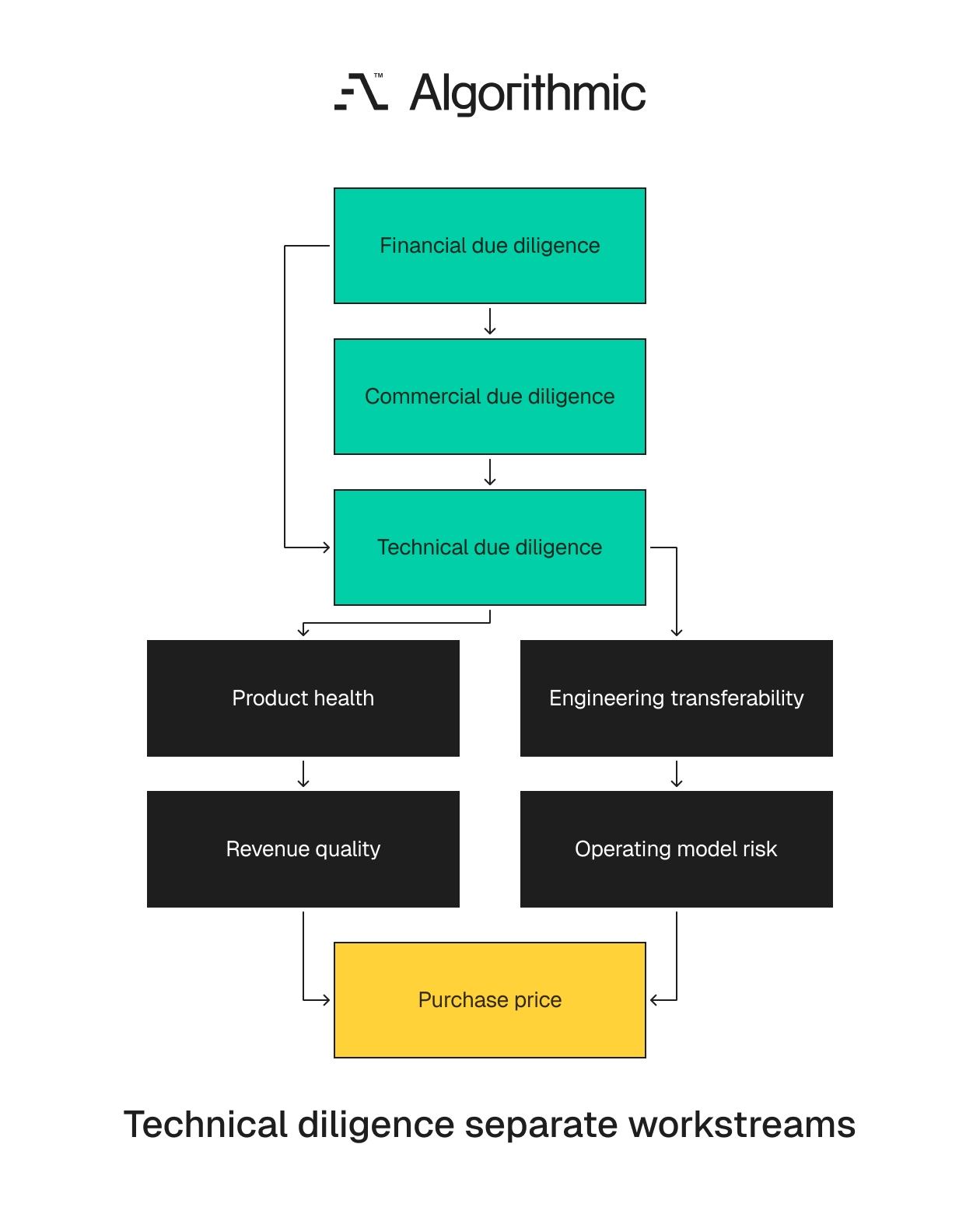
Revenue quality and engineering transferability are separate workstreams
Financial due diligence validates reported revenue, EBITDA, working capital, debt-like items, cash flow, forecasts, and accounting policy. Commercial due diligence tests demand, pricing power, retention, market position, and go-to-market repeatability. Technical due diligence answers a different operating question. Can the buyer operate, modify, secure, and deploy the product without the seller’s original engineering memory? That question belongs in the first diligence work plan, before the integration team receives its first post-close task list.
Standard technology diligence covers architecture, security, infrastructure, product, and team risk, and those categories are useful. They leave a pricing gap when the diligence team fails to convert handoff risk into time, cost, and deal mechanics. A diligence report that says “documentation is limited” gives the investment committee too little evidence to underwrite. Engineering handoff risk is the cost of transferring operational control from seller to buyer, and it includes onboarding windows, single points of knowledge, deployment fragility, missing incident records, weak CI/CD pipeline design, unclear production ownership, and the cost of reconstructing facts the seller team never recorded.
A product with high gross revenue retention can still require a six-month engineering transition, and that transition has a price that belongs in the purchase model, the escrow structure, and the first 180-day integration plan. The diligence team should make one practical distinction at the start. Product health shows whether customers receive value today, while transferability shows whether the buyer can preserve and extend that value after ownership changes.
 Click to expand
The product can work while the operating model fails transfer
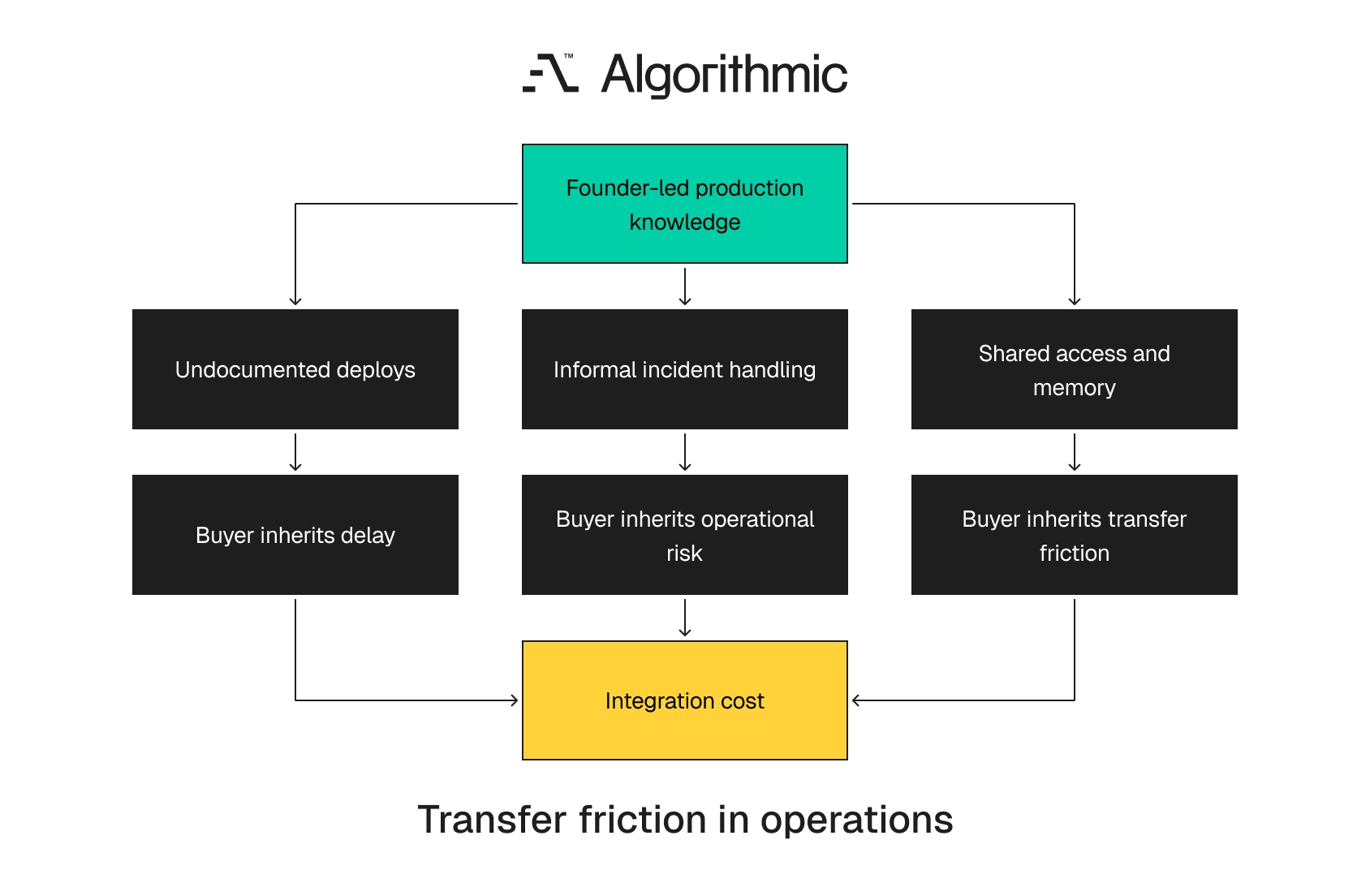
A live SaaS platform can serve customers daily while depending on one founder, one DevOps engineer, or one unreviewed deployment path. Customer usage provides demand evidence, but it provides limited evidence about operational transfer. This pattern appears often in founder-led companies between $5 million and $25 million ARR, where the product has reached commercial traction while the engineering operating model remains informal, because a small team has preserved production knowledge through memory, Slack threads, and repeated manual steps.
The buyer inherits that operating model on day one. If access, deployment, monitoring, and incident response remain undocumented, the buyer pays through delay and risk, and the payment appears through senior engineering time, deferred product work, and higher incident exposure. The buyer also inherits informal assumptions. A founder knows one migration must run before another, a senior engineer knows one tenant requires a special import script, and a platform lead knows which CloudWatch alarm produces false positives during batch jobs. Those facts are operating assets, and if they exist only in memory they become transaction risk that a buyer should identify before exclusivity ends.
 Click to expand
Deployment knowledge concentrated in one person
The highest-risk handoff pattern is a deployment process that requires undocumented judgment, and the risk increases when that judgment sits with one founder or one infrastructure engineer. A release process based on memory cannot transfer cleanly under deal pressure. In a common example, releases run through GitHub Actions, then require a manual database migration in psql, then a Redis reset, a Kubernetes rollout, and a log check in Datadog, and only one engineer has performed the complete sequence. The pipeline exists, but it does not represent the full release process, so the buyer needs to know whether the documented process matches the process used in production.
The diligence question is direct. Can a buyer engineer deploy a minor change to production within 72 hours using documented access, runbooks, and repository instructions? The answer gives the buyer a clearer signal than a 40-page architecture summary. If the answer is no, the product has handoff debt, and the cost appears as onboarding time, shadow operations, delayed feature work, and incident exposure. A buyer should assign a dollar value to each category before submitting final terms. The valuation team should translate the answer into a model input, so two senior engineers assigned for 12 weeks at $250,000 loaded annual cost each creates about $115,000 in direct labor cost, and that figure excludes delayed roadmap value, executive time, and customer communication load.
The diligence team should also inspect deployment frequency, because a platform released weekly with one person controlling deployment has a different risk profile from a platform released quarterly. Google’s DORA research on the four key delivery metrics shows deployment frequency and change failure rate travel together, so frequency changes the number of risky handoff events during the first 180 days. Release history should include successful deploys, failed deploys, hotfixes, rollbacks, and emergency database changes, and the buyer should request the last 10 production deployments and trace each one to a pull request, approval, and verification step, since missing links identify the exact transfer gap.
Incident history absent from the system of record
Incident history tells the buyer how the system fails under stress, and missing incident history forces the buyer to rediscover failure modes in production, often during the first customer escalation after close. A target should provide incident response runbooks, post-incident reviews, PagerDuty or Opsgenie records, status page history, customer-impact timelines, and mean time to recovery data. A company with three years of production service and zero recorded incidents is rarely incident-free, it is usually record-free, and that distinction changes valuation because a buyer cannot price operational reliability from memory-based assurance. “We handled it in Slack” gives no audit trail for recurrence, customer impact, ownership, or remediation.
The buyer should request the last 12 months of incidents by severity, and each record should include start time, detection source, customer impact, owner, remediation action, and follow-up work, since missing records require a higher integration reserve. The diligence team should compare incident records against support tickets and status page updates, because a support spike with no matching incident record indicates weak operational recordkeeping that matters when the buyer inherits enterprise service commitments. The review should also include customer communications, since enterprise accounts often receive incident explanations through customer success emails instead of a public status page, and those messages reveal service commitments, promised fixes, and account-specific exposure.
A buyer should ask for the three most expensive incidents, measured by credits, discounts, executive escalation, or lost expansion. The financial record often finds outages that the engineering record omits, and that comparison converts operational gaps into commercial evidence.
CI pipelines that test syntax instead of release safety
A CI pipeline can give false comfort, because passing unit tests and lint checks do not prove the system can be changed safely, so diligence needs to inspect the workflows that carry revenue, identity, and customer data. Reviewed systems often show high reported test coverage where the most important workflows have no integration tests, no migration tests, and no staging environment parity. Automated scores are signals, but human review must test craftsmanship, architectural intent, duplication, McCabe complexity, refactor history, and testability. A technical due diligence checklist that stops at code coverage misses the transfer question, and the stronger test asks whether a new engineer can modify billing, authentication, or data ingestion without private coaching from the original builder, since those three areas produce the highest post-close risk in most SaaS acquisitions.
The buyer should inspect the last 20 pull requests against revenue, identity, and data workflows, and reviewers should check test scope, rollback notes, database migration safety, feature flag usage, and production verification steps. This review takes hours and often reveals months of hidden integration work. It should include failed builds and reverted pull requests, because failed builds show where the team’s safety net breaks and reverts show whether release failures have a known recovery path. The buyer should also inspect how tests map to business risk, so a payment workflow needs end-to-end tests that cover subscription changes, tax handling, invoices, retries, refunds, and webhook failures, and a login workflow needs coverage for SSO, MFA, password reset, session expiry, and tenant boundary checks. Release safety also depends on environments, so if staging uses a different database engine, queue configuration, or third-party sandbox, the team tests a different system, and the buyer should record every material difference between staging and production.
The engineering handoff risk index
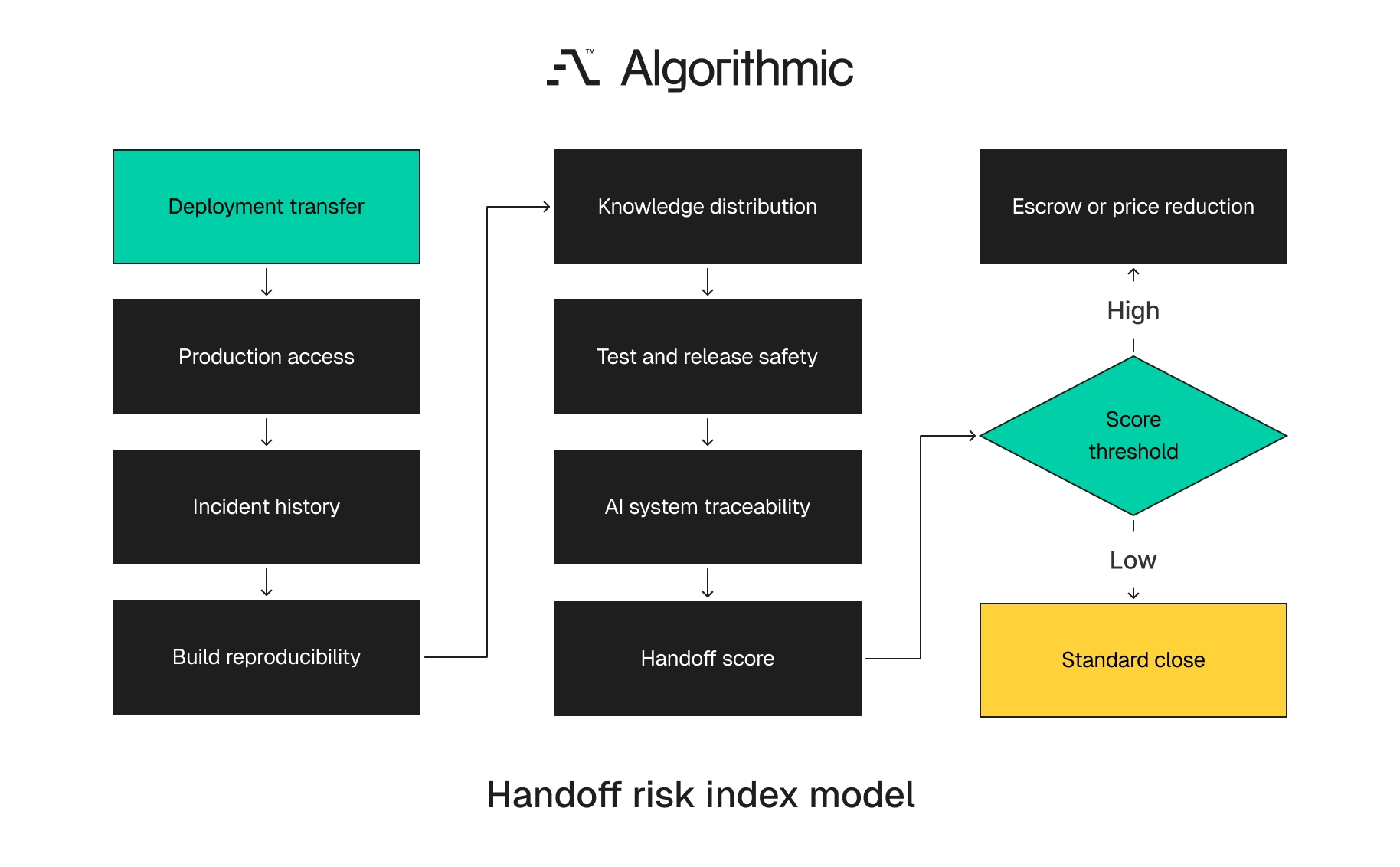
Diligence teams need a structured artifact that converts engineering transfer risk into deal terms. The Engineering Handoff Risk Index is a practical scoring model for buy-side diligence and sell-side preparation, and it forces technical findings into a format that investment committees can price. Score each category from 1 to 5, where a score of 1 means the buyer can assume control with standard onboarding and a score of 5 means the buyer faces high transfer cost and should price remediation.
 Click to expand
| Category | Evidence to request | Low-risk pattern | High-risk pattern | Deal response |
|---|---|---|---|---|
| Deployment transfer | CI/CD configs, release runbook, last 10 deployment records | Buyer engineer can deploy in 72 hours from documentation | Founder must supervise release steps | Price reduction, escrow, or closing condition |
| Production access | IAM roles, secrets policy, admin account list | Role-based access with audited permissions | Shared credentials and founder-owned cloud accounts | Remediation before close |
| Incident history | PagerDuty logs, post-incident reviews, status page data | Recorded incidents with owners and fixes | No incident records despite production usage | Escrow and 30-day shadow operations |
| Build reproducibility | Dockerfiles, Terraform, dependency lockfiles | New environment created from infrastructure as code | Manual server setup and undocumented dependencies | Integration staffing budget |
| Knowledge distribution | Team interviews, code ownership map | Three or more engineers can explain core paths | One person owns deploys, billing, or data pipelines | Founder transition covenant |
| Test and release safety | Test matrix, staging parity, migration tests | Critical paths covered by integration tests | Unit tests pass while release risks remain manual | 60- to 90-day remediation plan |
| AI system traceability | Label schema, sampling plan, model cards, deployment rules | Behavior traced to named decisions and artifacts | ”AI decided” used as explanation | AI diligence holdback |
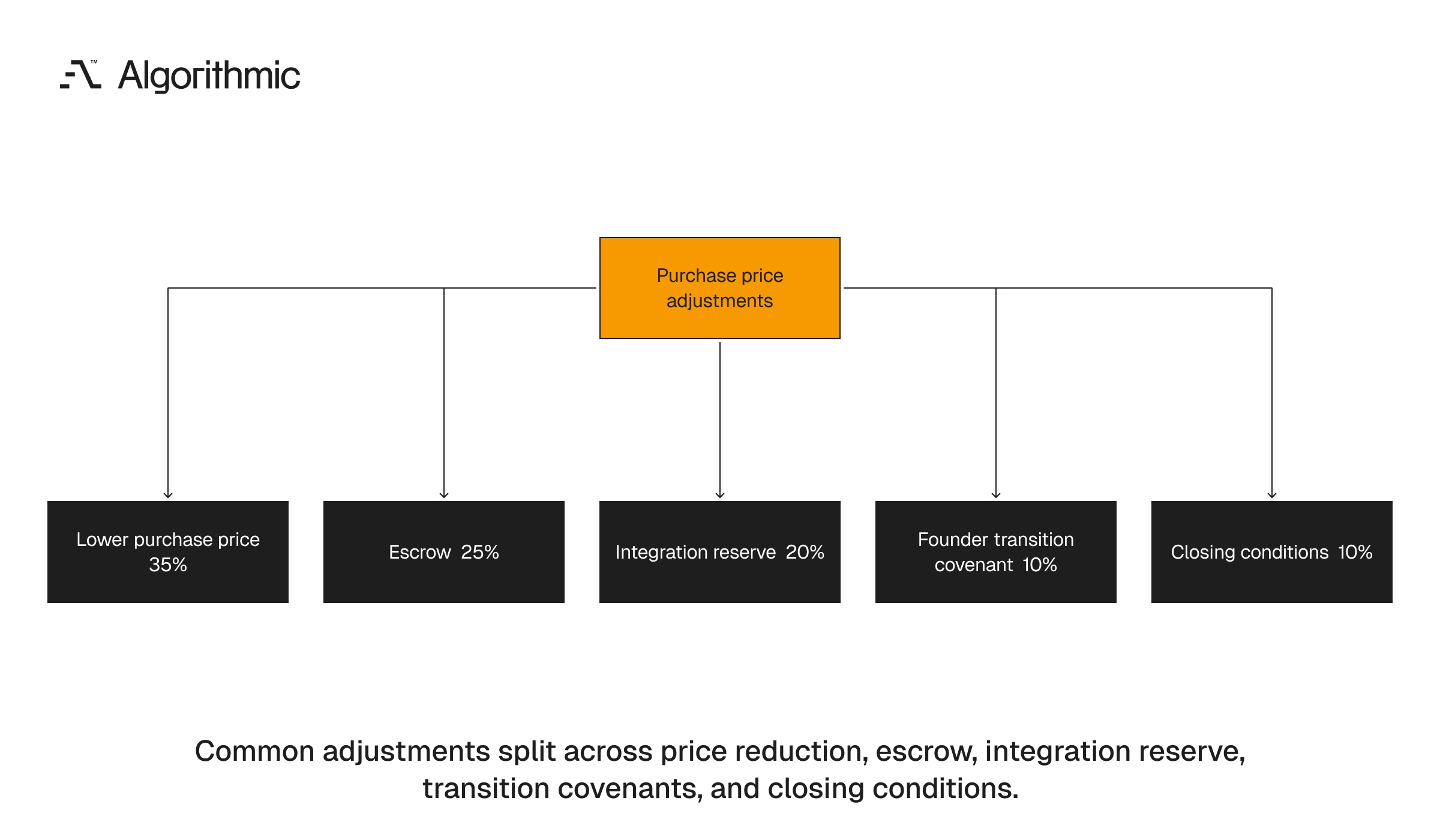
A target scoring 28 or higher across these seven categories should trigger a formal valuation adjustment, and that adjustment can take four forms, lower purchase price, escrow tied to transfer milestones, additional integration staffing, or delayed signing until critical artifacts exist. The adjustment should be stated in dollars, dates, and release conditions. This index also protects sellers, because a founder preparing for acquisition can reduce perceived risk by producing the artifacts before management presentations begin, showing operational maturity through evidence instead of verbal assurance.
The score should sit beside revenue retention, customer concentration, and security findings in the final diligence memo, because engineering transfer risk affects the same cash flows that commercial and financial diligence value, so it belongs in the same decision forum. The index works because it turns technical ambiguity into board-level language, so “Terraform coverage is incomplete” becomes “two infrastructure engineers for eight weeks and a closing condition for account transfer,” and that translation gives deal teams a usable decision. Scores should reflect evidence, not interviews alone, since a confident explanation from a founder has lower diligence value than a buyer-led deployment record, and the scoring model should reward artifacts that prove transfer under controlled conditions.
Handoff risk becomes valuation risk through four cost channels
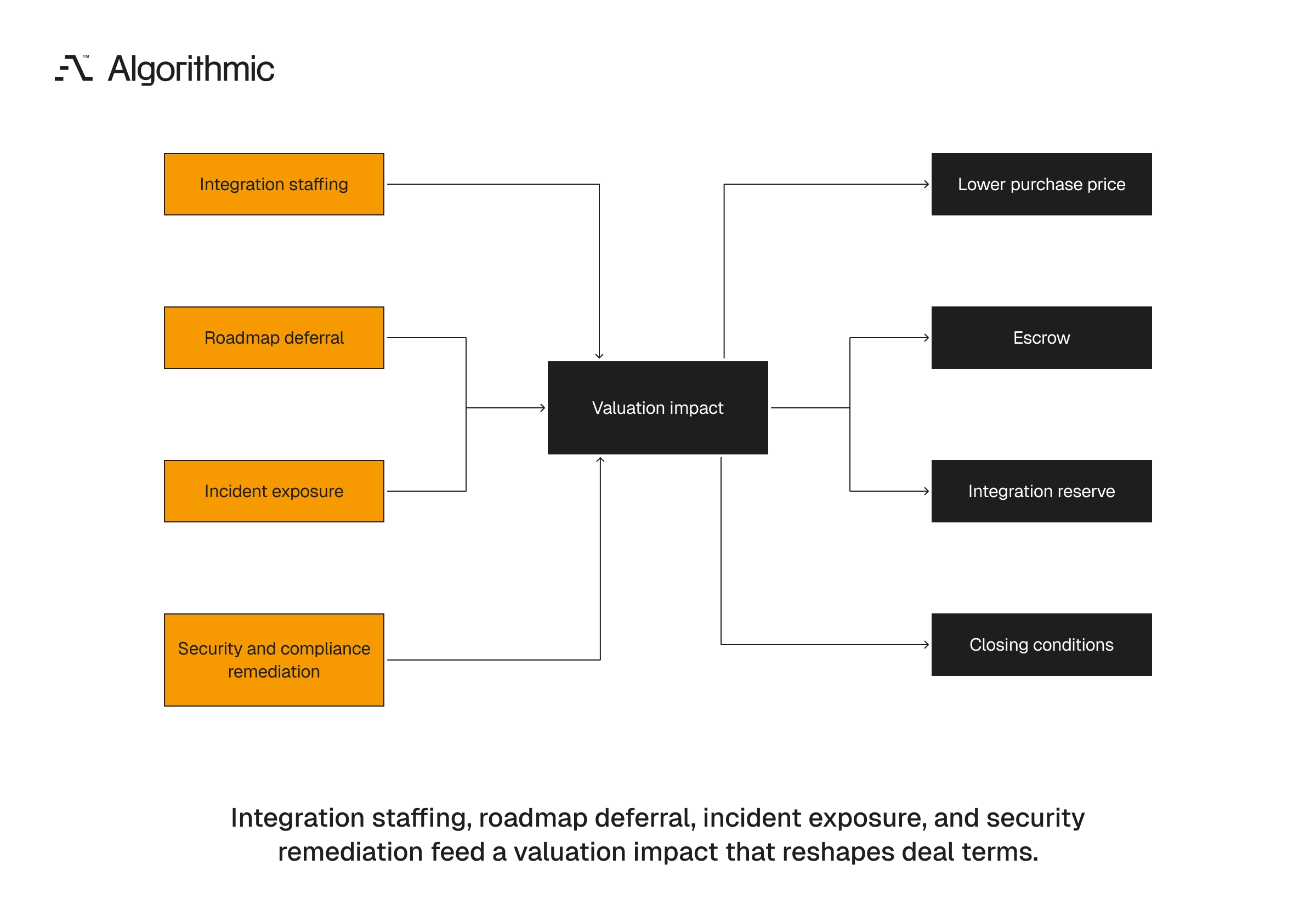
Engineering transferability has economic value because weak transfer creates cash cost, schedule delay, and execution risk, so the buyer should quantify each channel before signing, and each channel should have an owner, budget line, and timeline. The four channels are distinct, they affect different budgets, owners, and timelines, and treating them as one general “technology risk” line hides the cost. The deal model should include direct labor, lost roadmap capacity, incident exposure, and security remediation, and those categories also guide the first post-close operating plan, so the same analysis should support purchase price and integration budget.
 Click to expand
Integration staffing
A fragile handoff often adds 2 to 5 senior engineers for 3 to 6 months, which at fully loaded cost can reach several hundred thousand dollars before opportunity cost, and the cost rises when security, data, and machine learning systems need separate review. For a platform acquisition, the staffing need often includes one backend engineer, one infrastructure engineer, one security engineer, and one data engineer, and if the product includes production machine learning engineering, add an MLOps engineer who must inspect model training pipelines, model versioning, feature stores, and drift monitoring. This staffing cost should appear in the deal model, not as a post-close surprise budget, and the integration leader should enter signing with named roles, start dates, and acceptance criteria.
The cost also includes management load, because a VP of Engineering who spends 15 hours per week reconstructing seller knowledge loses time for the core product roadmap, and that time has direct cost when the acquisition thesis depends on product integration. A practical model should price four roles separately, engineering, security, data, and product operations, and each role should have a start date and a measurable exit condition, since “support integration” is too vague for a post-close budget. The staffing plan should also separate advisory work from operating work, because a founder can explain context while buyer engineers must still own production steps, so the transition plan should move production responsibility to the buyer through named drills and evidence. Contractor spend deserves separate review, since post-close teams often bring in cloud consultants, security reviewers, or data migration specialists after discovering missing records, and a diligence reserve should include those outside costs before the investment committee approves the transaction.
Roadmap deferral
The buyer’s investment thesis often assumes new enterprise features, geographic expansion, pricing changes, or integration with an existing product suite, and each assumption depends on engineering capacity after close, so weak handoff reduces that capacity during the highest-pressure period. A 120-day handoff delay pushes those assumptions back by at least one quarter, and for a company with $12 million ARR and a planned 20% growth initiative tied to product integration, one lost quarter can affect $600,000 of annualized revenue opportunity, a number that should appear in the downside case. That is a valuation input, so the buyer should model it in the base case and downside case, and a diligence report should state which roadmap items depend on knowledge transfer from the seller.
Roadmap deferral also affects customer commitments, because if the seller promised SSO improvements, audit logging, data residency, or API expansion, the buyer inherits those commitments, and weak handoff turns promised features into delayed revenue and support escalation. The buyer should review the seller’s customer success notes during diligence, since commitments often sit in sales calls, renewal decks, and enterprise security questionnaires, and engineering due diligence should connect those promises to the actual release plan. The review should also map roadmap items to code ownership, because a promised SSO enhancement carries higher delivery risk when one former contractor wrote the identity layer, and a data residency promise carries higher risk when deployment scripts hard-code a single AWS region. Product managers should participate in this review, since they know which commitments affect renewals, expansion, and executive relationships, and engineering diligence should translate technical transfer gaps into customer-facing delivery dates.
Incident exposure
Production systems fail during ownership changes because people, permissions, and process change at the same time, so access rotations, domain transfers, cloud billing changes, and monitoring changes introduce operational risk, and the first 90 days carry the highest coordination burden. The buyer should model incident exposure during the first 30, 60, and 90 days after close, and if the seller lacks runbooks, post-incident reviews, staging parity, and escalation paths, the buyer should plan shadow operations with the seller’s technical leads as a named workstream, with named owners and scheduled reviews. The escrow can then attach to measurable transfer milestones such as successful buyer-led deployment, recreated staging environment, documented rollback test, and verified incident response drill, and each milestone should have objective evidence.
The buyer should also define severity thresholds before close, so a Sev-1 incident names the executive owner, technical commander, communication owner, and customer contact path, because missing roles create confusion during the period when the acquired team is under the most pressure. Incident exposure also has customer economics, since a single enterprise outage during renewal negotiations can change discounting, expansion timing, and executive confidence, so the deal model should reflect that risk when service history is undocumented. Monitoring transfer deserves its own review, because the buyer should know who receives alerts, which alerts wake someone overnight, and which dashboards matter during an outage, since alert routing failures often create longer incidents than code defects. The first 90 days should include a tabletop incident drill that tests PagerDuty routing, status page access, customer communication approval, rollback authority, and executive escalation, and the evidence should become part of the integration record.
Security and compliance remediation
Handoff risk often exposes security gaps, since shared credentials, orphaned admin accounts, unmanaged secrets, and undocumented data flows are common in smaller SaaS companies, and these gaps become buyer liabilities after close. NIST SP 800-53 treats least-privilege, role-based access, and audited permissions as baseline controls, so shared credentials and founder-owned cloud accounts read as findings a buyer must remediate. For regulated targets, this extends beyond remediation cost, because it can delay SOC 2 renewal, HIPAA review, PCI scope confirmation, or enterprise customer security approvals, and a delay in a SOC 2 bridge letter can stall enterprise procurement.
A buyer should request cloud IAM exports, SSO policy, secrets inventory, audit logs, vendor access lists, and data lineage for customer data, because missing artifacts change both risk and closing conditions, and they also change the first-week integration plan. The buyer should inspect ownership of production accounts, since founder-owned AWS, GCP, GitHub, Stripe, Twilio, SendGrid, or Apple Developer accounts create transfer risk, and account ownership should move to company-controlled identities before close or under a signed transition covenant. The diligence team should test account recovery paths, because recovery email addresses, backup MFA devices, registrar accounts, and billing contacts control operational continuity, and these details look administrative while they can stop a release or outage response. Security review should include secrets rotation history, since if API keys, database passwords, and signing keys have never rotated, the buyer inherits unknown access exposure, and the first post-close week should include a prioritized rotation plan. Compliance review should connect evidence to customer commitments, because enterprise security questionnaires often contain promises about encryption, access review, logging, backup retention, and vendor controls, and the buyer should compare those promises with actual production controls.
AI products require decision traceability, not model theater
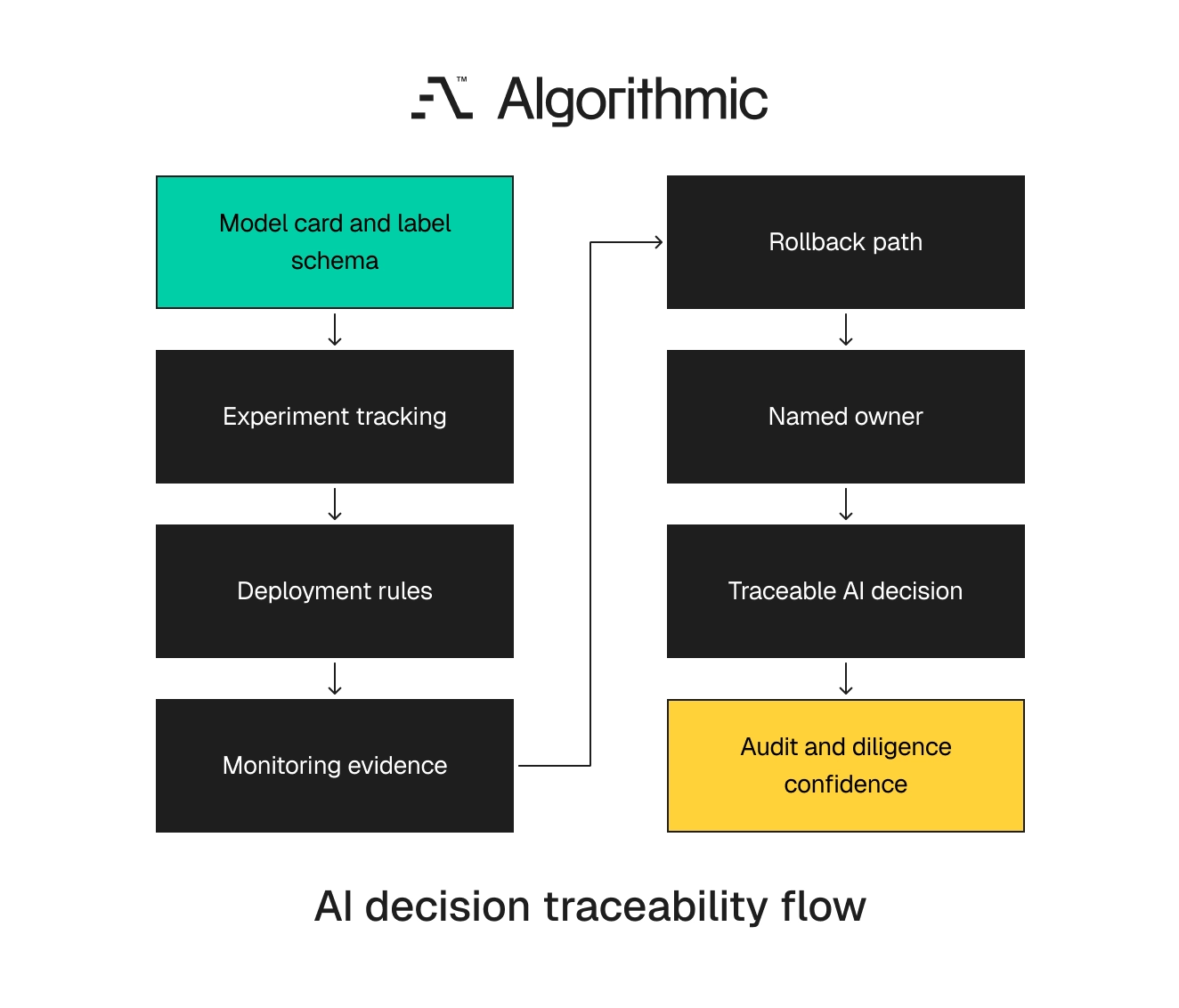
AI acquisitions add another layer to technical due diligence, because the buyer must trace material system behavior to people and decision artifacts, which is both a governance requirement and an operating requirement. Avoid explanations such as “the AI classifies customers” or “the model decides which claim is risky,” and instead identify the sampling plan, label schema, feature engineering choices, performance threshold, human review rule, deployment gate, and owner who approved each threshold, so each material behavior points to a dated record. This applies to recommendation systems, NLP systems, computer vision products, search ranking systems, and retrieval augmented generation systems, and the same rule applies when the product uses OpenAI, Anthropic, Google Gemini, AWS Bedrock, or an internal model, because third-party model use does not remove accountability from the seller. Our AI readiness assessment applies the same traceability standard to production model behavior.
A buyer should request a defined set of AI artifacts before pricing the asset.
- Model card with training data period, intended use, known limits, and performance by segment. The Model Cards for Model Reporting paper sets the reporting standard buyers should expect.
- Labeling guide with examples, reviewer instructions, and adjudication rules.
- Experiment tracking records from MLflow, Weights & Biases, SageMaker Experiments, or equivalent.
- Deployment rules that state when a model moves from offline testing to production.
- Monitoring evidence for drift, latency, error rate, and human override rate.
- Rollback path for model versions and prompt versions.
- Named owner for each model behavior that affects a customer, claim, transaction, or recommendation.
 Click to expand
For AI companies, commercial diligence can validate market demand while technology diligence must validate accountability, so buy-side teams still need engineering review that ties production behavior to named decisions. A demo does not show whether the system can be operated, explained, monitored, and changed after the founding team steps back, so the buyer needs evidence from the production control plane. The buyer should test prompt and model change control, and for a RAG product request the retrieval configuration, index update process, evaluation set, hallucination review process, and customer escalation path, while for a claims or underwriting model request threshold history, false positive review records, and human override logs. Traceability also affects indemnity, because if a model decision affects a financial transaction, healthcare recommendation, fraud flag, or legal workflow, the buyer needs dated approval records, since verbal explanations do not support audit, regulator review, or enterprise security questionnaires.
The buyer should also inspect data rights, because training data, customer data, vendor data, and synthetic data each carry different contractual constraints, and a model with uncertain data lineage creates post-close commercial and legal risk. AI diligence should include evaluation data, not only accuracy claims, so the buyer should review the holdout set, segment performance, failure samples, and escalation thresholds, since an average score hides risk when one customer segment carries most revenue or regulatory exposure. Prompt management also needs evidence, so the buyer should ask where prompts live, who approves changes, how versions are tracked, and how regressions are tested, because a prompt edited in a production console without review creates the same transfer risk as an undocumented deployment script.
The buyer should test transferability during diligence
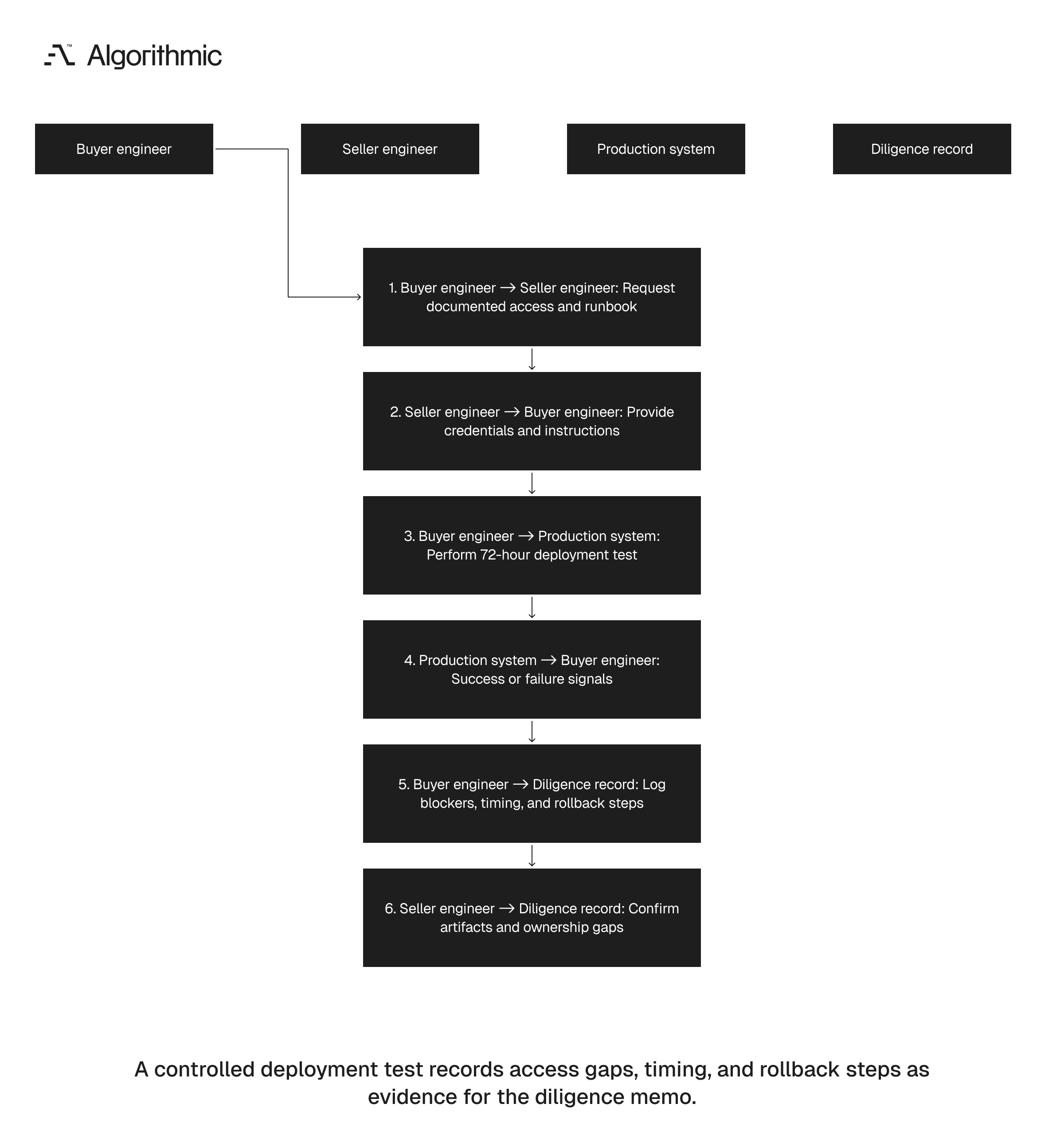
Document requests are necessary, but live transfer tests add evidence that a data room cannot provide, because a data room can contain strong documentation while the actual operating process still depends on memory. Across complex production engagements, including platforms serving millions of end users, the best diligence signal is a short controlled handoff exercise, and it should take place before exclusivity expires when possible, since the buyer needs this evidence while it still has negotiating power. A buyer that waits until after close loses price and escrow options, because the same finding that supports a 10% escrow before signing becomes an internal integration issue after closing, so timing changes economics. The test design should protect customers and still reflect real operations, since a low-risk change can expose missing access, undocumented scripts, unclear ownership, and incomplete rollback steps that the buyer should capture in the diligence record.
 Click to expand
The 72-hour deployment test
Ask the seller to nominate a small change with low customer risk, such as a copy update, feature flag adjustment, logging change, or admin dashboard field, and the change should touch the normal release path. Then require a buyer-designated engineer to perform the deployment using seller documentation, where the seller can observe and answer access questions but should not direct each step. Track elapsed time, missing permissions, undocumented steps, failed tests, rollback instructions, and production verification, and the observer should log every moment where the buyer engineer needs oral knowledge from the seller, because that log becomes direct evidence for the diligence memo. A successful test ends with a deployment record, monitoring check, rollback plan, and updated runbook, while an unsuccessful test gives the buyer evidence for escrow or valuation adjustment and gives the integration team a precise work plan.
The buyer should run this test against a non-critical change, since the point is to test transferability without placing customers at unnecessary risk, and a controlled change still exposes missing permissions, fragile scripts, and undocumented release order. The test should include time-boxed access setup, because if it takes two days to create accounts, assign roles, and find secrets, the buyer has learned something material, since access friction becomes deployment friction after close. The observer should use a standard log format where each entry includes timestamp, blocker, person contacted, artifact missing, and operational effect, which lets the deal team price the outcome. The buyer should repeat the test if the first change touches only a narrow path, because a UI copy change tests less than a migration, billing flag, or integration webhook, so the second test should match the highest-risk path the seller can safely expose during diligence.
The 30-day operating shadow
For higher-value assets, require a 30-day operating shadow before or immediately after close, where the buyer joins incident reviews, release planning, deployment windows, and infrastructure changes while the seller team continues to operate production. This period should produce a code ownership map, production access matrix, incident escalation tree, dependency inventory, and integration backlog, and it should identify the 10 highest-risk operational tasks with owners, dates, and acceptance tests. The buyer should assign named owners to each task before the founder’s transition window begins, and each owner should have a date, acceptance test, and escalation path, so the handoff plan reads like a production change plan.
Operating shadow work should include finance and legal inputs, because some risks live outside the repository, including cloud billing ownership, enterprise support commitments, third-party data contracts, and processor agreements, and engineering diligence should connect those items to the operating plan. The shadow period should also cover routine work, since weekly deployments, database maintenance, customer imports, and support escalations reveal ordinary operating risk, and ordinary work often exposes the transfer gaps that architecture reviews miss. The buyer should require written outputs at the end of each week, where week one covers access and ownership, week two covers deployment and rollback, week three covers incidents and customer commitments, and week four covers integration backlog, staffing, and unresolved risk. This cadence prevents the shadow period from becoming passive observation.
The repository orientation drill
Pick three code paths, authentication, billing, and the highest-volume customer workflow, then ask two engineers who did not write the code to explain request flow, data persistence, test coverage, failure modes, and deployment risk, giving them repository access, diagrams, and 90 minutes. If only the founder can explain these paths, the product has key person risk, but if the team can explain tradeoffs using architecture decision records, diagrams, and tests, the handoff risk is lower, and the buyer should record the difference in the handoff score. Checklists have limited value without judgment about how the system is built and run, and that judgment must come from engineers who have shipped and operated production systems.
The drill should include code search, local setup, database schema review, and recent incident discussion, because a strong team can explain why the code exists, how it fails, and how to change it safely, while a weak handoff produces incomplete answers and founder intervention. The buyer should compare the drill result with the code ownership map, since if ownership and understanding diverge, the buyer should plan knowledge transfer before feature work starts, and that sequence prevents new development from competing with basic operating readiness. The drill should also test dependency awareness, so engineers should identify external APIs, queues, data stores, background workers, and scheduled jobs in the selected paths, because hidden dependencies often create failures during migration or account transfer. The buyer should ask for one recent change in each path, where the engineer describes the pull request, tests, deployment steps, and production verification, since recent work reveals how the team changes the system in practice.
Deal mechanics should reflect the handoff score
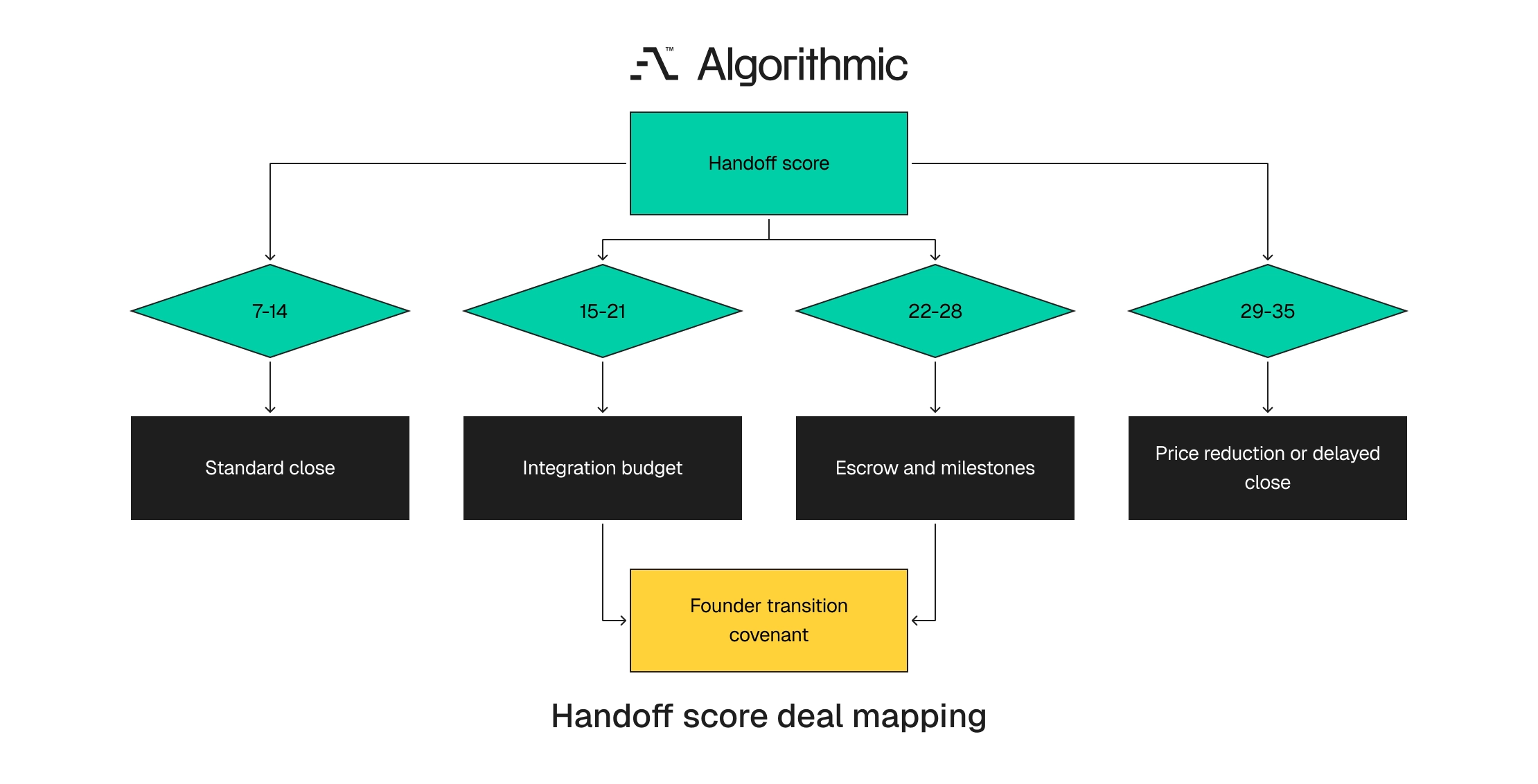
Handoff findings should produce deal mechanics, not a narrative appendix, because the investment committee needs a recommendation tied to price, escrow, staffing, covenants, or closing conditions, and technical findings without deal terms create post-close surprises. A low-risk target can proceed with standard representations, warranties, and post-close onboarding, a medium-risk target needs a defined remediation budget and integration staffing plan, and a high-risk target needs escrow, transition covenants, closing conditions, or price reduction. A practical deal matrix is below.
 Click to expand
| Handoff score | Risk interpretation | Recommended deal mechanic |
|---|---|---|
| 7-14 | Transfer-ready operating model | Standard close and 30-day onboarding |
| 15-21 | Manageable transfer debt | Integration budget and 60-day artifact delivery plan |
| 22-28 | Material transfer risk | Escrow tied to deployment, access, and runbook milestones |
| 29-35 | High dependency on seller knowledge | Price reduction, delayed close, or founder technical services agreement |
M&A technology diligence engagements run into six figures for mid-market software deals, and regulated, cross-border, or AI-heavy targets sit at the upper end, yet that spend is small compared with a six-month post-close integration delay on a platform asset. Bain’s global M&A research shows diligence timelines lengthening as deal complexity rises, and the response should be sharper diligence and better tests, not broader questionnaires. Deal teams should write handoff findings in economic language, so “deployment requires founder supervision” becomes “escrow releases after two buyer-led production deployments and one verified rollback,” because specific mechanics create accountability after signing.
Escrow terms should avoid vague language, and a release condition should name the artifact, test, owner, and evidence required, so “staging environment recreated from Terraform and validated by buyer engineering” is testable. Founder transition covenants should also be specific, because a 90-day advisory period with no required availability does not solve production risk, while a useful covenant names weekly hours, incident availability, documentation duties, and transfer milestones. The purchase agreement should also address access transfer, since domains, cloud accounts, repositories, app stores, payment processors, and monitoring tools should move under company-controlled identities, and the closing checklist should name each account and the person responsible for transfer. Deal teams should avoid soft milestone language, because “reasonable assistance” leaves too much discretion when production fails at 2 a.m., so a strong covenant states response times, named backups, escalation routes, and required participation in drills.
Founders can reduce the handoff discount before the process starts
Founders preparing for acquisition should treat engineering transferability as a sell-side workstream that starts months before the data room opens, because a 12-week preparation window can remove avoidable value leakage. The work is concrete. Produce deployment runbooks, move secrets into a managed vault such as AWS Secrets Manager, GCP Secret Manager, HashiCorp Vault, or 1Password Business, replace shared admin accounts with role-based access, document incident history, and write architecture decision records for major design choices. Confirm that infrastructure can be recreated from Terraform, Pulumi, CloudFormation, or equivalent, then rebuild a staging environment from those files and record the result, because buyers trust demonstrated reproducibility more than inventory lists.
The founder should also reduce single-person ownership, so at least three engineers can deploy, roll back, explain the top five customer workflows, and respond to a Sev-1 incident, and the company should test that standard before management presentations. For AI products, prepare traceability artifacts early, because a buyer will ask who chose the label schema, who approved the model threshold, who reviewed false positives, and who owns drift response, and the answer must be a named person and a dated artifact. These actions do not remove all technology risk, but they convert unknown handoff risk into documented operating cost that can be priced, staffed, and managed. Founders should also prepare evidence of learning, since ten clean post-incident reviews show operational maturity while a data room with no incidents, no runbooks, and no deployment records signals memory-based operations.
The best sell-side preparation is practical. Run a deployment using only the runbook, rotate one production credential, recreate staging, and ask an engineer outside the original feature team to explain billing and authentication, then record the gaps and correct them before the buyer asks. Founders should prepare a handoff pack for the data room that includes release records, access diagrams, incident history, architecture decisions, vendor ownership, and key operational workflows, because that pack reduces buyer uncertainty during exclusivity. The preparation should include a simulated buyer exercise, where an engineer who does not own the system deploys a low-risk change from the runbook and records every missing step, permission gap, and unclear rollback instruction. Sellers should also prepare account ownership evidence, since a clean list of AWS, GCP, Azure, GitHub, domain registrar, app store, payment processor, and email service accounts prevents late-stage friction, because buyers interpret founder-owned accounts as avoidable operating risk. Sell-side teams should treat customer commitments as technical evidence, so if an enterprise renewal depends on audit logging or data residency, that promise belongs in the diligence pack, since buyers need to see the link between commercial commitments and engineering capacity.
Put handoff risk into the purchase price
Technical due diligence should end with a quantified handoff view that covers onboarding window, people dependency, deployment risk, incident readiness, remediation cost, and effect on the first 180 days after close, stating the expected cost in dollars and calendar days. The buyer should require four outputs before investment committee approval.
- Engineering Handoff Risk Index score.
- 30-, 60-, and 90-day integration staffing plan.
- Remediation budget with named owners.
- Deal mechanic recommendation, price adjustment, escrow, covenant, closing condition, or pause.
 Click to expand
Private equity teams and strategic acquirers should add three tests to the standard technical due diligence checklist, the 72-hour deployment test, the incident history review, and the AI decision traceability review, and founders preparing for acquisition should build the same artifacts before the data room opens. The purchase price should reflect the asset that can be operated after close, because a product that works before signing still needs an operating model that transfers under new ownership, and engineering handoff risk connects those two values. This discipline improves both sides of the transaction, since buyers gain a defensible model for cost, timing, and protection, and sellers gain a practical path to remove avoidable discount pressure before exclusivity begins. The same evidence standard runs through how we help clients evaluate a software development partner and vet a software agency using delivery evidence, where inspectable records beat verbal assurance.
The final diligence memo should leave no ambiguity, stating who can deploy, who can recover, who can explain the core workflows, and what each gap costs, which is the level of evidence required to buy software with confidence. Algorithmic runs technical due diligence that prices engineering handoff risk into deal terms with live transfer tests, not questionnaires. Start a conversation if you are acquiring a software company and need the operating model priced before you sign.