
A codebase can show 82% unit-test coverage, zero critical CodeQL findings, and an A maintainability rating in SonarQube. The same system can still fail a production release because only one engineer understands the payment workflow. That is the central risk in technical debt rescue. Automated code quality tools identify visible symptoms, and they do not explain architectural intent, maintainability risk, domain ownership, or knowledge concentration.
For CTOs, investors, and acquirers, this distinction has direct economic value. A fragile platform can reduce acquisition value by seven figures, while a manageable codebase with visible linting defects can still support a four-week stabilization plan. Treating automated scores as diligence conclusions creates two costly errors. Buyers overpay for fragile software, or they reject an asset with contained remediation work, and both errors come from treating measurement as judgment.
Technical debt rescue requires senior engineering review, the same discipline our team applies in a technical due diligence engagement. Static analysis, test coverage, linting, dependency scans, and architecture maps are inputs that serve as evidence during diligence and remediation planning. A serious review connects code findings to money, time, and operating risk. It identifies which defects threaten revenue, which defects delay delivery, and which defects require governance changes, and that translation requires people who have shipped and operated production systems.
Automated scores measure visible code properties
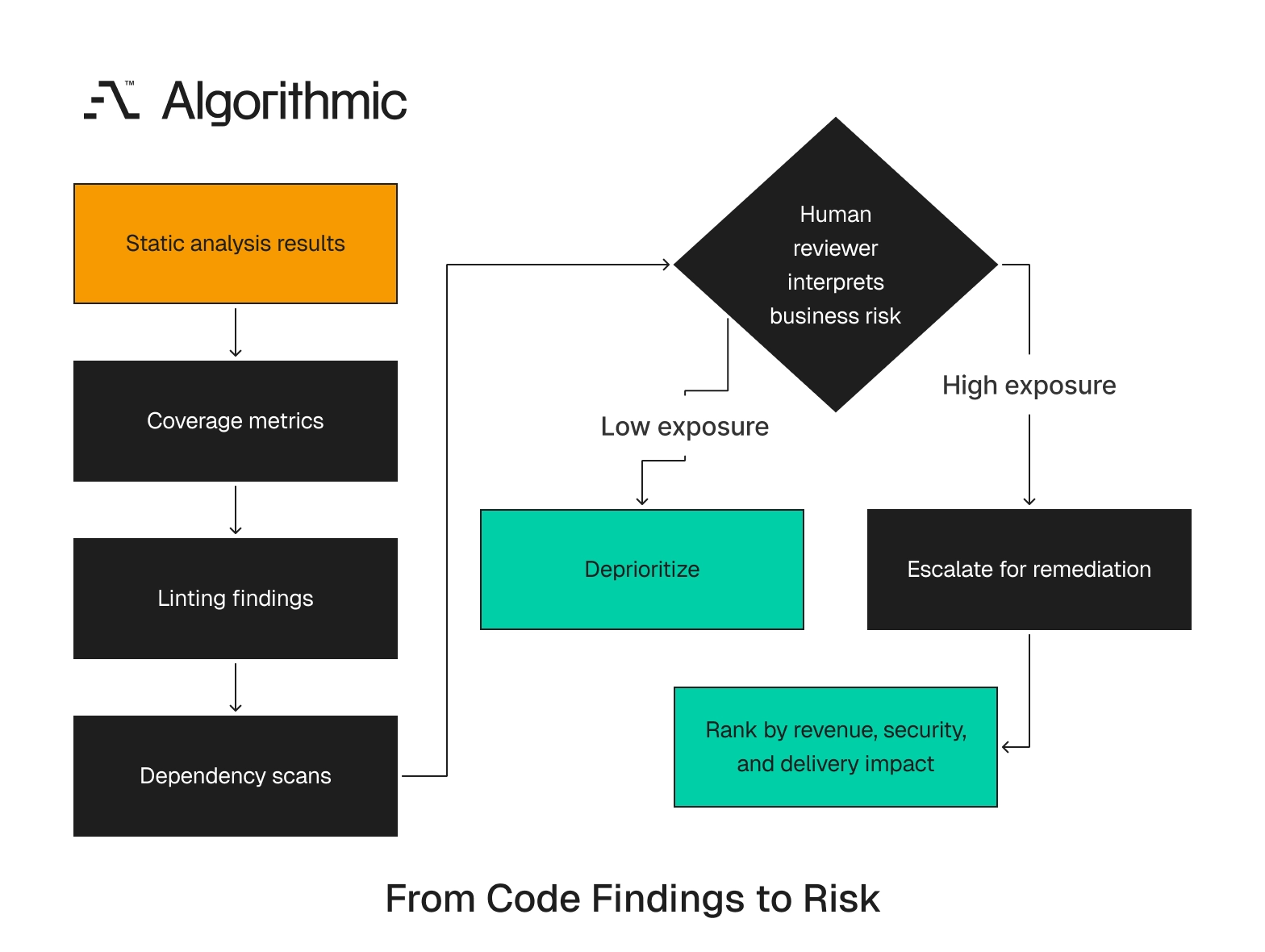
Automated tools have a defined role in technical due diligence. They inspect code at speed and create a shared fact base, and a 400,000-line repository can be scanned in hours with SonarQube, GitHub CodeQL, Semgrep, Snyk, ESLint, RuboCop, JaCoCo, Istanbul, pytest-cov, and dependency audit tools.
 Click to expand
These tools answer narrow questions well. They identify known vulnerable packages, and they flag high cyclomatic complexity, duplicated logic, missing tests, unreachable branches, unsafe patterns, and inconsistent formatting. They also produce audit trails that support diligence conversations, since a scan date, tool version, rule set, and finding list give reviewers a common reference point that reduces debate about whether problems exist.
The limitation starts when teams treat the report as a remediation plan. A scanner can rank findings by rule severity, but it cannot rank them by revenue exposure, regulatory exposure, or delivery risk. A useful scan gives the review team speed and breadth, and it can identify 1,200 findings across Java, TypeScript, Terraform, and Python in one workday. It cannot decide which 40 findings should shape the first remediation sprint.
The difference matters during acquisition and rescue work. A scanner sees a vulnerable library version, while a senior reviewer asks whether that library runs in an internal batch job or a customer-facing authentication path. The same discipline applies to old dependencies, since a package that is 30 months behind current releases deserves review and its risk depends on exploitability, runtime exposure, deployment model, and available replacement path.
Static analysis finds defects without explaining intent
A static scanner can show that a service has 18 methods with McCabe complexity above 15, but it cannot say whether those methods encode regulated business rules, rushed product experiments, or obsolete logic. That distinction changes the remediation path. Complex code inside a pricing engine needs characterization tests before refactoring, while complex code inside a discontinued onboarding experiment needs product validation before removal, so the same score leads to different engineering work.
SonarSource has expanded architecture management in SonarQube Cloud to show dependencies and structural relationships, a useful advance for codebase assessment. The tool still needs human interpretation of intended boundaries, domain ownership, and acceptable coupling. A reviewer must decide whether a dependency is a temporary migration bridge or a permanent design defect, and that decision affects staffing, timeline, and acquisition risk.
A useful static analysis review also separates age from danger. A ten-year-old module can be stable, well-tested, and low-risk, while a six-month-old service can carry higher risk if it bypasses authentication, logging, or rollback controls. The same principle applies to language and framework age. A Rails 5 application with disciplined tests and predictable releases can be recoverable, while a new Node.js service with shared secrets, manual deploys, and no rollback plan can be a material risk.
Static analysis also struggles with intent-preserving duplication. Two similar functions in separate regulated workflows can exist for audit reasons, so removing one copy without understanding the control requirement can create a compliance defect. The reverse also occurs, since four nearly identical permission checks across services can indicate unmanaged access-control drift. The scanner reports duplication in both cases, while human review classifies the operational consequence.
A senior reviewer reads code with version history, incident history, and product context open. The question is where change creates production exposure, and the answer rarely appears inside a single automated report.
Coverage percentages hide test quality
Test coverage is one of the most misused diligence metrics. A repository with 88% line coverage can still lack meaningful integration coverage, contract tests, performance tests, and end-to-end validation. As Martin Fowler notes on test coverage, high coverage numbers are easy to reach with low-quality testing, so the number describes execution, not protection. Static scans estimate the presence of unit tests, but they rarely show whether tests assert meaningful behavior, and they cannot verify whether CI runs database migrations against production-like data.
Scans also cannot prove that contract tests cover third-party API failures, that performance tests reflect real traffic, or that fixture data does not hide a known edge case. A green coverage surface can mislead non-technical buyers, so a senior reviewer inspects test intent, fixture realism, CI gates, flake rates, and failure modes. The business question is what production risks remain untested.
A payments platform illustrates the risk. A team can cover invoice formatting, currency conversion helpers, and controller branches, and the same suite can miss duplicate webhook delivery, partial refund handling, and idempotency failure after a database timeout. That gap matters during diligence, because the first set of tests improves coverage while the second set protects revenue.
A reviewer should also inspect how tests fail. A clean failure that blocks a release has value, while a flaky failure that engineers rerun three times trains the team to ignore the test suite. Coverage also hides missing negative-path tests, since a subscription workflow can test happy-path signup and still miss expired cards, failed tax calculation, and duplicate renewal events. Those gaps appear during chargebacks and support escalations.
The inspection should include test data. Perfect fixtures produce false confidence, because production data contains null fields, old tenants, duplicate records, and partial migrations, and a strong suite uses those cases directly. CI configuration deserves equal attention. A team can maintain high local test coverage while allowing release branches to bypass expensive tests, and in that situation the coverage report describes aspiration more than release protection.
Linting defects rarely rank business risk
Linting has value. It reduces inconsistency and catches some errors early, but it has low value as the dominant signal in technical debt rescue. A repository with 3,000 ESLint warnings can still have clear modular architecture and a manageable remediation path, while another repository with zero lint warnings can embed customer billing, permissions, and order state transitions in one shared service. The second system carries higher change risk. The first case can need a two-week cleanup and the second can need a quarter-long refactor, so linting alone cannot distinguish cosmetic inconsistency from structural risk.
Senior reviewers also look at how linting rules entered the system. A recent rule-set change can create thousands of warnings overnight, while a long-running warning backlog can show that the team accepts preventable defects. The same count means different things in each case, so the review must trace warnings to engineering behavior, production paths, and ownership. That translation requires people who have operated production systems under release pressure.
Linting also needs policy context. A team that fails CI on new warnings has a quality gate, while a team that records warnings in a backlog without owners has technical debt inventory without management control. Linting data becomes useful when tied to ownership and trend, since a backlog that falls from 3,000 warnings to 1,800 in four weeks shows discipline while a backlog that stays flat for six months shows weak follow-through.
Reviewers should also separate rule categories, because unused imports carry one risk profile while unsafe promise handling, missing null checks, and disabled security rules carry another. A mature diligence report does not treat every warning as equal. It groups findings by production exposure, defect class, and remediation cost, and that grouping turns a raw count into an engineering plan.
Human review identifies the debt that affects enterprise value
Technical debt becomes material when it slows delivery, increases incident risk, blocks hiring, or concentrates knowledge. These risks are only partly visible in automated dashboards, since they appear through architecture drift, unclear ownership, and brittle operations. Across 35+ complex engagements at Algorithmic, including platforms serving millions of end users, decisive debt signals usually appeared outside code quality scores. The strongest signals came from design gaps, ownership gaps, and operational gaps, so automated scores helped locate symptoms and senior review classified the business risk.
A diligence team should treat the codebase as one part of a production system that includes people, release rules, incident response, observability, documentation, and executive constraints. Technical debt rescue fails when those elements remain outside the review. The economic effect appears quickly, because a team with weak ownership can spend two release cycles locating the correct person for one billing change, while a team with clear service ownership can assign, test, approve, and deploy the same change inside a defined release window.
Human review also identifies sequencing risk. Fixing the wrong defect first consumes senior engineering capacity and leaves high-risk workflows exposed, so a rescue plan must protect revenue paths before cleaning low-risk code. For investors, the issue is valuation discipline. A technical debt finding should translate into purchase price adjustment, escrow condition, integration budget, or post-close staffing plan, and a dashboard score alone cannot support that decision.
Architectural intent must be reconstructed
Technical due diligence should identify the intended architecture and compare it with the implemented architecture. This requires more than a dependency graph, because the reviewer must reconstruct why the system was built this way. Senior reviewers look for bounded contexts, module boundaries, database ownership, integration contracts, and deployment seams, and they examine whether the code reflects product domains or accumulated feature requests. They inspect architecture decision records, migration notes, pull request discussion, and release history.
A system with a monolith can be healthy, and a system with microservices can carry severe debt. The deciding factor is whether boundaries match operational and product needs. A useful review produces a written architecture narrative that states what the system is designed to do, where the design has drifted, and which areas create risk in the next 6 to 12 months. That narrative should name concrete failure modes, such as shared tables across services, circular dependencies between modules, synchronous calls on checkout paths, and background jobs without retry controls, and each issue should connect to a product or operational consequence.
The narrative also gives executives a common language. Instead of debating whether the code is clean, the team can discuss payment reliability, release frequency, audit exposure, and migration cost, and that framing improves investment decisions. An architecture narrative should also name the work the team should avoid. If the order service owns payment retries through side effects, adding a subscription product increases release risk, and if reporting queries lock transactional tables, a new executive dashboard can degrade checkout performance.
Architecture reconstruction should include diagrams that match production, not aspirational drawings from a sales deck. Reviewers should compare diagrams with repository dependencies, network policies, database schemas, and deployment manifests, because a diagram that omits three shared databases misstates the remediation problem. The review should also identify architecture debt created by growth, since a direct database query between two modules can be acceptable during a six-person startup phase and becomes a delivery constraint when four teams deploy independently.
This history matters because it separates negligent engineering from rational shortcuts that outlived their context, and the remediation plan changes accordingly. Some shortcuts need retirement, and others need stronger tests and ownership.
Maintainability depends on ownership and standards
A recurring failure in vendor-built systems is assumed competence. Leaders assume engineers will apply sound design practices without explicit agreements, then find no artifact owners, no code review checklist, no design review process, and no documented engineering standards. The absence of these artifacts is a diligence signal, because a team can call itself agile and still lack engineering controls that protect maintainability. Delivery rituals do not replace engineering discipline, a pattern we cover in more depth in how to evaluate a software development partner before signing.
Senior review should inspect the operating model around the code, including named owners for services, review standards, definition of done, release approval rules, incident response runbooks, and architecture decision records. It also includes how exceptions are approved and later retired. A codebase with moderate debt and clear ownership can recover, while a codebase with moderate debt and no ownership model tends to decay after handover, and the difference appears when the original builders leave.
Ownership also determines onboarding cost. If a new engineer needs six weeks to make a safe change, the asset has a capacity problem, while an engineer who ships a contained change in ten business days signals recoverable complexity. Investors should ask for evidence, since named owners in CODEOWNERS files, service catalogs, incident rotations, and PR review history carry more weight than verbal assurances, and a platform without those records needs a remediation budget.
Standards must also be visible in routine work. Pull requests should show reviewers asking about migration safety, observability, rollback behavior, and user impact, and a repository with silent approvals from the same two people needs deeper review. Maintainability also depends on the quality of defaults, because new services should inherit logging, metrics, alerting, test templates, and deployment checks. When every team invents these controls separately, inconsistency becomes operating risk.
A reviewer should inspect three recent changes from idea to production. The evidence should show design discussion, code review, test execution, deployment, and monitoring after release, and missing steps indicate a process gap that will reappear after rescue work. Standards need enforcement inside tools and human review, so CI should reject unsafe migrations, missing tests on critical paths, and unreviewed changes to authentication or billing, while senior engineers review exceptions and set expiry dates.
Knowledge concentration creates acquisition risk
Knowledge concentration is one of the most expensive hidden risks in software asset review, and one of the least visible in automated reports, because no scanner can measure what only one engineer understands. The signs are concrete. One engineer approves most production pull requests, one Slack channel contains critical deployment instructions, and one contractor owns the data import process. Other signals are equally direct, since one former employee understands the permissions model, one spreadsheet maps tenant migrations, and one private script handles customer billing corrections.
A buyer acquiring that software is buying dependency on missing or concentrated knowledge. The remediation plan must include documentation, pairing, runbooks, and test creation before aggressive feature delivery resumes, and those activities should appear in the budget and the post-close plan. Recent research on cognitive debt formalizes this issue. As code generation and rapid delivery increase code volume, teams risk losing shared understanding and design rationale, and that debt affects future change safety even when the code compiles and tests pass. Ward Cunningham’s original technical debt metaphor frames the cost the same way, since the extra effort to add each new feature is the interest paid on the debt.
The practical test is direct. Ask three engineers to explain the same workflow using code, diagrams, and production logs, and divergent answers indicate intent debt that the rescue plan must address before major product changes. A second test is equally useful, since asking the team to walk through the last failed deployment from commit to rollback exposes weak controls. If the explanation depends on memory instead of logs and runbooks, operating risk is high.
Knowledge concentration also appears in commit history. If one person authored most changes in billing, permissions, or tenant migration, the diligence report should name that dependency, and the issue becomes more serious when that person is a contractor or former employee. The remedy is concrete. Pair two engineers through the workflow, write the runbook, add characterization tests, and record operational decisions in the repository, and these steps convert private memory into institutional control. This work should precede aggressive roadmap expansion, because feature delivery on top of private knowledge increases dependency on the same person. A 30-day knowledge-transfer sprint can reduce acquisition risk more than a broad lint cleanup.
The four-gate debt review separates symptoms from structural risk
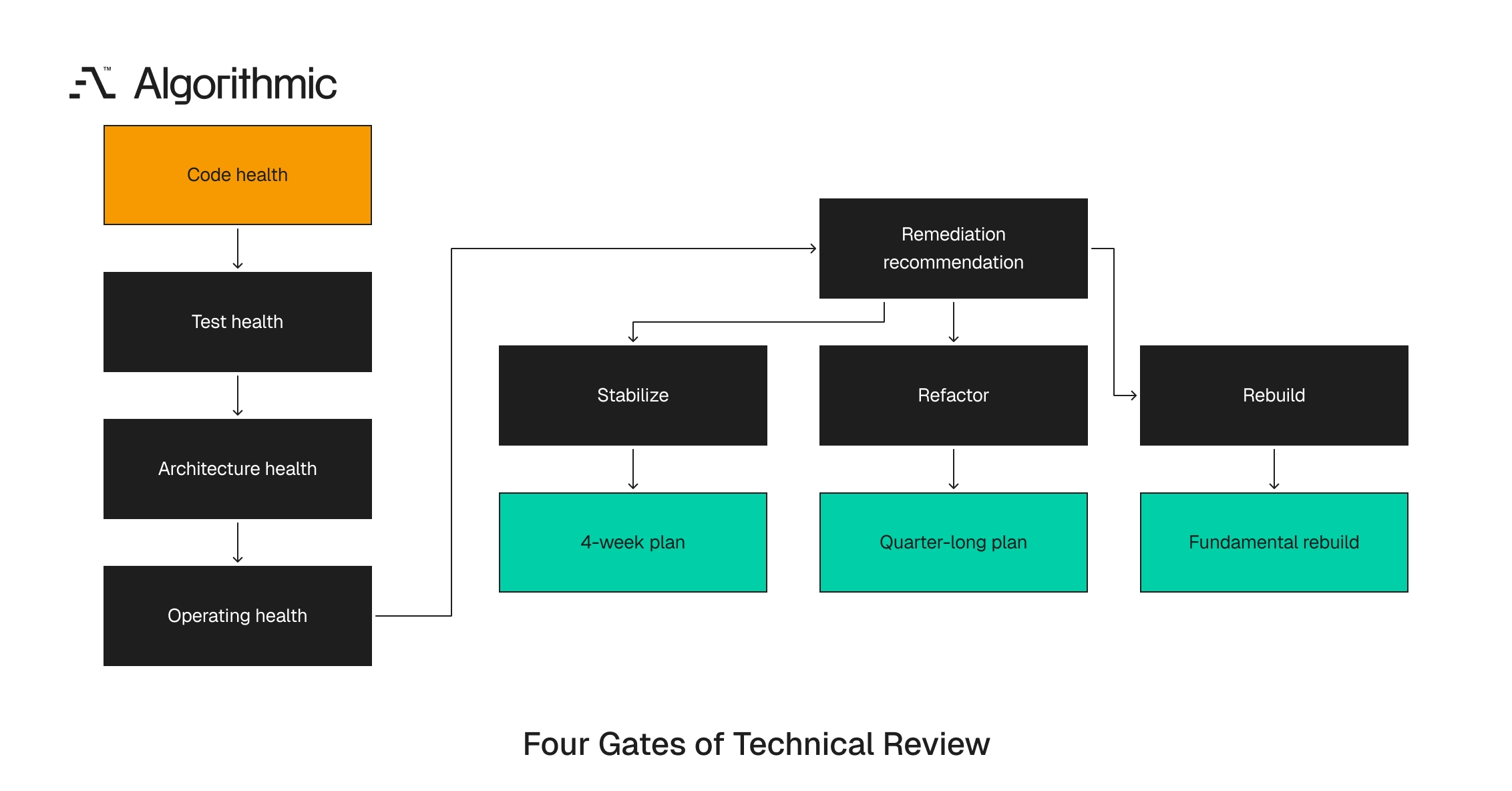
A technical debt rescue assessment should use automated tools, then force senior judgment through a consistent review model. We use a four-gate debt review to classify codebases before recommending stabilization, refactor, or rebuild, and each gate answers a different business question.
| Gate | Evidence reviewed | Automated tools help with | Human review must decide |
|---|---|---|---|
| 1. Code health | Complexity, duplication, dead code, dependency age, security findings | SonarQube, CodeQL, Semgrep, Snyk, dependency scanners | Whether defects affect critical paths or low-risk areas |
| 2. Test health | Unit, integration, contract, performance, end-to-end, CI reliability | JaCoCo, Istanbul, pytest-cov, CI history | Whether tests protect real production failure modes |
| 3. Architecture health | Module boundaries, service coupling, data ownership, deployment topology | Dependency graphs, architecture maps | Whether the implemented structure matches business domains |
| 4. Operating health | Ownership, standards, release process, runbooks, incident history | Git history, PR analytics, CI/CD logs | Whether the team can safely change the system after handover |
 Click to expand
This framework prevents two diligence failures. It stops teams from dismissing codebases because of surface-level disorder, and it stops teams from approving codebases because dashboards look clean. The gates should be run in order. Code health creates the defect inventory, test health shows change safety, architecture health determines remediation scale, and operating health shows whether the rescue will hold. The sequence gives executives a decision path from raw findings to capital allocation, and it gives engineers a work plan that respects production risk.
The method works because each gate has a distinct decision. Code health asks what is visibly wrong, test health asks whether change is safe, architecture health asks whether the system shape fits the business, and operating health asks whether the team can preserve gains after the initial rescue. Combining the four gates prevents single-metric diligence.
Gate 1 uses code health to create the defect inventory
The first gate should produce a defect inventory with severity tied to production paths. A scanner finding inside dormant admin tooling should not carry the same weight as a finding in authentication, and payments, medical workflows, and financial reporting deserve the highest scrutiny. Useful metrics include duplication above 10%, functions with McCabe complexity above 15, dependencies more than 24 months behind current versions, and unpatched critical CVEs. These measures create a starting map and make the discussion concrete enough for investment committees.
Senior reviewers then rank defects by business exposure. A deserialization vulnerability in an internal script differs from the same pattern in a public API, and a vulnerable dependency in a batch reporting job differs from one in login middleware. The output should be a ranked list with business context, where each item names the affected workflow, severity, likely fix, and owner, and a useful inventory also marks findings that can wait.
This gate protects the team from cosmetic work. Fixing 500 low-risk formatting issues before addressing authentication debt is a poor use of rescue time, so the highest-risk production paths should receive attention first. The inventory should also separate remediation work from investigation work, since some findings can be fixed with a package upgrade while others need a test fixture, stakeholder review, and a controlled release window. A useful defect inventory also marks confidence, because a confirmed SQL injection in a public endpoint needs immediate action while a suspected data race in a low-volume worker needs reproduction before budget allocation.
Code health review should include infrastructure-as-code. Terraform, Kubernetes manifests, GitHub Actions, and Dockerfiles often contain production risk such as broad IAM policies, unpinned base images, and secrets passed through environment variables. The final artifact should fit on one executive page and one engineering appendix, where executives need the top risks, cost range, and timeline, and engineers need file paths, owners, test requirements, and release constraints.
Gate 2 uses test health to measure change safety
The second gate assesses whether engineering teams can change the system without unpredictable regressions. Coverage percentage is one input, and the stronger signal is whether tests reflect real production failure modes. Reviewers should inspect test types and CI behavior, and a production-ready checklist should include integration tests for data stores, contract tests for external APIs, migration tests, smoke tests after deployment, and rollback validation, since each test type protects a different release risk. Contract tests matter most on external boundaries, where the consumer-driven contract pattern lets a consumer drive the API design and catch breaking changes before they reach production.
CI history matters. A suite that fails 12% of runs because of flaky tests will be ignored by the team, and a test suite that takes 90 minutes to complete pushes engineers toward unsafe shortcuts. Reviewers should also inspect skipped tests and quarantined suites, since a repo with 600 skipped tests has a different risk profile from one with ten. Skipped tests often mark areas where the team stopped trusting its own safety net.
The rescue plan should define a test floor for critical workflows. For example, billing changes can require unit tests, integration tests against PostgreSQL, Stripe contract tests, and a rollback smoke test, and that level of specificity turns quality goals into release rules. Test health also includes test data quality, because synthetic users, clean fixture tables, and perfect API responses hide common production failures. A strong suite includes duplicate events, expired credentials, partial network failures, and failed migrations.
This gate should examine who can modify tests. If tests are owned by one QA engineer, the suite becomes another knowledge bottleneck, so product engineers should understand the tests that protect their services. Release gates also matter, since a team can have strong tests and still deploy around them under schedule pressure, and reviewers should inspect branch protection, required checks, and records of emergency bypasses. The output should include the minimum test set required before new feature work resumes. For a payment workflow, that set often includes idempotency, refund, webhook retry, and failed authorization scenarios, and for a healthcare workflow it includes permission checks, audit logs, and data retention behavior.
Gate 3 uses architecture health to determine remediation scale
The third gate decides whether debt is local or structural. Local debt can be fixed in isolated modules, while structural debt crosses boundaries and changes how the system evolves. Reviewers should inspect service boundaries, database coupling, shared libraries, event contracts, and deployment dependencies. A SaaS product where every service reads and writes the same customer table has a different risk profile from a monolith with clear internal modules, so the service count alone does not determine quality.
Architecture assessment also needs product context. A marketplace platform with plans for multi-region payments will face different constraints than an internal workflow application with 300 users, so the review should test the architecture against the next stage of the business. This gate should identify seams for safe remediation, such as extracting a payment domain, separating reporting workloads, or isolating tenant configuration, with the goal of reducing change risk without pausing the whole business. Architecture review should also detect false modularity, since teams often create services that share schemas, deployment pipelines, and release timing, and those services add operational overhead without creating independent change paths.
A strong architecture review produces a dependency map that executives can read. It should identify the five to ten dependencies that most affect delivery risk, and it should name the teams or vendors attached to those dependencies. Architecture health should also include data ownership, because shared tables, unclear write paths, and unversioned schemas increase regression risk. These defects are expensive because they affect code, tests, deployment, and reporting.
Reviewers should inspect synchronous calls on revenue paths. A checkout flow that depends on five internal services and two external APIs needs timeout, retry, and degradation rules, and without those controls small outages become revenue incidents. The output should recommend the smallest architecture change that reduces the largest risk, since a targeted extraction can beat a broad platform program, and a new service should exist only when it creates independent ownership, deployment, or scaling behavior.
Gate 4 uses operating health to determine whether rescue will hold
The fourth gate assesses the system around the system. Technical debt returns when engineering standards are absent, and code changes alone will not hold if the team repeats the same practices. A debt rescue plan should inspect PR review depth, release frequency, incident history, monitoring coverage, and ownership records, and it should confirm whether senior engineers review design decisions before code starts. This is where many vendor-built systems fail diligence.
Operating health also includes incident learning. A team with post-incident reviews, follow-up owners, and error-budget rules can improve after failure, while a team with only Slack threads and memory will repeat incidents. The output of this gate should include governance changes such as CODEOWNERS coverage, release approvals for high-risk workflows, design review thresholds, and monthly debt review, and these controls keep the rescue from becoming a one-time cleanup. Operating controls should be small enough to survive normal delivery pressure, because a 12-page approval form will be bypassed while a two-person review rule for billing, authentication, and data migrations will be used.
This gate should also inspect vendor dependency. If an outside firm controls deployment credentials, release scripts, or production dashboards, the buyer inherits operational dependency, and that dependency should appear in closing conditions and transition planning. Monitoring depth belongs in operating health, since a team needs service-level indicators, alert ownership, and dashboards tied to customer impact, and CPU graphs alone do not show whether checkout, onboarding, or billing works. Operating health also includes decision cadence, because the team should review debt monthly, assign owners, and retire obsolete exceptions, and a backlog without decision rights becomes a storage location for ignored risk.
Three remediation paths have different costs and timelines
A senior software architecture review should end with a decision, not a score. The decision should classify remediation into stabilization, refactor, or rebuild, and each path has a different cost profile and management cadence. The decision should also state what evidence would change the recommendation, since a defect reported as contained can move stabilization to refactor if it turns out to affect the billing path, and a rewrite spike can move rebuild to the better economic choice if it proves migration risk is lower than expected.
Executives need this classification before approving budgets. A stabilization plan can fit inside one planning cycle, a refactor changes quarterly commitments, and a rebuild changes the operating plan. The classification should also assign owners, where a CTO owns the technical decision, a CFO needs the cost range, and product leadership needs the delivery impact by quarter. A strong recommendation includes stop points, so leaders know when to continue, when to change scope, and when to revisit valuation assumptions, because rescue work without decision points turns into open-ended engineering spend.
Four-week stabilization
A stabilization path fits codebases with contained defects, acceptable architecture, and recoverable test gaps. Typical work includes dependency upgrades, CI repair, logging improvements, high-risk test creation, and deployment runbook creation, and the work improves production safety without changing the product architecture. This path often takes four to six weeks with two to three senior engineers, and it is appropriate when the system can keep serving customers while risk is reduced in place. The team should define weekly milestones and a release freeze policy for high-risk areas.
A common example is a web application with 75% unit coverage, weak integration tests, and inconsistent linting. If domain boundaries are clear and deployment is repeatable, the rescue effort should focus on production safety, because redesign would consume time without reducing the highest risks. A stabilization plan should produce visible artifacts, including a ranked defect list, CI pass-rate targets, deployment runbooks, smoke tests, and ownership records, so executives see risk reduction every week. A good plan also limits new product work in risky areas, since the team can freeze billing schema changes while adding observability, idempotency tests, and rollback checks, and that trade protects revenue while the system gains safer release controls.
Weekly milestones should be concrete. Week one can complete scans, dependency inventory, and production-path mapping, and week two can fix critical dependencies and add smoke tests. Week three can repair CI reliability and add runbooks for deployment and rollback, and week four can validate the controls through a controlled release, giving leadership evidence rather than status theater. Stabilization should avoid broad rewrites, because the goal is risk containment, not architectural reinvention, so teams should measure success through fewer failed builds, shorter rollback time, and clearer ownership.
Quarter-long refactor
A refactor path fits systems where the architecture is workable while several central modules carry change risk. Typical work includes extracting domain services, reducing shared state, rewriting test seams, separating data ownership, and replacing fragile deployment steps, with the goal of safer change in the areas that block delivery. This path often takes 10 to 14 weeks, and it should be planned around product releases because refactors that ignore roadmap pressure lose executive support. The plan should protect revenue features while reducing the highest-risk coupling.
A quarter-long refactor is justified when feature delivery has slowed by measurable amounts. The operational pattern is easy to recognize, since a change that one engineer should safely modify requires three developers and two release windows, and every added dependency increases regression risk. A refactor plan should include a migration sequence, for example extracting permissions before billing, then separating reporting from transactional workloads, and the order should follow risk, dependency structure, and upcoming product commitments.
The team also needs a stop rule. If refactoring consumes more than the agreed budget without reducing release risk, leadership should reassess rebuild economics, because continuing open-ended remediation destroys confidence. A refactor should leave evidence that the system has improved, so pull request lead time should fall, rollback frequency should decline, and test coverage should increase in the protected workflows, and those measures matter more than the number of files changed. A refactor also needs a release strategy, using feature flags, parallel writes, migration checks, and rollback plans for every high-risk workflow, since these controls make partial progress safe.
Leadership should protect the team from constant scope changes. A refactor that absorbs every new product request will miss the remediation target, so product leaders should agree which features proceed and which wait. The plan should also include communication with customer-facing teams, because support and sales need to know which workflows are being hardened and which release windows carry risk, and that coordination prevents engineering work from surprising the business.
Fundamental rebuild
A rebuild path fits systems where structural debt blocks safe change. Signals include no reliable tests on critical paths, high coupling across unrelated domains, missing production observability, unsupported frameworks, and knowledge held by departed engineers, and these conditions prevent normal delivery discipline. A rebuild decision needs economic discipline, because rebuilds are expensive and expose the business to migration risk, so they are appropriate when refactoring cost exceeds replacement cost or when the existing architecture cannot support regulatory, scale, security, or product requirements.
For an investor or acquirer, this decision should affect valuation and closing conditions. A rebuild risk discovered after acquisition can consume 6 to 18 months of engineering capacity, and that capacity comes out of product delivery, customer support, and integration work. A rebuild plan should avoid vague platform language, so it should name the workflows being replaced, data migration strategy, cutover method, rollback plan, and parallel-run duration, since a payment system and a reporting system require different migration controls.
The strongest rebuild cases often involve external constraints, such as unsupported PHP versions, unpatched framework dependencies, audit requirements, tenant isolation, or scale targets beyond the current design, and these are board-level risks rather than engineering preferences. A rebuild should start with the riskiest workflow, not the easiest module, so if billing carries the highest acquisition risk the plan should prove billing migration early, because moving low-value admin screens first creates progress reports without reducing enterprise risk.
A rebuild also needs continuity controls, since the existing system must continue serving customers while the replacement is built, tested, and migrated, which means duplicate operational cost for a defined period. Data migration deserves separate planning, so the team should profile source data, identify corrupt records, create reconciliation reports, and test rollback, because a rebuild that ignores data quality fails during cutover. The board should expect a formal business case that compares refactor cost, rebuild cost, migration risk, retention risk, and opportunity cost, and the decision should survive scrutiny from finance, product, security, and customer operations.
Automated review and human review should be sequenced deliberately
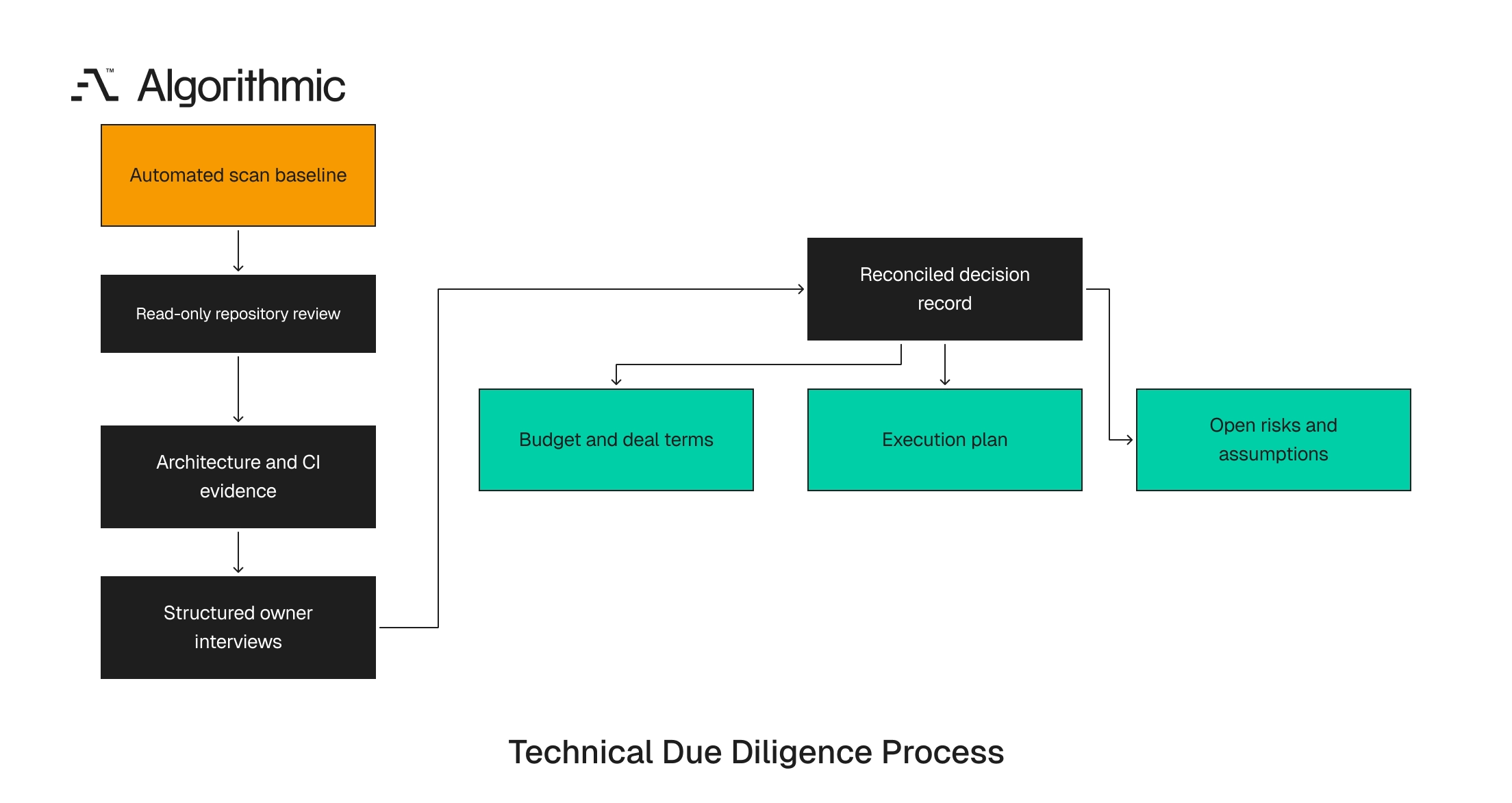
Technical debt rescue works when scans come first and judgment follows. The sequence matters because automated findings create the evidence base, and senior review then assigns meaning, priority, and economic consequence. Start with a read-only repository scan and dependency inventory, add CI history, deployment logs, incident records, architecture diagrams, database schemas, and cloud infrastructure definitions, then run structured interviews with the engineers who built and operate the system.
 Click to expand
A diligence review without interviews misses intent, and a review based only on interviews misses evidence, so the strongest review uses both sources and reconciles contradictions. The interview process should be structured. Ask engineers to identify the riskiest workflow, the slowest release path, the least trusted module, and the change they would avoid, then compare their answers against code history, incident records, and PR review data.
This sequence also reduces bias, because scans prevent reviewers from relying on reputation or vendor claims, and interviews prevent teams from mistaking rule violations for business risk. The review team should document contradictions explicitly. If engineers call a service stable and incident records show three outages in six months, the plan should explain the gap, and if scanners flag high complexity in a dormant module, the plan should mark it as low priority.
Sequencing also protects reviewer time, since senior engineers should spend effort on the highest-risk findings after automated tools create the baseline, and manual review without that baseline becomes expensive and uneven. The repository scan should be read-only, so diligence teams should avoid changing build files, dependency versions, or configuration during assessment, because the goal is evidence capture before remediation starts. Interview notes should be tied to artifacts, so if an engineer says deployment is safe the reviewer should inspect deployment logs and rollback history, and if a vendor says ownership is clear the reviewer should inspect CODEOWNERS and review history. The final review should reconcile evidence in one decision record that identifies confirmed risks, unresolved questions, and assumptions, and it becomes the basis for budget, deal terms, and execution planning.
A practical technical debt rescue checklist
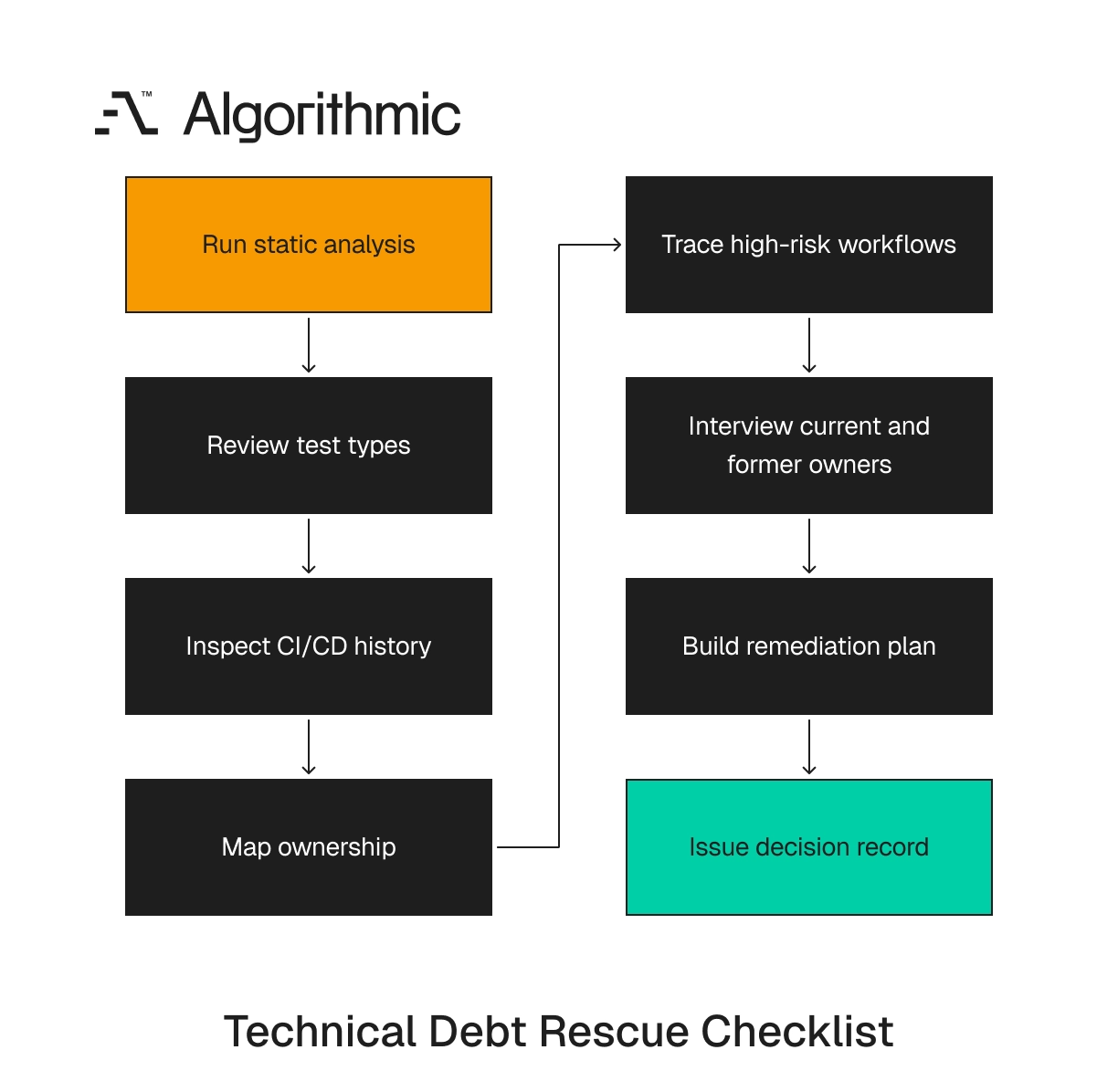
Use this checklist before investment, acquisition, or a major rescue effort.
 Click to expand
- Run static analysis with at least two tools, such as SonarQube and Semgrep, and classify findings by production exposure.
- Review test coverage by test type, not only by line percentage. Include unit, integration, contract, end-to-end, migration, and performance tests.
- Inspect CI/CD history for flake rate, build duration, failed deployments, skipped tests, and manual release steps.
- Map service and module ownership to named engineers or teams. Flag areas with one owner or no owner.
- Review architecture decision records, design documents, and major pull requests from the past 12 months.
- Identify the 10 highest-risk workflows, such as authentication, billing, permissions, data import, reporting, and customer-facing transactions.
- Compare implemented architecture with expected business domains. Document mismatches that increase change cost.
- Interview current and former technical owners where possible. Ask what they would change with 30 days and what they would replace with 12 months.
- Produce a remediation plan with timeline, staffing, risk reduction milestones, and explicit rebuild triggers.
- Tie every major debt item to delivery speed, incident risk, security exposure, or valuation impact.
This checklist is intentionally practical. It gives CTOs, investors, and acquirers a way to separate measurable symptoms from business risk, and it forces debt discussions into decisions about money, time, and safety. A good checklist output is short enough for executives and detailed enough for engineers, where the executive version classifies the asset and states remediation cost while the engineering version lists the first 30 days of work with owners.
The checklist should also produce a decision record that names the evidence reviewed, the people interviewed, and the assumptions behind the plan, and it becomes the reference point for closing conditions, budget approval, and post-close execution. It should include access requirements before work starts, since reviewers need repository access, CI logs, deployment history, production incident summaries, infrastructure definitions, and architecture documents, and missing access should be logged as a diligence constraint. The checklist should also include a sample workflow trace, so pick one high-risk workflow such as checkout or tenant provisioning and trace it through code, data, deployment, logs, and ownership, because this exercise exposes gaps faster than a broad document review. Each checklist item should produce evidence, and a verbal answer belongs in the record only when it is tied to a repository file, log entry, dashboard, ticket, or interview note, which keeps the review grounded.
The diligence conclusion should state the remediation class
A useful technical debt rescue review ends with a clear classification of stabilize, refactor, or rebuild, and it should state the expected team size, timeline, risk reduction sequence, and decision points. That conclusion gives leaders a basis for capital allocation. A score alone does not support an investment decision, because a dashboard cannot explain whether 3,000 lint warnings are a two-week cleanup or evidence of absent engineering standards, and a coverage report cannot show whether a former contractor is the only person who understands the revenue recognition pipeline.
The conclusion should also state confidence level and open risks, such as missing production logs, incomplete access to former contractors, or unavailable incident records, and these gaps should become closing conditions or post-close remediation items. Engineering leaders should require automated evidence and senior human review in the same process. Run the scans, inspect the architecture, interview the owners, and classify the remediation path before committing capital, signing the acquisition, or assigning a rescue team, because that discipline prevents technical debt from becoming a surprise line item after the deal closes.
It also gives the engineering team a rescue plan grounded in production risk. Dashboard scores should inform that plan, then senior reviewers should convert the evidence into operating decisions, which is how technical debt rescue protects delivery speed, platform reliability, and enterprise value. The strongest diligence conclusions are specific enough to fund, so they state, for example, that two senior engineers and one staff engineer need six weeks to stabilize billing, CI, and deployment rollback, and they identify the release freeze, test floor, and ownership changes required during that period.
They also name the consequences of inaction. If the team delays authentication remediation, incident exposure remains, and if the team delays knowledge transfer, acquisition risk stays tied to one engineer. A technical debt rescue review earns trust through traceable evidence and direct recommendations. Automated tools create the measurement base, and senior reviewers turn that base into decisions that protect capital, customers, and delivery commitments.
Algorithmic runs technical due diligence reviews that convert scan findings into a funded remediation class with owners, timelines, and closing conditions. Start a conversation if you are weighing an acquisition, an investment, or a rescue and need senior engineers to tell you what the dashboard cannot.