
A marketplace that launches a “verified same-day availability” badge without supplier-side verification creates support liability on day one. The customer sees a promise, while the platform holds partner spreadsheets, stale API fields, and manual operations notes. This pattern appears in travel, home services, health marketplaces, B2B procurement networks, field repair, logistics, and vertical SaaS products with partner inventory. The sector changes, but the failure mode stays the same, since customer-facing claims advance faster than supplier data capture. If your customer promises already run ahead of your data infrastructure and integrations, the badge is the symptom, not the cause.
The thesis is direct. Every supplier promise needs a ledger that records the claim, source, evidence, expiry rule, and the customer exposure tied to failure. Without that record, the platform cannot explain why it displayed the claim. Customer trust depends on claims that teams can verify at the source, so a badge without evidence is product debt with a customer-facing label. The cost appears later through refunds, partner disputes, manual exceptions, and lower repeat purchase.
Customer-facing attributes are contractual promises in product form
Filters, badges, rankings, and availability labels are product promises. A customer who selects “licensed electrician” treats that label as an operating fact, and the same applies to “wheelchair-accessible room”, “HIPAA-compliant vendor”, and “Wi-Fi above 100 Mbps”. Teams often classify these features as UX improvements because they appear in search, cards, or checkout, but engineering carries a stricter burden. Each attribute needs evidence from supplier entry through verification, storage, sync, display, support review, and audit.
A supplier attribute has four parts:
- Claim, what the platform states to the customer.
- Source, where the value comes from.
- Verification, how the platform knows the value is current and accurate.
- Expiry, when the value loses trust without refresh.
A platform can display a dietary badge for a restaurant based on one onboarding form, and that design fits a low-risk directory listing. It fails when the badge drives ordering, refunds, allergic-ingredient risk, and restaurant ranking. A stronger design requires structured menu data, ingredient attestations, update timestamps, exception reporting when items change, and a supplier workflow that prompts review after menu edits. These two designs create different customer outcomes and different legal records. The second design takes longer to ship, and it gives support, operations, and engineering teams a defensible record when the customer experience depends on accuracy. It also reduces disputes that require manual investigation.
The same principle applies to every supplier-dependent marketplace, so the platform should treat each customer-visible attribute as a governed claim strong enough to survive a refund request, partner dispute, or regulator review. A governed claim also changes launch accountability, since product owns the customer language, engineering owns the system behavior, and operations owns supplier completion. Legal and support receive records they can use during disputes. The result is a clearer production standard. If the platform cannot identify the source, evidence, and expiry rule, the product should avoid verified language, because customer-facing certainty requires supplier-side proof.
The failure pattern starts with an interface patch
A common marketplace sequence runs for 6 to 12 months before executives see the damage. Product teams add demand-side filters to raise conversion, but supplier data is incomplete, so teams backfill values through operations review, CSV imports, support notes, or inferred fields. The product metric improves in the first release, with search conversion rising by 3% or support tickets falling for one cohort. Then customers begin selecting based on the new attribute, and every missing value becomes a service failure.
The damage rarely appears in one dashboard. It shows up as refund requests, partner disputes, support handle time, search suppression rules, and lower repeat purchase, and by the time finance sees the pattern, three teams own fragments of the fix. The interface patch also changes customer behavior, because a filter invites customers to depend on a field that operations previously treated as informational. The product has converted weak data into a purchase criterion.
A travel platform sees this with “free airport shuttle”. A hotel provided the field during onboarding, an account manager entered it into a CRM note, and six months later the shuttle contract ends while the badge stays live in search. The first customer complaint reaches support as a refund request, the second reaches the account team as a partner dispute, and the third reaches product as a conversion-quality problem for paid traffic. The platform then adds special handling, so search suppresses the badge for one region, support adds a macro, and operations starts a weekly spreadsheet review. The product promise now depends on tribal knowledge across three teams.
Supplier workflows lag customer promises
Supplier-side tooling often remains an afterthought, so partners receive email requests, PDF forms, shared spreadsheets, or account-manager follow-ups. The customer interface advances through weekly releases while supplier data capture stays a manual operations process, and this is where trust erodes. If a home-services platform promises “first-time-fix certified” technicians, the supplier workflow must capture technician credentials, training status, part access, dispatch constraints, service territory, and job outcome data. A static partner profile cannot verify that claim on the day of service, since the profile records what a supplier declared during onboarding. The customer needs proof that the assigned technician can complete the job now.
Partner experience is part of the product surface, since dashboards, service-level agreements, instrumentation, and feedback loops determine what the customer receives. In field repair, first-time-fix rates often move more from partner routing and partner UX than from customer app changes. The same pattern appears in healthcare marketplaces, where a provider profile that lists accepted insurance plans has limited value without eligibility checks and update timestamps. A patient who books from a stale insurance field experiences a billing failure, not a content defect.
Supplier workflows deserve the same design rigor as customer checkout. A supplier who cannot update capacity, documents, coverage, or inventory creates downstream customer risk, and the platform absorbs that risk through refunds, manual exceptions, and lower trust. A supplier workflow also needs clear consequences. If a technician certification expires, the platform should remove that technician from jobs requiring the certification, and if a location fails to confirm accessibility data, search should remove verified accessibility language. These rules should be visible to the supplier, so a partner dashboard should show missing evidence, expiry dates, rejected files, and suppressed claims. Suppliers change behavior faster when they see the commercial effect.
Manual enrichment creates hidden operating cost
Manual supplier enrichment works during early marketplace formation, but it fails as supplier count, attribute count, and change frequency rise. A spreadsheet process that works for 80 suppliers becomes expensive at 2,000 suppliers. A platform with 2,000 suppliers, 40 customer-visible attributes, and quarterly verification creates 320,000 supplier-attribute checks per year. If each check takes 90 seconds, the annual operating load reaches 8,000 hours, and at a fully loaded operations cost of $45 per hour, the manual process costs $360,000 before escalations. That figure excludes refunds, credits, partner churn, executive review time, and the engineering time spent maintaining exception paths. In several marketplaces, those exception paths become more expensive than the original feature.
The cost is also technical, because product code begins to encode override fields, trust flags, support-only notes, region rules, and manual suppression lists. These patches make search ranking, checkout, and customer support harder to reason about. Manual enrichment also weakens accountability, since operations owns the spreadsheet, engineering owns the display logic, product owns the conversion metric, and support owns the customer failure, so no single team owns the claim.
A typical exception path starts with a support ticket, which becomes a Slack thread, then a spreadsheet row, then a Jira ticket for display logic. Two weeks later, the same supplier field fails in another market, and the repeat failure indicates a control issue. The platform has no authoritative capture pipeline, so each incident produces local repair, and local repair creates more fields, more overrides, and more unexplained customer outcomes.
The Promise Ledger is the control plane for supplier trust
Algorithmic uses a simple framing for partner-driven platforms, where the customer promise is a ledger entry before it is a UI element. The ledger records the promise in a form that product, engineering, data, operations, support, and legal can inspect, and it makes the platform’s trust position explicit.
A Promise Ledger contains six fields for every supplier-dependent claim:
- Customer claim, the exact language or UI state shown to the customer.
- Authoritative source, the system, workflow, or document that owns the value.
- Evidence record, the document, event, transaction, telemetry, or human review behind the value.
- Freshness rule, the refresh cadence and expiry threshold for the claim.
- Display rule, the condition that permits, downgrades, or suppresses the claim.
- Exposure metric, the searches, bookings, orders, or support cases affected by failure.
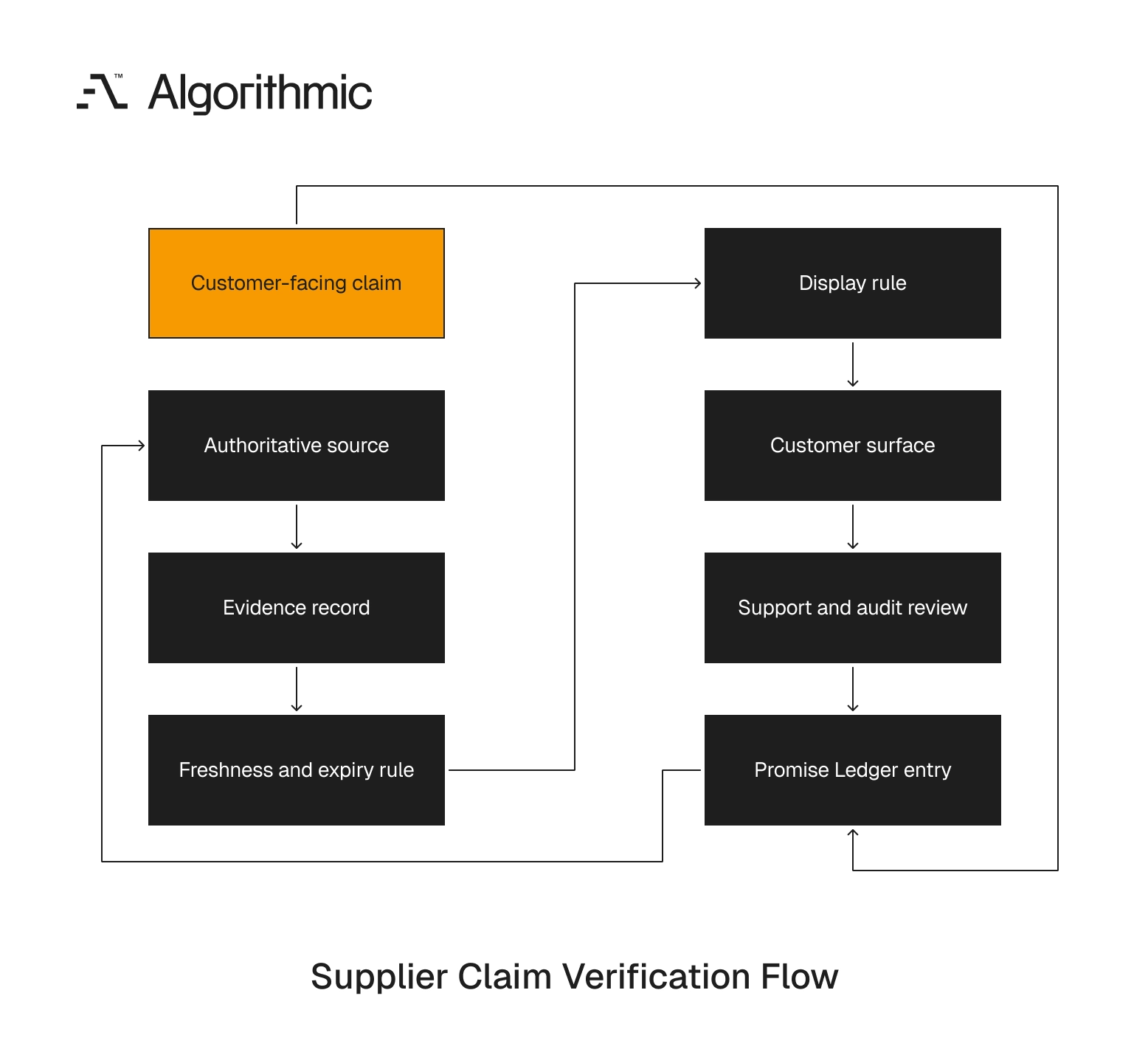 Click to expand
This framing changes the engineering conversation. A team no longer asks whether a badge can be added to a card, it asks whether the ledger has enough authority to expose the badge to customers. The ledger can live in a governed table, an internal service, a catalog, or a versioned repository, since the tool matters less than enforcement. Every customer-visible supplier attribute should map to one ledger entry. The Promise Ledger also gives executives a clearer view of risk, so leaders can see which revenue-bearing claims lack evidence, which sources have stale data, and which customer surfaces depend on weak records. That view is hard to obtain from tickets, spreadsheets, and dashboard fragments.
The ledger should include change history, because a claim’s current state matters and its path to that state matters during disputes. Support needs to know when the field changed, who changed it, and which evidence supported the change. The ledger should also separate supplier assertion from platform verification, so a supplier can assert “insured”, while the platform records policy number, expiry date, insurer, uploaded certificate, and reviewer state. The UI should use the verified state. This mirrors the auditable trail described in data lineage implementation from ingestion to audit evidence, where every value carries the provenance that lets a team defend it later.
A ledger entry for same-day availability can include dispatch feed name, last successful sync, service area, SKU class, cut-off time, and the number of search impressions exposed to the claim during the last 24 hours. That exposure metric turns a data issue into a customer-risk issue. A ledger entry for wheelchair-accessible rooms needs location-level and room-type-level evidence, because a brand-level declaration is not enough for a room-level claim. The platform should record elevator availability, entrance access, bathroom configuration, and last inspection date. The Promise Ledger creates one operating question for every release, which is which customer promises gain exposure and which evidence records support them. This question is practical, testable, and appropriate for executive review.
Authoritative capture pipelines define where truth enters the system
An authoritative capture pipeline is the process and technical path through which supplier data enters, changes, and becomes trusted. It is a product, data, and operations design decision that determines which team can state a customer promise with confidence. The source of truth must sit close to the supplier action or event being claimed, and supplier profiles, third-party systems, compliance documents, telemetry, transaction records, and human review all have roles. The architecture must state which source wins for each attribute.
A supplier profile can serve as the source for brand description, a dispatch system should serve as the source for same-day service availability, and a compliance document store should serve as the source for insurance and license status. The pipeline must also record change, because a correct value at onboarding can become incorrect after one staff change, one expired license, one inventory shortage, or one closed location. Supplier trust is a time-based property. Authoritative capture starts with field ownership, so each attribute needs one owner, one accepted source, and one conflict policy. If two systems disagree, the platform must know which system controls customer display. This design prevents false precision, since a supplier profile can say “open weekends”, while the booking engine shows no Saturday availability. The booking engine should control appointment claims because it reflects current capacity.
Capture at the source
Supplier-entered forms remain useful for declarations, but they are weak for claims that change often or carry customer risk. The difference appears when a customer depends on the value during checkout or service delivery.
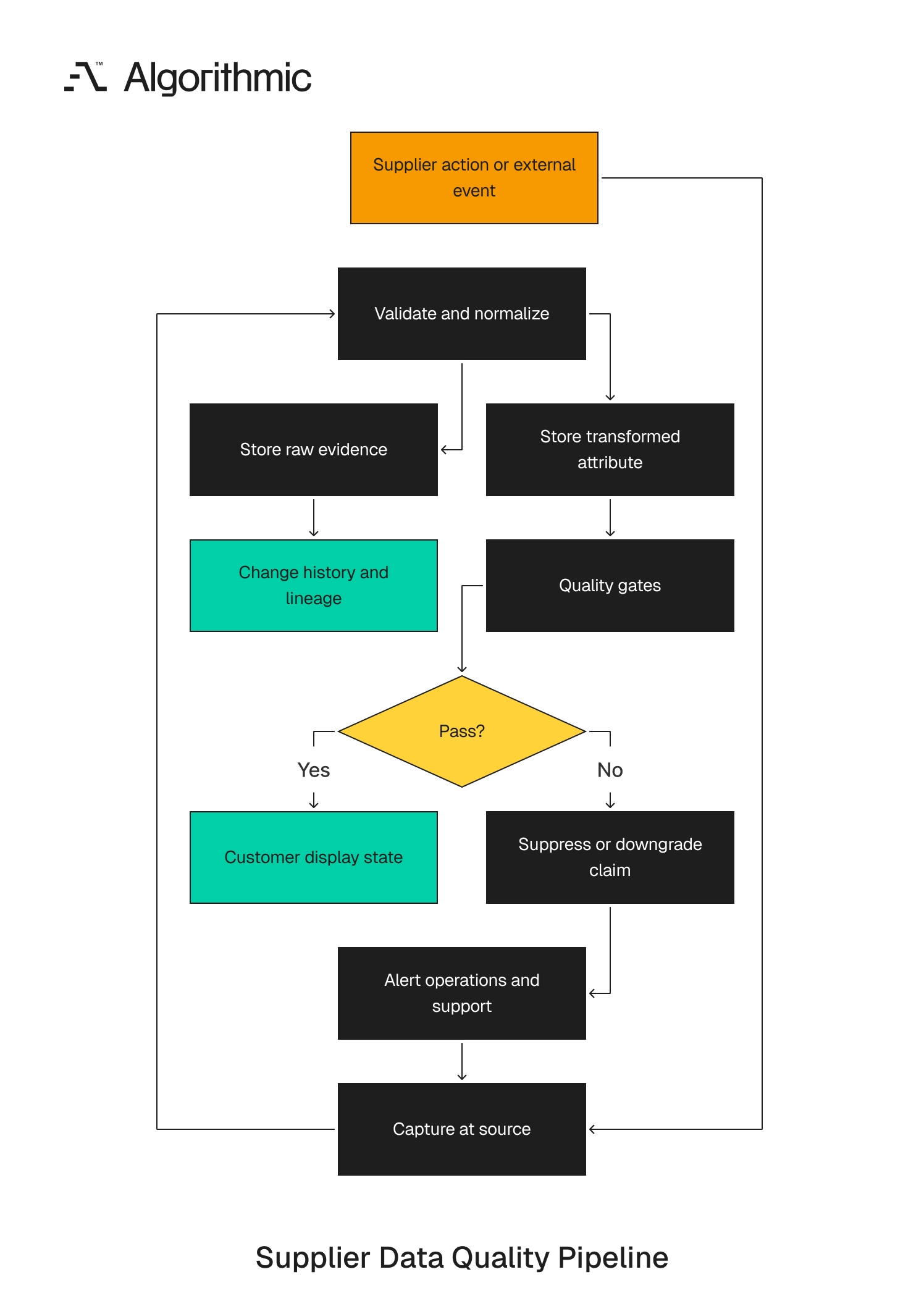 Click to expand
Availability should come from calendar systems, inventory systems, or dispatch tools. Compliance should come from document capture with expiry dates and review state, and staff skills should come from named worker records, certification attachments, training completion, or completed-job evidence. For integrations, engineering leaders should require a connector map that lists each external system, field, data direction, sync frequency, transformation rule, failure behavior, and audit output. Vague integration promises should fail technical review. In industrial design workflows, a serious connector map names systems such as Revit, Siemens NX, Maya, and Unreal Engine, and shows how USD scenes move across tools, which semantics survive, and what latency the round trip creates. Marketplace teams need the same standard for supplier systems.
The supplier connector map should name Shopify, Square, Salesforce, NetSuite, ServiceTitan, Mindbody, Sabre, Amadeus, Stripe, QuickBooks, or a partner-owned warehouse system, and it should also identify field ownership. If NetSuite owns tax status and Salesforce owns account status, the platform must resolve conflicts before display. The map should include manual sources as well, so a compliance analyst review, a field audit, or a partner attestation can serve as evidence. The key requirement is explicit authority, timestamp, reviewer identity, and expiry. A mature connector map also names failure behavior, so if a Shopify inventory feed fails, the marketplace should stop showing “in stock” for affected SKUs, and if a ServiceTitan dispatch feed lags, the marketplace should withhold same-day technician claims. Transformation rules need the same specificity, because a partner’s “available_today=true” field can exclude travel time, parts, union rules, or after-hours restrictions. The platform should record the transformation that turns that field into customer language.
Synchronize changes continuously
Supplier data decays. Licenses expire, staff leave, inventory changes, Wi-Fi speeds degrade after a venue changes network hardware, and accessibility equipment moves between locations. Monthly batch imports rarely support customer-visible claims, so high-risk attributes need event-driven sync, daily refresh, or verification before the claim appears in checkout. Lower-risk attributes can tolerate slower refresh when the UI labels certainty accurately.
A basic event model should include:
supplier_idattribute_nameattribute_valuesource_systemcaptured_atverified_atexpires_atverification_methodconfidence_statechanged_byevidence_uri
This schema lets engineering, operations, and support teams inspect the record behind a customer promise, and it supports lineage tracking, data quality monitoring, and incident response when claims fail. The record becomes a product asset, not a database detail. A marketplace can extend the model with location_id, worker_id, sku_id, service_area_id, or contract_id, and those identifiers matter when the claim applies to one branch, one technician, or one inventory category. Broad supplier-level fields often create false confidence.
The event model should also include processing state, because a failed webhook, delayed import, schema mismatch, or rejected transformation should produce an alert and a customer-surface decision. Silent decay creates the most expensive incidents. Processing state needs clear values, and common states include received, validated, rejected, superseded, expired, and display_blocked. These states give support a shared language with engineering and operations. The sync design should also include replay, since supplier systems send duplicate events, miss events, and resend old payloads after outages. The platform needs idempotency keys, ordering rules, and a recovery path.
Expose gaps before customers see them
A supplier data pipeline should produce quality metrics before attributes reach customer surfaces. Missingness, staleness, conflict rate, failed sync count, and verification expiry are operating metrics that belong beside conversion, booking, and support metrics. Dresner Advisory Services reported that 82% of respondents view data engineering as important in its 2026 Data Engineering Market Study, and at least 33% identified it as important for every use case. The practical reason is clear, since data pipeline engineering decides whether the product can make claims with confidence.
A marketplace should block or downgrade customer-visible attributes when the record fails quality gates. If a hotel’s accessibility data is older than 180 days, the platform should withhold verified language, and if the record lacks location-level evidence, the same rule should apply. If a repair partner’s part inventory sync has failed for 36 hours, same-day repair claims should be suppressed or labeled with lower certainty. The product should act before a customer complaint, so failed feeds and expired evidence should change what customers see.
The operating metric should include customer exposure, because a stale record viewed by three users has a different risk profile than a stale record shown in 40,000 search results. Exposure converts data quality from an abstract issue into a revenue and trust issue, and it helps prioritize remediation. Operations should contact the supplier with 12,000 exposed search impressions before one with 20 impressions, and engineering should repair the feed that affects checkout before a feed used only in admin reporting. Quality gaps should appear in release review, so a new filter with 40% missing verified values should be treated as incomplete production work. Product can still ship a lower-certainty version if the language and display rules match the evidence.
The supplier promise readiness matrix
Engineering leaders need a decision artifact before shipping a supplier-dependent customer claim. The Supplier Promise Readiness Matrix gives product, data, and operations teams a shared review model that turns a badge or filter into a controlled system change.
| Readiness area | Required evidence | Green condition | Red condition |
|---|---|---|---|
| Source of truth | Named system or workflow that captures the attribute | One authoritative source per attribute | Multiple conflicting sources |
| Verification | Document, telemetry, transaction, or approved human review | Verification method recorded with timestamp | Free-text note or inferred field |
| Freshness | Expiry rule tied to attribute risk | expires_at present and enforced | No expiry rule |
| Sync path | API, event stream, file import, or supplier portal | Sync frequency matches claim risk | Manual update after customer complaint |
| Exception handling | Defined process for conflicts and missing values | Customer claim suppressed or downgraded | UI displays fallback text as fact |
| Auditability | Record-level history and evidence link | Support can inspect claim history in under 2 minutes | Engineering query required |
| Supplier UX | Supplier can update and review claim state | Dashboard shows missing and expiring fields | Account manager controls updates by email |
This matrix prevents a common defect, which is treating display logic as data quality control. Display logic can hide a field, but it cannot verify a supplier claim. The matrix should sit in the product review process, so a team should complete it before design sign-off, engineering planning, and launch readiness, and each red condition should create a backlog item with an owner and date. For high-risk claims, the matrix should carry release authority, so legal, operations, and engineering should approve the source, verification rule, and expiry policy. That governance keeps customer-facing language aligned with evidence capture.
The matrix also reduces argument during launch review, because teams can debate the evidence standard before the design reaches production, and that timing prevents late-stage escalations between product, legal, and operations. The artifact should be short enough to complete in one working session, and a two-hour review with product, engineering, operations, support, and legal is often enough for one claim. The output should be a decision, an owner list, and a launch condition. The matrix also exposes hidden dependencies, since a “certified provider” badge can require document storage, supplier reminders, reviewer queues, search suppression, support visibility, and contract language. Seeing those dependencies early prevents expensive release freezes.
Different claims need different evidence standards
Supplier attributes do not carry equal risk. A marketplace should classify claims by customer consequence, regulatory exposure, and change frequency, and the classification should determine evidence, refresh cadence, and display language. The classification also informs build sequence, so low-risk descriptive fields can ship with supplier entry and periodic review, while high-risk compliance fields need evidence storage, expiry controls, and support visibility before launch. This tiering makes investment rational, because a brand tagline should not receive the same pipeline as a medical license, and a same-day repair promise should receive stronger controls than a general service description.
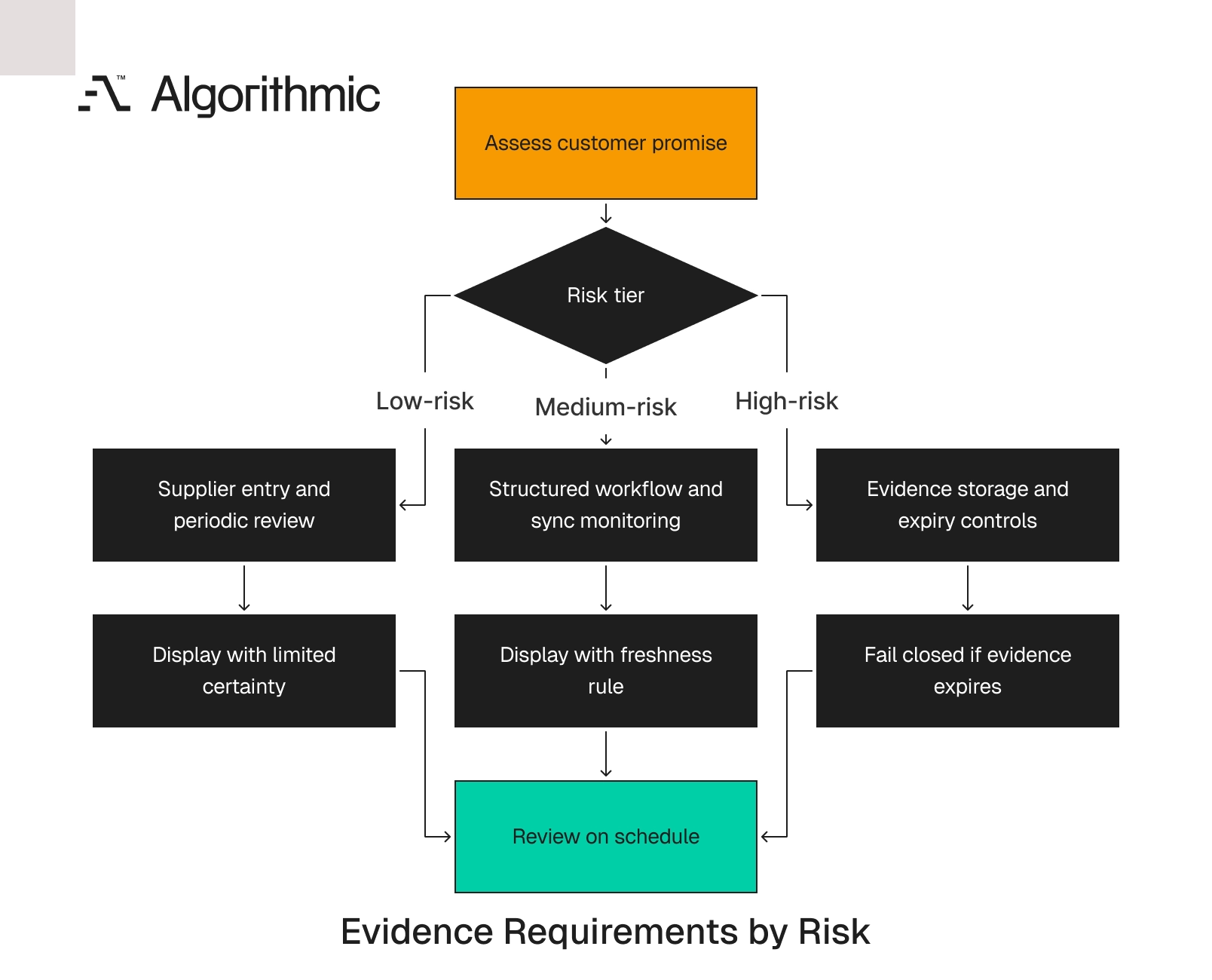 Click to expand
Low-risk descriptive attributes
Examples include business description, years in operation, brand images, spoken languages, and amenity text. These fields can rely on supplier entry with periodic review, and the platform still needs validation because low-risk data can reduce conversion. The main risk is customer confusion, so data quality rules should focus on completeness, formatting, duplicates, and brand policy, and a 90-day or 180-day review cycle is often adequate. A travel marketplace can treat lobby photos as descriptive data when the images do not support accessibility claims, and a B2B directory can treat company overview text the same way. These fields need governance, yet they rarely need transaction-level proof.
Descriptive attributes still need ownership, because a stale image, duplicate description, or unsupported language claim can damage trust. The remedy is clear validation and scheduled review, not a heavy compliance workflow. A practical control is a quarterly supplier review queue that flags missing logos, inconsistent capitalization, unsupported marketing claims, and duplicate descriptions. These checks improve trust without slowing high-risk compliance work. The display language should avoid certainty beyond the evidence, so “supplier-provided description” and “updated on March 12” are accurate for descriptive fields. The platform should reserve “verified” for records with stronger proof.
Medium-risk operational attributes
Examples include opening hours, location availability, capacity, service radius, equipment availability, and appointment slots. These fields affect conversion and support load, and they influence ranking, routing, and partner economics, so they need structured supplier workflows, timestamped updates, conflict detection, and sync monitoring. A restaurant marketplace should treat menu availability and opening hours as operational data, and a field-service marketplace should treat technician coverage and inventory as dispatch inputs. Medium-risk fields require stronger controls when customer behavior depends on them, since a “book now” slot needs a higher standard than a “usually available” label. The product copy should reflect the freshness and source behind the value.
A concrete rule helps. If an attribute can trigger a wasted trip, failed appointment, incorrect order, or refund, it belongs in the operational tier, and that tier needs active monitoring. Operational data should carry short expiry windows, so a calendar slot can expire within minutes, while service radius can remain accurate for weeks. The expiry rule should match the pace of the underlying operation. Operational fields also need conflict resolution, because a supplier portal can list a branch as open, while point-of-sale data shows closure. The platform should decide which system controls customer display before launch.
High-risk trust and compliance attributes
Examples include licenses, certifications, insurance, safety training, accessibility claims, healthcare compliance, age-restricted service eligibility, and ESG claims. These fields require evidence capture, expiry management, review state, and audit trails, and they require a clear owner outside the feature team. Marketplace platforms face a supplier truth gap when customer trust depends on partner attestations, and the issue becomes more severe when claims influence regulated decisions. High-risk claims should fail closed, so if verification expires, the customer-facing claim should disappear or move to an unverified state, and support teams should see the reason without opening a data warehouse ticket.
An insurance marketplace that labels an advisor as licensed should store license number, state, expiry date, issuing authority, and review status, because a screenshot in a support note does not meet that standard. The platform needs a record that can survive customer disputes and regulator review. High-risk claims also need a documented appeals process, since a supplier will challenge a removed badge, suppressed listing, or expired status, and the platform should show the evidence requirement and the exact remediation path. The appeal path should define who reviews evidence, how long the review takes, and the interim customer display while review is pending, and a pending review should not appear as a verified claim. High-risk fields also require periodic internal audits, so a monthly sample of licenses, certificates, and suppressed claims can reveal control gaps. Audit findings should feed the same backlog as product and engineering work.
Architecture patterns that hold under marketplace growth
Supplier data architecture should start with the promises the platform intends to make. A weak sequence starts with UI fields and then searches for data sources, while a durable sequence starts with the authoritative record and builds customer surfaces from it. The architecture should separate declaration, verification, and display, where declaration records capture what a supplier says, verification records capture what the platform accepts as evidence, and display records express what the customer can rely on. This separation prevents one field from carrying three meanings, so a supplier can declare 24/7 availability, a dispatch feed can verify same-day capacity, and the UI can display only the verified condition. Each layer has a different job.
The separation also reduces permission errors, because suppliers can edit declarations, reviewers can approve evidence, and product systems can consume display states. This access model prevents a portal edit from becoming a verified customer claim. Architecture work should also include data retention rules, since evidence records for regulated claims often need longer retention than descriptive fields. Legal and compliance teams should define retention before the first dispute.
Supplier attribute registry
Create a registry that lists every customer-visible supplier attribute. Each row should include owner, source of truth, validation rule, verification method, expiry policy, display surfaces, support path, risk tier, and launch date. This registry becomes an architecture decision record for trust-bearing claims, and it prevents a checkout team, search team, and support tooling team from setting different meanings for the same field. It also gives leaders a single view of unresolved supplier-data risk.
A registry can start in a database table, a governed catalog, or a versioned repository, since the tool matters less than ownership and enforcement. The registry must change when the product adds a badge, filter, ranking rule, or scripted support claim, and it should have change control, so a new customer-facing claim should require a pull request, data owner approval, and release note. This is lightweight governance with high operational value. The registry should also reference downstream systems, because a claim can appear in search, booking, confirmation emails, customer service scripts, and AI answers, and each surface should use the same display state. A strong registry entry answers a practical question, which is who fixes the source, who changes the display rule, and who contacts the supplier when the field is wrong.
Event-driven change capture
Use webhooks, message queues, or change-data-capture where supplier systems support it. Kafka, AWS EventBridge, Google Pub/Sub, or managed webhook ingestion can carry supplier changes into a canonical attribute store, and file imports can remain in place for suppliers without modern systems. The architecture should preserve raw events and transformed records, because raw events help during disputes and data incidents, while transformed records support product use cases such as search filters, ranking, and eligibility checks. Each event should carry source, timestamp, actor, and processing status, and failed events should enter a dead-letter queue with alerting and replay support. Silent failure is the most expensive failure mode for supplier promises.
Event capture should also preserve idempotency and ordering, since supplier systems often resend payloads, send partial updates, or update related records out of sequence. The platform needs deterministic rules for conflict resolution. For example, a booking platform can receive a room inventory update after a cancellation event, and if the platform processes events out of order, it can sell a room that no longer exists. Ordering rules protect the customer promise. Dead-letter queues should include operating ownership, because some failures require engineering repair and others require supplier outreach. A schema mismatch belongs with engineering, while a missing certificate belongs with operations.
Data quality gates in CI/CD and runtime
Data quality checks should run before release and during operations. dbt tests, Great Expectations, Monte Carlo, Soda, or custom checks can detect null rates, schema drift, invalid enums, and stale source feeds, and these checks should map to specific customer surfaces. Runtime gates matter more for customer promises, so if a supplier feed fails validation, the platform should block affected attributes from search, checkout, or confirmation emails. Customer-facing copy should reflect verified state, not aspirational supplier status.
A release gate can stop a new filter when 40% of eligible suppliers lack verified values, and a runtime gate can suppress a badge when evidence expires. These controls prevent product polish from outpacing operational truth. Quality gates should produce owner-specific alerts, so engineering needs schema and job failure alerts, operations needs supplier remediation queues, and product needs exposure metrics tied to customer surfaces. Quality gates should also write back to the Promise Ledger, because a failed check should change the claim state, record the reason, and identify affected surfaces. That audit trail reduces ambiguity during incident review. The release process should treat these gates as production checks, so a UI test confirms that the badge renders, while a data gate confirms that the badge has a defensible basis.
Operations console for supplier trust
Operations teams need a console that shows missing fields, expiring documents, failed syncs, conflicted records, and affected customer surfaces. A spreadsheet export is inadequate once supplier promises drive revenue, so the console should make data gaps visible before support volume rises. The console should let operations teams assign remediation, contact suppliers, approve evidence, and record exceptions, and it should show how many searches, bookings, orders, or support tickets are exposed to each data gap. That exposure metric helps leaders fund the work.
A practical console includes supplier filters, SLA timers, evidence previews, audit history, and task assignment, and it should integrate with Zendesk, Salesforce Service Cloud, Jira, or the internal operations tool. Support agents should see claim history in the same workflow they use for customer cases. The console should also show supplier accountability, so a partner that misses five document renewals or fails three inventory syncs should receive a different treatment than a partner with one late update. Supplier reliability becomes measurable. The console should include queues by risk tier, so high-risk expired evidence should appear above descriptive profile gaps, and that queue design prevents operations teams from spending scarce time on low-consequence work. Exception handling belongs in the console as well, and every exception should carry reason, approver, expiry, and customer-display state. Permanent exceptions should be rare and visible to leadership.
AI and automation increase the need for authoritative supplier data
AI search, recommendation systems, and agentic booking flows raise the cost of weak supplier data. A large language model can synthesize supplier attributes into a fluent customer answer, but the answer still depends on the record behind it. A travel assistant that says “this hotel has step-free access and high-speed Wi-Fi” needs evidence for both claims, and a B2B procurement agent that recommends a supplier based on certifications needs validated records, entity hierarchy, and current documents. The customer sees one answer, while the system can use 30 supplier fields. Automation also makes data defects harder to detect because the output can sound confident, so a generated answer can combine a stale field, an inferred attribute, and an expired document into one sentence. Without provenance, support teams cannot reconstruct the failure.
Enterprise data engineers spend a median of 44% of their time on pipeline work, and the Fivetran and Wakefield Research survey placed average pipeline upkeep near $520,000 per year. A separate Monte Carlo survey found data engineers spend two days per week firefighting bad data, which is the same reactive cost measured a different way. That spend is defensible when pipelines protect revenue-bearing customer promises, and it becomes waste when teams maintain pipes that feed unverified claims. Automation magnifies the difference, because agents can answer faster than humans, and they can spread stale supplier data across more customer interactions.
AI product teams should require attribute provenance before model output reaches customers, so retrieval records should include evidence links, verification state, and expiry status. Prompt instructions cannot replace source control, freshness rules, and runtime quality gates. For RAG architectures, the retrieval layer should filter records by verification state and expiry, because a vector index that contains expired supplier claims will still return them when the text matches. The answer layer needs provenance checks before generation. For agentic workflows, the execution layer needs stricter controls, so an agent that books a provider, submits a purchase order, or schedules a repair should verify the supplier claim immediately before action. Cached supplier facts should not authorize live transactions.
AI also expands the number of customer surfaces, since a supplier claim can appear in search results, chat answers, personalized recommendations, email copy, and automated support responses. The same evidence standard must apply across all surfaces. The model should never invent certainty from incomplete records, so if a supplier has no verified accessibility data, the assistant should state that verified accessibility data is unavailable. That response protects trust better than a polished answer built from weak records. AI governance should include supplier-claim evaluation sets that contain expired documents, conflicting fields, stale feeds, and suppressed suppliers, and a model that fails these cases should not answer customer questions about supplier trust.
What to build before the next supplier-dependent feature ships
Before adding a supplier attribute to search, ranking, checkout, or support scripts, leaders should complete a 10-point review that includes product, engineering, data, operations, support, and legal when the claim carries compliance risk.
- Name the customer promise in plain language.
- Identify the authoritative source for the attribute.
- Define the verification method and required evidence.
- Set freshness and expiry rules by risk level.
- Build supplier workflow screens for entry, review, and correction.
- Create sync jobs or event ingestion with failure alerts.
- Store raw evidence, transformed values, and change history.
- Add data quality gates before display.
- Give support teams a claim history view.
- Measure missingness, staleness, conflict rate, and customer exposure weekly.
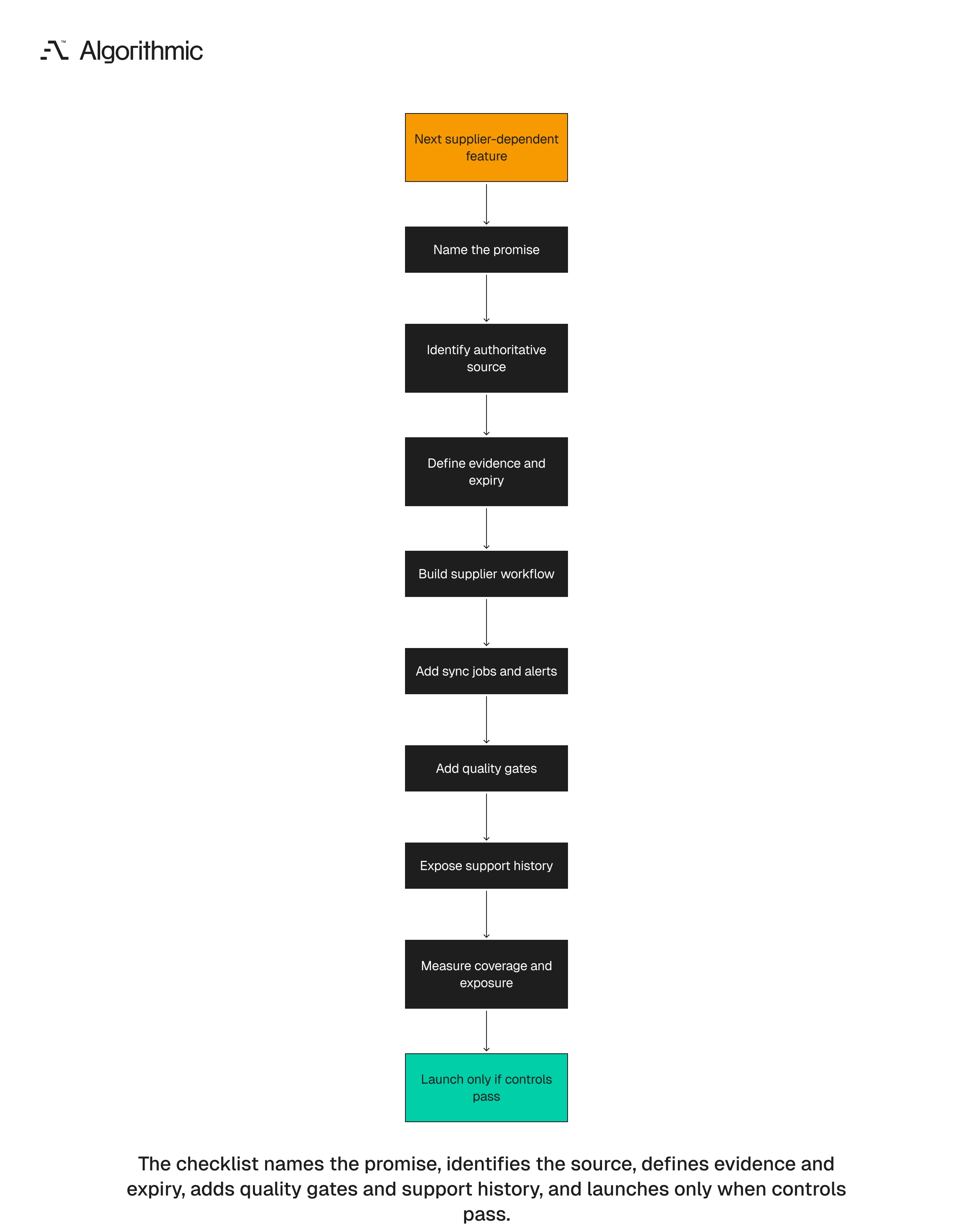 Click to expand
This review should happen before design sign-off, because once the badge, filter, or claim appears in the product, customers will rely on it. Removing a trusted-looking claim after launch creates more disruption than delaying the release. Algorithmic has seen this pattern across production software development, marketplace platform development, data platform development, and ML systems in production. The engineering decision rarely stays inside one feature team, since supplier promises touch product, data engineering, operations, legal, support, and revenue.
A 30-day implementation plan is enough for many teams to start. Week one defines the attribute registry and risk tiers, week two builds the first supplier workflow and connector map, week three adds quality gates and evidence storage, and week four exposes support history and operating metrics. The first release should cover the next 10 supplier-dependent claims, which is small enough to ship and large enough to expose cross-team gaps. It also creates the governance pattern for every later badge, filter, recommendation, and AI answer.
The sequence matters. Start with claims already planned for the next release, then add existing claims with high ticket volume, high refund value, or high compliance exposure. This work should have executive sponsorship, because the first 30 days will expose ownership gaps, missing supplier workflows, and old architectural shortcuts. Senior leadership should decide which customer promises deserve verified language, and the funding case should use exposure. A claim shown in 250,000 monthly search results deserves a stronger pipeline than a field shown inside one admin screen, since exposure gives finance a practical basis for prioritization.
A practical build pattern for the first 30 days
Day one starts with inventory. Pull every supplier-dependent claim from the current product, including filters, badges, cards, checkout messages, confirmation emails, support scripts, AI answers, and claims embedded in ranking rules and partner scorecards. Group the claims by customer consequence, separate descriptive fields from operational fields and trust-bearing fields, and assign an owner to each group before any schema work begins.
During the first week, build the initial supplier attribute registry as a table with claim text, risk tier, source, verification method, expiry rule, display surface, and support path. Leave unknowns blank, then review the blanks with product and operations. During the second week, select one supplier workflow to rebuild, choosing a claim with customer exposure and visible operational pain, such as same-day availability, insurance acceptance, technician certification, menu availability, or location accessibility. The workflow should collect structured data and evidence, show suppliers which fields are missing, expiring, rejected, or verified, and show the business effect, such as a suppressed badge, reduced ranking eligibility, or blocked booking state.
During the third week, connect source systems and add quality gates. Start with one API integration, file import, or portal workflow, capture raw events, transformed values, and evidence links, and add alerts for failed syncs, stale records, invalid enums, and missing evidence. Route alerts to the team that can fix the issue, and do not send every failure to engineering when the remedy is a supplier document upload. During the fourth week, expose claim history to support and operations, so a support agent should see the current claim state, evidence, source, timestamps, and expiry rule inside the case workflow, and an operations lead should see exposure by supplier, attribute, and customer surface.
This 30-day plan will not solve every supplier data issue, but it will establish the control plane, and once the first claim runs through the pattern, the next ten claims become easier to govern. The first month should also produce a stoplight view for executives, where green claims have source, evidence, expiry, display rule, and support visibility, and red claims lack one or more controls and should not carry verified language. A strong pilot uses one high-exposure claim and one high-risk claim, so a marketplace can pair same-day availability with license verification, and that pairing tests both operational freshness and compliance evidence. The team should document every decision during the pilot, including field definitions, source precedence, failure states, display copy, and exception policy, so the next team reuses this material instead of restarting the debate.
Metrics that make supplier trust visible
Supplier trust needs operating metrics, not occasional cleanup reports. The first metric is attribute coverage, the percentage of suppliers with a verified value for each customer-facing claim, and coverage should be segmented by market, category, and revenue tier. The second metric is staleness, so track records past the expiry threshold, records approaching expiry, and records refreshed within the required window, and display these counts beside the customer surfaces that depend on them. The third metric is conflict rate, which occurs when two sources disagree about the same claim, such as Salesforce account status and NetSuite contract status, and each conflict should have a resolution owner and an ageing timer.
The fourth metric is failed sync exposure, counting the searches, bookings, orders, or AI answers that used data from a failed or delayed feed, and this metric changes the conversation from pipeline health to customer risk. The fifth metric is support traceability, the percentage of supplier-claim tickets that support can resolve without an engineering query, and a strong target is under two minutes to inspect source, evidence, and history. The sixth metric is supplier remediation time, tracking how long suppliers take to correct missing evidence, expired documents, and rejected fields, which reveals whether the supplier workflow works in practice.
These metrics should appear in the same review cycle as conversion, fulfillment, and retention, because supplier trust is an operating system for marketplace growth. It deserves weekly review until the data shows stable control. A useful dashboard shows the top 20 claims by exposure, and for each claim, leaders should see coverage, staleness, conflicts, failed syncs, and support traceability. This view connects engineering work to revenue-bearing customer promises. The dashboard should also show claims removed from customer surfaces, because removal is not failure when evidence expires. Removal is the control working as designed. Teams should review remediation time by supplier segment, since enterprise suppliers with API feeds will have different failure patterns than small suppliers using portals, and the workflow should reflect those operating differences. Metrics should drive account management conversations, so a supplier with repeated missed renewals should receive a remediation plan or reduced customer exposure, while trustworthy suppliers should receive higher eligibility for verified surfaces.
Build the pipe before making the promise
Supplier data quality work is often framed as cleanup, which understates its role in partner-driven businesses. The supplier capture pipeline is part of the product architecture, and marketplaces should treat supplier attributes as trust-bearing records. Each claim needs a source, verification method, expiry rule, sync path, quality gate, and support view, and each claim also needs an owner who can remove it from the customer surface when evidence fails.
Run the Supplier Promise Readiness Matrix on the next 10 supplier-dependent claims in the product. Remove or downgrade claims that lack authoritative capture, and fund the supplier workflow and data pipeline work before adding more filters, badges, recommendations, or AI-assisted answers. The decisive test is simple. If support cannot inspect the evidence in under two minutes, the platform should not present the claim as verified, and if the source cannot refresh at the pace of the promise, the product language should change. If the claim carries compliance or safety risk, expired evidence should remove the claim automatically. Customer trust is built through records, workflows, and runtime controls, so the badge is the last step and the pipeline is the product.
Algorithmic builds the data infrastructure and integrations that turn supplier promises into governed, verifiable records. Start a conversation if your customer-facing claims have run ahead of the pipelines that should back them.