
A SaaS company resolving 120 support tickets a week loses more than 500 engineering hours a year when agents need developers to inspect account state, issue credits, reset entitlements, or repair failed workflows. That loss rarely shows up in the roadmap, since it surfaces as Slack threads, support escalations, database console access, and senior engineers answering account-specific questions between planned work.
The operational pattern is familiar. A customer cannot access a paid feature, the agent sees the ticket, asks in Slack, waits for the right engineer, and returns hours later with an answer that should have taken 90 seconds. The same pattern repeats across billing, authentication, product access, imports, exports, and integrations. Each case looks small in isolation, but at weekly volume the work becomes a permanent tax on engineering capacity.
Support tooling deserves the same engineering discipline as customer-facing product work, because it has users, workflows, permissions, APIs, latency targets, audit requirements, and failure modes. Treating it as an internal convenience creates slow resolution, uneven customer treatment, and repeated engineering interruptions. The engineering question is narrow, since it asks which backend surfaces must exist before support teams resolve account-specific issues safely.
The answer is concrete. Support teams need product-state visibility, guarded action APIs, role-based permissions, immutable audit events, and service-level targets for the resolution workflow, and those surfaces are backend product surfaces. The work also needs executive ownership, because support systems touch revenue, privacy, access, and trust. They deserve named product owners, engineering owners, security review, and operating metrics.
Engineering escalations are a product design failure
A mature support operation resolves routine account inspection without engineering involvement. The recurring escalation list is predictable, since agents ask engineering to confirm billing status, inspect entitlement flags, identify failed webhooks, reset a trial, re-run an import, issue a credit, or explain a 403 response. Each request starts as a support ticket and becomes an engineering interruption.
Assume 28 percent of weekly tickets need engineering input, each engineering touch runs 18 minutes, and the customer waits close to four hours because the request moves through Slack, issue trackers, and code owners. At a loaded engineering cost of $180 an hour, 33 weekly escalations consume about $104,000 a year in direct engineering time. That figure excludes lost focus, delayed roadmap work, context switching across product areas, and revenue risk from slow treatment of enterprise accounts.
The cost extends to customer experience, because resolution depends on which engineer is available, which channel the agent used, and which internal convention the engineer remembers. One agent grants a 7-day trial extension, another waits for finance approval, and a third asks engineering to modify a row in PostgreSQL. The product has one policy and the support operation executes three versions of it, which damages trust. The damage increases when the affected customer pays $50,000 a year and expects a clear answer within the hour.
Engineering escalation also hides product debt. A missing entitlement viewer becomes normal, a failed webhook replay path becomes a manual runbook, and a billing credit path becomes a private SQL script owned by one engineer. These gaps last because they sit outside product planning, so support absorbs the delay, engineering absorbs the interruptions, and customers absorb the inconsistent outcome.
The correct response is product work. Define the user, the action, the state model, the permission model, and the failure behavior, then ship the internal surface with the same care applied to customer-facing workflows. A useful test is direct, since a support agent who needs a developer to inspect production state twice a week reveals a missing internal read surface, and a developer who changes customer state by hand reveals a missing guarded mutation surface.
The strongest teams treat these gaps as defects. They write tickets against product domains, assign owners, and track the resolution path. They stop describing support pain as “internal process” once customer data or customer access changes.
 Click to expand
Support tooling has the same product surface as the application
A support tool that changes customer state is a backend product surface, and it needs the same controls as any external feature that mutates production data. The users are internal agents, the affected parties are customer accounts, and the product behavior is state inspection and controlled mutation. The risk profile includes financial loss, account damage, privacy exposure, and audit gaps, since a support action that extends a trial changes revenue exposure and a button that resets an entitlement changes access. A replay control for a failed webhook can trigger downstream invoices, emails, or customer-side automations, and these stay production actions even when the interface sits inside Zendesk, Plain, Salesforce Service Cloud, Slack, or Retool.
The backend contract should reflect that reality. Each action needs an owner, a policy, a permission rule, a typed request, an audit event, and a recovery path, because without that contract the interface becomes a thin wrapper over operational risk. The tool also needs a product manager’s discipline, so the team knows which tickets it serves, which users can operate it, which policies it encodes, and which defects it refuses to hide.
A support panel also has product quality requirements, so it needs fast load time, understandable labels, error states, empty states, and versioned behavior, and agents should never infer policy from a partial screen. The same rule applies to maintenance, since the support action must change with billing when billing rules change, and the support model must change with the product schema when entitlement states change.
APIs define the safe action boundary
Support actions should run through explicit backend endpoints, and manual database updates should be removed from routine support operations. An endpoint such as POST /admin/accounts/{account_id}/trial-extension can enforce tenant scope, maximum extension length, plan rules, reason codes, and idempotency, while a manual SQL update bypasses those controls and leaves future agents without a reliable record of what changed and why. The same principle applies to credits, entitlement resets, feature toggles, failed job replays, and webhook retries, since each action needs a named API, a typed request body, validation, authorization, structured logging, and a predictable response that helps the agent explain the result to the customer.
The FSE 2026 study Developer Perspectives on REST API Usability notes that SaaS APIs can expose hundreds of operations, and it warns that weak API design can threaten entire organizations. Internal support APIs carry the same risk because they operate on customer production state. Following resource-oriented conventions like Google’s API design guide keeps those endpoints predictable across the front ends that call them.
A guarded endpoint gives product teams a place to encode policy. Trial extensions can cap at 14 days, credits can require a ticket link and a customer-visible reason, and webhook replays can use an idempotency key and reject events older than 30 days. Entitlement refreshes can run through the same state machine used by the customer-facing application, and billing actions can write ledger entries instead of isolated account notes. The API boundary also improves testability, since engineering can write unit tests for policy checks, integration tests for downstream side effects, and contract tests for the support interface, where a raw database procedure gives teams few of those protections.
A good endpoint also protects the agent. It rejects unsafe requests before customer data changes and gives a structured error message that says which rule blocked the action. The error response should include enough context for resolution, so a credit endpoint can return approval_required, amount_exceeds_limit, and finance_queue_id, and the agent then knows the next step without asking engineering. The API contract should use stable field names and versioned schemas, because support tools often live longer than the first interface, and Zendesk apps, Slack workflows, Retool screens, and AI agents should call the same backend contract.
Permissions protect customers and the business
Support permissions need more than an “admin” role. A practical model combines role-based access control with account and action constraints, so a Tier 1 agent can view account state and reset a password link, a billing specialist can issue credits up to $250, and a support lead can approve credits up to $2,000. Actions above that threshold require finance approval or a second internal user, and the approval record should bind to the same request ID as the final mutation.
The permission decision should include actor role, customer tier, plan type, region, account status, action size, and reason code, and the endpoint should reject requests that lack required context so broad internal access never bypasses the action policy. This matters most in multi-region SaaS products, since a US-based agent viewing EU customer records needs a different permission path than an EU support lead, and a suspended account needs a different path than an active enterprise account with a failed renewal payment.
Permission rules should live near the product domain, so entitlement services decide entitlement changes, billing services decide credit rules, and security-sensitive workflows require security review through an auditable approval step. The permission model also needs negative paths, since the interface should show why an action is unavailable, which approval is missing, and which team owns the rule, which stops agents from returning to Slack for informal exceptions. Permission design should also account for temporary access, because an incident commander needs short-lived authority during a production incident that expires automatically and writes a separate audit event.
Access reviews should run on a fixed schedule. Monthly review works for small support teams, while larger teams with multiple regions and contractors often need weekly review for high-risk actions. The review should answer three questions, namely who used each permission, which accounts were affected, and which denied requests indicate a missing product path or an attempted policy bypass.
Audit trails make support decisions reviewable
Every support action should produce an immutable audit event that includes actor ID, customer ID, action type, previous state, new state, reason code, ticket link, request ID, IP address, timestamp, and approval chain. Logs should be queryable by account and by internal user, and security teams should export these events into the company’s retention system. Audit design matters most during disputes, since a customer who asks why a feature disappeared needs the exact source of change, and the answer should distinguish a system job, an agent action, and a billing rule after non-payment.
Audit trails also help managers find training gaps. If one agent issues four times as many credits as peers on the same ticket type, the support lead needs that pattern within days, since a quarterly review arrives after the behavior has affected dozens of customers. The audit event should be a product artifact, not an afterthought in application logs, so it needs a schema, retention policy, query path, and owner, and finance, security, support leadership, and engineering should agree on the fields before sensitive actions ship.
A strong audit path also reduces fear inside support. Agents trust tools when they know actions are visible, reversible when appropriate, and tied to approved policy, which increases adoption and reduces informal workarounds. The audit trail should also record failed attempts, since a denied credit, blocked regional access request, or payload mismatch can reveal policy confusion that helps teams fix training and interface design. Audit storage should resist accidental modification, so append-only tables, event logs, and write-once storage all work when access is restricted, and the key requirement is plain, since support operators should not edit the record of their own actions.
The support panel should show product state, customer value, and recent failures
Support agents make better decisions when operational context is visible in the workflow. The minimum useful panel contains plan tier, contract value or lifetime value, renewal date, seat count, recent usage, billing status, entitlement state, feature flags, last login, recent API errors, failed jobs, and related exceptions from the last 24 hours, and this data belongs beside the ticket. Plain’s 2026 benchmark analyzed 559 B2B SaaS workspaces and found that 41.1 percent of teams use Slack for support and 19.5 percent of support conversations happen there. Slack is now a major support channel, despite being designed for collaboration rather than customer operations.
That shift fragments context. The account record sits in the application, billing state sits in Stripe, Chargebee, or NetSuite, error traces sit in Sentry, Datadog, Honeycomb, or OpenTelemetry, and the customer conversation sits in Zendesk, Intercom, Plain, Salesforce Service Cloud, or Slack. A support tool should join these views around the customer account so agents stop searching five systems during a live customer exchange, and it should reduce copy-and-paste errors, since a copied account ID from the wrong tenant can turn a routine ticket into a privacy incident. The same principle applies to “cannot reproduce” tickets, where the tool closes the visibility gap by exposing account-specific traces, feature flags, request IDs, and recent failures in one place.
A concrete panel design is straightforward. The left column shows identity, plan, renewal date, owner, and customer tier, the middle column shows entitlements, usage limits, feature flags, and recent state changes, and the right column shows failed jobs, recent exceptions, API error rates, and support-safe actions. Each field should answer a common support question, and fields without a known support use should stay out of the first version. This design gives agents the same operational view a developer would assemble manually, and it reduces the risk of exposing raw infrastructure data to people who need account facts, recent events, and approved actions.
The panel should show freshness, since billing status loaded 12 minutes ago carries a different risk than billing status loaded 12 seconds ago, and agents should know when they are looking at cached data. It should also name source systems, so contract value from Salesforce and billing status from Stripe reduce confusion when systems disagree, and it should show partial failure, since a Stripe timeout should surface in the billing section rather than display stale values without a visible timestamp and source status.
The panel should also handle identity resolution with care, because a ticket email can differ from the account owner email, billing contact email, or SSO identity, so the system should show the matched account and the confidence basis, such as domain, workspace ID, or verified external ID. For enterprise accounts, the panel should surface commercial context without exposing private contract notes, since annual recurring revenue, renewal date, customer tier, and customer success owner are usually enough to resolve an access issue. The interface should avoid raw internal labels, so plan_enterprise_2024_q3_migration_exception belongs in engineering tools while “Enterprise plan, migration exception active until 2026-06-30” belongs in support.
The first 5 to 10 actions determine most of the return
Support tooling programs fail when teams build a full internal admin suite before shipping a useful workflow. The first release should target the highest-frequency support actions, and in most SaaS products that list contains 5 to 10 items, namely extend trial, issue credit, reset entitlement, resend invite, replay webhook, retry failed import, toggle feature access, restore account access, update billing contact, and generate a diagnostic bundle. Each action should be safe, logged, reversible when the business process allows it, and fast enough for live support, since many of these actions happen while the customer waits.
A well-designed “reset entitlement” button should complete in under 10 seconds. It should show the current entitlement state, ask for a reason code, validate the agent’s permission, call a guarded endpoint, write an audit event, display the resulting state, and give the agent a copyable customer-facing explanation. That is backend product work, since the visible button is a small part of the system and the larger work sits in the endpoint, policy model, audit path, and recovery design.
A diagnostic bundle is a useful early action because it changes no customer state. It collects request IDs, recent errors, account metadata, feature flags, and job status into one support-safe artifact that agents can attach to escalations, which reduces engineering triage time before mutation actions ship. The diagnostic bundle also creates a feedback loop, since engineers see which fields matter during real incidents and product teams see which account states confuse customers.
The first version should avoid rare administrative cases, because account merges, historic invoice corrections, data export approvals, and permanent deletion workflows require deeper policy work and belong in later releases with stronger review gates. The early action list should come from ticket data instead of internal preference, so an import retry belongs before a low-volume account merge screen when agents escalate failed imports 18 times a month, and billing contact updates belong in the first release when billing contacts cause the longest delays. The first action set should also represent different risk levels, since one read-only artifact, one low-risk mutation, and one governed high-value action create a baseline where the team learns how policy, audit, and permissions behave under production use.
Reversible actions reduce operational fear
Support teams avoid internal tools they do not trust, so reversibility changes adoption. A trial extension can be reversed by restoring the prior expiration timestamp, a credit can be voided before settlement or offset with an adjustment, a feature toggle can be restored to the previous state, and a job replay can include an idempotency key to prevent duplicate side effects. The support interface should show the rollback path before the agent submits the action, which helps agents act with discipline instead of hesitation.
Some actions are irreversible. Account deletion, payment capture, and data export approval need stronger gates with secondary approval, delay windows, and clear warnings inside the interface. The approval design should match business risk, so a $50 credit can require one authorized user, a $5,000 credit should require a billing lead and a finance approver, and a production data export should require security review and a record of the legal basis. The same review should capture the requester, destination, retention period, and ticket link, since those fields matter during audits and customer disputes.
Reversibility also needs user education. The runbook should distinguish reversible, compensating, and irreversible actions, and agents should see that classification inside the tool before submission. The interface should show the exact prior value when reversal is available, so “Previous trial end date 2026-06-02 23:59 UTC” beats “rollback available” and gives the agent and approver confidence. Compensating actions need equal clarity, since a settled credit cannot always be voided, so the system should show the offset path and finance should approve those rules before the action appears in the support panel.
Idempotency prevents duplicate damage
Support work happens under pressure, since agents retry requests when browsers freeze, APIs return ambiguous errors, or customers wait in live chat. Each state-changing support endpoint should accept an idempotency key and return the original result for duplicate requests, which prevents duplicate credits, repeated webhook sends, and multiple entitlement changes from one support intent. Idempotency also helps AI agents and workflow automation, since that value depends on backend actions that tolerate retries and preserve state integrity.
The implementation is standard and follows the pattern in Stripe’s idempotent requests. The client generates a key for the support intent, such as ticket_48291_credit_250_2026_05_24, and the server stores the key, request body hash, response status, and result. A repeated request with the same key returns the stored response, while a repeated request with the same key and a different payload should fail, which protects the customer account from ambiguous support intent.
Idempotency records should have a retention policy, since credit and billing actions need longer retention than invite resends, and the retention window should match the financial and audit risk of the action. The idempotency path should also appear in observability, so teams track duplicate submissions, payload mismatches, and retry rates by action type, where a spike in retries often points to a slow endpoint, unclear interface state, or browser-side failure.
Idempotency should extend to downstream systems where possible. A webhook replay that calls a customer endpoint should include the original event ID and replay attempt ID, and a billing adjustment should carry the same support request ID into Stripe, Chargebee, or NetSuite. The support UI should also make retry state visible, so a running action shows “in progress” and disables duplicate submission, and an already-accepted request prompts the UI to fetch the stored result.
Treat support resolution stages like SLOs
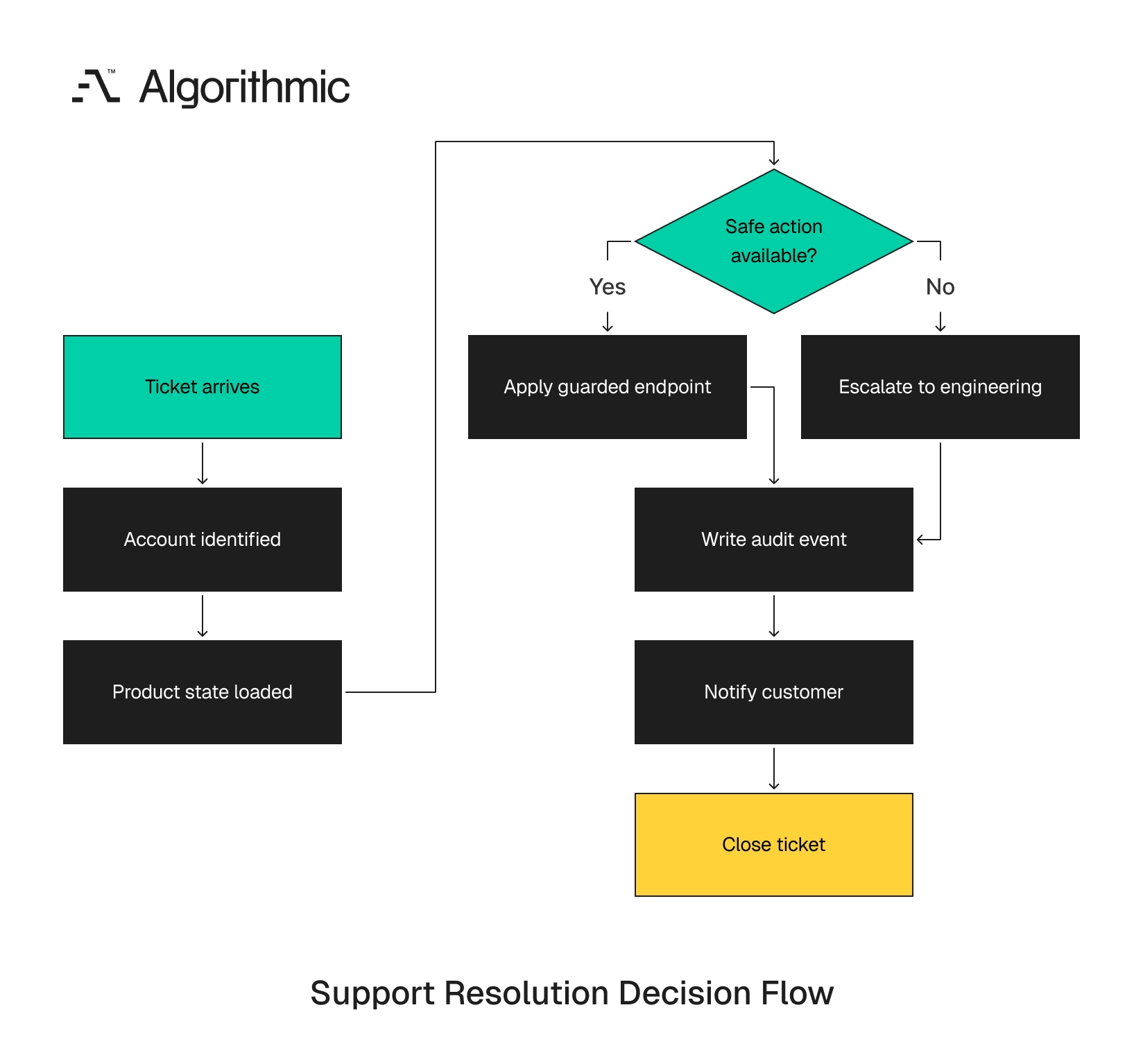
Support operations need service-level objectives for the internal workflow and the external customer promise. The useful stages are measurable, namely ticket created, account identified, product state loaded, failure classified, safe action available, action completed, customer notified, and ticket closed, and each stage should have a target, trend chart, alert, and explicit owner. A practical target set for B2B SaaS looks like this.
| Resolution stage | Target | Alert condition | Owner |
|---|---|---|---|
| Account identified from ticket | 95% within 60 seconds | 3-hour drop below 90% | Support systems |
| Product state panel loaded | p95 under 2 seconds | p95 above 5 seconds for 15 minutes | Platform engineering |
| Known failure classified | 80% within 5 minutes | Daily rate below 70% | Support operations |
| Safe action available | 90% of top 10 issue types | Weekly drop below 85% | Product engineering |
| Engineering escalation rate | Below 10% of tickets | 7-day average above 15% | Support and engineering leaders |
| Audit event completeness | 100% of mutations | Any missing required field | Security engineering |
These metrics change management behavior, since a drop in product state loading becomes an engineering incident, a rise in escalation rate becomes backlog input for support tooling, and a missing audit field becomes a security defect. The same execution logic applies to product funnels, where teams that instrument setup rate, first-use conversion, and activation milestones as SLOs can distinguish code regressions from behavior changes, and support resolution needs the same discipline.
A weekly operating review should examine the same six metrics every time and name the top three escalation causes, the number of tickets affected, the median delay, and the product area owner, which converts scattered frustration into prioritized engineering work. The target is controlled escalation, since some problems require engineering diagnosis, especially data corruption, security events, and unreleased product defects, while routine state inspection and approved mutations should stay inside a governed workflow.
The review should produce one engineering decision, namely add a field, add an action, change a permission rule, fix a product defect, or close the issue with no action, because ambiguous follow-up wastes the same time the tooling is meant to recover. It should also include one support decision, namely update the runbook, change training, adjust approval limits, or retire an unsafe workaround, since support tooling succeeds when operational process and backend design move together.
SLOs should include customer-facing and internal measures, so time to first customer response matters and time from account match to safe action completion matters as well. The second measure is often where engineering work hides, since a ticket can receive a quick human reply and still wait four hours for entitlement repair, and internal workflow timing exposes that gap. Metric definitions need discipline, so “escalation” should mean a request for engineering inspection or mutation of customer state while a product bug filed for later repair is counted separately. Without clear definitions, teams argue about reporting instead of fixing the workflow, so a support systems owner should maintain the metric dictionary and version changes like any other production contract.
The backend architecture is small, precise, and high-control
A small team can build production-grade support tooling when the architecture has narrow boundaries and strong controls. The architecture should minimize novelty, since most SaaS teams already have identity, account services, billing services, entitlement services, observability, and event storage, and support tooling should compose those systems through a controlled surface. The design should separate state visibility from state mutation, so read models help agents understand the account while action APIs change customer state through explicit policy. It should also separate the support interface from the authority to change data, so Zendesk, Slack, Retool, and custom React screens call the same backend actions and none of those front ends own business rules.
Reference architecture for guarded support actions
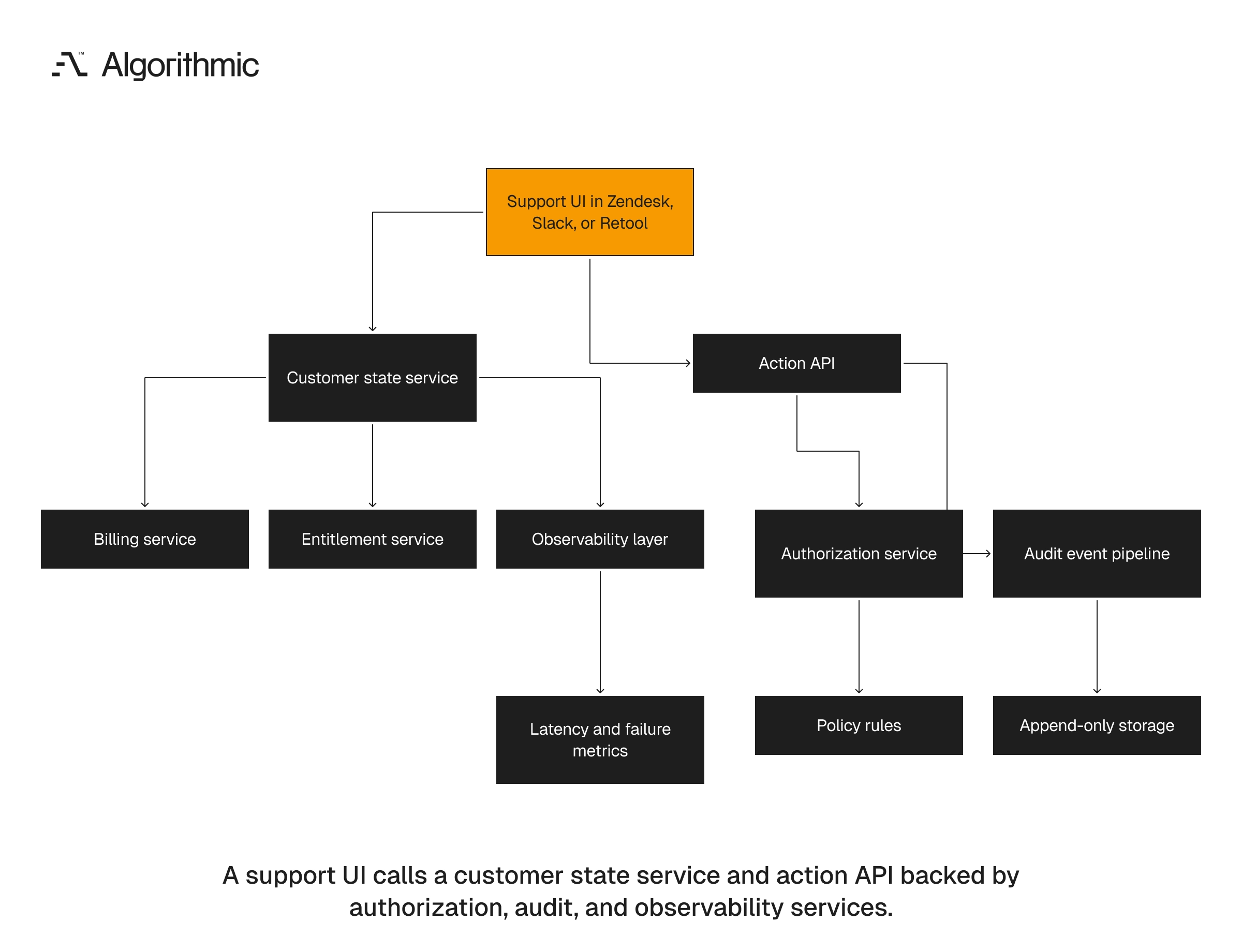
A production-ready support tooling architecture has six components:
-
Support UI embedded in the agent workflow The panel appears inside Zendesk, Intercom, Plain, Salesforce Service Cloud, or an internal console. It receives ticket ID, customer email, workspace ID, and channel context. It should authenticate the agent through the company’s identity provider, such as Okta, Microsoft Entra ID, or Google Workspace.
-
Customer state service A read API joins account, plan, billing, entitlement, usage, and recent error data. The service hides database structure and returns a stable support-facing model. It should return fields designed for support decisions, not raw table names or internal enum values.
-
Action API Each mutation has a typed endpoint, schema validation, permission check, idempotency key, reason code, and structured error response. The endpoint should return a customer-safe message when the action succeeds or fails. That message helps agents communicate without inventing policy.
-
Authorization service Policy decisions use role, action, customer tier, region, credit amount, account status, and approval state. The policy engine can start as application code. Larger teams often move this logic into Open Policy Agent, Cedar, or a centralized authorization service.
-
Audit event pipeline Every mutation writes to append-only storage, such as PostgreSQL with write-once semantics, an event log, or a dedicated audit store. Events include before-and-after state. Security and finance teams should receive exports for actions that affect money, access, or regulated data.
-
Observability layer Metrics track latency, failures, retry rates, permission denials, missing context, and engineering escalations. Logs link back to ticket IDs and request IDs. Traces should connect the support action to downstream jobs, queues, and third-party API calls.
This architecture can start inside a monolith, since separate services are a later choice when traffic, team ownership, or security review requires them, and the first version should favor existing infrastructure.
 Click to expand
PostgreSQL, Redis for idempotency records, OpenAPI, and the existing identity provider are enough for most SaaS teams, since a new platform rarely pays for itself during the first 30 days and the early return comes from disciplined boundaries. The architecture also needs test environments with realistic policy data, because support actions fail in production when test accounts lack billing states, tenant boundaries, and regional constraints, so a support tooling test suite should include enterprise, suspended, trial, delinquent, and EU-region accounts.
The deployment path should include feature flags and staged access, so a small pilot group tests the first actions against real tickets and wider rollout follows after audit completeness, permission denials, and latency meet the agreed targets. Runbooks should live next to the API contract, since the endpoint defines what the system permits while the runbook defines when support should use it, what the customer should hear, and which cases need approval.
Integration choices matter less than state ownership
Teams often begin with the front-end integration decision and debate whether support actions should live in Zendesk, Slack, Salesforce, Retool, or a custom React console, but the more durable decision is backend state ownership. Retool can be a sound front end if every action calls guarded APIs, Slack can trigger workflows if each command uses the same authorization and audit path, and Zendesk apps can work if they display canonical product state instead of cached fragments. Direct write access from a low-code tool into production tables is unacceptable, since it is quick to build and difficult to govern and creates a second, informal product surface without versioning, permissions, tests, or audit design.
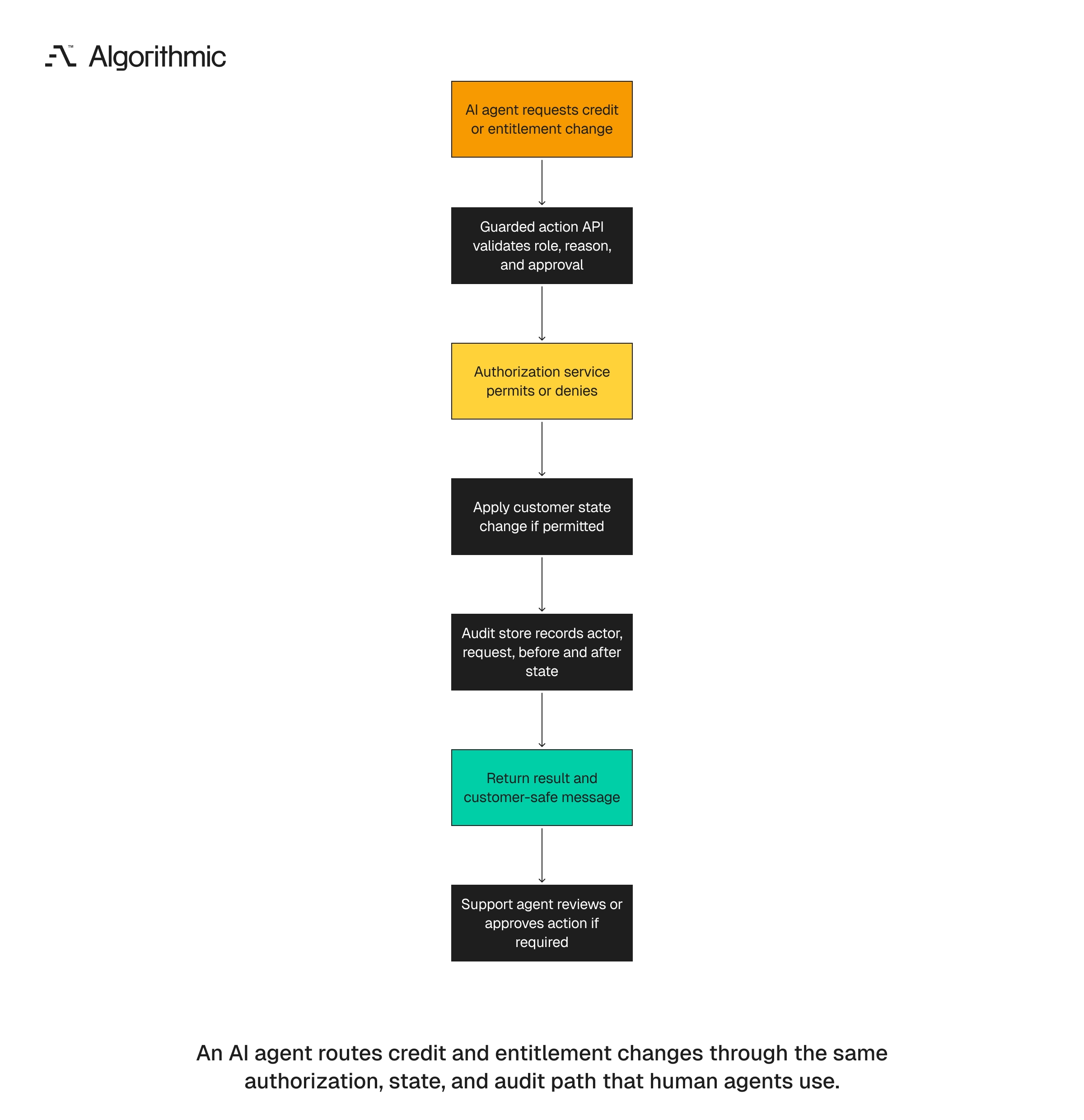
State ownership should sit with the product systems that already own the data, so billing credits belong behind billing services, entitlement changes belong behind entitlement services, and webhook replays belong behind the event delivery system. This ownership model protects invariants, since support actions should use the same transition rules when product code requires an entitlement state machine, and support credits should write through the ledger when billing requires ledger entries. The same rule applies to AI support agents, so an AI workflow should never receive broader mutation rights than a trained support agent and should call the same guarded endpoints, carry the same reason codes, and write the same audit events.
State ownership is also a staffing decision, since the team that owns the production invariant should own the support action that changes it and understands the edge cases, rollback path, and downstream consequences. Ownership should appear in the service catalog, where each support action needs an engineering owner, business owner, security reviewer, and support runbook owner, which prevents orphaned internal features after team changes. Versioning also matters, since the support state model must move with an entitlement service when it changes from boolean flags to plan-scoped grants, and a versioned API gives the support interface a controlled migration path.
A practical build sequence for the first 30 days
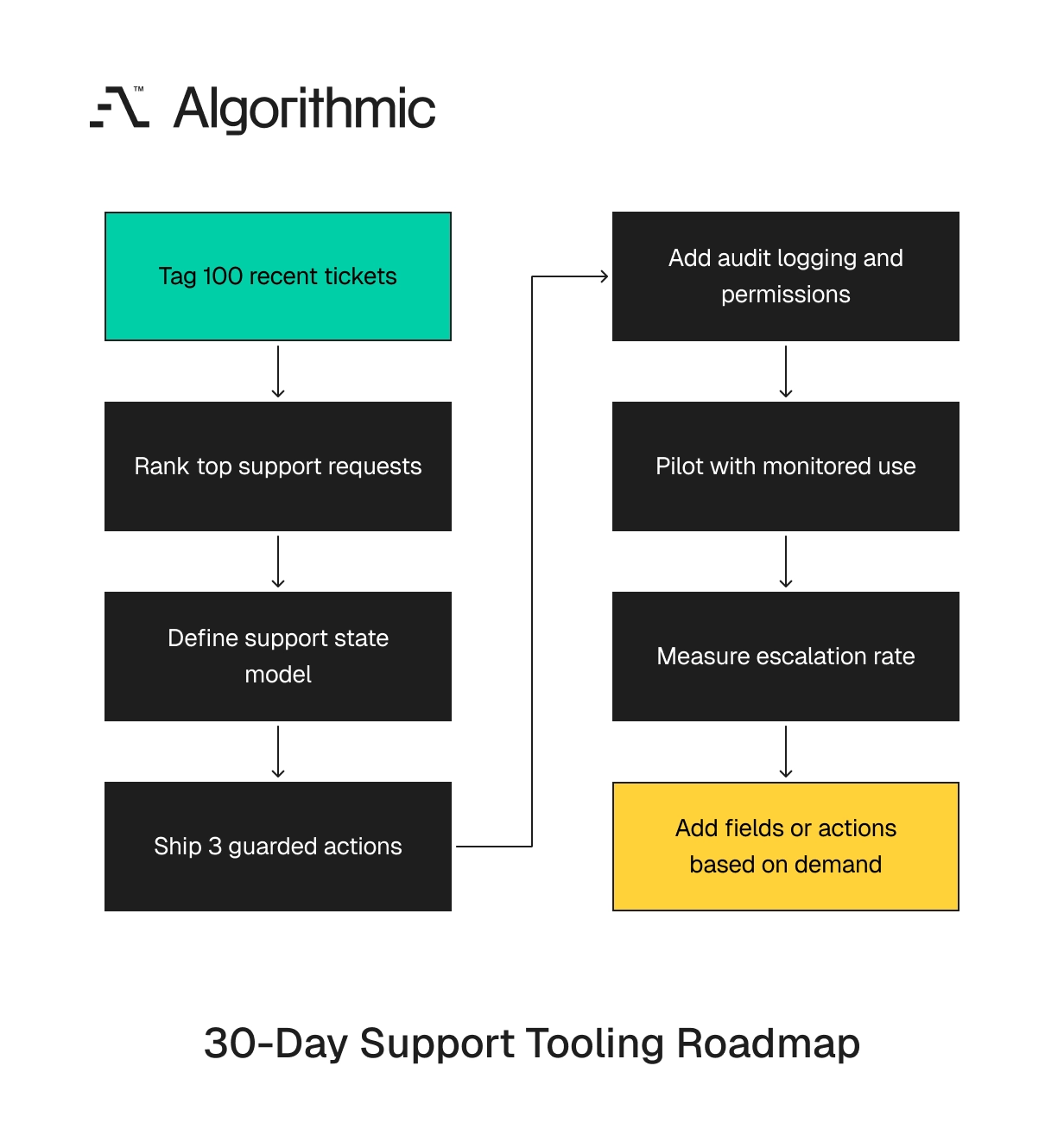
Engineering leaders can make progress without pausing the product roadmap for a quarter. The first month should produce three concrete artifacts, namely a measured escalation list, a versioned support state model, and three guarded actions in production, and that scope is small enough for one senior engineer and one support operations partner. The operating model should be explicit from day one, so product engineering owns state and mutation APIs, support operations owns ticket taxonomy, runbooks, and adoption, and security owns audit requirements and permission review.
 Click to expand
Week 1 measures escalation demand
Start by tagging 100 recent tickets and label the request type, systems touched, time to first response, time to resolution, engineering involvement, and customer tier. This creates a ranked list of support friction, so the first support panel should show entitlement state when 37 of 100 tickets require entitlement inspection, and the first action endpoint should replay webhooks safely when 22 require failed webhook replay. The tagging exercise should include account value, since ten escalations from enterprise customers carry a different operating risk than ten from free trials, and the backlog should reflect frequency, revenue exposure, and risk. The team should also capture the engineering path and record whether the request went to Slack, an issue tracker, a database console, a runbook, or a named code owner, since that path shows where time disappears.
At the end of Week 1, the team should publish a one-page findings memo listing the top 10 support requests, affected ticket count, median delay, engineering minutes, revenue exposure, and proposed first actions, and that memo becomes the charter for the build. It should also name the product owner for each state area, since entitlements, billing, identity, imports, and webhooks often sit under different engineering teams and naming owners early prevents stalled approvals in Week 3. A small sample is enough for the first decision, because 100 recent tickets will not answer every operational question but will identify the repeated failures consuming the most engineering time.
Week 2 defines the support state model
Create a support-facing account object that includes identity, plan, billing state, entitlement state, usage counters, feature flags, recent errors, and related external IDs. The model should be versioned and documented with OpenAPI so front-end tooling, workflow systems, and AI agents consume the same contract. The first version should fit on one screen, since a model that requires agents to interpret 80 fields will slow the workflow, so start with the fields needed for the top ticket types and expand with evidence from escalation reviews.
Each field should have an owner and source system, so contract value from Salesforce, billing status from Stripe, and entitlement state from the product database appear as distinct facts that matter during reconciliation. The model should include freshness metadata, so a cached field shows its age and a source-API field shows success, timeout, or partial failure, and it should avoid raw internals, so agents see “Analytics export enabled” instead of feature_flag_analytics_export_v3=true. The schema should include stable identifiers like account ID, workspace ID, organization ID, billing customer ID, and CRM account ID where permitted, since these reduce misrouting between systems. The team should also define redacted fields, because support agents rarely need full payment details, raw tokens, secrets, or unrestricted logs, so the model should carry safe summaries and links to approved escalation paths.
Week 3 ships the first safe actions
Select three actions with high frequency and low irreversibility, so good candidates include trial extension, invite resend, entitlement refresh, and webhook replay, and each action needs permission checks, reason codes, audit events, idempotency, and clear success or failure messages. The release should include a short internal runbook stating when to use each action, who can approve it, what the customer should hear, and how to roll it back, which prevents policy drift during the first month. The first release should also include access review, so name the initial users, roles, and approval thresholds and remove broad access after the pilot group finishes validation.
A production rollout should start with monitored use, so for the first week every action notifies a shared support-systems channel with ticket ID, action type, actor, and result, and that notification links to the audit event instead of exposing sensitive state. Week 3 should end with an adoption review that counts how many eligible tickets used the tool, how many still escalated, and why agents avoided it, since low adoption usually means missing fields, unclear policy, or distrust of rollback behavior. The engineering team should review failed action attempts in detail, since a permission failure signals training or policy work while an endpoint-latency failure signals product engineering work, and the support lead should review customer language, since agents need approved phrases for credits, entitlement resets, and replayed webhooks that reduce inconsistent promises across tickets.
Week 4 adds SLOs and escalation review
Track the operational effect and measure resolution time, escalation rate, action success rate, audit completeness, and customer reopen rate. Review escalations weekly and add one new guarded action when a pattern repeats at least 10 times a month. Across dozens of complex software engagements, including production systems serving millions of users, we have seen this sequence reduce avoidable engineering escalation within one month, and the common factor is disciplined backend ownership rather than the size of the internal tools program.
The weekly review should end with one decision, namely add a field to the support state model, add a guarded action, improve an existing workflow, or close the issue as a product defect, which keeps support tooling tied to measured demand. Week 4 should also define the operating cadence, so support operations owns ticket classification, product engineering owns action APIs, and security engineering owns audit completeness and permission review. The cadence should remain small, since a 30-minute weekly review with six metrics and three escalation examples beats a monthly meeting with 40 slides, and support tooling needs the same tight feedback loop as a customer-facing product.
The month should close with a baseline report comparing escalation rate, median resolution delay, engineering minutes, and reopen rate against Week 1, and listing the next three actions by expected return. The executive readout should be short and state the direct engineering hours recovered, the customer segments affected, and the remaining unmanaged risk, since that format supports funding without turning the program into a committee exercise.
AI support agents need the same backend controls
AI changes the interface to support work, but it does not remove the need for controlled backend actions. An AI agent that summarizes tickets can operate with read-only access, while an AI agent that issues credits, changes entitlements, or replays webhooks operates on production customer state and needs the same policy checks as a human support agent. The backend should treat AI as another actor type, so the audit event records the model, workflow ID, human approver when present, prompt or instruction reference, request ID, and final action, and the permission model states which actions require human approval.
 Click to expand
AI workflows should start with diagnostic bundles and draft responses, since those actions improve speed without changing customer state, and mutation actions should arrive after the guarded endpoints, approval rules, and audit events already exist. This sequencing avoids a common failure mode, where teams add an AI layer over a fragile internal process and then discover that the model can accelerate unsafe work, so the safe path is to engineer the backend action surface first. AI also raises the importance of idempotency, since automated workflows retry more consistently than humans, so duplicate prevention, payload hashing, and replay-safe endpoints become mandatory once machines initiate support actions.
The same principle applies to data exposure, so an AI assistant should receive the support-facing account model rather than raw database rows or unrestricted logs, and the model should include the fields needed for the workflow and omit sensitive data outside the ticket context. AI agents also need approval boundaries that are visible to humans, since a draft response can be low risk while a $500 credit, entitlement reset, or data export request should require a human approval step until the organization has enough operating history. The audit trail should record both machine recommendation and human decision, so an AI-suggested credit approved by a support lead leaves both events in the record, which matters when reviewing customer disputes and model performance.
Evaluation should use production-like cases, so the team should test duplicate retry, wrong-account match, stale billing state, permission denial, and ambiguous customer language, since these expose unsafe automation before the workflow reaches customers. AI support agents also need rate limits, because a misconfigured workflow can send 200 replay requests in minutes, and backend throttles and per-account limits prevent automation from turning one support error into a customer incident.
The investment test for SaaS executives
Support tooling deserves backend capacity when three conditions are present. Support agents ask engineering to inspect or mutate customer state more than 10 times a week, the action affects revenue, access, security, or customer trust, and the correct treatment can be expressed as a policy and encoded in an API. Those conditions justify product engineering time and create a clear funding case, since the work reduces direct engineering waste, protects customer trust, and removes informal production access paths.
A single senior engineer can usually ship the first version in 2 to 4 weeks when the product has clear account models and existing authentication, while more complex products with fragmented billing, multiple tenants, or regional data rules need 6 to 8 weeks. The decision should be based on measurable waste and risk, so a $180-an-hour engineer who spends 10 hours a week on avoidable support escalations costs $93,600 a year in direct time, and enterprise accounts that wait hours for entitlement repair carry a retention risk that exceeds the engineering cost.
The investment should start with a 30-day support tooling assessment, so tag 100 tickets, rank the top 10 state inspection and mutation requests, define the support account model, and ship the first three guarded actions behind audit logging and role-based permissions. The first 30 days should answer four executive questions, namely which support requests consume engineering time, which actions create revenue, access, or security risk, which backend owners control the required state, and which guarded actions will reduce the next 100 escalations. The funding model should be small and explicit, so assign one senior engineer, one support operations partner, and named reviewers from security and finance, give the team 30 days, and measure the effect against the current escalation baseline.
The roadmap should remain narrow, since a support panel with 12 reliable fields and three guarded actions beats a broad admin console with unclear ownership, and internal tools fail when teams mistake surface area for control. Executives should also remove unsafe shortcuts, so database console access, private SQL scripts, shared admin credentials, and manual ledger edits should have retirement dates, and every retired shortcut should map to a governed replacement. The close is operational, so stop treating support tooling as an internal convenience, fund it as backend product work, assign production owners, and move routine customer-state decisions out of Slack, database consoles, and interrupted engineering calendars.
Algorithmic builds backend infrastructure that turns manual support escalations into guarded, audited actions with named owners. Start a conversation if your engineers keep answering account-specific questions between planned work.