
The demo record moved, and production owned the bill. That gap is the most common source of software development cost overruns, and it hides inside every vendor pitch that ends with a green checkmark. In its 2025 Connectivity Benchmark, MuleSoft found that 95% of organizations face integration challenges and that around 70% of the average company’s 1,061 applications are not properly connected. A vendor demo rarely shows any of that.
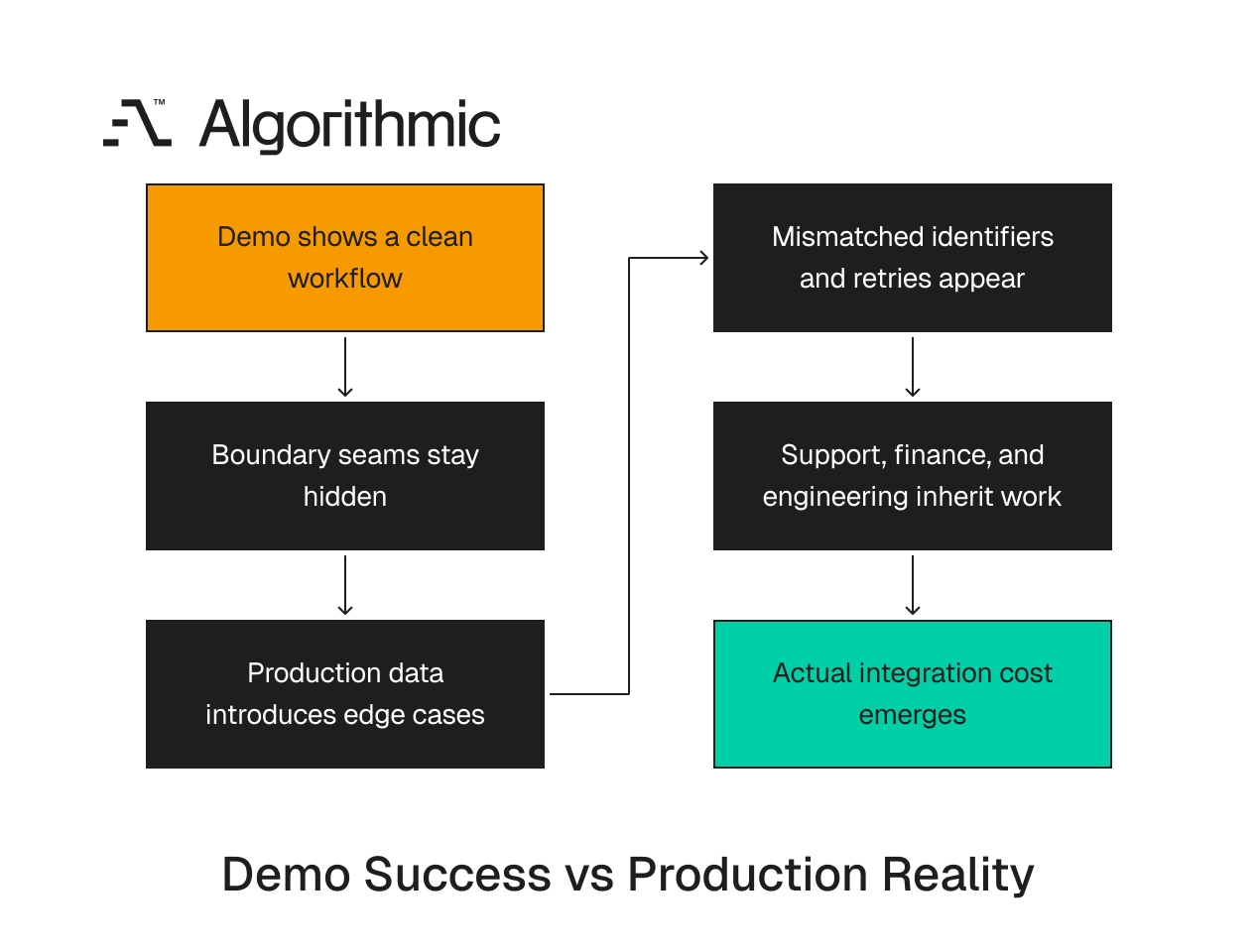
The demo shows a clean path. A user clicks a button, a record appears in the target system, a dashboard refreshes, and the sales engineer moves to the next feature. The meeting ends with confidence that the integration exists, but production work starts after that moment. Engineering teams then find mismatched identifiers, partial writes, retry storms, missing billing hooks, unclear ownership, and ambiguous sync rules that lived in a spreadsheet, a support queue, or one employee’s memory.
The statement of work appears scoped, and the first walkthrough gives the executive team confidence. The project then spends three to six months on integration plumbing that procurement never priced, covering schema mapping, test environments, replay tooling, support runbooks, and data repair. None of that fits inside a polished demo flow, which is why a strong software development partner prices the system that will run in production rather than the path shown in a sales call.
Enterprise buyers and CTOs need a stricter standard. A vendor claiming integration support must show connector maps, preserved semantics, latency numbers, failure handling, and ownership boundaries before signature. Treat every integration claim as an operating commitment, because a connector creates recurring engineering work after launch, and that work belongs in commercial terms, acceptance tests, and support runbooks.
The demo hides operational seams by design
A vendor demo is a controlled sales environment. The data is clean, the workflow is rehearsed, and the API keys are configured before the meeting starts. Edge cases sit outside the script, and the vendor controls the record set, the network path, and the success criteria.
 Click to expand
This does not make the demo deceptive. It makes the demo incomplete as evidence for production readiness, because a demo proves only that a vendor can show a workflow under known conditions. Production proof requires load behavior, failure behavior, recovery behavior, and data integrity evidence, so the vendor must show the workflow under realistic volume, including bursts and retry queues, and recovery after a third-party timeout.
The failure mode is predictable. Buyers accept phrases such as “we integrate with Salesforce”, “we support SAP”, or “we have an API connector”, and those phrases leave the engineering scope undefined. They do not define directionality, completeness, latency, retry rules, data ownership, security model, or support responsibility, and they do not define who answers the ticket when two systems disagree. That gap becomes cost during implementation.
A vendor can show a green checkmark with one account record and a preloaded credential set, while production teams inherit duplicate contacts, stale permissions, deleted objects, expired tokens, and downstream reports with conflicting values. The difference appears in support queues within weeks of launch. Integrations look contained during sales, then expand when production data and operating failures enter the system.
The decision standard must move to boundary evidence. Buyers need to know what crosses the boundary, under which conditions, through which failure contract, and under whose ownership, and each answer belongs in the statement of work. This evidence also protects internal teams, since engineering can plan test coverage, support can prepare runbooks, and finance can price recurring reconciliation work. Without it, the buyer accepts an undefined operating burden.
A connector map is the first artifact to request
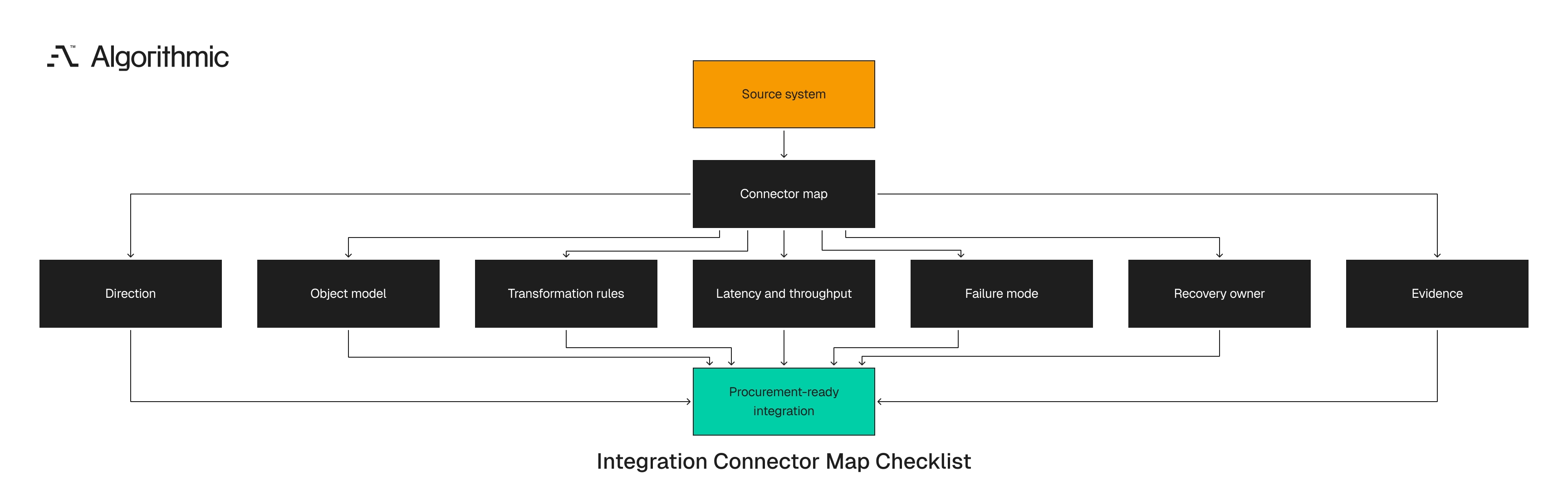
The most useful artifact in vendor evaluation is a connector map. It lists every system boundary involved in the proposed product, and it names data direction, object model, transformation rules, and operating owner. A verbal integration claim has little value, while a connector map forces specificity and converts a sales phrase into an engineering artifact.
 Click to expand
For design and engineering workflows, the map should list which tools push and pull scenes or artifacts. Revit, Siemens NX, Maya, Unreal Engine, and Omniverse USD pipelines each carry different assumptions about geometry, metadata, materials, hierarchy, units, references, and versioning. For enterprise SaaS, the same rule applies to Salesforce, NetSuite, Workday, Stripe, HubSpot, Snowflake, and internal services, because an API endpoint does not prove that the business object survives the round trip. The buyer needs evidence that meaning survives the transfer.
A customer record is a simple example. Salesforce can treat it as a sales account, NetSuite as a billable customer, the product database as a tenant, and support tooling as an organization, so the connector map must state which identifier controls each relationship. A missing identifier policy creates defects that automated tests miss, since one system can treat account_id as primary while another treats external_customer_id as primary, and a merge in Salesforce can then detach the product tenant from its billing customer.
That defect rarely surfaces during a demo. It shows up when customer success opens an account and sees the wrong contract status, and again when finance asks why an invoice belongs to a deleted tenant. The connector map also shows how work recurs after release, because each boundary needs version tracking, test fixtures, sample payloads, and escalation paths, and each owner needs authority to repair data when the integration creates a mismatch.
Minimum connector map format
| Field | Required detail | Example |
|---|---|---|
| Source system | Named system and version | Salesforce Sales Cloud API v59 |
| Target system | Named system and version | NetSuite SuiteTalk REST Web Services |
| Direction | Push, pull, or bidirectional | Bidirectional account sync |
| Object | Business entity crossing the boundary | Account, contact, invoice, entitlement |
| Transformation | Field mapping and semantic changes | Salesforce Account becomes NetSuite Customer |
| Latency | Measured transfer time | p95 under 4 seconds for single-record update |
| Throughput | Sustained volume | 10,000 records per hour |
| Failure mode | Timeout, duplicate, partial write, invalid schema | 429 rate limit from target API |
| Recovery owner | Vendor, client team, third party | Vendor owns retry queue and dead-letter review |
| Evidence | Test run, logs, transformed file, sample payload | JSON payload, trace ID, replay log |
A vendor that cannot complete this table has not defined the integration, and the buyer is being asked to fund discovery after signature when that discovery belongs before procurement approval. The connector map also exposes false equivalence. “We integrate with billing” can mean a nightly CSV export, or it can mean idempotent subscription creation, entitlement enforcement, invoice reconciliation, refund propagation, and tax service coordination.
Those are different engineering scopes. A nightly export often needs one scheduled job and a file transfer process, while full billing ownership needs event handling, ledger reconciliation, support visibility, and finance controls. The same distinction applies to design tools, where “we support USD” can mean opening a file in a viewer, or it can mean preserving hierarchy, materials, variants, references, units, and animation data across export and import. A buyer should treat each meaning as a separate scope item.
The connector map gives procurement and engineering a shared document, and it gives finance a basis for comparing two proposals that use the same integration label. A complete map also prevents late disagreement about ownership. If Workday owns employee status and Okta owns access, the connector must state how a termination event propagates, and if Salesforce owns account hierarchy, the map must state how NetSuite receives parent-child changes. This detail moves the vendor conversation from product claims to object behavior, state transitions, and repair paths, which reduces the chance that procurement buys a demo path and inherits production work.
Preserved semantics matter more than field movement
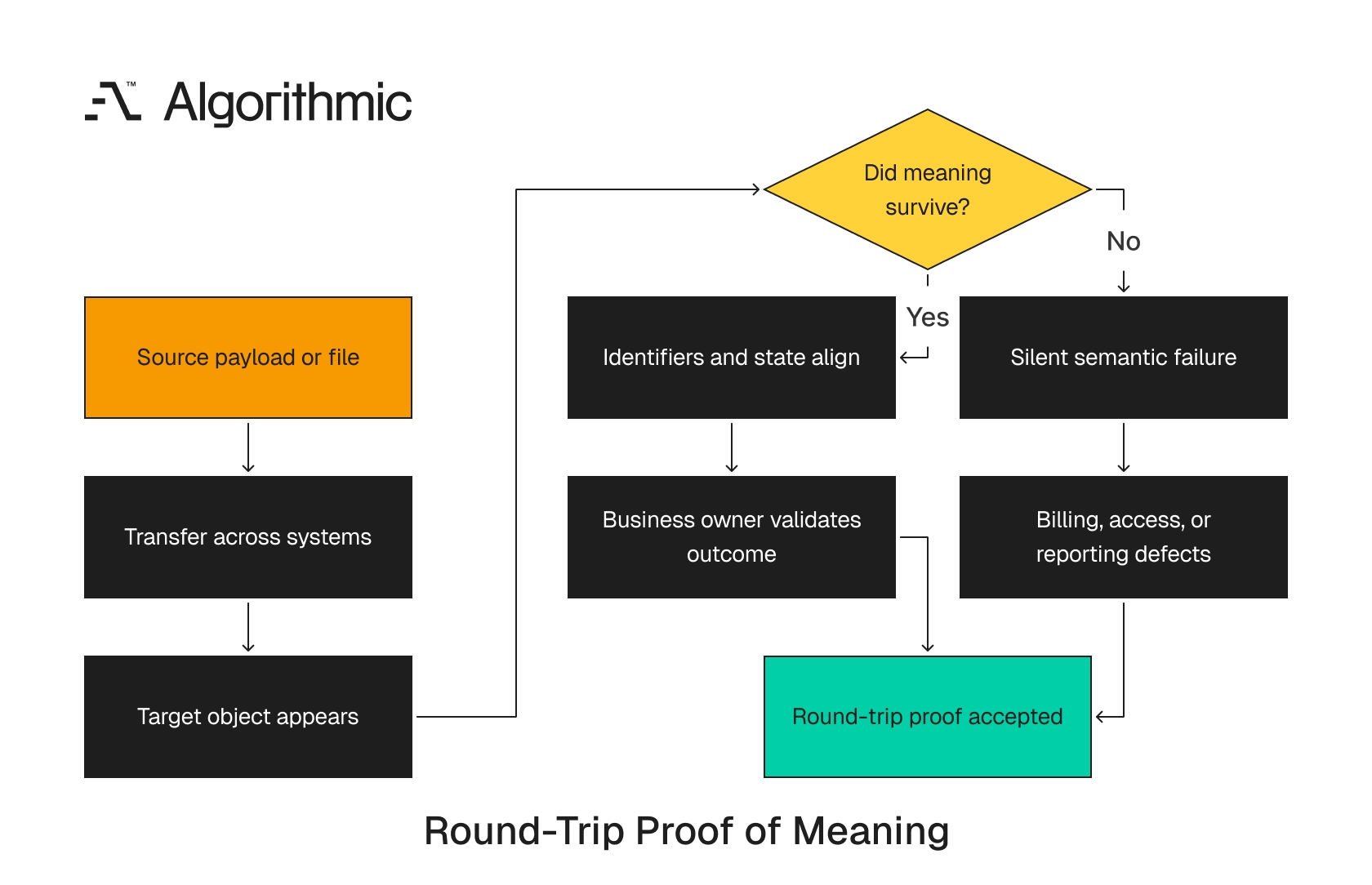
Moving data between systems is the visible layer, but preserving meaning is the production requirement, and a record that arrives with the wrong meaning creates silent failure. A field called “customer” can mean payer, buyer, legal entity, account owner, tenant, or end user. A “plan” can mean pricing package, entitlement bundle, contract term, feature flag set, or invoice line template, and a “completed order” can mean payment captured, goods shipped, service activated, or cancellation window expired.
When vendors show integrations through UI screens, semantic loss is easy to miss. The screen confirms that a record arrived, but it does not show whether the target system interpreted the record correctly. That distinction matters in production, because if a product treats “plan” as an entitlement bundle and billing treats “plan” as an invoice template, upgrades create defects where customers receive access before payment, or finance invoices a contract that product never activated.
Semantic errors are expensive because they pass basic monitoring. HTTP 200 responses look healthy, so the business process fails while the infrastructure reports success. A technical proof must inspect the business object after transfer, so the buyer should examine values, identifiers, timestamps, state transitions, and downstream records, and the review should include the person who owns the business process. The problem grows when systems use similar words with different meanings, since “active” can mean contract signed in Salesforce, subscription paid in Stripe, feature enabled in LaunchDarkly, or account provisioned in the product. A single status label can conceal four separate business states.
Round-trip proof is the standard
Buyers should request a round-trip test. The vendor must show data moving from System A to System B, then show the same business meaning in System A or a downstream reporting layer. For a USD design workflow, this means showing the transformed file after import and export, and the review should include hierarchy, materials, metadata, units, object references, and version history, since screenshots alone do not meet the evidence standard. For a SaaS workflow, the test should follow one subscription through the connected systems until it becomes a billing record, an entitlement, an invoice, and an analytics event, with each object carrying consistent identifiers.
A proper round trip includes four artifacts:
- The source payload or file before transfer.
- The transformed payload or file after transfer.
- The logs and trace IDs for the transaction.
- The validation rules proving semantic preservation.
 Click to expand
This level of proof separates marketing support from production-grade interoperability, and it gives legal and procurement teams a precise reference when integration scope becomes disputed. The buyer should store these artifacts with the statement of work, because a trace ID, payload, and validation rule provide stronger evidence than a slide, and they become seed material for acceptance tests.
A strong proof session uses production-shaped data. A single idealized account, order, or USD file will miss the conflict patterns that matter, so the sample should include null values, renamed objects, historical records, and boundary cases. For SaaS, use an account with multiple contacts, one unpaid invoice, one active entitlement, and one pending plan change, and for design pipelines, use a scene with nested assemblies, external references, and unit conversions. The test should force the integration to preserve meaning under ordinary production complexity.
The round trip should include a manual review by a business owner. Finance should validate invoice state, product should validate entitlement state, and support should validate customer visibility, because a technically successful transfer still fails if the business owner cannot use the resulting record. The buyer should also review the negative case, where a missing field, invalid state, or deleted object should produce a defined result. Silent drops and unclassified errors become expensive incidents after launch.
Latency and throughput belong in the statement of work
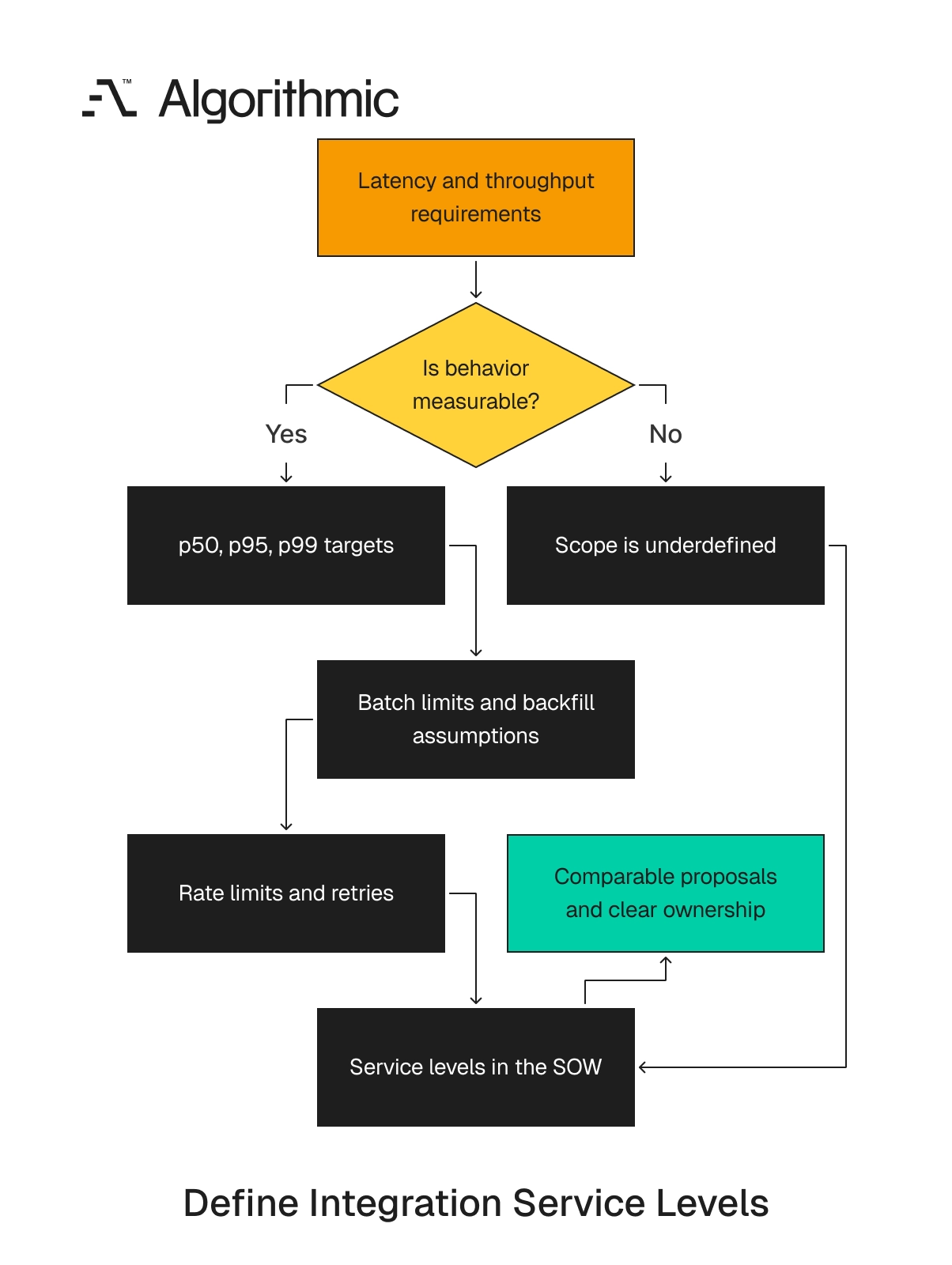
Latency and throughput are often absent from vendor proposals, and their absence creates avoidable disputes. A demo that moves one record during a sales call says little about sustained production behavior. A system that synchronizes records every 24 hours can support finance reporting, while real-time inventory allocation needs a different design, and fraud screening, operating alerts, and entitlement checks during login also need tighter service levels.
A vendor demo rarely makes this distinction visible. The sales environment processes a small sample dataset, while the production system faces burst traffic, rate limits, backfills, retry queues, and scheduled jobs competing for the same APIs. That operating cost is real. Fivetran’s 2026 enterprise data infrastructure benchmark reported that pipeline failures cost enterprises around $3 million per month, and the same study found that enterprises spend an average of $29.3 million per year on data programs, with $2.2 million going to keeping pipelines running. That cost exists because data movement requires monitoring, repair, schema management, and service ownership.
The same cost pattern appears in application integrations. A point-to-point connector starts as a feature request, then becomes an operating system for data movement once customers rely on it daily. Latency changes product behavior, since a five-minute entitlement delay can block login after a paid upgrade, and a two-hour inventory delay can oversell stock during a promotion. Throughput changes operating cost, because a nightly job that handles 5,000 records in test can fail on a 700,000-record backfill, and the buyer then pays for emergency batching, rate-limit workarounds, and manual reconciliation. The numbers must match the business process, because a board dashboard can tolerate a longer refresh interval than a checkout authorization.
Write service levels for integration behavior
Integration requirements need measurable thresholds. The following language belongs in a statement of work:
- Single-record synchronization must complete within 5 seconds at p95.
- Batch imports must process 100,000 records within 2 hours.
- The system must tolerate 30 minutes of third-party API downtime without data loss.
- Duplicate webhook events must not create duplicate invoices, orders, or entitlements.
- Failed records must enter a dead-letter queue with reason codes and replay controls.
- Retry logic must use exponential backoff and respect vendor rate limits.
- Backfill jobs must run without blocking customer-facing write paths.
- Schema changes must trigger alerts before production payloads fail.
 Click to expand
These requirements change the buying conversation, since the vendor must price the actual system rather than the demo path, and the buyer receives a basis for comparing technical scope across proposals. Two proposals that both claim “Stripe integration” are not equivalent. One can include idempotent billing hooks, refund propagation, and entitlement reconciliation, while the other can include checkout session creation only, and those scopes carry different delivery timelines, support burdens, and finance risks. A disciplined statement of work makes that difference visible before signature.
The thresholds also protect the engineering team after launch. When a webhook backlog reaches the agreed limit, the support path is clear, and when a vendor API changes schema, the alert and escalation path already exists. Service levels should include measurement rules, because a p95 target needs a source of truth, a time window, and an excluded-event policy, and without them each party can interpret the same production trace differently. The contract should also define backfill conditions, since a migration, customer import, or historical correction can create traffic that dwarfs daily volume, and the vendor should price that operating path before the first large data repair.
Failure handling defines integration ownership
Every production integration fails. Networks time out, APIs return 429 and 500 responses, webhooks arrive out of order, credentials expire, vendors change schemas, and users edit records in both systems. The buyer’s risk is unmanaged recovery, because a failed event is a normal operating condition, and an undefined owner turns that condition into an incident.
A software development agency or SaaS vendor can claim responsibility for “integration implementation” while excluding operating recovery. The client’s internal team then inherits retry queues, data repair, support tickets, and reconciliation work, and that transfer rarely appears in the commercial comparison. This is where integration ownership becomes budget ownership, since the party that owns recovery owns engineering hours, support operations, customer credits, and executive escalation. Procurement needs to price that burden during vendor selection.
A production incident shows the difference. Stripe sends the same invoice-paid webhook twice during a network retry, and a naive product grants access twice while finance sees one invoice and support sees two entitlement events. Stripe’s own documentation states that a webhook endpoint can receive the same event more than once and that every handler must be idempotent, so a mature integration treats duplicate delivery as expected behavior. It uses idempotency keys, durable event storage, replay controls, and reconciliation reports, and the owner can explain the recovery path before launch. Failure handling also requires clear data authority, because if two systems update the same field, the contract must state which system wins, and if neither wins automatically, the contract must state who resolves the conflict.
The ownership boundary must cover five areas
- Retries - who designs retry logic, backoff rules, idempotency keys, and replay tooling?
- Billing hooks - who owns subscription creation, invoice events, coupons, refunds, failed payments, and tax service events?
- Data synchronization - who resolves conflicts, stale records, deleted objects, and duplicate entities?
- Monitoring - who builds alerts, dashboards, logs, and runbooks for integration failures?
- Support operations - who answers the support ticket when Salesforce and the product disagree?
These are production integration responsibilities that require engineering design, test coverage, observability, and an operations model, and they should not sit inside an undefined “integration” line item. The same principle applies to AI platforms, where the gap between a controlled demonstration and a production workflow includes state, permissions, retrieval, tool calls, monitoring, and escalation paths. Buyers should require the same evidence for conventional software, ML systems in production, and data pipeline engineering, because the technology changes while the ownership questions stay the same.
The owner must also control the repair toolchain. A team cannot own recovery if it cannot inspect payloads, replay events, or correct corrupted records, so contract language should grant the required access before go-live. Auditability belongs in the same discussion, because the team repairing data needs before-and-after records, operator identity, and timestamped changes, and finance and security teams will ask for that evidence after the first customer-impacting incident.
Pricing, billing, and entitlement integrations carry special risk
Billing integrations deserve separate scrutiny because errors create financial exposure. A delayed analytics sync creates reporting noise, while a delayed billing sync creates revenue leakage, customer disputes, and audit risk. A pricing partner or custom software development company must map pricing promises to enforceable entitlements, so every plan, add-on, coupon, metered usage rule, and contract exception must become a system rule, and finance and product teams should review those rules together.
The work crosses product, finance, legal, and engineering. A pricing page is a small artifact, but the integration surface is much larger, and it includes Stripe, Chargebee, Zuora, NetSuite, Salesforce CPQ, tax providers, feature flag systems, data warehouses, and customer support tooling. Each system owns a different part of the revenue lifecycle, and a failure in one system can distort the ledger or the customer experience. A metered billing example shows the risk, because product usage events must reach the billing system with correct timestamps, units, customer identifiers, and contract rules, and a failed replay can double-charge a customer or erase usage from an invoice.
Billing defects also create month-end pressure. Finance teams find missing invoices, incorrect credits, and mismatched customer states when the close calendar is already compressed, and engineering then repairs data under executive scrutiny. Entitlement defects create a different failure class, where a customer can lose access after payment or gain access after a failed renewal, and both outcomes create support cost and contract risk. Tax and revenue recognition add another layer, since Avalara, TaxJar, NetSuite, and revenue subledgers use different timing and jurisdiction rules, and a pricing change can trigger downstream work across every system that touches the invoice.
Three tests for billing integration readiness
A vendor is ready to own billing integration when it can answer three questions with architecture and past examples:
- Can pricing promises become enforceable entitlements? The vendor should show how product access changes when a contract starts, upgrades, downgrades, expires, or enters failed payment status.
- Can migrations run safely? The vendor should describe rollback plans, dual-write periods, audit tables, and reconciliation reports for moving customers from one billing model to another.
- Can experiments be measured without corrupting finance data? The vendor should separate experiment assignment, product usage, invoice generation, and revenue recognition.
A partner that can only discuss UI flows and checkout screens is unprepared for billing ownership, and the cost appears later through finance escalations, manual credits, and engineering repair work that surface during month-end close. The buyer should request one complete billing scenario during evaluation, covering checkout, plan upgrade, coupon application, failed payment, refund, entitlement downgrade, and revenue report, and the vendor should show each state change across product, billing, finance, and support systems. The same proof should include a reconciliation report that compares product entitlements, billing subscriptions, invoices, and customer support state, where any mismatch needs a named owner and a repair path.
The scenario should include one contract exception, because enterprise customers often receive custom terms, usage caps, manual credits, or invoice timing exceptions, and a billing integration that handles only catalog pricing will fail in the first enterprise rollout. The proof should also include one migration path, so if the buyer is moving from Chargebee to Stripe Billing, the vendor must show how historical invoices, current subscriptions, payment methods, and tax records move, and the migration plan should name rollback points and frozen periods.
The evaluation process needs proof before procurement
Enterprise procurement often compares price, team size, timeline, and references, and those categories miss the integration risk that drives late-stage overruns, so a lower implementation price can transfer operating cost to the buyer. A stronger vendor evaluation adds a technical proof phase before the final statement of work. This phase should last 5 to 10 business days and produce concrete artifacts, not slide content. The questions must become evidence requests, so the buyer should ask for payloads, logs, and ownership models rather than broad qualification answers.
The proof phase does not need to build the full integration. It should test the highest-risk boundary, because one realistic object, one round trip, and one failure case will expose most unpriced work. This phase also reduces negotiation ambiguity, since a vendor that sees the real object model can price the work with fewer assumptions, and a buyer can compare proposals on engineering scope instead of presentation quality. The output should be stored with procurement records, so future change requests can reference the original payloads, logs, test results, and ownership model, and that record protects delivery teams after the sales team leaves. A disciplined proof phase also exposes internal gaps, since the buyer may discover that no team owns a key identifier, schema version, or source-of-truth decision, and that finding is useful before the contract locks the delivery plan.
Integration proof checklist
Use this checklist before selecting a software development partner:
- Request a connector map for every external system.
- Require one round-trip demonstration using realistic data.
- Ask for transformed payloads, files, logs, and trace IDs.
- Define p50, p95, and p99 latency expectations.
- Define batch throughput targets and backfill assumptions.
- Identify API rate limits and quota constraints.
- Require idempotency design for write operations.
- Require retry rules and dead-letter queue behavior.
- Define ownership for billing hooks, refunds, coupons, and entitlements.
- Define monitoring, alerting, and incident response runbooks.
- Require data reconciliation reports for critical objects.
- Document schema change handling and vendor API version policy.
- Name the owner for support tickets caused by integration mismatches.
- Add acceptance tests to the statement of work.
- Require a test environment plan for each external dependency.
- Require a data retention rule for payload logs and replay records.
- Confirm security controls for credentials, secrets, and scoped tokens.
This checklist changes the commercial model, since vendors with senior engineers for product build work can price the integration properly, while vendors relying on vague API claims will resist the artifact request. That resistance is useful information, because a vendor unwilling to show logs during evaluation will struggle to own incidents after launch, and a vendor unable to name rate limits has not designed the operating path. The proof session also improves internal alignment, since product sees the user flow, engineering sees the boundary conditions, and finance sees the billing and reporting exposure before the contract is locked.
The best evaluation teams assign owners before the proof session starts. Product owns the scenario, engineering owns the technical review, finance owns billing and reporting questions, support owns escalation and recovery questions, and procurement records the artifacts and converts them into contract language. The proof phase should end with a written decision record that lists accepted risks, rejected assumptions, open questions, and contract changes, because a two-page record can prevent months of later dispute. The team should also tag every artifact to an acceptance test, since a payload without a test becomes reference material only, while a payload tied to acceptance criteria becomes contract evidence.
A scoped demo script should test the seams
The buyer should not watch the vendor’s default demo. The buyer should provide a demo script based on the systems, data, and failure modes that matter, so the script reflects the buyer’s production environment. For a marketplace platform, the script should include seller onboarding, payment capture, refund handling, tax calculation, inventory update, payout reconciliation, and support escalation, and each step should name the source system, the target system, and the expected final state. For a SaaS product, the script should include provisioning, plan change, failed payment, entitlement downgrade, data warehouse event, and customer success visibility, and the vendor should show how identifiers connect these events across the trace path.
The script should contain at least one failure event, such as a duplicate webhook, a target API timeout, a missing required field, or a rate-limit response, because a clean path without a failure event does not test production ownership. A vendor that has built production-ready systems will show how the system behaves under those conditions, with logs, queues, dashboards, and recovery steps, and will name the person or team that receives the alert. The strongest evaluation conversations become concrete quickly, moving from “we support NetSuite” to the SuiteTalk payload, idempotency key, retry state, reconciliation report, and alert owner, so the buyer can judge the operating model instead of the sales script.
A scoped demo also reveals team depth, because senior engineers can explain queue behavior, rate limits, and replay semantics without leaving the room, while a vendor team that depends on one unavailable specialist creates delivery risk. The script should use the buyer’s terminology, so if the buyer treats “organization”, “tenant”, and “payer” as separate objects, the demo should preserve those distinctions, and if the vendor collapses them into one account record, the scope gap is visible. The buyer should also require the vendor to run one step twice, since duplicate execution exposes idempotency design, and many production billing and fulfillment defects begin with a repeated event that the system treats as new.
The script should include one stale-data condition, where a record updated in Salesforce and NetSuite during the same hour should produce a defined conflict result, and the vendor should show the rule, the log entry, and the repair path. The buyer should also ask the vendor to explain test environment constraints, because sandboxes often differ from production APIs, rate limits, and data shapes, and those differences can conceal defects until launch week.
Contract language must assign integration ownership
Technical diligence has limited value if the contract remains vague. Integration ownership should appear in the statement of work, acceptance criteria, support model, and change control process, and the same language should appear in procurement documents and engineering plans. The contract should state which connectors are included, which objects are covered, and which latency and throughput targets apply, and it should also state which failure modes are part of the agreed scope, with excluded systems and objects named. A clear exclusion beats an implied promise, since if the vendor owns Stripe checkout and excludes downstream revenue recognition in NetSuite, the buyer can plan for the gap, and if the scope says “billing integration” without detail, the gap will surface during implementation.
Acceptance criteria should use testable statements:
- A refund initiated in Stripe must appear in the product ledger and customer support view within 60 seconds.
- A duplicate order event must not create a second fulfillment record.
- A Salesforce account merge must preserve the product tenant association.
- A failed entitlement update must trigger an alert within 5 minutes.
- A replayed webhook must produce the same final state as the original event.
- A NetSuite customer update must appear in the product account record within the agreed p95 latency.
- A deleted object must produce a documented tombstone event or a documented exclusion.
These statements reduce ambiguity and protect both parties, since the buyer knows what is included, the vendor can price the work without absorbing undefined production duties, the engineering team can turn acceptance criteria into tests, and the support team can turn ownership language into runbooks. Change control should follow the same discipline, so a new external system, new object, new latency target, or new failure mode should trigger a scope review, because without that rule integration work expands through support requests and executive escalations.
The support model needs the same precision. A contract should name response times for integration incidents, evidence required from each party, and the escalation path across vendors, and it should also define who repairs corrupted data. Security language belongs in the integration scope, since tokens, credentials, scoped permissions, audit logs, and secret rotation affect production ownership, and a connector that requires broad administrative access creates a different risk profile than one using scoped service accounts. Contract language should also define data retention for logs and replay records, because thirty days of payload logs may support ordinary support work while financial systems often need longer retention for audit and month-end reconciliation. The agreement should name the system of record for each critical object, since account, tenant, payer, subscription, entitlement, invoice, and refund need explicit ownership, and ambiguous authority creates conflict when two systems report different states.
What engineering leaders should do before signing
Vendor demos are useful for learning the product surface, but they are inadequate as proof of integration ownership, so treat them as an introduction and then require production evidence. Before signing a statement of work, require a connector map, one realistic round trip, latency and throughput numbers, failure handling design, and named ownership. The ownership model should cover retries, billing hooks, data synchronization, monitoring, and support operations, and those artifacts should go into the contract as acceptance criteria. The same discipline shows up when you evaluate a software development partner on the delivery records that prove production habits rather than the polish of a sales deck.
For the next vendor evaluation, replace the standard demo agenda with an integration proof session. Give the vendor realistic data, include one failure case, and require logs, transformed payloads, recovery behavior, and named alert ownership. Ask the vendor to show the exact record path across systems, and confirm that the sales claim matches the engineering design. Select the partner that can show the operating seams before the project starts, because that partner will price the work more accurately and the buyer will enter delivery with fewer unknowns and stronger control over integration ownership. Do not sign on the demo, but sign on the connector map, the round-trip proof, the failure path, and the owner named in the contract.
Algorithmic runs data infrastructure and integration work that turns vendor promises into connector maps, round-trip proof, and named ownership before a contract is signed. Start a conversation if you are evaluating a vendor and want the integration seams priced before you commit.