
Fairway Finder
 Click to expand
 - Client
- Fairway Finder
- Industry
- Consumer / Sports Tech
- Location
- United States
- Year
- 2026
- Stack
- Ruby on Rails, PostgreSQL, Redis, Flutter, Digital Ocean, Twilio, Customer.io
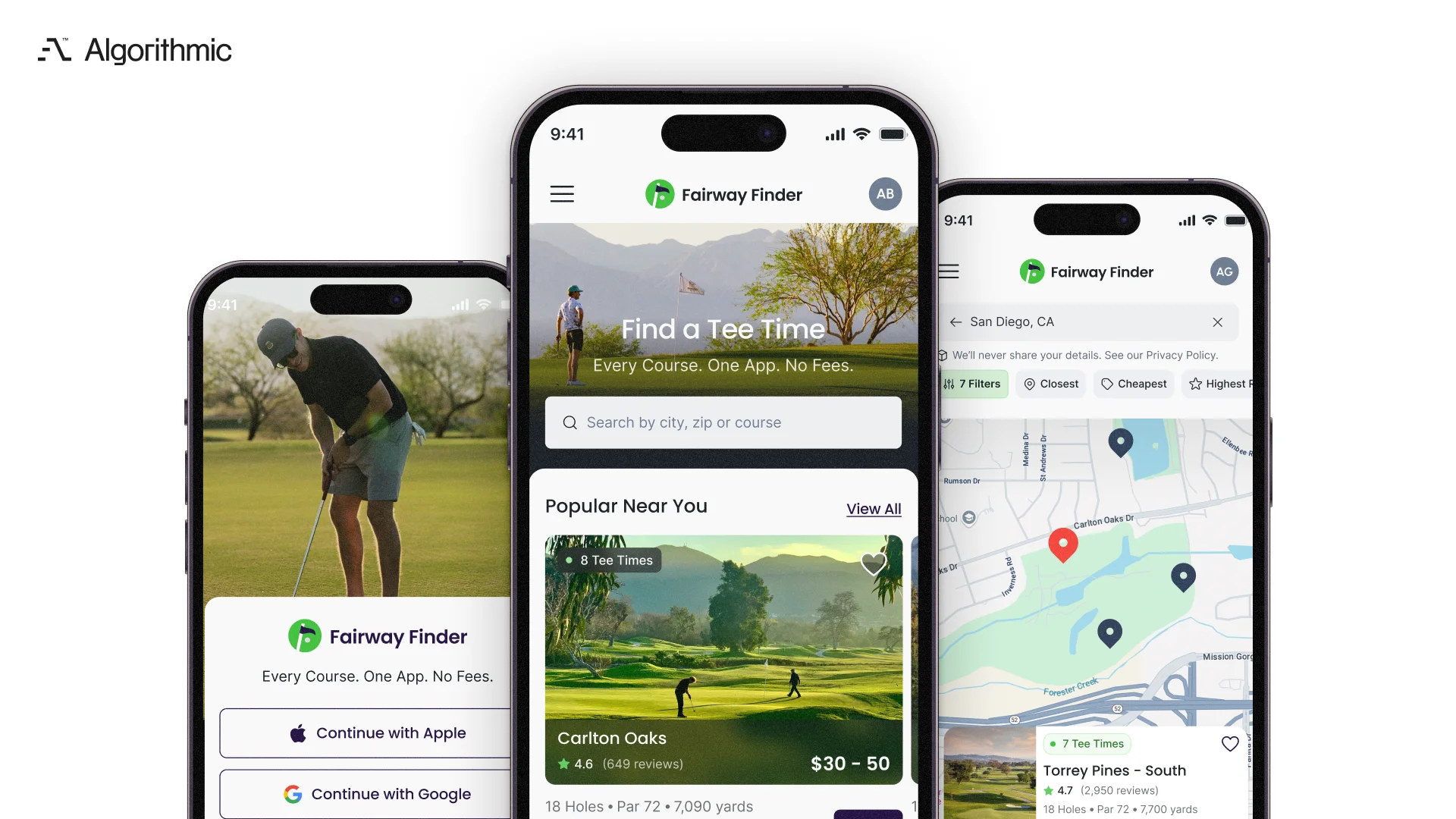
Fairway Finder came to Algorithmic with a validated prototype and a national ambition. We owned the full product build, strategy, design, architecture, engineering, and deployment, shipping a cross-platform app, a responsive web experience, a real-time availability backend, and the operational tooling to run it in a single engagement.
Click to expand The problem
Ryan, founder of Abyssal Digital, had proven demand with Tee Time Alerts, a prototype that pinged golfers when cancellations opened at their saved courses. Golfers kept coming back because it solved a weekly problem, find an open slot and grab it before someone else does.
The prototype proved demand. It did not provide the design system, data architecture, or operational layer needed for national coverage across dozens of fragmented booking sources. Algorithmic was brought in to own the full zero-to-one build:
- Product strategy
- UX and visual design
- System architecture
- Flutter app development
- Rails backend engineering
- Admin tooling and release management
 Click to expand
 The approach
Golf booking in the United States runs on a patchwork of course websites, third-party platforms, and proprietary systems. Every source structures availability differently, dates, prices, time slots, booking rules, and course metadata all vary. A consumer product cannot expose that complexity, since golfers expect one search, one alert system, and one booking path.
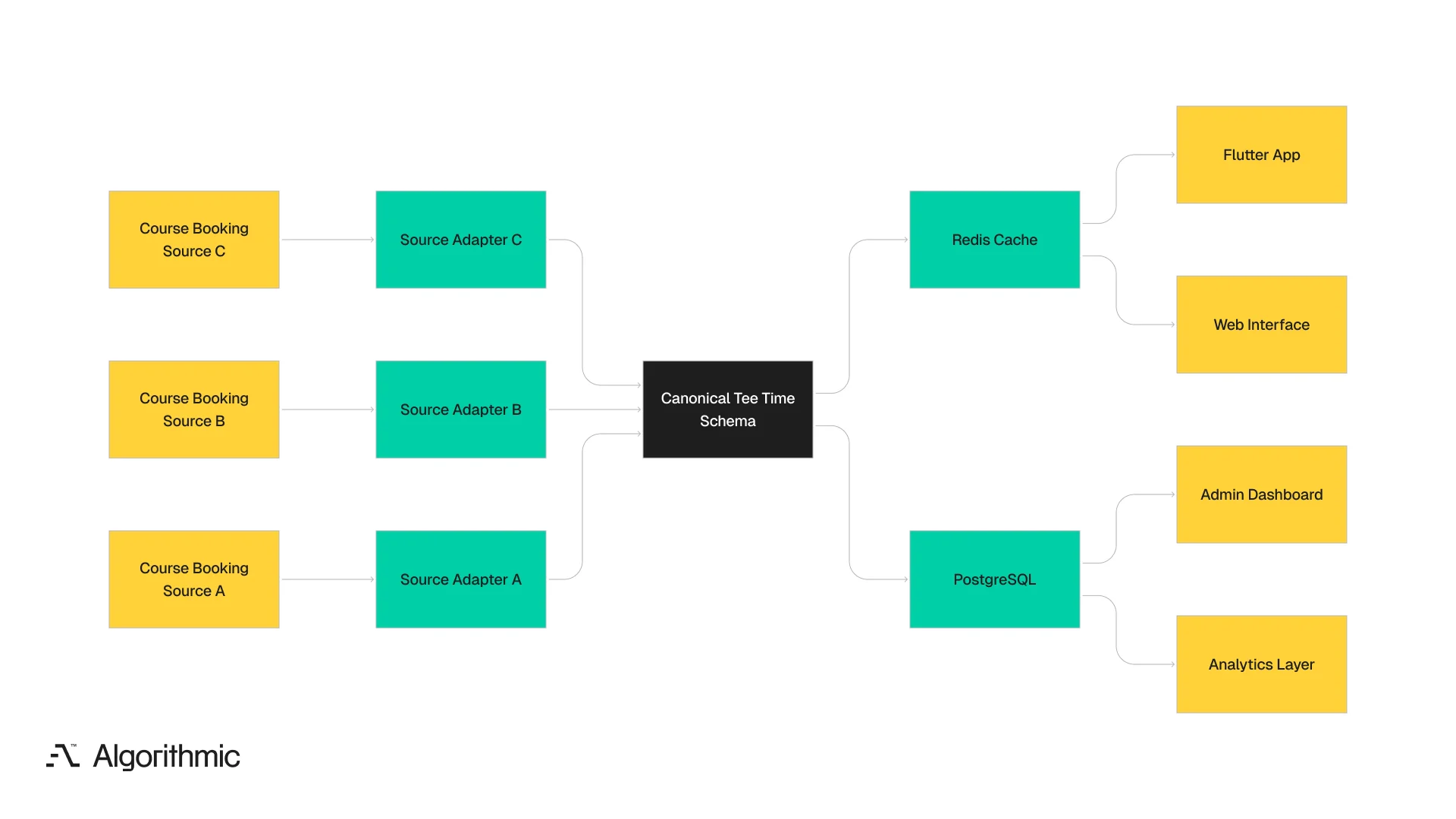
Three requirements shaped the architecture. Every source had to normalize into one canonical schema, course, date, time, price, player count, status, and booking metadata, before it reached the app. Availability had to stay fresh under load, so Redis serves high-frequency reads while background poll cycles refresh entries on source-specific intervals. And onboarding cost had to stay flat, because adding the 200th course cannot cost what the 20th did.
An adapter pattern isolates source-specific behavior. Each booking source connects through its own adapter, maps into the Fairway Finder schema, and feeds a single internal contract, so search, alerts, booking, and sync all run against one data model no matter how many sources sit behind it. That separation keeps product logic clean, stops a single failing source from breaking the platform, and lets courses on shared booking systems onboard through configuration instead of custom code. The low-level acquisition mechanics stay private, and the public architecture explains the system without exposing sensitive detail.
 Click to expand
 The build
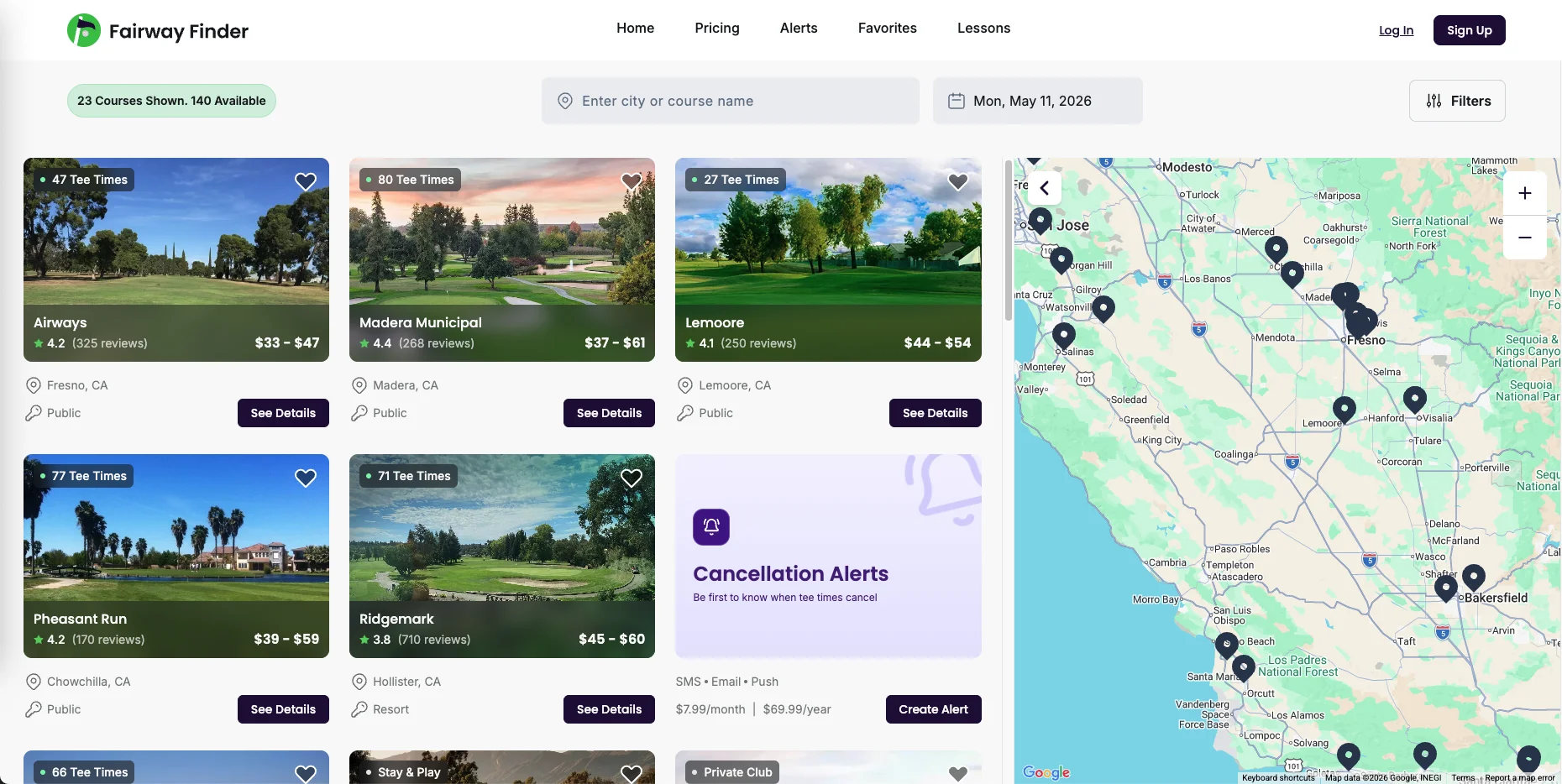
Every screen was built to get a golfer from search to booking in three taps, reducing friction at the moments where bookings are won or lost. Golfers search map and list views filtered by location, date, time window, price, and availability, so someone after a Saturday 7 to 9 AM slot filters once and compares live options across nearby courses without opening each course page.
The strongest retention driver is the cancellation alert. Golfers save course and time preferences, the system checks availability on a recurring cycle, and when a slot opens from a last-minute cancellation it sends a push notification within minutes. For popular courses where weekend mornings fill weeks ahead, that alert is often the only way to land a tee time.
Behind the product, an admin dashboard gives Ryan direct control over course onboarding, source-health monitoring, market launches, and engagement analytics, so growth decisions stay data informed. The stack served three constraints, fast iteration, simple operations for a small team, and a clear path to national scale:
- Flutter, one codebase for iOS and Android, keeping releases synchronized.
- Ruby on Rails for business logic, APIs, admin workflows, and the web experience.
- PostgreSQL for relational data, Redis for high-frequency availability queries.
- Digital Ocean hosts the system, while Twilio and Customer.io handle communications.
Outcomes
Fairway Finder is live as a multi-market discovery and booking platform, a Flutter app, a responsive web experience, a real-time availability backend, and an admin dashboard for daily operations. Once an adapter exists for a booking platform, new courses on that system enter through the admin workflow with no new application code.
The strongest signal remains cancellation alerts. Golfers return because the product solves a time-sensitive problem they face every week, and the architecture keeps availability fresh enough to deliver on it.
Fairway Finder is now live in every US market, rated 4.8 stars, and used by over 50,000 golfers each month.