
MMA Betting Intelligence
 Click to expand
 - Client
- BetterWin
- Industry
- Sports Betting
- Location
- United States
- Year
- 2025
- Stack
- Python, Gradient Boosting, Deep Learning, AWS, PostgreSQL
Mixed martial arts is structurally hard to model. In team sports, roster depth dampens individual variance. In MMA a single fighter carries the entire outcome, and one undisclosed injury, opponent substitution, or weight-cut complication can invalidate weeks of preparation.
Most MMA models run on historical fight records - win-loss ratios, finishing rates, broad stylistic categories - data that is public and already priced into the market before a bettor acts. The edge lives in what the market has not yet absorbed: last-minute roster changes, training-camp intelligence, physical-condition signals, and context such as cage size, altitude, and travel fatigue.
We built a predictive betting platform for those constraints. It ingests multi-source data in real time, engineers features that capture fighter condition, stylistic matchups, and environmental context, and deploys machine learning models gated on profitability rather than accuracy alone. The result is a 10-20% lift in long-term ROI on managed betting portfolios.
The problem
Three characteristics of MMA guided every architecture decision. The first is sparse career data. A professional fighter competes two to four times a year, producing 20 to 40 career data points, a fraction of what an 82-game basketball season yields, so the models had to pull signal from limited fight-level data, which shaped our feature engineering and model choices.
The second is late-breaking disruption. Opponent substitutions, injury disclosures, and weight-cut failures often surface within 48 hours of an event, and a model trained on the announced matchup becomes unreliable when the opponent changes, so our ingestion detects and responds to these shifts faster than the market reprices.
The third is stylistic interaction. Outcomes depend on how two specific styles meet, since a striker against a grappler is a different contest than two strikers. Historical records capture the outcomes but miss the interactions that produced them, so our features model the matchup itself, two fighter profiles combining into probabilities that differ from what either predicts alone.
The approach
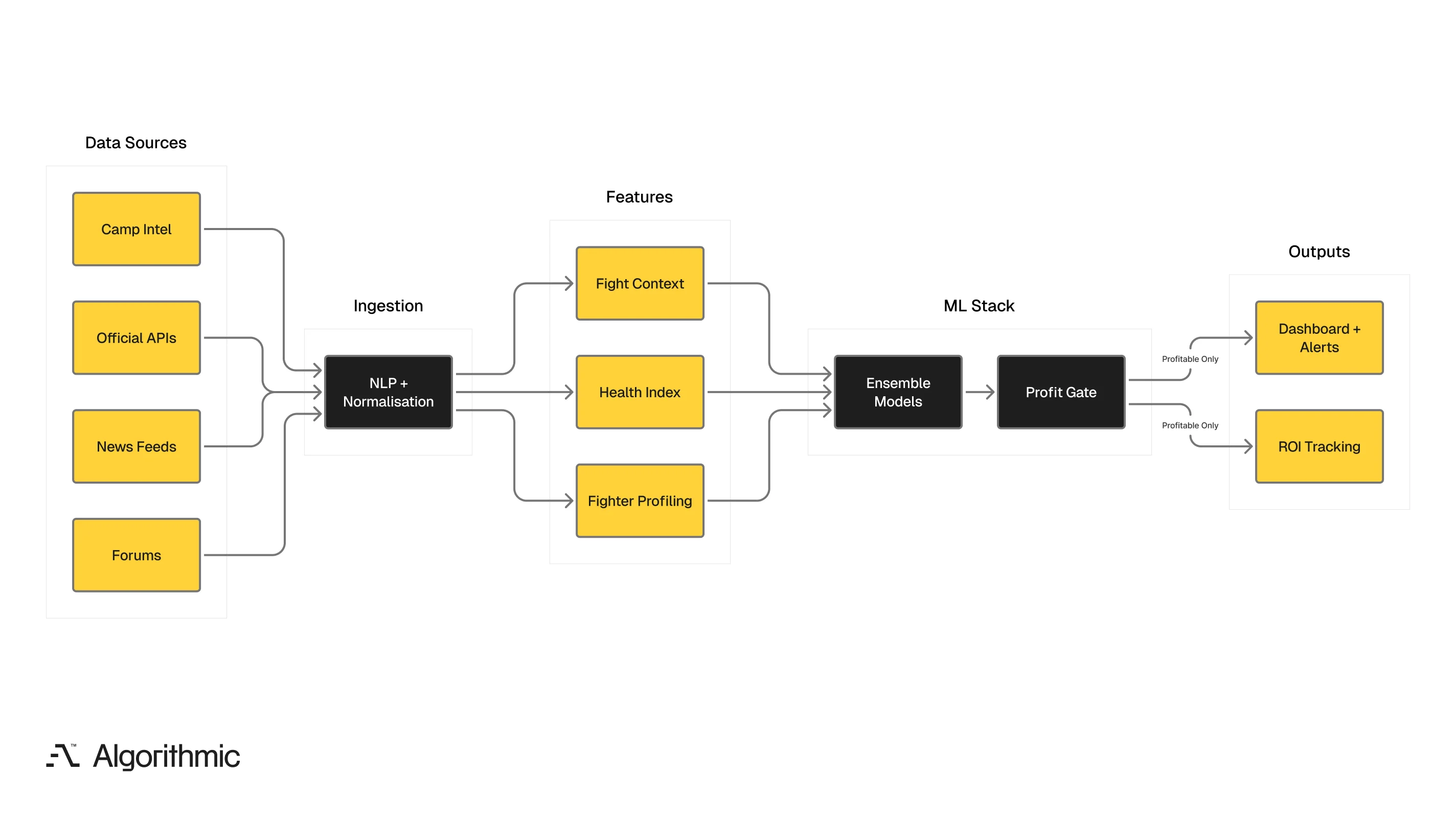
We pull from four source categories, each carrying signal that public fight statistics cannot. Official fight data APIs deliver the structured baseline of results, round-by-round scoring, significant strikes, takedowns, and control time, though that baseline is already reflected in market pricing. Sports news feeds report injuries, camp changes, coaching updates, and fighter statements, and our NLP pipelines turn unstructured reporting, a paragraph about a fighter’s knee rehab, into a quantified recovery indicator. Fan forums and fight breakdowns add community intelligence, sparring reports, informal injury mentions, and stylistic analysis, all validated and weighted against historical accuracy before it reaches the model. Insider camp updates surface weight-cut progress, sparring performance, and strategic adjustments with direct predictive value. All four feed a unified pipeline that normalizes, deduplicates, and validates the data before the feature layer touches it.
Raw data then becomes predictive signal across three feature domains. The first is fighter profiling, where each fighter is modeled well beyond win-loss records and updated as new fight data, training reports, and injuries arrive. Style-matchup analysis segments performance by opponent type rather than raw averages, signature-technique mapping shows how a fighter’s most frequent patterns meet the opponent’s defenses, and opponent-adjusted performance recalculates statistics for the quality of opposition, so a 70% takedown-defense rate against low-level grapplers reads differently than the same rate against elite wrestlers.
The second domain is condition and durability, assessed through three indicators that ranked among the strongest predictors in our feature-importance analysis. Damage accumulation tracks strikes absorbed, knockdowns, and submissions survived across recent bouts, weighting recent damage more heavily. Activity and rest are balanced against ring rust on one side and fatigue on the other. Injury recovery draws on reported injuries, medical suspensions, and the gap between a suspension expiring and a fighter returning.
The third domain is fight context, where environmental and logistical factors carry weight comparable to direct fighter statistics. Cage size and altitude both matter, since smaller cages favor pressure fighters and higher altitude wears on late-round cardio. We weight cross-continental travel by distance, direction, and time-zone differential, and we track the severity, direction, and recency of a fighter’s move between weight classes.
The build
The modeling stack has a defined hierarchy, and deployment is gated on profitability. Logistic regression sets the validation baseline, since any model that cannot beat it on held-out data does not justify its complexity. Gradient boosting and ensembles do the primary work, handling heterogeneous features, continuous statistics, categorical style labels, and temporal sequences, and producing calibrated probabilities through stacking across feature subsets. Deep learning networks sit on top to capture the nonlinear matchup interactions that tree-based methods miss.
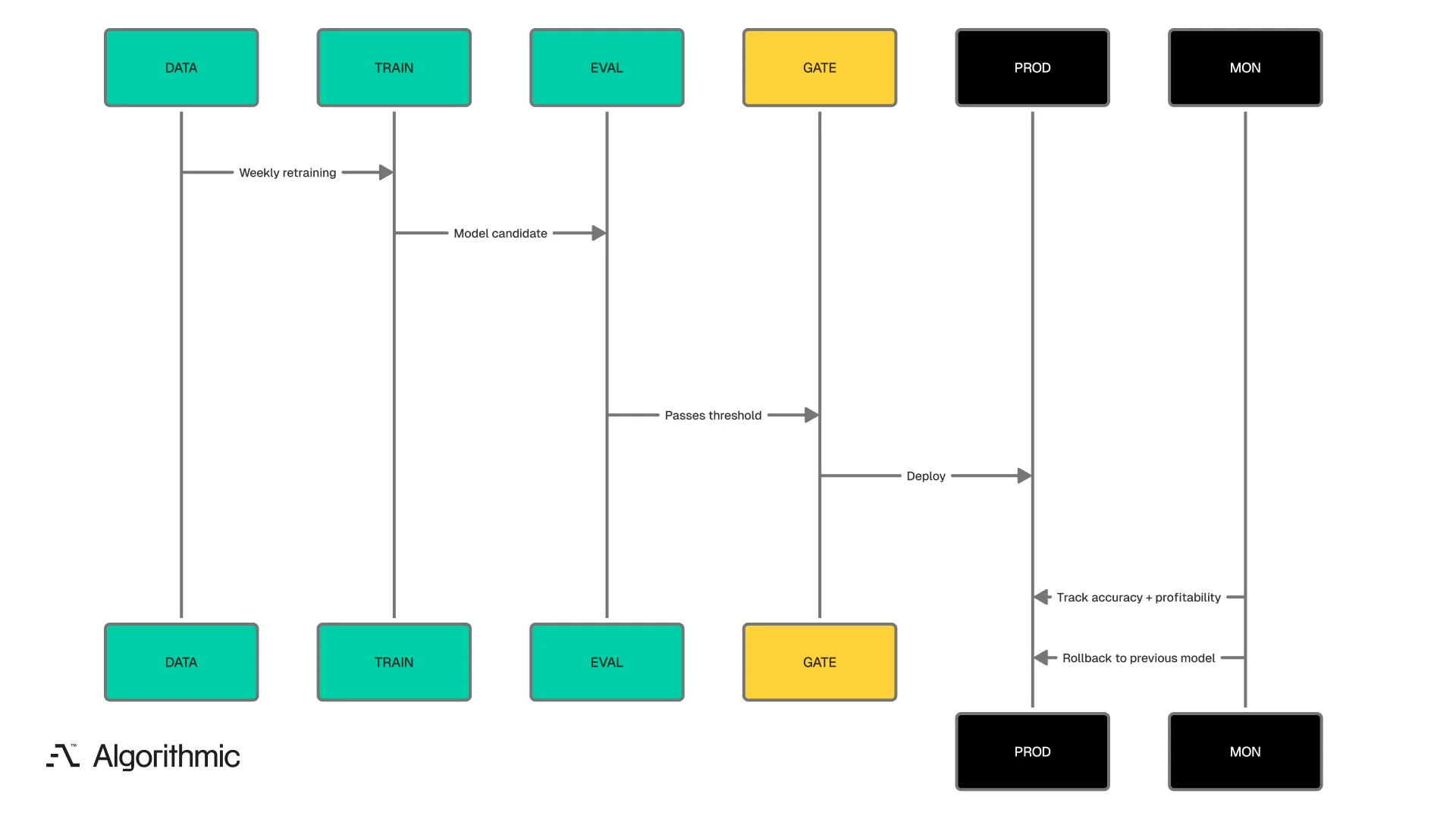
Models retrain weekly on fresh fight data, injury updates, and market movement. Candidates are backtested against historical lines and paper-traded against live odds, and each is judged on expected value against live market prices. A model with 62% accuracy but negative expected value does not deploy, only sustained profitability reaches production, and live degradation triggers automated rollback to the previous stable version.
 Click to expand
 The dashboard is built for professionals making many decisions per card. It ranks recommended bets by expected value with transparency into the features behind each one, tracks ROI segmented by bet type, weight class, event, and time horizon, filters performance down to a matchup category such as grappler-versus-striker at flyweight, and fires real-time alerts when updated predictions or market moves create expected-value opportunities.
The platform runs on AWS around MMA’s event-driven schedule: dynamic scaling during fight weeks, continuous monitoring of performance and calibration with drift detection, automated rollback on anomalous behavior, and full data lineage from raw source through feature engineering to final prediction for audit.
 Click to expand
 Outcomes
| Metric | Result |
|---|---|
| Long-term ROI lift | 10-20% on managed betting portfolios |
| Time-to-bet | From hours of manual research to automated alerts within minutes |
| Risk management | Bankroll allocation and loss flagging integrated into decision workflow |
| Market coverage | UFC, Bellator, and regional promotions |
| Model discipline | Profit-gated, only demonstrably profitable models reach production |
| Rollback ability | Automated reversion on performance anomaly detection |
The platform serves professional bettors managing personal portfolios, betting syndicates and quantitative funds operating at scale, and sports-data companies integrating predictive signals into their own products.
Combat-sports prediction sits at the intersection of sparse-data modeling, real-time information processing, and profit-driven deployment. The same pattern - multi-source real-time ingestion, contextual feature engineering, profit-gated deployment, and event-driven infrastructure - applies wherever predictions must generate financial value, from team sports to financial markets to demand forecasting.
This platform was built through Algorithmic’s predictive analytics and data infrastructure practices, combining domain-specific feature engineering with production-grade ingestion, training, and deployment pipelines.