NBA Betting Engine
 Click to expand
 - Client
- Maverick Sports Group
- Industry
- Sports Betting
- Location
- United States
- Year
- 2025
- Stack
- Python, XGBoost, Neural Networks, AWS, PostgreSQL, Docker
The NBA produces an enormous volume of structured data: play-by-play, shot-level tracking, sub-second player movement, real-time box scores, and public injury reports. That abundance is both the opportunity and the problem. There is enough signal to model outcomes with real precision, but the same data reaches every bettor, syndicate, and quantitative fund, so public and even advanced statistics are already priced in by the time most people act.
We built a platform that finds edge in the contextual features the market underweights: travel fatigue on back-to-back games with cross-country flights, lineup-chemistry shifts when rotation players absorb minutes from injured starters, and momentum captured through rolling efficiency metrics that move before win-loss records do. The system fuses more than 3,000 engineered features across moneyline, point-spread, and over/under markets, refreshes predictions in under a minute, keeps every output explainable, and delivers 8 to 15% measured ROI.
The problem
The NBA market is one of the sharpest in sports, and its characteristics shaped every architecture choice. Lineup changes and injury downgrades often surface between morning shootaround and tip-off, sometimes in the final hour, so a model using yesterday’s projected lineup is already stale. Ingestion has to detect, process, and re-score predictions in real time, with a target of source-to-prediction in under sixty seconds.
The margin for profitable prediction is narrow and it moves as participants trade on information. A model profitable last month degrades this month once the features it relies on are absorbed into market pricing, which makes continuous monitoring and retraining operational requirements rather than afterthoughts. Engineering more than 3,000 features from raw feeds, across player performance, team dynamics, context, and cross-feature interactions, is as much a data-engineering challenge as a modeling one, since the feature space has to be managed to prevent overfitting, keep models interpretable, and surface which features actually add predictive value.
 Click to expand
 The approach
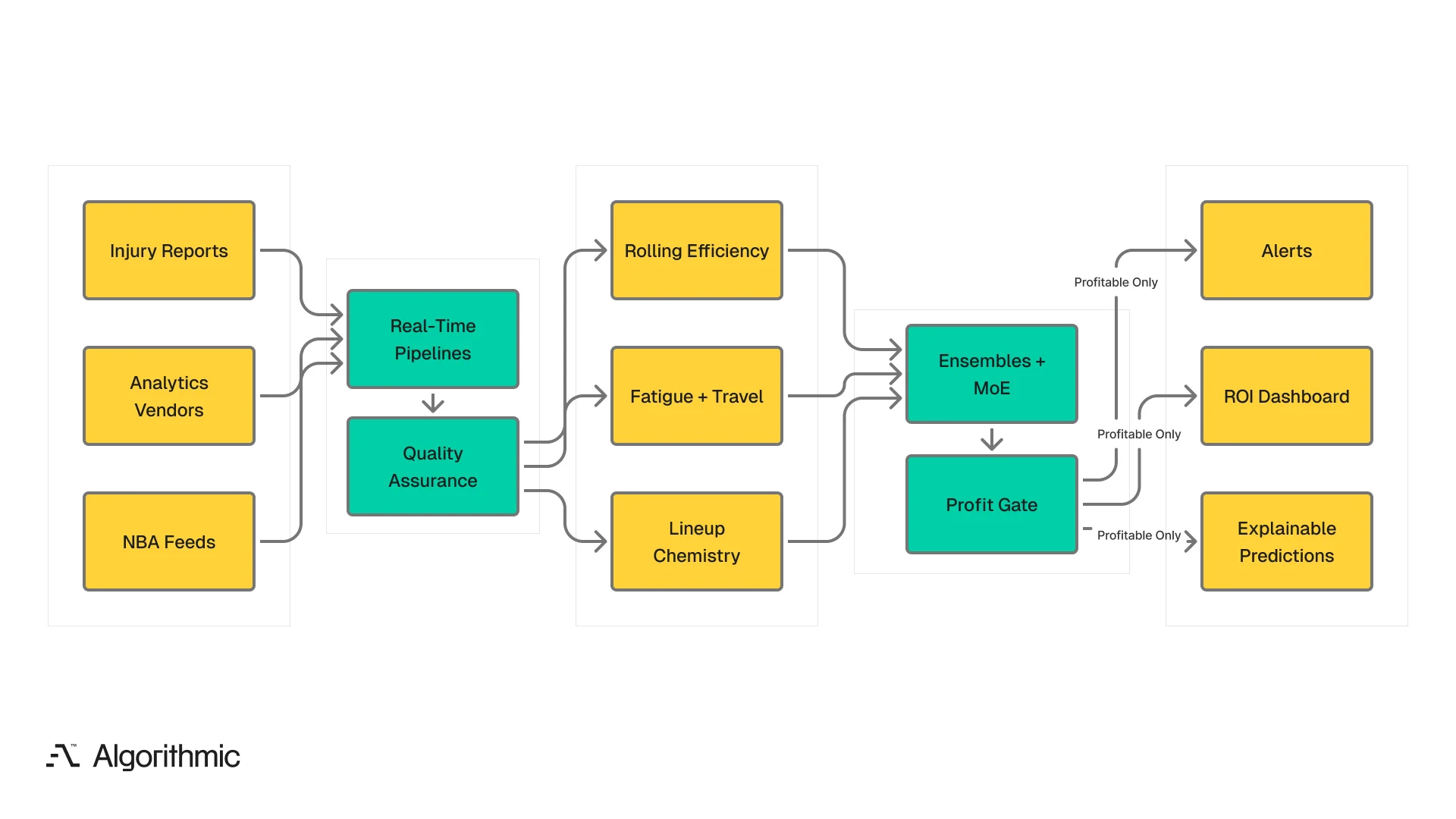
The data infrastructure rests on three priorities. Real-time ingestion pulls from official NBA feeds and low-latency premium vendors, so lineup changes, injury updates, and live game statistics enter the system within seconds of publication. Automated quality assurance sits between ingestion and feature engineering, validating incoming data against expected schemas and flagging anomalies such as a player listed at a position they have never played or a box score with impossible totals, a layer we added after finding that even premium feeds occasionally deliver malformed records that can cascade through 3,000+ features. Containerized compute runs ingestion, feature engineering, training, and inference as independent services that scale and roll back without affecting each other, so inference can scale during playoff rounds or trade-deadline week independently of training.
The 3,000+ feature set spans three categories, and the contextual ones are our primary differentiation from models running on public statistics. The first fuses individual player statistics with lineup-pairing data to model chemistry in real time. Shooting efficiency changes with who else is on the floor, so we compute two- and three-player combination statistics that update as rotations shift through the season, and a point guard paired with a stretch five produces different spacing, and different outcome probabilities, than the same guard with a traditional center.
The second is a player-level fatigue index that tracks the cumulative toll of the schedule. It weights consecutive-day games, compounds cross-country flights by distance and direction, scores compressed stretches such as three games in four nights across time zones, and separates a star logging 38 minutes from a rotation player logging 18 on the same trip. Working at the player level matters, because team averages hide the individual variation that drives outcomes.
The third tracks rolling efficiency on 5-, 10-, and 20-game windows to catch momentum before it reaches season-long aggregates. A team on a 7-game winning streak with declining offensive efficiency over its last 5 games carries a different risk profile than one with stable metrics and an identical record, and the models weight that divergence accordingly.
The build
The modeling stack combines three families. XGBoost, random forests, and ensemble stacks form the primary engine, handling the heterogeneous feature space of continuous, categorical, and temporal inputs and producing calibrated probabilities, with stacking across feature subsets and market types. A Mixture of Experts runs multiple specialists trained on different feature subsets or markets, with a gating mechanism that weights them by game context, so a travel-and-fatigue specialist gets more weight for a team on the third game of a west-coast trip and a lineup-chemistry specialist gets it when a rotation player returns from injury. Neural feature learners capture the nonlinear interactions between lineup composition, opponent matchup, and venue that have too many dimensions for explicit feature engineering.
Hyperparameter search runs across distributed GPU infrastructure and optimizes for expected value against market lines rather than accuracy in isolation, so a configuration that improves accuracy by 0.5% while reducing expected value is discarded.
Every candidate passes a profitability gate, backtested against historical lines and paper-traded against current ones, and only models with positive expected value across a meaningful sample deploy. In production, monitoring tracks ROI segmented by bet type, team, conference, and time horizon (including edge above the closing line), performance-alert thresholds calibrated on historical drawdown to separate variance from genuine decay with automatic exposure reduction, and explainable predictions that carry the top contributing features, historical precedent, and a confidence interval so professional bettors and funds can allocate with the rationale in hand.
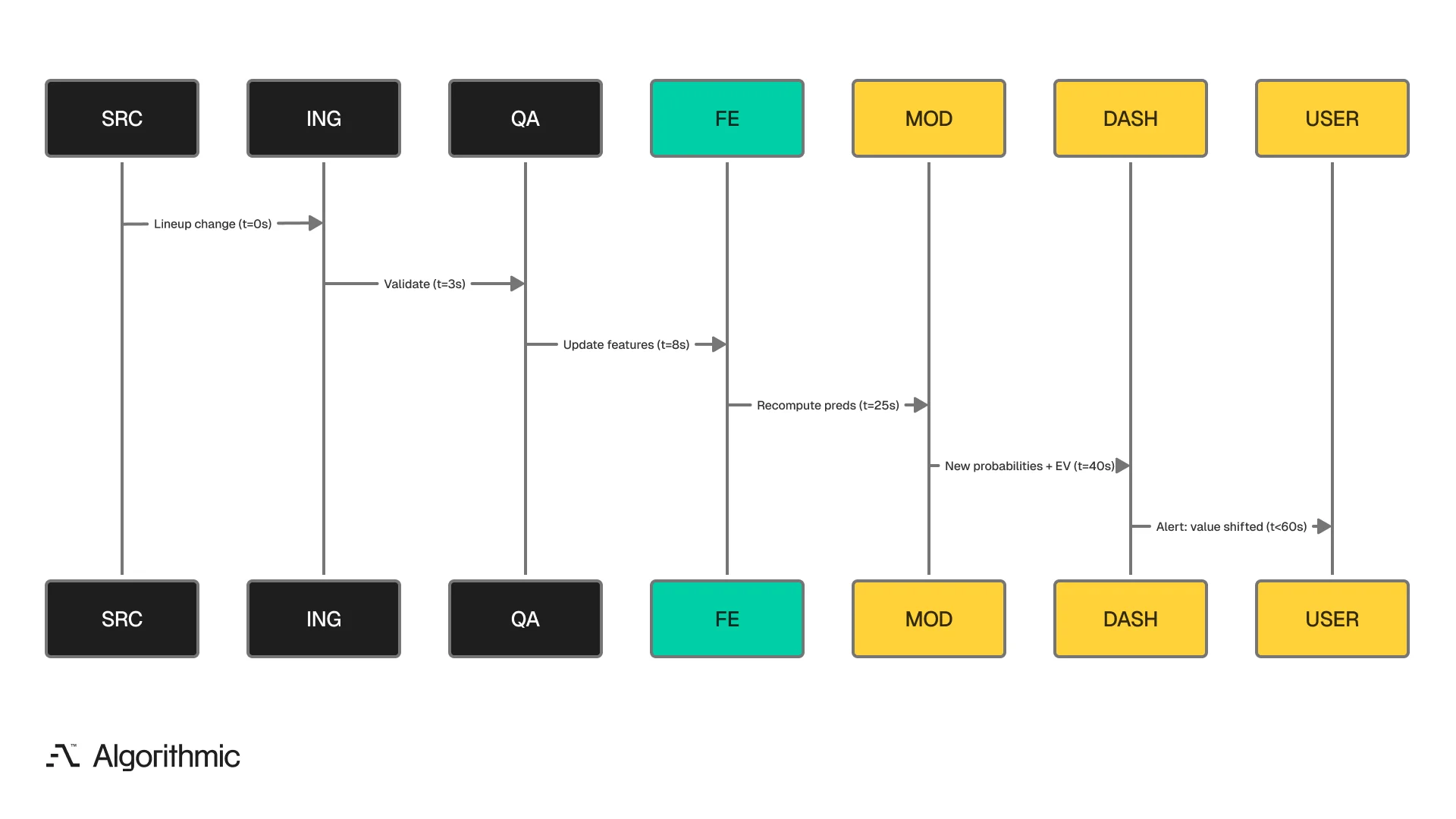
The full refresh cycle, from a data-source event to an updated prediction in the dashboard, completes in under sixty seconds. When a lineup change publishes, ingestion picks it up within seconds, QA validates it, the feature engine recomputes every affected feature, the production model re-scores the game, and updated probabilities and expected values push to the dashboard with an alert if the line value shifted meaningfully.
 Click to expand
 Outcomes
| Metric | Result |
|---|---|
| ROI | 8-15% across moneyline, spread, and over/under markets |
| Feature engineering | Over 3,000 contextual features from raw NBA feeds |
| Model refresh | Sub-minute, source event to updated prediction in under 60 seconds |
| Explainability | Feature attribution, confidence intervals, and historical precedent per prediction |
| Infrastructure | Cloud-native, containerized, independently scaling services |
| Monitoring | Real-time profitability tracking with automated exposure reduction on degradation |
| User base | Professional bettors and quantitative funds |
NBA prediction at this level is a systems-engineering problem. The data is available and the statistical methods are well understood, so the difference between interesting analysis and measured returns comes down to execution: real-time ingestion, contextual feature engineering at scale, profit-gated deployment, and monitoring that catches degradation before it costs capital. The same architecture - high-dimensional contextual features, sub-minute refresh, profit-gated deployment, explainable outputs - applies wherever predictions must generate financial value in efficient markets, from sports to finance to commodity trading and demand forecasting.
This system was built through Algorithmic’s predictive analytics practice, with data infrastructure engineered for sub-minute refresh and real-time feature recomputation at scale.