

A user types “replacement gasket 2019 espresso model” into a retail search box. The first result shows a newer gasket built for a different machine, while the second result shows the correct part, in stock, with delivery by Friday. That ranking order determines whether the user buys, reformulates the query, or leaves for Google, and the same pattern appears in support portals, travel search, B2B documentation, and marketplaces, so search ranking ML systems sit one click from revenue, retention, and user trust.
A 1% movement in search conversion can change annual revenue by $2 million, on an estimate that assumes 20 million monthly searches, a 5% search-to-purchase rate, and a $20 average order value, and for larger catalogs the same movement funds a dedicated search team. Small ranking changes compound because every query creates a product decision, so in retail the first result can decide whether a user buys the item, and in support search the first result can decide whether a customer opens a ticket.
Search teams often debate ranking signals through intuition, offline metrics, or isolated benchmark scores. Those inputs help during model development, but they do not decide whether ranking variant A helps users complete more tasks than ranking variant B under production conditions. The release decision needs a direct contest, so head-to-head evaluation compares two ranking variants on the same query set, under the same constraints, against task completion and engagement metrics, and it gives product and engineering leaders a repeatable gate for ranking changes.
This is the scientist-builder stance Algorithmic uses in production ML work. Build the model, instrument the system, falsify the release claim, then scale traffic. A ranking roadmap without this discipline becomes a sequence of opinions with model artifacts attached.
Offline relevance scores do not settle product relevance
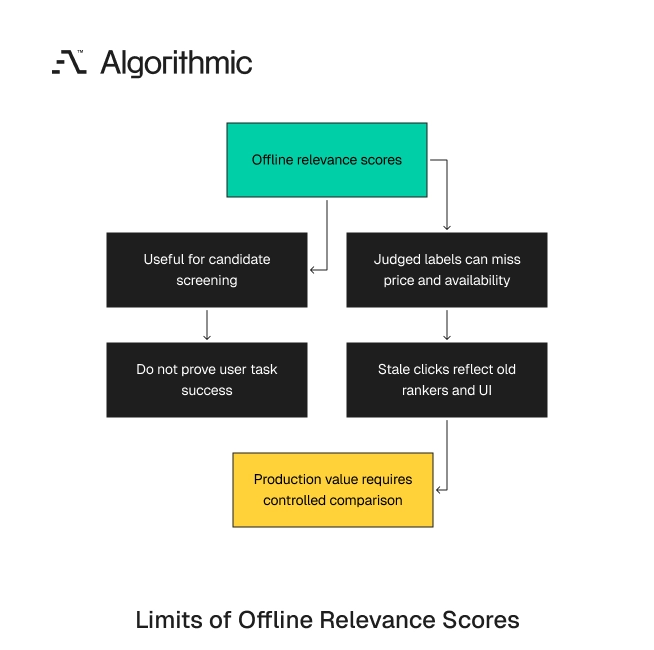
Offline metrics help during model development. NDCG@10, MRR, Precision@K, and recall provide fast feedback before production traffic enters the test, so they help teams reject weak candidates within hours. These metrics create false confidence when teams treat them as release criteria, because a ranking model can improve NDCG@10 by placing judged documents higher while reducing purchases, bookings, messages sent, or support deflection, and the cause is usually a mismatch between the judgment set and the live task.
Editorial judgments and user task completion measure different outcomes. A judge can mark a result as topically correct while users reject it for price, availability, compatibility, or missing instructions, so a model trained against the first signal can fail against the second. Production teams report a telling pattern, where a 0.001 NDCG improvement can drive a 5% engagement lift, while a 0.05 NDCG improvement can show no measurable product gain.
That range invalidates release decisions based only on offline score movement. A team cannot infer production value from NDCG change without a controlled product test, because the offline metric shows ranking movement against labels while it does not prove user progress. Offline scores also age, because query distributions shift after new inventory, new content, seasonal demand, paid acquisition campaigns, and UI changes, so a judgment set created six months ago can overrepresent head queries and underrepresent long-tail recovery.
Long-tail recovery often determines trust. A user searching for “replacement gasket 2019 espresso model” expects a precise item or a usable substitute, and a ranking system that fails this query class trains the user to bypass site search. The problem worsens when teams train against stale click data, because historical clicks record the behavior of the old ranker, old snippets, old UI, and old inventory, and they do not automatically describe the result list users need after the product changes.
Click data also reflects position bias. A document at rank one receives more clicks because it is visible, even when rank three answers the query better. Teams need counterfactual logging, randomized interleaving, or controlled tests before treating historical clicks as relevance labels.
 Click to expand
 This is why offline work belongs early in the system. It screens candidates, catches obvious regressions, and reduces wasted engineering time. It cannot carry the release decision alone.
Head-to-head evaluation changes the unit of decision
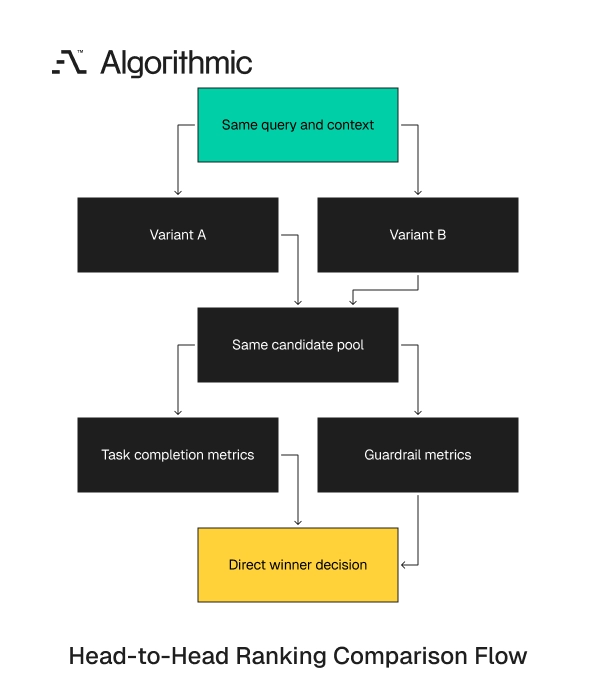
A head-to-head test asks a narrow production question. Given the same user intent and the same candidate pool, it asks which ranking variant produces better task outcomes, and the answer comes from paired comparison instead of isolated model scores. The comparison must be direct, so variant A and variant B receive the same query, filters, locale, inventory state, personalization context, and latency budget, and the system records which variant wins against predefined user and business measures.
 Click to expand
 This structure reduces argument, because the team stops debating whether BM25 weight, embedding similarity, click prior, freshness, price, margin, or popularity deserves more weight, and instead measures the ranked output produced by the complete formula. A direct comparison also gives executives a decision record, so the release discussion moves from “the model improved offline” to “variant B increased purchase per search by 0.8%”, and the same record should state cancellation rate and p95 latency.
The strongest decision records include segment-level outcomes. A global lift hides damage when high-volume head queries mask regressions in high-margin long-tail queries, so search leaders need the segment table before they approve rollout. The decision record should also state the exposure unit, because user-level randomization produces one form of evidence while session-level randomization produces another, and the record needs enough detail for a staff engineer to reproduce the analysis six months later.
The minimum viable comparison
The first head-to-head system does not need a large experimentation platform. It needs four parts:
- A stable query sample, usually 500 to 5,000 queries.
- Two ranking variants with identical candidate generation inputs.
- A task-specific win definition.
- Telemetry that links variant exposure to outcome.
For an e-commerce search product, the win definition can combine add-to-cart rate, purchase rate, zero-result recovery, and reformulation rate, for a support knowledge base it can combine answer acceptance, time to first useful click, and ticket deflection, and for a B2B SaaS documentation search it can include successful page dwell, copy events, and reduced repeat searches within 10 minutes. The right metric follows the user’s job, because generic click-through rate is often too shallow since a misleading result can earn a click and still fail the task, and in documentation search a click followed by an immediate return often signals failure.
The comparison also needs stable inputs. If one ranker receives fresher inventory or a broader candidate pool, the result no longer isolates ranking quality, so candidate generation changes need their own test. A practical first cycle can run with a small team, where one ML engineer prepares variants, one product engineer wires exposure logging, and one analyst prepares the decision report, and a domain expert reviews the highest-risk query pairs before traffic moves.
That team can ship the first evaluation loop in two weeks if the logs already contain query ID, result IDs, rank positions, click events, and downstream conversion events. If those fields are missing, instrumentation becomes the first release. Ranking work should wait until exposure and outcome data are trustworthy.
Why paired comparisons beat isolated benchmarks
Isolated benchmark scores compare a model against a static corpus and static labels, while head-to-head comparisons compare ranking decisions under the same product context, and search requires this structure because quality is relative inside the result list. The user sees a sequence of options, where position one changes the value of position two, so a correction at rank one can change the entire session.
A relevance improvement at rank eight often fails to change behavior. This is common on mobile screens, where the first three results dominate attention, while a desktop interface with filters can spread attention farther down the page. Paired comparisons expose regressions that aggregate metrics hide, so a new neural ranker can improve long natural-language queries and reduce quality for short known-item queries, and aggregate NDCG can increase while the highest-value query segment declines.
This pattern appears often in marketplace and catalog search. Embedding models handle descriptive queries such as “waterproof hiking jacket for heavy rain” well, while the same model can miss exact SKU, brand, or part-number intent when lexical matching loses weight. A direct comparison also protects teams from model bias toward easy wins, because a ranker can improve broad category searches while failing high-intent queries, and purchase per search often declines when known-item queries lose exact matches.
Exact-match failures are expensive because they occur close to purchase intent. A user searching “Brother TN760 toner” expects a compatible cartridge, price, delivery date, and stock status. A semantically similar printer accessory at rank one wastes the session.
A production evaluation stack needs four layers
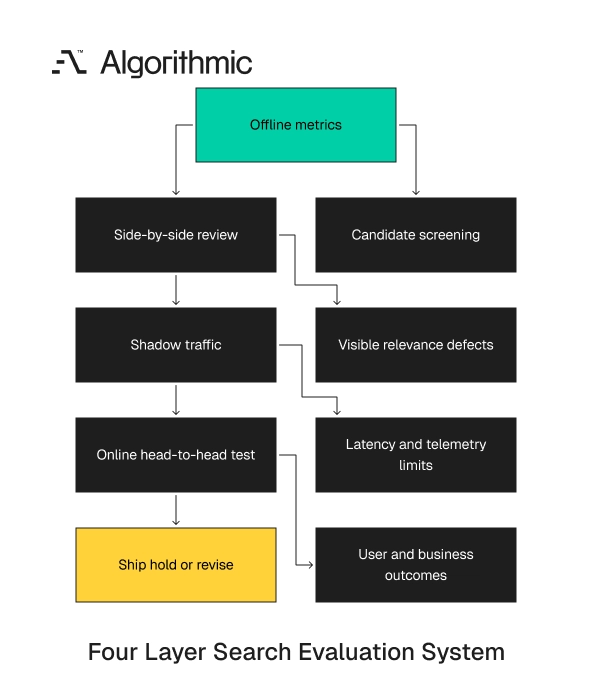
Search relevance evaluation should separate four concerns, which are offline development, side-by-side review, shadow traffic, and online experimentation. Each layer answers a different question, and together they form a release system.
| Evaluation layer | Primary question | Typical sample size | Decision made |
|---|---|---|---|
| Offline metrics | Is the candidate model worth further work | 10,000 to 1 million query-document pairs | Continue or stop development |
| Side-by-side review | Which ranked list better satisfies intent | 500 to 5,000 queries | Adjust ranking signals and guardrails |
| Shadow traffic | Can the ranker run within production limits | 1% to 10% mirrored traffic | Approve performance and telemetry |
| Online head-to-head test | Which variant improves task outcomes | 2 to 4 weeks of live traffic | Ship, hold, or revise |
Each layer removes a different class of failure. Offline evaluation removes weak model candidates before they consume engineering time, side-by-side review finds visible relevance defects before users see them, shadow traffic tests runtime behavior under production load, and online testing measures user behavior and business outcomes, so skipping any layer increases the chance that a model reaches users with an avoidable defect.
The stack also separates engineering truth from product truth, because a model can be correct in the notebook and unusable in the service path, and a ranker can pass latency targets and still damage task completion. This separation matters in multi-stage search systems, where retrieval, filtering, feature lookup, ranking, reranking, and blending each introduce failure modes, so a release process needs to identify the stage that created the regression.
 Click to expand
 Offline development screens candidates before release review
Offline evaluation is where teams move fastest. It supports feature engineering, model training pipeline changes, embedding model tests, and loss function experiments, and it is the right place to remove candidates that cannot beat a baseline. Offline evaluation should feed the release process, so side-by-side review, shadow traffic, and online behavior data complete the production decision, and the order matters because each step costs more than the step before it.
The offline set should be versioned like code. Store the query set, corpus snapshot, labels, model version, feature definitions, and evaluation script hash, because without that discipline a team cannot explain why a score moved from 0.412 to 0.426 across two weekly runs. The evaluation script also needs controlled dependencies, since a change in tokenizer version, stop-word handling, or negative sampling can move a metric without improving the model, so teams should record those details in the same repository as training configuration.
Use the same discipline for embedding models, so record the model family, vector dimension, chunking rules, pooling method, and approximate nearest neighbor index settings, because a change from HNSW ef_search=64 to ef_search=128 can alter recall and latency. Offline evaluation also needs negative examples that reflect production errors, so include unavailable items, near-duplicate documents, outdated pages, and substitutes that appear plausible, because these examples teach reviewers and models where the product fails.
Side-by-side review finds relevance failures before traffic
Side-by-side review puts two ranked lists in front of trained reviewers, internal domain experts, or a sampled user panel. The reviewer sees query, context, and two anonymized result sets, then chooses a winner and records the reason. This step works well for high-risk query classes such as medical content, regulated financial products, marketplace safety, enterprise permissions, and brand-sensitive results, and it also detects failures that clicks do not reveal.
Common failures include duplicate clustering, inappropriate freshness boosts, and results that satisfy a different intent. Reviewers can identify permission leaks, missing exact matches, unsafe inventory, and low-diversity result pages, and these issues often appear before online metrics have enough volume. Open-source evaluation tools can reduce build time for this layer, since several show lightweight patterns for comparing search APIs across evaluation runners, which are a useful reference when designing internal review tooling.
A practical review interface needs only six fields at first, showing the query, context, result list A, result list B, winner, and failure mode, plus reviewer identity and timestamp for auditability. The rubric matters more than the interface, because reviewers need written guidance for exact matches, substitutes, duplicates, unsafe items, freshness, and diversity, and without a rubric reviewer preference becomes another noisy ranking signal.
Reviewers also need examples of acceptable tradeoffs. A result can be less textually similar and still satisfy the task because it is available, current, or compatible. The rubric should define those cases before reviewers score the list.
Shadow traffic tests production constraints
A model that wins offline and in side-by-side review can fail under production load. Search ranking ML systems often have strict latency targets, especially inside multi-stage retrieval stacks, and latency failures reduce search quality because slow results reduce task completion. A common consumer search target is p95 below 150 milliseconds for ranking, a common full-response target is p99 below 300 milliseconds, and the exact threshold depends on product type, network conditions, and UI behavior.
Shadow traffic runs the new ranker in parallel without serving its results. It records latency, errors, feature availability, cache hit rate, model server behavior, and output drift, which prevents a team from spending four weeks on a ranker that cannot meet production limits. Shadow mode should mirror production routing as closely as possible, so the test should include peak traffic, warm and cold cache periods, feature store variance, and regional traffic differences, because a ranker that passes at 10 a.m. on Tuesday can fail during a weekend demand spike.
The telemetry should also compare output shape, so record score distributions, top-k overlap, empty result rates, duplicate rates, and filtered result counts, because a sudden drop in top-k overlap deserves investigation before live traffic expands. Shadow tests should also include dependency failures, because feature store timeouts, partial catalog updates, model server restarts, and cache misses occur in production, and a ranker that returns acceptable fallback results during these events carries lower release risk.
Online testing measures user behavior
Online head-to-head testing decides shipment. Randomization should usually happen at the user level, not the query level, because personalization and session behavior create carryover effects, and a two-week minimum captures weekday and weekend patterns. Four weeks is safer for lower-traffic products or seasonal query sets, so a travel product with weekend booking spikes needs a longer window than a high-volume retail search page, and a B2B documentation search product also needs enough weekday coverage across time zones.
The test must track leading and lagging measures separately, where leading measures include clicks, refinements, dwell time, and add-to-cart, while lagging measures include purchase, renewal, retention, ticket closure, and repeat usage. Teams should decide stopping rules before launch, so a 0.5% conversion lift can justify release at high volume, while a 3% click lift with flat conversion and higher reformulation should block release.
It also needs a single source of truth for exposure, so impressions, ranked results, clicks, conversions, reformulations, and downstream outcomes must share a common experiment identifier, because without that link the team cannot attribute movement to a ranker. A clean exposure event includes user ID, session ID, query ID, variant ID, ranker version, corpus version, and timestamp, along with feature availability state for personalized search, and inventory and seller eligibility state for marketplaces.
The analysis should report confidence intervals, segment counts, and missing-event rates. A positive point estimate with a high missing-event rate is not a release case. Data quality belongs in the same decision record as conversion movement.
The evaluation metric must match the search task
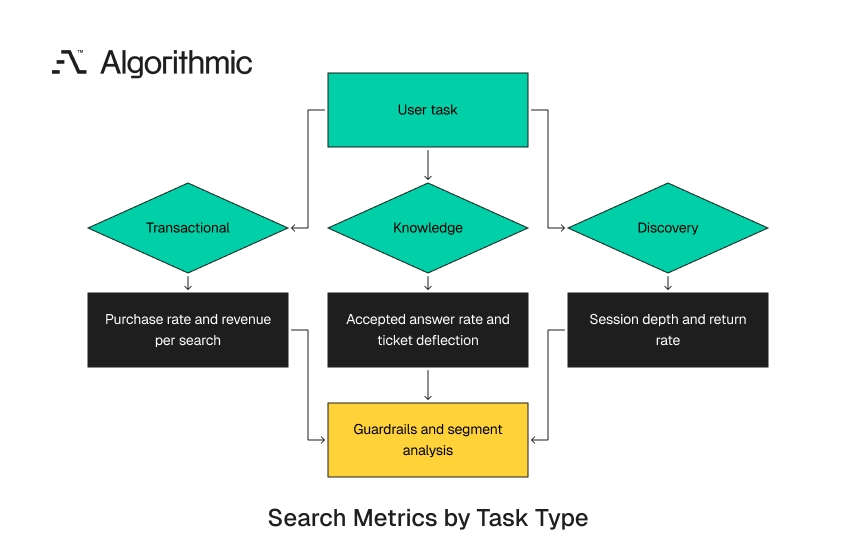
Search quality requires task-specific metrics. Different products need different outcome definitions, because a marketplace search box, a support portal, and a media feed do different jobs. The same metric can mean different things across products, so a click in retail search can signal purchase intent, while a click in support search can signal that the snippet failed to answer the question.
Metric design should start with the user’s job. The team should write the desired completion event before reviewing ranker output, which prevents a late shift toward whichever metric favors the new model. The metric plan should also state the attribution window, because add-to-cart can occur within minutes while renewal and repeat purchase take days or weeks, and mixing those windows creates analysis that no release committee can defend.
 Click to expand
 Transactional search
In marketplace, travel, retail, and food delivery search, the outcome is usually a transaction or a strong precursor, so use purchase rate, booking rate, add-to-cart rate, seller contact rate, and revenue per search, tracked per query segment. Guardrails are also needed, because a ranker that increases revenue by overexposing high-margin items can reduce repeat purchase if task fit declines, so track refund rate, cancellation rate, low-rating events, and return visits within 7 or 30 days.
Seller concentration also needs attention in marketplaces, because a ranker can improve near-term conversion by concentrating exposure on a small group of sellers, and over time that pattern can reduce supply health and weaken marketplace liquidity. The segment table should separate known-item, category, attribute, and compatibility searches, because “Nike Pegasus size 10” and “running shoes for flat feet” deserve different success measures, since one demands an exact product while the other allows substitutes.
Compatibility search needs special treatment. Automotive parts, appliance components, medical devices, and industrial supplies often require model-year, serial-number, or regulatory fit. A semantically similar item can create a return, a safety issue, or a support ticket.
Knowledge search
In documentation, support, and internal knowledge bases, completion signals carry more weight than raw clicks. Good measures include accepted answer rate, successful dwell time, copy events, ticket deflection, and reduced repeat search, and the right measure depends on how users finish the job. Click-through rate can mislead here, because a poor snippet can force the user to open more pages, so the system records more clicks and worse completion.
A support search product should record the path after the result click, so if the user opens a ticket within five minutes the search likely failed, while if the user copies a command and leaves the session the search likely succeeded. Documentation search needs special treatment for developer behavior, because a user who copies a CLI command after 40 seconds often completed the task, while a user who opens five tabs and returns to search likely did not.
Internal enterprise search also needs permission and freshness metrics. A result from the wrong workspace or an obsolete policy page can produce operational errors. The evaluation plan should treat those outcomes as release blockers.
Discovery search
Media, content, and social products need engagement quality measures. Session depth, saves, follows, watch completion, and return rate are stronger than one-click measures, and these systems should measure both session behavior and longer-term return. Discovery rankers also need diversity and fatigue controls, because a ranker can increase short-term engagement by repeating familiar content, and over 30 days that behavior can reduce retention and content supply health.
Content supply metrics belong in the guardrail set, so track creator concentration, repeated exposure, hide actions, and negative feedback, because these measures prevent a ranking change from improving session depth while degrading the marketplace for content. Discovery systems should also track novelty bands, because a healthy result list mixes familiar items, adjacent interests, and controlled exploration, since too much novelty lowers immediate engagement while too little novelty weakens return behavior. The test should also separate new users from returning users, because new users need fast recognition of interest while returning users need continuity and discovery, and a single aggregate engagement metric hides those differences.
The head-to-head relevance evaluation framework
Engineering leaders need a repeatable release gate. A one-off analysis does not create lasting ranking discipline, so the following framework gives production machine learning teams a practical starting point. The framework works for lexical rankers, learning-to-rank systems, embedding rankers, and LLM rerankers, and it also works with Elasticsearch, OpenSearch, Solr, Vespa, Pinecone, Weaviate, and custom retrieval stacks, so the system under test can vary while the comparison discipline stays fixed.
This framework is intentionally operational. Every gate creates an artifact that a CTO, product leader, or staff engineer can inspect, and the goal is a release decision that survives pressure from schedule, sales, and internal preference. A mature team keeps these artifacts in the same place as architecture decision records, so query samples, metric plans, reviewer rubrics, experiment IDs, and rollout decisions remain accessible, because search relevance degrades when evaluation history lives in chat threads.
Gate 1 defines the task and segments
Start with the top 20 query segments by volume and business value. Typical segments include known-item, broad category, long-tail natural language, misspelled, filtered, personalized, cold-start, and zero-result recovery, and each segment needs a named owner. Each segment also needs its own baseline, because a single aggregate score invites weak decisions since head-query gains can hide long-tail regressions, and a high-volume segment can drown out a smaller segment with higher revenue per search.
Segment definitions should be stable during the experiment. If the team changes segment logic during analysis, the comparison loses integrity, so record the segment definition in the experiment plan before launch. The segment owner should approve the metric before the model runs, so for known-item queries exact match rate belongs near the top, while for broad category queries diversity and filtered refinement can matter more.
The segment list should include protected or high-risk traffic. Examples include regulated products, safety-sensitive content, enterprise-restricted documents, and brand terms. Low-volume segments can still carry high legal, trust, or revenue risk.
Gate 2 freezes the comparison inputs
The two rankers must receive the same candidate set unless the experiment explicitly tests retrieval, because if candidate generation changes at the same time as ranking the team cannot isolate the cause of movement, so retrieval and ranking changes need separate experiments. Freeze the corpus snapshot for offline tests, log inventory state for online tests, and record feature availability for both variants.
For personalization, record the user features presented to each ranker, because missing features can create false regressions, and a feature store timeout in one variant can look like a ranking failure unless telemetry captures it. The same rule applies to filters and permissions, so an enterprise search test must record document visibility, role memberships, and access-control decisions, because a ranking win that exposes restricted content is a failed release.
Freezing inputs does not mean freezing the product for weeks. It means recording enough state to explain the result. Catalog changes, document edits, and seller availability should appear in the analysis dataset.
Gate 3 sets win, loss, and guardrail metrics
A valid head-to-head test has one primary win metric, two to four secondary measures, and explicit guardrails. For a marketplace search system, the primary metric can be purchase per search, while secondary measures can include add-to-cart, result click depth, and reformulation. Guardrails can include latency, cancellation, seller concentration, and low-rating events, and each guardrail needs a threshold before the test starts, so a ranker that clears the primary metric and violates a guardrail should not ship.
Avoid adding metrics after the result is known, because that practice turns evaluation into data mining, and it also makes future release decisions harder since each experiment uses a different standard. The metric plan should fit on one page, including metric definitions, SQL sources, exposure event names, attribution windows, and owner names, because a one-page plan reduces ambiguity during the release meeting. The plan should name the decision rule in plain language, such as “Ship if purchase per search increases by at least 0.5%, p95 latency remains below 150 milliseconds, and no priority-one segment declines”, which prevents post-test negotiation.
Gate 4 runs paired review before live traffic
Use side-by-side judgments on the highest-risk segments. Require reviewers to label both winner and failure mode, and keep failure modes structured and consistent. Useful labels include wrong intent, duplicate results, stale item, unsafe item, missing exact match, poor diversity, and latency timeout, plus product-specific labels when needed, so for healthcare content include missing clinical disclaimer and unsafe care guidance.
A team of three reviewers can evaluate 1,000 query pairs in two to three working days with a clear rubric. That is faster than releasing a weak model to 10% of users and waiting for ambiguous telemetry, and it also creates training data for future judgment sets. Reviewer disagreement is useful data, because if reviewers disagree on 30% of a segment the rubric or query intent definition needs refinement, so agreement rates should be tracked across review cycles.
Do not average away severe failures, because one permission leak, unsafe medical answer, or prohibited product result can block release, so severity labels belong beside preference labels in the review tool. The review sample should include both common and adversarial queries, where common queries validate everyday quality while adversarial queries test edge cases that hurt trust, such as misspellings, old product names, restricted documents, and ambiguous medical terms.
Gate 5 releases through shadow mode and online test
Shadow mode should run long enough to capture peak traffic and feature store variance. For many products 48 to 72 hours is enough to expose missing features, slow joins, model server timeouts, and cache behavior, while higher-risk systems should run longer. Then run the online head-to-head test, maintain the same tracking plan from day one, and if the team changes the metric definition during the test, restart the test.
The launch plan should define rollout steps. A common pattern is 1% shadow, 5% live, 25% live, then 50% or full release after review, and each step should have latency, error, and business metric thresholds. The final decision should be written down in an architecture decision record or experiment decision record, including the baseline, candidate, metrics, segment results, guardrail status, and release decision.
The record should also name the next action, whether to ship, hold, revise, or retire the candidate, because a vague “needs more analysis” decision usually means the experiment plan was incomplete. Rollback criteria belong in the same record, so if p99 latency crosses the threshold for 30 minutes, name the owner and the action, and if a priority-one segment declines, define whether traffic returns to baseline or holds at the current allocation.
LLM-based search makes controlled comparison more important
Generative search systems add another layer of evaluation difficulty. Retrieval, ranking, summarization, citation selection, and answer generation can each change the user outcome, so head-to-head comparison helps teams isolate which component improved the task. Recent work on LORE, a large generative model for search relevance, describes iterative practices for LLM-based e-commerce search and reports a cumulative 27% online improvement in its setting, and the key lesson for product leaders is the measurement discipline behind that improvement.
Iteration requires a controlled way to compare variants. For LLM search, the variant can be a retriever, reranker, prompt, citation policy, answer generator, or refusal rule, and each change needs isolation and task-level measurement. LLM-based systems also face benchmark contamination and reproducibility risks, and a widely cited meta-analysis of neural retrieval results found that many reported gains came from comparisons against weak baselines, so static benchmark progress can exceed the production gain that a team can reproduce.
A production search ranking ML system should treat public benchmarks as one input, because the release decision needs a product-specific head-to-head test tied to task completion, and that requirement becomes stricter when generated answers can hide retrieval errors. Generated search answers also need citation evaluation, because a user can accept a fluent answer that cites the wrong source, so the evaluation system should record source coverage, citation correctness, answer acceptance, and downstream task completion.
LLM search also needs refusal and abstention metrics. A system that answers every query can look useful while inventing unsupported steps, so track unsupported claims, missing citations, unsafe completions, and escalation to human support. Teams should evaluate the answer and the source path separately, because the answer can be fluent while the retrieval set is weak, and the retrieval set can be correct while the generated summary omits a required warning.
LLM evaluation should also record prompt version, model version, decoding settings, retrieval depth, and citation policy, because small changes to temperature, chunk size, or reranking depth can alter user outcomes, so those settings belong in the experiment record. Cost is part of the release decision for generated search, because a reranker that adds 400 milliseconds and $0.03 per query needs a measurable gain in task completion, so search leaders should report unit cost beside latency and conversion.
Evaluation hygiene is a partner selection criterion
For leaders hiring an external MLOps engineering team or machine learning development company, experiment hygiene is one of the best signals of technical maturity. The first discussion should cover falsification, telemetry, and decision thresholds, and a capable team will start with measurement before model selection. A credible team can name the riskiest assumption in the ranking change, describe the smallest experiment that will disprove it, and specify which events must be logged before model work starts.
For a $50,000 to $250,000 search ranking engagement, this matters more than a long feature list. A senior software development team will ask for query logs, judgment data, click models, latency budgets, feature store definitions, and business metrics, while a weaker team will start with model choice. The same standard applies to internal teams, so before scaling traffic leaders should ask for the experiment plan instead of a model demo, because a model demo rarely shows segment regressions, runtime risk, or downstream metric movement.
The strongest teams can also explain what would make them stop, because they define failure conditions before the test, and that discipline protects the budget and reduces pressure to ship a model that lacks evidence. This is where scientist-builder teams separate themselves, because they can write production code and design the experiment that proves whether the code improved the product, so they treat measurement as part of the system, not a reporting layer.
A weak partner will ask which model the company wants to use, while a strong partner will ask which user task the ranker must improve, and that difference shows up in week one, before any model training begins. Procurement should test for this discipline, so ask the vendor to write a one-page experiment plan during discovery, because the answer will show whether the team understands ranking risk, production telemetry, and executive decision rights.
A practical checklist before scaling search traffic
Use this checklist before exposing a new ranker to more than 5% of production traffic. The checklist is intentionally operational. Each item should be verifiable in code, configuration, telemetry, or an experiment document.
- The team has a named baseline ranker and a named candidate ranker.
- Offline evaluation uses a versioned query set, corpus snapshot, labels, and script hash.
- The comparison separates retrieval changes from ranking changes.
- The top 20 query segments have segment-level metrics.
- Side-by-side review has covered at least 500 high-risk query pairs.
- The primary win metric is tied to task completion and not limited to click-through rate.
- Guardrails include p95 latency, p99 latency, error rate, and at least one quality risk metric.
- Shadow traffic has run for 48 to 72 hours under production-like load.
- Online randomization is at the user level unless the team has documented a better unit.
- The test has predefined stopping rules and a minimum runtime of two weeks.
- The tracking plan links impressions, ranked results, clicks, conversions, reformulations, and downstream outcomes.
- The release decision is recorded in an architecture decision record.
- The segment table shows wins, losses, and neutral results separately.
- The review tool records failure modes, reviewer identity, and timestamp.
- The release plan names rollback triggers and rollback owners.
- The experiment record includes corpus version, feature availability, and ranker version.
- The analysis reports missing-event rates and exposure-count balance.
- The decision meeting includes product, engineering, data, and domain ownership.
This checklist turns relevance evaluation into a release path. It also gives engineering, product, and executive teams the same language for ranking decisions, so the result is fewer opinion-driven launches and more controlled production learning. Teams can start without a mature experimentation platform, because a spreadsheet of query pairs, a simple review tool, and a consistent telemetry schema are enough for the first cycle, so the discipline matters before the tooling does.
The first version should be small and strict. Run it on the highest-value query segments, document the decision, and keep the artifacts, because the second cycle will be faster since the comparison contract already exists. A quarterly review should retire stale query sets and add new failure modes, because catalogs change, users change, and business priorities change, so the evaluation system needs maintenance in the same way the ranker does.
Build the evaluation system before the ranking roadmap expands
Search ranking teams move faster when every proposed signal faces the same comparison standard. Freshness, personalization, margin, embeddings, click priors, query rewriting, and LLM reranking should pass through the same head-to-head process, because a shared gate prevents each signal owner from arguing from a different evidence base. The next step is concrete, so define the top 20 query segments, choose one primary task-completion metric per segment, and run the first side-by-side comparison within 14 days, comparing the current ranker with the next proposed variant.
After that first comparison, require every future ranking change to pass the same gate before traffic scales. Record the decision, preserve the query set, and keep the telemetry contract stable, because search quality improves when evaluation becomes part of the system, not an after-the-fact review. For CTOs, the operating instruction is direct, so reject any ranking roadmap that lacks a head-to-head evaluation gate, and fund the evaluation system before funding another quarter of ranking features.
Algorithmic builds search and recommendation systems with the A/B evaluation gates that catch ranking regressions offline metrics miss. Ask us to test your next ranking change before it ships.