

Machine learning has become the gold rush of modern business. Since ChatGPT’s public debut in 2022, nearly every organization has looked for ways to bring AI into the workflow, and some have built real value through smarter chatbots, faster decisions, and sharper customer understanding. Others have poured time and money into projects that never made it past the pilot stage. Machine learning feels inevitable, the next step in digital maturity, and beneath that excitement sits a quiet truth that many companies are not ready.
Building and deploying intelligent systems demands clean, reliable data, a resilient infrastructure, and a team that understands both the math and the objective. Without those foundations, machine learning becomes a costly experiment that solves the wrong problem, or no problem at all. As Sam Altman, CEO of OpenAI, once noted, the intelligence of an AI model roughly equals the log of the resources used to train and run it. Intelligence scales slowly and expensively, so you can spend heavily on people and capital and still ship a model that underperforms or does not fit your users’ needs.
So before you train models or draft an AI roadmap, ask the harder question. Is your organization ready for machine learning? This article sets out the essentials, the data, infrastructure, people, and budget you need in place first, as a readiness checklist that helps leaders balance ambition with the realities of execution.
Clearly define the problem you are trying to solve
One of the most common mistakes in machine learning adoption is starting with the model instead of the mission. Teams get excited about AI, assemble data, and only then ask what problem they are trying to solve, by which point the solution has already outgrown the need. Start by questioning the problem itself. What decision or process are you trying to improve, and what is broken within the system, whether accuracy, speed, cost, or feedback loops? The clearer the question, the easier it is to see whether machine learning is the right tool.
Not every challenge needs a learning algorithm. Many problems are better resolved through improved logic, better workflow design, or automation. Machine learning earns its place when the pattern space is large or unpredictable, when rules frequently fail, or when the data holds a story too complex for simple if-then statements. Fraud detection, customer churn prediction, and personalized recommendations are domains where human intuition or fixed rules fall short, while a stable, well-defined process such as a compliance check or a transaction validation is faster, cheaper, and more transparent as a deterministic system.
The most resilient organizations blend both worlds. They use rule-based systems as the backbone of reliability and machine learning as the brain that adapts, so the two layers reinforce each other.
What “data-driven” means for your problem
Before investing in machine learning, it helps to understand what data-driven actually means. The term is used loosely, sometimes as a synonym for modern or digital, but it signals a real shift in how decisions and systems are designed. A data-driven solution learns from patterns hidden in information collected over time, discovering rules rather than only following them, while a rule-based system runs on logic that humans define, the familiar if this, then that. One is probabilistic, the other deterministic.
Neither approach is inherently better, and the real question is which one fits the problem. Machine learning excels when patterns are too complex or fluid for fixed logic, as in predicting demand, identifying anomalies, or tailoring user experiences. When the problem space is stable and well understood, traditional rule-based software is faster, cheaper, and more reliable. The best systems blend both, using rules for structure and models for insight.
A fraud detection engine shows the pattern. It enforces strict rule-based limits for known risks while machine learning models watch behavior to catch the unexpected, and the skill is in knowing where each layer belongs.
Define your margin for error
Every organization has a different appetite for risk, and machine learning tests it. These systems analyze probabilities, which is both their strength and their limitation. Traditional software gives you certainty, since the same input always returns the same output, while machine learning deals in likelihoods and predicts what is most probable from patterns in the data. That makes it brilliantly right in many cases and wrong in unexpected ways in others.
So the real measure is tolerance for error. Ask how much inaccuracy the use case can absorb before it causes harm. A misclassified movie recommendation is harmless, while a misread signal in an autonomous vehicle is not.
Tolerance for error sets the tone for everything downstream, including how models are trained, how results are validated, and how human oversight is structured. In low-risk applications, autonomy drives efficiency, while regulated or safety-critical domains demand rigorous controls and contingency design from the start. Leading organizations treat this as calibrating trust. They build systems that fail safely, adapt quickly, and stay accountable, so a wrong prediction never becomes a major business risk.
Assess your data readiness
Data is the raw material of machine learning, and like any raw material, its quality determines what you can build. If the foundation is weak, no model can fix it. Real readiness means having the right data, relevant, reliable, and responsibly managed, and in most organizations this is where the first cracks appear.
Start with quality, since incomplete, inconsistent, or noisy records distort the patterns a model learns, so cleaning and validating that data is what produces reliable systems, and feature engineering often shapes the outcome more than the choice of model. Then check balance, because data that skews toward one geography, customer type, or scenario teaches the model that bias as truth. Governance is the third test, where good data has clear ownership, secure storage, and well-defined access rules, with the right sign-offs in place before anyone uses it. Every stakeholder should know what the data is being used for, so departments do not work from different assumptions.
Before you build models, make sure the foundation is sound, because most machine learning projects fail when the data behind them cannot be trusted. Treat data readiness as a core business safeguard.
Build the right team and toolset
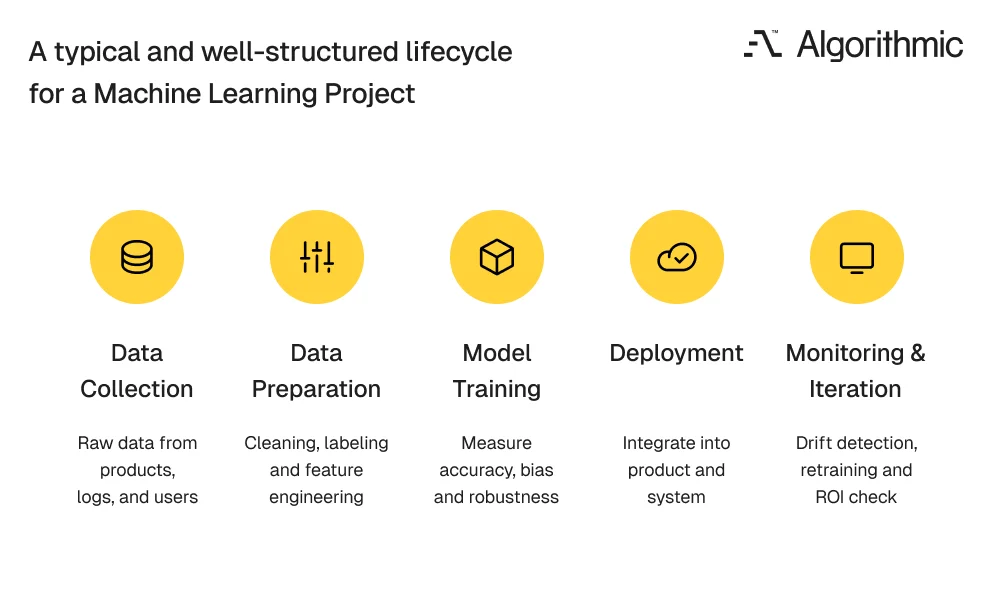
Even with high-quality data, machine learning initiatives rarely succeed without capable teams and the right tools, because execution is what turns a model into value. Every ML system follows the same lifecycle:
- Data collection: Gathering raw information from products, user interactions, and logs.
- Data preparation: Cleaning, labeling, and shaping that data through feature engineering.
- Model training: Measuring accuracy, bias, and reliability before moving into production.
- Deployment: Integrating the model into live systems and workflows.
- Monitoring and iteration: Detecting drift, retraining, and checking if the model requires fine tuning.
Each stage requires a mix of technical skill, business judgment, and continuous iteration, and as the diagram below shows, the effort only pays off when your data, infrastructure, and people are ready.
 Click to expand
 The challenge for most organizations is operationalizing these steps. Teams underestimate the ongoing work of cleaning and labeling data, building reliable pipelines, monitoring performance drift, and integrating retraining loops into product cycles, the operational discipline that Google’s Rules of Machine Learning was written to address.
At Algorithmic we have helped startups, mid-sized businesses, and large organizations stand up this end-to-end system, from data pipelines and experimentation frameworks to the governance models that make ML sustainable. Our role is to make machine learning operationally ready and technically sound, so you arrive with a problem and leave with a system. With the right people and tools in place, ML shifts from a research experiment into a repeatable, value-generating system.
Build the right infrastructure
Infrastructure is where machine learning projects often stall, usually on the question of efficiency. Many teams over-engineer their environments, spending heavily on compute and storage that adds little real value.
A sound setup is fit for purpose and built with close attention to cost. The goal is an environment that supports experimentation, scales when needed, and stays cost-efficient under real workloads. At Algorithmic we take a pragmatic view, designing lean infrastructure that balances performance against cost discipline and using the right stack rather than the largest one. Across several client engagements this approach has cut monthly cloud spend from five figures to a few hundred dollars without compromising performance, and in some cases it made the whole pipeline faster because the technical stack itself improved.
The principle is simple, since infrastructure should serve the model. By choosing the right frameworks, improving data pipelines, and automating deployment and monitoring, organizations get reliability and room to grow without costly mistakes.
Evaluate financial readiness and ROI
Sound infrastructure and capable teams make machine learning possible, and financial readiness decides whether it lasts. Every initiative eventually meets the same test of whether it creates more value than it consumes.
Machine learning carries real costs, from infrastructure, compute, and data storage to the ongoing work of monitoring and retraining. Teams that judged a project affordable at launch often find it expensive to maintain once it reaches production, the hidden cost that the classic paper on technical debt in machine learning systems documented in detail. Financial discipline means being intentional about that investment from the start.
Well-run teams design for efficiency from the start, selecting a model that fits the problem, automating where possible, and tying performance metrics directly to business outcomes. The organizations that succeed spend less over time because they measure business value alongside model accuracy.
The right operational frameworks cut recurring costs sharply, sometimes by an order of magnitude. The discipline is to map where costs will land before they arrive and to budget provisions for them in advance.
Last few words
Machine learning is becoming part of the core architecture of forward-looking businesses. Success here rarely comes from business objectives alone. It depends on readiness, the discipline to align data, infrastructure, people, and finances before scaling.
The organizations that succeed resist the temptation to chase technology for its own sake and instead build the conditions that make it useful. They treat machine learning as a managed system that combines technical, operational, and financial discipline. Readiness, in that sense, is a strategic posture, and it decides whether AI becomes a cost center or a lasting advantage. For niche applications of these ideas in production, see how we applied machine learning to sports betting and to quality assurance on the factory floor.
Algorithmic’s AI readiness assessment walks organizations through this checklist, evaluating data quality, infrastructure maturity, team capability, and financial readiness before any model is built. When the conditions are right, our predictive analytics team delivers models that hold in production. Start a conversation if you are weighing an ML initiative and want a clear read on whether you are ready.
If you’d like to follow our research, and case studies, connect with us on LinkedIn, Instagram, Facebook, X or simply write to us at info@algorithmic.co