

A single cleaning rule can move a customer from “high value” to “standard”. It can remove $2.4 million from a quarterly revenue dashboard, or exclude 18,000 borrower records from a credit model’s training set. The rule often looks harmless in code, where income is not null, merchant_type in ('retail', 'marketplace'), or amount < percentile_99_5, but the business effect is larger than the syntax. The organization has changed who counts, which transactions count, and which history the model sees.
Data cleaning is often assigned to analytics engineers, data scientists, or contractors as preparation work, and the tasks appear technical, remove nulls, standardize labels, merge categories, deduplicate records, exclude outliers, and fill missing values. Each task changes the business meaning of the dataset. That meaning matters when pipelines feed financial reporting, customer segmentation, pricing, fraud detection, underwriting, and automated eligibility decisions. When an organization cannot show which rule changed, who approved it, and which downstream assets changed, the cleaning layer becomes a control failure. The data platform keeps running while the evidence trail breaks.
Liquibase’s 2026 State of Database Change Governance report found that 96.5% of enterprises allow AI or LLMs to interact with production databases, and only 28.1% have reached standardized, consistently enforced governance. That gap matters because models and dashboards rarely use raw source data. They use transformed data after preparation rules have changed source records, labels, categories, and missing values. Strong data analytics and business intelligence depends on knowing exactly how that transformation happened.
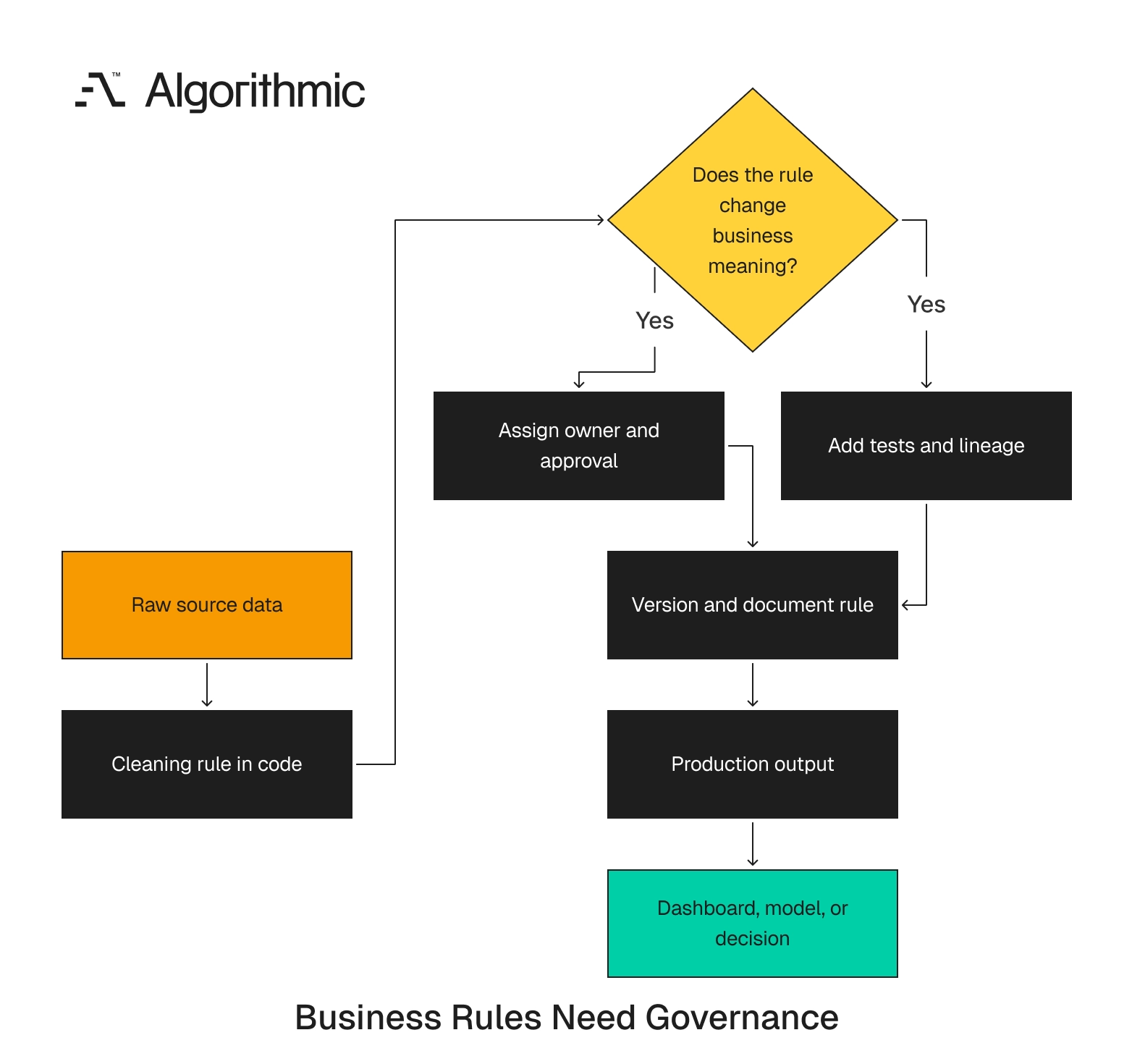
Algorithmic treats every material cleaning rule as a production experiment, where the hypothesis is the business assumption and the treatment is the code. The measured effect is the movement in dashboards, model metrics, customer decisions, and operational queues. A filter that removes five percent of records deserves the same inspection as a model release, and a mapping that changes revenue allocation deserves the same record as a finance policy change. That frame changes the operating standard. A governed cleaning rule needs an owner, version, test record, lineage record, approval trail, and rollback path before it changes a production output.
Cleaning rules are business rules expressed in code
A cleaning rule is rarely neutral. Dropping rows with missing income values changes the population represented in a lending model, merging “contractor”, “freelancer”, and “self-employed” changes employment risk analysis, and capping transactions above the 99th percentile can remove fraud signals, enterprise buyers, or data entry errors. The SQL operation can be short while the business interpretation requires approval, testing, and a durable record. Standard cleansing methods such as deduplication, standardization, validation, and outlier handling all support production data quality, and risk starts when the choice behind the method has no record that survives staff turnover.
Three questions define the governance status of a cleaning decision:
- What business assumption does the rule encode?
- Who approved that assumption?
- Which dashboards, models, reports, and customer decisions changed because of it?
 Click to expand
 When those answers live in a notebook comment, Slack thread, spreadsheet tab, or analyst memory, the organization has no durable control. The rule still changes production meaning, and the evidence trail disappears before the next audit, dispute, or model incident. A cleaning rule should read like a controlled operating instruction. “Remove outliers” is weak, while “exclude merchant QA transactions above $50,000 where account_type = test and route excluded records to quarantine” is reviewable. The difference matters during audit and incident response, since engineers can defend specific logic, owners, thresholds, and evidence, but they cannot defend intent inferred from a stale comment written 14 months earlier.
The business risk increases when the rule crosses functions. A sales operations filter can become a finance reporting rule, and a data science feature can become an eligibility condition. That path is common in production systems, where a notebook becomes a scheduled Airflow job and a dbt staging model becomes the source for executive reporting. The governance record must follow the rule across that path, with the original author, approval, test result, and release date still attached. Without that record, the organization inherits business logic without authority.
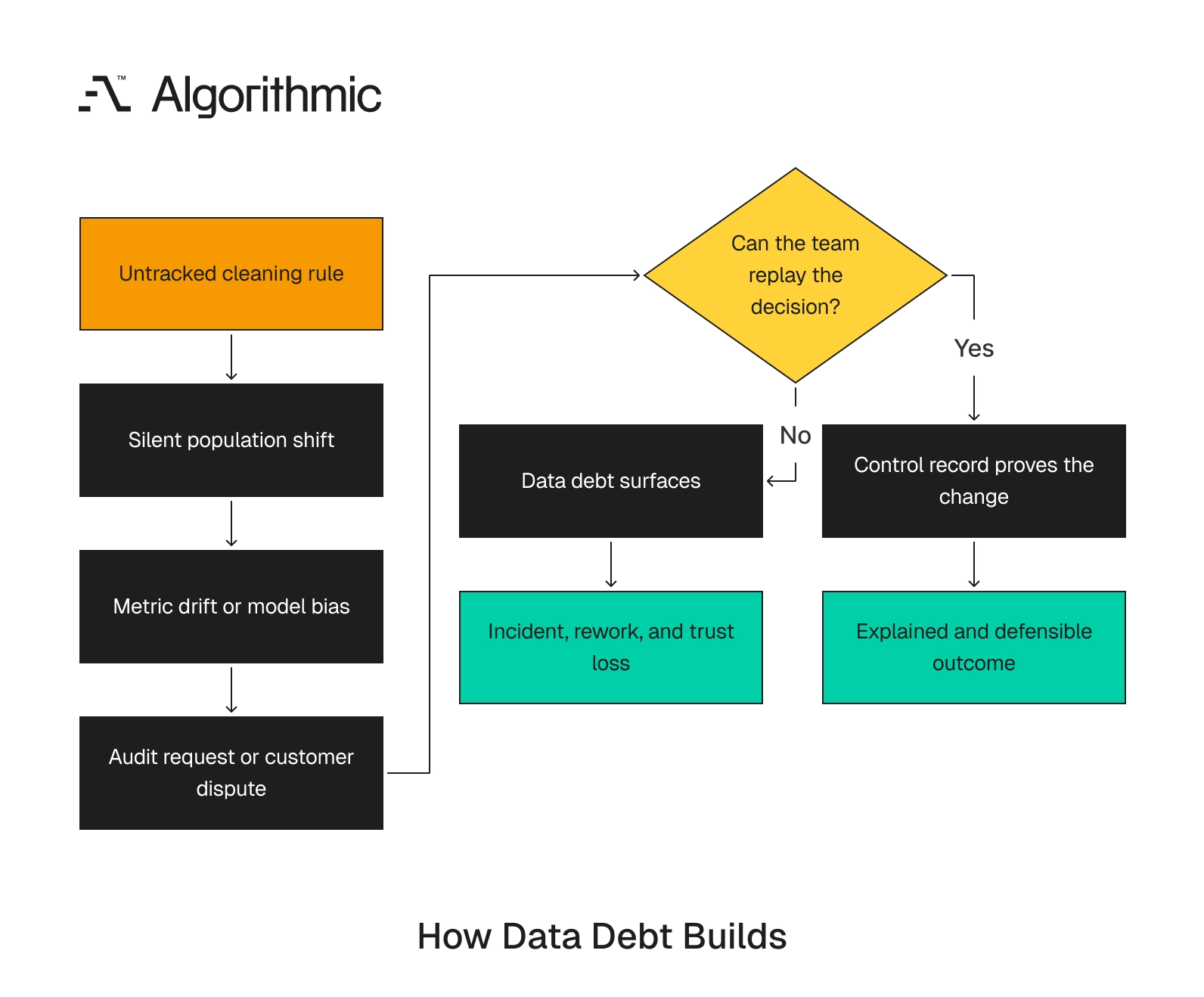
Untracked cleaning creates data debt that surfaces under pressure
Data debt accumulates when transformations change over time without version control, tests, or lineage. It rarely produces immediate failure, since dashboards load, models score, and reports circulate. The exposure appears during events that require explanation. Auditors ask for provenance, customers ask for a decision record, model owners ask why performance changed between two releases, and executives ask why the same metric has different values in Tableau, Looker, and a board packet.
 Click to expand
 Audit requests expose missing provenance
During an audit, a finance team needs to prove why revenue from a channel was excluded from a board report in Q3. The warehouse table shows the result and the dbt model shows the current SQL, but the analyst who added the filter left 11 months earlier. The pull request linked no policy ticket, and the filter name, exclude_partner_test_channel, describes the code path without proving business approval. That scenario creates audit friction because the organization cannot connect a transformation to an approved policy. The issue is evidentiary, since the business decision existed and the control record did not.
Cleaning rules often live in development, testing, and analytics environments before they reach production. A notebook used for a pricing model becomes a scheduled job, a spreadsheet mapping becomes a reference table, and a one-time filter becomes the denominator for quarterly reporting. By the time finance questions the number, the original context is gone. The same pattern appears in revenue recognition. An analyst excludes trial conversions from paid bookings because a finance manager asked for a one-time analysis, and three months later the SQL feeds a recurring board metric. The audit team then asks for the approval basis. The warehouse can show the filtered result, but it cannot show why the filter became policy unless the rule was governed from the start. This is where a formal data lineage implementation from ingestion to audit evidence turns a stale filter name into a defensible record.
Customer disputes require replayable decisions
A customer dispute changes the standard of explanation. A bank needs to explain why a customer was excluded from a product offer, a marketplace needs to explain why a seller was assigned to a lower service tier, and a health platform needs to explain why a patient cohort excluded certain records. In each case, the answer depends on the data version, cleaning rules, taxonomy mappings, and model version used at the time. Re-running today’s pipeline gives the wrong evidence when rules changed last week.
The organization needs replayability, so it can reconstruct the dataset, transformation graph, feature set, and decision path for a specific timestamp. Replayability requires more than code versioning. It requires source snapshots, reference data versions, run IDs, model artifacts, and approval records. Without those artifacts, the organization can describe the current process and still fail to explain the original decision. A replayable decision record should answer one concrete request, “show the dataset and rule set used for customer 841722 at 09:14:33 UTC on April 18”. That request requires timestamped source data and governed transformation history.
Replayability also protects the business during internal disputes. A sales leader can challenge a territory credit calculation, and a risk officer can question a portfolio segment change. The answer should come from the record, not from an analyst rebuilding logic under pressure. The record should show the rule version, source snapshot, pipeline run, and approver, and that record turns a dispute into a reviewable fact pattern.
Model failures often trace back to cleaning assumptions
Model incidents are often attributed to drift, feature quality, or training-serving skew. Those diagnoses are valid, and they frequently sit downstream from a cleaning rule that was never tested as a hypothesis. A fraud model trained after removing “extreme” transaction amounts can underperform on high-value fraud, a churn model that fills missing usage as zero can penalize customers with logging gaps, and a recommendation system that merges niche categories can reduce performance for high-intent users. Denoising is a hypothesis, and it deserves the same treatment as a model change, counterfactual testing, metric review, approval, and rollback.
The same discipline applies to feature stores. A feature that fills missing tenure with the regional median changes customer history, a feature that removes bot sessions changes conversion analysis, and a feature that groups device types changes fraud patterns. The feature table should record the rule version, affected population, and measured effect on model behavior. A model review should inspect these rules before reviewing coefficients, prompts, or hyperparameters, because training data defines the behavior space available to the model and cleaning rules define that training data. A team can tune a model for weeks and still miss a preparation rule that removed the strongest signal. In production work, the data preparation layer often explains more variance than the model architecture, and that finding should lead to stronger controls at the cleaning layer.
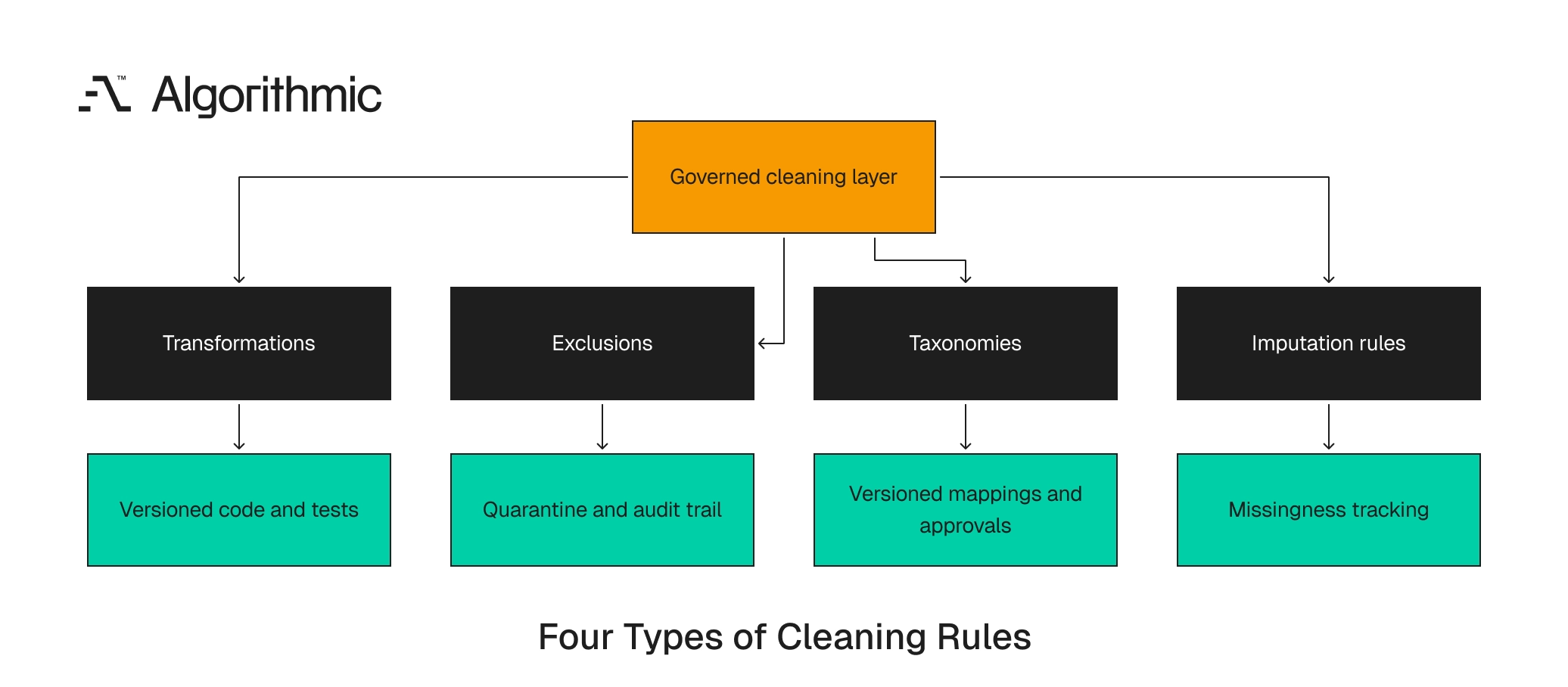
The governed cleaning layer has four artifact types
Organizations need a data governance model that treats cleaning decisions as governed artifacts, and the control model should cover transformations, exclusions, taxonomies, and imputation rules. These four categories are distinct enough for ownership and broad enough for most analytics system development, and they cover the main preparation decisions used in production machine learning engineering.
Algorithmic uses a Rule Ledger for this layer. A Rule Ledger is a versioned record that links each cleaning rule to its assumption, owner, evidence, downstream assets, and rollback procedure. It turns preparation logic into an inspectable production asset, giving engineers a build target and risk leaders a review record. The ledger should have a durable identifier for each rule, and that identifier should appear in code, tests, lineage metadata, quarantine tables, approval records, and incident tickets so the rule stays traceable across tools. A spreadsheet can start the process during remediation, but production governance requires the ledger to connect with Git, CI/CD, orchestration, catalogs, and model registries. The control must run where the pipeline runs.
 Click to expand
 Transformations define how values change
Transformations include normalization, parsing, type conversion, unit conversion, standardization, and derived fields. Examples include converting currencies to USD, parsing timestamps into fiscal quarters, standardizing country names, and deriving customer lifetime value. Each transformation needs a rule description, source fields, target fields, validation tests, and owner. A transformation that feeds financial reporting should have stricter control than one used for an internal exploratory dashboard, since control level should follow business materiality.
Converting order timestamps from UTC to local time can shift revenue across fiscal periods, and a two-hour offset near month-end changes daily sales reporting. The rule needs a calendar owner, a timezone policy, and a reconciliation test against the general ledger that compares period totals before and after the timestamp conversion. Derived fields deserve the same scrutiny, because “active customer” can mean one login in 30 days, one paid transaction in 90 days, or an open contract. Each definition leads to a different retention number, so the production definition should have an owner, a test, and an effective date.
Transformations also create problems when source systems change units or formats. A logistics feed can shift from pounds to kilograms, and a billing API can switch timestamps from local time to UTC. The pipeline can keep running while the metric becomes wrong. A governed transformation checks source metadata, reference tables, and value ranges before publishing downstream results, and that check should block the release when the input contract changes.
Exclusions define which records disappear
Exclusions include row filters, outlier removal, bot traffic removal, test account removal, and deletion of records that fail validation. These rules carry high governance risk because they change the denominator. A dashboard that shows conversion rate after excluding “low quality traffic” must define that term with precision, and a model that removes outliers must show the distribution before and after removal. Every exclusion rule should produce an audit table with record counts, percentage removed, reason codes, and time window, and for high-risk datasets the excluded records should remain queryable in a restricted quarantine table.
The quarantine table matters during disputes and model reviews. It lets the organization show which records were removed, which rule removed them, and whether reinstating them changes the outcome, and it prevents permanent loss of evidence. A common pattern stores excluded rows with columns such as exclusion_rule_id, rule_version, exclusion_reason, pipeline_run_id, and excluded_at. That structure gives engineers a technical path for rollback and gives compliance teams a reviewable record. The quarantine table should retain the original row payload or a governed pointer to the source snapshot, and it should record the rule owner and approval reference so a technical exclusion never becomes an undocumented policy decision.
Exclusions need segment-level reporting. Removing one percent of total rows sounds immaterial, while removing 14 percent of small-business applicants in one state changes the risk profile. A governed exclusion test should show counts by geography, channel, product, protected attribute proxy, and commercial segment where lawful and appropriate. The test should compare current output with the prior release, and that comparison exposes policy movement before publication.
Taxonomies define how categories are interpreted
Taxonomies include segment labels, product categories, merchant types, diagnosis groupings, content labels, and risk classes. They shape analysis because they decide which records are treated as equivalent, and a contested taxonomy can change pricing, personalization, underwriting, or operational reporting. Treat it like code, with versioned taxonomy files in Git, pull requests for category changes, unit tests for downstream behavior, and provenance fields that show who authored each mapping. Someone must have the right to change the rule, and the system must record that authority.
Taxonomy drift creates silent reporting changes. If “enterprise customer” changes from 1,000 employees to 500 employees, pipeline code can stay unchanged while segment revenue changes, so the taxonomy version must travel with every dependent metric. For machine learning systems, taxonomy changes affect labels, features, and training distribution. A merchant category merge can change fraud prevalence by segment, and a diagnosis grouping change can alter cohort balance in a clinical model. Taxonomy review should include a downstream diff. Before deployment, teams should rebuild governed metrics under the current and proposed mappings, and the review should show which metrics move, which cohorts change, and which model labels shift.
A mature taxonomy process also records effective dates. A customer can belong to one segment under the old definition and another under the new definition, so historical reporting must preserve both interpretations. That design prevents retroactive metric changes without approval, and it lets analysts answer historical questions with the definitions used at the time. Finance, risk, and operations all need that separation.
Imputation rules define how missing values become data
Imputation rules include filling missing values with zero, mean, median, forward-fill, model-based estimates, and domain-specific defaults. These rules introduce data that did not exist in the source system. They can be legitimate, and they can also hide source quality problems and distort downstream metrics. A governed imputation rule should record the method, source missingness rate, affected columns, validation threshold, and downstream consumers. If 18 percent of income values are filled in a credit model, the model documentation should state that fact and show sensitivity tests.
Missingness itself often carries signal. A missing income field can reflect customer behavior, channel design, integration failure, or a data collection policy, and treating all missing values the same can remove that signal. A stronger design records both the filled value and an indicator flag, with feature-table fields such as income_imputed_flag and income_imputation_method that give model owners a way to measure the effect of imputation directly. Imputation should also preserve the source value state, so a downstream reviewer can see whether a value was observed, defaulted, carried forward, or estimated. That distinction matters in credit, healthcare, insurance, and pricing models.
Imputation rules also need expiry controls. A forward-filled account balance should not stay valid for months without a source refresh, and a regional median should not mask an upstream integration failure. A governed rule should set a maximum age for carried values, and it should trigger an alert when missingness crosses a defined threshold. That alert should route to the data owner and the system owner.
A governed cleaning decision matrix
The following matrix gives data governance, analytics engineering, and compliance leaders a practical control model.
| Cleaning artifact | Example decision | Required owner | Required tests | Required lineage | Rollback path |
|---|---|---|---|---|---|
| Transformation | Convert local currency to USD using daily FX rates | Finance data owner | Type checks, reconciliation to source totals, FX table freshness | Source table, FX table, code version, deployment timestamp | Re-run prior transformation version against archived source |
| Exclusion | Remove transactions above 99.5th percentile | Risk or finance owner | Distribution test, excluded-count threshold, counterfactual metric test | Excluded record IDs, reason code, rule version | Restore quarantined records and reprocess |
| Taxonomy | Merge “freelancer” and “self-employed” | Business domain owner | Mapping completeness, downstream segment count change, dashboard diff | Taxonomy version, author, approval, affected assets | Revert mapping file and rebuild dependent tables |
| Imputation | Fill missing customer age with median by region | Model owner and data owner | Missingness threshold, bias check, model metric sensitivity | Column-level lineage, imputation rate, training dataset version | Restore previous feature table and model artifact |
 Click to expand
 This matrix should live in the data platform. A slide deck cannot enforce approval, block failed tests, or attach a run ID to a report, so the controls should run in CI/CD and production orchestration. In practice that means Git for version history and dbt data tests or Great Expectations for validation. It also means OpenLineage or Marquez for lineage, Airflow or Dagster for orchestration, and Snowflake, BigQuery, Redshift, or Databricks for governed storage.
Model artifacts should be archived in MLflow, SageMaker Model Registry, Vertex AI Model Registry, or an equivalent registry. The registry should link each model version to its training dataset version, feature table version, and cleaning rule versions, or model governance stops at the artifact boundary. The Rule Ledger should sit next to these systems, connecting lineage, tests, and model registry records through one governed rule identifier. That identifier should appear in code comments, test output, lineage metadata, quarantine tables, and approval records, and during an audit it becomes the path from business assumption to production effect.
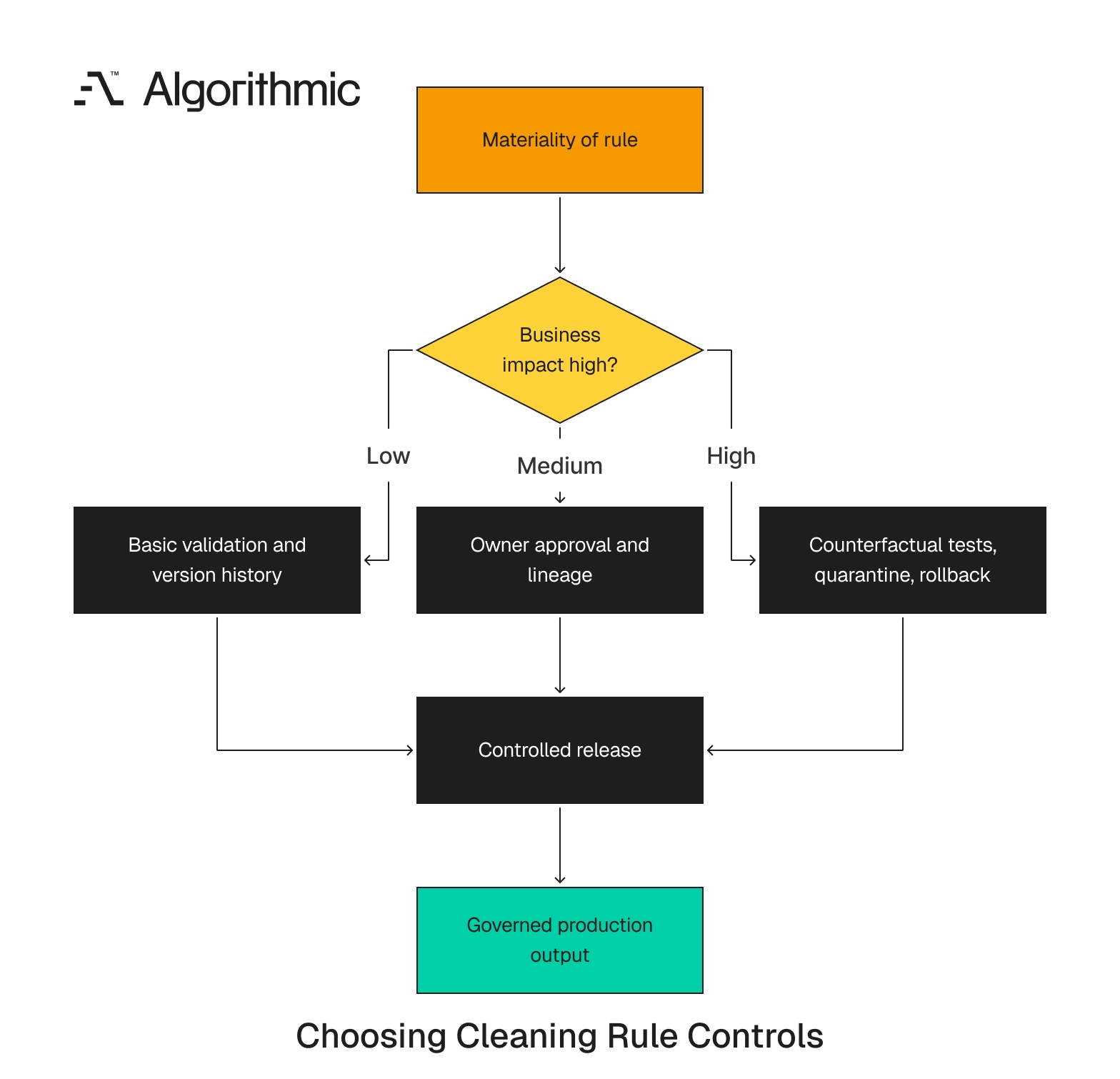
The matrix also helps teams scope work. Low-risk transformations need basic validation and version history, while high-risk exclusions need counterfactual tests, owner approval, quarantine, and rollback exercises. That separation matters because teams cannot govern every text normalization rule at the same level. Materiality drives effort, so the standard stays consistent while the control depth changes by business exposure.
Reproducibility is the standard for governed data cleaning
Reproducibility means the organization can rebuild the same dataset from the same sources, code, configuration, and reference data, and explain the dataset without relying on the person who built it. A production data pipeline should be reproducible across five layers, sources, code, reference data, outputs, and operating records. Each layer answers a different control question, and together they turn a data preparation step into an auditable production process. Reproducibility is both an engineering requirement and a governance requirement, since engineers need it to debug incidents and risk leaders need it to prove control. The standard should be explicit, so a governed output is reproducible when a reviewer can rebuild it, trace it, and explain it from retained records. Tribal knowledge does not meet that standard.
Source data must be immutable or snapshot-based
Source tables change, operational systems update records, and SaaS APIs revise historical values. Governed pipelines need immutable snapshots or append-only change logs, or a team can version transformation code and still fail to reproduce the dataset because the source changed. Tools such as Debezium, Fivetran history mode, Delta Lake time travel, Apache Iceberg snapshots, and BigQuery table snapshots support this requirement. The design choice should match business risk, so a customer analytics dashboard can use daily snapshots while a credit decisioning system needs timestamped records tied to each decision. Source capture should include ingestion time, source update time, and pipeline run ID, which separate late-arriving data from business corrections and help teams explain why two reports produced on different dates show different results.
A source snapshot policy should define retention by asset class. A monthly executive dashboard can retain source snapshots for seven years if it supports financial reporting, while a low-risk product dashboard can use a shorter retention window. The policy should also define replay cost, since some systems can store full snapshots and others need change data capture with reconstruction logic. That decision should be documented with the governed asset. If reconstruction takes six hours, the incident runbook should say so, and if replay requires archived object storage, the access path should be tested.
Transformation code must be versioned with review
SQL, Python, Spark jobs, dbt models, and notebook exports should be treated as production code when they feed governed outputs. Every material cleaning rule should have a pull request, reviewer, test result, and deployment record, and architecture decision records are useful for high-materiality changes such as redefining active customers or changing revenue recognition filters. A rule that changes a board metric by 3 percent deserves a written rationale that names the business owner, the approved definition, the validation evidence, and the rollback path. Notebook-based work needs extra discipline, because a notebook can contain hidden state, manual cells, local files, and undocumented parameters. Production pipelines should convert governed notebook logic into versioned code with scheduled runs and controlled inputs.
The code review should examine business meaning and technical correctness. A reviewer should ask which population changes, which metrics move, and which downstream assets consume the result, and the approval should record those answers. Code review also needs test evidence, so a reviewer should see row-count deltas, distribution changes, dashboard movement, and failed checks, with the approval record linked to those artifacts. For high-risk rules, the deployment should require separation of duties, since the author should not be the sole approver and a domain owner should approve the business assumption.
Reference data must carry its own version
Taxonomies, mapping tables, currency rates, business calendars, market definitions, and exclusion lists are often edited outside normal code review, which creates silent changes. Reference data should have version IDs, effective dates, owners, and approval history, so if a category mapping changes on March 12 the system knows which reports used version 17 and which used version 18. Reference tables should be append-only for governed use, where a correction creates a new version with an effective date instead of overwriting the prior value without trace.
Currency rates illustrate the point. A revenue pipeline that converts EUR to USD needs the FX rate source, rate timestamp, base currency, and effective date, and if the finance team restates the rate, the old and new versions both need to remain available. The same requirement applies to business calendars, since a fiscal week definition can shift period reporting and a holiday calendar can change service-level metrics and staffing forecasts. Reference data should also have validation checks, with freshness and duplicate-rate checks for currency tables and mapping completeness and invalid-code checks for taxonomy tables. A governed reference table should publish a version manifest that lists source, owner, effective date, approval ticket, and dependent assets, which gives reviewers a direct path from mapping to metric.
Outputs must be tied to the pipeline run
A dashboard value, model score, or regulatory report should point back to the pipeline run that produced it. That means run IDs, code commit hashes, source snapshot IDs, transformation versions, test results, and artifact locations, since data lineage tracking has value when it connects business outputs to exact upstream decisions. A governed dashboard should expose its data build record, a model score should link to the feature table version and model artifact, and a regulatory report should retain the source extracts, transformation versions, and approval record used for submission.
The output record should be visible to business users in plain language. A finance lead should see the reporting period, source snapshot, rule set, and approval status without needing warehouse access to confirm the build record. This requirement changes dashboard design, so a metric tile should link to its build record, not only to a chart definition, and the build record should show when the data was produced and which rules applied. For models, the prediction log should include feature table version, model version, and decision policy version. That log becomes the starting point for customer disputes and risk reviews, and it reduces incident response time.
Operating records must survive staff turnover
Governed cleaning requires operating records that outlast the original engineer or analyst, including pull requests, deployment logs, test results, incident tickets, and approval history. Staff turnover turns undocumented cleaning into business risk, because the organization loses the reasoning behind filters, mappings, and derived fields, and new teams inherit logic that nobody can defend. The operating record should answer four questions without a meeting, what changed, who approved it, when it ran, and what outputs changed. A data catalog entry alone rarely answers all four. The record should also show failed attempts, since failed tests, rejected approvals, and rolled-back rule versions explain why the current rule exists, and that history matters when a dispute asks why one option was rejected.
Operating records need retention rules. A governed model score may require years of retained evidence, while a low-risk product analysis may require months. Retention should match legal, financial, and customer exposure, and the policy should cover logs, test artifacts, source snapshots, reference versions, approval tickets, and model artifacts. Partial retention creates replay failures.
Counterfactual tests make cleaning assumptions visible
Cleaning rules should be tested for correctness and business effect. Standard data quality checks catch format issues, but they do not prove that a cleaning assumption is safe. Counterfactual tests compare outcomes with and without the cleaning decision. For an exclusion rule, run the model with excluded records restored and measure precision, recall, calibration, and segment-level effects. For a taxonomy change, rebuild the dashboard using the old and new mappings and compare affected KPIs. For an imputation rule, train with three alternatives and compare model behavior across protected and commercial segments, for a transformation rule compare financial totals before and after the change, and for a derived field test whether the definition changes customer counts across time windows.
Data observability platforms now detect thousands of data quality incidents a day across millions of monitored tables. Volume at that scale shows why manual review cannot carry the control burden, so tests must run as part of data pipeline engineering. A practical test suite should include:
- Schema validation for field names, types, and nullable status.
- Freshness checks for source and reference data.
- Distribution tests for key numeric fields before and after cleaning.
- Excluded-record thresholds by segment and time window.
- Mapping completeness tests for taxonomies.
- Imputation-rate thresholds by column and segment.
- Dashboard diff tests for governed metrics.
- Model sensitivity tests for high-risk feature transformations.
- Reconciliation checks against finance, risk, or operational source totals.
- Drift checks between training data and current scoring data.
- Approval checks that block high-materiality changes without a named owner.
These tests should block deployment when thresholds fail, and they should create records that compliance teams can inspect without asking engineers to reconstruct history from logs. Threshold design matters, since a 0.5 percent movement in a product engagement metric can be acceptable for experimentation while the same movement in recognized revenue can require finance approval. Segment-level thresholds carry more weight than aggregate thresholds, because a rule can leave the total population stable while removing 12 percent of records from a protected or high-value segment. Governed tests should report both total effect and segment effect.
The test record should become part of the rule history, since a passed test without a stored result has limited value during review. Store the input snapshot, code version, thresholds, actual values, and reviewer decision. A strong counterfactual review has one page of evidence that shows the proposed rule, affected population, metric movement, segment movement, failed thresholds, and approval status, and executives can read it in five minutes. Counterfactual testing also creates better engineering decisions, because teams see which cleaning rules move outcomes and which only reduce noise. That evidence helps teams remove unnecessary complexity from production pipelines, so the result is a smaller controlled surface, where rules with no measured business benefit can be retired and rules with measurable effect can receive stronger governance.
Ownership must match the business meaning of the rule
Engineering teams can write the rule, but they should not own the business meaning alone. A finance owner should approve rules that affect revenue, margin, bookings, or cash reporting, a risk owner should approve exclusion and imputation rules in credit, fraud, or insurance models, and a compliance owner should approve transformations that affect protected classes, consent status, retention windows, or regulated reporting. Analytics engineering owns implementation quality, code review, tests, orchestration, lineage, and rollback. Data governance owns policy structure, approval thresholds, evidence standards, retention, and audit rights, and business owners own interpretation. This division reduces ambiguity, and it prevents the common failure mode where a technically correct cleaning rule becomes an unauthorized policy change.
Ownership should be recorded at the rule level, since a table-level owner is too broad for high-risk datasets, and one table can contain revenue transformations, privacy exclusions, and model features that require different approvers. The approval path should follow materiality, so a low-risk label standardization can require one analytics reviewer while a rule that changes loan eligibility should require business, risk, and compliance approval before deployment. A RACI chart is insufficient unless the workflow enforces it. The pipeline should reject a high-materiality rule when the required owner field is blank, and the deployment record should show the named approver and timestamp. The owner list should also include emergency contacts, because production data incidents often occur outside normal review cycles, and a weekend rollback needs the same authority model as a planned release.
Ownership also needs periodic review, since business owners change roles and data products change scope. A quarterly review should confirm owners, approvers, materiality labels, and active downstream assets, and it should identify orphaned rules, because an orphaned rule is a production control gap. For larger organizations, the ownership model should map to policy domains, where finance rules, risk rules, privacy rules, and model rules have distinct approval queues. That design prevents a generic data owner from approving decisions outside their authority.
A 30-day remediation plan for untracked cleaning rules
Most organizations already have cleaning logic spread across dbt projects, stored procedures, Airflow DAGs, notebooks, spreadsheets, and BI semantic layers. The first step is containment, and a full platform migration can wait. The goal for the first month is to control the highest-risk outputs by identifying governed assets, classifying rules, adding tests, and assigning owners, and the work should produce evidence that survives audits and staff changes. The plan below assumes a small working group, one analytics engineering lead, one data governance lead, one risk or compliance representative, and business owners for high-risk assets. The group should meet twice weekly and publish a single register.
Week 1 inventories governed outputs
List the dashboards, models, reports, and operational decisions with financial, customer, compliance, or automated-decision exposure. For each output, record the source tables, transformation jobs, owners, refresh cadence, and known cleaning logic, and limit the first pass to the top 20 assets by business risk. The inventory should include BI semantic layers and spreadsheet-based reference data, because many high-risk definitions live outside the warehouse codebase, and “active customer”, “eligible seller”, and “recognized revenue” often appear first in reporting tools.
By the end of the week, leaders should have one register with asset name, business owner, technical owner, materiality, and known preparation rules, with missing owners marked explicitly and unknown rules treated as open control gaps. The register should include a direct link to the production asset plus the last successful run, last code change, and last approval date, since those three dates often reveal abandoned control points. The team should interview the analysts who maintain the assets and ask for known filters, manual adjustments, spreadsheet mappings, and exceptions, because these interviews find rules that code search misses. A code scan should run in parallel for where, case, coalesce, fillna, percentile functions, hard-coded lists, and mapping joins, since those patterns identify likely cleaning decisions.
Week 2 classifies cleaning rules
Classify each rule as a transformation, exclusion, taxonomy, or imputation rule, and add materiality labels of low, medium, or high. A high-materiality rule changes financial reporting, customer eligibility, pricing, risk scoring, or regulatory reporting, and these labels determine review depth and test coverage. Use concrete thresholds where possible, so a rule that changes a board metric by more than 1 percent or changes automated eligibility for any customer should receive high-materiality review. Document the business assumption for each high-materiality rule, since “remove outliers” is insufficient while “exclude transactions above 99.5th percentile because they are confirmed test loads from merchant QA accounts” is reviewable.
The classification should include the affected population, the count of rows touched, the percent of the table touched, and the segments with the largest movement, which makes materiality visible before approval. The team should also record the current evidence quality, since some rules have pull requests and test output while others have only comments or analyst memory. This evidence grade helps leaders set priorities, so a high-materiality rule with weak evidence moves to the top of the remediation queue while a low-risk formatting rule can wait.
Week 3 adds versioning and tests
Move high-materiality rules into version-controlled code or versioned reference tables. Add tests for record counts, distributions, mapping completeness, imputation rates, and dashboard diffs, and connect each pipeline run to code commit, source snapshot, and output artifact. Start with tests that expose business effect, because a distribution test, excluded-record table, and dashboard diff reveal more risk than another schema check. Schema checks still matter, but they do not measure policy change. Use CI/CD to block unapproved changes, so a high-materiality cleaning rule does not deploy when approval fields are blank, tests fail, or lineage metadata is missing. The pipeline should fail closed.
The first test suite should be narrow and enforceable, with five checks per governed output run on every production build, and coverage expands after teams trust the signal. The team should publish test results to a shared location, since engineers need machine-readable output and business owners need a readable summary. A useful summary shows rule ID, asset name, prior value, new value, threshold, status, and approver, and it should fit on one page for each governed output. That format supports review without forcing every approver into SQL logs.
Week 4 assigns owners and rollback paths
Assign a business owner and technical owner to each high-materiality rule. Define rollback steps in the runbook, store quarantined exclusions where required, and archive training datasets, feature tables, model artifacts, and evaluation results for ML systems in production. Rollback should be tested before it is needed, because a runbook that has never been executed is an assumption, so teams should run at least one restoration exercise for each high-risk output. The exercise should answer a practical question. Can the team rebuild last month’s board revenue dashboard with the prior rules in less than four hours, and can the team reproduce a customer eligibility decision from a timestamped record? These tests reveal control gaps quickly, and they create confidence that the team can respond during audit, customer dispute, or model incident.
The end-of-month deliverable should be a Rule Ledger for the top 20 governed assets, with rule IDs, owners, materiality, evidence links, lineage links, tests, approvals, and rollback steps. The final week should also set an expansion plan that adds the next 20 assets by risk, not by engineering convenience, and the governance team should keep the same classification model and evidence standard. A monthly review should track three metrics, governed assets onboarded, high-materiality rules with owners, and rules with tested rollback, which tell leaders whether the control is becoming real.
Implementation details that prevent governance from becoming documentation
Cleaning governance fails when it becomes a static document. The control must sit inside the engineering workflow, and engineers should not need a separate ceremony to do the right thing. A practical implementation starts with metadata fields in the pipeline, so each governed rule needs rule_id, rule_version, materiality, owner, approval_ref, and rollback_ref, required for high-materiality rules. dbt projects can carry this metadata in model YAML, exposures, tests, and tags, Airflow and Dagster can pass the same identifiers through run metadata, and Snowflake, BigQuery, Databricks, and Redshift can store run records in control tables. For Python and Spark jobs, rules should use named functions instead of inline filters, since a function named exclude_confirmed_test_transactions is easier to test than a buried where clause, and the function should emit counts and rule metadata on every run.
BI semantic layers need the same discipline, because LookML, Tableau data sources, and Power BI semantic models often contain business filters that should reference governed definitions and approval records. Spreadsheets require containment, so if a spreadsheet defines mappings used by production reporting, import it into a governed reference table, version the file, record the owner, and capture the effective date. The same standard applies to manual overrides. If finance adjusts a mapping for a quarter close, the override should have an approval ticket, expiry date, and reconciliation test. Manual work becomes risk when it lacks a record.
Common failure modes and how to correct them
The first failure mode is code-only governance, where teams version SQL and assume the problem is solved. Code history shows what changed, while governance must also show who approved the business assumption and which outputs changed. The correction is a rule record that links code, owner, test evidence, and downstream assets, mandatory for high-materiality rules, and CI/CD should fail when the link is missing.
The second failure mode is catalog-only governance, where teams document definitions in a catalog while production pipelines continue to accept unapproved changes. Catalog entries become stale when they are not connected to deployment. The correction is workflow enforcement, where the deployment system validates required metadata, tests, and approvals before publishing governed outputs, and the catalog reads from production metadata instead of relying on manual updates.
The third failure mode is aggregate-only testing, where a pipeline passes because the total record count stays within tolerance while a segment loses a large share of records that the test never looked at. The correction is segment-level testing for high-risk outputs, with a segment list that matches the business decision, since credit, fraud, healthcare, and pricing systems need tighter segmentation than internal product dashboards.
The fourth failure mode is irreversible exclusion, where teams remove rows, publish outputs, and retain no quarantine table, so they cannot show the removed records when a dispute arises. The correction is governed quarantine that stores removed rows, rule identifiers, reason codes, run IDs, and source pointers, with restricted access and retention that follows the governed asset policy.
The fifth failure mode is reference data drift, where business teams edit mappings outside Git or data governance workflows and reports change without a code deployment. The correction is versioned reference data with owner approval, where append-only tables, effective dates, and mapping completeness tests prevent silent changes, and the reference version appears in every dependent output.
The control standard leaders should require
Data cleaning decisions deserve governance when they shape reported numbers, customer treatment, or automated decisions. The required standard is specific, every material cleaning rule has an owner, version, test suite, lineage record, approval trail, and rollback path, and every governed output can be traced to the exact source snapshot, code version, reference data version, and pipeline run that produced it. Precisely’s 2026 State of Data Integrity and AI Readiness report found that 43% of organizations name data readiness as their largest AI obstacle, and cleaning governance reduces that obstacle because it converts tacit preparation choices into controlled artifacts.
Start with the 20 highest-risk outputs this month. Classify their cleaning rules, assign owners, add tests, and require replayable lineage before the next model release, board report, or audit cycle. The concrete deliverable is a production Rule Ledger connected to CI/CD, lineage, and model registry records that shows every material cleaning rule, the approved business assumption, the tested effect, and the rollback path. This work does not require replacing the data platform. It requires treating preparation decisions with the same discipline already expected for production code, financial controls, and regulated model changes. Algorithmic builds data infrastructure and integrations with these controls wired into the pipeline. Start a conversation if your highest-risk dashboards and models cannot yet show which rule changed, who approved it, and what moved downstream.