

A vendor that claims 200 integrations proves one narrow point, that its sales team counted 200 logos. That count says nothing about whether customer records, design files, warehouse tables, or operational events retain meaning after a production round trip. Enterprise CTOs and data infrastructure leaders should treat integration claims as unverified until the vendor produces connector-level evidence that shows payloads, transformations, error handling, latency, throughput, and observability across the exact systems in scope. That is the core of any serious data infrastructure and integrations review.
This distinction carries financial weight as budgets rise. Research and Markets estimates the big data professional services market will grow from $61.01 billion in 2025 to $67.63 billion in 2026, then to $103.34 billion by 2030. At that spend level, logo-based evaluation becomes an expensive governance failure, since a procurement team that accepts a static integration grid also accepts unknown engineering work, unknown operating cost, and unknown data risk.
The cost appears after contract signature. Engineering teams discover unsupported operations, data owners find missing fields, and finance teams inherit reconciliation work that never appeared in the business case.
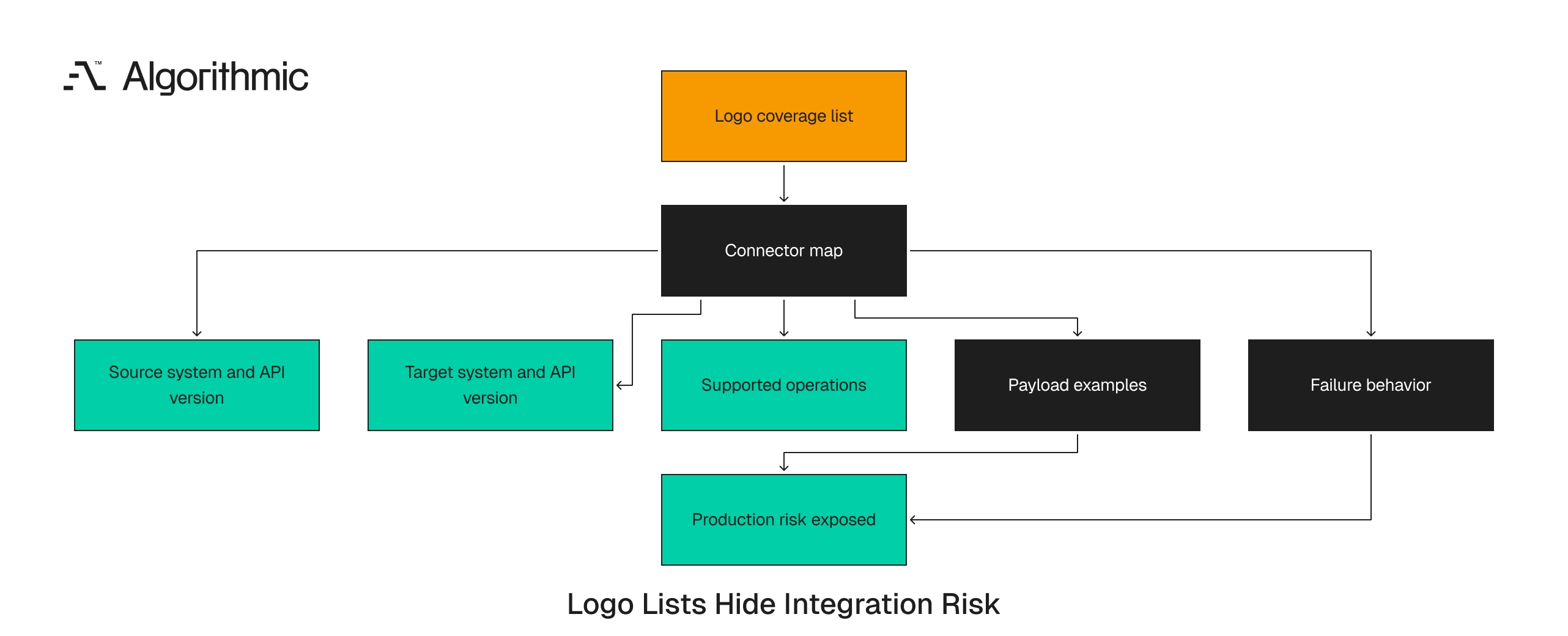
Logo coverage records intent while connector maps record behavior
A connector map is a concrete inventory of system-to-system behavior. It lists each source, each target, each supported operation, each data shape, and each observed failure mode. For a data platform, the map should show whether Salesforce pushes account updates into Snowflake, whether Snowflake returns enriched segments to Braze, and whether deletes propagate correctly. Delete behavior matters because retained records affect privacy requests, churn reporting, and customer segmentation.
For an industrial design workflow, the map should cover Revit, Siemens NX, Maya, and Unreal Engine. It should show whether those systems push and pull USD scenes with preserved geometry, material semantics, hierarchy, units, and metadata.
A serious connector map includes six fields:
- Source system and API version
- Target system and API version
- Supported operations: read, write, update, delete, upsert, subscribe
- Payload examples before and after transformation
- Latency and throughput under measured load
- Failure behavior, retry policy, and monitoring surface
 Click to expand
 This artifact separates production-grade interoperability from marketing support, and it gives architecture reviewers a way to compare vendors through observed behavior, contract language, and repeatable tests. Vendor release pages help teams track connector maturity. Google Cloud’s Integration Connectors release notes show the operating pattern, where connectors change, preview features appear, known issues emerge, and deprecations occur. A procurement decision based on a static logo grid ignores that operating pattern, so the buyer accepts a point-in-time claim for systems that change weekly through API versions, security policies, limits, and schema changes.
The map also exposes scope boundaries. One vendor supports Salesforce Account reads through REST, while another supports Account upserts, Bulk API backfills, delete capture, and replay after rate-limit errors. Those differences affect engineering cost in the first quarter after purchase, and a buyer who accepts the same logo for both products signs up for discovery during production rollout. That discovery usually arrives through integration tickets, warehouse exceptions, and late escalation calls with vendor support.
The same problem appears in engineering software. A product can list “Unreal Engine support” and still lose material bindings during export from Maya. A product can list “Kafka support” and still fail to preserve event order after consumer retries. A connector map forces the vendor to state the supported operation, the tested version, and the observed behavior.
The round trip is the unit of proof
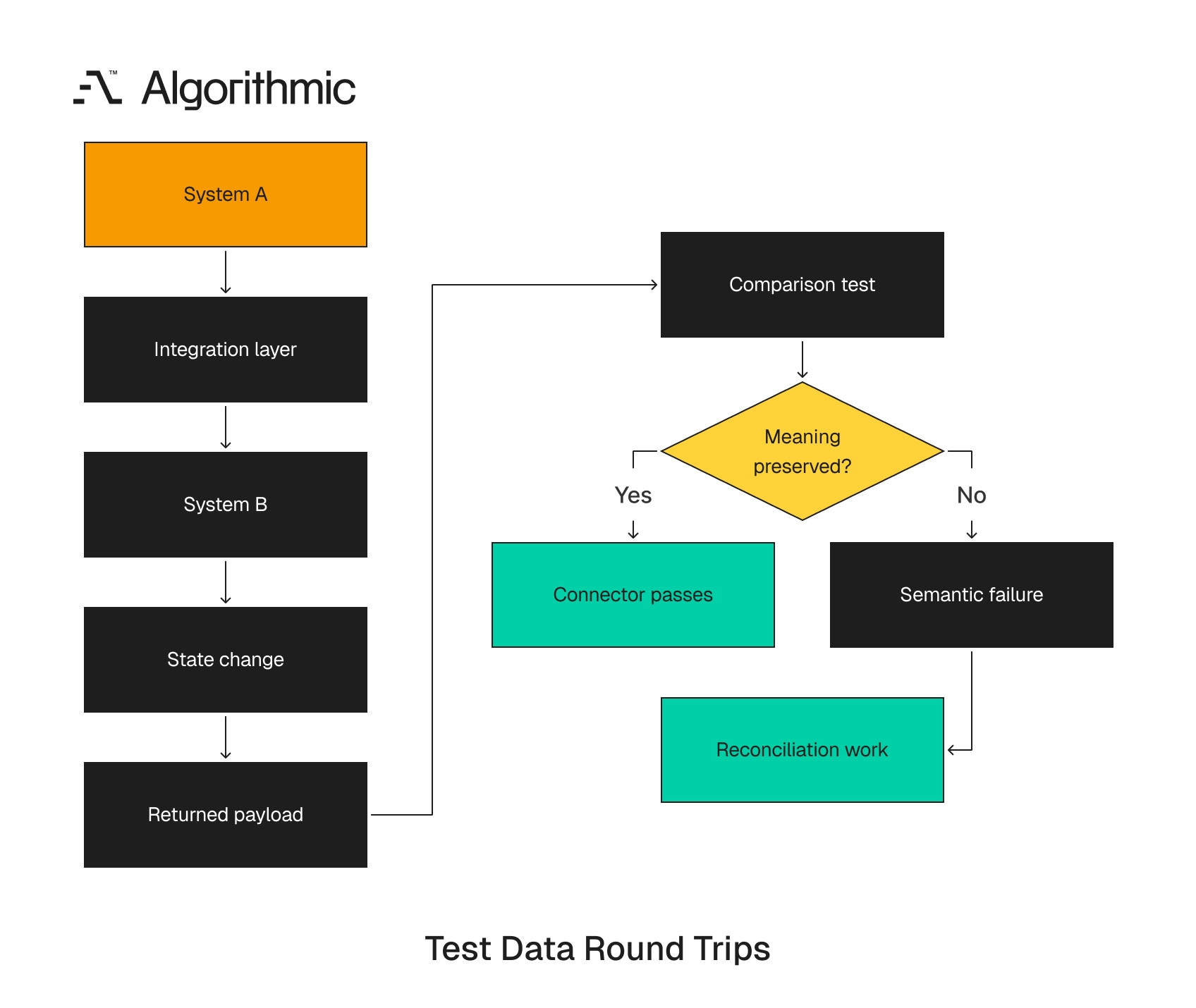
An integration demo proves a one-way path, and production reliability requires a round trip. A round trip means data leaves System A, passes through the integration layer, lands in System B, changes state, and returns to System A. The returned data can also move to a downstream consumer, if the test verifies preserved meaning.
 Click to expand
 For ETL pipeline development, that path can run from PostgreSQL to Fivetran to BigQuery to Looker to a reverse ETL tool. For product telemetry, it can run from Segment to Kafka to Databricks to a recommendation service to a mobile application. The proof must include the transformed artifact, so a vendor should provide the original payload, the intermediate representation, the target payload, and the returned payload.
The returned payload matters because many failures appear after the target system changes the record. Common examples include normalized phone numbers, truncated decimals, default time zones, collapsed arrays, and regenerated identifiers. A one-way success screen misses those changes, while a round-trip payload comparison shows whether the data can still drive billing, entitlement checks, segmentation, reporting, or model features.
The same test should cover both create and update paths, since many connectors pass an initial insert and fail when a source record changes ownership, status, address, or consent state. A round-trip test should also include delete and restore behavior, because privacy, audit, and lifecycle workflows depend on deletion semantics as much as insert semantics. A customer deletion in the CRM should remove, mask, or tombstone the corresponding warehouse record based on policy, and the test should show which action occurs and which system owns the final state.
Semantics that must survive the trip
The evaluation should test fields that fail in production instead of clean records from a demo dataset. Demo datasets usually avoid nulls, unknown enum values, nested objects, large payloads, and mixed timestamp formats.
Required semantic checks include:
- Null versus absent fields
- String, integer, decimal, timestamp, array, and object types
- Time zone handling, including daylight saving transitions
- Currency and unit conversion
- Enum mapping and unknown enum values
- Primary keys, composite keys, and surrogate keys
- Soft deletes and hard deletes
- Ordering guarantees for event streams
- Duplicate event handling
- Schema drift across additive and breaking changes
A customer record with phone = null carries a different meaning from a record with no phone field, and a timestamp stored as local time and read as UTC can shift revenue recognition, subscription renewal, or clinical event sequencing. These details determine operational reliability, since they decide whether the integration supports production work or creates reconciliation work for finance, operations, and support teams. A subscription system can treat cancelled_at = null as an active contract, so if the connector drops the field, the warehouse model can interpret the same customer as unknown. That difference changes renewal forecasts, sales compensation, customer health scoring, and the queue of accounts that customer success managers review each Monday.
Schema drift deserves direct attention. An additive field should flow without breaking existing consumers, while a breaking type change should stop in a controlled path with alerts, dead-letter records, and a clear replay process. The connector map should state whether that stop occurs in the connector, orchestration layer, warehouse load, or downstream model.
Precision requires the same scrutiny, because a payment value stored as decimal(18,6) in one system and float in another can create rounding differences across millions of rows. Those differences affect tax reporting, usage billing, and sales commission calculations, so the connector map should record numeric precision and rounding rules for every financial field. Identifiers also need direct testing, since composite keys, tenant-scoped IDs, and external IDs break when a connector assumes one global primary key. A support case with case_id = 1042 in two regional tenants needs a namespace, and without that namespace downstream joins merge two customers into one record.
Latency and throughput must be measured together
Latency alone creates a false sense of performance, and throughput alone hides queue buildup when p95 and p99 latency deteriorate. The connector map should report p50, p95, and p99 latency for each path, plus sustained records per second, maximum payload size, retry rate, and the first rate limit encountered. A vendor claiming near-real-time synchronization should show numbers. A useful response states that for 1 KB account update events, the connector processed 1,200 records per second for 30 minutes, reached p95 end-to-end latency of 4.8 seconds, and reached p99 latency of 11.6 seconds. The same response should name the first platform limit reached, and for Salesforce that means the API family, tenant allocation, percentage consumed, and reset window. That evidence lets engineering leaders design capacity, alerts, and fallback paths, and it gives procurement a factual basis for contract terms and service commitments.
The same standard applies to batch paths, where a daily 40 million-row load should report partition size, start time, completion time, rejected records, retry count, and warehouse compute cost. If those measurements are absent, the buyer learns performance after go-live through delayed dashboards, missed campaign windows, or manual finance reconciliation. A performance table should also record the test environment, since cloud region, warehouse size, connector runtime, network path, and source tenant limits all change the measured result.
Measurement should include cost per unit of work, because a connector that moves 40 million rows for $80 in warehouse compute belongs in a different budget category than one that costs $1,200. The test should also report quota consumption, since a path that uses 65 percent of a Salesforce daily API allocation leaves little room for sales automation, support tooling, or incident replay.
Connector failures live in production edge cases
Integration failures rarely appear in board-level demos, because the demo uses stable schemas, clean credentials, low traffic, and controlled records. Production traffic is less forgiving. Schema changes arrive without warning, source systems throttle requests, and downstream warehouses reject records after a column type change. SaaS APIs return partial success, event consumers process messages out of order after a retry storm, identity providers rotate credentials, and service accounts lose permissions during routine security reviews.
Data integration now sits at the center of AI cost, not the back office. A Gartner analysis reported by the European Business Review frames the integration layer as a hidden tax on AI investment when it is managed poorly, and a board-level issue that determines how fast use cases deploy and how costs evolve. Data quality, synchronization, and operating evidence sit inside that gap, since teams cannot calculate return when they cannot prove the data path that feeds the model, dashboard, or operational workflow.
The pattern is common in software project rescue work. A platform ships with a connector library that looks complete during acceptance testing, and three months later finance finds that 6 percent of invoices are missing tax fields after a NetSuite schema update. Customer success then finds that churn-risk flags arrive in Gainsight 18 hours after the daily account review. These incidents are architecture failures, because procurement accepted compatibility claims without connector evidence.
The impact spreads beyond engineering. Finance teams run spreadsheet checks, customer success teams distrust scores, and data scientists exclude entire data sources from training sets. Each workaround adds labor and weakens confidence in the platform, and the cost appears as manual reconciliation hours, delayed executive reporting, and model retraining with smaller datasets.
In one common failure pattern, the source system changes an enum from trial to trialing, the connector accepts the new value, the warehouse model maps it to unknown, and the lifecycle campaign excludes new trial users. The integration appears green while revenue operations loses a week of conversion data, and a connector map with enum drift tests would have exposed the failure before production launch. Another common pattern involves partial batch success, where a target system accepts 97 records, rejects 3, and returns a mixed response. A weak connector records the batch as complete, while a strong connector marks the rejected records, creates a replay path, and reports the customer IDs affected. These failures matter because they rarely stop the whole system, so partial failure creates false confidence while dashboards still refresh and jobs still show green status.
The four-gate connector evidence framework
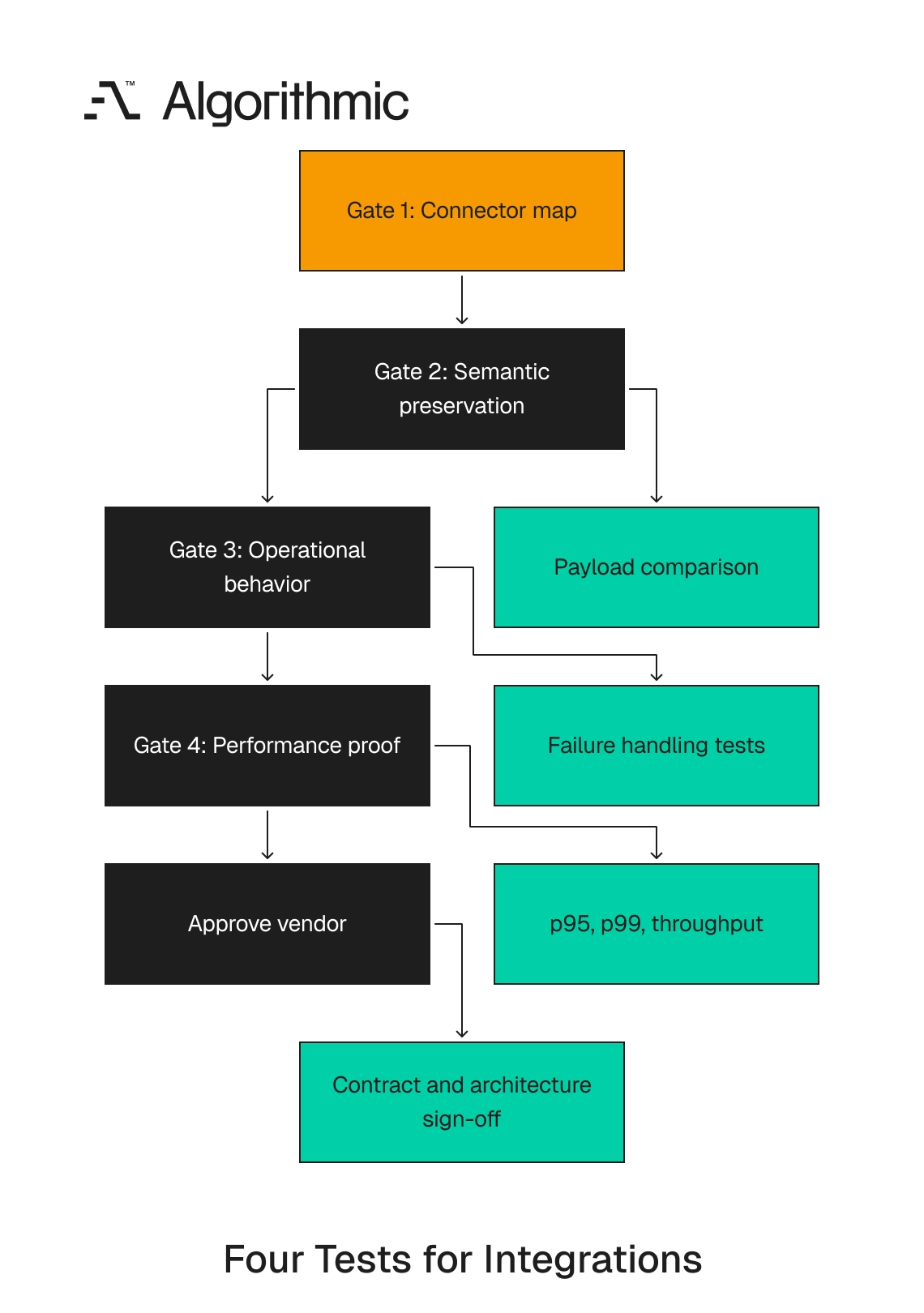
Engineering leaders need a repeatable evaluation method. The Four-Gate Connector Evidence Framework gives teams a concise structure for vendor diligence, architecture review, and technical due diligence.
| Gate | Evidence required | Failure signal |
|---|---|---|
| 1. Connector map | Named systems, API versions, operations, payload shapes | Logo list without operation-level detail |
| 2. Semantic preservation | Before-and-after payloads, type handling, null behavior, schema drift tests | Screenshots of successful syncs without payload inspection |
| 3. Operational behavior | Retry policy, dead-letter handling, idempotency, rate-limit response | Manual replays, silent drops, unclear ownership |
| 4. Performance proof | p50/p95/p99 latency, records per second, payload size, load duration | Single-record demo or unmeasured batch job |
 Click to expand
 A vendor should pass all four gates before the platform enters the target architecture, and a partner providing data engineering services should produce the same evidence before approval to build integration paths. The framework works because each gate tests a separate risk. Gate 1 tests declared scope, Gate 2 tests meaning, Gate 3 tests failure recovery, and Gate 4 tests operating behavior under load. Together, the gates cover what the connector claims, what the data means, how failures recover, and how the path performs. A team can run the gates during procurement, technical due diligence, or a post-merger platform review, and the same structure applies to SaaS connectors, data pipelines, industrial design workflows, and event-driven product systems.
The framework also gives executives a common language. Legal can tie contract terms to tested paths, finance can tie budget approval to measured operating cost, and architecture review boards can use the same evidence for buy, build, and partner decisions. This reduces debate based on vendor positioning and increases review based on facts.
Gate 1 requires the connector map before architecture sign-off
The connector map must be specific enough for an engineer to reproduce the test, so “Salesforce supported” is insufficient. A statement like “Salesforce REST API v59, Account upsert, Contact read, Opportunity delete capture unavailable, Bulk API used for backfill” is useful, because it gives reviewers scope, gaps, and implementation choices. The map should also state ownership. Some vendors own runtime, storage, monitoring, and deployment, while others provide SDKs and require the client team to assemble the production path, and that distinction affects total cost, staffing, incident response, and upgrade planning. Engineering teams that plan to own connector code carry every part of that path, while buying a managed integration platform with contractual service commitments is a different decision. Ownership should cover code, infrastructure, secrets, observability, incident response, upgrades, and backward compatibility, and each item needs a named owner before architecture approval.
The map should also record version policy. A connector tied to Salesforce REST API v59 needs a plan for v60, v61, and deprecated fields, and a warehouse connector tied to a specific driver version needs upgrade testing before production rollout. The same rule applies to Kafka client versions, OAuth scopes, warehouse drivers, and cloud storage APIs. Security ownership belongs in the same map, so the team should record credential type, rotation schedule, least-privilege scope, and break-glass process. A connector that needs broad administrator access creates a security decision, not an engineering detail, and the architecture review should approve that access explicitly or reject the path.
Gate 2 inspects payloads, not dashboards
Dashboards show success counts, while payloads show meaning. Reviewers should ask for 20 to 50 sample payloads per critical connector path, and the sample should include standard records, sparse records, malformed records, records with new fields, records with removed fields, and records near size limits. For USD scene workflows, ask for the transformed file and check whether hierarchy, materials, units, animation metadata, and object identifiers survived movement between Revit, Siemens, Maya, and Unreal Engine. For customer data workflows, check whether consent status, regional privacy flags, and deletion markers survive each transformation, and verify customer identifiers across CRM, billing, support, product analytics, and warehouse records. Semantic failure is silent, because a green sync status does not prove that the record still means the same thing.
Payload review should include field-level comparison, so the team should compare source, intermediate, target, and returned payloads in a table. That table should mark type changes, missing fields, defaults, truncation, and renamed values, and it should include the responsible component for each transformation. The review should also include privacy and security fields, since consent flags, residency attributes, legal hold markers, and deletion requests must survive the same path as revenue fields. Security teams should review masked and tokenized samples before the vendor receives them, and the evaluation should never require production secrets or unrestricted customer data.
The payload review should produce a retained artifact, because a screenshot in a sales deck does not meet the standard for later audit or regression testing. Store the payload comparison, test data description, and approved exceptions with the architecture decision record, and six months later that record becomes the baseline for connector upgrades.
Gate 3 tests failure handling under controlled stress
A connector evaluation should inject failures. Disable credentials, exceed a rate limit, add a field to the source schema, and change a column type from integer to string. Send 10 duplicate events, send events out of order, and force the target system to accept five records and reject three records in the same batch. The vendor should show the resulting logs, alerts, dead-letter records, replay process, and recovery time, and the team should inspect whether retries are idempotent. A failed payment event that retries three times must not create three invoices, and a replayed shipment event must not reopen a completed fulfillment case.
Strong observability and monitoring appear in the first evaluation session, while weak monitoring creates post-launch discovery through customer complaints, finance reconciliations, or manual spreadsheet checks. Failure testing should name the alert destination and owner, because a dead-letter queue without an on-call owner becomes hidden data loss. A retry log without correlation IDs slows incident response, and during an outage engineers need to connect source records, connector attempts, target responses, and downstream effects. The evaluation should also test backfill after recovery, so if the connector pauses for four hours during an authentication failure, the vendor must show how missed records are identified, replayed, and reconciled.
Runbook quality matters during this gate, and the vendor should show the steps an engineer follows at 02:00 during an authentication failure or schema rejection. The runbook should include command names, dashboard links, required permissions, and rollback steps, since a paragraph that says “contact support” does not meet the production standard.
Gate 4 measures the path under production-like load
A single-record test proves syntax, while a load test proves operating behavior. The performance test should run long enough to expose queue growth, token refresh behavior, memory pressure, and rate-limit recovery, and Confluent’s Kafka performance testing guidance makes the point that short runs miss steady-state behavior that only appears under sustained load. For daily batch workloads, test a full representative partition including late-arriving records, and match production row width, file size, compression, and expected rejection patterns.
The measurement should include protocol hops, since CSV export to object storage, warehouse ingestion, and batch transformation add delay and operational work. Where possible, prefer zero-copy or memory-sharing APIs, columnar formats such as Apache Arrow or Parquet, and vectorized execution paths, and rest the decision on measured latency, measured cost, and compatibility with the source system. The practical test is direct, so count serialization steps and measure the latency each step adds.
Load tests should also include cost, because a connector that meets latency targets by increasing warehouse compute, API calls, or message broker partitions changes the operating budget. The decision memo should record compute cost, API quota consumption, and storage growth, and it should state whether the test used reserved capacity, burst capacity, or a shared development tenant. For event streams, the test should report lag under sustained load and lag after a pause, and for batch pipelines it should report total elapsed time, rejected rows, retry volume, and reconciliation counts. The team should also record backpressure behavior, since when the target slows down the connector should preserve order guarantees, expose lag, and avoid silent drops.
A production-like load test also needs representative concurrency, because ten parallel sales operations, nightly billing, and dashboard refreshes compete for the same API quotas. The test should run with the surrounding workload active or modeled, or the team measures an empty lane that does not exist in production.
Semantic specifications do not remove operational testing
A semantic specification can be correct and still fail under operating load. This pattern appears in data catalogs, lakehouse integrations, semantic layers, and API-based federation. A critique of the Iceberg REST Catalog by Data Engineering Weekly makes a related point, that a system which is correct but slow is in practice incorrect when engines depend on timely metadata, catalog state, and coordination. In enterprise data infrastructure, stale meaning can damage decisions as much as missing data.
Semantic layers deserve the same scrutiny. A metric definition for “active customer” is useful only if every connector path preserves the fields used to compute it. A customer deleted in the source CRM and retained in the warehouse through a missed delete event can corrupt segmentation, compliance reporting, and model training data, so the metric remains formally defined while the underlying records violate the definition. Access and meaning are separate engineering concerns, since query access gets data into reach while semantic preservation keeps it trustworthy. The connector evidence review must test both concerns through payload comparison, policy timing, and load measurement.
Metadata freshness also affects access control, because if a catalog receives policy changes late, a query engine can serve data under outdated permissions. That failure belongs in the same evidence review as payload transformation and latency, so access policy events should have the same round-trip proof as revenue and customer events. The same rule applies to metric stores, where if the metric definition updates before the underlying connector backfills new fields, dashboards can mix old and new logic. The result is a board packet with inconsistent revenue, retention, or usage numbers, and the fix starts with change sequencing, connector backfill proof, and metric validation before publication.
Change sequencing needs an owner, so metric definition changes, connector schema changes, warehouse model changes, and dashboard releases should follow a documented order. A practical order starts with connector readiness, then backfill proof, then warehouse validation, then metric publication, and each step should have a named approver and a retained test record.
How to run a 10-day connector evaluation
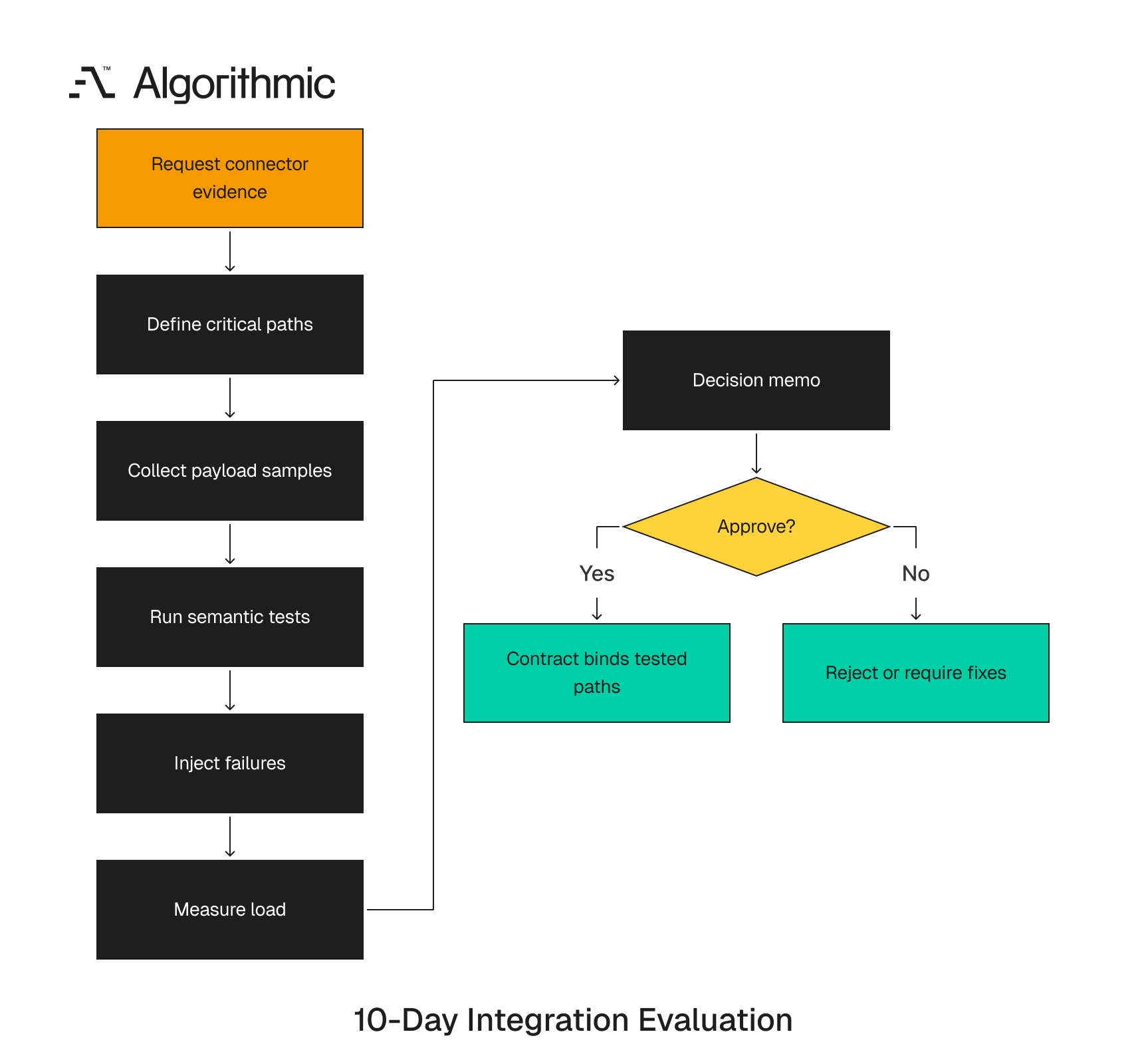
A focused evaluation does not need a quarter, since a disciplined team can complete the first proof cycle in 10 working days.
 Click to expand
 Days 1 and 2 should define the critical paths. Select three to five connector paths that carry revenue, risk, customer experience, or regulatory load, and do not spend the first evaluation on low-value reference data. Use paths that create financial exposure, customer impact, audit findings, or operational backlog when they fail. Days 3 and 4 should collect payloads, using real record shapes with sensitive fields removed or tokenized, and including both normal records and records designed to trigger failure conditions. The sample set should contain nulls, unknown enum values, duplicate identifiers, late events, and records near size limits.
Days 5 and 6 should run semantic tests, comparing field presence, types, constraints, identifiers, timestamps, units, and enum values before and after the round trip. Record every transformation in the connector map, naming the component that changed the field and the reason for that change. Days 7 and 8 should run failure tests that force rate limits, authentication errors, schema drift, duplicate events, and partial target failures, then capture alerts, logs, dead-letter queues, replay steps, and recovery time. Confirm that alert routing reaches the named owner during the test window. Days 9 and 10 should run performance tests and produce the decision memo, which should state whether each connector path is approved, approved with constraints, or rejected. It should include p95 latency, throughput, failure behavior, open risks, required engineering work, and the unsupported operations that the business assumed were available.
This 10-day process fits procurement timelines and prevents common production failures, and it creates an evidence record that architecture, security, finance, and operations leaders can review together. The team should assign roles before the test starts. Engineering owns connector setup and measurement, security reviews credentials, secrets, and access scope, and data owners approve payload samples and semantic checks. Procurement should attend the final readout, and contract language should reflect the measured paths, operating limits, support ownership, and remediation duties. Vendor claims outside the tested scope should remain outside the approved architecture, which prevents an approved connector from expanding into untested workflows through later project pressure.
A 10-day evaluation also creates a baseline for later change control, so when the vendor upgrades a connector, adds an API version, or changes retry behavior, the team can rerun the same tests. This prevents regression hidden behind a release note, and it gives internal audit a repeatable record for systems that handle regulated, financial, or customer-sensitive data. The schedule works best with a small evaluation team, a typical group being one integration engineer, one data engineer, one security reviewer, one data owner, and one procurement lead. The group should meet daily for 30 minutes during the test window, since longer workshops signal missing preparation, unclear ownership, or vendor evidence gaps.
The 10-day evaluation output
The final packet should be short enough for executives and detailed enough for engineering, so a 12-page memo and linked evidence repository usually works. The memo should include the business paths tested, the systems involved, and the connector operations approved, and it should state unsupported operations in plain language. For each path, include a table with source, target, API versions, payload count, p95 latency, p99 latency, throughput, rejection count, and replay result, and use the same table format across vendors. The evidence repository should hold source payloads, transformed payloads, target payloads, returned payloads, logs, screenshots, and test commands, with sensitive fields masked or tokenized.
Each exception needs an owner and a deadline, for example a note that Opportunity delete capture is unavailable and revenue operations accepts daily reconciliation until the vendor ships CDC support by 30 June. Exceptions without owners become permanent production risks, while exceptions with owners, dates, and test conditions become controlled decisions.
Contract terms should match connector evidence
The RFP should request connector maps before vendor selection, and the contract should then bind service commitments to the measured paths. A generic uptime clause does not protect a revenue connector that silently drops 2 percent of records, so the agreement should define the path, operation, latency target, replay duty, and support response. The contract can state that Salesforce Account upserts to Snowflake must meet a specific p95 latency under a defined event rate, and it can require vendor support when error rates exceed a named threshold. The same contract should define data loss handling, since silent drops, unreported partial failures, and replay gaps need remediation duties and escalation paths.
Version changes need advance notice and regression testing, so if the vendor changes an API version, connector runtime, retry policy, or field mapping, the buyer should receive test evidence before production rollout. Support ownership should be explicit, and the contract should state which party owns connector runtime, logs, secrets, monitoring, incident response, and replay. This language protects both parties, because the vendor avoids open-ended obligations and the buyer avoids paying for discovery that belonged in diligence. Procurement should avoid accepting broad terms such as commercially reasonable efforts for critical data paths, since those paths need named service levels, evidence records, and remediation steps.
The evidence standard for vendor selection
A vendor that owns integration quality will welcome connector-level diligence, because the sales process becomes more concrete and the architecture decision becomes easier to defend. Engineering, finance, security, and procurement can discuss the same evidence set instead of separate interpretations of a logo grid. A vendor that cannot produce payloads, latency data, failure behavior, and connector ownership boundaries is asking the buyer to fund discovery after contract signature, which is a poor trade for any data platform development program, especially when the integration layer carries finance, customer, operations, or ML data.
CTOs should make connector evidence a formal procurement requirement. Add the Four-Gate Connector Evidence Framework to the RFP, require a connector map before architecture approval, and reject integration claims that have not completed a measured round trip. The standard should apply to software vendors, systems integrators, and internal platform teams, since internal teams create the same risk when they publish connector catalogs without payload evidence or production load data. The final approval package should include the connector map, sample payload comparisons, failure test records, performance results, and ownership matrix, and it should state the unsupported operations in plain language. To carry that same evidence through to audit and compliance, pair this review with data lineage implementation from ingestion to audit evidence, which tracks how records keep their meaning across the whole path.
This discipline changes the procurement conversation. The buyer no longer asks whether a vendor integrates with Salesforce, Snowflake, Braze, Revit, or Kafka, but asks which operations work, under which API versions, at which load levels, with which failure behavior, and under whose ownership. The answer must include observed payloads, measured latency, error recovery, and named accountability. That is the evidence standard integration claims require, and anything less leaves production semantics, operating cost, and customer trust to post-contract discovery.
Algorithmic runs data infrastructure and integrations work that produces connector maps, round-trip payload proof, and load evidence before a platform enters your architecture. Start a conversation if you are evaluating a vendor whose integration claims still rest on a logo grid.