
Architecture approval should follow one production walk-through. A one-week technical due diligence review can prevent a $25,000-per-month operating burden when it tests runtime ownership before design approval. That burden rarely appears in class diagrams, and it lands after handoff, when the client team must deploy, patch, monitor, restore, and fund the system.
Most architecture reviews inspect diagrams, frameworks, repository structure, database choices, and API boundaries. These checks answer structural questions, but ownership requires runtime evidence. Runtime ownership covers deployment, storage, observability, incident response, access control, backups, cost controls, dependency upgrades, and lifecycle management. A design can pass a static review and still transfer daily production work to a client team with limited staff, tooling, or context, which can add two full-time operating roles inside one quarter.
Engineering leaders who commission architecture reviews before scale, funding, vendor replacement, or platform rebuilds should make runtime ownership a formal approval gate. The review should test the system people will operate, and approval should wait until the intended owner proves control through production evidence.
Runtime ownership sets the cost profile
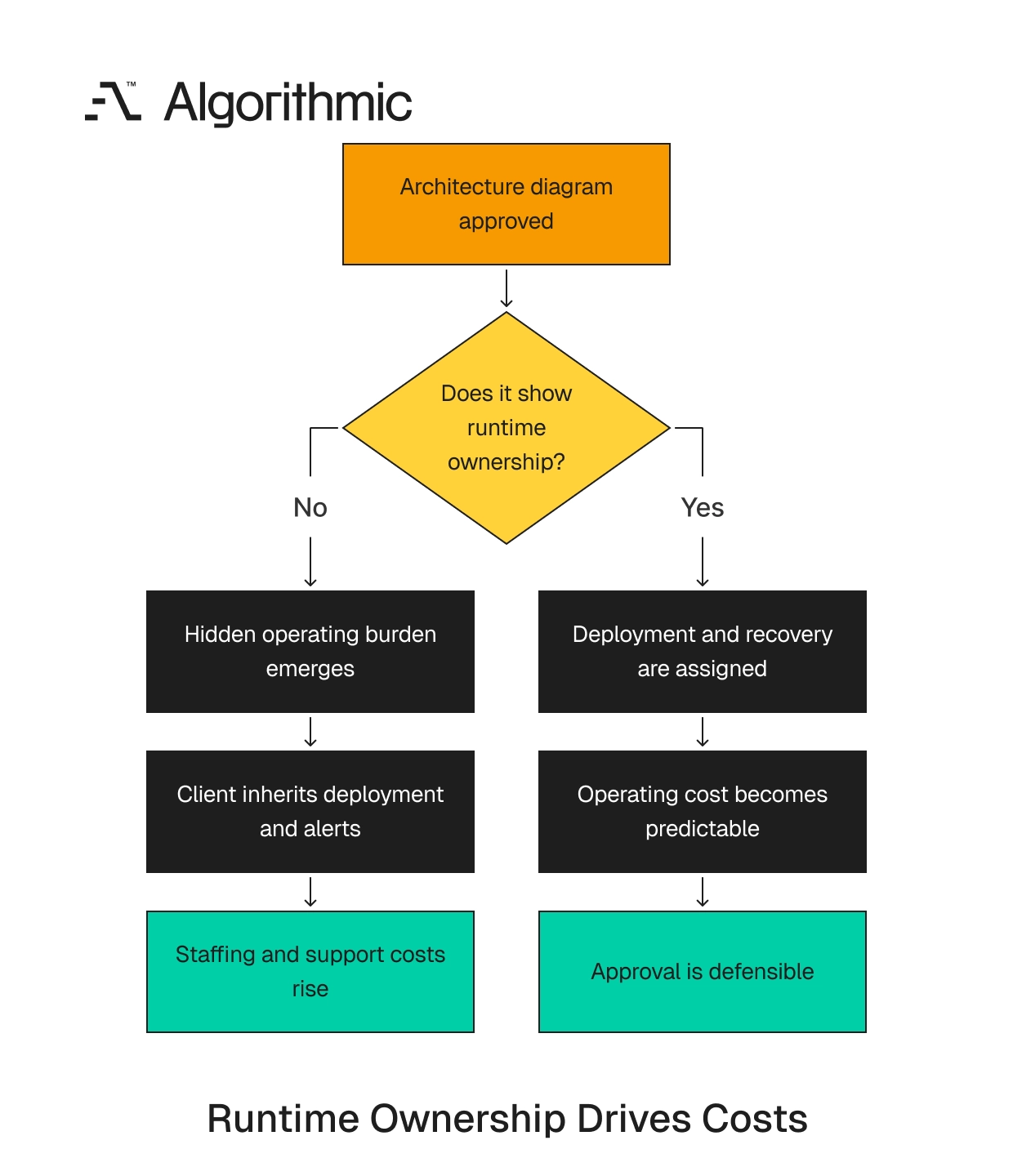
A platform with clean service boundaries can still create an expensive operating model. The cost appears when the team asks basic production questions after the design has been approved. Who rotates credentials, who patches base images, and who responds when queue depth crosses 50,000 messages. Who reviews Terraform drift, who owns PostgreSQL vacuum settings, index growth, retention policies, and point-in-time recovery, and who approves emergency releases after 11 p.m. Who decides when logs exceed the monthly budget by $8,000, who investigates failed scheduled jobs that affect executive reporting, and who contacts the vendor when an identity provider changes an API contract.
These questions determine staffing. A system that requires 0.25 FTE from a platform team has one cost model, and a system that requires 2.0 FTE across DevOps, data engineering, and application support has another.
 Click to expand
 The same architecture diagram can produce both outcomes. React, Node.js, PostgreSQL, Redis, S3, and Kubernetes can support a six-person product team, but that result requires engineered deployment, observability, runbooks, and data lifecycle rules. The same stack can require a standing external support contract when the original vendor retains deployment knowledge and gives the internal team source code alone, since GitHub access does not equal production control.
The cost difference compounds. At a fully loaded engineering cost of $180,000 per year, two unplanned operating roles add $30,000 per month, and that figure excludes cloud spend, incident cost, customer credits, and roadmap delay. Runtime ownership also affects hiring, because a platform that depends on undocumented Kubernetes procedures forces the company to hire senior infrastructure staff, while a platform that runs through versioned pipelines can be operated by the intended product team with scheduled platform support. This difference matters during funding and acquisition, where investors review product velocity, margin, and technical risk, and a platform with unresolved runtime ownership converts technical uncertainty into recurring operating expense.
Across 35+ complex engagements, Algorithmic has seen the same pattern in product engineering, machine learning systems, and data platforms. The most expensive surprises appear after handoff, once ownership has been assumed in a meeting and left untested in production. Healthcare platforms discover weak audit log ownership during compliance review, and fintech platforms discover recovery gaps during payment incidents. Data platforms discover cost ownership gaps when warehouse spend crosses budget, AI products discover model API dependency gaps when inference latency rises under load, and marketplaces discover queue ownership gaps when order events back up during peak traffic.
The pattern also appears in smaller companies with fewer than 50 employees. A founder signs off on a platform because the demo works and the repository looks disciplined, and three months later the team learns that certificate renewal, log retention, and restore testing still sit with the original builder. Runtime ownership turns those hidden duties into named work, assigning the person, the permission, the evidence artifact, and the recurring review date. That assignment changes the economics of the architecture before the company funds growth.
Static reviews miss operating risk
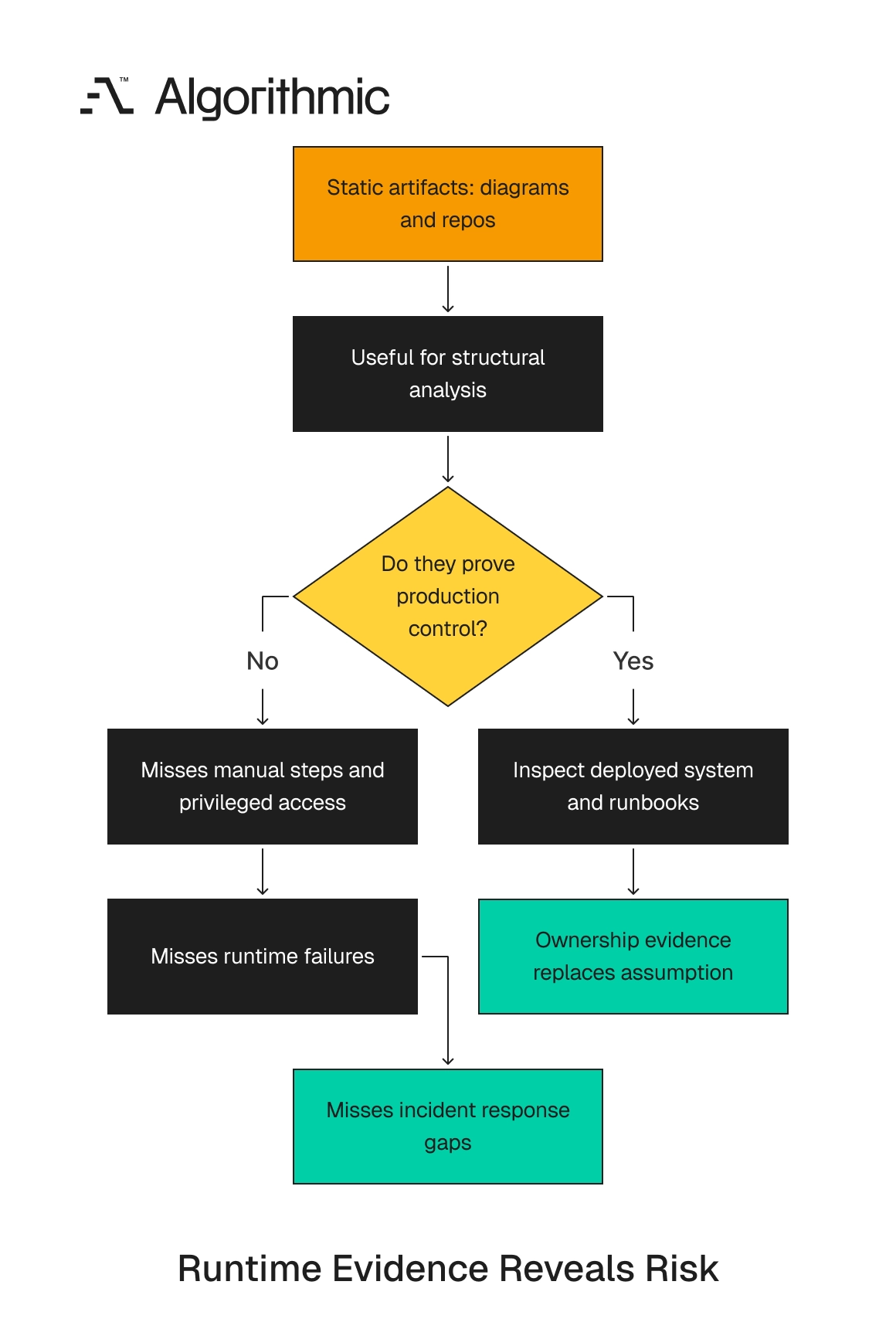
Static reviews have a defined role. C4 diagrams, architecture decision records, dependency maps, and codebase scans help teams reason about structure, and they expose coupling, unclear boundaries, and technology choices that increase maintenance cost. The limitation is scope, since static artifacts describe intended structure while production systems fail through runtime behavior. Repository inspection alone misses manual console steps, unmanaged credentials, disabled alerts, and undocumented recovery procedures, so a repository can look disciplined while production remains fragile. A reviewer must follow one change into production.
We have seen Terraform modules present in GitHub while actual changes were made in the AWS console, Helm charts in source control while production deployments depended on one engineer’s laptop, and CloudWatch dashboards built for a launch week and abandoned for nine months. Architecture-as-code helps when it keeps rules close to the codebase, and a policy check can reject a misconfigured manifest, but the operating model still needs named owners for failed builds, expired secrets, alert fatigue, and rollback decisions. Automated checks also need responders, because a policy engine can block an unsafe change while a named team must fix it, ship the correction, and verify production recovery. This is the substance of the AWS Well-Architected operational excellence pillar, which treats runbooks, event response, and clear ownership as design concerns rather than afterthoughts.
The review must inspect the control plane, which means CI/CD workflows, IAM policies, runtime manifests, secret stores, alert routing, backup jobs, and cost controls. Diagrams become evidence only when they match deployed infrastructure.
 Click to expand
 A static review can approve an elegant design that no internal team can run, and runtime review prevents that approval failure by connecting design quality to operating control. The reviewer should ask for the deployed system rather than the intended system, since the deployed system shows which scripts run, which credentials work, and which alarms reach responders. That evidence replaces opinion with inspection.
This point matters in vendor-led builds. Vendors often deliver diagrams that describe the target architecture accurately, then the production account contains manual exceptions, temporary credentials, and undocumented release steps created under schedule pressure. Those exceptions become the client’s burden after handoff, and a one-week review identifies them before they harden into the operating model. The result is a transfer plan with owners and dates, not an abstract technical inventory.
The runtime ownership test
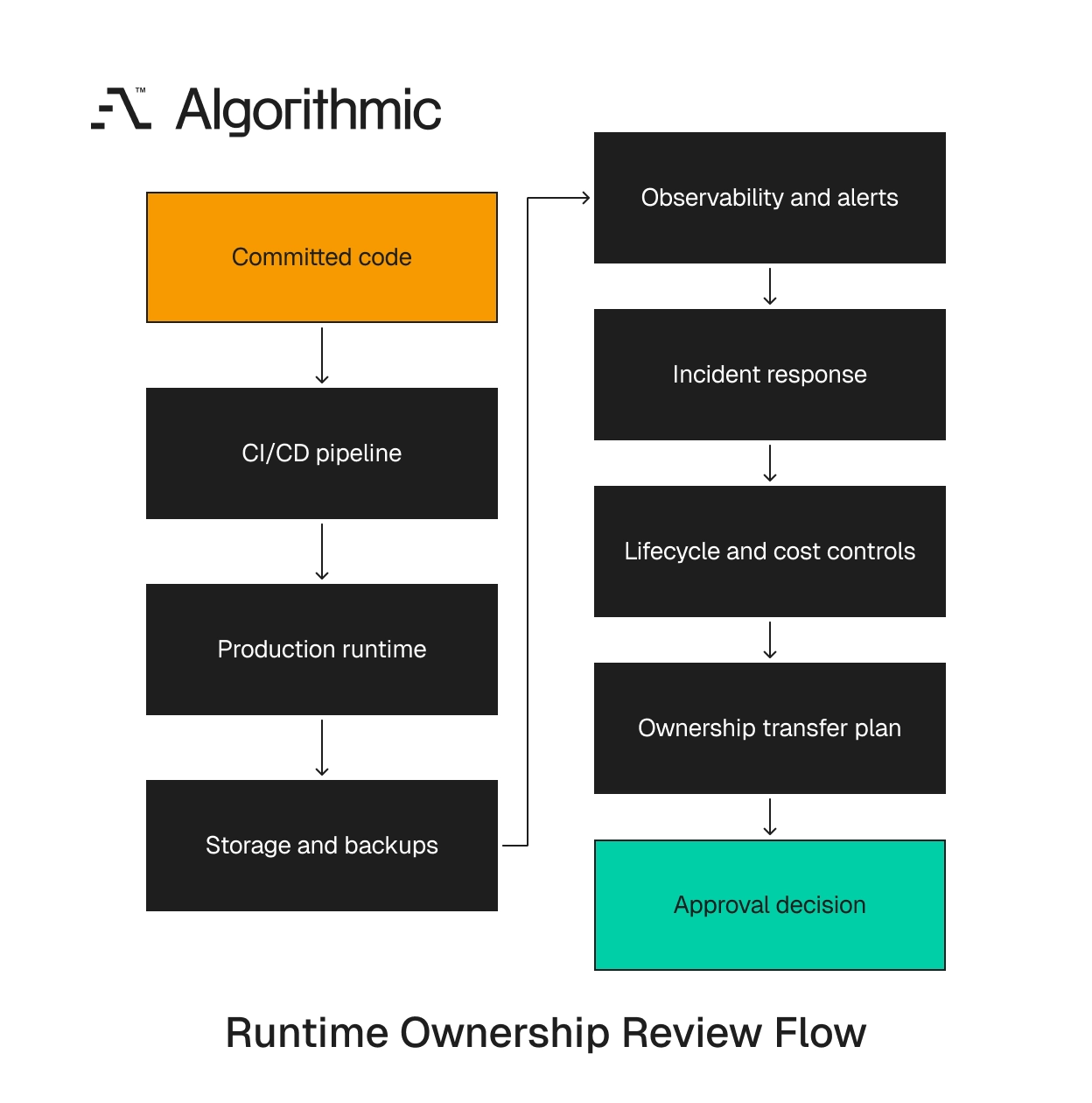
The Runtime Ownership Test is a one-week review method for assessing whether a system can be maintained by the intended owner. It works for technical due diligence, software project rescue, architecture review, and pre-scale platform assessment. The test answers four questions, since the intended owner must be able to deploy the system, recover the data, detect and resolve failure, and keep the platform current. These questions sound simple because production ownership is concrete, and the evidence is concrete too, in logs, pipelines, restore records, runbooks, access policies, and owner names. Written intent does not pass the test.
 Click to expand
 | Review domain | Evidence to inspect | Pass condition | Failure signal |
|---|---|---|---|
| Runtime | Terraform, Pulumi, CloudFormation, Helm, service manifests, topology | Internal team can explain and recreate the environment | Vendor-only console access or undocumented setup |
| Deployment | CI/CD workflows, migration scripts, release logs, rollback notes | A change reaches production through a repeatable pipeline | Releases require one external engineer |
| Storage | Schema history, backup policy, restore records, retention rules | Restore procedure ran within 90 days | Backups exist with no restore evidence |
| Observability | Dashboards, alerts, traces, runbooks, incident history | Three known failures trigger clear detection paths | Alerts route to a shared inbox |
| Lifecycle | Upgrade calendar, dependency policy, cost review records | Owners exist for runtime, libraries, data, and vendors | No named owner for patching or deprecation response |
| Access | IAM policies, RBAC, secret stores, admin accounts | Operators have least-privilege access and rotation dates | Shared credentials or unknown break-glass owners |
| Cost | Cloud budgets, log retention, warehouse spend, API usage | Cost thresholds have owners and review cadence | Spend grows without alerting or budget ownership |
This table should be completed before architecture approval. A review that cannot fill the owner column is incomplete, and a review that cannot produce evidence has found an operating risk. The table also prevents false agreement, because teams can agree that “DevOps owns deployment” in a meeting, and the evidence column forces the review to show pipeline access, release logs, rollback history, and escalation paths.
Ownership should name three roles. The runtime owner controls deployed infrastructure, the first-fix owner restores service during an incident, and the long-term owner reduces recurrence through design changes, dependency replacement, or capacity work. These roles often belong to different people. A platform engineer can restore a queue worker during an incident, and the application lead must still fix the retry logic that caused the backlog. A database administrator can restore a snapshot, and the product engineering lead must still decide how to repair user-visible data.
The ownership map should survive staff turnover, so “Platform team” is incomplete while “Platform team, primary owner Dana Lee, escalation Head of Engineering, evidence PagerDuty service and GitHub CODEOWNERS” is usable. A useful ownership map also records the transfer path, stating which person holds access now, which person will hold it after approval, and the test that proves the transfer worked. As an example, “vendor engineer deploys production” is an operating dependency, “internal engineer runs GitHub Actions deployment with vendor observing” is transfer evidence, and “deployment succeeded at 14:32 UTC with rollback notes attached” is approval evidence.
What the review must test
A software architecture review should produce an ownership map across seven operating domains, and each domain must identify the owner, escalation path, evidence artifact, and transfer plan. The map should be specific enough for an executive to fund the remediation. The review should inspect real artifacts, since meeting notes do not prove deployment control and a runbook does not prove recovery until the intended team uses it.
1. Runtime and access
The review should identify where code runs and who controls that environment, including Kubernetes clusters, ECS services, serverless functions, VM groups, batch workers, schedulers, background processors, DNS, TLS certificates, feature flag services, and webhooks. The reviewer should require proof that the runtime can be recreated from source-controlled configuration, so Terraform, Pulumi, CloudFormation, Helm charts, and GitHub Actions workflows should be readable by the future owner, because a runtime owned through a vendor console creates dependency risk. Permissions matter as much as configuration, since AWS IAM roles, Kubernetes RBAC, GitHub environments, and secret manager policies define who can operate the system, and ownership without access is a paper assignment.
The review should also cover environment parity, where production, staging, and development share the same deployment pattern, because special production-only steps become failure points during incidents. Privileged access needs its own review, since root cloud accounts, break-glass credentials, CI/CD service accounts, and database administrator roles require named owners, and each privileged path needs a rotation schedule and audit trail. The principle of least privilege sets the standard here, so the reviewer should inspect access logs for recent privileged actions, since a root account used weekly signals poor role design and a break-glass account with no last-tested date creates recovery uncertainty. Runtime review should also include third-party control points, because Stripe webhooks, Auth0 tenants, SendGrid domains, LaunchDarkly projects, and Datadog org settings affect production behavior, and each service needs an owner with administrative access and a backup contact.
2. Deployment and release control
Deployment ownership covers CI/CD pipeline design, release approvals, feature flags, rollback, database migrations, and environment promotion. The architecture review should inspect the release path from merged pull request to production URL, and a complete review asks for a live deployment demo. The team should show a schema change, service change, deployed endpoint, smoke test, and rollback path, and the change can be small, since a health check endpoint, configuration update, or non-breaking schema addition is enough. The point is to test control, so the reviewer records every handoff, and each manual approval, credential request, undocumented command, and private Slack message becomes evidence of operating dependency.
Release ownership also includes failed release handling, so the reviewer should ask who pauses a rollout, who reverts a migration, and who communicates customer impact, because those decisions need names, permissions, and rehearsed steps. Database migrations deserve separate inspection, since a backward-incompatible migration can take a production application offline even when the service deploy succeeds, and the review should test migration locks, rollback notes, and data backfill procedures. Feature flags also need ownership, because a stale flag can keep old behavior alive for months and a flag with no removal date creates branching logic that increases test burden. The reviewer should inspect release frequency and failure records, since a team that ships twice per month needs a different rollback model from a team shipping 40 times per week, and the DORA four key metrics give the approval record a shared vocabulary for deployment frequency, lead time, change failure rate, and time to restore.
3. Storage and data lifecycle
Storage ownership includes schema design, migrations, indexes, backups, retention, encryption, data lineage, and restore procedures, and these items create long-term cost through cloud bills and recovery risk, since a clean entity model does not cancel untested recovery. A review should inspect the database migration history, backup configuration, restore tests, and data retention policy, because a PostgreSQL database with no documented restore test in the last 90 days is not production-ready, and the backup job is evidence of intent rather than evidence of recovery. The Google SRE data integrity practice makes the point directly, since a recovery path can sit in a latent broken state that nobody notices until they attempt a real restore. For data-heavy systems, ownership extends to warehouse jobs, dbt transformations, event schemas, and data quality monitoring, so the business intelligence engineering layer needs the same ownership clarity as the application layer, because a failed dbt model can break board reporting while the application stays healthy.
Storage cost also needs an owner, since logs, object storage, warehouse tables, and indexes grow without visible failure signals, and a system can remain available while its storage bill doubles over two quarters. The reviewer should ask for retention rules by data class, because customer records, audit logs, clickstream events, model features, and support attachments have different retention needs, and one default policy across all storage creates cost and compliance risk. Restore testing should produce evidence, so the reviewer should inspect the date, target environment, recovery duration, data validation step, and person who ran the test, since a tabletop without a measured restore time leaves recovery risk unresolved. Encryption and key ownership also belong in storage review, because AWS KMS keys, database encryption settings, and secret stores affect recovery, and a backup encrypted with a key no current operator controls is a failed recovery plan. Data lineage matters when reports drive board metrics or regulatory filings, so the reviewer should trace at least one revenue metric from source event to dashboard, where each transformation step has an owner, a test, and a failure notification path.
4. Observability and incident response
Observability ownership covers logs, metrics, traces, dashboards, alerts, on-call schedules, runbooks, and incident review. The review should test whether the team can detect, diagnose, and recover from known failure modes, and tool presence alone does not pass this gate. The reviewer should inject or simulate at least three controlled probes, and strong probes include a failed payment webhook, saturated queue, and database connection exhaustion, where each probe produces an alert, a runbook path, and a measurable recovery step. The control layer matters most in distributed systems architecture, since schedulers, orchestrators, rate limiters, circuit breakers, retries, and alert rules govern production behavior under load, and these controls need owners because they change during incidents.
A dashboard without an owner has limited operational value, so the reviewer should identify who maintains each dashboard, who tunes thresholds, and who removes stale alerts, because a Slack channel with 118 members is not an on-call model. A named PagerDuty service with escalation, runbook links, and response records is an operating model, and incident review should connect back to architecture, since repeated queue saturation points to capacity planning, retry behavior, or workload partitioning. The review should also inspect alert quality, because alerts that fire daily without action train responders to ignore them, while alerts tied to customer impact, error budgets, or recovery steps create better operating discipline. Incident response needs communication ownership, since the person restoring service often differs from the person updating customers or executives, and the review should name both roles for severity-one and severity-two incidents.
5. Lifecycle management
Lifecycle ownership covers upgrades, deprecations, security patches, dependency review, cost review, and migration planning, and this domain is where elegant designs become expensive, because deferred maintenance becomes production risk when nobody owns it. A review should identify the owner for Node.js runtime upgrades, Python package pinning, Kubernetes version updates, managed database major versions, API deprecations, and third-party contract changes, and each item needs a review date, since backlog entries without dates become future incidents. A platform built on a deprecated SDK, an unmaintained Terraform module, or a vendor-specific deployment path creates migration cost before the next feature ships, so lifecycle work should appear on an engineering calendar, where runtime upgrades, certificate renewals, license renewals, and dependency reviews all carry dates.
The review should also inspect the vendor dependency register, because payment providers, identity systems, email services, model APIs, data warehouses, and observability tools all change contracts and APIs, and each dependency needs an owner and exit path. Security patching deserves direct inspection, so the reviewer should ask who triages GitHub Dependabot alerts, Snyk findings, container CVEs, and operating system patches, and the answer should include severity thresholds and release windows. Lifecycle management also covers end-of-life dates, since PostgreSQL major versions, Kubernetes minor versions, and Node.js LTS schedules are predictable, and a team that tracks these dates avoids emergency work during business-critical releases.
6. Cost control
Cost ownership belongs in the architecture review because production cost follows design choices, and compute, storage, logs, metrics, warehouse queries, and third-party APIs all need thresholds, since finance cannot control technical spend without engineering owners. The reviewer should inspect cloud budgets, log retention rules, warehouse cost reports, and API usage limits, and the review should name the owner for each cost class, because a single “cloud cost” owner cannot manage the full profile. Cost failures rarely page the team at 2 a.m., since they appear in month-end reports, gross margin erosion, and budget variance meetings, and that delay makes ownership essential.
Specific examples matter, because a product team can accept 30 days of indexed logs for customer support and keep cold storage for 365 days, then reject indefinite full-text log retention that adds $8,000 per month. Cost review should also cover unit economics, so the reviewer should ask for cost per tenant, cost per 1,000 requests, cost per inference, or cost per report refresh, since the right metric depends on the product model. AI systems need special attention here, because model API calls, GPU workloads, vector database queries, and embedding jobs can grow faster than user revenue, and each cost driver needs a budget, threshold, and owner.
7. Knowledge transfer
Knowledge transfer must be tested through action, since documentation has limited value until the receiving team uses it under review, so the architecture review should require the internal team to perform core operating tasks. The internal team should run a release, rotate a secret, restore a backup, respond to an alert, and update one dependency, and each task should produce a record that proves ownership moved from the builder to the operator. Training sessions alone do not prove transfer, because the receiving team must operate the system with the vendor present as observer, and the final approval should use that evidence.
The transfer should cover normal work and incident work, where normal work includes releases, configuration changes, and dependency updates, and incident work includes rollback, restore, escalation, and customer communication. Documentation should be written for the receiving team’s skill level, since a five-person product team needs different instructions from a 30-person platform group, and the review should test whether the intended operator can follow the material without private vendor context.
How a one-week review exposes future operating burden
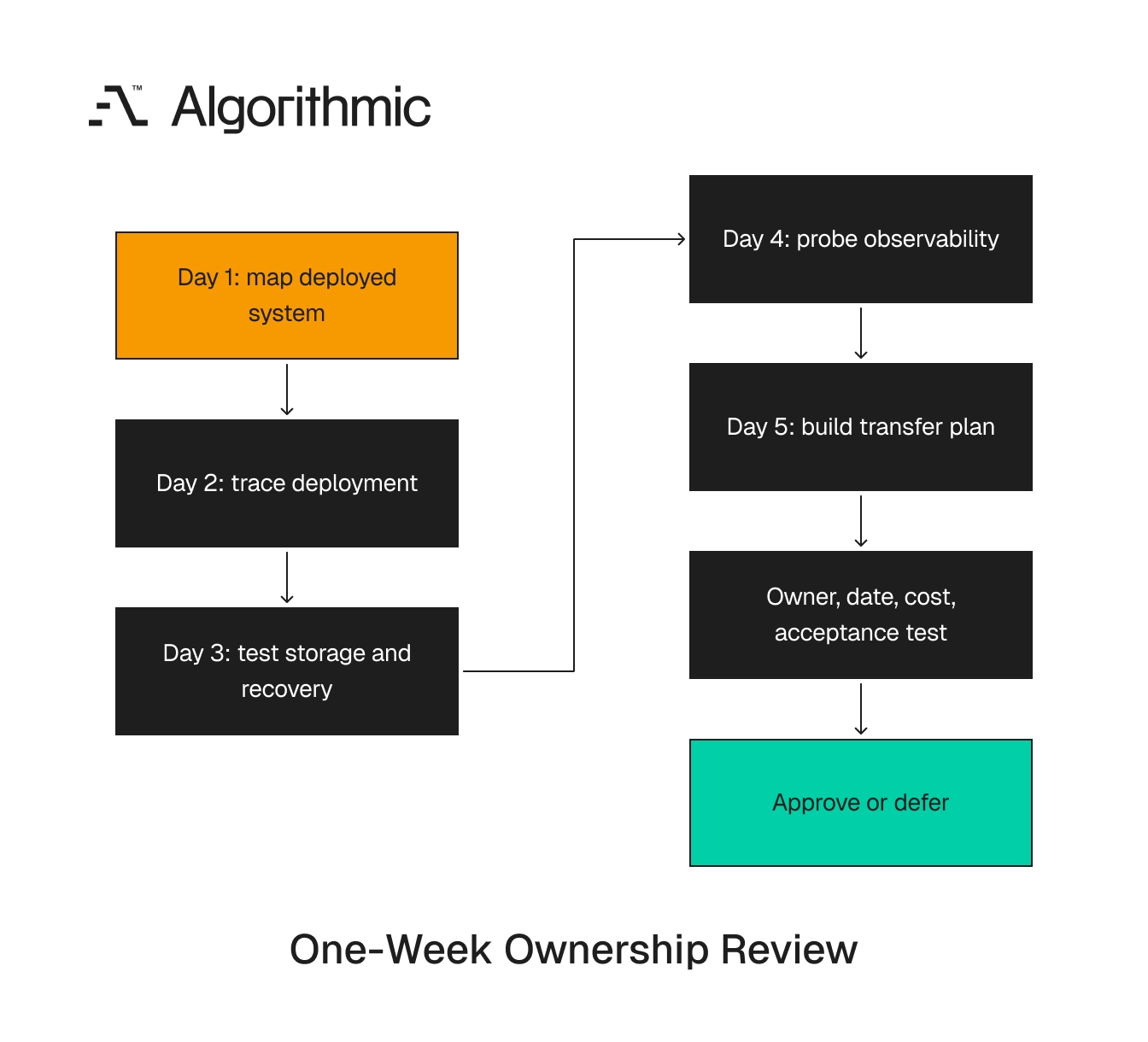
A runtime ownership review does not need six weeks, since five focused days can expose the major risk areas, and the schedule works because the review starts from production evidence. The review avoids abstract debate and tests the paths teams use after launch, and the output is an ownership transfer plan with names, dates, cost, and acceptance tests. The week should include the people who will own the system after approval, which usually means the engineering lead, one application engineer, one platform or DevOps engineer, and one product or operations owner, with a vendor representative attending as an observer and evidence provider. The review should use a shared evidence folder, where each finding links to a pipeline run, access policy, restore record, dashboard, runbook, or cost report, and this discipline makes the final approval record auditable.
 Click to expand
 Day 1 maps the deployed system
The review starts with the deployed system before repository inspection. The team maps production services, environments, databases, queues, caches, object stores, secrets, third-party APIs, and scheduled jobs, and the output is a runtime topology diagram with owners assigned to every node. Any node with no owner becomes a review finding, and the map should include non-code assets, since DNS zones, TLS certificates, email domains, analytics scripts, payment webhooks, and feature flag services affect production behavior. The reviewer should also identify privileged access paths, because root cloud accounts, break-glass credentials, CI/CD service accounts, and database administrator roles require named owners and rotation schedules, and these paths decide whether the team can act during an incident.
Day 1 should end with an owner list, and each owner should confirm access during the review rather than after it, since a role assignment in a document does not matter if the person cannot log in. The topology should show data flow as well as services, because customer records, payments, logs, and analytics events often cross different systems, and each crossing creates a support path and a recovery path.
Day 2 traces deployment from commit to production
The reviewer follows one change through the delivery path, including pull request checks, artifact build, container registry, infrastructure changes, database migration, release approval, smoke test, and rollback, and the trace shows who controls the route to production. This day often reveals hidden dependency on external vendors, since a founder may believe the internal team owns the platform because the team has GitHub access, while production deployment still depends on credentials and scripts held by the original builder.
The release trace should use a small change, so a health check endpoint, configuration update, or non-breaking schema addition is enough, and the reviewer should record every manual step and credential request. The trace should include failure handling, where the team shows how it stops a bad release, reverts a service, and handles a failed migration, and the reviewer captures the exact command, pipeline job, or runbook step. Day 2 should produce a deployment control score of owned, shared, or vendor-controlled, and any vendor-controlled step needs a transfer date and acceptance test.
Day 3 tests storage and recovery
The review inspects data stores and runs a recovery tabletop exercise. For PostgreSQL this includes backup schedule, point-in-time recovery settings, restore history, index growth, slow queries, migration lock risk, and retention rules, and the review also checks who owns each decision. For event-driven architecture the review examines topic retention, dead-letter queues, replay procedure, idempotency, and schema versioning, and storage failure modes are expensive because recovery time affects customers, finance, compliance, and executive reporting, so the owner must know the recovery path before the incident starts.
The tabletop should use a specific scenario, for example an engineer drops a tenant-level table at 10:15 a.m. and customer support reports missing records at 10:40 a.m., and the team should state the recovery target, restore path, communication owner, and validation step. Data warehouses need the same scrutiny, since a failed dbt model can break executive dashboards while the application stays healthy, and the review should trace ownership from ingestion through reporting. Day 3 should produce a recovery evidence record covering recovery point objective, recovery time objective, last test date, and actual recovery duration, and it should also identify missing permissions and data validation gaps. For regulated data the review should add audit requirements, because HIPAA, SOC 2, PCI DSS, and FINRA controls all require evidence, and the runtime owner should know where that evidence lives and who produces it.
Day 4 probes observability and control systems
The reviewer tests whether the system can identify predictable failures, so the team should show alert paths for worker failure, latency breach, API error spike, queue backlog, third-party timeout, and database saturation, and each path needs an owner and a response step. A system using Datadog, Grafana, OpenTelemetry, or CloudWatch can still fail this gate, because dashboards need owners and alerts need runbooks. The probes should be controlled and reversible, so the reviewer can lower a threshold in staging, pause a worker, simulate a webhook failure, or exhaust a small test connection pool, and the production team should perform the response.
Each probe should produce a record covering alert time, responder, runbook link, diagnosis step, recovery action, and follow-up ticket, and these records become evidence for approval. Day 4 should also test alert routing, since a message in a shared Slack channel does not prove response, and the reviewer should see escalation rules, acknowledgement records, and ownership during business hours and after hours. Observability review should include customer impact signals, because internal metrics matter and user-facing symptoms matter more during executive escalation, so the team should know which dashboard answers how many customers are affected right now.
Day 5 builds the ownership transfer plan
The final day converts findings into named owners, timelines, and decisions, and each unresolved ownership gap receives a severity rating and cost estimate, so the plan separates immediate control risks from scheduled lifecycle work. A production-ready transfer plan should specify a 30-day stabilization window, a 60-day documentation and training path, and a 90-day reduction in external dependency, because without dates ownership remains aspirational and without acceptance tests transfer remains a claim. The plan should also specify proof points, where the internal team runs a release, rotates a secret, restores a backup, responds to an alert, and updates one dependency, and these tests prove the transfer occurred.
Severity ratings should connect to cost, since a missing restore test carries customer and compliance risk while a vendor-controlled deployment path carries roadmap and continuity risk. Day 5 should end with an approval recommendation that is binary for the current state and specific for remediation, approving when evidence exists and deferring when ownership gaps remain unfunded. The final plan should be suitable for a board packet, stating the operating risk, required spend, owner, due date, and acceptance test, so executives can fund that plan without interpreting low-level infrastructure detail.
A concrete scenario of an elegant platform that transferred the burden
A SaaS company with 42 employees commissioned a software architecture review before raising a Series A extension. The platform used Next.js, NestJS, PostgreSQL, Redis, SQS, Lambda, and Terraform, the code structure was disciplined, and the service boundaries were clear. The runtime review found a different risk profile, since production deploys depended on two engineers at the external development partner, and database migrations were run manually from one engineer’s workstation. CloudWatch alerts routed to a Slack channel with 118 members and no named responder, and although the company had automated backups for its primary PostgreSQL database, no one had tested recovery in the prior 12 months.
The first restore test took 7 hours and 40 minutes, and the team discovered missing permissions, unclear snapshot naming, and no validation checklist, against a business recovery target of four hours. The gap was operating control, so the review did not recommend a platform rebuild and instead recommended a four-week ownership transfer. The team moved deployment into GitHub Actions with environment approvals, added migration checks with rollback notes, and created seven runbooks covering deployment failure, queue saturation, database connection exhaustion, failed webhooks, expired certificates, restore procedure, and elevated error rates. They set service ownership in PagerDuty and ran a restore test into a staging account, and the second restore completed in 2 hours and 25 minutes with validation signed by the engineering lead.
The company’s board received a clearer risk picture after the review, and the issue was no longer framed as a rewrite decision but as a four-week transfer with acceptance criteria, named owners, and a measured recovery target. This outcome matters for boards and investors, since a codebase can be technically sound and operationally dependent, and a software architecture review should identify both conditions. The strongest review separates structural defects from operating dependency, because structural defects require redesign, refactoring, or replacement, while operating dependency requires access transfer, runbooks, tests, and ownership assignment. Those paths have different budgets, since a rewrite can consume six months and seven figures, while an ownership transfer can take four weeks when the underlying architecture is sound.
The company also avoided a hiring mistake, because leadership had considered hiring a senior infrastructure engineer to stabilize the platform, and after the review the team funded a limited transfer plan and kept hiring focused on product engineering. The distinction changed the Series A extension discussion, since investors saw measured recovery improvement, named owners, and reduced vendor dependency, and the company replaced an open-ended technical risk with a dated remediation plan.
Vendor evaluations should include runtime architecture
The same standard applies when selecting tooling vendors, AI product studios, MLOps teams, data engineering partners, or a custom software development company, since a vendor’s API quality matters and its runtime architecture carries equal weight. This connects directly to how you evaluate a software development partner on delivery evidence rather than presentation. For an ML application tool, the review should ask how the runtime handles concurrent users, model inference, live updates, session state, GPU scheduling, and deployment, because a small API can hide complex runtime work, and inference cost, queue behavior, and model versioning decide production economics. For a data platform vendor, the review should ask who owns orchestration, warehouse cost controls, dbt transformations, data quality checks, and lineage, since a polished executive dashboard has limited value if the client inherits fragile ETL work with no runbook, and warehouse spend can rise for weeks before users report a failure. For a full product build from scratch, the review should ask whether the partner manages runtime, storage, deployment, and observability during build and transition, and a demo should show the full lifecycle across a schema change, service change, deployed URL, monitoring signal, and rollback path.
AI code review tools also illustrate the boundary, because these tools can increase code review throughput and flag insecure dependencies, while runtime ownership still requires named humans, production permissions, escalation paths, and tested recovery procedures. An AI tool can identify an outdated package, and a production owner must still patch it, release it, monitor the deployment, and verify the service remains stable, so that handoff should be explicit in the operating model. Vendor contracts should reflect this standard, since statements of work should specify deployment transfer, infrastructure code ownership, runbook creation, monitoring setup, restore testing, and cost control, and acceptance should depend on evidence instead of presentation materials. This requirement protects both sides, because the client receives an operable system and the vendor avoids indefinite support obligations caused by unclear handoff terms.
The contract should also define the end state, since source code delivery is insufficient for a production platform, and the end state should include working pipelines, transferred credentials, tested recovery, active alerts, and a signed ownership map. Vendor evaluation should include a production-readiness demo before final selection, so the buyer should request a sample release trace, restore record, alert path, and handoff plan, and vendors with mature delivery practices can provide this evidence early. Procurement teams should avoid accepting uptime claims without operating detail, because a vendor can meet a service-level target through its own staff while leaving the client dependent after transfer, so the review should identify who operates the system on day one after acceptance.
What engineering leaders should require before approval
Architecture approval should require evidence across design, code, and operations. The following checklist fits most platforms with fewer than 25 services, and larger platforms should expand the same categories across domains and teams.
Runtime ownership approval checklist
- Every production service has a named owner and escalation path.
- The intended internal team can run the deployment pipeline.
- Infrastructure configuration is stored in version control.
- Secrets ownership and rotation procedures are documented.
- Database backup and restore ran within the last 90 days.
- Alerts route to named responders instead of shared channels alone.
- Runbooks exist for the top 10 failure modes.
- Cost controls exist for compute, storage, logs, and third-party APIs.
- Dependency upgrades have owners and review dates.
- Each external vendor dependency has a documented reduction plan.
- Privileged access paths have owners, rotation dates, and audit records.
- The release path has a tested rollback procedure.
- Data retention rules exist by data class.
- Lifecycle work appears on an engineering calendar.
- The approval record links to evidence, not slide summaries.
This checklist changes the tone of a software architecture review, since the conversation moves from architectural preference to operating fact, and senior teams welcome that standard because they can show production evidence. Teams that have built production systems can show deployment evidence, recovery evidence, monitoring evidence, and lifecycle plans, while teams that rely on presentation artifacts struggle, and the difference becomes visible in one week. The checklist should be attached to the approval record, so if the architecture review supports a funding round, acquisition, or vendor transition, the record gives executives a defensible operating view and gives engineering leaders a funded remediation plan.
For boards, the checklist translates engineering risk into decision language, showing which risks require hiring, which require contract changes, and which require engineering remediation, and it prevents a false rewrite debate when the primary issue is ownership transfer. The approval record should include cost exposure, for example two unplanned operating roles adding about $30,000 per month at a fully loaded cost of $180,000 per engineer, while a missed restore target can create customer credits, compliance work, and executive escalation. That level of specificity changes governance, since executives can fund a four-week transfer plan and can also reject a design that creates permanent vendor dependency.
The checklist should also define acceptance authority, where the CTO, VP Engineering, or technical diligence lead owns final approval, and procurement, finance, and product leaders see the cost and delivery effects. Approval should expire when the operating model changes, so a new cloud account, major vendor replacement, database migration, or platform acquisition should trigger a new runtime ownership review, because production control is a living condition rather than a one-time statement.
The executive decision standard
Architecture reviews should support decisions rather than produce long technical inventories, and runtime ownership gives executives a clear decision standard, since you approve the architecture only when the intended owner can operate it. That standard requires evidence, so a reviewer should observe a deployment, inspect a restore record, and see alert routing, runbook links, and escalation history. The reviewer should also quantify gaps, because missing restore evidence is a recovery risk, vendor-controlled deployment is a continuity risk, and unowned cost controls are a margin risk. Each gap should receive an owner, date, and funding decision, and if the company will accept the risk, the approval record should state that decision, because silent risk acceptance is poor governance.
The standard also improves vendor relationships, since it defines the handoff before build work starts and gives both parties a shared definition of production-ready. A partner can still provide support after transfer, and that support should be a deliberate commercial choice rather than something that exists because the client cannot run its own platform. Executives should ask for the same three artifacts in every review, the runtime topology, the evidence log, and the ownership transfer plan, which show what exists, what was tested, and who will operate it. The decision then becomes direct, since executives fund remediation, accept a named risk, or defer approval, and that structure protects product velocity, operating margin, and governance quality.
Make runtime ownership the approval gate
Commission the next software architecture review with a written requirement, that no architecture receives approval until runtime, deployment, storage, observability, lifecycle, access, and cost ownership are assigned and tested. Ask for the Runtime Ownership Test as a named workstream, and require a deployed-system walkthrough, a release trace, a restore check, three observability probes, a 90-day ownership transfer plan, and evidence links in the approval record. Run this review before scaling the team, raising funding on the platform, replacing a vendor, or approving a rebuild, because the architecture diagram should describe the system while runtime evidence proves the organization can operate it.
The approval decision should be binary, since a design with missing ownership evidence remains unapproved, and a platform with ownership evidence and funded remediation dates for its gaps has a credible path to production operation. This standard saves money because it finds recurring cost before that cost becomes headcount, vendor dependency, or incident response, and it creates a cleaner relationship between engineering leaders and executives, where the discussion moves from opinion to evidence. Software architecture reviews should test the system people will operate, so make runtime ownership the approval gate.
Algorithmic runs technical due diligence reviews that test runtime ownership before an architecture is approved or a platform changes hands. Start a conversation if you are approving a design, funding a scale-up, or replacing a vendor and need proof that your team can operate the system.