

A 12-person product team can spend $900,000 in nine months rebuilding software and leave its delivery economics unchanged. The same team can defer a $120,000 refactor until the system needs a $700,000 rescue. Both outcomes start with the same management failure, since leaders accept frustration as evidence. Engineers report slow delivery, fragile tests, and painful releases, and executives approve architecture spend without asking which constraint changes the next six months of work. That omission turns technical judgment into budget risk, and a disciplined architecture decision review replaces it with numbers.
Rebuild versus refactor decisions need an economic model that shows how the current architecture raises the marginal cost of future work, along with customer experience damage, operating risk, and product revenue delay. Each claim needs a number, a workflow, and an owner. Without that evidence, teams debate taste, history, and confidence, and the room gets louder as the system ages while the financial case stays thin. Leadership then funds the most visible complaint instead of the constraint with the largest measured cost.
Technical debt is a measured cost of future change
Technical debt is a prior technical decision that raises the cost of later change, and an engineering annoyance does not qualify by itself. Martin Fowler frames the idea the same way, since the extra effort every future feature takes is the interest paid on the debt. A single-platform launch shows the distinction. A startup launches iOS before Android because iPhone users drive most of its paid acquisition, and that choice represents deferred work. It becomes debt only when the iOS-first architecture makes Android delivery materially harder.
The same logic applies to database schema design, API boundaries, framework choice, and deployment architecture. A monolith with clear modules and fast CI runs can stay economically sound, while a microservices estate with 43 services, four deployment methods, and no shared tracing imposes higher change cost. Current vocabulary does not make architecture cheaper to run.
Engineering leaders need to separate three categories:
- Intentional sequencing, a conscious delay that does not materially raise future cost.
- Technical debt, a shortcut that raises future change cost in measurable ways.
- Architectural failure, a design constraint that blocks required product, security, or operating goals.
A rebuild is justified in the third category, and in severe debt cases with measured cost separation. A refactor addresses the second category. The first category needs documentation, ownership, and acceptance, so intentional sequencing belongs in an architecture decision record with a review date and named owner instead of consuming rebuild budget. Fowler’s technical debt quadrant sharpens this further, since prudent deliberate debt behaves nothing like reckless inadvertent mess and each demands a different response.
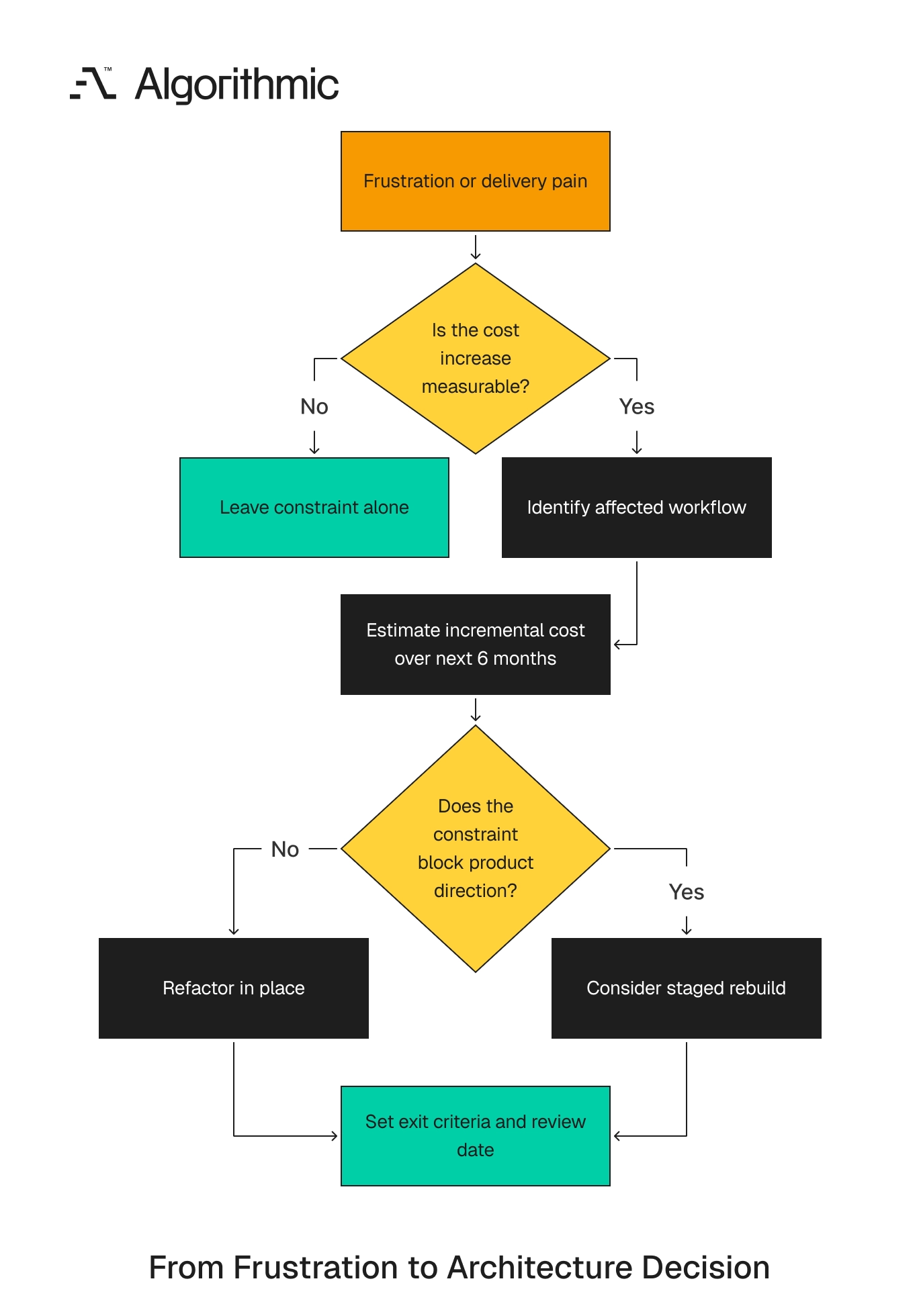
This classification prevents a common executive mistake, where teams label every constraint as debt and then treat every debt item as a rebuild candidate. That creates a false queue of architecture work that competes with customer delivery without proving economic return. A CTO should require one answer before funding that queue, since the team must identify which constraint raises the cost of the next roadmap item. If the team lacks delivery data, the item is not ready for funding. Frustration can start the review, then evidence must carry it.
A simple decision record helps, and it should name the constraint, affected workflows, planned review date, and dollar exposure. For example, “customer export jobs run overnight” is a constraint, and it becomes debt when enterprise renewals require self-service exports within 30 minutes. That trigger changes the classification, since before that point a streaming export platform wastes budget and adds operating burden.
Frustration is a weak signal and incremental cost is evidence
Teams request rebuilds after repeated friction, when features take longer, test suites fail, incident response slows, and new engineers need months to become productive. Those signals deserve review, but they do not justify a rewrite by themselves. The evidence must show the cost delta between working within the current system and changing the system, and the unit of analysis is marginal cost.
A practical review measures five data points over the prior 90 days:
- Average cycle time for the last 20 product changes.
- Defect rate per release or per 1,000 lines changed.
- Engineering hours spent on rework, merge conflicts, and manual regression testing.
- Production incidents linked to named architecture constraints.
- Deferred revenue or retention impact tied to delayed product changes.
 Click to expand
 A B2B SaaS company with 35 engineers applied this method to a payments module written in Ruby on Rails, and the team wanted a rebuild in Go. The review showed that 64% of delivery delay came from unclear product rules and manual QA, while the Rails code accounted for 14% of delay. The correct move was a six-week refactor of the payment state machine, with contract tests around the Stripe and Adyen integrations, a release checklist, and one engineer named as payment release owner. Those changes addressed the measured source of delay, while a rebuild would have consumed two quarters and left the main delivery constraint untouched.
This distinction matters because software teams often confuse visible pain with economic cause, and the loudest issue in engineering meetings rarely drives the largest cost. A review should trace each delay to a cause, since product ambiguity, missing test data, unclear ownership, and manual release steps often exceed framework limitations. The same discipline applies to hiring complaints, where a legacy framework can slow hiring and the cost should be measured. If three senior candidates decline offers because the stack is AngularJS, record that cost and assign recruiting fees, vacancy cost, and missed delivery time. If onboarding takes 16 weeks because domain rules live in tribal memory, the framework is not the primary constraint, and documentation, pairing, and test coverage will change economics faster.
The review should distinguish preference from throughput. “Engineers dislike AngularJS” is a morale signal, while “AngularJS reduces qualified candidate acceptance from 62% to 38% across 14 offers” is decision evidence that connects architecture choice to staffing cost. The same test applies to developer tooling, since a slow CI system matters when it changes delivery time, defect escape rate, or release frequency. A 45-minute pipeline creates material cost when 22 engineers wait for it eight times per week, while a 45-minute nightly build for one release manager deserves a different ranking.
The incremental cost evidence model
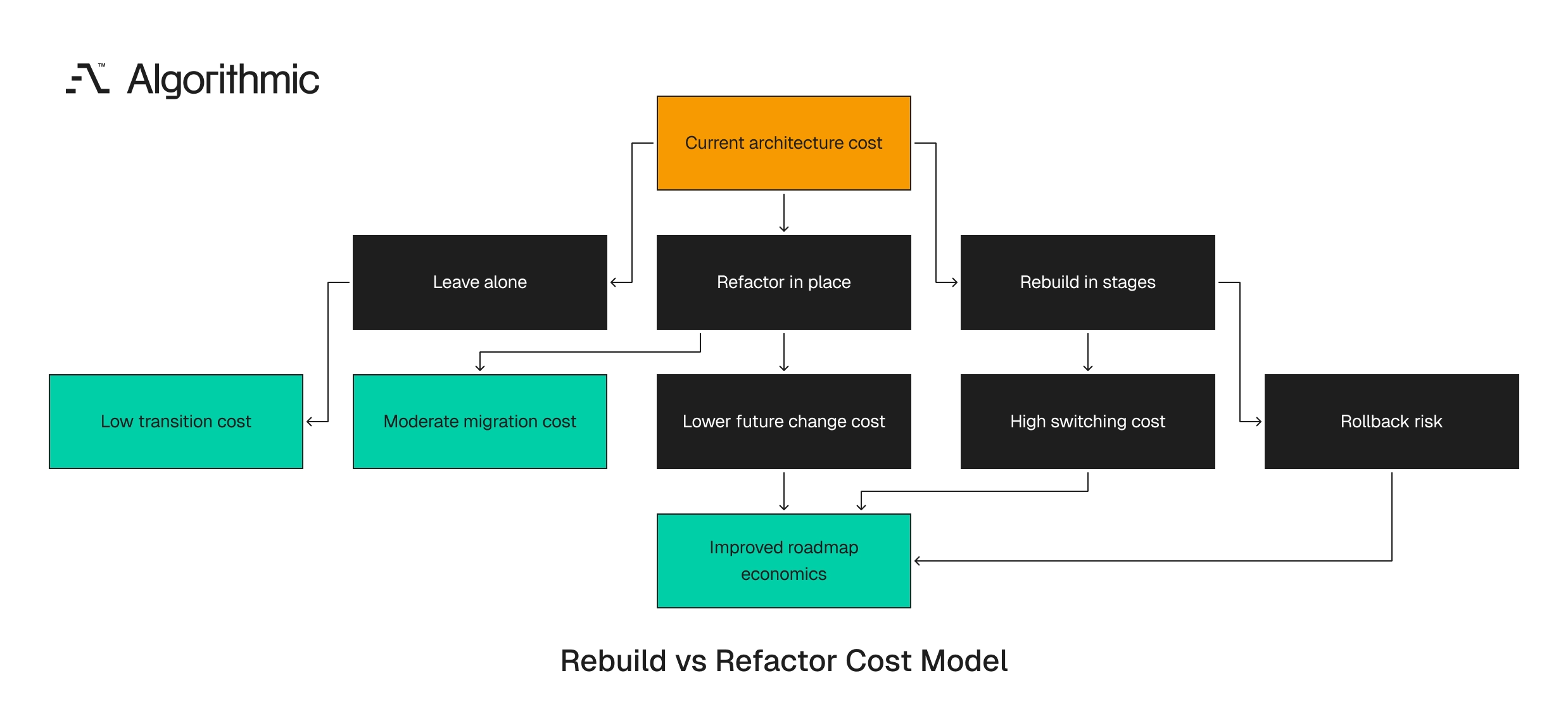
The decision should compare three paths, to leave the constraint alone, refactor in place, or rebuild in stages. A full replacement from scratch requires a separate burden of proof, since it pauses product learning, creates migration risk, and stands up a second system that must match production behavior before customers benefit. Joel Spolsky’s warning against full rewrites still holds, since old code carries years of fixed edge cases that a clean slate throws away. Use the following model before committing budget.
| Decision factor | Leave alone | Refactor in place | Rebuild in stages |
|---|---|---|---|
| Incremental cost of next 6 months of roadmap | Less than 10% premium | 10% to 40% premium | More than 40% premium or blocked work |
| Customer impact | No measured customer harm | Measured friction in narrow flows | Revenue, retention, or compliance risk |
| Operating risk | Incidents remain within SLO | Incidents tied to specific modules | Current design prevents safe operation |
| Migration complexity | No migration needed | Localized data or API changes | Parallel run, data backfill, or dual writes |
| Opportunity cost | Product roadmap remains intact | 1 to 2 roadmap items deferred | 1 or more quarters materially affected |
| Reversibility | No change | High | Low to medium |
This model forces the discussion into units leadership can inspect, which are dollars, weeks, customer impact, and operating risk. The numbers do not replace engineering judgment, they discipline it. A CTO can approve a $300,000 refactor when the model shows $700,000 of avoided roadmap cost, and reject a $900,000 rebuild when the measured premium is 8%.
 Click to expand
 The model also changes the burden of proof, since the team asking for budget must connect architecture work to a commercial outcome. That standard protects engineers from opinion contests, and it protects executives from funding a rewrite that satisfies engineering preference and leaves delivery unchanged. The model should include confidence levels for each estimate, where high confidence uses delivery history, production data, and finance-approved revenue assumptions. Low confidence uses engineering estimates without observed baselines, and those estimates belong in the model with a plan to replace them during the first milestone.
Incremental cost of roadmap delivery
Start with the next six months of committed product work and list the 10 to 20 planned changes. Estimate each change twice, once on the current architecture and once after the proposed refactor or staged rebuild, so a material gap becomes visible. If the current system adds 8% to roadmap cost, rebuilding is excessive. If it adds 55%, blocks two strategic features, and creates repeated release risk, staged replacement becomes credible, and the case should show which features are blocked and why.
Estimates should include engineering effort, QA effort, release coordination, data migration, and production support, since excluding support work understates the cost of change. Use actual delivery history where available, so if the last five checkout changes averaged 12 engineering days, the model starts from that baseline and then adjusts for scope. A checkout tax calculation change should not inherit the estimate for a full payment provider migration. The review should also separate build time from wait time, since a feature delayed by security review needs a different intervention than one delayed by fragile code.
A useful estimate includes three numbers for each roadmap item, the current-system cost, the changed-system cost, and the transition cost, and transition cost often decides the case. Moving pricing to a new service can reduce future pricing work by 40%, but if migration requires six months of dual writes, the payback period changes. The model should calculate payback against the roadmap, since a refactor that pays back in one quarter deserves a different decision than one that pays back in three years.
Customer and revenue impact
Customer impact must attach to a workflow, because “slow development” is too broad for an executive decision. “Enterprise onboarding takes 11 days because provisioning requires manual database edits across three services” is specific enough to evaluate, since it names the workflow, delay, and architecture cause. Product leaders should assign revenue or retention value to the affected workflow using the same forecast as the operating plan. If reducing onboarding from 11 days to 2 days raises activation by 5 percentage points, the technical case becomes a business case, and on $4 million of annual new contract value that movement deserves executive review.
The same logic applies to churn, so if billing defects create 40 support tickets per month and affect renewals, quantify both costs. Do not describe customer harm in generic terms, and instead name the workflow, customer segment, revenue exposure, and defect pattern. “Customers dislike billing” is not useful evidence, while “Twenty-eight enterprise customers opened billing adjustment tickets last month after prorated upgrades failed” gives leaders a decision-grade fact the team can trace to pricing rules, ledger design, or release process.
Customer impact should include severity, frequency, and account value, since ten defects in free-tier accounts create a different case than three defects in $250,000 enterprise renewals. Sales input also belongs in the review, so if a missing SAML feature blocks three late-stage deals, price the constraint with sales operations data. Use the same close probability in the architecture model that finance uses in the forecast, and separate technical opinion from the revenue plan.
Operating risk and incident cost
Operating risk should include incident frequency, mean time to recovery, severity, and architecture contribution, and each incident needs a named cause. A single outage caused by an invalid deploy is weak evidence, while five incidents in one quarter caused by shared mutable state in a billing ledger is strong evidence. Incident cost should include engineering hours, customer credits, support load, and executive escalation time, and for enterprise accounts it should include renewal risk.
Security and compliance constraints also belong here, since a platform that cannot support tenant isolation for enterprise customers requires staged replacement in many B2B settings. The same standard applies to auditability, because a financial system that cannot produce an immutable change history creates operating risk beyond feature delivery cost. Operating data should come from PagerDuty, Datadog, Sentry, Jira, GitHub, GitLab, and customer support systems, and anecdotes should be tested against those sources.
The incident review should name the architecture mechanism, such as shared mutable state, missing idempotency keys, cross-service transaction gaps, and manual database repair. Risk data should also include near misses, since a failed deployment caught in staging still consumes time and indicates release risk. If four release candidates fail because test environments lack production-like data, record that cost, because the answer may be test data management rather than service extraction.
Rebuilds carry switching cost and rollback risk
A new technology decision should be treated as an investment with a reversion cost, and teams often focus on expected improvement while understating return-to-prior-path cost. A framework migration from AngularJS to React can reduce hiring friction and improve component reuse, but it also introduces training cost, duplicated UI states, analytics parity work, accessibility retesting, and feature freeze risk. A database migration from MySQL to PostgreSQL can be sound, but the plan must price data validation, replication lag, rollback, stored procedure rewrites, and reporting compatibility.
The same applies to adopting a new backend stack, so a team moving from Django to Node.js should estimate marginal throughput gain and reversal cost. If the expected improvement is 15% and rollback requires three months, treat the move as a controlled experiment rather than the default architecture after a slide-deck decision. The exact threshold varies by business, but the discipline stays consistent, since a rebuild needs measured cost separation before it earns budget.
Rollback planning also improves the architecture conversation, because engineers must define failure before the first migration begins. A data-platform rebuild should define acceptable lag, reconciliation tolerance, and cutover criteria, since without those numbers teams discover migration risk in production. A practical rollback plan names three items, the data state, the traffic routing state, and the customer communication state, and each item needs an owner. For a billing migration, rollback requires more than switching an API route, because the team must account for invoices generated, credits issued, webhooks processed, and ledger entries written. That reversion path can cost more than the forward build, so a disciplined decision prices it before approval.
Switching cost also includes organizational load, since a team that changes language, framework, deployment model, and data store in one program creates four training curves. That load reaches product management and support, where release notes, support playbooks, analytics definitions, and customer communications all need updates. The business pays for that work through slower roadmap delivery, so the rebuild case should price those costs instead of placing them outside the architecture budget.
Staged replacement often produces the best risk profile
A full rewrite creates a second product that must reach parity with the first, and during that period teams split attention between current production defects and future platform delivery. Product scope also expands during full rewrites, since stakeholders use the rebuild to request long-deferred changes. Staged replacement reduces this risk by replacing a bounded domain behind stable interfaces while the production system keeps serving customers, a pattern Microsoft documents as the strangler fig approach. This pattern fits systems with identifiable business boundaries, and it works poorly when teams choose seams based on code layout alone.
A staged path also creates management checkpoints, so leaders see measured progress every four to eight weeks instead of waiting two quarters for a reveal. That cadence matters when product plans change, since a staged rebuild can stop after one domain if the economics no longer justify the next move. Staged replacement also gives engineering leaders cleaner staffing options, where one team owns the extracted domain while other teams protect current delivery. That structure lowers coordination cost and gives executives clearer accountability for budget, risk, and milestone progress.
Use domain seams instead of code seams
The right seam is a business boundary, so billing, search, authentication, order fulfillment, scheduling, pricing, and reporting make strong candidates. Arbitrary layers make weak seams, since “replace all controllers” or “move the data access layer” rarely maps to customer value. A marketplace platform can extract search first because ranking quality drives conversion, and search changes can become expensive in a database schema designed for transactions. The team can place Elasticsearch or OpenSearch behind a search API, replay historical queries, compare relevance metrics, and route 5% of traffic before expanding.
This path creates evidence during execution. If conversion rises, latency falls, and operating load stays stable, the next domain can move, and if results disappoint the blast radius stays contained. The team can stop after one domain without carrying a half-finished platform rewrite. A good seam also has clean ownership, so one team should own the service boundary, service-level objective, runbook, and data reconciliation plan. The seam should have a clear data contract too, since ambiguous ownership of customer, order, or entitlement records creates long-term operating cost. In practice, the data contract should name the system of record, allowed writers, event format, and reconciliation cadence, and those details matter more than service names.
A domain seam should also have an economic target. For search, the target can include conversion, latency, and merchandising change cycle time. For billing, it can include invoice accuracy, support ticket volume, and payment-change delivery time. These targets keep the staged rebuild tied to business outcomes rather than to internal structure.
Run parallel systems only when validation cost is justified
Dual-running systems is expensive, since it requires data reconciliation, observability, monitoring, incident response runbooks, and clear ownership of divergence. A financial ledger can justify parallel runs for 60 to 90 days because correctness risk is high, while a marketing content module rarely warrants the same cost. The decision should reflect transaction value, regulatory exposure, and customer-visible error cost, since a $2 discrepancy in a consumer cart differs from a $2 discrepancy in a securities ledger.
Parallel runs also require a stopping rule, so teams should define the variance threshold that allows cutover and the threshold that triggers rollback. A payments team can require 99.99% match rates across authorization, capture, refund, and dispute events, and lower match rates should pause migration. The team should also define comparison windows, since a nightly reconciliation catches different failures than real-time comparison during checkout. Finance, support, and engineering should agree on the variance report before launch, because if those groups disagree afterward, cutover decisions become political.
A validation plan should state who investigates mismatches and set response times for high-value transactions. Payment mismatches above $1,000 should reach an owner within one hour, while low-value reporting mismatches can follow a daily review cycle.
Refactor when the foundation still fits the product direction
Refactoring is the better path when the product direction stays compatible with the current architecture, since the team improves internal structure while preserving the system’s external contract. Good refactor candidates share four traits:
- The data model can support planned use cases with controlled schema changes.
- Performance issues come from query design, caching, or inefficient workflows.
- Incidents cluster in specific modules.
- The test suite can be expanded around current behavior before change begins.
A refactor should have a budget, scope, and measurable exit criteria, since “improve the codebase” is not sufficient. “Reduce checkout change cycle time from 12 engineering days to 5” is a refactor plan, and “cut payment-related defects by 50%” is another measurable target. A stronger plan combines delivery, quality, and operations metrics, so it might move release rollback from manual database edits to a documented script. This economic framing mirrors the false economy of the quick MVP, where the cheapest visible option often hides the largest downstream cost.
Refactors also need protection from scope creep, since a six-week refactor should not become a redesign of every adjacent module. Set a change budget by module and track each additional request against the original economic case. A good refactor plan states what stays unchanged, because public APIs, customer workflows, reporting outputs, and permission behavior often need preservation. That constraint disciplines the work and prevents a contained refactor from becoming an unpriced product redesign.
Refactors need the same production discipline as new builds, so the team should add tests around current behavior before changing the internals. This matters most for systems with undocumented business rules, since tests become the working specification when written documentation is incomplete. The refactor plan should also include a release strategy, where feature flags, canary releases, and rollback scripts reduce operational exposure. A checkout refactor can start with one payment method and one country, which limits tax, currency, and processor variation.
Leave constraints alone when they do not change the economics
Some constraints should remain, since engineering organizations waste large sums treating aesthetic discomfort as commercial risk. An internal admin panel built in an older UI library can irritate the team, but if it serves 18 support agents, replacement should rank below revenue and reliability work. The same panel can change twice per quarter and present no customer-facing performance risk, and those facts matter more than the age of the library. A batch data pipeline that runs in 47 minutes can be acceptable when the business reads the report daily at 8 a.m., since moving it to streaming architecture increases cloud cost and support burden. Architecture should serve the operating model, so if the business makes one daily decision from the report, minute-level freshness has limited commercial value.
If the constraint does not increase delivery cost, customer harm, or operating risk, record it in the architecture decision log and move on. This discipline protects engineering credibility, because it shows leadership that the team distinguishes technical preference from business risk. The decision log should include the reason for leaving the constraint in place and the trigger for reopening the decision. For example, keep the batch pipeline until report users need intraday decisions or customer-facing freshness, since that trigger converts future debate into a defined management review.
Leaving a constraint alone still requires ownership, so someone should watch the trigger and review the decision on a fixed cadence. Quarterly review works for most internal tools, while monthly review fits revenue, compliance, and customer-facing workflows. The record should also capture rejected options, since six months later the organization can see why a rebuild lost to a targeted refactor or no change.
A 10-day review process for CTOs and product leaders
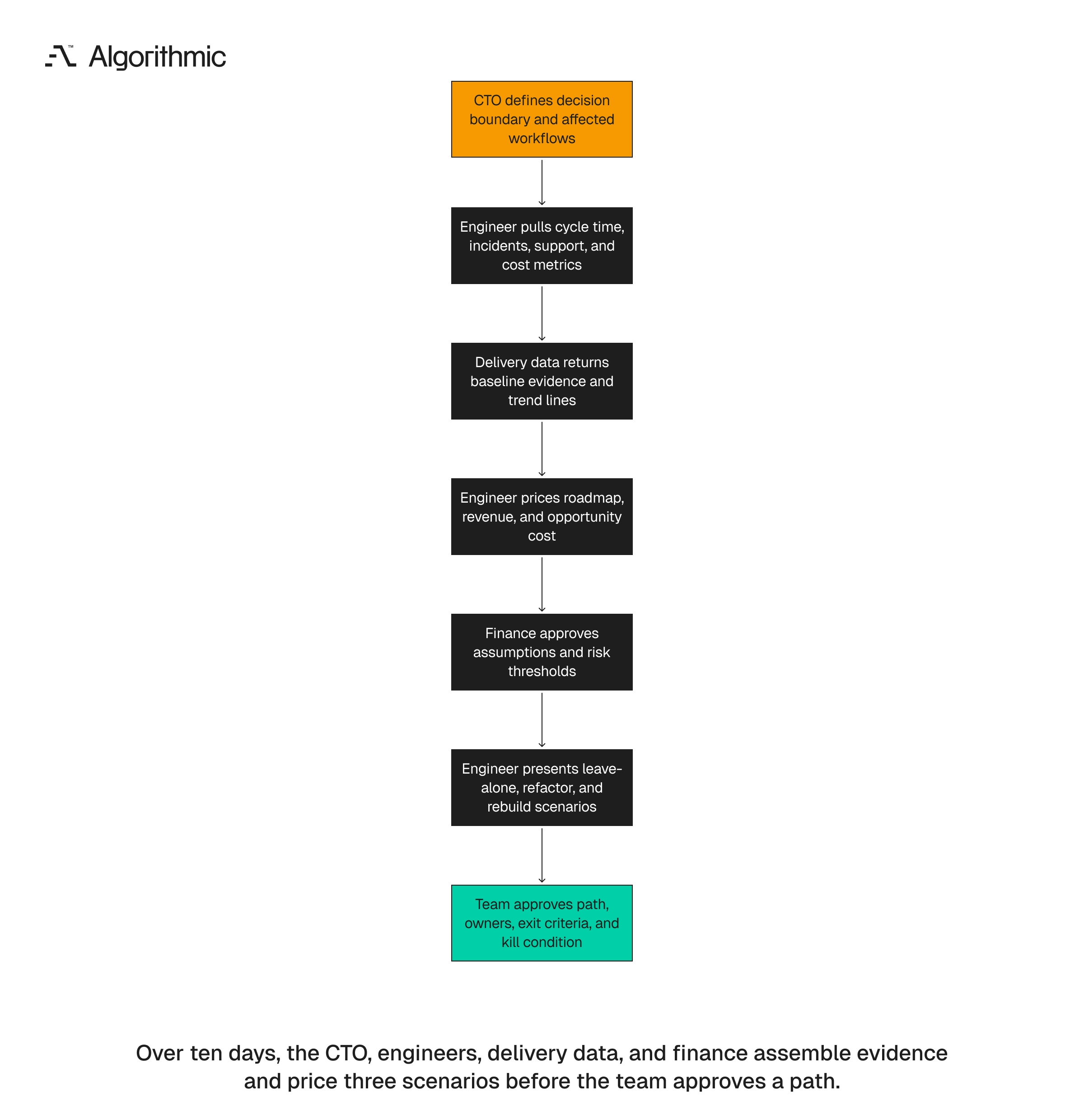
A disciplined decision does not require a three-month study, and a 10-day review is enough for most mid-size systems when telemetry and delivery history exist. The review should produce a decision, budget range, exit criteria, and kill condition, plus a written record for future architecture debates. The process works best with one accountable owner, and in most organizations that owner is the CTO, VP Engineering, or senior engineering director. Product and finance should participate from the start, since architecture spend competes with roadmap delivery and that trade must be explicit. The review should include one senior engineer who knows the system and one engineer from outside the team, which reduces blind spots. Customer support should contribute data when the system affects tickets, credits, or escalation load, and finance should verify revenue assumptions before approval.
 Click to expand
 Day 1 to 2 defines the decision boundary
Name the system, modules, customer workflows, and roadmap items under review, and exclude unrelated frustrations. The output should be a one-page architecture decision record that names the decision owner, business sponsor, time horizon, and options under review. A tight boundary prevents emotional expansion, so a payments refactor should not become a debate about the entire backend stack. The boundary should also define excluded work, and if analytics exports, CRM sync, and admin screens are out of scope, state that in writing. This protects the review from becoming a catalog of every complaint about the system, since a narrow decision produces stronger evidence. A good boundary also names the time horizon, and six months works for most product roadmap decisions, because longer horizons introduce too much forecast error while shorter ones miss migration cost and delayed benefit.
Day 3 to 5 measures cost and risk
Pull delivery data from Jira, Linear, GitHub, GitLab, Datadog, Sentry, PagerDuty, and cloud billing before interviewing engineers. That sequence keeps interviews grounded in evidence, since the conversation can test observed patterns instead of collecting opinions. Quantify cycle time, defect rate, incident cost, support load, and cloud spend, and link each number to a named architecture constraint. For example, connect checkout defects to the promotion engine if that module causes them, rather than attributing all defects to “legacy code”. The review should also inspect pull request history, since long-lived branches, repeated revert commits, and high-conflict files often reveal the true cost center.
Customer support records belong in the same review, because a module that creates few engineering incidents can still create high customer cost. Cloud billing should also be inspected, since some architecture constraints appear as infrastructure spend before they appear as delivery delay. Inefficient search queries can create $40,000 of monthly database cost, and that number changes the refactor case.
Day 6 to 8 models the three paths
Estimate leave alone, refactor in place, and staged rebuild against the same six-month feature list. Include engineering cost, migration cost, QA cost, customer communication, revenue delay, rollback effort, and production support during the transition. Use ranges when precision is false, since a $250,000 to $350,000 refactor estimate is more useful than a confident single number with weak assumptions. Document the assumptions behind each range, and name the dependency, data source, and owner for each material estimate.
The model should also show the cost of waiting, so if deferring a refactor by two quarters adds $180,000 of rework, show that number. Waiting can be rational when roadmap pressure is high, and the point is to make the cost visible before the decision is made. The model should also assign work to named teams, because a cost estimate without staffing assumptions cannot support a credible plan. If the rebuild needs four senior engineers for six months, state the product work those engineers will stop, since opportunity cost belongs in the decision.
Day 9 to 10 decides and sets guardrails
Choose the path with the best cost-to-risk profile, then set exit criteria and a kill condition. For a staged rebuild, a kill condition can state that if the extracted pricing service does not support 95% of current pricing rules by week 8, the team pauses extraction and returns to targeted refactoring. For a refactor, the condition can state that if checkout cycle time does not fall by 30% after the first two modules, the team re-evaluates the architecture. Guardrails convert architecture intent into management control, and they reduce sunk-cost behavior after the team starts work.
The decision should include a review cadence, and weekly delivery review plus monthly budget review are enough for most quarter-scale work. Leaders should track the same metrics used to approve the work, since switching metrics after approval weakens accountability. The final decision should fit on two pages, because longer documents often hide weak assumptions under extra detail. The record should name the decision, rejected options, approved budget, owners, metrics, and review dates, and that is enough for executive control.
Production-ready checklist for rebuild versus refactor decisions
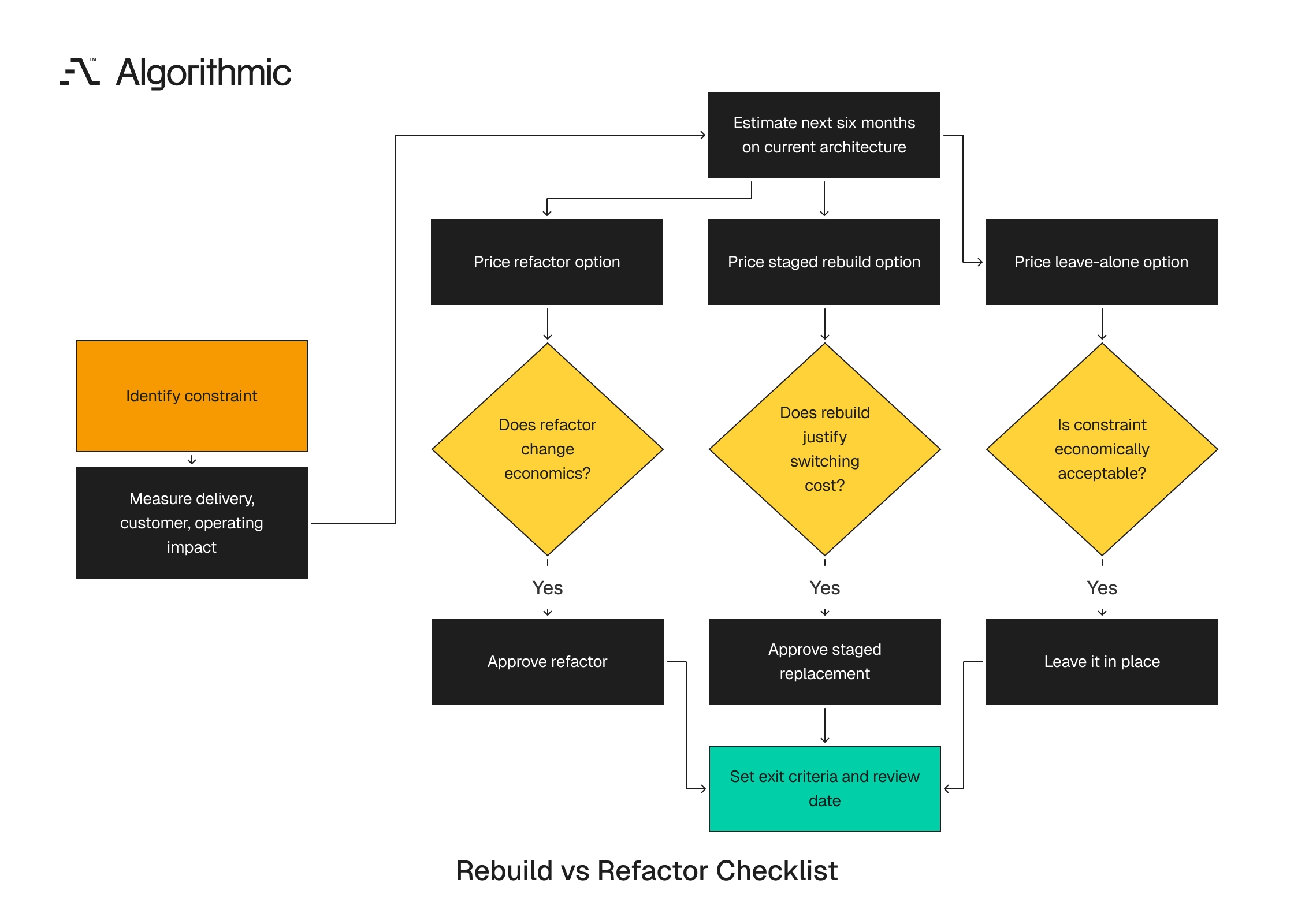
Use this checklist before approving budget above $100,000 or work longer than one quarter.
- The team has identified the specific architecture constraints under review.
- Each constraint has a measured effect on delivery cost, customer impact, or operating risk.
- The next six months of roadmap work has been estimated on the current architecture.
- Refactor, staged rebuild, and leave-alone options have been priced against the same roadmap.
- Migration cost includes data movement, QA, observability, rollback, and customer communication.
- New technology choices include a rollback estimate.
- The plan has named owners for production support during transition.
- Exit criteria are measurable.
- A kill condition exists before major budget is spent.
- Leadership has approved the opportunity cost in product roadmap terms.
The checklist should be owned by the CTO or VP Engineering, and product and finance should review the cost model before budget approval.
 Click to expand
 For high-risk systems, add legal, security, or compliance review, since billing, identity, health data, and regulated financial workflows deserve this extra step. The checklist also belongs in the architecture decision record, so six months later the team can compare actual cost, delivery impact, and incident reduction against the approved case. That retrospective creates institutional memory and prevents the same organization from debating the same rebuild every year without better evidence. A mature organization also records forecast error, and if the refactor cost twice the estimate, the next model should explain why. Common causes include hidden data migration work, underestimated QA, and unclear ownership, and those findings improve the next architecture decision.
Across 35+ complex software engagements, Algorithmic has found that the best rebuild decisions contain fewer opinions than spreadsheets. The spreadsheet is not a substitute for engineering judgment, it forces that judgment to face cost, risk, and customer value, and it gives leadership a record when the organization revisits the same system six months later. Run a 10-day incremental cost evidence review before approving a rebuild or major refactor, price the three paths against the same roadmap, document the constraints that create measured cost, and fund the smallest intervention that changes the economics.
Algorithmic runs technical due diligence and architecture reviews that price rebuild, refactor, and leave-alone paths against your real roadmap. Start a conversation if a rebuild is on the table and you want the decision grounded in evidence instead of frustration.