

Engineering leaders learn this during the first audit request. A model decision must trace to the data, features, consent flags, code version, training run, evaluation results, and inference path that produced it, and machine learning systems need that provenance with the same engineering discipline as model serving, feature computation, CI/CD design, and observability. Without the trace at decision time, an audit request becomes reconstruction work that consumes engineering capacity, freezes releases, and weakens enterprise trust.
Lineage has to exist before procurement, audit, incident response, and customer escalation. Teams that build it after release spend months proving facts their systems never captured. Treating production machine learning engineering as a provenance problem from day one is the difference between answering a buyer in a day and freezing a launch for a quarter.
Lineage belongs in the production path
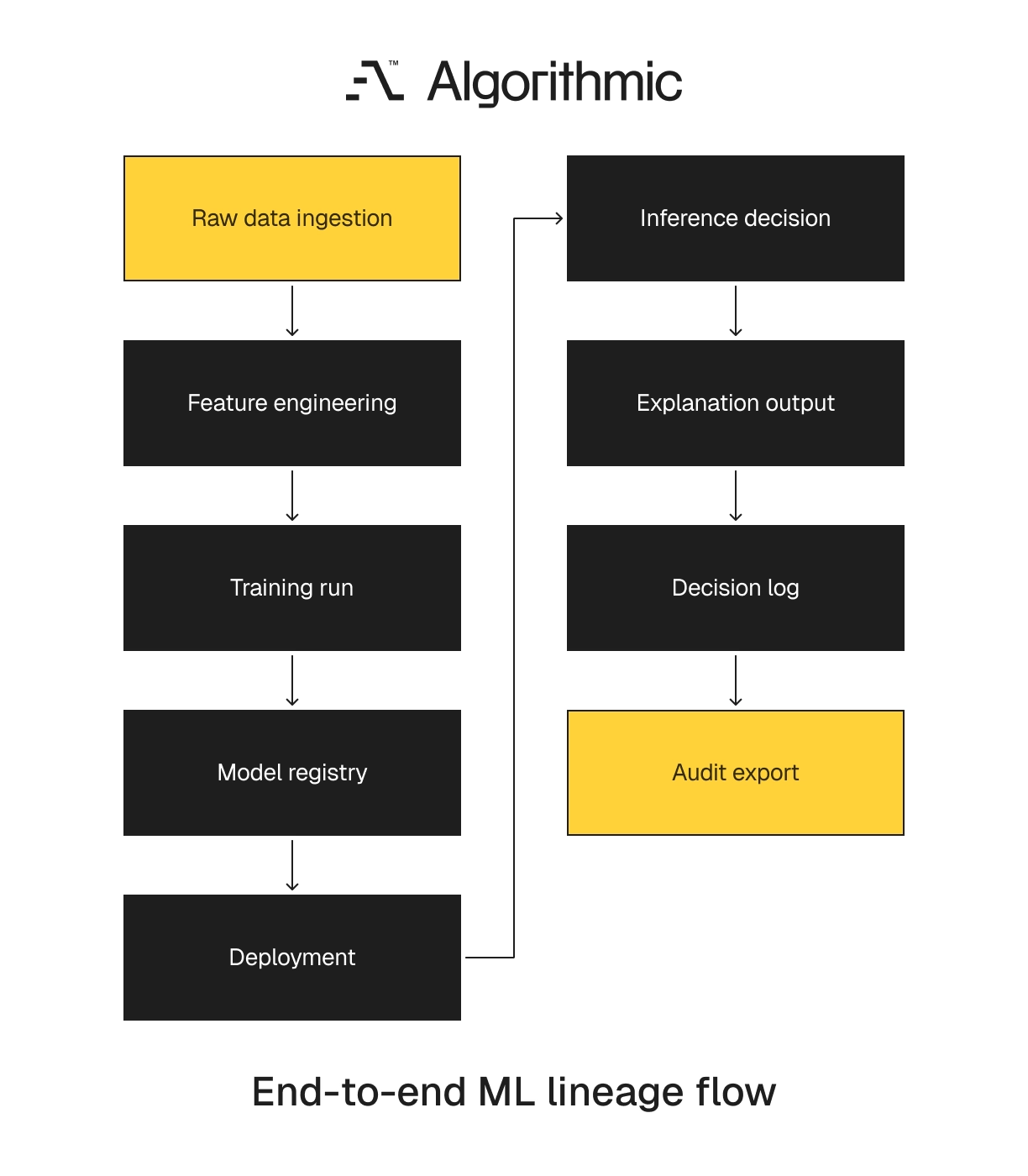
Lineage is the record of how a model decision was produced, and in production it spans raw data ingestion, transformations, feature store writes, model training, model registration, deployment, inference, and explanation output. A regulated AI system needs this record for every material decision, so credit decisions, insurance quotes, fraud scores, clinical triage recommendations, hiring rankings, and enterprise security alerts require the same base evidence.
 Click to expand
 The system has to show which inputs were used, whether those inputs were allowed, which model version ran, and which explanation was returned, with timestamps and immutable references drawn from production systems. Teams create risk when they treat lineage as documentation after deployment, because documentation records intent while production lineage records facts. A model card can describe how a model was trained, but it cannot prove that the decision made at 14:03:12 UTC on March 17 used model version risk-v4.8.2, feature set fs_credit_2025_03_12, consent policy cp_eu_v7, and training artifact hash sha256:9b1c....
That proof requires architecture. Production evidence comes from events, manifests, immutable references, promotion gates, and decision logs inside the serving path, and it has to be created as the system runs. The distinction becomes material during contract review, when an enterprise buyer asks for decision evidence, retention terms, and audit export procedures before approving a high-stakes deployment. A sales engineer cannot answer those questions with a slide deck or a model registry screenshot, since the answer has to come from the same production systems that served the decision.
The audit failure starts during feature engineering
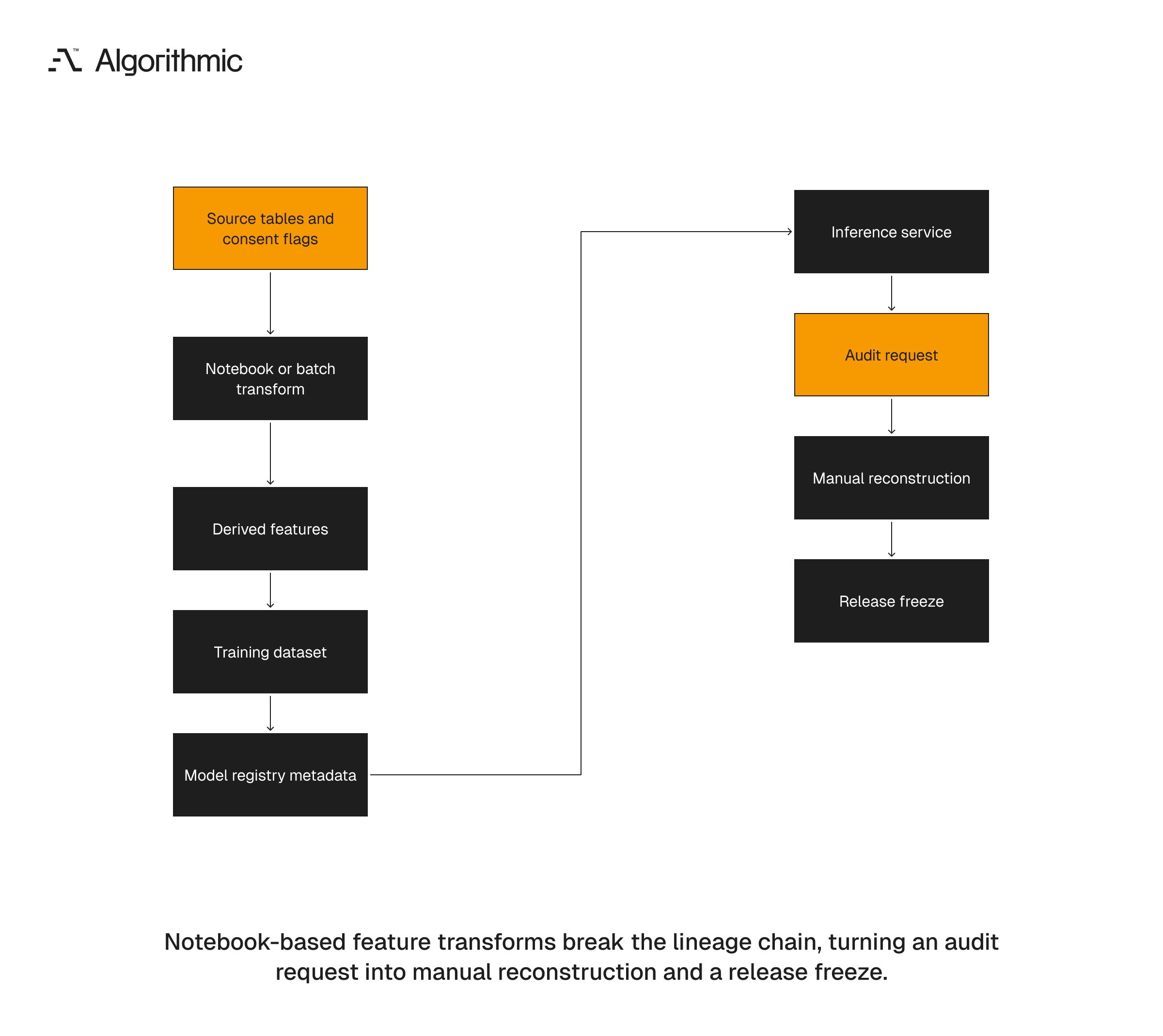
Most lineage gaps begin before model training, when feature engineering runs outside the controlled production path. A data scientist exports 18 months of customer activity from a warehouse, a notebook applies transformations in pandas, and a training job reads a CSV from S3. The model is registered in MLflow, and the inference service later recomputes similar features through a separate service path.
 Click to expand
 This pattern moves quickly during prototype work, but it creates four separate sources of truth before the model reaches production. The training dataset has one lineage path, the production feature service has another, consent flags live in a customer system, and evaluation artifacts sit in a model registry with partial metadata. The gaps stay hidden while the model works and no customer requests evidence.
During an enterprise audit those seams become visible. The audit team asks for one decision record, and the engineering team reconciles warehouse queries, notebook cells, object storage timestamps, and service logs, pulling senior engineers away from roadmap delivery. A two-hour customer evidence request becomes a multi-week investigation when source records lack shared identifiers. The failure is rarely a single missing log line, since it is usually a missing chain across data extraction, feature creation, model training, release approval, and inference, where each team sees its own records and assumes the next team preserved the link.
Consent must travel with the feature
Consent and usage restrictions have to attach to the data and move through transformations, because a boolean field in a source table is inadequate after features are aggregated, joined, embedded, or cached. Consider a churn prediction model used by a SaaS company with 40 enterprise customers, trained on product usage data, support tickets, billing history, and account metadata. One customer revokes permission for support ticket content to be used in training, and this is a live obligation under the right to erasure in GDPR Article 17, so the engineering team then needs to answer three questions within days: which derived features included that ticket data, which model versions were trained on it, and which customer recommendations were influenced by those versions.
Without per-feature provenance and immutable training manifests, the team reviews SQL, notebook history, warehouse query logs, and S3 object timestamps by hand, and a two-day audit response becomes a six-week release freeze. The failure is architectural. Consent has to be recorded before feature creation, and the same consent state has to persist in feature metadata, the training manifest, the model registry, and the inference log.
Consent also needs a time dimension, since a permission state on April 2 can differ from the state on April 17 and both dates matter during review. A production system should preserve the consent snapshot used at feature creation time and record the policy version that converted that snapshot into an allow or deny decision, because legal and product terms change and a feature created under policy_v6 can become restricted under policy_v7 without changing the raw data. This record has to survive aggregation, so if 10,000 support tickets produce an account-level feature, the feature value still needs lineage back to allowed source records.
Derived features need their own identity
A feature is a production object that needs a name, owner, transformation definition, source lineage, consent policy, freshness target, backfill policy, and validation rules. Feature stores such as Feast, Tecton, and SageMaker Feature Store help when teams treat them as controlled interfaces, and they fail when teams treat them as shared caches. The feature store should record which raw sources produced each feature value and which transformation version created it.
A feature named avg_transaction_amount_30d has incomplete metadata, while a production-grade feature record includes source tables, column lineage, aggregation window, timezone handling, null handling, code commit, consent filter, and computation timestamp. The record should also include a backfill identifier, so that if the feature is recomputed after a schema correction the system can distinguish the original production value from the corrected value. Audit teams care about what the model saw at decision time, and a corrected value from a later backfill does not explain the original decision.
This distinction matters during disputes, since a lender, insurer, or employer has to defend the decision that was served, not the decision a corrected pipeline would serve later. Feature identity also protects incident response, because when a distribution shift appears engineers need to know whether the source data changed, the transformation changed, or the backfill policy changed. A feature registry should store all three facts, since a cache key or column name does not provide enough evidence.
Reproducibility requires immutable artifacts
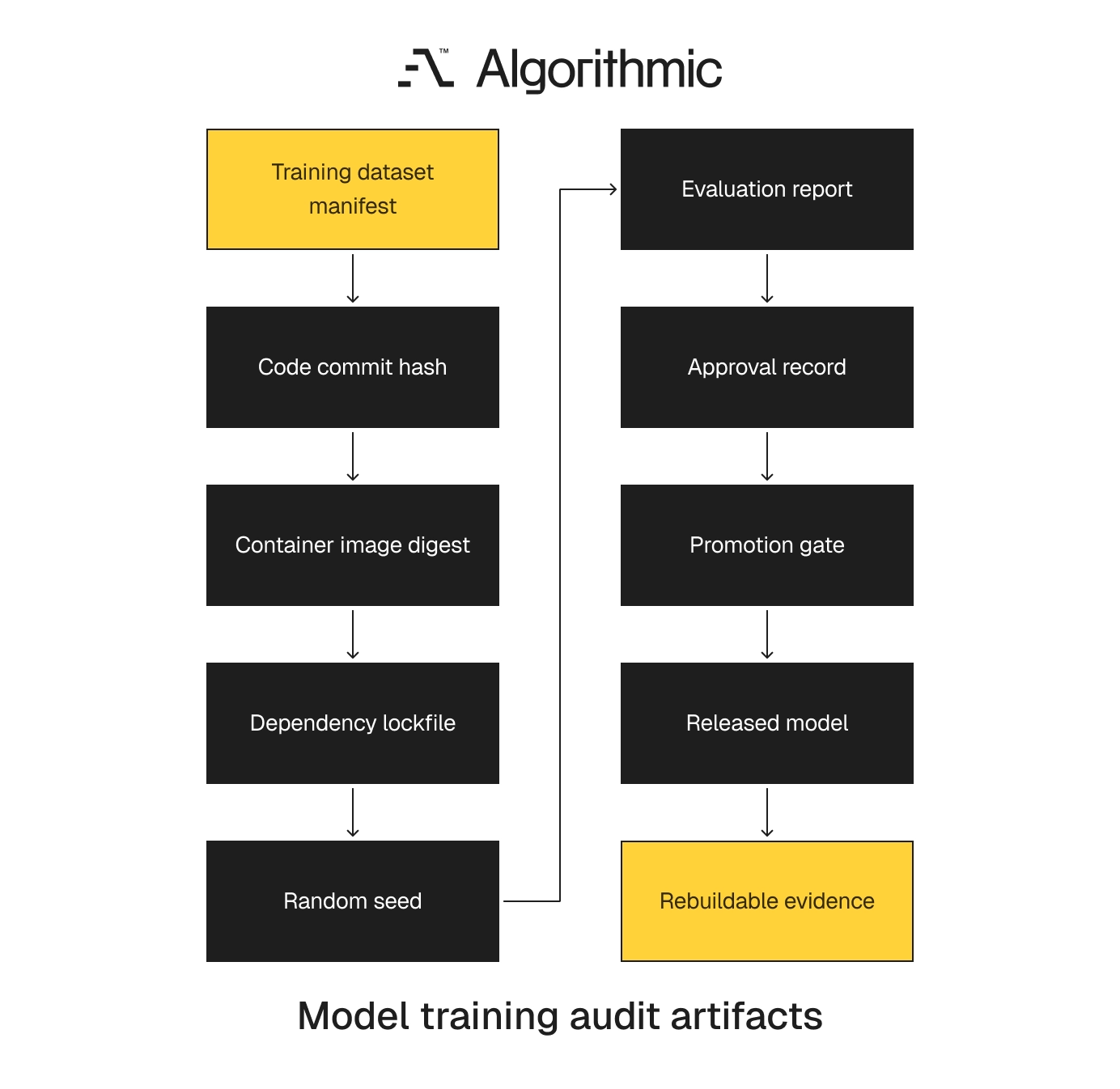
Reproducible training means a team can rebuild the model or defend the original training run without guessing, and that requires immutable inputs and archived outputs. A production ML system should retain five artifact classes for every trained model:
- Dataset manifest with immutable references to training, validation, and test data.
- Feature definitions and transformation code versions.
- Consent and policy filters applied at dataset creation time.
- Training configuration, environment image, dependency lockfile, and random seeds.
- Evaluation reports, fairness checks, calibration plots, and approval records.
 Click to expand
 MLflow, Weights & Biases, Neptune, and Kubeflow Pipelines can store much of this evidence, so the tool choice matters less than the release rule. A model cannot be promoted unless its lineage package is complete, and the promotion record should show the package passed automated checks before release. Google’s engineers named this failure mode a decade ago in Hidden Technical Debt in Machine Learning Systems, which shows that data dependencies cost more than code dependencies because they cannot be traced by a compiler and compound silently.
The lesson for production ML systems is direct. Model accuracy work without data provenance produces fragile operations, and teams pay for missing provenance during audits, incidents, renewals, and procurement reviews. The operational cost appears in routine work, where engineers repeat validation steps, product managers delay customer commitments, and security teams field evidence requests with incomplete records. The cost also compounds over model generations, since a missing manifest for risk-v2 creates uncertainty when risk-v5 inherits features, training data, or calibration rules from that earlier release.
Model registries need promotion gates
A model registry should control promotion across development, staging, and production, and its metadata should include more than model name, version, and evaluation score. A strong promotion gate checks lineage completeness and blocks deployment when the dataset manifest is missing, the feature set lacks traceability, consent filters are unrecorded, or explanation endpoints are absent. This is standard release discipline, the same way a web service ships with tests and observability while a model ships with provenance and reproducibility evidence.
The gate should run as code, not as a manual approval checklist. A GitHub Actions workflow can call the MLflow Model Registry API to verify manifest presence, check feature definitions in Tecton, and block promotion when required artifacts are missing, producing an auditable release record tied to the model version. Promotion gates should also record exceptions, so if a risk owner approves a release with a known evidence gap the registry stores the approver, reason, expiration date, and remediation owner. The expiration date matters, since permanent exceptions become hidden policy changes when teams rotate and release pressure increases.
Training pipelines need deterministic rebuilds
Perfect bit-for-bit determinism is difficult for GPU training, because CUDA kernels, distributed execution, and library versions can introduce small variance. That variance does not remove the need for deterministic rebuild standards, so teams should define acceptable reproducibility thresholds before release. A fraud model may require AUC within 0.002 of the original run, calibration error within 1 percent, and approval from the risk owner if variance exceeds the threshold.
A rebuild fails before statistical variance is even discussed when the source data, code version, or training container cannot be found, so the build record needs durable references to all three. The standard should be written before the first regulated release, because if the first threshold discussion happens during an audit the team has already lost control of the evidence chain. Rebuild standards should also define ownership, with data engineering owning source manifests, ML engineering owning training containers, and model risk owning variance thresholds, which prevents the common failure mode where each team assumes another team owns the missing artifact while the audit clock runs.
Rebuild procedures should be tested quarterly for high-stakes models, since a team that has never rebuilt a released model cannot rely on the rebuild path during audit. The test should start from archived records, not from team memory, and engineers should retrieve the manifest, container image, code commit, dependency lockfile, and configuration through documented paths.
Explainability must be available at inference time
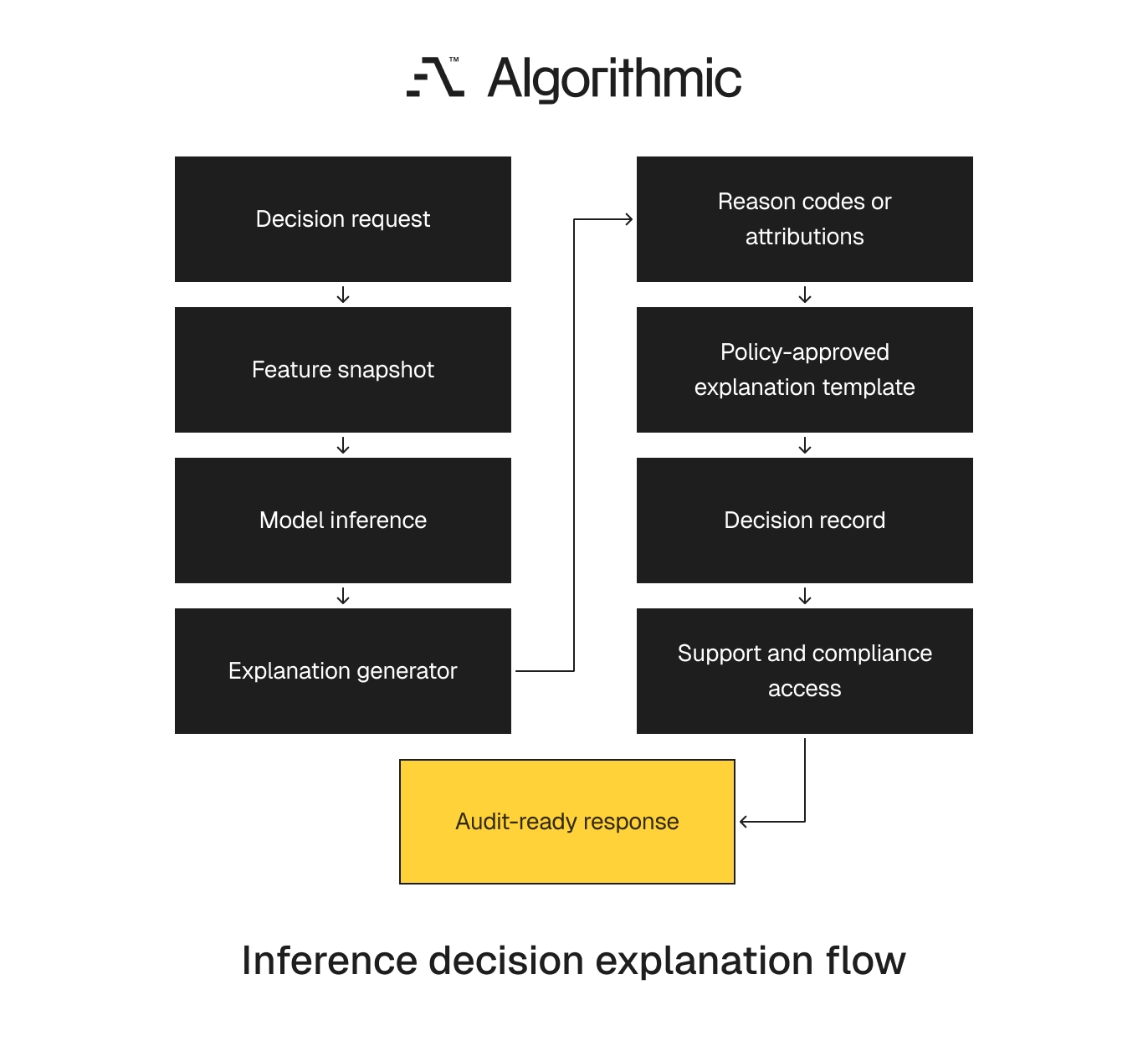
Explainability is often added after a customer asks for it, and that timing creates rework because explanation outputs depend on the model, feature pipeline, and decision service. A customer-facing decision should produce an explanation record at the same time as the prediction, and that record can include reason codes, feature attribution, counterfactual thresholds, policy constraints, or domain-specific text.
 Click to expand
 Legal and product teams should approve customer-facing explanation text before release, and engineering should store the approved template version with each decision. The correct explanation method depends on the model class and business context, so SHAP feature attribution can fit tabular credit risk models while attention traces rarely satisfy enterprise audit needs for LLM applications. For retrieval augmented generation the system needs source document IDs, embedding model version, retrieval query, ranking score, prompt version, safety filter results, and generated answer, since the answer alone is insufficient evidence for an enterprise customer or regulator. The same principle applies to agentic workflows, where a decision record should include tool calls, tool responses, policy checks, and the final user-facing output.
Explanation records should also capture failed explanation generation, because if the prediction succeeds and the explanation fails the system has produced an incomplete regulated decision. The service should treat that condition as a release and operations concern, since silent explanation failures create hidden audit debt.
Explanation endpoints need contracts
An explanation endpoint should have a precise contract, like a prediction endpoint, accepting a decision ID and returning the model version, input feature snapshot, explanation type, explanation payload, timestamp, policy context, and data access boundary. This endpoint should serve internal support teams, compliance teams, and enterprise customers, where access rules can differ by audience while the underlying decision record stays consistent. A system that requires engineers to query five stores to explain one decision is unprepared for audit and expensive to operate, because every customer escalation becomes a custom investigation.
The contract should define latency, retention, and redaction behavior, so a support user may receive reason codes and approved language while a compliance user receives full feature snapshots, policy versions, and approval records. The endpoint should also log access, since regulated customers often ask who viewed a decision record, when they viewed it, and which fields they received. A mature design separates storage from presentation, keeping the decision record stable while each audience receives a view that matches policy and contract terms.
The contract should also define failure behavior. If a feature snapshot has expired, the endpoint should return an explicit evidence gap with owner and remediation status, which is materially better than a timeout, an empty payload, or an engineer-authored explanation. Audit workflows need controlled failure modes.
Retrofitting lineage creates operational paralysis
Retrofitting lineage is costly because the missing evidence was never captured, and teams cannot reconstruct every intermediate feature value, consent state, or training artifact after the fact. In one technical due diligence review for an enterprise AI vendor, the model registry contained 27 production model versions, only 9 had complete training manifests, fewer than half linked to immutable datasets, and no model recorded the consent policy version used during training. The vendor had strong model performance and credible engineers, but the issue appeared during procurement when the buyer requested decision-level auditability for a high-stakes deployment and performance metrics did not answer the governance question.
The sales team discounted the contract by 18 percent to offset audit and governance risk, and the engineering team then spent 11 weeks rebuilding training pipelines, feature provenance, and model registry gates before the deployment moved forward. That is the commercial cost of missing lineage, while the technical cost includes delayed releases, repeated validation work, higher incident response effort, and lower confidence from enterprise buyers. The finance team sees the discount, the engineering team sees the freeze, and the executive team sees both during the next board review.
Retrofitting also creates political cost inside the organization, since product teams see blocked launches, sales teams see delayed contracts, and risk teams inherit incomplete evidence. The work then competes with roadmap commitments, and engineers who should build new model features spend weeks reconstructing historical records from logs and storage timestamps. A technical due diligence review surfaces exactly these gaps before a buyer does, which is when they are cheapest to fix.
Debugging slows without provenance
A model quality incident starts with one question, which is what changed, and without lineage that question becomes a search across data pipelines, feature definitions, training jobs, model registry entries, deployment logs, and inference traces. A lineage-ready system narrows the search path, so the team can compare feature distribution changes, identify the first affected model version, inspect upstream schema changes, and roll back the model or feature set with confidence. The ability to trace production behavior back to source artifacts is part of reliability engineering, not a compliance afterthought.
The incident runbook should refer to lineage records directly, telling engineers which manifest, registry entry, feature definition, and decision log to inspect. It should also define escalation thresholds, so a 5 percent drift in a regulated score band triggers a model risk review before retraining starts, which reduces guesswork during incidents and prevents teams from treating retraining as the default response to every quality problem.
Retraining without provenance can make the incident worse, since the team can train on contaminated data, repeat the same feature error, or erase the evidence needed for customer review. A better incident sequence starts with isolation, identifying the affected decision IDs, model versions, feature versions, and customer segments before changing production behavior.
Rollbacks require compatible feature history
Model rollback without feature rollback can create new failure modes, because a previous model version may expect a different feature definition, null policy, or category encoding. Production rollback needs a compatibility contract across model version, feature set version, schema version, and inference service version, and teams should test rollback paths during release rehearsal. Incident response is too late for the first rollback test, since a failed rollback during a live credit, claims, or fraud incident creates a second incident.
For regulated deployments the rollback decision also needs an audit record, so the system should record who approved the rollback, which decisions were affected, and which customer-facing explanations changed. A mature rollback plan includes two paths, where the first reverts the model while preserving the current feature set and the second reverts the model and feature set together after compatibility checks pass, both tested in staging with production-shaped data. Rollback records should link to customer communication plans, so if explanations change after rollback, support and account teams have approved language before customers ask.
The rollback plan should also define stop conditions. If compatibility checks fail, the incident commander needs authority to freeze decisions, route cases to manual review, or degrade service, and those choices need preapproval in regulated domains, since a live incident is the wrong setting for legal, product, and engineering to negotiate decision authority.
The lineage readiness framework
CTOs evaluating an MLOps engineering team should assess lineage across six layers, where each layer answers a different audit and operations question.
| Layer | Production question | Required artifact |
|---|---|---|
| Data ingestion | Which raw data entered the ML system | Source manifest, schema version, ingestion timestamp |
| Consent and policy | Was the data allowed for this use | Consent snapshot, policy version, exclusion log |
| Feature engineering | Which transformations produced each feature | Feature definition, code commit, source lineage |
| Training | Which inputs and settings produced the model | Dataset manifest, container image, config, seed, metrics |
| Deployment | Which model served each decision | Model registry record, deployment ID, release approval |
| Inference and explanation | Why was this decision returned | Decision log, feature snapshot, explanation payload |
A system that lacks one layer has an audit gap, and the severity depends on the deployment domain, contract terms, and regulatory exposure. This framework also gives executives a practical inspection path, since they can ask one team to produce artifacts from each layer for the same decision ID and watch broken handoffs appear quickly. The exercise should use real production decisions, because synthetic examples often pass by avoiding the data joins, consent states, and release history that expose weak controls.
The inspection should include at least one approved decision, one denied decision, one escalated decision, and one manual override, since different paths expose different evidence gaps. An override should link the original model score, human reviewer, reason code, approval time, and customer communication, because the model record alone cannot explain the final business outcome.
Minimum production checklist
Use this checklist before shipping ML into a regulated or high-stakes environment:
- Every model version links to immutable training, validation, and test dataset manifests.
- Every feature has an owner, source lineage, transformation version, and consent policy.
- Consent flags are applied before feature creation and recorded after transformation.
- Training runs are reproducible from archived code, environment, configuration, and data references.
- Model registry promotion blocks incomplete lineage packages.
- Inference logs record model version, feature snapshot reference, request context, and decision output.
- Explanation endpoints return decision-level evidence without engineer intervention.
- Rollback tests cover model, feature, schema, and inference service compatibility.
- Incident response runbooks define who can freeze, roll back, and approve model releases.
- Enterprise customer audit exports can be generated within 5 business days.
Five business days is a practical target for enterprise AI, and longer response times create commercial risk during procurement and renewal cycles. The checklist should be owned by engineering, product, legal, and security together, where engineering controls the artifacts, product defines customer commitments, legal defines retention and disclosure rules, and security defines access and audit logging, with finance understanding the revenue exposure tied to failed evidence requests.
The checklist should also have a release status, so a team knows whether each model is green, yellow, or red against lineage requirements before sales commits to deployment terms. A red model should block regulated deployment, and a yellow model should require a dated exception, named risk owner, and customer-facing limitation. This status belongs in the same governance forum that reviews security exceptions and production readiness, not in a separate spreadsheet.
Tooling choices should follow the evidence model
The evidence model should come before tool selection, so a team defines which facts need to be recorded, where they will be stored, how long they will be retained, and who can access them. Common patterns include Kafka or Pub/Sub for event capture and lakehouse storage such as Delta Lake or Apache Iceberg for immutable data versions. Teams often use dbt or Spark for transformations, Feast or Tecton for feature management, MLflow or Weights & Biases for experiment and model tracking, and OpenTelemetry to connect service traces to inference records.
Temporal fidelity also matters, because regulated platforms need to know what the system knew at decision time and a warehouse table after a backfill does not answer that question. The engineering requirement is straightforward, since teams have to preserve the original event record before enrichment, correction, aggregation, or deletion. That means time-versioned source records, point-in-time correct feature computation, and immutable decision logs, and a nightly data catalog scan cannot provide this evidence by itself.
A catalog remains useful for discovery and governance reporting, but production auditability requires event-level records tied to model decisions, and periodic metadata snapshots detached from inference do not satisfy that requirement. Tooling should also reflect retention policy, so a fraud score may require seven years of evidence while a low-risk personalization model requires a shorter period. Storage cost should be planned during architecture design, since retention becomes expensive when teams discover late that every decision requires feature snapshots, policy versions, and explanation payloads.
The architecture should also separate write paths from audit read paths, so production services write immutable records once while audit tools read from controlled replicas or indexed stores. This protects serving latency and reduces pressure to alter production tables for one-off evidence requests, and audit systems get controlled access patterns and clear redaction rules.
Governance needs engineering ownership
Lineage programs fail when governance lives outside engineering execution, because a policy document cannot create a dataset manifest, feature version, or inference log. Engineering teams have to own the controls that generate evidence, while legal, compliance, and security define requirements, retention periods, disclosure rules, and access boundaries. The operating model should assign ownership by artifact, so data platform teams own source manifests and table versioning, ML platform teams own training records, registry gates, and deployment metadata, application teams own decision logs and explanation endpoints, and security owns access review, audit logging, key management, and customer export controls.
This division should appear in production readiness reviews, where each artifact needs an owner, a storage location, a retention period, and a test method. A quarterly control test should select recent decisions and verify the full chain, and it should fail if the response requires undocumented queries or engineer memory. Governance also needs budget, since immutable storage, lineage indexing, and audit export tooling consume platform time and cloud spend, and that budget is smaller than the cost of a frozen release or discounted enterprise renewal while producing a stronger technical due diligence position during strategic sales.
LLM and agent systems increase the evidence burden
LLM applications add lineage objects that traditional tabular ML systems rarely track, since prompts, retrieved documents, embeddings, tool outputs, safety policies, and human feedback all affect the final response. A retrieval augmented generation system needs evidence for each generated answer, including source document versions, chunk identifiers, embedding model version, vector index version, retrieval query, ranking score, prompt template, model version, safety checks, and final output. A customer complaint about an answer cannot be resolved with the final text alone, because the team needs to show which documents were available, which chunks were selected, and which prompt shaped the response.
Agent systems require more evidence, since a single workflow can call a CRM, pricing engine, policy service, document search index, and email drafting tool. Each tool call needs an input payload reference, output payload reference, authorization context, timestamp, and policy decision, and the final action should link to every intermediate step. This creates more storage and more review surface, and it also creates better incident control when an agent takes an unexpected action. For regulated agents the system should record the human approval path when one exists, so if a human approves a generated recommendation the record includes reviewer identity, approval time, and displayed evidence.
The executive test for regulated ML readiness
An enterprise AI leader can test production readiness with one request, which is to produce the full evidence package for 20 random model decisions from the last 30 days. The package should include input data references, feature snapshots, consent state, model version, training run, evaluation report, deployment approval, inference logs, and explanation output, completed without manual reconstruction by the model development team. If the organization cannot produce this package, regulated deployment is premature, and the next investment should go into lineage architecture, reproducible pipelines, model registry gates, and explanation endpoints.
The test should sample different model versions, customer segments, and decision outcomes, including approved, denied, escalated, and manually overridden decisions when the business process supports them. The result should be reviewed by the CTO, CISO, general counsel, and product owner for the model, each of whom owns a different failure mode across production reliability, access control, legal exposure, and customer commitment. The review should produce a dated remediation plan where each gap has an owner, a target date, and a release impact statement, and the same test should run before major renewals and before regulated launches to give sales, legal, and engineering a shared view of evidence readiness.
The same discipline that builds decision-level lineage also builds source-to-audit data lineage across the wider platform, so the two efforts reinforce each other rather than duplicate work. Run the 20-decision evidence test this month, and freeze new high-stakes ML deployments until the evidence package can be produced from production systems, because memory, notebooks, and incident calls are inadequate sources for regulated evidence.
Algorithmic runs production machine learning engineering that builds lineage into the system before the first regulated customer goes live. Start a conversation if an enterprise buyer is about to ask for decision-level evidence you cannot yet produce.