

A dashboard that loads in 8 seconds for 500 internal users needs a different architecture at 100,000 users and 700-millisecond p95 latency. The feature name stays the same, but the product scope changes. Latency, reliability, throughput, accessibility, security, and maintainability set the operating conditions for the product, and when they enter the backlog as acceptance notes after feature approval, the estimate is incomplete. The team then makes architecture decisions inside the sprint, with less context and fewer technical options.
Across 35 complex delivery engagements, we have seen this pattern in SaaS platforms, marketplaces, analytics systems, and production machine learning products. The cost appears late, as Redis caching after query plans fail, Amazon SQS after synchronous workflows stall, regional deployment after procurement asks for data residency, and PostgreSQL redesign after reporting exceeds the original model. CTOs and product owners need a stronger operating model where nonfunctional requirements act as scope gates before sprint planning, and where the gate sets the performance envelope, the risk class, the architecture path, and the cost range before teams size stories. This mirrors how we scope a software project around business decisions, since a feature estimate without production conditions describes only the visible interface and excludes the system that must carry that interface under load, audit, recovery, and support pressure.
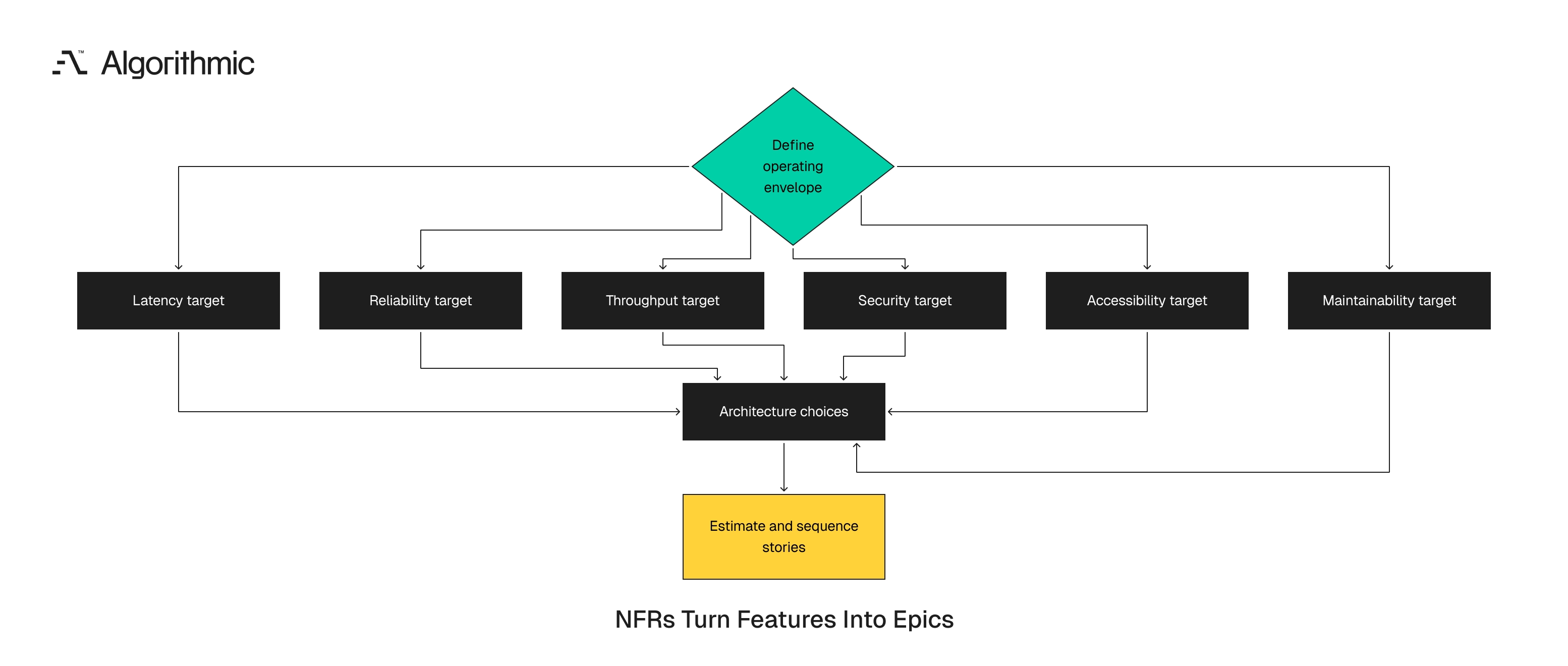
Nonfunctional requirements are epic-level dials
A functional requirement describes what the product does, and a nonfunctional requirement describes the conditions under which the product must work. That distinction changes planning. A story that exports a CSV for 10,000 records within 2 minutes is one engineering task, while a story that exports 5 million records, preserves row-level permissions, runs during peak traffic, and returns a download link within 30 seconds is a different task that changes data access, job control, storage, monitoring, and support.
Scrum.org’s guidance on handling nonfunctional requirements places NFRs inside product delivery work, and that framing supports backlog discipline. Senior engineering leaders should attach measurable targets at the epic level before child stories are sized.
 Click to expand
 The six dials that change scope
The most common dials are measurable, and each one changes engineering work, validation work, and run cost. Each one also changes sequencing, since production constraints affect early design choices.
| Dial | Weak statement | Scope-shaping statement | Likely engineering effect |
|---|---|---|---|
| Latency | ”Fast page load” | p95 API response under 700 ms at 300 requests per second | Caching, query redesign, CDN, asynchronous work |
| Reliability | ”High availability” | 99.9% monthly availability with a 15-minute recovery target | Health checks, runbooks, failover, incident alerting |
| Throughput | ”Handles growth” | 2,000 checkout attempts per minute for 20 minutes | Queues, rate limits, autoscaling, load testing |
| Accessibility | ”Accessible UI” | WCAG 2.2 AA across checkout, account, and admin flows | Design system rules, keyboard testing, semantic markup |
| Security | ”Secure login” | OWASP ASVS Level 2 controls, audit logs, MFA for admins | Threat modeling, secrets management, access control |
| Maintainability | ”Clean code” | 80% coverage on domain logic, typed API contracts, ADRs for major decisions | Test architecture, CI gates, code ownership |
These targets belong above individual stories, since they change how the system is designed, tested, monitored, and operated in production, and they change the number and order of stories. A product owner can approve “bulk invite users” as one feature, but the estimate changes when the feature must process 50,000 invitations, prevent duplicate sends, support retries, and expose an audit trail, and it changes again when all invitations must complete within 10 minutes during onboarding windows.
Teams should treat each dial as a product decision. A latency target affects user experience and cloud cost, while a security target affects onboarding flow, support load, and procurement evidence. A maintainability target affects the next six releases, since if typed API contracts and migration rollback plans are required, the first sprint includes scaffolding work, and if those standards are absent, the cost appears later through defects, inconsistent reviews, and slower onboarding.
The same logic applies to mobile applications. A screen that works on Wi-Fi during development needs more engineering when it must handle packet loss, offline mode, and background sync, and those conditions change state management, conflict resolution, local storage, and telemetry. For API products, rate limits and idempotency matter early, since a partner integration that receives 100 calls per day can start with direct writes, while a public API that receives burst traffic from 200 customers needs request signing, replay protection, quotas, and clear error contracts.
The senior operating model for classifying the epic before sizing it
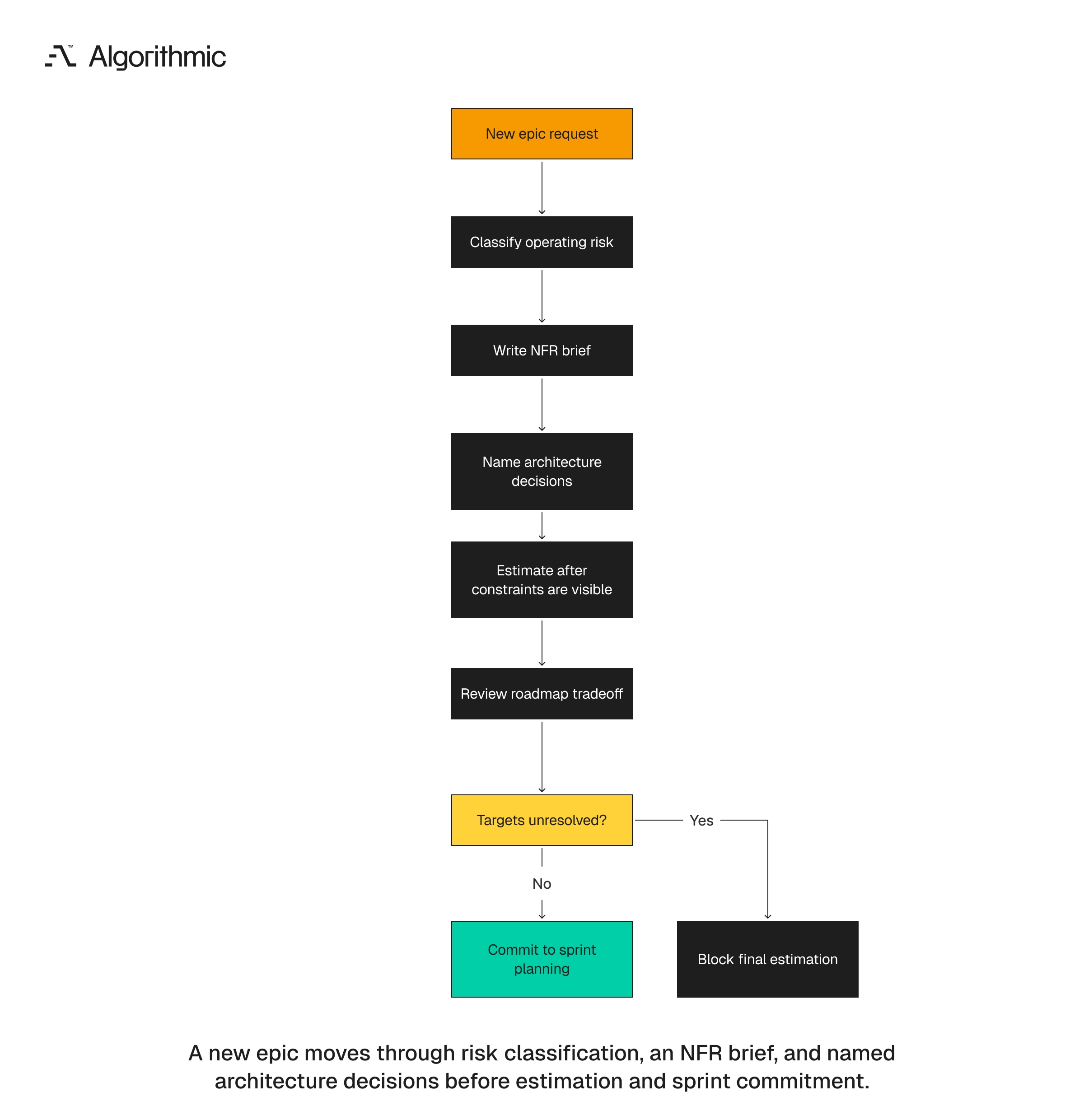
Most planning processes ask, “How many points is this feature”.? That question arrives too early, and the first question should classify the epic by operating risk. Use four classes. Class 1 covers internal tools with low traffic and no regulated data, and Class 2 covers customer-facing workflows with modest load and standard security controls. Class 3 covers revenue, identity, payments, analytics, or enterprise procurement evidence, and Class 4 covers regulated, high-volume, multi-region, or safety-sensitive systems. The class determines which NFRs must be quantified before estimation.
A Class 1 internal admin screen needs basic reliability and maintainability standards. A Class 3 billing workflow needs latency, audit logging, recovery, access control, support procedures, and monitoring before sizing, and a Class 4 workflow needs disaster recovery tests, regional failover paths, and executive approval for residual risk. This classification keeps planning efficient, since teams do not need a 30-point NFR review for a temporary operations screen, but they do need a formal gate for checkout, reporting export, search, authentication, billing, and customer data flows.
A strong operating model also assigns a decision owner for each dial. Product owns the customer promise and acceptable degradation, and engineering owns the architecture path. Security, data, infrastructure, and design own the standards in their domains, QA owns the validation plan and the evidence standard, and support owns escalation handling and customer communication during degraded service. The output is a short scope contract attached to the epic that does not replace user stories, it sets the boundaries within which those stories have meaning.
This contract should use plain language. It should state which user paths are covered, which conditions are excluded, and which measurements define success, and it should record the cost range accepted by product and finance. A senior planning meeting should end with one of three outcomes, where the epic is ready for estimation, the epic needs a technical spike, or the epic returns to product for a tradeoff decision. Ambiguous approval creates ambiguous delivery.
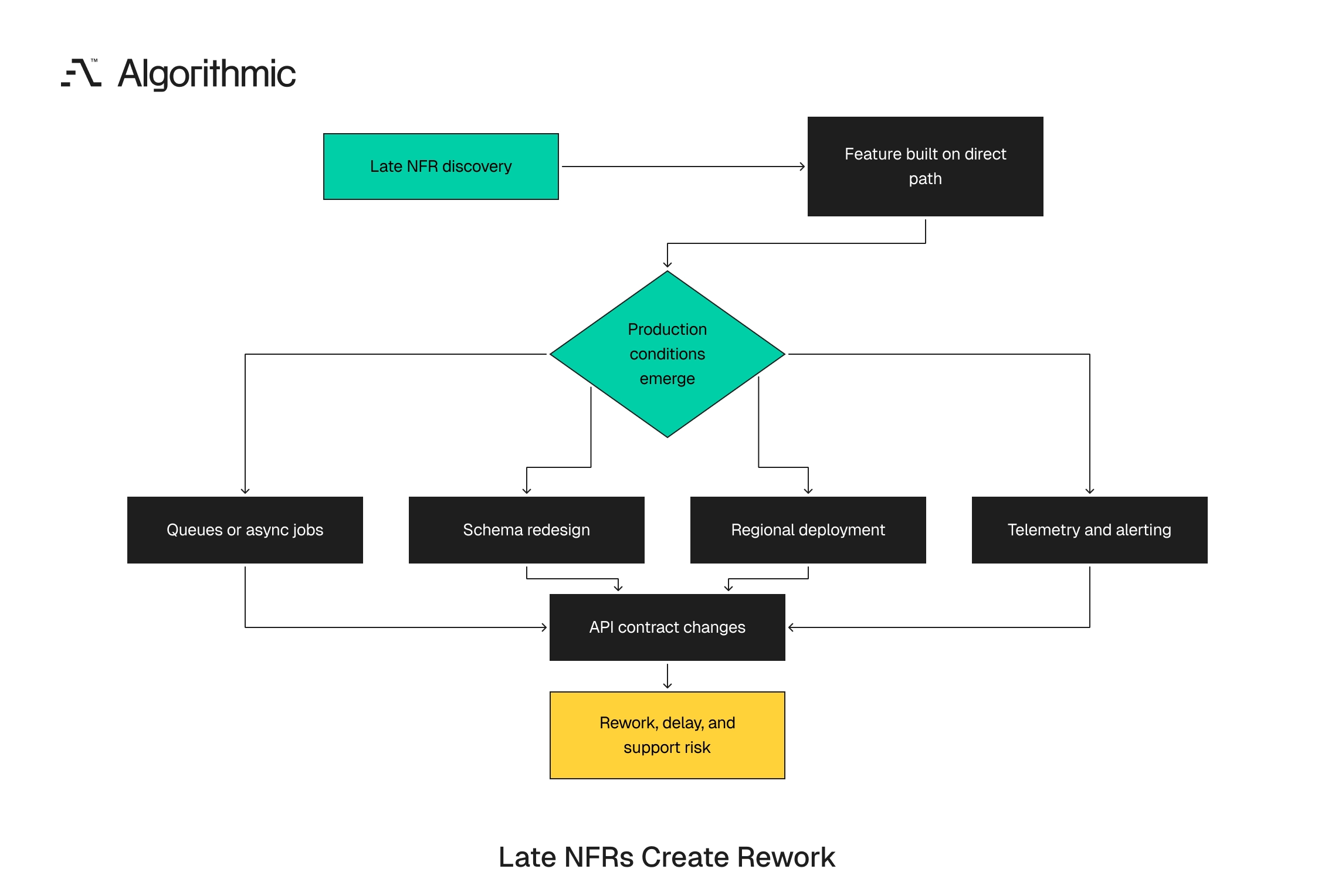
Late NFR discovery creates architectural rework
The business cost of late NFR discovery comes from sequencing. Teams build the direct path first, then discover the system needs a different production path for load, compliance, recovery, or support. A synchronous request-response design works for a low-volume administrative action, but the same design fails when the workflow triggers external APIs, email delivery, fraud checks, and billing events under variable load, and adding queues after the feature is built changes API contracts, user states, error handling, telemetry, and support runbooks.
 Click to expand
 The pattern repeats across data models, deployment topology, and observability design. A team that designs the database for the first screen often misses export, retention, and audit needs, and a team that deploys to one region often revisits data residency after enterprise procurement review. Once customers depend on a system, each architectural correction carries operational risk, since a schema migration needs backfills, validation queries, rollback plans, and support communication, and a deployment change needs security review, disaster recovery testing, and release coordination.
Late changes also damage trust between product and engineering. Product sees missed dates, engineering sees scope that was never sized, and both teams lose credibility with executives when the planning process hid the operating conditions. The executive team then receives a new date, a new cost, and a technical explanation after the commercial commitment exists, and that sequence weakens confidence across the organization. The better sequence is straightforward, since you define the operating envelope before story sizing, then decide whether the feature promise, timeline, or cost should change.
A concrete example of product search
A product search feature can start as a database query with filters. For a catalog of 20,000 items and 500 daily users, PostgreSQL with indexed columns can meet the requirement, and the team can ship with one service, several composite indexes, and request logging. Change the requirement to 2 million SKUs, 100,000 daily users, typo tolerance, p95 response under 300 ms, and personalized ranking, and the architecture now includes OpenSearch or Elasticsearch, an indexing pipeline, denormalized documents, event-driven updates, cache invalidation, relevance tests, and offline evaluation. It also requires a plan for index rebuilds and schema changes.
The team also needs operational alerts for indexing lag, failed document updates, shard pressure, and query error rates. Search relevance requires test queries, click-through measurement, and rules for promoted results, and merchandising teams need tooling that holds latency under promotional load. The roadmap label still says “search”, while the engineering scope now includes ranking systems, data pipeline engineering, query tuning, and production monitoring, and the release plan must compare the old and new search paths before cutover.
This changes staffing, since a product engineer can build a filter query, but a production search system usually needs a backend engineer, a data engineer, and an engineer with search relevance experience. It also changes sequencing, since the indexing model and event contract should arrive before the UI reaches final QA, and if the UI ships first, every relevance change turns into a release coordination problem. The validation plan changes as well, since the team needs a fixed query set, relevance judgments, latency tests, and error budgets for indexing delay, and a screen-level acceptance test cannot validate the production search promise. Search also has business rules that affect architecture, since promoted products, out-of-stock filtering, regional availability, and contract pricing all change the document model, and if these rules arrive late, the team rebuilds the index and retests relevance.
A concrete example of reporting export
An internal reporting export can run as one SQL query and return a file from the web server. That approach works for small reports with low concurrency, but it fails when customers request 18 months of history, 5 million rows, account-level permissions, and no effect on live application latency. The revised scope requires a read replica, a background job system such as Sidekiq or Celery, object storage such as Amazon S3, signed URLs, job status polling, and query limits, and it needs retention rules, download expiration, error recovery, and permission checks at export time, with a record of the filter set used for each export.
Without those controls, one report can degrade the application database for every user, and in a multi-tenant SaaS product, that failure can move from inconvenience to contract breach. The audit trail must show who requested the export, when it completed, and which permission set applied. If these constraints enter after sprint commitment, the team misses the date or ships a fragile path that needs rework, so the better sequence is to define export volume, concurrency, permissions, and latency budget before estimation. The estimate then reflects the production system.
The same pattern appears in operational analytics. A dashboard for 50 managers can query the transactional database, while a dashboard for 5,000 external users often needs warehouse modeling, materialized views, cached aggregates, and row-level security tests. Exports also create support requirements, since users need status messages, retry behavior, and clear errors when a report exceeds limits, and support teams need a way to find failed jobs without asking engineering to query logs. Data retention changes the scope again, since a 24-month retention promise affects partitioning, archive storage, deletion policy, and legal hold behavior, and these decisions belong in the export epic because users experience them through the report.
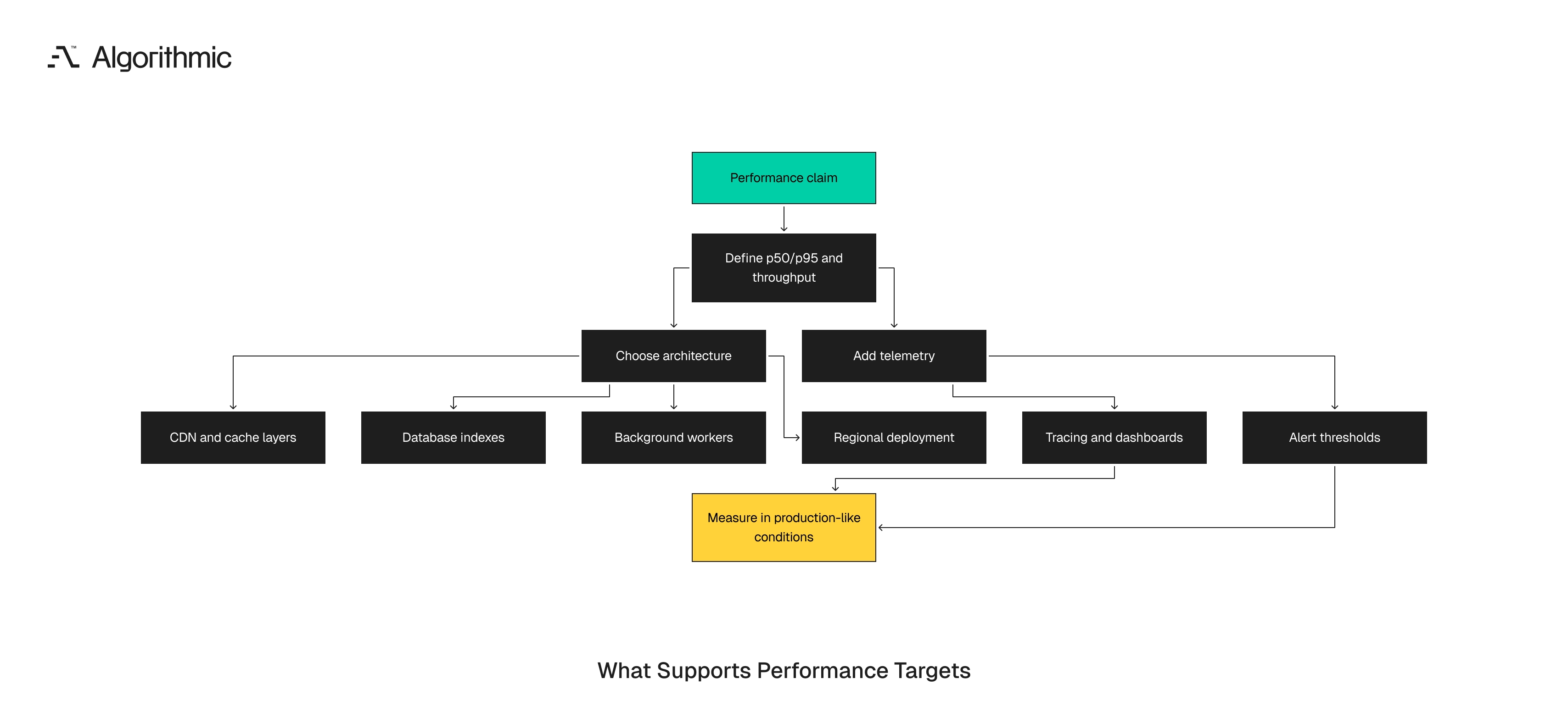
Performance claims need telemetry and architecture
Performance requirements require numbers, since “fast” has no engineering meaning. A product plan should define p50 latency, p95 latency, throughput, and error rate before build work starts. For user-facing systems, p95 reflects the experience outside the median path, and that slice drives abandonment, support tickets, and executive escalations, while for operational systems, tail latency often determines whether teams trust the tool during peak hours. A credible performance claim also needs architecture evidence, so buyers should see deployment regions, CDN strategy, cache layers, database indexes, background workers, and monitoring dashboards, since these artifacts turn a performance target into an engineering commitment.
 Click to expand
 A vendor claiming fast page speeds should publish metrics such as Time to First Byte, Largest Contentful Paint, Lighthouse scores, cache hit rate, and regional latency, and engineering leaders also need the measurement method, traffic profile, test data volume, and test environment behind each number, since a test against seed data in a staging database does not represent a production claim. A performance target without test conditions creates false confidence, so a dashboard that loads in 600 ms against 10,000 rows tells executives little, while the same dashboard tested against 100 million rows, 200 concurrent users, and production-like permissions gives a planning team useful evidence.
The same rule applies to ML systems in production. A recommendation system with a 100-ms inference budget needs precomputed candidates, vector database architecture, model versioning, and feature freshness checks, while a recommendation system with a 2-second budget can use a different serving design. ML latency depends on model size, feature retrieval, network hops, and batch size, so a team serving recommendations from Amazon SageMaker, Redis, and a feature store has different work than a team serving cached recommendations from PostgreSQL. The NFR determines the design before model training becomes the visible work.
Telemetry should be part of the original scope, since a p95 target without tracing gives teams no reliable way to find the slow segment. OpenTelemetry tracing, alongside vendor tools such as Datadog, New Relic, or Honeycomb, should appear in the plan when latency and reliability targets matter. The telemetry plan should name spans, dashboards, alert thresholds, and ownership, so for a checkout flow, that means separate timings for cart calculation, tax service calls, payment authorization, inventory reservation, and order creation, since one aggregate endpoint timer hides the failure point. Telemetry also needs cardinality discipline, since a tag strategy with customer ID, region, plan type, and endpoint can answer business questions, while unbounded tags on request IDs or free-text fields can create high observability cost and weak dashboards. Performance budgets should be visible in pull requests and release gates, so a new endpoint that adds 400 ms to checkout should trigger review before release, with automated checks where the path is critical and manual review where judgment matters.
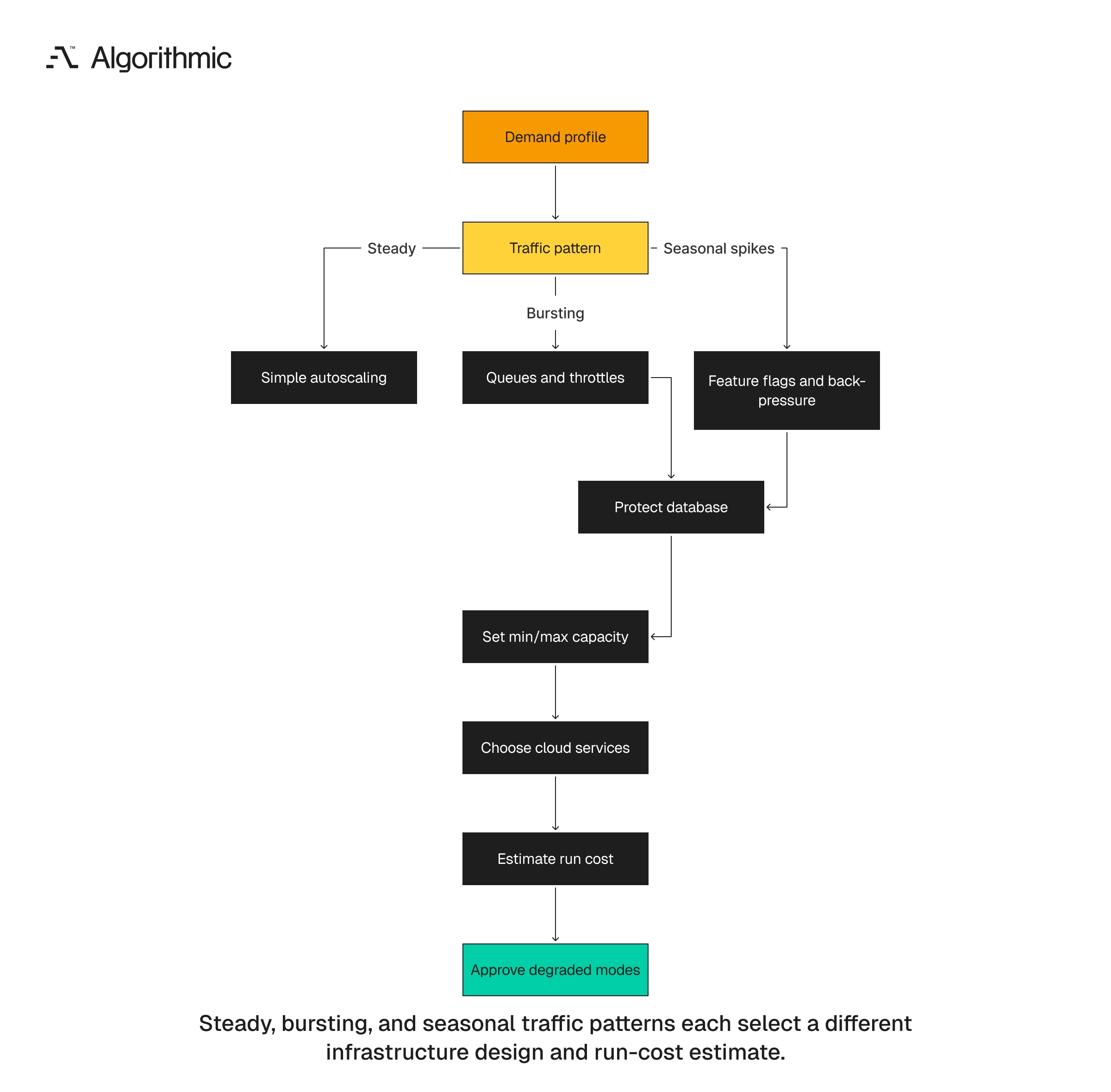
Demand volatility changes infrastructure choices
Peak load is an incomplete planning input, since volatility changes design. A system that serves 1,000 steady requests per second differs from one that serves 20,000 requests per second for 15 minutes. E-commerce systems, ticketing platforms, and marketplace launches often see short bursts followed by sharp declines, so a launch can drive 20 times normal traffic for 30 minutes, then return to baseline, and that pattern requires autoscaling, queues, throttles, and feature flags that isolate costly flows. A fixed infrastructure plan wastes spend during quiet periods and fails during bursts when it lacks back-pressure, while a variable plan sets minimum and maximum capacity, defines queue depth thresholds, and protects the database from request storms, and it defines how the product degrades under pressure.
 Click to expand
 For AWS-based systems, this can mean Application Load Balancer scaling policies, Amazon SQS for expensive work, Lambda reserved concurrency for burst control, CloudFront for static and semi-static responses, and RDS read replicas for query isolation. For Kubernetes-based systems, it can mean Horizontal Pod Autoscaler settings, KEDA for event-driven scaling, and pod disruption budgets tied to reliability targets, and for Google Cloud, the same discussion often includes Cloud Run concurrency, Pub/Sub, Cloud CDN, and Cloud SQL read replicas.
The NFR selects the infrastructure pattern. A 99.9% availability target allows 43.8 minutes of downtime per month, while a 99.99% target allows 4.38 minutes. That extra nine changes monitoring, deployment, failover, and on-call expectations, and it changes release process, since a team moving from three nines to four nines usually needs blue-green deployment, rollback automation, synthetic checks, and tested recovery procedures.
Cost must be part of the same conversation, since a launch architecture that supports 10,000 requests per second for one week can cost several times more than the baseline environment, and product owners need that number before they commit to dates, customer promises, or launch campaigns. The cost discussion should include normal load, peak load, test environments, and observability retention, since Datadog custom metrics, CloudWatch logs, OpenSearch clusters, and data warehouse storage all carry recurring cost, and a product margin model that excludes them is incomplete.
Volatility also affects partner dependencies. Payment gateways, identity providers, tax services, and email vendors have their own limits, so a product promise that exceeds those limits needs throttling, retries, circuit breakers, and fallback paths. The product team should approve degraded behavior before launch, since under load, the system can disable recommendations, delay exports, queue noncritical emails, or serve cached content, and each choice affects customer experience and should be documented before traffic arrives.
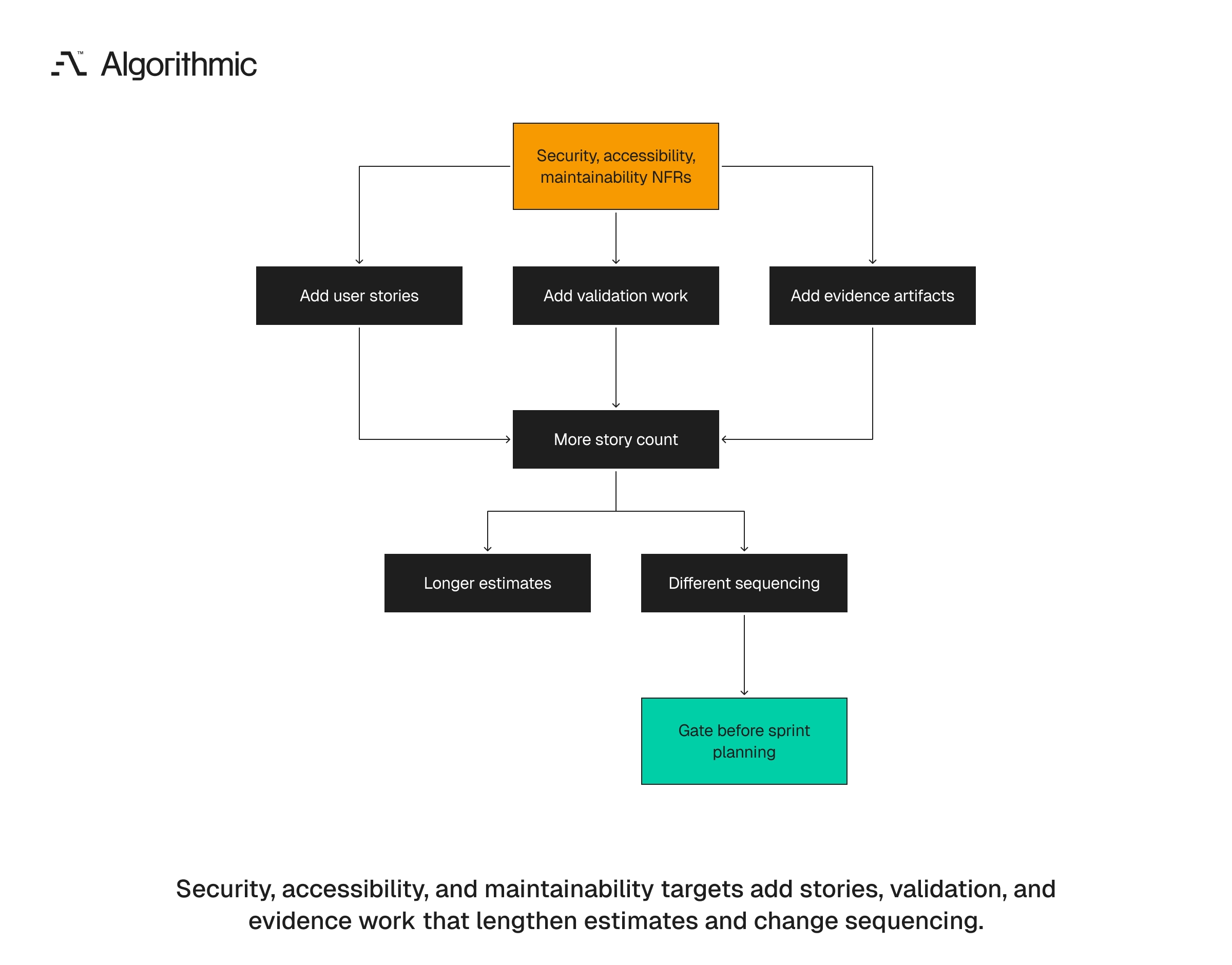
Security, accessibility, and maintainability change story count
Performance and reliability receive attention because they fail visibly, but security, accessibility, and maintainability change scope with equal force, since these requirements create flows, tests, artifacts, and review gates. They also affect procurement, since enterprise buyers request SOC 2 reports, audit logs, WCAG statements, penetration test summaries, data retention policies, and disaster recovery evidence before contract signature, and sales teams need those artifacts before late-stage procurement, not after the security questionnaire arrives. These requirements also change the definition of done, since a flow that lacks audit evidence remains incomplete for an enterprise buyer, and a form that lacks keyboard support remains incomplete for users who rely on assistive technology.
 Click to expand
 Security adds workflow and evidence
Security requirements add user stories, system states, and audit evidence. Multi-factor authentication for administrators requires enrollment, reset paths, recovery codes, device changes, support procedures, and logging, and role-based access control requires permission models, tests, UI restrictions, API enforcement, and audit trails. Tenant isolation changes the data model and query layer, since a multi-tenant SaaS application needs tenant identifiers, authorization checks, scoped queries, and tests that prove cross-tenant access fails, and those controls belong in the first schema and service design.
AI-assisted coding increases the need for explicit security rules, since faster code production creates more review work when access control, dependency policy, and secret handling are undefined, and a team that doubles pull request volume without security gates moves risk into production. The response should be concrete, since teams need secure coding rules, dependency scanning, secret detection, threat modeling for high-risk flows, and pull request checks tied to OWASP ASVS or a similar standard, and those tasks affect estimates and sprint sequence.
Security also changes customer support, since an admin MFA reset path needs identity verification rules, logging, and escalation handling, and if support can bypass controls without audit evidence, the system has a control weakness. A payment workflow adds further scope, since the team needs token handling, PCI boundaries, webhook verification, dispute evidence, and reconciliation checks, and each item becomes engineering work, test work, and operational documentation. API security adds another set of decisions, since public APIs need authentication schemes, rate limits, key rotation, audit logs, and abuse detection, and internal APIs still need authorization checks when they expose customer data.
Accessibility changes design and QA
WCAG 2.2 AA affects color contrast, focus order, keyboard flows, form errors, touch targets, motion, and semantic structure, and it affects test plans, so designers, engineers, and QA analysts need the same acceptance standard before component work starts. A checkout flow that passes visual review can fail keyboard navigation, and an admin table that works with a mouse can become unusable for screen reader users if headers, row actions, and state changes lack semantic markup. These are product defects. Accessibility should be part of design acceptance before sprint planning, since retrofitting it after UI components are built often requires design system changes, and that creates rework across every screen that uses the affected components.
A practical acceptance plan includes keyboard-only testing, screen reader checks, visible focus states, color contrast verification, and form error review, and teams can run axe, Lighthouse, Playwright accessibility checks, and manual tests with NVDA or VoiceOver, since automated tests catch common failures while manual testing catches task flow problems. The design system should carry the standard, since buttons, modals, tables, form fields, alerts, and navigation patterns need accessible defaults, and if every team solves accessibility screen by screen, the defect rate stays high.
Accessibility also affects content and state messages, since error text should identify the field, the issue, and the corrective action, and loading indicators, success messages, and validation errors need screen reader announcements. Complex data tables require early design decisions, since sorting, filtering, pagination, row selection, and bulk actions need keyboard behavior and semantic structure, and these choices affect component design, QA scripts, and acceptance evidence.
Maintainability determines future delivery rate
Maintainability is the product’s future cost curve, since it determines how fast new engineers become productive, how safely teams change code, and how often releases create incidents, and it determines whether a second product line can reuse the platform. Maintainability requirements should define test depth, modular boundaries, API contracts, logging standards, and architecture decision records. A senior software development team moves faster when these constraints are explicit because the review standard is clear, while vague preferences create inconsistent reviews and avoidable rework.
Maintainability belongs at the epic level because it affects every child story, so it should appear in the epic brief, the definition of done, and the engineering review checklist, since a story-level note about “clean code” has no planning value. Maintainability also affects hiring and onboarding, since a codebase with typed API contracts, migration rules, and documented architectural decisions reduces context transfer cost, while a codebase without those standards forces each new engineer to learn through production incidents and code archaeology.
The standard should be specific, with examples such as TypeScript contracts for public APIs, database migrations with rollback plans, test coverage on domain logic, and structured logs with correlation IDs, since these items consume engineering time and reduce future operating cost. Maintainability also includes dependency policy, since a team should know which packages require security review, which versions are supported, and how upgrades are scheduled, and without that policy, urgent patch work interrupts product delivery. Service boundaries require the same discipline, since a monolith can serve a product well when modules are clear and tests are reliable, while a set of services can fail quickly when ownership, contracts, and deployment rules are weak.
The NFR scope gate before sprint planning
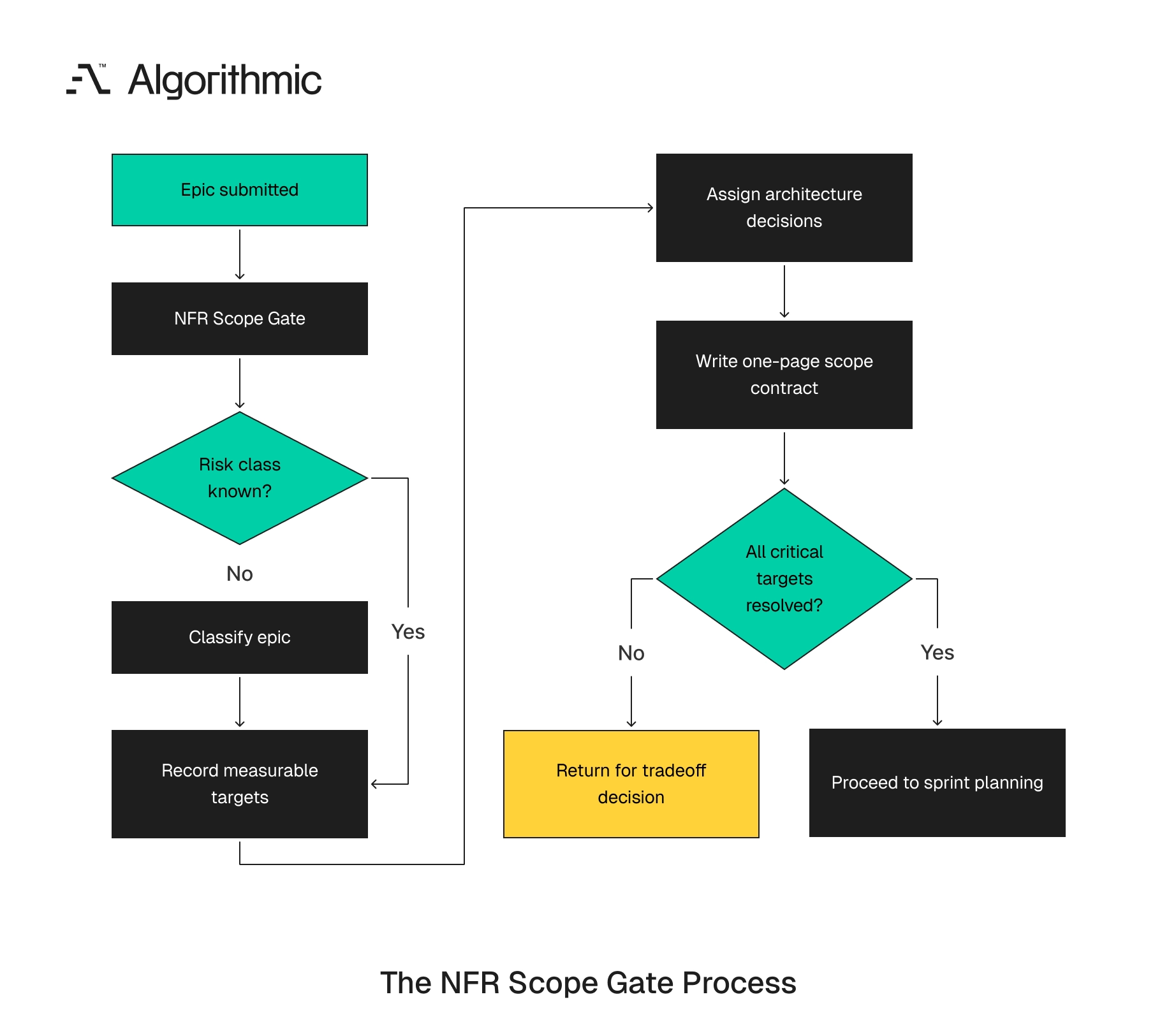
Teams need a short gate before sprint planning that takes 60 to 90 minutes for a normal epic, while regulated, high-volume, or customer-facing workflows need a deeper review. The goal is to turn vague quality expectations into measurable constraints and architecture decisions, and this gate belongs before estimation, since build work should start after the team understands the operating conditions. The meeting should include the product owner, engineering lead, designer when UI is affected, QA lead, and a senior engineer close to the production system, with security, data, and infrastructure leaders joining when the epic touches their domains, so the attendance list matches the risk class of the work.
The output is a one-page scope contract that attaches to the epic before story decomposition, and the contract should be short enough to read during planning and specific enough to drive estimates. A one-page contract also creates executive visibility, since leaders can see which promises affect cost, staffing, and timeline, and which assumptions remain unresolved before they approve a date.
 Click to expand
 The meeting should not become an architecture committee with no decision rights. It should identify the operating envelope, assign unresolved decisions, and state whether estimation can proceed, since a gate without clear outcomes becomes ceremony.
The NFR scope gate checklist
Use this checklist for every epic that affects production traffic, customer data, payment flows, analytics, or enterprise procurement.
- User scale: Define expected users, peak concurrent users, and 12-month growth. Example: 5,000 monthly active users at launch, 100,000 by month 12.
- Latency target: Set p50 and p95 response times for each key path. Example: p95 search response under 300 ms.
- Throughput target: Define request volume and burst window. Example: 2,000 writes per minute for 15 minutes.
- Reliability target: Set availability, recovery time objective, and recovery point objective. Example: 99.9% availability, 15-minute RTO, 5-minute RPO.
- Security controls: Identify authentication, authorization, audit, encryption, and compliance needs. Example: admin MFA, immutable audit logs, tenant isolation.
- Accessibility level: State the required standard and covered flows. Example: WCAG 2.2 AA for onboarding, billing, and account management.
- Data model pressure: Confirm record volumes, query patterns, retention, and reporting needs. Example: 24-month retention, account-level aggregation, export over 1 million rows.
- Operational ownership: Define alerts, dashboards, runbooks, and on-call expectations. Example: Datadog dashboard, PagerDuty alert for error rate above 1%.
- Maintainability standard: Set test, documentation, and code review rules. Example: typed API contracts, migration rollback plan, architecture decision record.
- Cost envelope: Set the monthly cloud cost range under normal and peak load. Example: $4,000 baseline, $18,000 during launch week.
The brief should also record open decisions, so if the team lacks a firm number, the brief should assign an owner and a deadline, and an unresolved latency target or security standard should block final estimation for the affected work. A practical brief can fit on one page, listing the epic name, risk class, target users, key paths, metrics, architecture decisions, validation plan, and cost envelope, and the team can then break the epic into stories with production constraints already attached.
The brief should include the decision log, so if the product owner accepts a slower export to reduce infrastructure cost, record that decision, and if engineering recommends a queue before the UI, record the reason and the affected date. This discipline stops the common pattern where NFRs live in comments across 14 tickets, since it gives QA one acceptance frame and engineering one architecture frame. It gives product one approved tradeoff record, and it gives executives a trace from promise to cost, which matters when sales asks for a delivery date or finance asks for margin assumptions. The brief should remain alive through delivery, so if load testing finds that the original target needs a new database index or cache layer, update the contract, since scope control requires a visible record of the production promise.
How NFRs change estimates and sequencing
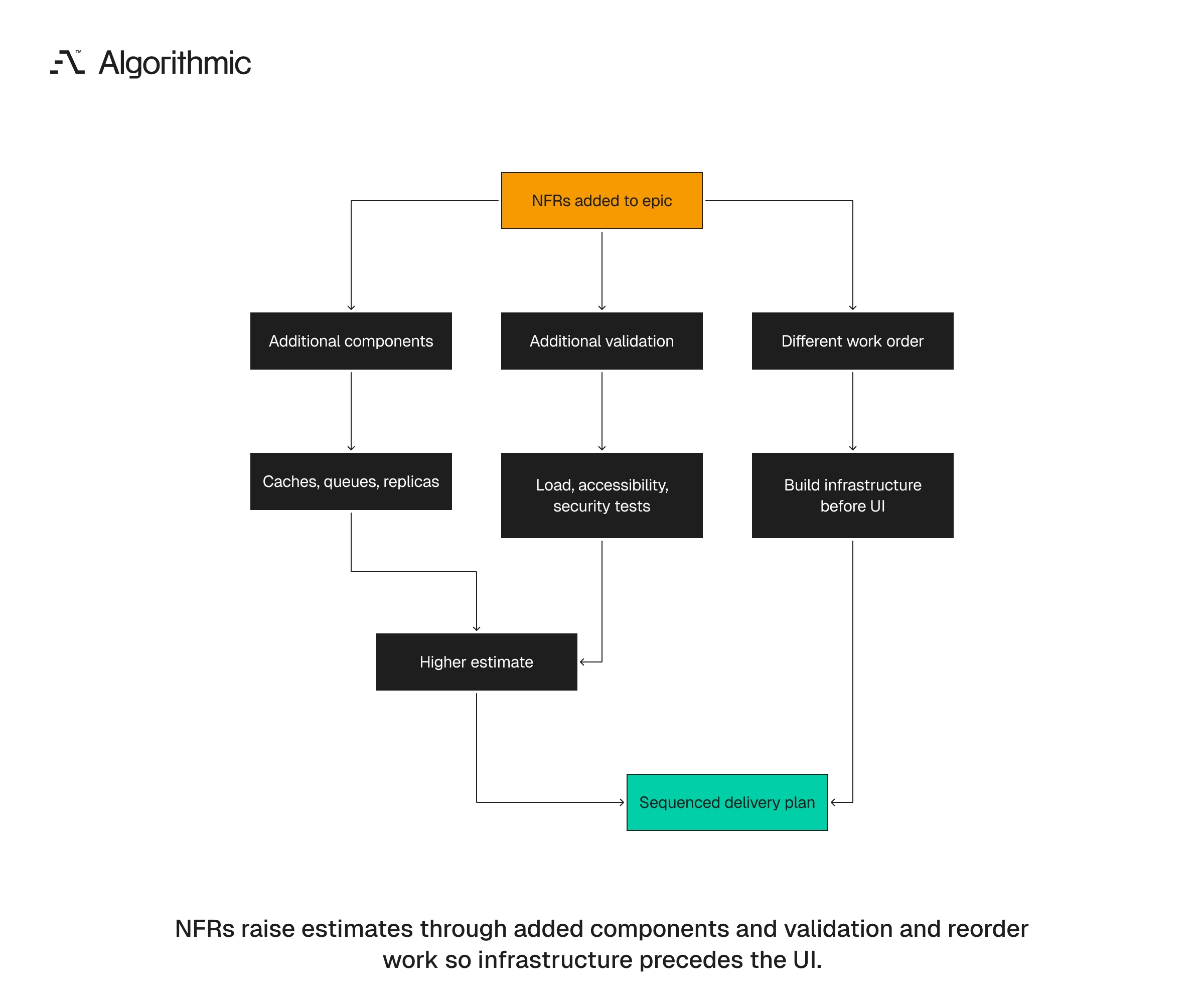
NFRs change estimates in three ways, through additional components, additional validation, and a different order of work, and each category should appear in the estimate, since an estimate that shows only feature coding is incomplete. Additional components include caches, queues, replicas, CDNs, observability tools, secrets stores, and deployment automation. Additional validation includes load tests, accessibility audits, penetration tests, chaos testing, and recovery drills, and a different order of work means architectural seams must be built before visible UI work is complete.
 Click to expand
 A marketplace platform can place messaging, payments, and dispute workflows in separate epics, but add audit-grade traceability across all three, and the sequence changes, since the event model, identifiers, and logging conventions should be designed before teams build the individual screens. The same applies to analytics products, since a dashboard epic can start with charts and filters, but add 24-month retention, row-level security, export over 1 million rows, and p95 load under 1 second, and the work changes. The revised scope includes warehouse modeling, materialized views, permission tests, cache invalidation, and export job control, and it includes monitoring for data freshness and failed refresh jobs, since these tasks are part of the product promise because customers rely on the dashboard for decisions.
This is where a software feasibility study has value, since a 2-week feasibility pass can identify the three or four NFRs that drive architecture, cost, and timeline, and for a $250,000 product build, that study can prevent a six-figure rebuild later. A feasibility pass should produce decisions, naming the data store, queue, deployment model, observability stack, security standard, and load test approach, and it should name the assumptions that remain unproven. The strongest studies include one or two technical spikes, since a spike can test PostgreSQL query performance on representative data, measure OpenSearch indexing lag, or validate SQS worker throughput, and that evidence gives executives a better estimate than opinion-based sizing.
NFRs also change team composition, since a feature team can build a standard CRUD workflow with product engineering skills, but the same workflow under strict latency, audit, and recovery targets requires infrastructure, security, data, and QA specialists. Staffing should reflect the risk class of the epic, since assigning only application engineers to a Class 3 data export creates hidden work for later, while assigning security, data, and platform support at the gate prevents avoidable redesign. Sequencing should show technical dependencies in plain terms, since the queue arrives before the export UI, the permission model arrives before the admin screens, and the telemetry arrives before the load test. This order protects the delivery plan, since teams can still show progress through working software, prototypes, and test results, and they avoid the false progress of screens that cannot survive production conditions.
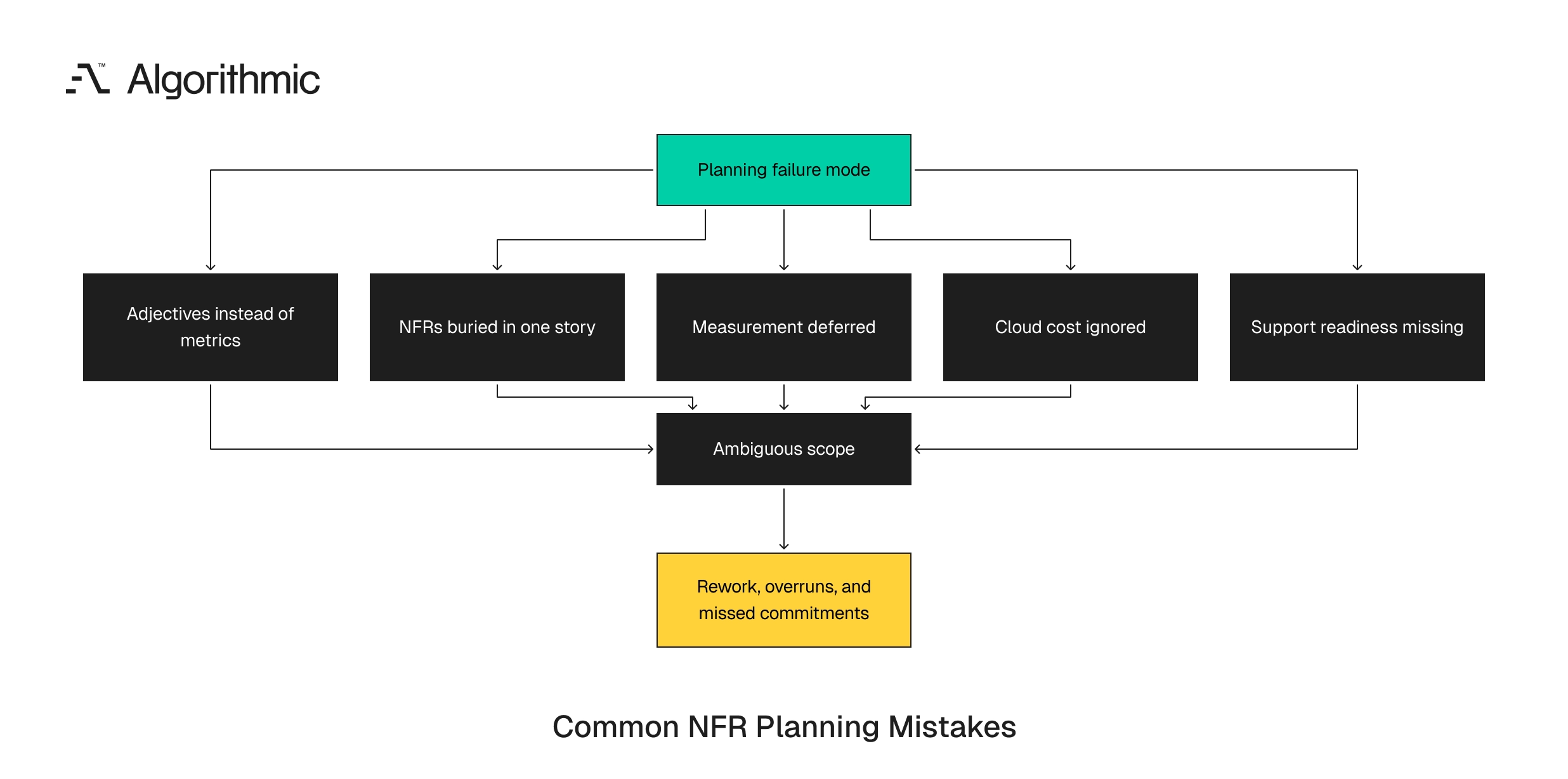
Common failure modes during planning
The first failure mode is accepting adjectives as requirements. Words such as fast, secure, reliable, accessible, and maintainable sound useful during roadmap review, but they provide no basis for architecture or estimation.
 Click to expand
 The second failure mode is placing NFRs inside a single child story, since a reliability target attached only to the API ticket misses worker behavior, database limits, deployment design, and alerting, and epic-level constraints prevent that fragmentation. The third failure mode is deferring measurement, since teams that build first and measure later discover performance issues after the architecture has hardened, and instrumentation should arrive with the first production path. The fourth failure mode is treating cloud cost as an afterthought, since a system can meet latency and availability targets through overprovisioning, and that decision creates a product margin problem when customer pricing assumes a lower cost base.
The fifth failure mode is separating quality from user value, since a customer buying an analytics platform cares that exports complete, permissions hold, and dashboards load during business hours, and those outcomes are part of the product promise. The sixth failure mode is letting procurement define the NFRs after the product is built, since enterprise buyers will ask for data residency, audit logs, retention policy, incident response, and access controls, and teams should price and design those controls before sales commits to them. The seventh failure mode is ignoring degraded modes, since under pressure the product needs defined behavior, where search can drop personalization, exports can queue longer, and recommendation systems can serve cached results. A degraded mode is a product decision that should specify the user message, the operational trigger, and the recovery path, and if the team decides this during an incident, customers experience improvisation.
The eighth failure mode is testing with data that lacks production shape, since 10,000 clean records do not expose skew, hot accounts, long histories, deleted entities, or permission edge cases, and representative data should be part of the planning brief. The ninth failure mode is assuming vendor services remove engineering responsibility, since managed databases, managed queues, and managed identity products still need configuration, limits, monitoring, and failure handling, and the team remains accountable for the product promise. The tenth failure mode is ignoring support readiness, since a feature that fails silently creates engineering escalations for every incident, and support needs dashboards, user-facing explanations, and clear escalation paths before launch.
The executive tradeoff table
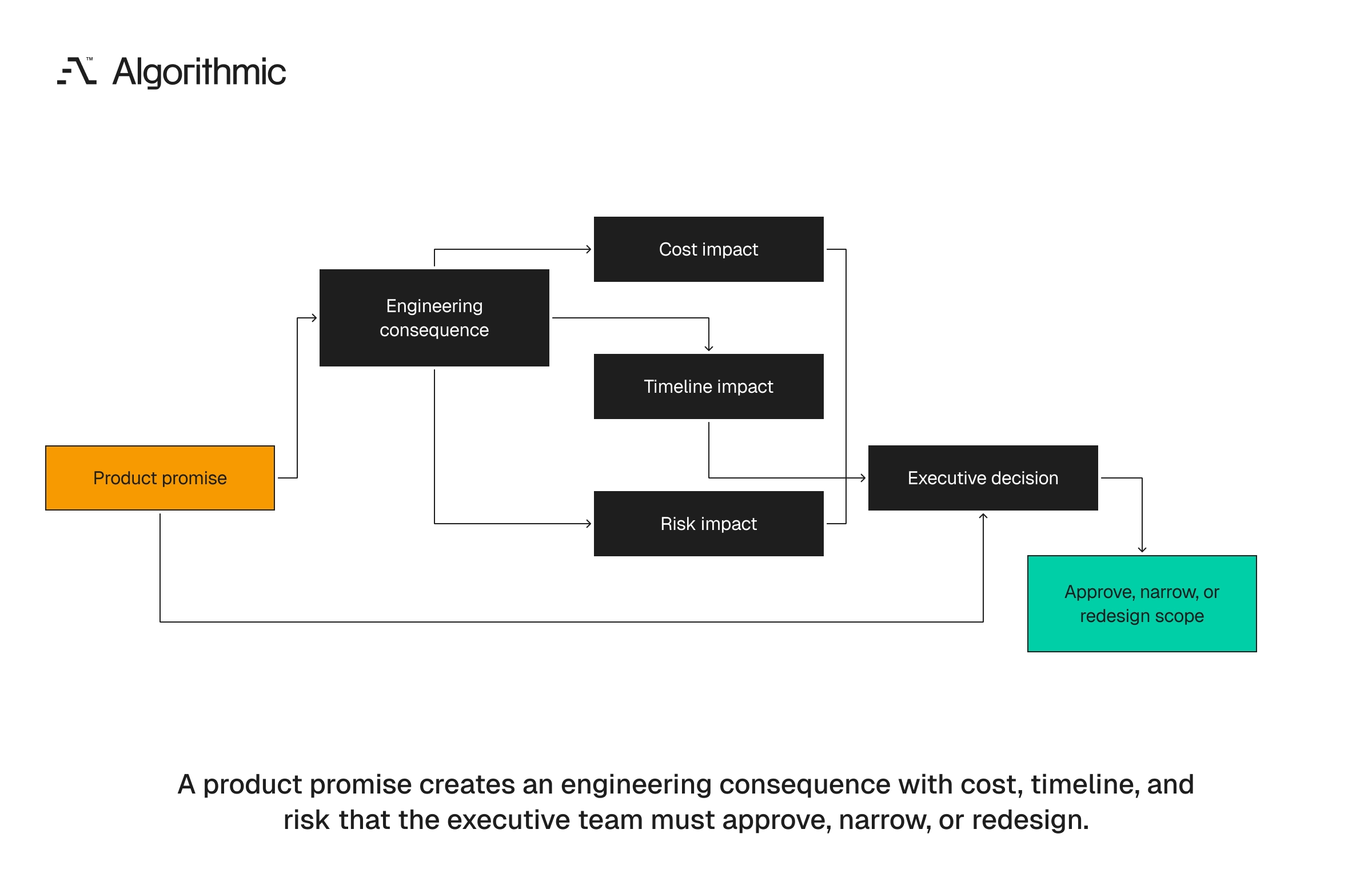
CTOs should bring NFR tradeoffs into roadmap approval. Product owners should understand which target changes cost and sequence, and the decision should be visible before sprint planning.
| Product promise | Engineering consequence | Executive decision |
|---|---|---|
| p95 response under 300 ms globally | CDN strategy, regional routing, cache design, data locality | Approve cloud cost and regional scope |
| 99.99% availability | Failover, release automation, synthetic checks, on-call maturity | Approve operations investment |
| 5 million-row export | Replica, job queue, S3 storage, signed URLs, permissions at export time | Approve background processing path |
| WCAG 2.2 AA | Design system rules, manual testing, semantic components | Approve design and QA time |
| Tenant isolation | Scoped queries, authorization tests, audit trails, schema discipline | Approve security review and test coverage |
| 24-month retention | Storage planning, partitioning, archive policy, reporting model | Approve cost and data governance |
| 15-minute recovery target | Backups, restore tests, runbooks, escalation paths | Approve operational practice and test time |
| Public API launch | Rate limits, key rotation, abuse detection, contract tests | Approve platform and support investment |
 Click to expand
 This table turns quality language into management choices, and it prevents hidden commitments, since a product promise without an engineering consequence is a future escalation. Executives do not need every technical detail, they need the cost, time, risk, and customer promise tied together, and the NFR gate creates that view before teams commit. This also improves portfolio management, since two features with the same visible size can have different risk classes, and a small authentication change can carry more operating risk than a large marketing page. The table should become part of roadmap review, since when a product owner asks for a date, the leadership team should see the production promise attached to that date, and that practice replaces surprise with informed approval.
What CTOs and product owners should change now
Roadmap approval should include explicit NFR approval, since a feature estimate without latency, reliability, throughput, accessibility, security, and maintainability targets is incomplete, and you should treat it as a placeholder, not a commitment. Product owners should reject “we will handle performance later” as a planning answer, engineering leaders should reject acceptance criteria that bury production constraints at the bottom of a story, and both roles should require measurable targets before commitment. Adopt the NFR scope gate for every material epic, require measurable targets, name the architecture decisions they trigger, and size the work after those constraints are visible, since this is the shortest path to production-ready software that supports customer commitments without late architectural rework.
 Click to expand
 Start with the next five epics on the roadmap, classify each epic by operating risk, add the one-page scope contract before sprint planning, and block final estimation where the targets are unresolved. The process change is small and the effect is large, since a 90-minute gate can prevent weeks of redesign, missed launch dates, and unplanned cloud spend, and it gives executives a clear view of what the product will cost to build, run, and support. The same discipline pairs well with a production readiness review, which proves how the system fails, recovers, and rolls back before real traffic arrives.
The directive is simple, since no material epic enters sprint planning without its operating envelope. If the team cannot name the latency, reliability, security, accessibility, data, and cost constraints, the scope is not ready, and product scope is complete only when the production conditions are visible. A practical first step takes one working session, where you select one revenue workflow, one data workflow, and one customer administration workflow, write the NFR brief for each, then compare the revised estimate with the current roadmap plan. The gaps will show where the plan carries hidden cost, since some gaps will be acceptable tradeoffs, while others will require a different architecture, a different date, or a narrower product promise. That decision belongs before sprint planning, with the people accountable for revenue, customer trust, engineering quality, and operating cost, since nonfunctional requirements change product scope because production conditions define what the product is.
Algorithmic runs feasibility studies that turn quality language into measurable targets and architecture decisions before a build starts. Start a conversation if your next epic needs its operating envelope defined before sprint planning.