

A $120,000 interface redesign will not reduce refund tickets if the product cannot tell whether a refund was issued, pending, reversed, retried, or settled. That pattern sits behind many disappointing product investments. Teams fund motion design, onboarding screens, cleaner navigation, and refreshed component libraries, and users still open support tickets because coupons fail, entitlements stay locked, technicians miss appointments, or retries charge cards twice.
Product delight is often assigned to design, but in production systems trust comes from the full transaction path. Payments, entitlements, fulfillment, retries, partner handoffs, analytics, and support tools all shape the user’s experience, and most of that path is backend infrastructure the redesign never touches. The cost appears after launch as support volume rises, churn increases, and operations teams build spreadsheets to track states the product should have modeled in software. A redesign cannot repair missing idempotency keys, clarify workflow ownership, or detect partner failures that never produce alerts.
The pattern is measurable. In one marketplace, a fulfillment exception rate near two percent generated more weekly support load than the entire checkout flow. The checkout screens looked clean, while delivery states had no shared model across the vendor portal, customer app, and support console.
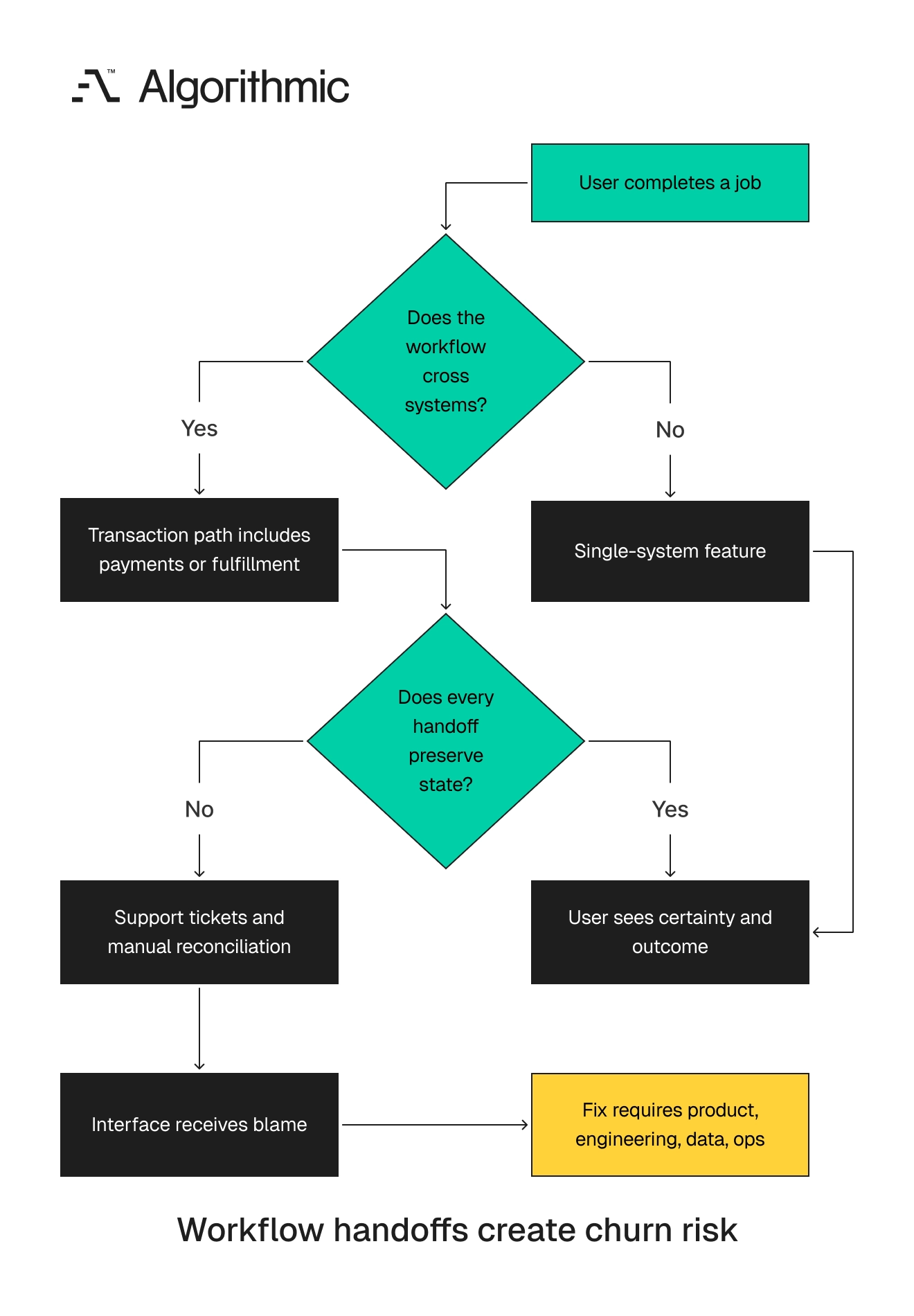
Product leaders need to treat these seams as product surfaces. A seam is any point where user intent crosses a system boundary, and that boundary can sit between Stripe and the application, Salesforce and billing, dispatch and a technician, or a job queue and a customer notification. The user does not see those boundaries, since the user sees one product while the company builds it across teams, vendors, APIs, queues, databases, and operating processes. When a seam fails the interface receives the blame, but the failure sits deeper in the transaction path, and the fix requires product, engineering, data, and operations to own one flow together.
Users judge the completed job
Users judge a product by whether it completes the job they came to do. In B2B SaaS, that job crosses authentication, billing, permissions, scheduling, notifications, analytics, and third-party APIs. A polished interface can make the first session feel strong, but retention is tested at handoffs. A user creates a campaign, schedules it, waits for delivery, checks performance data, edits permissions, and exports results, and each step depends on a backend flow that must preserve state and recover from partial failure. One failed handoff can erase the value of five well-designed screens, because the user experiences the product as one sequence.
 Click to expand
 End-to-end usage matters more than isolated feature quality. A content tool with strong creation UX and weak scheduling loses users between creation and distribution, and a marketplace with strong search and weak fulfillment loses trust after purchase. A SaaS analytics product with strong dashboards and stale data trains users to verify numbers in spreadsheets, and once that behavior starts the product becomes a display layer rather than the customer’s system of record. That shift lowers retention. The customer keeps the account open during evaluation, and expansion stalls because the team no longer trusts the workflow. This is the same dynamic behind SaaS retention and completed workflows, where the weekly completion rate predicts renewal better than any single feature.
The gap for product leaders is operational. They need to know which seams carry revenue, support load, and churn risk, since a seam that handles payments deserves deeper engineering review than a seam that syncs a preference toggle. The practical question is ownership, because one team must own the user flow from click to business outcome, and fragmented ownership creates ambiguity exactly where the customer expects certainty.
The same pattern appears in lower-volume enterprise products. A workflow that runs 200 times per month can still carry contract renewal risk, and one failed permission change can block a 40-person customer team for a full business day. The product roadmap should reflect that risk, so a seam that protects a renewal deserves inspection before a cosmetic release. That sequencing gives leaders a factual basis for allocating engineering time.
Three seams that decide whether the product feels trustworthy
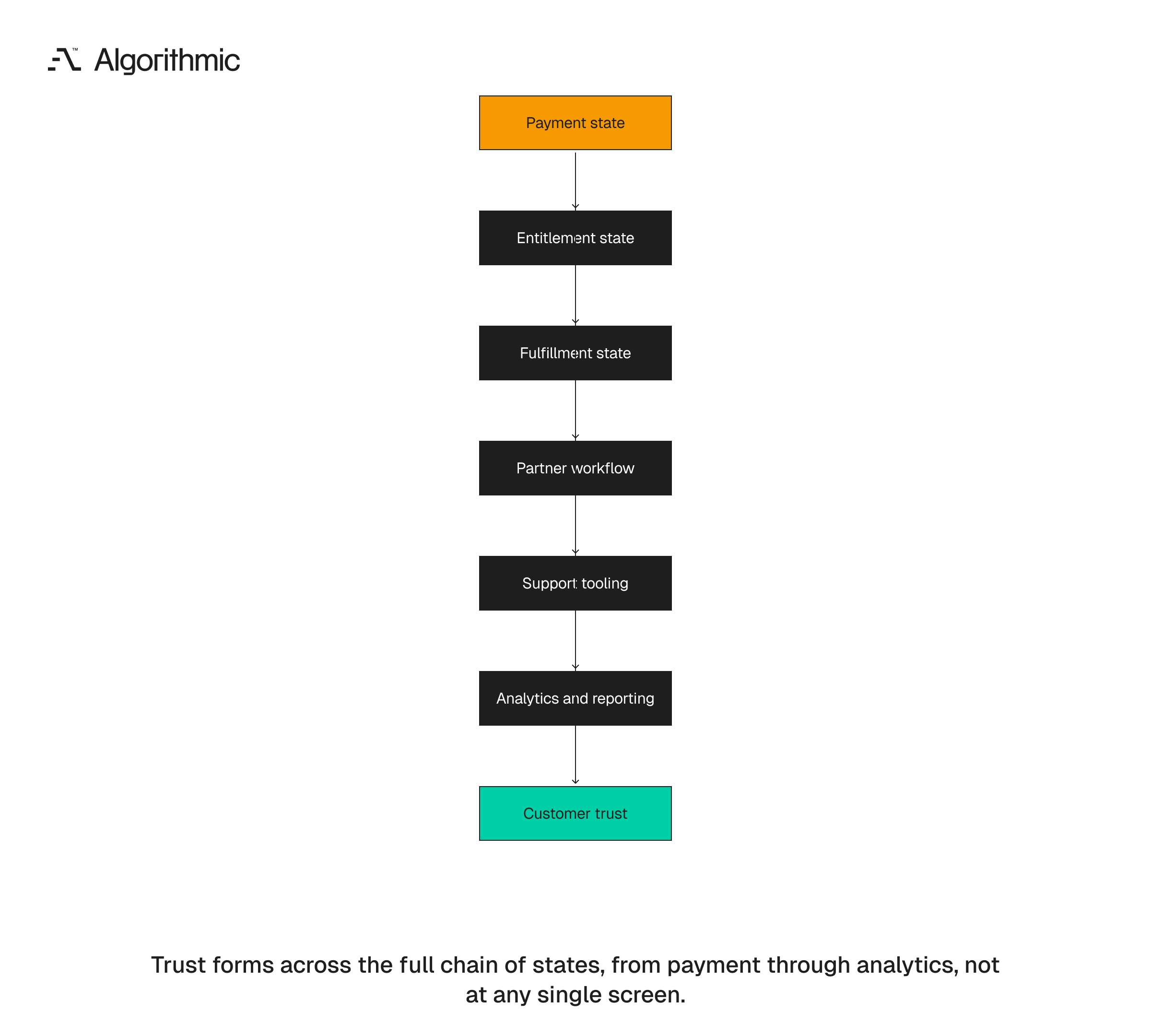
Most seam failures fall into three categories. Money must settle correctly, access must match what the customer bought, and operational work must move through partners, teams, and systems without losing state. These categories cover the highest-risk flows in SaaS products, marketplaces, fintech workflows, and service platforms, and they account for a large share of avoidable support volume. Each category requires explicit state, named ownership, and a recovery path.
 Click to expand
 Payments, refunds, and retries
Payment flows fail in partial states. The card processor accepts a charge, the application times out, the webhook arrives late, and the user refreshes the page. Without idempotency keys, the system can create duplicate charges, missing receipts, or cases with no audit trail. Refunds create the same pattern. A customer sees a refund-requested label in the interface, support sees a Stripe refund ID, and finance sees a bank settlement delay.
The product needs one shared state model across all three views. That model should define requested, approved, submitted to processor, processing, failed, reversed, settled, and closed, and each state needs a timestamp, owner, processor reference, and next allowed action. A production-ready software development team treats refunds and retries as product flows, and tests browser refreshes, duplicate clicks, delayed webhooks, processor timeouts, and failed redirects before launch. It also builds internal tools so support can answer users without querying logs.
This work prevents avoidable refunds and dispute fees. A Stripe dispute costs $15 per case in the United States before lost revenue is counted, so at scale weak payment state becomes a margin problem. A clean payment flow has four technical properties. The client sends an idempotency key with any money-moving request, the backend records the request before calling the processor, webhooks reconcile against internal state, and support sees processor IDs, timestamps, and allowed actions in one screen. Finance can then match product status against settlement records without asking engineering for a database export.
A weak payment flow has a different profile. The UI disables the button after click, the backend relies on the user session to track completion, webhooks update tables without a reconciliation job, and support asks engineering to search logs when a customer reports a double charge. Finance reviews disputed transactions after the customer has already lost confidence. The difference becomes visible under production traffic, where users refresh pages, mobile networks drop requests, and processor events arrive out of order. Customer support needs a factual answer within minutes, and a we-are-checking-with-engineering reply is an internal status rather than a customer answer, so the product should provide the evidence that support needs.
A refund flow needs the same rigor. A refund request is not a refund settlement, a processor confirmation is not a bank deposit, and a reversed refund needs its own terminal state and explanation. The product should distinguish processor acceptance from funds availability and show when the next update will occur. Teams that skip this model push ambiguity into the support queue, where the user asks for status, support asks finance, and finance asks engineering. The customer receives a vague update after three internal handoffs, which creates avoidable contact volume and turns a routine refund into a trust event.
A payment review should include charge creation, receipt delivery, refund initiation, reconciliation, and dispute handling, and it should inspect failed payment recovery. Payment methods expire, 3D Secure challenges fail, and banks decline transactions after authorization. Each branch needs a visible state and a recovery action, so customers know whether to retry, wait, contact their bank, or update a payment method, and support sees the same answer in the console.
Entitlements and access control
Entitlements decide what the user can use after purchase, upgrade, downgrade, invitation, cancellation, or trial expiry. Weak entitlement design creates high-friction UX, where the interface promises access that the backend denies. This shows up in SaaS products when a customer upgrades from Team to Business and still sees locked features for 20 minutes, in marketplaces when a buyer pays for premium placement and the listing stays hidden, and in AI products when token limits, model access, and workspace roles use separate sources of truth.
A clean entitlement system needs one authority for permissions, a time-based audit log, and deterministic rules for edge cases. Product design then reflects operational truth, so the user sees the access they paid for, support can explain every permission decision, and administrators can review override history without asking engineering to run a query. Entitlement defects are expensive because they affect paying customers at moments of high intent. An upgrade failure blocks expansion revenue, a downgrade failure creates billing disputes, and an invitation failure blocks team adoption inside the customer account.
The technical pattern is direct. Store plan, role, workspace, usage limit, trial status, billing status, and override history in one permission service, and expose those decisions through APIs used by product, admin, billing, and support surfaces. The permission service should answer one question for every user action, whether this user is allowed to take this action in this workspace at this time, and the answer should include the rule, source record, timestamp, and override history. A fragile design spreads this logic across billing callbacks, feature flags, frontend checks, and admin scripts, so the user’s account depends on timing and a successful payment can fail to grant access because one system updated before another. That failure damages confidence quickly, because the user has paid, the product says access stays locked, and the support agent cannot explain which system disagreed.
Entitlement design deserves early attention in products with team accounts, usage tiers, metered billing, or regulated permissions. These products need a permission model before pricing experiments scale, or every new plan creates more branching logic. The strongest implementation separates pricing language from authorization logic, since pricing can change quarterly while authorization rules need stable names, explicit transitions, and complete history. This separation matters during sales-led expansion, when a customer can move from 25 seats to 250 seats during procurement and the product must handle provisional access, purchase order timing, billing approval, and administrator assignment. Those events often span Salesforce, Stripe Billing, the application database, and a customer success workflow, and a single missing transition can block an enterprise rollout that the customer experiences as product unreliability.
Entitlements also need revocation design. A cancelled contract, expired trial, failed invoice, or terminated employee account requires a defined access change, and revocation without audit history creates risk in regulated industries. The system should record who changed access, why it changed, and which policy applied. That record protects support, customer success, and compliance teams, and it prevents informal exceptions from becoming hidden production dependencies.
Fulfillment and partner workflows
Fulfillment workflows carry the strongest emotional weight in many products. A user cares less about the checkout animation than the delivery window, repair status, onboarding milestone, or claim decision. The product must expose state with enough precision to reduce uncertainty, and an in-progress label is inadequate when six internal states exist, from assigned and accepted through en route, blocked, awaiting parts, and rescheduled. Each state should have an owner, timestamp, service level, and next action.
Test environments often use cleaned sample data and stable systems, while production runs under time pressure, concurrency, and exceptions. Fulfillment seams require operational design as much as software design, so a status model must match how work happens in warehouses, service depots, repair networks, or implementation teams, and a state that nobody owns becomes a support backlog. The strongest fulfillment systems separate customer-facing language from internal operating detail. Customers see precise expectations such as a technician assigned, parts ordered, or a delivery rescheduled for Thursday, while operations teams see assignment history, exception reason, service-level risk, and escalation owner.
External partners are product users. Field technicians, logistics providers, repair shops, implementation partners, and brokers shape the customer experience, and their tools often decide whether the customer receives the promised outcome. A partner without a dashboard will use email, a partner without service-level visibility will prioritize the loudest account, and a partner without structured feedback loops will create exceptions that product and support see only after a customer complains. We have seen NPS and first-time-fix rates move more from partner routing and technician UX than from customer UI changes, because the customer sees one product while the organization operates a chain of users.
Partner workflows need explicit contracts. The contract should define acceptance rules, rejection reasons, response time, evidence requirements, retry behavior, and escalation paths, since email threads and shared spreadsheets cannot carry that load in a high-volume operation. A repair marketplace shows the point. If a technician rejects a job because the address is outside the service area, the customer should receive a new schedule path, support should see the rejection reason, and dispatch should receive an exception task. The system should also record why the rejection occurred, so operations can distinguish service-area gaps from poor routing, technician overload, or inaccurate customer addresses. Without that record, the business sees only a missed appointment.
Fulfillment and partner seams also affect analytics. A delayed status update can make the dashboard report the wrong delivery rate, and an unstructured rejection reason can hide the main driver of refunds. These workflows need service-level timers, because a partner acceptance window of 30 minutes means little if the system checks exceptions once per day, and the timer, alert, escalation queue, and customer message should share the same source of truth. The product should also distinguish delay types, since a missing part, customer no-show, technician cancellation, and weather event require different actions, and grouping them under a single delayed label prevents operations from fixing the operating model.
Partner workflows are often the least instrumented part of the product. The company owns the customer relationship while another organization controls part of the delivery, and that split requires more visibility, not less.
Integration quality now carries board-level risk
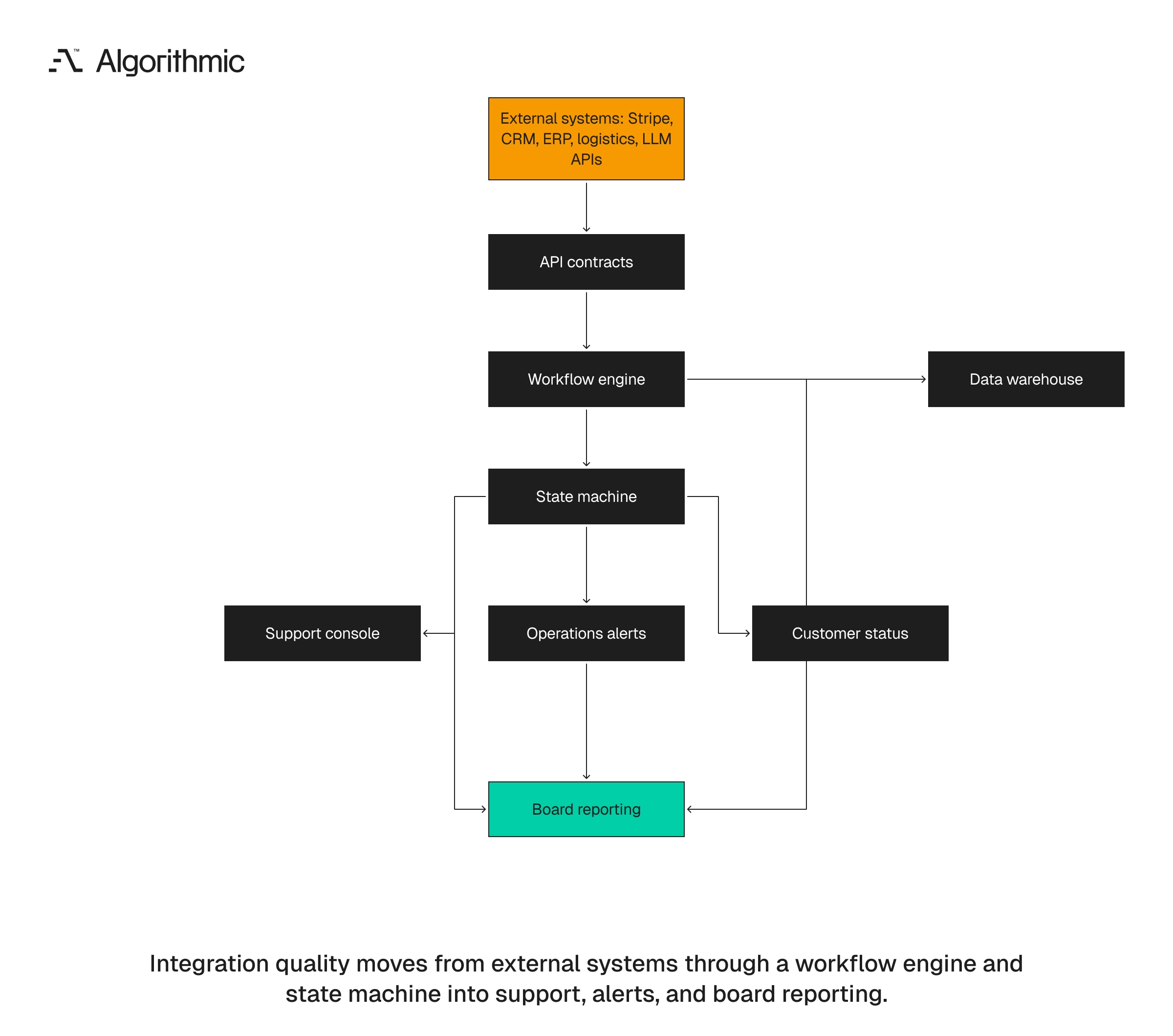
The integration burden is growing because modern products depend on more external systems than prior generations of web applications. Payments, CRM, ERP, warehouse systems, data platforms, identity providers, LLM APIs, vector databases, and workflow tools now sit on the transaction path.
 Click to expand
 The MuleSoft 2026 Connectivity Benchmark Report, based on more than 1,000 IT leaders, reports that 95% of organizations face integration challenges, and that APIs and API-related work account for 40% of company revenue, up from 25% in 2018. AI makes seam quality more visible, because AI agents, automation, and workflow products require systems that expose state and actions clearly. A product that is hard for a human support agent to operate is harder for a software agent to operate safely, since ambiguous state increases duplicate actions, incorrect refunds, and unauthorized access.
Atlassian’s 2026 State of Product report surveyed more than 1,000 product professionals and found that 84% fear their products will fail. Integration quality converts broad product risk into testable engineering work, and gives leadership a way to inspect the transaction path before customers do. Boards now ask product leaders to defend margin, retention, and AI readiness in the same planning cycle, and integration quality sits under all three, since weak seams create support cost, churn risk, and unsafe automation paths.
The budget impact is direct. A team that spends 25 hours per week reconciling failed jobs pays through support headcount, engineering interruptions, and delayed roadmap work, and at a blended internal cost of $85 per hour that single seam costs more than $110,000 per year before refunds or churn. These numbers also change the vendor conversation, because a team hired to deliver screens cannot carry ownership for state machines, queue behavior, partner alerts, and support tools. Production ownership requires a different scope and a different review process.
The board-level concern is control. A product that depends on 12 external systems needs clear ownership for each failure path, or leaders approve roadmaps without knowing which commitments depend on untested handoffs. This concern grows during AI adoption, because agents execute workflows faster than humans and repeat errors at machine speed, so a duplicate refund path that affects 20 users per month can affect thousands when exposed to automation. Integration quality also affects valuation during diligence, where buyers examine churn, support cost, gross margin, data quality, and engineering risk. A seam audit gives leadership evidence before an acquirer, investor, or strategic partner asks for it.
Front-end polish cannot create operational certainty
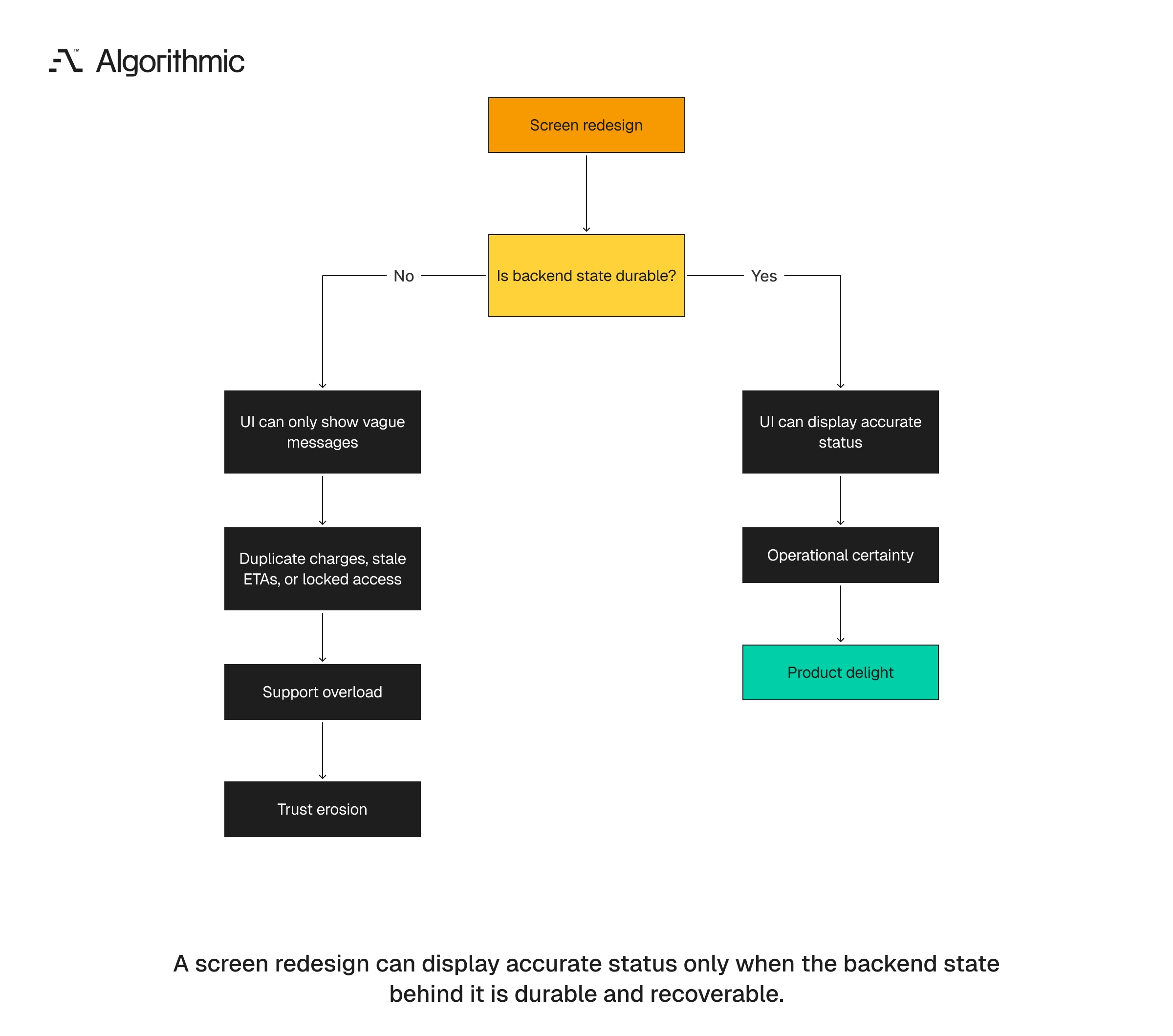
A redesign changes how state is displayed, but it does not create the state model. If a refund has no durable status the interface can show only a generic message, if a retry can run twice a confirmation screen cannot prove a single transaction occurred, and if fulfillment ownership changes by email no dashboard can show a reliable ETA. This is where many product development cost overruns begin. A team launches with screens that assume success paths, and production traffic then reveals missing exception states, delayed webhooks, duplicate events, failed partner callbacks, and support paths tied to individual employees.
The repair often requires backend refactors, support tooling, data reconciliation, and process redesign, so a two-week design iteration becomes a 10-week systems project because the product lacks the primitives that make UX trustworthy. The timing makes the repair harder, since customers are already affected, support is already overloaded, and engineering must fix production behavior while protecting the release plan.
 Click to expand
 Four primitives matter most.
- Idempotency so repeated requests produce one intended result, especially for payments, bookings, submissions, imports, and workflow transitions.
- Explicit state machines so every operational object has named states, allowed transitions, owners, timestamps, and terminal outcomes.
- Workflow visibility so support, operations, partners, and customers see the right state at the right level of detail.
- Recovery paths so failed events, late webhooks, and partner errors enter queues with retry rules, alerts, and human review paths.
These are engineering decisions with product consequences, and they should be designed before launch and tested under failure conditions. Waiting for the first support surge forces the team to repair trust after customers feel the damage. A practical engineering review should inspect the code paths behind the primary user actions, covering database writes, queue behavior, external callbacks, retry logic, alerts, and support screens, because screens alone cannot answer whether a user’s intent survives a timeout. The AWS guidance on making retries safe with idempotent APIs sets the bar here, since any request with side effects needs an idempotency token before a retry is safe.
Operations leaders should join the same review. Support teams know where users become confused, finance teams know where refunds and adjustments leak, and partner managers know where external providers fail to respond. The review must follow the transaction, not the org chart, because a refund starts in the customer app and moves through the application server, Stripe, a webhook receiver, a ledger, an email service, and a support console, and every handoff needs a named owner and a testable failure mode.
This review should include observability, so Datadog, Sentry, New Relic, OpenTelemetry, PagerDuty, and cloud logs carry trace IDs that follow the transaction and a failed workflow is searchable by customer ID, order ID, payment ID, and internal job ID. Observability without product state still leaves gaps, because logs can show that a webhook failed at 14:03 UTC while the product also needs to show what the customer should do next. The same standard applies to support tooling, where a support console should show the workflow state, source records, last successful event, failed event, owner, and safe next action. An ask-engineering escalation should be rare, not the default operating model.
The seam audit scorecard
Product leaders and CTOs need one artifact that connects UX failure, engineering work, operational ownership, and business cost. The Seam Audit Scorecard serves that purpose, and replaces abstract debate with named flows, states, owners, and remediation estimates. Use the scorecard before a redesign, during vendor selection, or during software project recovery, and use it during quarterly planning too, because the artifact shows which seams protect revenue and which ones mostly affect preference or convenience.
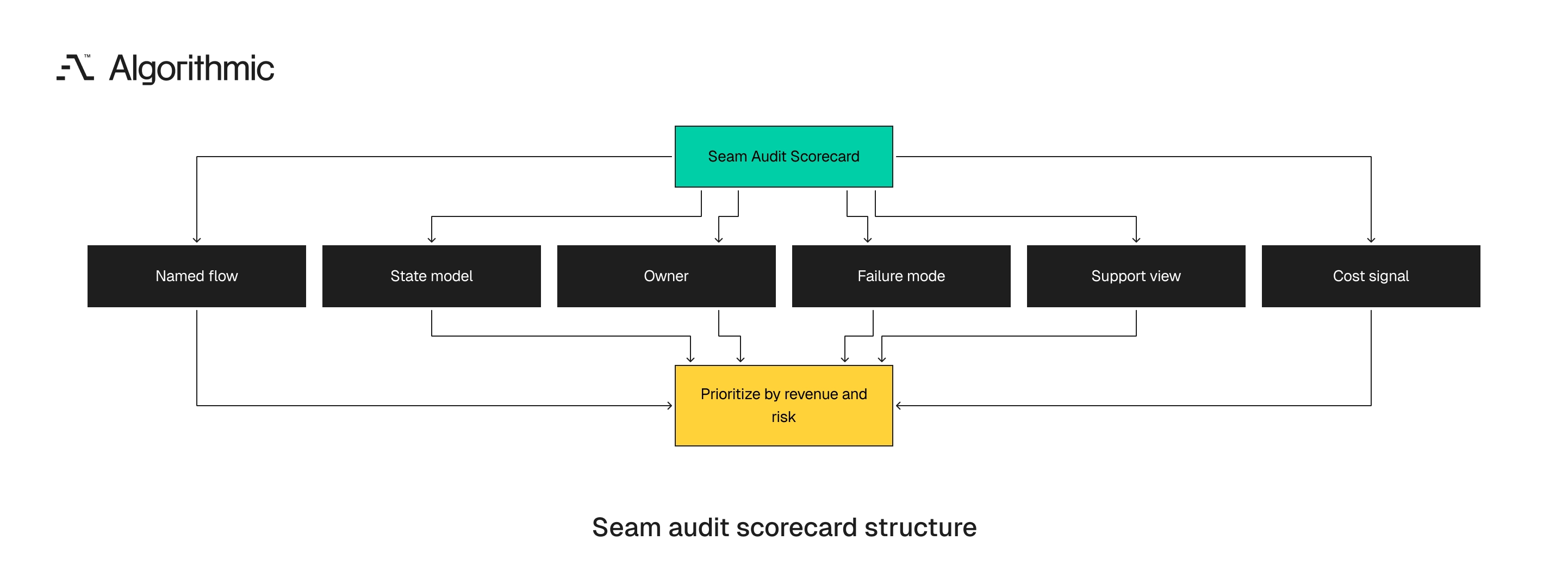 Click to expand
 | Product seam | User-facing failure | Engineering requirement | Operational requirement | Primary owner | Cost signal |
|---|---|---|---|---|---|
| Payment and refund | Duplicate charge, missing receipt, unclear refund status | Idempotency keys, webhook reconciliation, payment state machine | Support view with processor IDs and settlement status | Product engineering | Disputes, refunds, support hours |
| Entitlement | User pays and still sees locked access | Central permission service, audit log, deterministic upgrade rules | Admin override with approval trail | Backend engineering | Failed upgrades, billing disputes |
| Fulfillment | Customer receives vague status or missed ETA | Workflow state model, service-level timers, event history | Exception queue and escalation policy | Product and operations | Credits, churn events, missed appointments |
| Partner handoff | External provider misses or rejects work silently | Partner API contracts, retries, failure alerts | Partner dashboard and service-level reporting | Product engineering and partnerships | Rework, SLA penalties, ticket spikes |
| Analytics loop | User distrusts reports or exports | Data lineage, freshness checks, metric definitions | Incident process for stale data | Data engineering | QBR friction, lost expansion |
| Scheduling | Created work does not publish or execute | Job queue, retry policy, conflict handling | Calendar, audit trail, manual reschedule path | Full-stack product team | Manual fixes, duplicated work |
The scorecard should be completed with real production data. Pull tickets from Zendesk or Intercom, refund and dispute data from Stripe, and alerts from Datadog, Sentry, PagerDuty, or the logging stack. It should also include current support behavior, so if agents use Slack threads, spreadsheets, or database requests to answer customers, record that work, because those paths reveal missing product state.
The artifact changes prioritization. A new onboarding animation and a refund reconciliation tool may compete for the same engineering capacity, and the scorecard shows which investment reduces ticket volume, protects revenue, and increases customer trust. It also exposes ownership gaps across vendors, where a design firm may own screens, a backend contractor may own APIs, and an internal operations team may own exceptions, while the customer expects one outcome across all three groups. Use the scorecard in planning meetings before design starts, and ask the team to name the state model, source of truth, support view, failure mode, and owner for each seam. If nobody can answer, the team has found a production risk before customers find it.
A useful scorecard includes severity and frequency, where severity captures money movement, access loss, regulatory exposure, and customer disruption, and frequency captures transaction volume and exception rate. The best version also includes detection time, because a seam that fails silently for six hours deserves more attention than one that pages an owner in two minutes, and time-to-detection often decides whether a defect becomes a support spike. Teams should review the scorecard quarterly, since product changes, vendor changes, pricing changes, and AI features can alter seam risk, and a low-risk integration can become revenue-critical after one pricing launch. The scorecard should live with the product operating plan rather than a one-time audit folder, so product, engineering, operations, support, and finance use the same artifact during prioritization.
How to run a 30-day seam audit
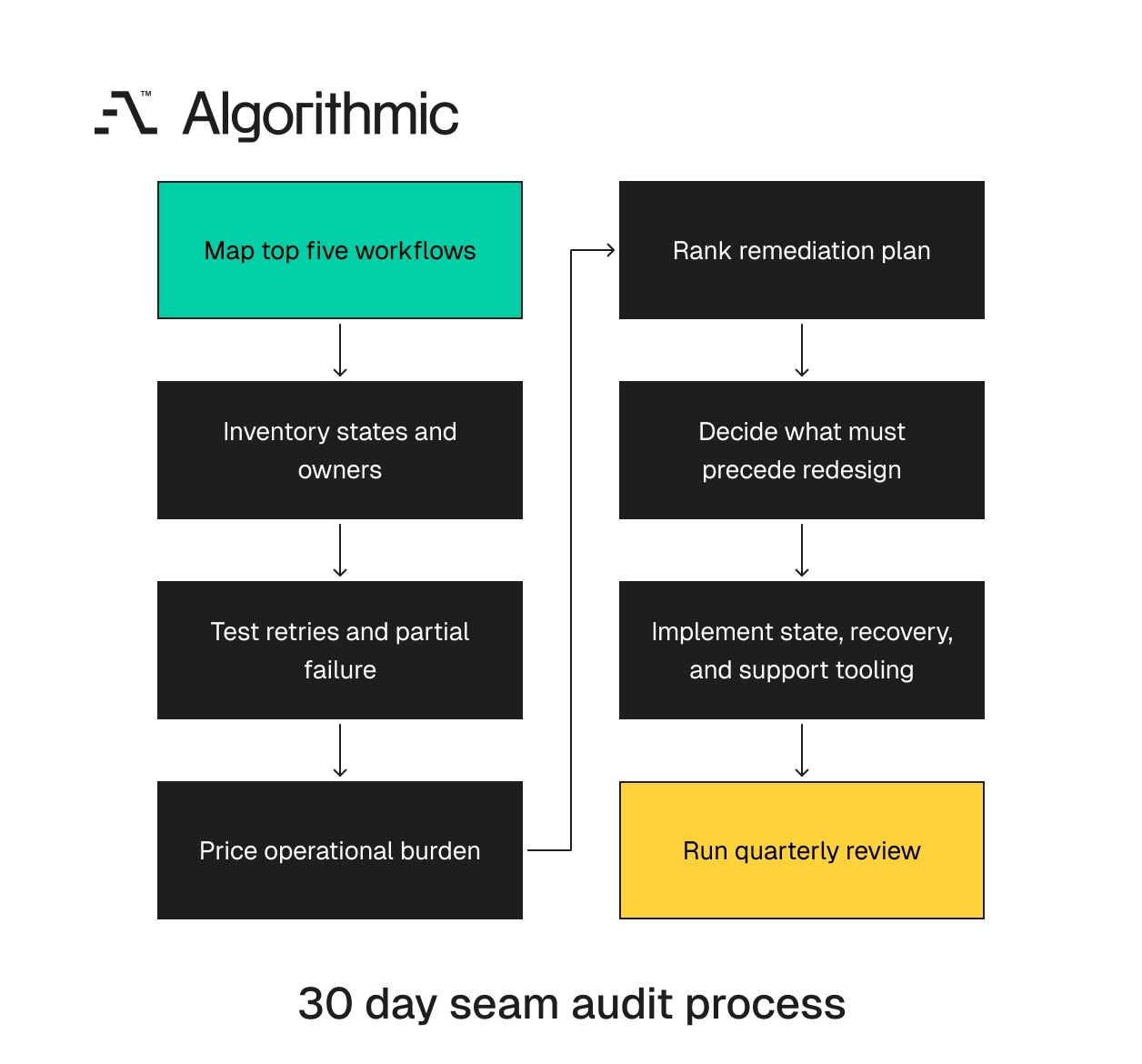
A seam audit is a 30-day review of workflows where user trust depends on multiple systems, and it should happen before a major redesign, before vendor selection, or during failed software project recovery. The audit should produce specific artifacts, including transaction maps, state inventories, failure test results, and a cost model, and those artifacts help executives decide whether the next dollar should fund interface work, backend repair, or operations tooling. The strongest audits use real tickets, real logs, and real transaction data. A focused audit does not require a large committee, and a strong team includes a product lead, senior backend engineer, data engineer, support lead, and operations owner, with finance joining the working sessions for payment-heavy products.
 Click to expand
 Week 1 map the transaction paths
List the top five revenue or retention workflows, and for each one draw the path from user action to final business outcome. Include external APIs, internal services, job queues, data warehouse updates, notifications, support views, and partner steps, mark every place where state crosses a system boundary, and label each boundary with the owning team and expected response time. For a SaaS billing flow, the path often includes the application server, Stripe, a webhook receiver, an entitlement service, a workspace permissions table, an email service, and a support console. For a marketplace, the path can include checkout, seller acceptance, inventory reservation, dispatch, customer notification, and payout, and the map should show the full operating path in one view.
A useful transaction map includes failure paths, so show what happens when Stripe sends a late event, a partner rejects work, or a queue job fails three times, and show which employee can see the failure without database access. The map should include identifiers, where order ID, payment intent ID, customer ID, workspace ID, job ID, and partner reference travel through the workflow, because missing identifiers make reconciliation slow and error-prone. Teams should document timing assumptions too, since a webhook expected within 10 seconds needs different handling than a bank settlement expected in three days, and the map should show those time windows directly.
Week 2 identify ambiguous states
For each workflow, list every status shown to users, support, operations, and partners, then compare those labels with backend states. The usual finding is a mismatch, where users see three statuses, operations tracks twelve, and engineering logs contain the only evidence of failure. State ambiguity creates avoidable tickets, because a customer who sees a processing label for 36 hours will ask support for an explanation, and support then searches Stripe, Salesforce, internal logs, and Slack because the product does not present one answer.
The audit should convert these mismatches into a state dictionary, where each state has a definition, owner, allowed transitions, timeout threshold, customer-facing label, and support-facing explanation. This document becomes the contract between product, engineering, and operations. The dictionary should also define terminal states, because a workflow cannot stay open forever, and closed, failed, cancelled, refunded, reversed, expired, and escalated each need precise meaning. The team should remove duplicate labels, since pending, processing, and in progress often mean different things in different systems, and a state dictionary forces each label to carry one meaning. The dictionary should also name forbidden transitions, so a refund cannot move from settled back to processing without a reversal event, and a technician cannot move from rejected to completed without a new assignment.
Week 3 test retries and partial failure
Run controlled tests for duplicate clicks, browser refreshes, webhook delays, partner API failures, queue retries, and cancelled requests, and give payments, bookings, imports, exports, and workflow submissions special attention. The goal is to find whether the system produces one correct outcome, multiple conflicting outcomes, or no recoverable outcome, so record the test result, visible user state, internal state, alert behavior, and support recovery path. A failed test without an alert is a production incident in waiting.
The tests should run in staging with production-like data volumes and dependency behavior, because clean sample data hides concurrency problems, and realistic tests include delayed webhooks, duplicate messages, expired sessions, invalid partner responses, and queue backlogs. One test should follow a money-moving action from click to settlement, another should follow an entitlement change from payment to permission update, and a third should follow fulfillment from acceptance to completion or rejection. The audit team should also test manual recovery, so if support changes a status the system records who changed it, why it changed, and which downstream events fired, since manual correction without audit history creates a second failure path.
Testing should include out-of-order events, because processors, logistics systems, and partner APIs do not always send messages in the expected sequence, and the product should reject invalid transitions and reconcile valid late events. The team should also test duplicate partner messages, since a carrier can send two delivery confirmations and a technician app can retry a completion event after a network timeout, and the system should store one intended outcome.
Week 4 price the operational burden
Measure ticket volume, manual handling time, refund leakage, churn events, and engineering interruptions tied to each seam, using actual numbers from Zendesk, Intercom, Stripe, Datadog, warehouse queries, and incident records. A common pattern is a small exception rate with large cost. At 50,000 monthly transactions, a 1.5% exception rate creates 750 cases, and at 12 minutes per case that is 150 support hours before engineering escalation, refunds, or customer success intervention.
The cost model should separate direct cost, revenue leakage, and opportunity cost. Direct cost includes support time and engineering interruptions, revenue leakage includes refunds, credits, failed upgrades, and churn from unresolved failures, and opportunity cost is often the largest category. Senior engineers pulled into reconciliation work are not shipping the roadmap, customer success managers explaining stale reports are not expanding accounts, and product managers triaging missing states are not improving the core workflow.
The audit should end with a ranked remediation plan, where each item includes owner, engineering estimate, operational change, expected ticket reduction, and revenue risk, and the plan identifies work that must precede redesign and work that can run alongside interface improvements. A strong remediation plan includes small fixes and structural repairs. A small fix may add a support field for processor IDs, and a structural repair may introduce a state machine for refunds, entitlements, or fulfillment exceptions. Both types matter, because small fixes reduce pressure quickly while structural repairs prevent the next redesign from hiding the same operational ambiguity.
The plan should include acceptance criteria, since add refund visibility is too broad for execution, while a target such as support can view processor ID, internal refund state, settlement status, and next allowed action gives engineering a testable goal. The plan should also include an executive decision point, because some seams require product sequencing changes, vendor contract changes, or operating model changes, and those decisions belong in the leadership forum, not only in the backlog.
How to evaluate technical partners for full-stack product development
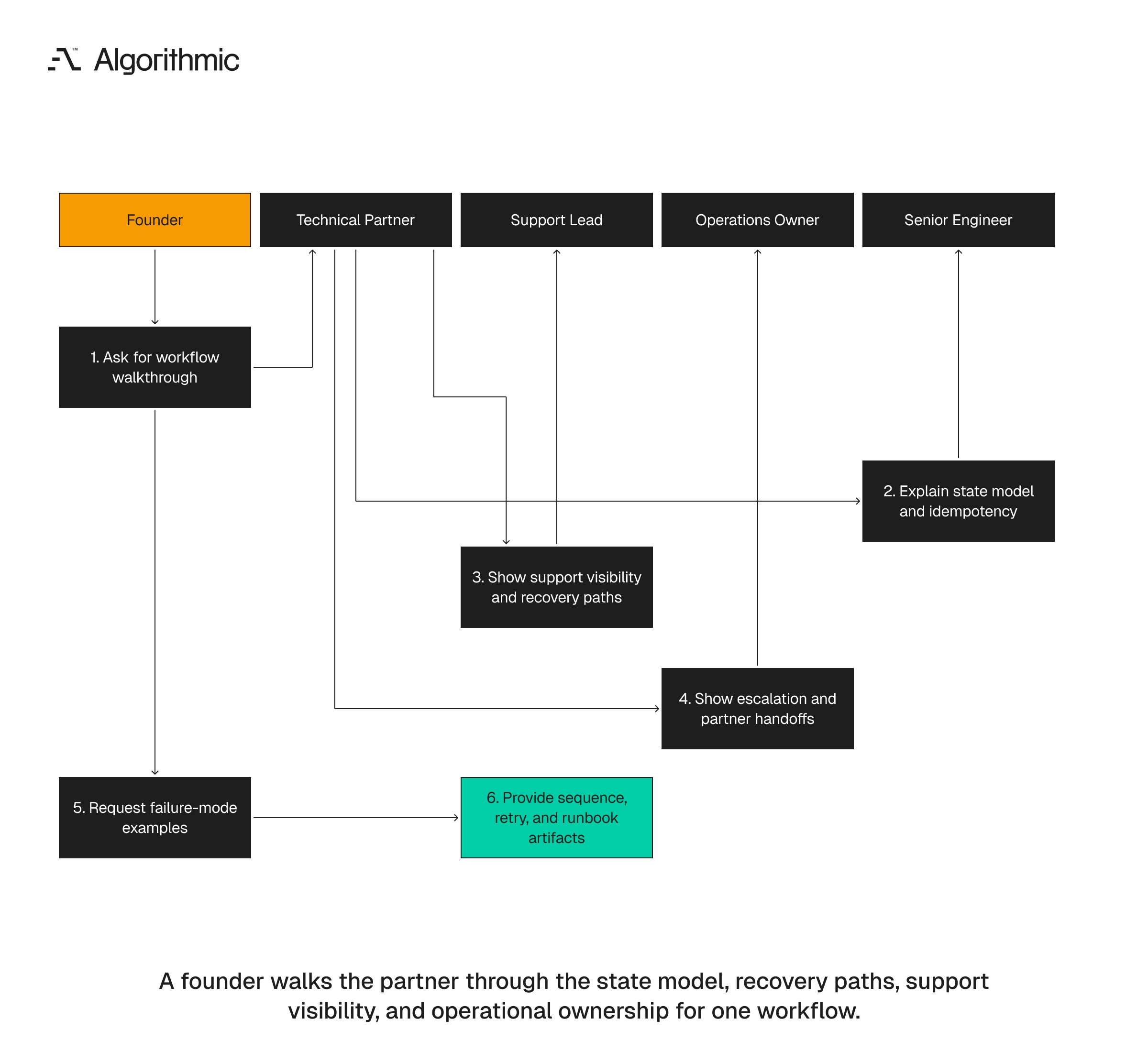
A full-stack product development partner should own the user flow and the systems that support it, which is the practical difference between a production software studio and an outsourced implementation team. During evaluation, ask for concrete answers instead of portfolio language, and a senior software development team should describe how it handles idempotency, state modeling, observability, support tooling, and third-party failure, with examples from payments, fulfillment, scheduling, imports, exports, or permissions.
 Click to expand
 Use these questions in technical partner evaluation:
- Which backend states support the primary user journey?
- Where can a user action be retried, duplicated, delayed, or reversed?
- What idempotency strategy protects payments, bookings, submissions, and imports?
- Which systems are sources of truth for entitlements, balances, permissions, and status?
- How will support staff inspect and correct operational state without database access?
- What partner workflows need dashboards, alerts, and service-level tracking?
- Which API contracts need versioning before launch?
- What happens when Stripe, Salesforce, Shopify, HubSpot, or a logistics provider sends late events?
- Which jobs need queues, dead-letter handling, and manual replay?
- What data freshness guarantees support dashboards and user-facing analytics?
- Which failure modes will be covered in load testing and staging drills?
- What incident response runbooks exist for refunds, entitlement failures, and fulfillment exceptions?
Weak answers show up quickly. If a team describes delight through screens alone, it will struggle to reduce support tickets or churn, and if it can walk through failure modes and recovery paths, it is thinking like a product engineering team. This matters for founders who need MVP development to reach production, because a prototype can assume success while a production system must survive retries, partial failures, and users who take actions out of order.
Evaluation should include a technical walkthrough of one revenue workflow, so ask the partner to draw the sequence from click to business outcome, and the diagram should include the database write, queue entry, external API call, webhook, support view, and reconciliation path. A strong partner will identify failure modes before being prompted, asking who owns refunds, who approves overrides, how support sees processor IDs, and how late events are reconciled, and it will explain which parts deserve custom engineering and which parts should use proven vendor infrastructure.
The commercial model matters as well. Fixed-scope screen delivery creates pressure to ignore backend ambiguity, while production ownership requires room for state modeling, failure testing, and operational tooling in the plan. A contract that excludes those items transfers risk back to the founder, where the risk appears later as support cost, delayed releases, and customer trust issues, and the lower initial estimate becomes the more expensive path. The evaluation should also cover team composition, since payments, entitlements, and fulfillment seams require senior backend engineering, analytics loops require data engineering, and partner workflows require product management that understands operations. A vendor that supplies only interface design cannot own these risks alone, a vendor that supplies only backend implementation will miss the customer-facing consequences, and the right team can connect the screen, transaction path, support console, and operating model.
Ask for artifacts from prior work, including sequence diagrams, state diagrams, retry policies, support console screenshots, runbooks, and incident reviews, because portfolio screenshots alone do not prove production judgment. References should speak to production behavior, so ask whether the partner reduced support volume, improved recovery time, or prevented duplicate transactions, and ask how the team handled late vendor events and partial failures after launch. A credible partner will also set boundaries, because some integrations should use vendor-native billing, identity, or workflow products, while other flows deserve custom state machines because they carry revenue or regulatory risk. That judgment matters more than the technology stack alone, since React, Next.js, Rails, Django, Node.js, Go, PostgreSQL, Kafka, SQS, and Stripe can all support strong products, and the deciding factor is whether the team engineers the transaction path with discipline.
What to fund before the next redesign
Before funding another redesign, inspect the seams behind the top five workflows that drive revenue, retention, and support volume. The audit should happen before new UI work starts, since it gives leadership a factual basis for sequencing. Some findings will support the redesign, where users may need clearer status language, better progress indicators, or cleaner recovery paths, and those changes work when the backend state can support them. Other findings will defer screen work, because a refund page cannot provide certainty until refunds have durable states, and a scheduling screen cannot prevent duplicate work until the queue and conflict rules are fixed.
The sequencing matters. Build state models before status pages, build recovery queues before new notifications, and build support views before asking agents to close more tickets. The same sequencing applies to AI readiness, because a software agent needs explicit state, allowed actions, and safe rollback paths, and ambiguous workflows that confuse support teams will create higher-risk agent behavior.
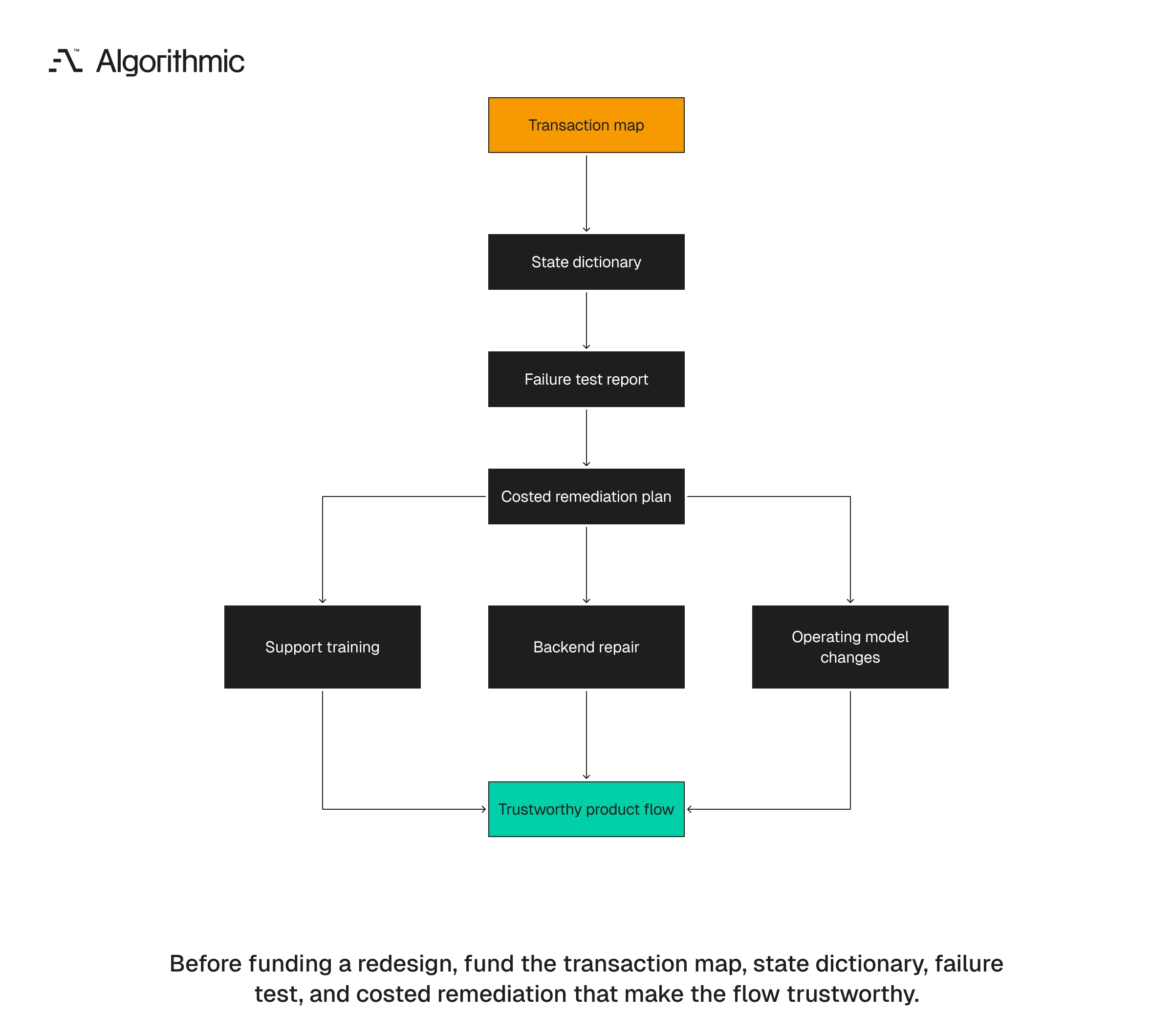
Executives should look for four outputs before approving a major redesign, a transaction map for each revenue workflow, a state dictionary with owners and terminal outcomes, a failure test report, and a costed remediation plan.
 Click to expand
 Those outputs turn delight into production work, and make tradeoffs clear, so a team can decide whether the next dollar reduces support volume, protects revenue, or improves first-session perception. The tradeoff is often uncomfortable, because a polished screen is easier to show in a steering committee while a reconciliation job, support console, or permission service carries less visual appeal. The business result favors the deeper work when the seam carries revenue, since customers remember duplicate charges, locked access, missed appointments, and wrong reports far more than the animation that preceded the failure.
Funding decisions should follow business exposure. A seam tied to payments, access, fulfillment, or executive reporting deserves priority, and a seam tied to preference settings can wait unless it blocks adoption. The budget should also include operating change, because a new state model fails if support lacks training, partner contracts lack response times, or finance lacks settlement visibility, so product work and operating work must ship together. Leaders should treat seam repair as product investment, since it improves conversion after payment, reduces avoidable contact, protects renewals, and prepares workflows for automation, and those outcomes belong in the same portfolio review as new features.
Product delight belongs to the team that owns the full flow
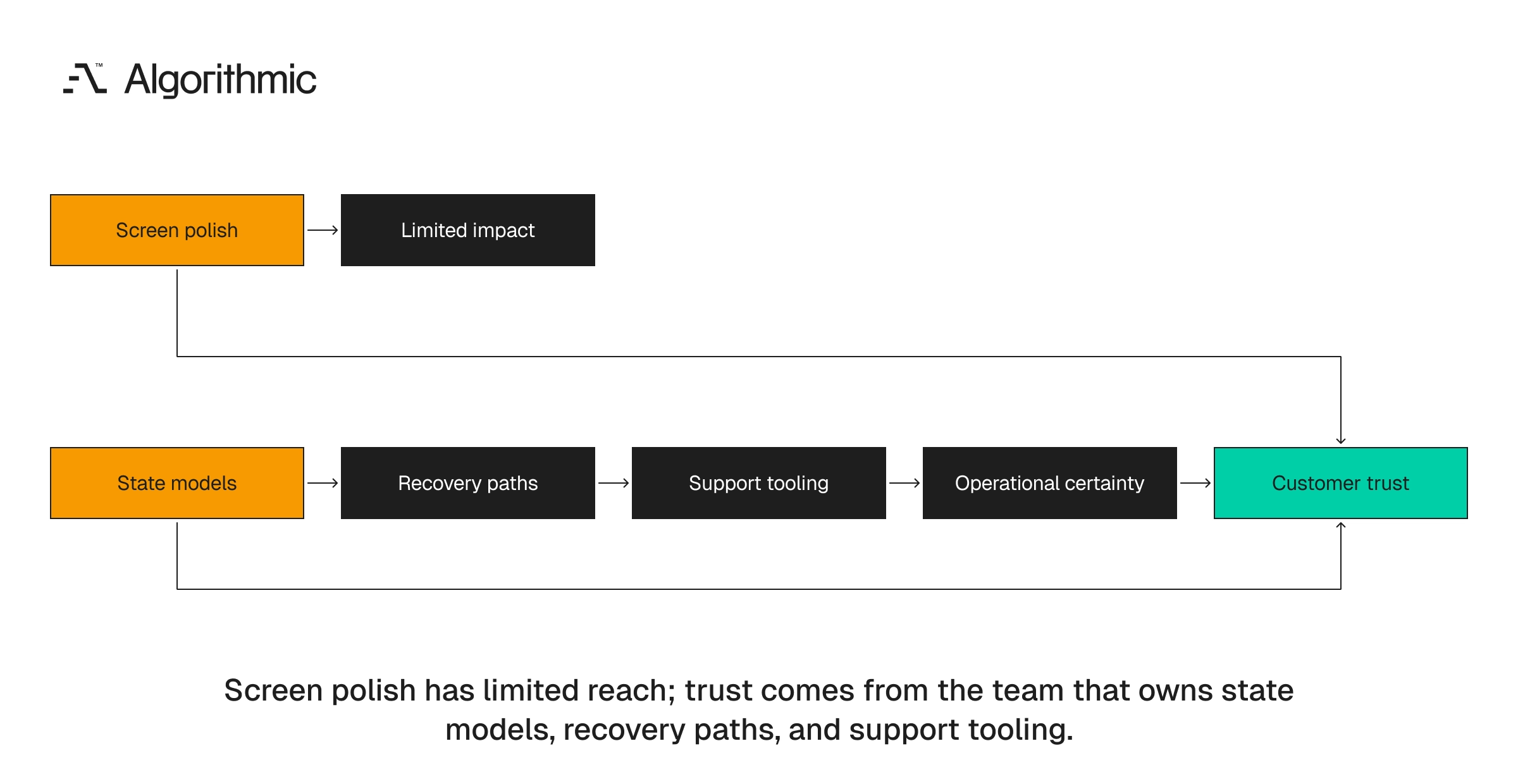
A product feels trustworthy when it preserves intent across systems. The user clicked once, paid once, received the right access, saw the right status, and had a clear recovery path when an external service failed.
 Click to expand
 That outcome requires product design, backend engineering, data engineering, and operations design in one decision loop. Separate vendors can work when the problem is bounded, but they create risk when the experience depends on refunds, retries, entitlements, fulfillment, and partner workflows. Algorithmic has delivered 35+ complex engagements across production systems serving more than 14 million end users, and the consistent pattern is that durable UX comes from teams that design the screen and engineer the transaction path beneath it.
Algorithmic runs backend and integration engineering that turns fragile handoffs into state machines, recovery queues, and support tooling users can trust. Start a conversation if refunds, entitlements, or fulfillment seams are driving your support and churn. Run a seam audit before the next redesign, map the top five workflows, price the failures, and assign one full-stack team to own the state models, recovery paths, support tooling, and partner workflows that make the interface trustworthy.