

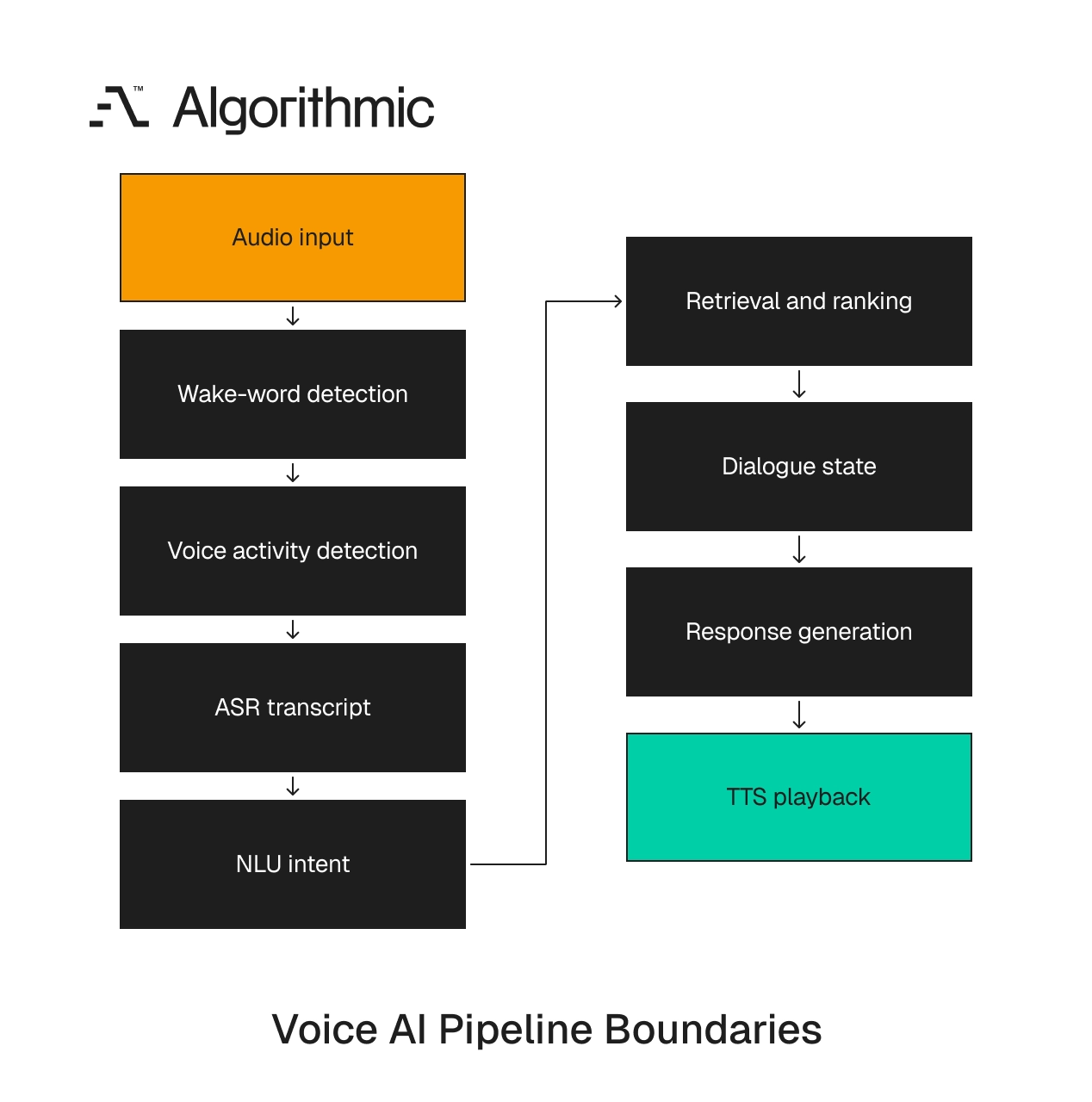
A voice product with six sequential components at 95% task success per component delivers 73.5% end-to-end success before network loss, device variance, and user behavior enter the system. That arithmetic explains a large share of production failure in voice automation, and recent research on long-horizon execution in LLMs shows why marginal per-step accuracy compounds so sharply across a chain. Each model can pass offline evaluation while the user receives an unreliable service. Speech systems fail because quality emerges across that chain, where a typical production path runs wake-word detection, voice activity detection, automatic speech recognition, natural language understanding, retrieval, re-ranking, dialogue management, response generation, and text-to-speech, and each step adds latency, changes data shape, and creates a boundary where context disappears.
For CTOs funding NLP system development, the decision is architectural. The team must measure the handoffs where failures compound, since model accuracy alone misses the production defects that users notice and support teams absorb. The component boundary is the unit of reliability in production voice systems, so a review that ignores boundaries overstates readiness while a launch plan that instruments them finds defects earlier, recovers faster, and spends less money on misdirected model tuning.
The operating pattern is consistent across high-volume voice systems. A small transcription defect becomes an intent defect, a small latency increase becomes a barge-in defect, and a small state mismatch becomes a wrong tool call. These failures rarely announce themselves through one dashboard. ASR reports acceptable word error rate and the NLU classifier reports acceptable intent accuracy, yet the customer still repeats the request, escalates to a human agent, or completes the wrong workflow.
The voice stack is a chain of contracts
A production speech system is a set of contracts between components. Audio becomes a wake event, a wake event becomes a stream, and a stream becomes a transcript. A transcript becomes an intent, an intent becomes ranked actions, and ranked actions become dialogue state. State becomes a response, and the response becomes synthesized audio delivered through a client device. Each transition changes the data format, confidence model, and operating assumption, moving the system from waveform probabilities to token probabilities, then to semantic labels, retrieval scores, policy decisions, generated text, and spoken output.
 Click to expand
 These surfaces produce different error types. A speech recognizer can report 8% word error rate on a controlled test set and still produce weak product outcomes, because if the errors cluster around product names, account identifiers, addresses, drug names, or command verbs, downstream NLU receives damaged input. Research on measuring ASR quality for LLM-powered applications shows the same point directly, since a low word error rate does not predict downstream task success once meaning depends on a few high-stakes tokens. The damage lands at the exact point that determines the action, so a transcript error on filler words rarely matters while a transcript error on “cancel”, “transfer”, “refill”, “tomorrow”, or “five thousand” can change the workflow outcome.
Consider a pharmacy refill agent. If ASR transcribes “atorvastatin” as “a tour of statin”, the transcript-level error looks small, yet the workflow-level error blocks the refill, triggers a fallback, or routes the caller to a human queue. A banking agent creates the same pattern with account movement, where “transfer to savings” and “transfer from savings” differ by one preposition and a local word error rate metric hides the financial risk carried by that boundary.
Failures cluster where components exchange assumptions. A clean transcript can feed a weak policy layer, and a correct intent can select the wrong action after retrieval returns stale policy text. The contract between components must preserve uncertainty, carrying timing, confidence, alternatives, model version, and state source, since a plain string passed from ASR to NLU is not enough for workflows with financial, medical, or operational risk. Contract design also governs recovery, because if ASR passes only the final transcript the NLU layer cannot inspect competing hypotheses, and if the dialogue manager stores only the last utterance incident reviewers cannot reconstruct why a slot changed.
A typed contract gives each component a clear operating surface. It defines required fields, optional fields, fallback behavior, timeout behavior, and ownership, and it gives the release process a target for regression testing. The contract should treat uncertainty as production data, because a token-level confidence score, an entity span, and a competing transcript candidate carry different meaning, and collapsing them into one text string removes evidence at the point where policy needs it.
Small losses compound into user-visible unreliability
Component-level benchmarks hide sequence risk. A system with strong individual metrics can produce a weak session-level experience, because the user experiences the chain, not any single component. Consider a customer support voice agent with the following production characteristics.
| Component | Isolated success rate | Added p95 latency | Common boundary failure |
|---|---|---|---|
| Wake-word detection | 98.5% | 80 ms | False accept from television audio |
| Voice activity detection | 97.0% | 250 ms | Early cutoff during pauses |
| ASR | 94.0% | 450 ms | Domain terms mistranscribed |
| NLU intent classification | 93.0% | 120 ms | Transcript confidence discarded |
| Re-ranking and policy selection | 96.0% | 180 ms | Wrong action selected from near ties |
| Dialogue management | 95.0% | 90 ms | State reset after interruption |
| Response generation and TTS | 97.0% | 650 ms | Response starts before state is final |
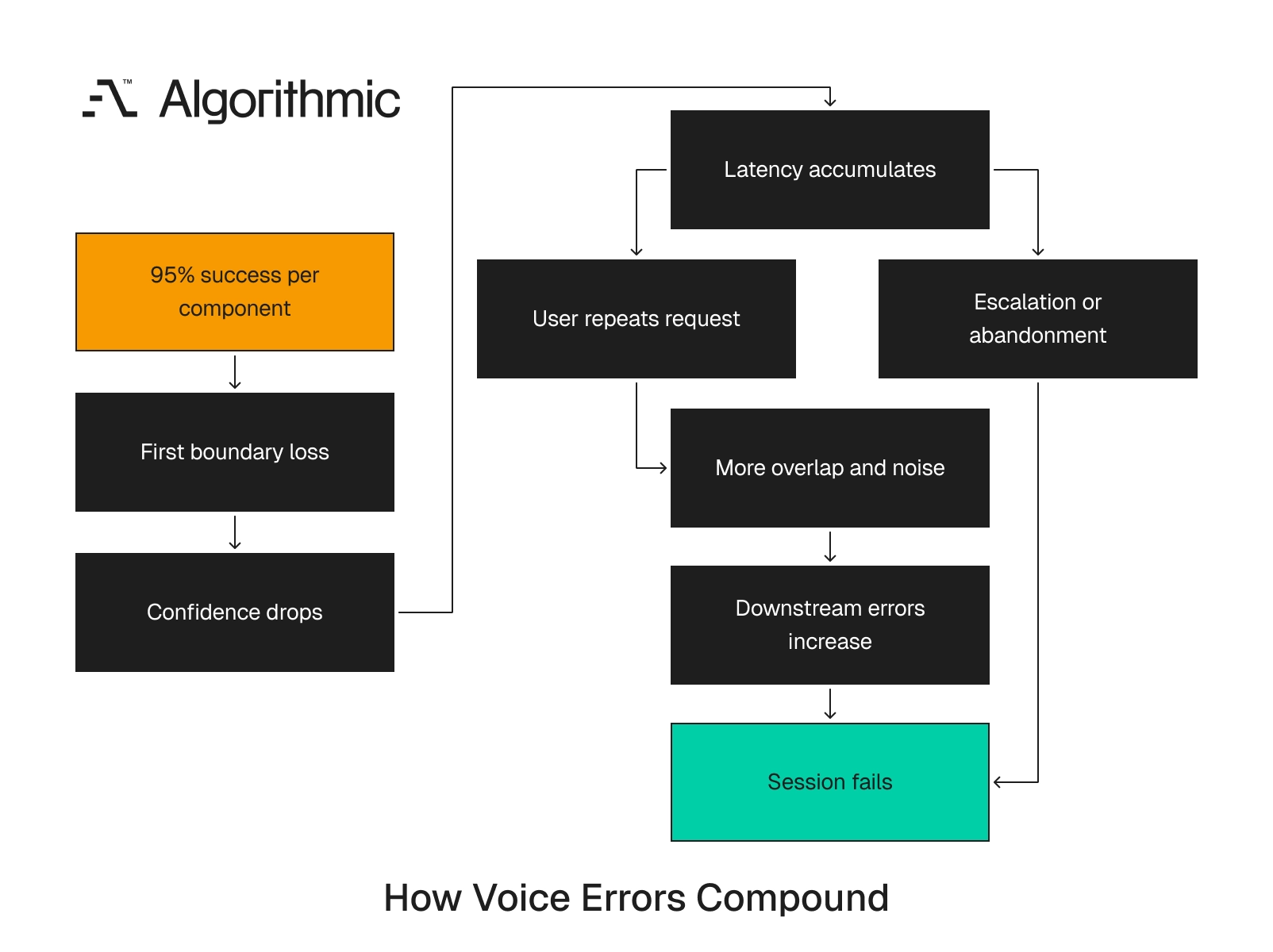
Multiplying those rates gives 73.1% end-to-end success for a single clean turn, and a three-turn task compounds again, so the expected clean completion rate drops to about 39.1% before escalations, timeouts, and network variability. The math is unforgiving because voice sessions are sequential, and a password reset, delivery change, appointment booking, or prescription refill rarely completes in one turn, so each extra turn creates another chance for the system to lose timing, context, or confidence.
Latency compounds in the same way. The p95 path above adds 1.82 seconds before client playback and transport overhead, and adding 200 ms for mobile network variance and 300 ms for a Bluetooth device path pushes the interaction past 2.3 seconds. Users interpret that delay as confusion, so the product feels uncertain even when each component meets its local target, because the aggregate path governs the experience. The threshold is well studied, and empirical work on the timing of conversation shows that human turn-taking gaps sit around 200 ms, so a multi-second delay reads as a broken conversation rather than a slow one.
Production machine learning engineering for voice must treat the speech interface as a distributed system, since users respond to total turn time, interruption handling, and recovery behavior while offline model scores capture only part of that experience. A one-second delay changes user behavior, so callers repeat themselves, speak over the assistant, or abandon the session, and those reactions introduce new audio and state conditions that the offline benchmark never tested. That feedback loop matters, because a slow response creates overlap, overlap increases diarization and turn-detection errors, and those errors create more latency through fallback, confirmation, and retry paths.
 Click to expand
 The operating result is easy to miss in a dashboard, since ASR accuracy can remain flat while escalation rate rises, and response generation latency can remain flat while barge-in increases because TTS starts too late. A production scorecard must connect those events and show how latency, confidence, retries, and task outcomes move together, because without that connection teams tune isolated services while the customer experience degrades. This problem becomes more expensive as traffic grows, so at 10,000 monthly calls a five-point completion gap creates a manageable review queue while at 500,000 monthly calls the same gap becomes staffing pressure, customer churn, and executive attention.
The defect rate also changes how users speak, so after two failed turns callers shorten phrases, raise volume, or over-explain, and those behavior changes move the session farther from the clean evaluation set. A mature evaluation plan measures those second-order effects, tracking repeat utterances, interruption frequency, silence after prompt, and abandonment after latency spikes, because these measures connect engineering work to the user experience that the business funds.
Boundary instrumentation changes the operating conversation
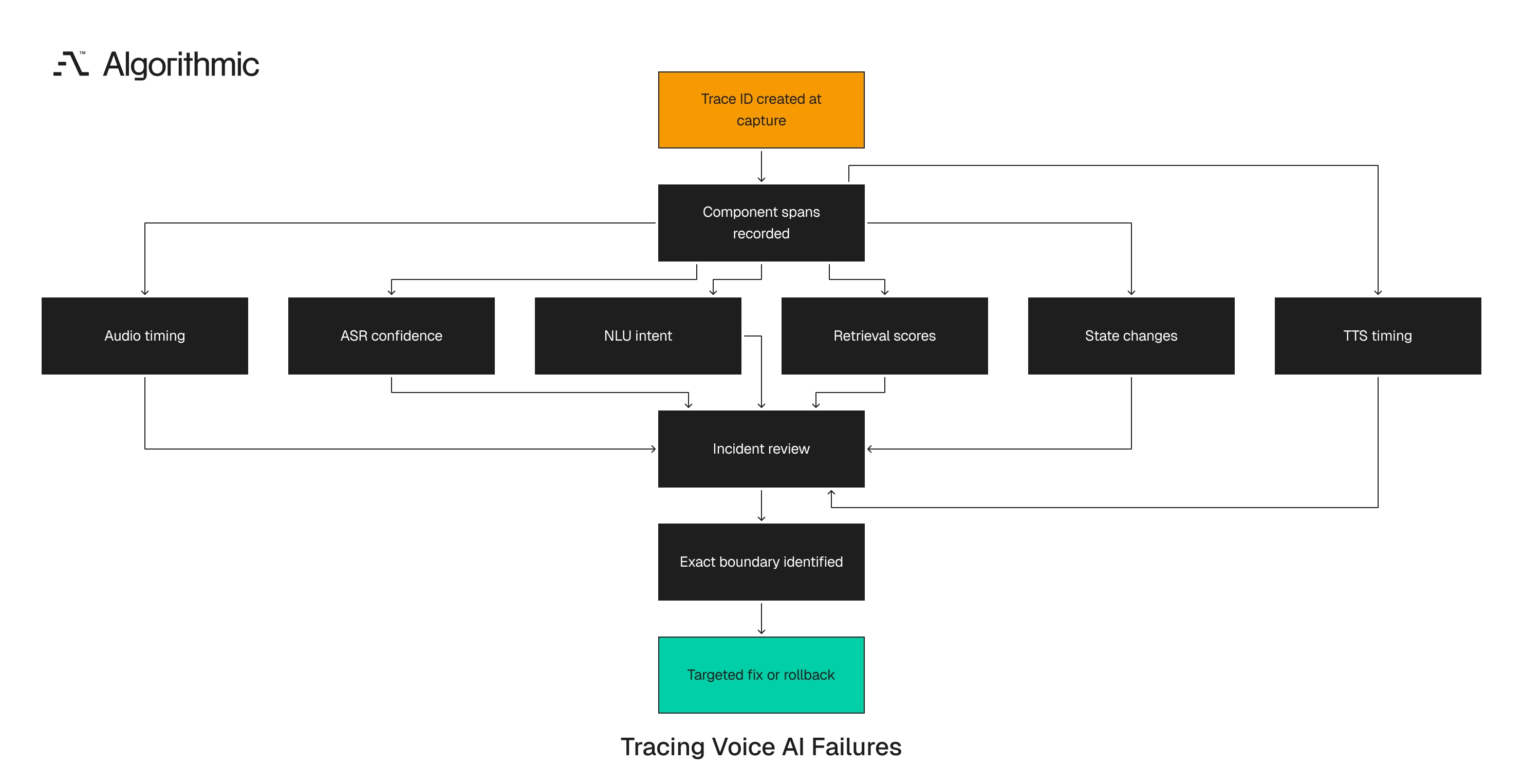
A voice team needs observability at every handoff, because aggregate session success, average latency, and model accuracy are too coarse to identify whether failure came from turn detection, transcription, intent mapping, ranking, state management, or response timing. A production incident review needs one answer within minutes, which is where the chain broke, and without boundary data teams inspect dashboards that show green services and red customer outcomes, so that gap turns a one-hour fix into a multi-week tuning cycle. The right trace changes the meeting, since engineers stop debating broad categories and inspect the exact sequence while product leaders see which defect drives cost, escalation, and customer abandonment.
 Click to expand
 Boundary instrumentation also changes vendor management, because a vendor dashboard can report healthy service latency while the product misses its turn-level objective, and internal traces show whether the delay came from client buffering, orchestration, queueing, provider response time, or playback.
The minimum trace schema
Every voice turn should carry one trace ID from audio capture to final response playback, and each component should write structured events against that trace ID so the trace connects audio, transcripts, model decisions, policy choices, generated output, and user outcome. A minimum production trace includes:
device_id,session_id,turn_id, andtrace_id- Audio start time, speech start time, speech end time, and end-of-turn decision time
- Wake-word score, wake threshold, and false accept review label when available
- ASR partial transcript timestamps, final transcript, token confidence, and domain entity spans
- NLU intent, confidence, fallback reason, and competing intents
- Retrieval query, candidate IDs, ranking scores, and selected action
- Dialogue state before and after policy execution
- Response generation start time, first token time, TTS start time, and playback start time
- User interruption events, barge-in handling, retry events, and escalation outcome
- Model version, prompt version, feature flag state, and deployment region
- Redaction status, consent state, retention class, and audio reference
This schema is the minimum for a paid production system, because without it the team cannot distinguish an ASR defect from a dialogue-state defect, and the result is weeks of tuning the wrong layer. The schema also supports privacy controls, since security and legal teams need consent, redaction, retention, and access fields before they approve failure sampling, and regulated conversations need those controls in the trace, not in a separate spreadsheet. Trace design also protects the team during vendor disputes, because a provider dashboard can report service health while the product misses its turn-level target, and internal traces show where queueing, serialization, client buffering, and third-party calls consumed time.
The schema should also support replay. A replay tool should reconstruct the same transcript, intent, candidate list, state update, and response path from sampled failures, which lets engineers verify a fix against the exact sequence that failed. Replay needs strict access controls, so audio references should point to redacted segments or approved secure storage, and reviewers should see only the fields required for diagnosis, with every access logged.
Latency budgets must be assigned per boundary
Voice systems need explicit p50, p95, and p99 budgets for each step. Average latency gives false confidence because voice frustration is driven by tail behavior, and a system that responds in 900 ms at p50 and 4.8 seconds at p95 feels inconsistent. A practical target for many customer service voice agents is a first audible response within 1.2 to 1.8 seconds at p95 after the user stops speaking, and complex retrieval or regulated workflows require longer paths, so the product must account for that delay through earcons, acknowledgement phrases, or transfer logic.
The budget should be owned by boundary. ASR finalization at 700 ms, retrieval at 400 ms, and generation first token at 900 ms create one correction plan, while three components each adding 200 ms through serialization and service hops create a different correction plan. The budget must include vendor calls, because a speech provider can meet its published service target while the product misses its turn-level target, so client capture, network transit, queueing, model execution, orchestration, and playback all count.
Tail latency also needs ownership, since a p99 failure that affects 1% of 100,000 monthly calls still affects 1,000 conversations, and in regulated support flows those conversations often become the most expensive calls in the queue. The team should review latency as a waterfall, where each boundary receives a budget, measured actuals, and a named owner, and any boundary that consumes its budget for two consecutive releases enters the release risk register.
Latency budgets should include serialization and transport, because a 60 ms serialization cost appears harmless during unit testing, yet across six boundaries the same pattern consumes more than one-third of a 1.2-second target. The team should also record queue depth and concurrency, since a model server can perform well at 50 concurrent sessions and fail at 500, and tail latency often appears first during campaign traffic, billing deadlines, outages, or seasonal demand.
Error budgets must follow user tasks
Per-turn accuracy is incomplete. Track task completion for the jobs users perform: reset password, change delivery date, check claim status, book appointment, update payment method. The unit of success is the completed user task.
For each task, report:
- End-to-end completion rate
- Number of turns to completion
- Fallback rate by turn
- Human escalation rate
- Correction rate after ASR final transcript
- Interruption recovery rate
- p95 first-response latency
- p95 full-turn latency
- Cost per completed task
- High-risk action confirmation rate
- Unauthorized completion count
This moves evaluation from model-centric reporting to product-centric reporting. It gives engineering leaders a basis for investment decisions, and it exposes the difference between an accurate transcript and a successful workflow. A password reset flow illustrates the difference, because the ASR model can transcribe 96% of words correctly and still fail on one six-digit code, so the task metric captures the failed reset, retry, escalation, and cost of the extra call. Task-level metrics also identify false success, since a system can complete a change of address with the wrong apartment number, and that completion should count as a defect, not as automation success.
This distinction matters for executive reporting, because a launch dashboard that reports containment alone can reward unsafe automation, while one that reports verified task completion gives the board a defensible view of risk. Task metrics should include cost, since a task that completes after seven turns, two confirmations, and a human review has a different cost profile from a two-turn self-service completion, so the scorecard should show both completion and cost per verified completion. The error budget should also separate user-abandoned sessions from system-escalated sessions, because abandonment after silence points to latency or prompt quality, while escalation after repeated fallback points to recognition, intent, policy, or unsupported requests.
The common production failures sit between models
Production voice failures repeat across sectors. We have seen the same patterns in healthcare intake, field-service scheduling, retail support, and financial account servicing, and the sectors differ in vocabulary and risk while the failure modes stay consistent. The recurring defects occur at handoffs, where audio enters the wrong turn, confidence disappears before policy, retrieval returns a plausible action with the wrong constraint, and dialogue state survives in text yet fails in tool arguments. These defects share one operating feature, since the local component appears healthy while the combined workflow fails, which is why boundary data belongs in the standard operating model.
Wake-word and turn detection errors contaminate the whole session
False accepts create sessions the user never intended to start, false rejects make the product feel absent, and early end-of-turn detection cuts off the user before the critical phrase arrives. Turn detection is especially important for full-duplex agents, and a recent paper on interactional friction in modular speech-to-speech pipelines examines how modular S2S-RAG systems feel conversationally impaired when timing, grounding, and turn handling fail to compose cleanly. The finding aligns with production experience, since timing errors change the perceived intelligence of the product. These failures rarely appear in a clean ASR benchmark, and instead show up in barge-in rates, partial transcript churn, sessions where users repeat themselves, and call recordings where the assistant responds to a sentence the user had not finished.
A field-service scheduler shows the operational cost. “Schedule for Friday after lunch” becomes “Schedule for Friday” when VAD cuts off the final phrase, so the technician arrives during the wrong window and the customer blames the assistant. The cost extends beyond one wrong appointment, because dispatch operations absorb rework, customers call again, and support agents lose trust in automation, so one missed prepositional phrase becomes a routing, labor, and customer-experience defect.
Turn detection needs its own test set, which should include pauses, filler words, cross-talk, background audio, accented speech, and long account identifiers, because a clean command set will not expose these defects. The set should include device variance, since speakerphones, laptop microphones, car audio, Bluetooth earbuds, and browser capture paths all shape turn detection, so a production agent that serves mobile users needs samples from the devices those users carry. Turn detection should also record the cost of silence, because waiting too long after the user stops speaking adds latency while ending the turn too early removes words, so the tuning target must balance both errors against task outcomes.
ASR confidence is often lost before NLU
ASR systems produce more than words, adding timing, alternatives, token confidence, diarization markers, and sometimes entity hints, yet downstream services often discard this information and pass a plain string to NLU. That design removes useful uncertainty, so the NLU layer treats “cancel my card” and “cancel my cart” as equally final if both arrive as text, when a better design passes confidence and alternatives forward and lets policy ask for confirmation on high-consequence actions. This is a boundary contract issue, because retraining the NLU classifier alone leaves the contract defect in place, so the interface must carry uncertainty across the boundary.
High-consequence workflows should encode this directly. Card cancellation, prescription changes, wire transfers, insurance claim changes, and account closure need confirmation thresholds, so a transcript with low confidence on the object of the action should enter a confirmation path. Confidence should also affect ranking, since a low-confidence entity should lower the score of actions that depend on it, and a high-confidence intent with a low-confidence slot still needs a safe policy path. The schema must define how confidence is represented, because token-level, entity-level, and utterance-level confidence serve different purposes, and combining them into one number removes the evidence needed for safe decisions.
A healthcare intake agent shows the risk. “I take fifteen milligrams” and “I take fifty milligrams” differ by a short acoustic pattern, so the downstream workflow should treat that slot as high risk and request confirmation when confidence falls below threshold. The same rule applies to account numbers and addresses, because a transcript can look mostly correct while one digit or apartment number fails, and entity-level confidence gives policy a chance to protect the workflow before a tool call executes.
Re-ranking and policy layers create silent action errors
Many voice agents now combine ASR, an intent model, retrieval, a re-ranker, a policy engine, and an LLM, so the selected action can be wrong even when the transcript and intent are correct, which makes this one of the most common sources of silent production defects. It happens when candidate actions are near ties, and it happens when retrieval returns outdated policy text, because a re-ranker can favor semantically similar content with the wrong operational constraint. A refund policy for premium customers can outrank the standard policy when metadata filters are weak, so the response sounds reasonable yet violates business rules, the customer hears confidence, and the back office receives an exception. The retrieval discipline that prevents this is the same one we cover in building and evaluating RAG systems, where the failing layer is usually retrieval rather than generation.
A trace must show candidate sets and scores, because without candidate visibility teams inspect the generated response and blame the language model, when the defect can sit in retrieval filters, re-ranking weights, policy versioning, or stale content ingestion. The production fix differs by layer, so a retrieval defect requires index and metadata changes, a policy defect requires rule correction and regression tests, and a generation defect requires prompt, model, or guardrail changes. Silent action errors deserve special treatment because they often pass early QA, since reviewers hear a fluent answer and mark the interaction as acceptable, and the defect appears later through refunds, compliance exceptions, chargebacks, or repeat calls.
Policy layers need versioned test cases, so each high-cost action should have examples that prove the right rule fires under common transcript variants, and those tests should run before any retrieval index, ranking model, or prompt reaches production. Metadata design deserves direct ownership, because policy documents should carry effective date, customer segment, region, product line, channel, and approval status, and retrieval should filter on those fields before ranking text similarity. A re-ranker should expose near ties, so when the top two candidate actions differ by a small score gap the policy layer should record it, and near ties should trigger confirmation, human review, or a constrained response for high-cost workflows.
Dialogue management fails after interruptions
Human speech is not a clean sequence of requests, since users interrupt, correct themselves, pause, change their mind, and speak over the assistant, so the dialogue manager must preserve state through those events. A fragile state machine loses slot values after barge-in, and an LLM-only manager can accept a corrected date in the transcript while retaining the previous date in tool arguments, so the visible error occurs at response time while the defect was introduced when state changed. Incident review must include state diffs between turns, because logs that contain only input and output text are not enough, and reviewers need to see each slot, confidence value, source event, and overwrite rule.
A travel booking agent gives a common example, where the user says “Book Tuesday”, then interrupts with “No, Wednesday morning”, so the transcript can show the correction while the tool call still carries Tuesday as the departure date. The state model must treat corrections as first-class events and record old value, new value, source utterance, confidence, and policy rule, because a simple overwrite makes later review difficult and weakens regression testing. The same pattern appears in healthcare intake, where a caller gives a symptom, changes the duration, and then corrects the medication name, so the final scheduling and triage decision depends on the state merge, not the transcript alone.
State ownership should be explicit, so the dialogue manager owns slot state, source attribution, and overwrite rules, and the LLM can propose updates while a deterministic state layer validates and records the change. State diffs also protect auditability, because when a user disputes an appointment time, transfer amount, or medication name the team needs the full event chain, and a final transcript alone does not show which correction the system accepted.
TTS and playback timing can change user behavior
Text-to-speech quality affects more than pronunciation, since voice speed, prosody, first-audio delay, and barge-in sensitivity shape how users respond, so a slightly slower voice can reduce interruptions while an unnatural pause can increase them. Playback timing also affects turn ownership, because if the assistant starts speaking before dialogue state is final it can deliver an acknowledgement that conflicts with the executed action, and if playback starts late users repeat the request and create duplicate intents. These defects sit at the edge of generation, TTS, client playback, and state management, so the trace must show response generation time, first token time, TTS start time, playback start time, and interruption timing, because audio observability belongs in the same incident review as model observability.
The client path deserves the same scrutiny as the cloud path, since Bluetooth routing, mobile OS audio sessions, browser permissions, and device wake states all affect perceived quality, and a cloud-only trace misses the part of the system the user hears. Production teams should sample audio around failures, because a text transcript cannot show whether the assistant cut in too early, spoke too slowly, or paused in the wrong place, so the trace should link to redacted audio segments with proper consent controls.
TTS should have regression tests for product vocabulary, so drug names, city names, plan names, and account terms are pronounced consistently, because poor pronunciation increases user correction behavior and reduces trust in the agent. Playback should also respect state completion, since a response that begins before a tool call finishes can create conflicting user signals, where the assistant says the change is complete while the backend request is still pending.
Production speech needs infrastructure around the models
The engineering effort in voice products is often weighted toward the surrounding system. That includes fast lookup stores, compact model serving, model version routing, feature flags, data collection, annotation workflows, A/B testing, rollback, and monitoring.
A team building a production voice agent should expect the following workstreams:
| Workstream | Production artifact | Owner |
|---|---|---|
| Model serving | Versioned ASR, NLU, ranking, and generation endpoints | ML engineering |
| Orchestration | Turn-level state machine and timeout policy | Backend engineering |
| Data collection | Consent-aware audio, transcript, and label pipeline | Data engineering |
| Evaluation | Offline test sets and online task metrics | Applied ML |
| Release control | Feature flags, canary deployment, rollback plan | Platform engineering |
| Observability | Distributed traces, dashboards, alerts, runbooks | SRE or platform |
| Compliance | Retention policy, redaction, access logging | Security and legal |
This separates a demo from a production system, because a vendor that reports only ASR word error rate or LLM benchmark performance has not shown product readiness, which requires evidence across orchestration, measurement, recovery, and release control. Providers with long production histories make the same point, emphasizing latency, turn detection, and pipeline behavior over isolated model quality, and that focus matches what production incident reviews reveal. For voice automation, model choice defines the quality range while infrastructure determines whether the model can run safely, so the release system, trace design, and data pipeline determine how fast the team can correct defects after launch.
The operating cost also sits outside the model. A voice agent that escalates 18% of eligible calls at $6 per human-handled call can erase expected savings, so task-level economics must sit in the same scorecard as recognition accuracy. A 100,000-call monthly volume makes this concrete, where five thousand extra escalations at $6 each costs $30,000 per month, and that figure excludes repeat calls, supervisor review, refunds, and missed service-level targets. Infrastructure investment pays back when it shortens diagnosis, because if boundary traces reduce one incident from four weeks to one week, the team saves three weeks of engineering time and the business avoids three weeks of avoidable escalations.
The architectural point is direct, since production speech quality is operated rather than benchmarked, so a benchmark result starts the conversation while the production system proves itself through traces, task outcomes, safe releases, and controlled recovery. The staffing model should reflect that operating burden, because a production voice program needs applied ML, backend engineering, data engineering, platform engineering, SRE, security, legal, and product operations, and a two-person model team cannot own all of that work at launch scale.
Data operations also matter, since failed sessions need labeling, taxonomy, review policy, and regression paths, and without that loop the same failures recur across releases and vendors. The data pipeline should separate raw audio, redacted audio, transcripts, labels, and derived metrics, so each class carries its own retention period and access policy, which reduces privacy risk while preserving diagnostic value.
A boundary-first evaluation framework for voice architecture
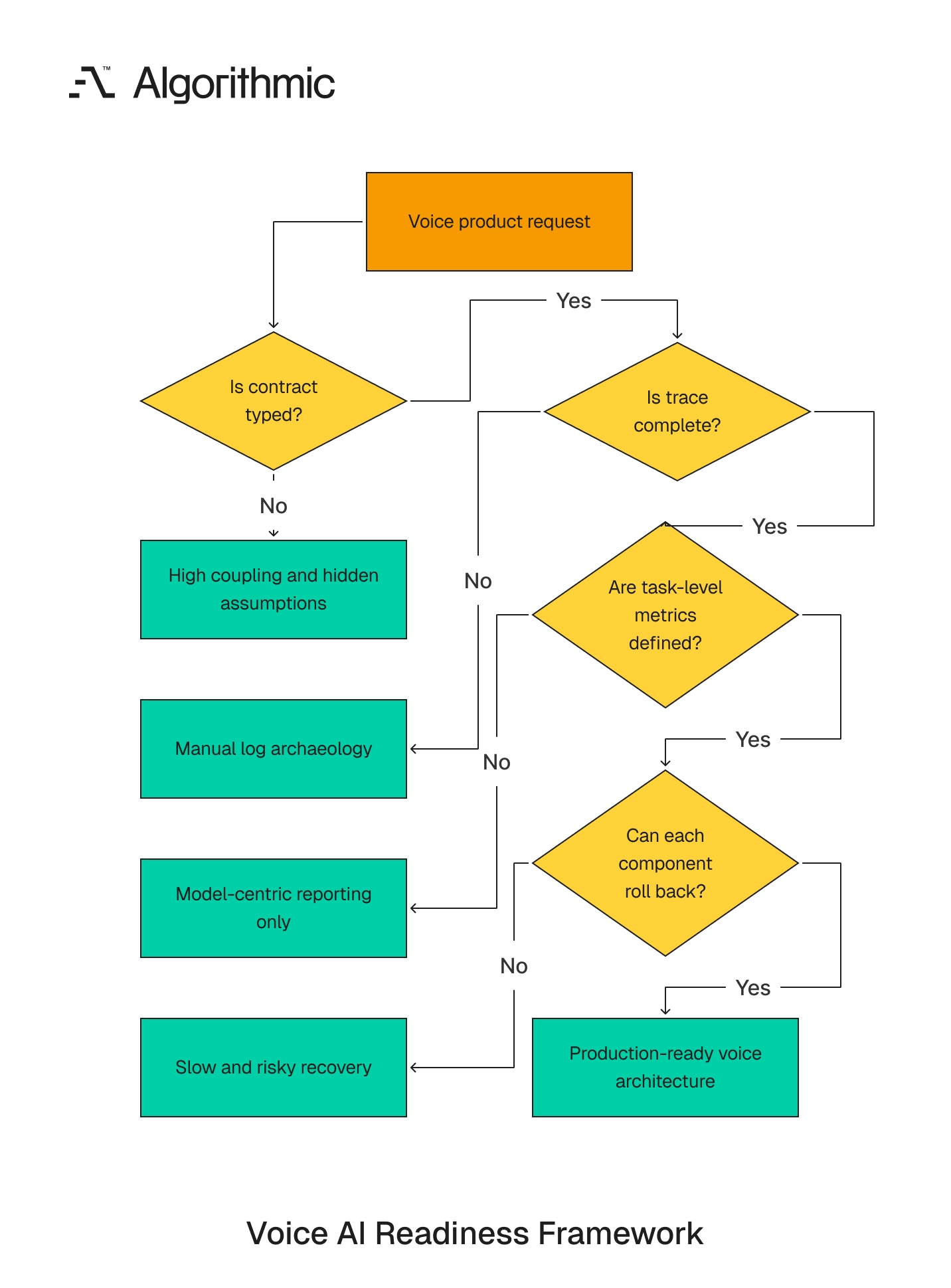
Engineering leaders need a practical way to assess production readiness, and the following four gates provide that structure, covering contracts, traceability, task evaluation, and release control. Use them before pilot launch, before traffic expansion, and after major model changes, because a team that cannot pass these gates should not receive production traffic at scale, while a team that passes them can diagnose failures with discipline. The gates work best as entry criteria and should appear in the program plan before procurement, vendor selection, or pilot scope approval, since retrofitting them after launch increases cost and leaves the first failures under-instrumented.
 Click to expand
 Gate 1 requires contract clarity
Each component must declare its input schema, output schema, confidence fields, timeout behavior, and failure modes, because plain text interfaces between ASR and NLU are not enough for serious workflows, which need typed contracts with version history and ownership. Required evidence:
- Interface definitions in OpenAPI, Protobuf, Avro, or an equivalent format
- Versioned schemas for transcripts, intents, candidate actions, and dialogue state
- Explicit timeout and retry rules per component
- Ownership of each contract by a named engineering team
- Contract tests that run in CI before deployment
- Schema migration rules for model and prompt changes
The contract should define what happens when confidence is low, how alternatives are represented, and which downstream service can override a prior decision. Contract clarity also prevents unplanned coupling, because a downstream service should not infer meaning from undocumented strings, so each field should have an owner, a version, and a compatibility rule. Contract tests should include malformed data, testing missing confidence fields, stale model versions, empty retrieval results, delayed ASR finalization, and duplicate turn IDs, because these cases appear in production during vendor outages, traffic spikes, and release mismatches. Schema ownership should be written into the runbook, so if ASR changes token confidence format one named team approves the contract change, and if policy adds a new action type one named team updates downstream validation.
Gate 2 requires trace completeness
A reviewer should select any failed session and reconstruct the turn path in under 10 minutes, because if that requires manual joins across audio storage, application logs, vendor dashboards, and analytics exports, the system is not ready for high-volume operation. Required evidence:
- One trace ID across the full session
- Component spans with p50, p95, and p99 latency
- Model and prompt versions attached to every decision
- User task outcome attached to the trace
- Replay tooling for sampled failures
- Redaction status and consent state attached to reviewed sessions
- Candidate retrieval and ranking data for selected actions
Trace completeness changes management discussions, because the team stops debating broad failure categories and starts reviewing event sequences, so a single sampled session should show where latency entered, where confidence dropped, and where state changed. The 10-minute reconstruction target is practical, since senior engineers should not spend half a day joining logs after every severe incident and should instead spend that time correcting the boundary that failed. Trace completeness should also support cohort analysis, so the team can filter failures by device, region, accent cluster, traffic segment, model version, prompt version, and vendor route, and those filters turn incident review into engineering work instead of speculation. The trace must survive asynchronous execution, because retrieval, ranking, generation, TTS, and analytics often run on different queues, so the same trace ID must follow each job or the sequence becomes impossible to prove.
Gate 3 requires evaluation at task level
Offline tests should include recorded user audio, synthetic noise, accents present in the customer base, domain vocabulary, and multi-turn workflows, and the production scorecard should report task completion, because transcript quality alone is not enough. Required evidence:
- At least 500 labeled domain utterances before pilot launch
- Separate test sets for ASR, NLU, ranking, and end-to-end tasks
- Regression tests for the top 20 user intents
- Weekly review of failure clusters during pilot
- A confusion matrix for high-cost intents
- Annotated examples for interruption, correction, silence, and overlapping speech
- Negative tests for unsupported and high-risk actions
The 500-utterance threshold is a floor for a narrow pilot, since a national retail deployment with regional accents, store names, and seasonal products will need a larger sample, and the sample should reflect actual call volume, not convenience recordings. Task-level evaluation also needs negative tests, so the system should refuse unsupported actions, ask for confirmation on risky actions, and route regulated requests correctly, because a high completion rate loses value when it includes unauthorized or inaccurate completions. Evaluation should separate clean-room progress from production readiness, because a model can improve on a static test set while failing on new product names or seasonal campaigns, so weekly failure review keeps the test set connected to live traffic.
The annotation plan should define labels before pilot traffic starts, including ASR entity error, intent error, retrieval miss, wrong policy, state overwrite, latency timeout, barge-in failure, and user abandonment, because a shared taxonomy prevents every incident review from inventing new categories. Sampling should include successful sessions, since success samples reveal brittle paths that completed through user effort, and a caller who repeats an account number three times still completed the task while the path signals a production defect.
Gate 4 requires release control and rollback
Voice changes can fail through timing and composition, so a TTS change can alter barge-in behavior and a prompt change can affect tool selection. A new ASR model can increase transcript stability while delaying finalization, a retrieval index update can change policy selection without changing any generated prompt, and a client SDK change can alter audio buffering and move the failure into the device path. Required evidence:
- Feature flags for each major component
- Canary release by traffic segment
- Rollback target under 15 minutes for high-severity defects
- A/B test design tied to task completion and latency
- Incident response runbook with named owners
- Release notes that list expected boundary effects
- Independent rollback paths for ASR, NLU, retrieval, policy, generation, TTS, and client audio
A production incident can involve a small audio change with broad system effects, and the lesson is operational, since audio systems need controlled releases because user experience is created by composition. Rollback must be component-specific, because if the team can roll back only the whole application recovery becomes slower and riskier, so ASR, NLU, retrieval, policy, generation, TTS, and client audio handling need independent release paths. Release notes should describe boundary effects in plain engineering terms, stating expected changes in latency, confidence distribution, interruption behavior, state updates, and fallback rate, because those notes give incident responders a starting point when live metrics move.
Canary design should include high-risk cohorts only after low-risk cohorts pass, so a new ranking model should start with low-cost intents before touching refunds, account closure, or medical triage, and the rollout plan should state the traffic percentage, duration, and stop conditions. Rollback tests should run before every major release, because a rollback path that has not been tested is an assumption, so voice systems should treat rollback time as an operating metric, not a document field.
What to ask before funding NLP system development
Leaders funding voice automation should ask for architecture evidence before approving a production build, because the right partner can show how the system will be measured, operated, and corrected after launch while the wrong partner offers model benchmarks and a demo. Use this review in vendor selection, technical due diligence, or an internal architecture decision.
- Which components sit in the voice chain, and what contract connects each pair?
- What is the p95 latency budget for wake, ASR finalization, NLU, retrieval, response generation, and TTS?
- Which confidence fields move from ASR into NLU and from NLU into policy?
- How are interruptions, corrections, silence, and user overlap represented in state?
- What data is collected for failed sessions, and how is consent handled?
- How many labeled domain utterances exist before launch?
- Which metrics decide launch readiness: word error rate, task completion, escalation rate, or cost per completed task?
- How are model versions, prompt versions, and ranking rules tied to each production decision?
- What can be rolled back independently within 15 minutes?
- How will the team identify whether a defect sits in ASR, NLU, ranking, dialogue state, or response generation?
- Which high-risk actions require confirmation, and where is that rule enforced?
- How are production failures sampled, labeled, and added back into regression tests?
- Which team owns each boundary contract after launch?
- What is the cost per completed task at pilot volume and projected launch volume?
- Which service-level objective triggers a halt, rollback, or traffic reduction?
Weak answers to these questions predict long pilots and unclear accountability, while strong answers predict faster diagnosis and safer iteration, and the difference appears during the first production incident. A vendor response should include architecture diagrams, trace examples, sample dashboards, test-set descriptions, and rollback procedures, because slide-level claims about accuracy are not enough, so the buyer should request evidence from systems that handled real users, real noise, and real support paths. Internal teams should face the same standard, since a prototype can prove user demand and interaction design while a production build needs operating controls, data rights, and a measured path from audio capture to business outcome.
The funding decision should also include staffing, because a production voice system needs backend engineering, applied ML, data engineering, platform or SRE, security, and product operations, and a small model team without these roles will struggle after launch. Ownership should be explicit before the first pilot call, so one team owns the ASR-to-NLU contract, another owns state transition rules, and a named incident commander owns live recovery. This level of operating clarity prevents drift, because without named owners teams debate whether a defect belongs to the model, orchestration, vendor, or client, while with named owners the trace points to the boundary and the owner corrects it.
The review should include data rights, so buyers know whether they can retain redacted audio, export transcripts, label failures, and run their own evaluation, because a vendor that blocks failure sampling limits post-launch learning. It should also include cost under load, since pricing should be calculated per completed task rather than per model call, and a three-turn workflow with ASR, NLU, retrieval, generation, TTS, and escalation has a different unit cost than a single service call. Contract terms should specify incident access, because during a production outage the operating team needs timestamps, provider status, request IDs, model versions, and latency breakdowns, so waiting three business days for vendor logs is incompatible with high-volume support automation. Security review should cover trace content, since traces often contain account identifiers, health details, addresses, and payment context, so redaction, retention, access logging, and role-based access should be in place before pilot traffic starts.
Build the first release around observability
Voice products should be designed as measured chains from the first sprint, because retrofitting observability after launch creates gaps in the sessions that matter most, which are the failed, interrupted, high-latency, and high-cost interactions the team must understand. The first production release should include distributed tracing, component-level service objectives, labeled failure review, and release controls, along with a small set of business tasks with clear acceptance thresholds, such as 85% password reset completion, p95 first audible response under 1.5 seconds, under 8% human escalation for eligible calls, and zero high-risk actions without confirmation. Those thresholds should be written before traffic starts, and the launch decision should reference the same metrics every week, because changing the scorecard during a pilot creates confusion and hides regressions.
Algorithmic has delivered complex production systems across more than 35 engagements, including platforms serving millions of end users, and the pattern is consistent, since mature teams measure the seams. They invest in data pipelines, monitoring, rollback, and boundary contracts before spending another quarter tuning a model that already performs within its valid range. The economics support the same conclusion, because if a voice agent handles 100,000 monthly calls and each failed automation adds a $6 human support cost, a five-point completion gap costs $30,000 per month, so boundary instrumentation pays for itself when it shortens diagnosis by one release cycle.
The close is operational. Review the current voice architecture against four gates, which are contract clarity, trace completeness, task-level evaluation, and release control, and fund the next phase only after the team can show where latency and errors enter the chain. Require evidence for measurement and recovery, require independent release paths for each component, and require task-level economics before declaring the system ready for production. Production speech systems do not fail only because a model misheard a word, but because one boundary drops confidence, timing, state, or policy context and the next component treats damaged input as final, so design the system around those boundaries from day one.
The first sprint should produce a trace design, contract inventory, task metric definition, and release plan, because those artifacts reduce ambiguity before the first model comparison and give engineering, product, security, and operations a shared operating language. The production path should start small and measured, so select three to five user tasks, define acceptance thresholds, and instrument every handoff, and expand traffic only when the team can explain failures without manual log archaeology. This approach creates a system that can improve after launch, because each failure becomes a labeled example, a contract test, a metric update, or a release-control change, so the system gains reliability through measured operation, not through hope placed in the next model version.
Algorithmic builds AI agents and voice automation with the boundary contracts, traces, and release controls this article describes. Start a conversation if your voice product passes every component test yet still loses callers between the models.