

A mobile MVP priced near $171,000 can become a $300,000 product when the first platform hides the cost of the next one. The added cost starts in week one, when teams put pricing rules, entitlement logic, analytics names, copy, and device behavior inside one client, and by the time Android, iOS, or web enters the roadmap those early choices have become rewrite work. Algorithmic treats this as a platform option problem in product engineering. A single-platform launch is sound when the team preserves the option to add the next platform at a known cost, and it becomes debt when the team cannot price that option before production engineering starts.
Founders often label every deferred platform as technical debt, and that label covers too much ground. A narrow launch is disciplined when it cuts initial spend without raising the known cost of the next build. The decision matters because early product data is usually weak, since demand remains unproven, retention moves across cohorts, and workflows change during the first release cycle. The median app retains around 4% of users at day 30, so building every platform before validating behavior spends six figures before the product earns it. The better executive question is specific, what will the next platform cost, and which first-platform decisions move that number.
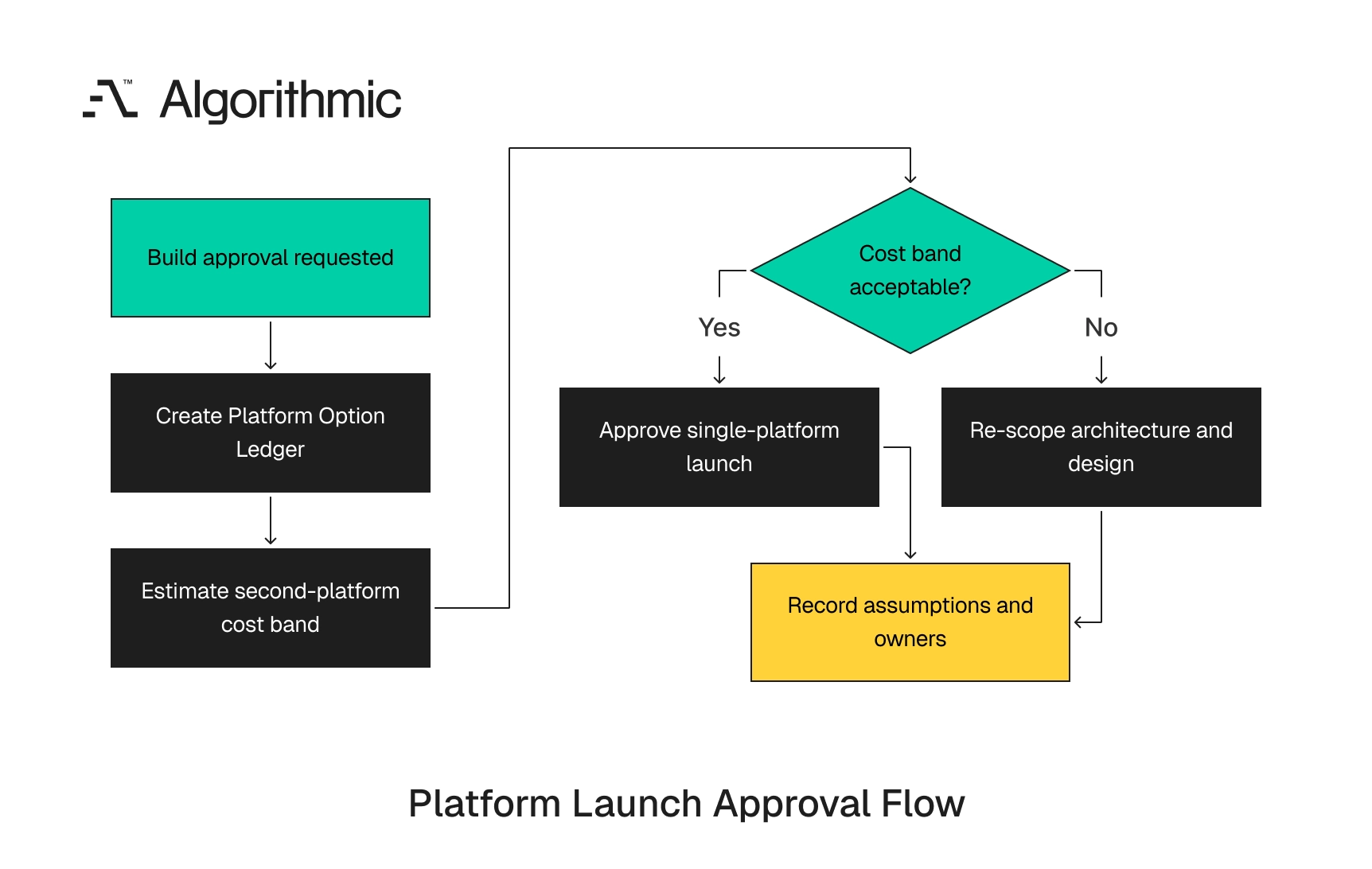
Use a platform option ledger before build approval
A single-platform launch needs a written second-platform estimate before approval. The estimate should list assumptions, cost drivers, proof artifacts, and decisions that affect future work. A roadmap entry that says “Android later” or “web later” gives no planning value.
 Click to expand
 We use a Platform Option Ledger for this decision. It is a one-page artifact that prices the right to add the next platform after the first launch, and it records what the team preserves, what it spends now, and what it will pay later. For a founder choosing between web, iOS, Android, or cross-platform mobile app development, the ledger covers five cost areas.
- UI rebuild cost
- Shared business logic cost
- API and backend adaptation cost
- Design system expansion cost
- Localization and regional readiness cost
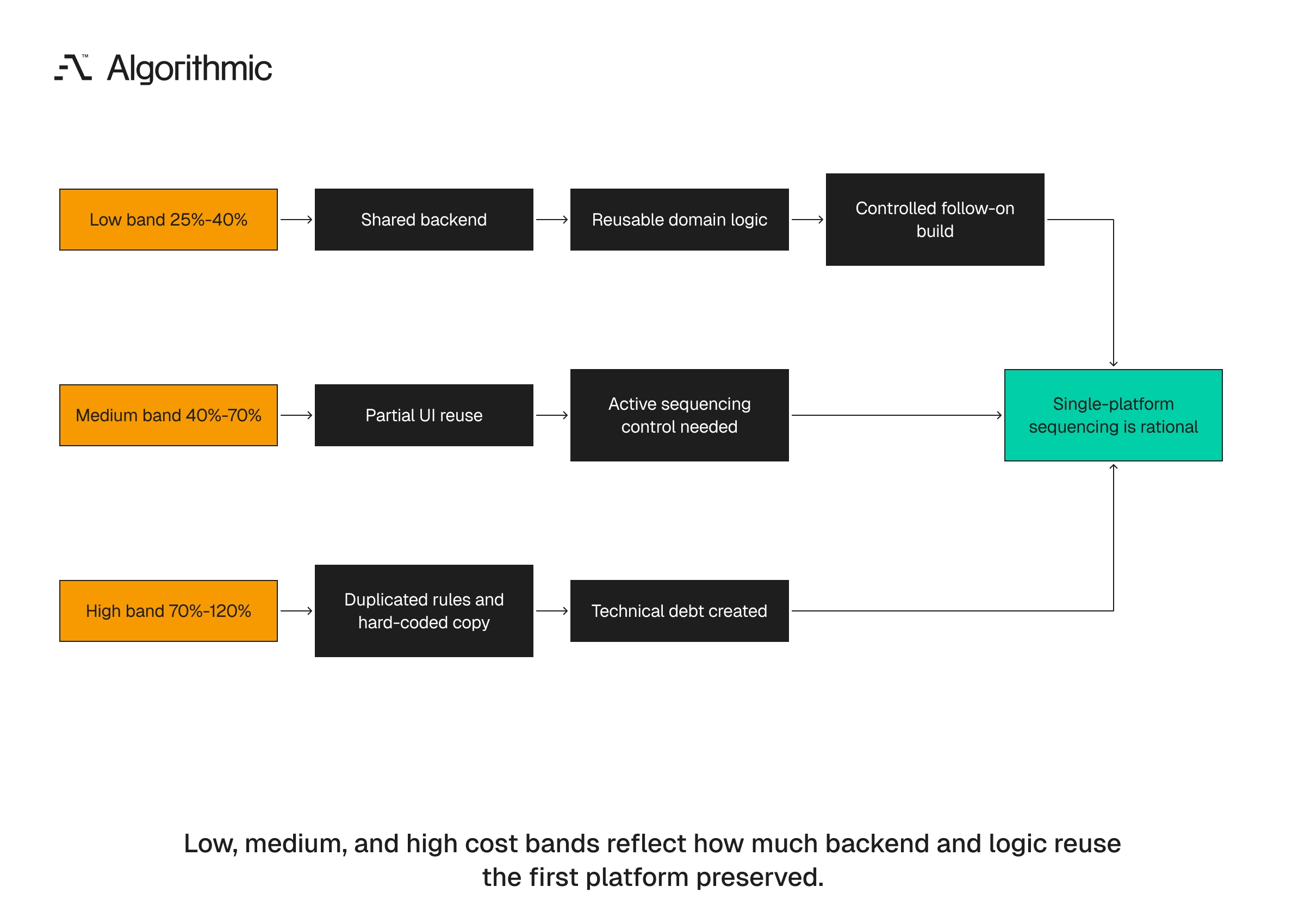
The estimate needs no false precision. It needs a range, named cost drivers, and the decisions that move the range up or down. A practical model uses three bands.
| Second-platform cost band | Expected cost as % of first platform | Typical condition | Decision meaning |
|---|---|---|---|
| Low | 25% to 40% | Shared backend, reusable domain logic, tokenized design system, platform-aware QA | Single-platform sequencing is rational |
| Medium | 40% to 70% | Shared APIs, partial UI reuse, platform-specific flows, limited test automation | Sequencing needs active control |
| High | 70% to 120% | Platform-specific state, duplicated business rules, no design tokens, hard-coded copy | The first launch creates technical debt |
The ledger should name the evidence behind each band. Architecture diagrams, API contracts, test coverage, Figma libraries, localization files, and analytics schemas carry more value than team confidence, and that evidence lets a CTO inspect the platform decision before the first sprint creates sunk cost.
 Click to expand
 A web application development services team building a marketplace MVP can often hold Android or iOS follow-on cost near the low band. That outcome requires platform-neutral backend services for payments, identity, notifications, search, and order state, and event tracking that uses the same taxonomy across web and mobile. A mobile app development agency that builds pricing logic inside a Swift client creates a different cost profile, because the Android build then requires interpretation, replication, and validation of rules already embedded in the first client. That work often reaches the high band before the second platform has one production user.
The difference appears in the first 30 days, when repository structure, API contracts, Figma component libraries, and test plans show whether the team built a product with one initial client. A board or founder can request those artifacts before approving the first production sprint. The ledger also reduces false certainty, since teams often say a second platform will cost “about half” of the first build, and that estimate has no meaning unless it ties to rule placement, component reuse, test coverage, and native-service seams.
A useful ledger assigns an owner to every future-cost driver. Engineering owns domain logic placement, API contracts, state models, native interfaces, and test coverage, while product and design own tokens, platform behavior decisions, copy structure, and release scope. The ledger should also record accepted exceptions. A fitness app can put Apple HealthKit integration inside the iOS client during the first release, and the exception remains controlled when the team records the Android path through Health Connect and names the shared domain model.
A board-ready ledger fits on one page. It should show the initial platform, the likely second platform, the cost band, the top five cost drivers, and the artifacts that prove control, so non-technical executives can inspect the decision without reviewing code.
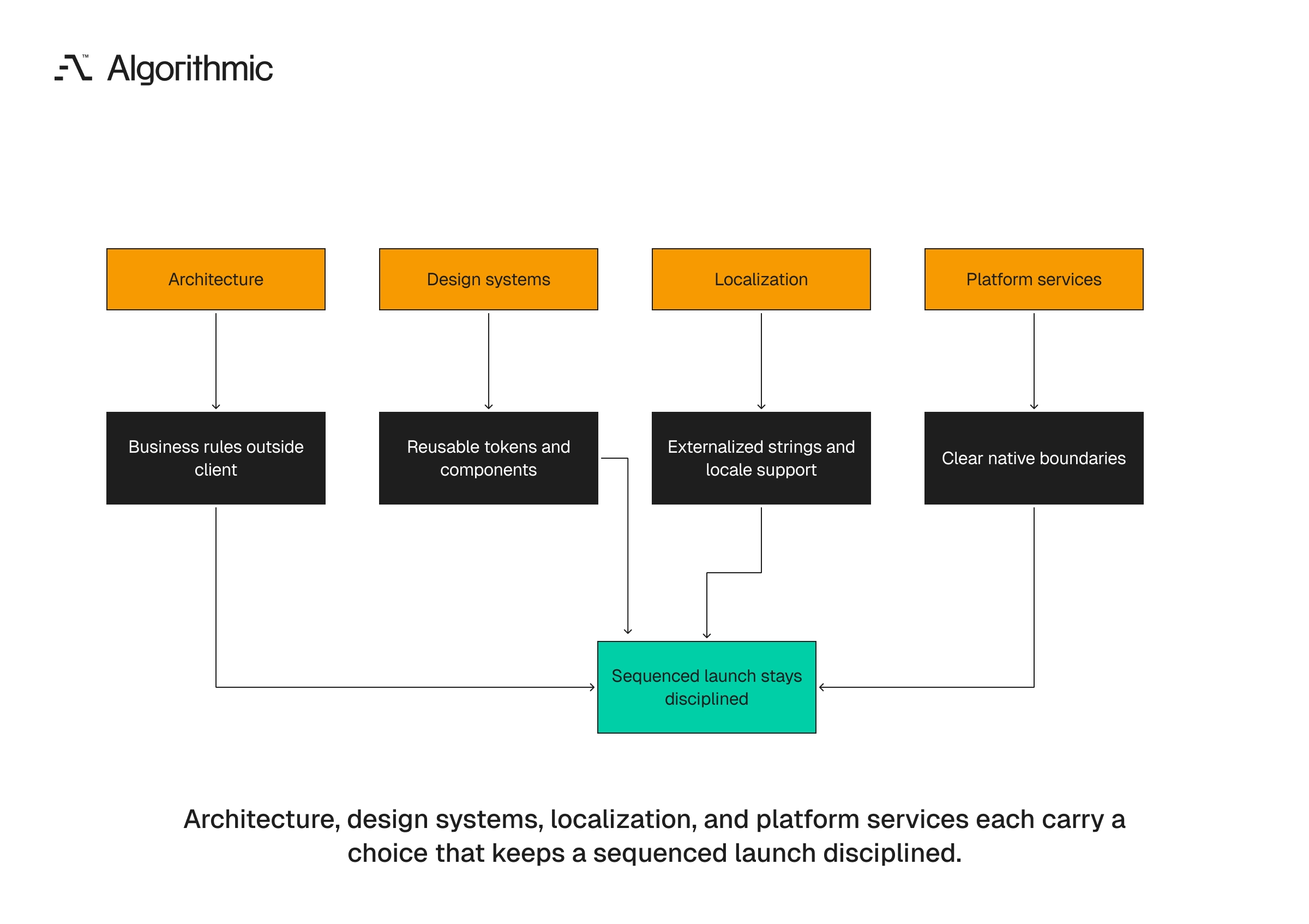
Four areas that decide whether sequencing stays disciplined
Platform sequencing becomes expensive through specific technical choices. The risk sits in architecture, design, localization, and native services, and each area requires an explicit decision before build work starts.
 Click to expand
 Architecture and why business rules belong outside the client
The first platform can use native iOS, native Android, React Native, Flutter, or a responsive web app, and the more important decision is where product rules live. Pricing rules, eligibility logic, permissions, inventory rules, recommendation policies, and workflow state belong in backend services or shared libraries when practical. A SwiftUI front end or Kotlin app should render state and collect input, not become the source of truth for commercial policy, so client code handles device behavior, presentation, local interaction, and offline constraints.
This matters in SaaS product development, marketplace platform development, and subscription apps. A founder who later adds Android can lose months when the iOS client contains 7,000 lines of rules for plans, discounts, renewals, and entitlements, since the second platform inherits interpretation work, duplicate tests, and a higher defect rate. A reasonable MVP target places roughly 80% of business logic outside the platform-specific UI, leaving the remaining share for native concerns such as camera access, push permissions, biometrics, local caching, and platform-specific navigation. That split gives the team a practical engineering target during sprint planning. The same rule applies to web-first products, because a React web app that stores eligibility logic in front-end components creates the same second-platform problem as a native app. The rule location matters more than the framework name.
The proof artifact is an architecture decision record. It should state where each business rule lives, who owns it, and which tests verify it, and it should name exceptions, because every exception becomes part of the next-platform estimate. A subscription product shows the pattern, since plan eligibility, renewal timing, entitlement state, refund rules, coupon logic, and trial conversion should sit behind server-side contracts while the iOS or Android client receives entitlement state and renders the permitted action. This boundary prevents duplicate commercial logic across clients and gives finance, support, and product operations one source for customer state, so when a refund policy changes, one backend rule changes before both clients receive the new state.
State management deserves the same discipline. Domain state should use typed models that move across clients with stable semantics, while view state can remain platform-specific because it describes presentation, focus, animation, and navigation. A team should inspect the repository by the end of the first month, where shared domain packages, service contracts, and test fixtures indicate a controlled option and deep business rules inside views indicate future rewrite cost. Architecture review should include concrete file paths, so a CTO can see where pricing, entitlement, permissions, and workflow state live in the repository, since a diagram without code ownership leaves too much room for interpretation.
Testing should follow the same boundary. Rules that affect revenue, identity, consent, or entitlement need tests that run outside the client, so UI tests verify rendering and interaction instead of carrying the full burden of commercial correctness. API contracts need version discipline too, since a mobile client on version 1.3 can remain in production while the backend supports version 1.4, and without versioning each new platform increases release coordination and support risk. Teams should define backward compatibility before launch, with additive fields, deprecation windows, error codes, and retry behavior in the first API agreement, so the second platform never inherits undocumented server behavior.
Design systems and why screens do not equal product design
A Figma file with 40 iOS screens is a screen inventory, while a design system contains reusable primitives, variants, states, and rules. The second-platform cost depends on whether the team creates those primitives before visual design becomes a collection of exceptions. A disciplined first-platform build defines typography scales, spacing tokens, color roles, component states, error patterns, empty states, and accessibility rules, which let a team translate the product to Android Material conventions or responsive web without restarting product design. They also reduce debate during the next build because the product already has named visual rules.
A weak first-platform build treats every screen as a separate design artifact, so the Android build becomes a redesign project with engineering attached and product managers spend weeks deciding whether differences are intentional, accidental, or dictated by the first platform. For a product with 25 to 35 core screens, creating a basic design system usually adds 1 to 2 weeks, small against a second-platform redesign that consumes 4 to 8 weeks across product, design, and engineering. The cost compounds when marketing pages, onboarding flows, and admin tools use different visual rules. Our product engineering work treats these tokens as the seam that keeps a follow-on build cheap.
The practical artifact is a design readiness checklist. It should confirm token definitions, component variants, accessibility rules, responsive breakpoints, platform-specific behavior, and the source of truth, whether that is a Figma library, code components, or both. The checklist should include specific tokens, so typography defines size, line height, weight, and role, and spacing defines fixed increments and layout behavior across narrow, standard, and wide screens. Component states need equal attention, because buttons, inputs, cards, tabs, modals, toasts, empty states, and error states require normal, loading, disabled, focused, and error variants, and without them the second platform recreates product decisions screen by screen. Accessibility rules also affect cost, since contrast ratios, touch target size, focus order, screen-reader labels, and reduced-motion behavior should appear in the first design system, and Android, iOS, and web expose these rules through different mechanics while the product policy stays stable.
A design system requires no large platform team for an MVP, only naming conventions and ownership, so one designer and one front-end engineer can maintain the token file, component inventory, and exceptions log. The exceptions log is valuable during executive review, because if the first build has 12 one-off components after four sprints the team should know why, recording exceptions that reflect product needs and correcting those that reflect rushed execution before expansion. Design debt often starts in onboarding, where teams create special cards, banners, permission prompts, and empty states during launch pressure that then spread into checkout, account settings, and support flows. A controlled design system gives each pattern a name, so a “permission rationale card” can support camera, location, contacts, and notification requests, and the second platform adapts the pattern to platform rules without inventing new product behavior.
Responsive design needs product decisions, not only layout decisions, so a desktop workflow with a side panel can become a bottom sheet on mobile once the design system defines that adaptation before engineers build separate experiences. Design tokens also improve estimation quality, because a second-platform estimate tied to 18 shared components and 64 tokens is stronger than an estimate tied to “reuse design”, and the artifact changes the conversation from confidence to evidence.
Localization and how hard-coded copy creates a delayed rebuild
Localization decisions often look harmless during an English-only launch, and they become expensive when copy, date formats, pluralization, currency, and layout assumptions sit inside components, because the later rebuild touches product copy, UI layout, QA, analytics labels, and support content. Internationalization is the engineering work that lets a product support multiple languages and regions without code changes, while localization adapts content and experience for a specific market. XTM’s software internationalisation guide explains the distinction, and it applies directly to early platform sequencing.
Teams do not need to translate a product into 12 languages before demand exists, but they do need to externalize strings, support locale-aware formatting, avoid fixed-width text assumptions, and plan for right-to-left layouts when those markets are in scope. These decisions cost little during the first build and cost far more after screens harden. When localization matters, translations should be treated like code, so use a translation management system such as Crowdin or Phrase, sync it with the repository, generate pull requests, and keep translators connected to product context, because spreadsheets create stale language branches, unclear ownership, and release delays. This pattern is localization debt when future markets are known and the product still hard-codes language into views, and it appears when the first regional launch requires a code freeze across every screen.
A practical MVP standard stores copy in resource files, runs pseudo-localization before release, and tests the longest expected language strings on small devices, which catches truncation, broken layouts, and pluralization errors before the second platform starts. Localization planning should include analytics and support content, so event names describe user intent rather than visible button labels, and support macros, onboarding emails, push templates, and legal consent text follow the same source-control discipline as application copy. Currency and date formatting also belong in the ledger, because a product that assumes US dollars, month-day-year dates, and English plurals has embedded market assumptions, and the second market then needs product, engineering, QA, support, and finance work at the same time.
Pseudo-localization gives a low-cost early test that expands strings, inserts accented characters, and reveals fixed-width layouts, so run it before the first production release, not during the international launch sprint. Right-to-left planning belongs in the first decision if Arabic or Hebrew markets are commercially likely, since the team can defer translation while avoiding layout choices that block mirror behavior, and this is a platform option, not a translation project. A checkout flow shows the risk, because “Pay $19.99 today” carries currency, tax, timing, and renewal assumptions in five words, and the better model separates price, billing period, tax language, renewal date, and consent text.
Legal text deserves the same treatment, since consent labels, privacy notices, cookie messages, and cancellation terms change by jurisdiction, and if those strings live inside components, regional launch work becomes a code release across the product. Localization also affects design estimates, because German and Finnish strings often expand beyond English while Japanese and Chinese compress differently, and small devices expose these differences before tablet or desktop layouts show them. The ledger should name the first three likely locales even if translation comes later, which gives design and engineering a concrete test set and prevents abstract localization planning from becoming a late-stage scramble.
Platform services and why native integrations need early boundaries
Device-specific features need explicit seams, because camera, notifications, location, health data, file storage, Bluetooth, and offline sync behave differently across iOS, Android, and web, and those differences should sit behind interfaces with named responsibilities. A single-platform MVP can use native features aggressively as long as it isolates them behind clear contracts, so the next platform implements equivalent adapters without changing core workflows. A field-service app can launch on iOS with Core Location, APNs, and offline SQLite storage, and the future Android build will use different permission flows, Firebase Cloud Messaging, and different local persistence, so if the core job workflow depends on a location service interface the second platform adds adapters. If location behavior is embedded throughout UI views instead, the team must trace and rewrite flows across the app, which creates hidden cost because product behavior and device behavior are tangled together, and QA expands because every workflow now carries platform-specific risk.
The same pattern applies to payments and subscriptions, since Apple in-app purchase rules, Google Play Billing, Stripe web checkout, and tax handling all require different integration paths, so the product should separate entitlement state from payment provider behavior. The proof artifact is an interface map that lists each native service, the platform API used, the product workflow affected, the adapter contract, and the test doubles for automated testing. Offline behavior requires special care, because sync conflict rules, retry policies, local storage limits, and cache invalidation should live in named services, and if those rules sit across screens the second platform inherits hidden product decisions. Push notifications are another common source of debt, since APNs, Firebase Cloud Messaging, notification categories, deep links, permission prompts, and quiet hours behave differently across platforms, so the product should define notification intent and user preference rules separately from delivery mechanics.
Payments create the highest commercial risk, because store policies, tax handling, refunds, proration, upgrades, downgrades, and grace periods affect revenue recognition and support operations, so the entitlement model should stay stable even when payment providers differ. File handling also needs early boundaries, since iOS document pickers, Android storage scopes, and browser upload flows expose different permission and security models, and a shared document domain model prevents these differences from spreading through the workflow. Camera and media features carry the same risk, so image compression, metadata stripping, upload retries, and background transfer behavior sit behind a media service where the UI requests an image and receives a result, error, or retry state. Bluetooth and device pairing need extra discipline too, because iOS and Android expose different permission prompts, background behavior, and pairing states, so the product should define device status, connection state, and failure recovery apart from platform APIs. Native service maps should include failure modes, since permission denied, service unavailable, network timeout, provider error, and stale cache states each need named behavior, so the second platform implements known product states instead of inventing them.
The second-platform cost model
The board-level artifact for this decision is a second-platform cost model. It should fit on one page, be reviewed before the first production sprint, and force the team to name evidence instead of relying on confidence statements.
| Area | Low-cost signal | High-cost signal | Evidence to request |
|---|---|---|---|
| Backend architecture | Platform-neutral APIs, server-side business rules | Rules embedded in iOS, Android, or web client | API contracts, service diagrams, test coverage |
| UI implementation | Component library, design tokens, documented states | One-off screens, no shared primitives | Figma library, Storybook, component inventory |
| State management | Clear domain models and typed contracts | Platform-specific state scattered through views | Type definitions, data flow diagrams |
| Localization | Externalized strings, locale-aware formats | Hard-coded copy, fixed layouts, no pluralization plan | i18n files, TMS plan, pseudo-localization tests |
| QA and release | Automated tests for core flows, device matrix | Manual testing only on one device class | CI pipeline, test plan, device coverage |
| Analytics | Event taxonomy independent of platform | Different events per client | Tracking plan, event schema |
| Native services | Adapter boundaries for device features | Direct platform calls across product flows | Interface definitions, integration tests |
Each row should have an estimated remediation cost, so if remediation costs less than building every platform upfront, single-platform sequencing is disciplined, and if it costs more than building shared foundations now, the team is creating technical debt. This model also helps founders evaluate technical partners, because a senior software development team should explain these tradeoffs before writing code, and a custom software development company that quotes one platform without a second-platform view leaves a material planning gap. The best partner conversations are specific, so ask for the API boundary between commercial rules and client presentation, how the design system will map to Android Material, iOS Human Interface Guidelines, or responsive web patterns, which tests prove shared behavior across clients, and how analytics events keep the same meaning when a second client ships. These questions expose future cost before the first sprint produces sunk cost.
The model should include decision thresholds, so any first-platform choice that raises next-platform cost by more than 20% requires CTO approval, and any hard-coded rule affecting revenue, identity, consent, or entitlement requires an exception record. Cost models work best in hours and dollars, because a row that says “Android adaptation risk” is too vague while a row that says “48 engineering hours to extract coupon logic from Swift into a pricing service” gives management a decision. The model should separate one-time migration cost from ongoing operating cost, since a duplicate analytics taxonomy creates one cleanup project and recurring reporting confusion, while a poorly bounded notification service creates repeated engineering cost across every release. Tie each cost line to a proof artifact, so a claim of reusable business logic comes with tests that run outside the client, a claim of design reuse with tokens and component variants, and a claim of localization readiness with pseudo-localization output.
This discipline changes partner selection, because a credible studio will discuss seams, contracts, tests, and cost ranges before quoting delivery, while a weak proposal promises a future Android or iOS build without showing the technical path. The cost model should include a short risk register where each risk carries an owner, estimated cost, trigger date, and mitigation plan, so “Extract in-app purchase entitlement mapping before Android billing work starts” is specific enough to manage. The model should also identify decisions that can wait, since a team can defer final Android animation behavior until Android design starts, but it cannot defer where subscription entitlements live if the iOS launch sells paid plans. QA estimates need device and workflow detail, because “manual mobile QA” has no management value while “thirty regression cases across iPhone 13, iPhone SE, Pixel 7, and Samsung A14” gives the team a baseline, and analytics cost needs the same precision, since a product with 60 named events and one taxonomy can compare web, iOS, and Android cohorts while client-specific event names turn every platform report into a data cleanup project.
Choosing web, native, or cross-platform based on second-order cost
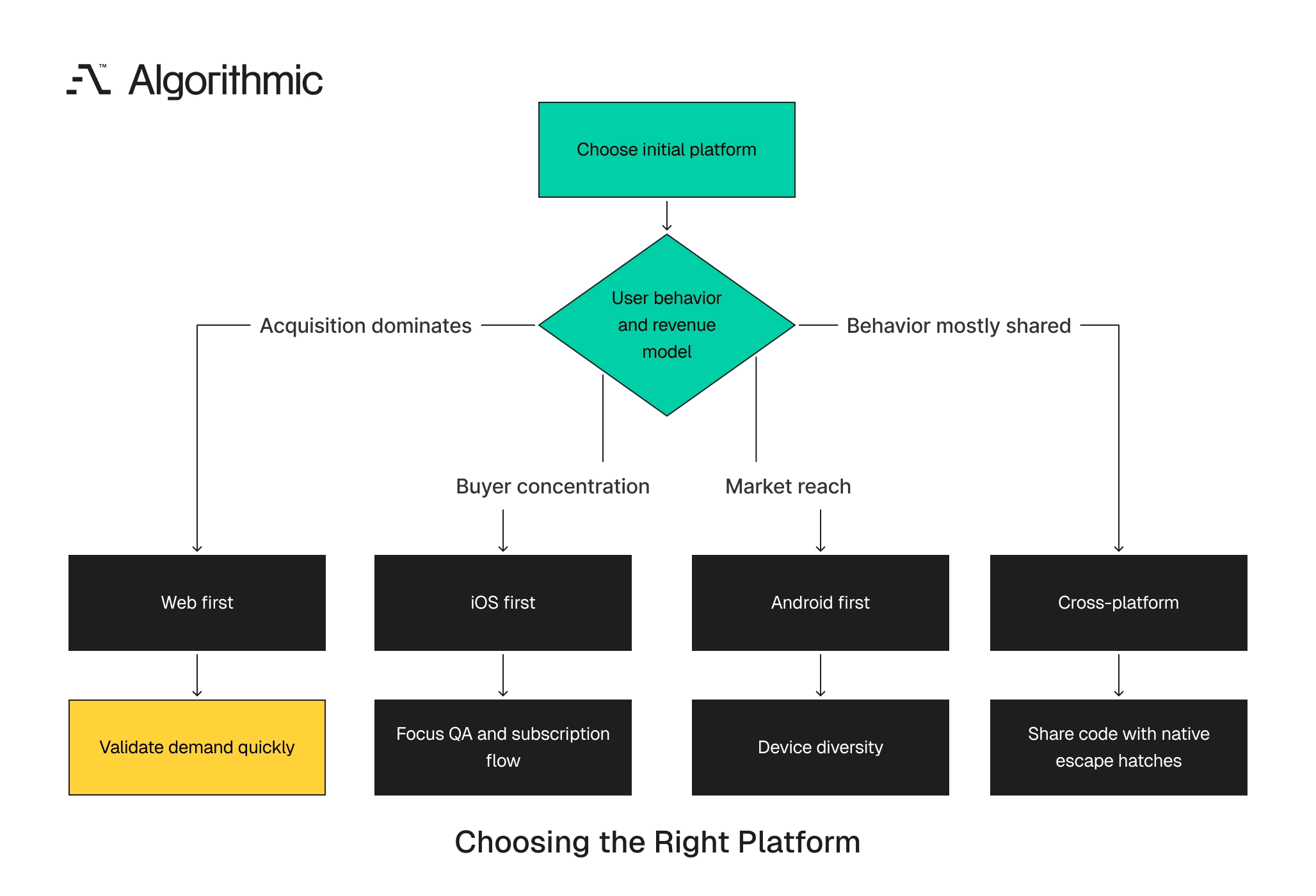
The first platform decision should reflect user behavior, hardware needs, distribution, and revenue model, and it should also reflect the cost of the next platform. A disciplined decision ties platform order to evidence, not founder preference.
 Click to expand
 Web first works when acquisition and iteration dominate
A web-first launch is often rational for B2B SaaS, marketplaces, analytics tools, internal workflow products, and products where SEO or shareable links matter, because it reduces App Store review delays, supports faster release cycles, works across desktop and mobile browsers, and lets teams test pricing, onboarding, and retention loops without packaging every change into a store release. The second-platform cost stays controlled when the web product has clean APIs, responsive design foundations, and platform-neutral analytics, and it becomes expensive when mobile behavior is treated as a compressed desktop layout, since a phone workflow often needs different navigation, input patterns, error handling, and offline behavior. For a B2B workflow product, web first can validate demand in 8 to 12 weeks, and native mobile can then focus on field use, offline access, push notifications, and camera workflows, so the mobile release becomes a targeted extension of proven workflows.
A web-first product requires mobile discipline from day one, so test core flows at common breakpoints including 360, 390, and 430 CSS pixels wide, and track event names by user intent, not by button text or page layout. Web first also changes release governance, because teams can ship multiple production releases per week, which increases learning speed but becomes a liability if no one maintains API contracts, tracking plans, and design tokens. The web-first ledger should name the mobile workflows expected later, since field capture, document upload, barcode scanning, offline approval, and push notifications differ from desktop administration, so the first web release keeps those workflows in the domain model even when the UI ships later. Web-first builds should also define authentication patterns early, because magic links, SSO, passkeys, and device trust behave differently across browsers and native clients, and the second-platform estimate should include account recovery, session refresh, and secure storage changes. A marketplace illustrates the sequence, since web can test supply onboarding, search, checkout, messaging, and dispute handling before native apps exist, and mobile can then focus on push alerts, location-aware discovery, and faster repeat transactions. A web-first path also needs browser support decisions, because Safari on iOS, Chrome on Android, desktop Chrome, and enterprise-managed Edge behave differently, so name unsupported browsers before customer onboarding begins.
iOS first works when buyer concentration supports it
iOS first can be rational for consumer subscriptions, creator tools, fintech products in certain markets, and products with high Apple device concentration, because it helps teams focus design and QA in the first release, and the App Store path gives a controlled distribution channel and a clear subscription purchase model. The second-platform risk is Android parity, since Android has a wider device range, more varied screen sizes, different permission flows, and different background execution constraints, so the team should account for that range before treating Android as routine follow-on work. An iOS-first team should keep business logic out of Swift when practical, document platform assumptions, and create Android-ready design tokens, because without that discipline the Android estimate moves toward the high band.
The team should also document Apple-specific decisions, since Sign in with Apple, in-app purchases, privacy nutrition labels, background task rules, and push permission flows shape the product, and Android equivalents require planned replacements, not late discovery. iOS first also requires subscription discipline, so StoreKit, trial handling, grace periods, restore purchases, and receipt validation connect to a server-side entitlement model that the Android build later reaches through Google Play Billing. Device QA should stay narrow without becoming blind, so test current and older iPhones, small screens, large screens, and slow networks, and record every assumption that will change when Android enters delivery. The iOS-first ledger should include a parity map that lists each iOS feature and its Android replacement path, which prevents teams from discovering policy, permission, and screen-size differences after the iOS launch.
iOS first works best when the buyer data supports it, so a consumer wellness app with 78% iOS traffic in pre-launch waitlist analytics has a stronger case than a founder preference for Apple devices, and the platform decision should reflect acquisition data, payment behavior, and support cost. The parity map should cover design patterns too, because iOS tab bars, navigation stacks, swipe gestures, and permission timing do not translate one-to-one to Android, so each material difference receives a product decision before Android design begins. Crash reporting and diagnostics also need early setup, since Xcode Organizer alone is insufficient when Android follows, so use a cross-platform crash taxonomy that lets product and engineering compare release quality across clients.
Android first works when market reach requires it
Android first fits markets where Android share dominates, where lower-cost devices drive adoption, or where distribution outside the App Store matters, and it suits hardware-adjacent products that depend on device variation testing early, so device diversity becomes part of product learning rather than a late QA burden. The second-platform risk is underestimating iOS design and review expectations, because a product that performs well on Android can still need adjustment for iOS navigation, permissions, subscriptions, and App Store policy, and those changes affect design, engineering, legal review, and release timing. Teams should model Apple sign-in, in-app purchase rules, notification permissions, and privacy labels before deciding that iOS follows Android directly, and review navigation patterns against Apple’s Human Interface Guidelines, since small mismatches create rejection risk or a weak first impression.
Android-first teams should define device tiers for testing, so a practical MVP matrix includes low-memory devices, current mid-market devices, and at least one current flagship device, which protects performance expectations before the second platform enters planning. Android first also reveals performance constraints early, because startup time, memory pressure, image handling, offline storage, and background work require specific budgets that should become product standards before iOS implementation begins. The Android-first ledger should include distribution assumptions, since Google Play, enterprise distribution, OEM channels, and sideloading each carry different support and security obligations, and iOS follow-on work should account for Apple’s more controlled review path. Hardware variation also affects analytics, so device model, OS version, memory class, network type, and permission state should appear in diagnostic events that help the team separate product issues from device constraints.
Android first is common in emerging markets and field operations, so a logistics product serving drivers on low-cost devices should learn from Android performance before designing iOS refinements, and the device fleet should shape product scope and QA depth. The team should also define offline tolerance, because rural routes, warehouse dead zones, and weak mobile networks expose sync weaknesses early, and these findings should become shared product rules before the iOS client ships. Security reviews differ across distribution paths too, since enterprise Android deployments can require mobile device management, certificate handling, and private app channels, so the iOS plan should include equivalent controls where customers require managed devices.
Cross-platform works when product behavior is mostly shared
React Native and Flutter can reduce duplicate UI effort when product behavior is similar across iOS and Android, so they are strong candidates for marketplace apps, community products, booking flows, lightweight workflow tools, and many subscription products, and the fit is strongest when device-specific code stays limited and well bounded. Cross-platform mobile app development has a different cost profile, because it lowers duplicate feature work and raises the need for strong engineering discipline around native modules, release tooling, crash reporting, and performance budgets, so weak release discipline can erase the savings from shared code. A React Native app with weak native boundaries still becomes expensive, while a Flutter app with a structured domain layer, design tokens, and tested platform channels can add features across iOS and Android with consistent behavior, since the framework choice matters less than the architecture around it.
Teams should inspect the native module plan before choosing this path, because camera, maps, push notifications, payments, and background tasks each need ownership, test coverage, and upgrade plans, and cross-platform code still ships through two stores with different review rules. Cross-platform work also needs explicit version governance, since React Native, Flutter, Xcode, Android Gradle Plugin, SDK versions, and store policies change on separate schedules, so the release plan should include upgrade windows and regression testing. Performance budgets should be written before UI implementation, because startup time, interaction latency, memory use, crash-free sessions, and bundle size should have thresholds, and without them cross-platform decisions drift until users report poor behavior. The ledger should identify native escape hatches, since some workflows belong in native modules because of performance, device API depth, or store policy, and recording those choices early prevents framework ideology from driving product risk.
Cross-platform choices also affect hiring, because React Native skills often align with JavaScript and TypeScript teams while Flutter requires Dart experience and a different set of platform-channel practices. Release ownership should be named before the first build, so one engineer owns iOS store readiness and another owns Android store readiness, since shared code does not remove store-specific review, signing, provisioning, or crash triage. Cross-platform testing should cover shared and native paths separately, so unit tests prove shared domain behavior while device tests cover permissions, notifications, purchases, deep links, and background behavior on each store path.
Technical debt starts when future cost goes unmodeled
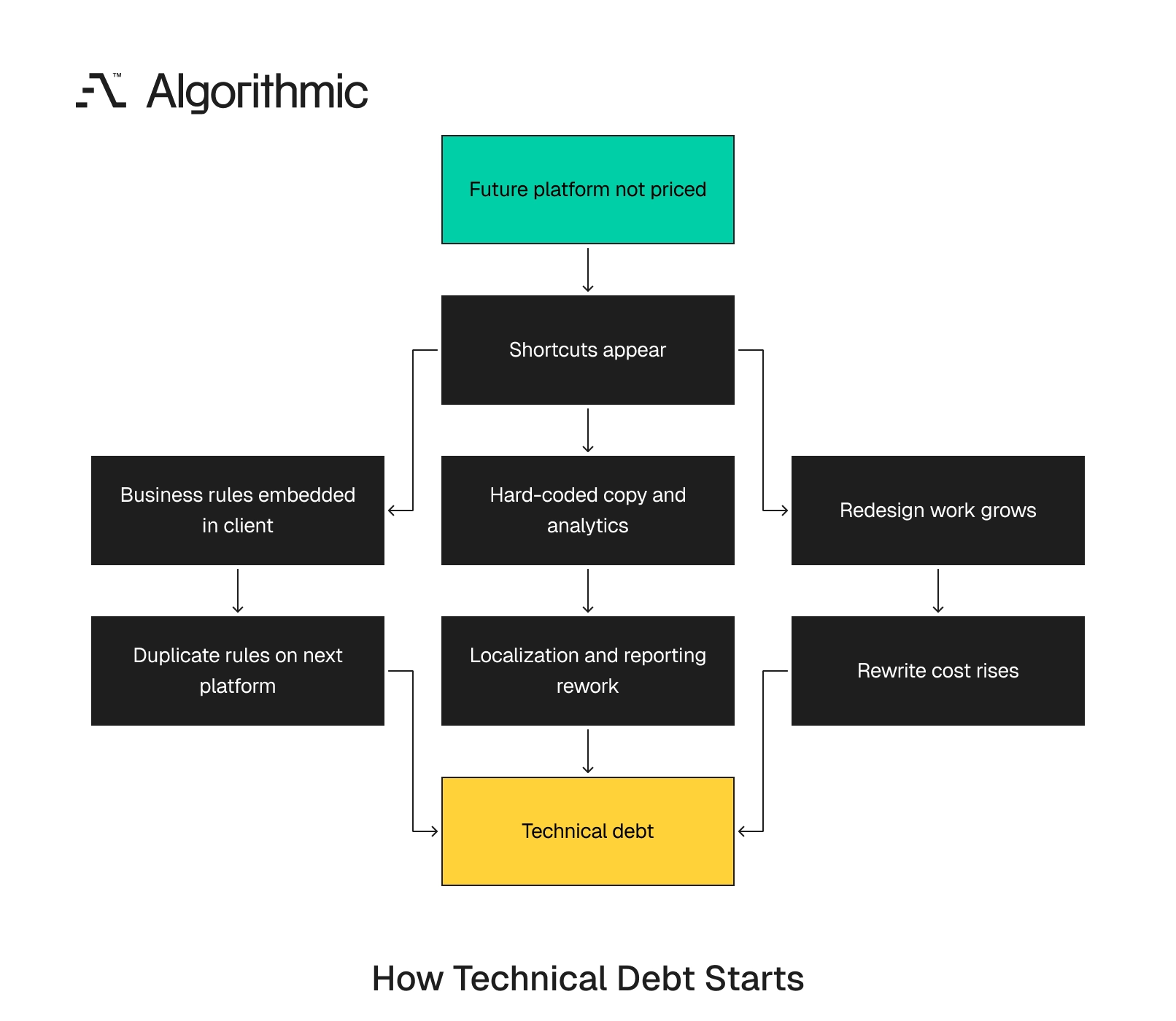
Technical debt is a financing decision that trades lower cost now for higher cost later, and that trade is rational when the repayment terms are explicit. The problem is misclassification, since some teams call every deferred platform technical debt and then overbuild too early, while others call every shortcut sequencing and discover six months later that the next platform needs a rewrite. Martin Fowler’s technical debt quadrant separates prudent, deliberate debt from the reckless kind, and platform planning needs the same discipline, since a deferred platform is prudent only when the future cost is named. This is the same trap behind the false economy of the quick MVP, where speed hides a bill that arrives later.
The label should follow the economics. A narrow launch is disciplined sequencing when four conditions hold.
- The second-platform cost is estimated before build starts.
- The architecture preserves shared business logic.
- The design system can extend to the next form factor.
- Localization and analytics avoid hard-coded platform assumptions.
A narrow launch becomes technical debt when those conditions are absent and the future platform remains commercially likely, and the debt then appears as duplicate rules, redesign work, translation rework, analytics repair, and native integration rewrites. Those categories should be visible in the cost model before the first sprint begins.
 Click to expand
 This definition also protects speed, because teams should avoid abstractions for imaginary markets, devices, or channels and protect only options that have a credible business path within the next two release cycles. The distinction is practical during backlog planning, since “extract pricing rules from iOS into pricing service” is debt repayment, while “refactor component names because a new engineer dislikes them” is preference unless it changes delivery cost. Good teams record both, because preference work can improve maintainability and morale, while debt work has a financial repayment logic tied to future platform cost.
Debt records should include repayment triggers such as a second-platform approval, a regional launch date, a paid subscription release, or a regulatory review, because without a trigger debt entries become a vague backlog category. Teams should also record debt interest, since duplicate pricing rules can create support incidents and revenue leakage before the second platform starts, and poor analytics naming can distort retention reporting during the first month. This discipline gives executives a cleaner funding decision, so they can approve a narrow release, track the cost of preserving optionality, and reject shortcuts that make the next platform economically irrational.
The 30-day platform sequencing review
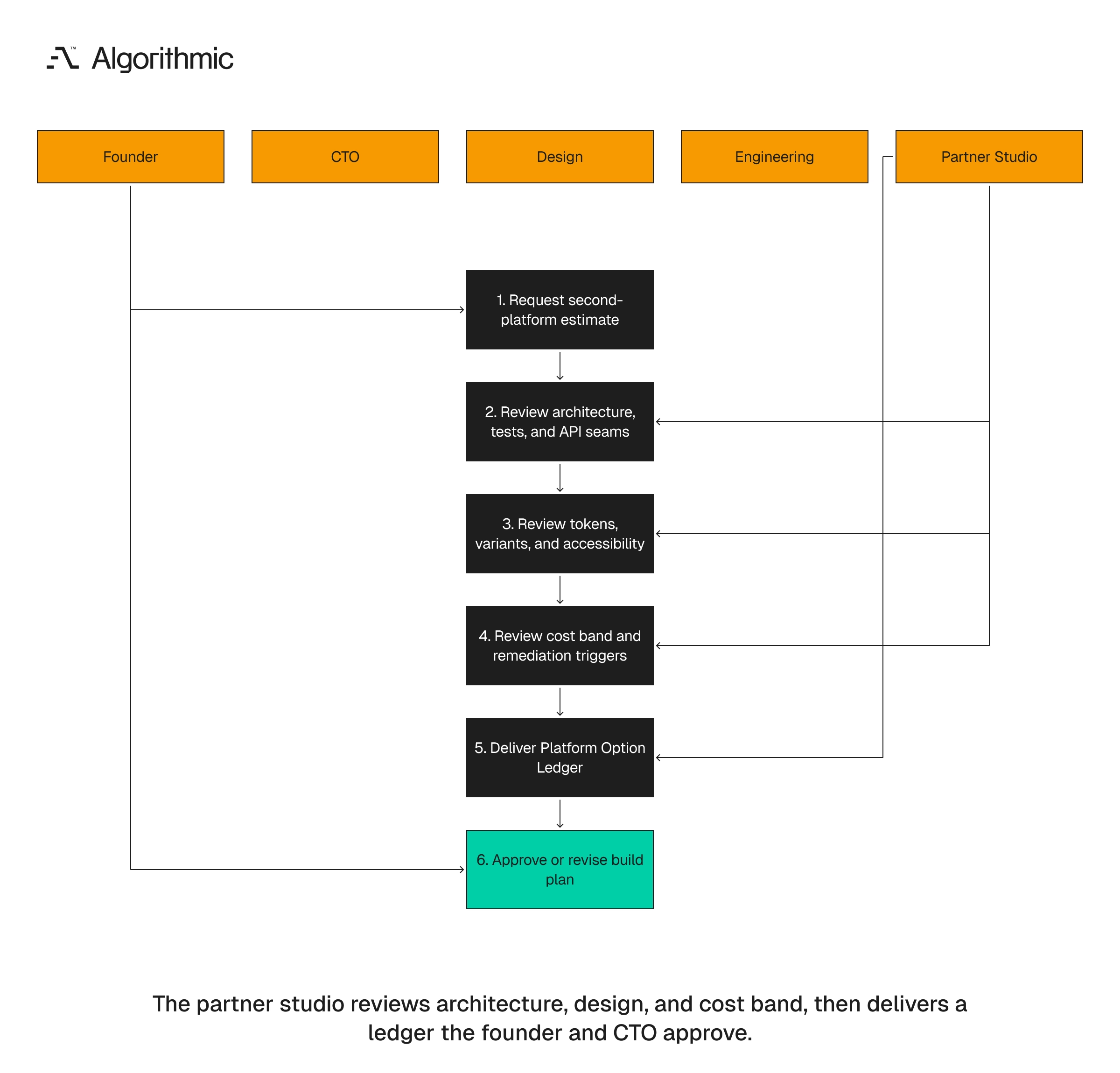
Before committing MVP development to production, run a 30-day platform sequencing review. This is a focused architecture and product planning exercise that should produce decisions a founder, CTO, and board can inspect. The review should produce five artifacts.
- A primary platform decision with user and revenue rationale
- A second-platform cost model with low, medium, and high estimates
- An architecture decision record for business logic placement
- A design system readiness checklist
- A localization and analytics readiness plan
For a $50,000 MVP, this review can take 2 to 3 days, and for a $250,000 product build it should be a formal gate before implementation starts. The cost is modest because it prevents a common failure mode, learning after launch that the first build cannot support the second platform.
 Click to expand
 Use this review when hiring a software studio for startups or selecting a mobile app development agency. Ask for the second-platform estimate during partner evaluation, which first-platform choices would change that estimate by more than 20%, where business rules will live and how the team proves that through tests and code structure, and who owns design tokens, localization files, analytics events, and native service interfaces. A credible partner will answer with diagrams, contracts, cost ranges, and tradeoffs, because vague assurances are inadequate and “we can add Android later” has no planning value without a cost range and supporting architecture. The partner should show the specific seams that make the later build predictable.
The review should include both product and engineering leaders, since product brings revenue timing, user segment priority, market sequence, and scope discipline, while engineering brings architecture, code ownership, testing, release risk, and future migration cost. Design must also participate, because platform sequencing often fails through design drift before it fails through code, so tokens, variants, accessibility rules, and responsive behavior need a named owner during the first sprint. The review should end with signed decisions, not open questions, so a founder knows the initial platform, expected next platform, estimated cost band, protected seams, and accepted exceptions, and the team knows which decisions require escalation.
The review should include finance when subscriptions, marketplace fees, taxes, or refunds are in scope, because revenue rules often enter the product through payment code, and finance can identify reporting, refund, and recognition rules before engineers place them inside clients. Support and operations should also review the plan, since password resets, account merges, cancellation requests, delivery disputes, and notification preferences affect customer operations and often expose platform-specific gaps after launch. A strong review ends with a short decision log where each decision carries owner, date, rationale, cost impact, and artifact link, which becomes the reference point when scope pressure arrives in sprint three. The review should also define the first post-launch checkpoint, so thirty days after release the team compares actual usage against the platform assumptions, and if mobile web conversion fails on checkout the next-platform plan may need to move earlier.
What product leaders should do next
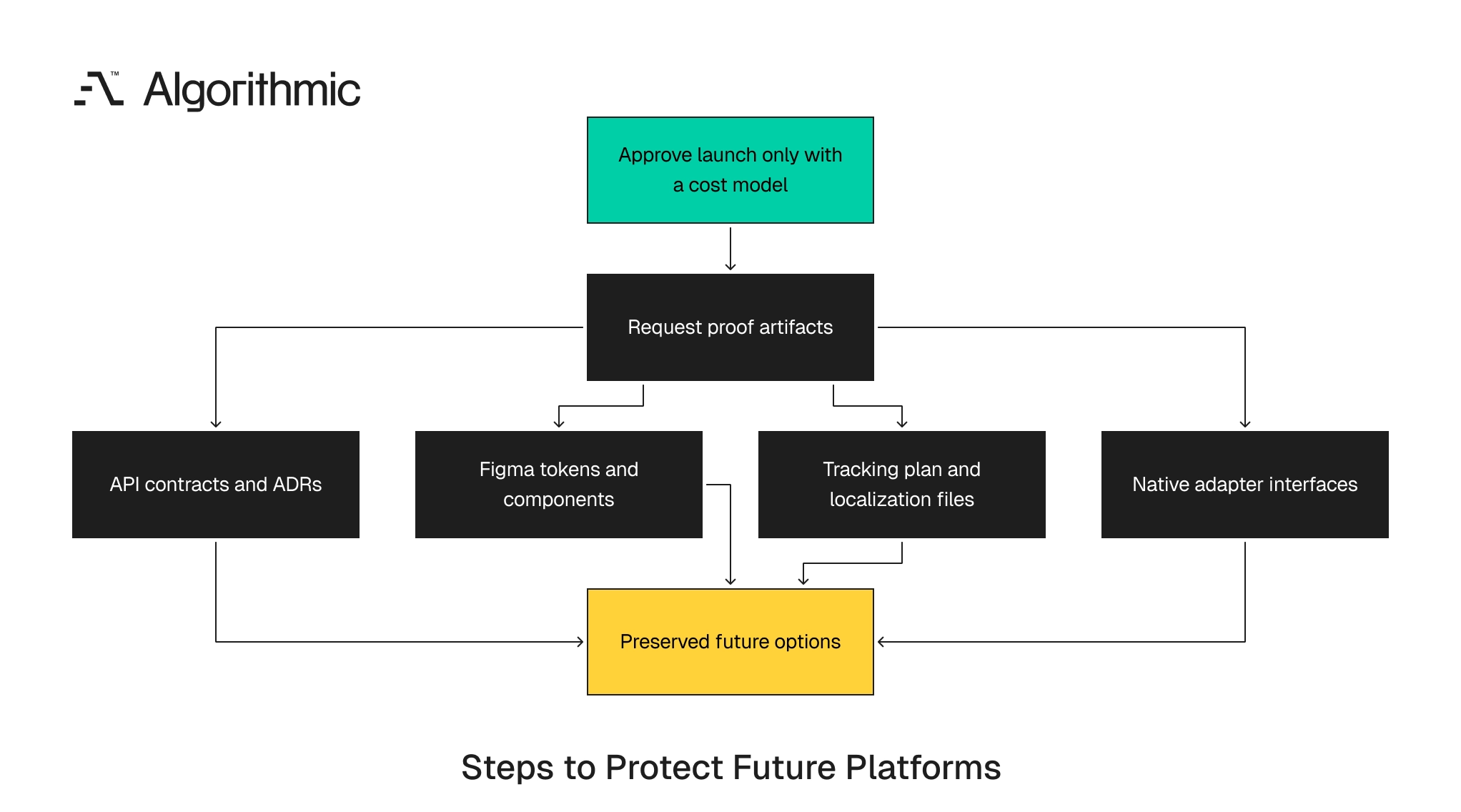
Treat single-platform sequencing as a financial and architectural decision, and approve an iOS-only, Android-only, or web-only launch only with a written second-platform cost model that identifies the expected cost band, known risks, and decisions that protect future options. For the next platform decision, document the target first release, the likely second release, the expected cost band, and the technical choices that protect that path, then review architecture, design systems, localization, analytics, and native service boundaries before the first sprint begins, assigning owners for each area before design and engineering create sunk cost.
Use the Platform Option Ledger as the operating artifact, short enough for a board packet and specific enough for engineering review, and update it after scope changes, pricing changes, payment changes, or major workflow changes. Ask every partner to show proof, so request API contracts, architecture decision records, Figma token files, component inventories, tracking plans, localization files, and native adapter interfaces, and treat missing artifacts as cost signals.
 Click to expand
 Build narrowly when the market needs focus, but preserve enough structure that the next platform becomes an extension instead of a reconstruction, because that discipline separates controlled sequencing from debt that arrives with interest.
Algorithmic runs product engineering that prices the second platform before the first sprint and keeps the seams that make a follow-on build predictable. Start a conversation if you are choosing a first platform and want the next one to stay an extension, not a rewrite.