

The model checkpoint is one asset in the production system. The runtime determines latency, concurrency, reliability, and cost under customer traffic, so engineering leaders who treat inference as model hosting inherit avoidable incidents. A trained model with strong offline metrics can fail commercially within weeks of launch. A 4% accuracy gain has limited value when p95 latency moves from 900 milliseconds to 4.2 seconds, and it loses commercial value when cost per call doubles at production volume.
VPs of Engineering planning ML model deployment should treat runtime architecture as product architecture. GPU scheduling, request routing, caching, batching, fallback policy, observability, and cost controls decide production behavior under load, and these decisions belong in launch planning, procurement planning, and release governance. The runtime is the unit of production readiness. A model passes launch review when the serving system proves its latency, cost, and failure behavior under load, since offline evaluation alone never proves production readiness.
A production launch should answer one practical question before customer traffic arrives. Can the serving path meet the customer promise when traffic spikes, dependencies slow down, and costs rise under real usage? The answer comes from traces, load tests, route rules, and rehearsed failure paths.
Benchmark quality does not predict production inference behavior
Offline evaluation measures model behavior against a controlled dataset, while production inference measures the full path from request arrival to user-visible response. Those two measurements answer different engineering questions. The production path varies across request mix, concurrency, payload size, feature freshness, and downstream dependency timing. A benchmark run on a quiet GPU says little about a Friday 9 a.m. traffic spike that includes 1,200 concurrent requests, uneven prompt lengths, and three external feature lookups.
The same gap appears in frontier infrastructure results. NVIDIA reports that serving software and routing logic, not hardware alone, moved production-grade latency in MLPerf Inference v6.0, with software updates raising token throughput on identical hardware. The MLCommons results confirm the same reading across the submitting vendors, since the inference path improves when runtime decisions change how requests reach compute.
This is the operating reality for production ML. A model server sits inside a distributed system with authentication, feature stores, vector databases, gateways, queues, and billing systems. Each dependency adds latency variance and failure modes that offline evaluation never measures. The failure pattern is consistent in incident reviews, where the model response time looks acceptable in isolation, then the full request path misses the customer promise. The gap sits in queue delay, feature fetches, cache misses, regional routing, or downstream retries.
A serious launch review separates model quality from serving quality, measures both with production-shaped tests, and rejects a model release when either one fails the production contract. This separation matters because teams fix different problems with different tools. A model quality issue needs data work, training changes, or calibration, while a serving quality issue needs routing, queue policy, caching, scheduling, or dependency isolation. The risk rises when one dashboard mixes these signals, because a single model-latency chart hides gateway time, cache wait, feature reads, and queue delay. Each stage needs its own span, owner, and threshold.
The runtime path has six production control points
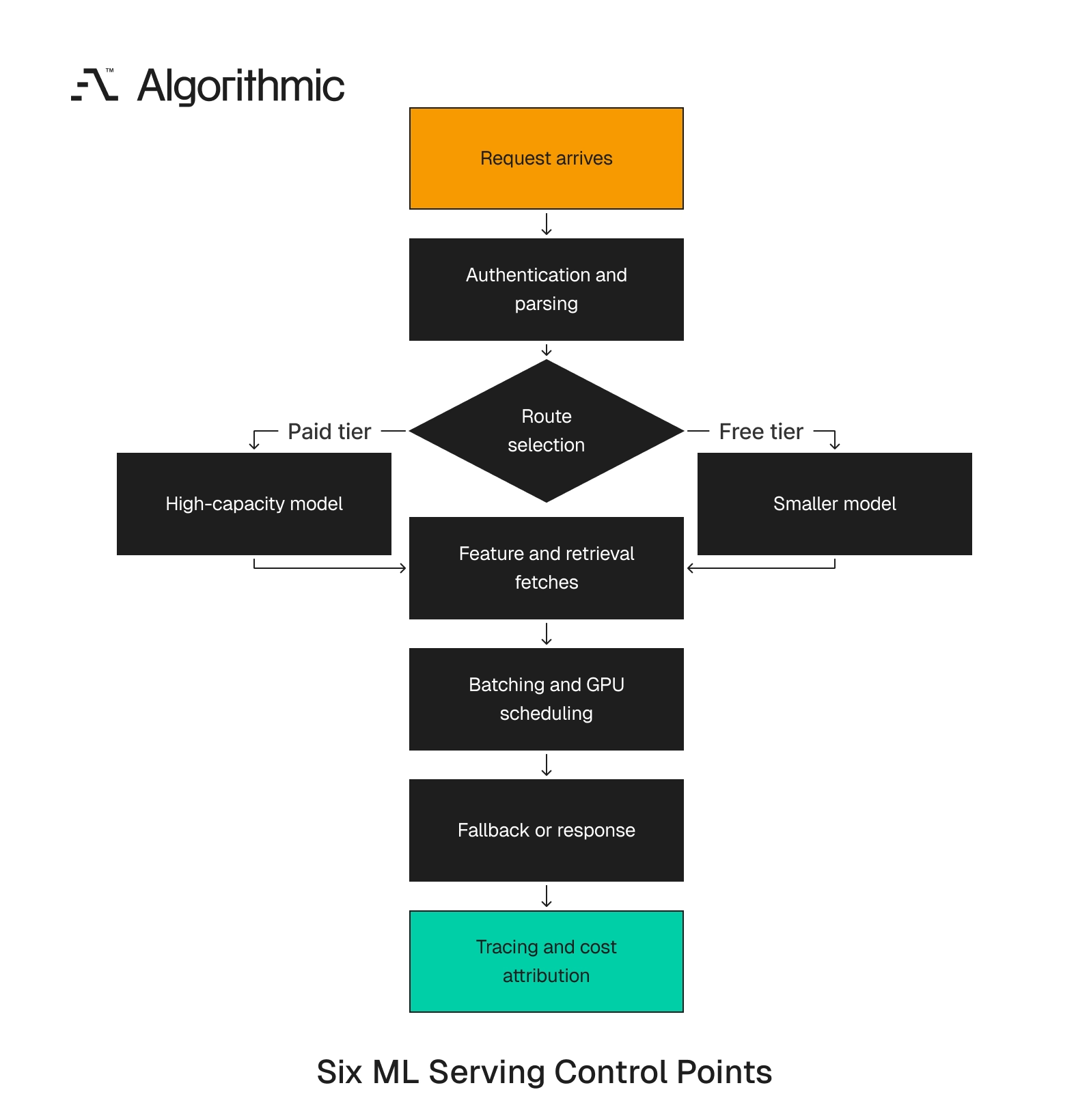
A useful inference architecture starts with the serving path, not the checkpoint. The checkpoint sits inside that path, and the path defines production behavior. A typical real-time ML inference system contains six control points, and each one needs an owner, a metric, and a failure response before launch. These controls form the minimum operating surface for production ML.
Each control point also needs a business interpretation. A 200-millisecond queue delay has different meaning for checkout fraud, customer support, and asynchronous document review, so runtime policy should reflect the product promise attached to each route.
 Click to expand
 Request routing
Routing decides which model, hardware pool, region, or fallback path receives a request. A fraud scoring request with a 150-millisecond budget and a medical summarization request with a 6-second budget need separate routes, since shared default routing hides differences in risk, latency tolerance, and cost. Routing policy should encode business rules, so paid-tier customers can receive a larger model while anonymous traffic uses a smaller model with stricter token limits.
Low-confidence responses can trigger a second-stage model when the expected business value exceeds the added cost. An e-commerce fraud system can route a $12 order through a small model, while a $4,800 order from a new account warrants a heavier model and an additional identity check. Routing also governs regional placement, so a European tenant with data residency requirements should hit an EU inference endpoint, and a latency-sensitive mobile feature should use the nearest healthy region with available GPU capacity.
A senior launch review should include a route map instead of a single deployment diagram. The route map lists customer tier, model version, region, hardware pool, fallback, and cost ceiling for each path, and this artifact exposes hidden coupling before traffic arrives. Routing rules should also include ownership boundaries. The product team owns customer-tier policy, the ML platform team owns model placement and hardware pools, security and compliance teams own residency and retention constraints, and finance owns cost ceilings by plan and contract. The route map becomes the shared control surface across those owners, and it records promotion rules, so a new model version can receive 5% of paid-tier traffic for 24 hours and advance only when p95 latency, p99 latency, fallback rate, and cost per response stay within contract.
Admission control and queue policy
Admission control protects latency budgets during traffic spikes. Queues grow silently when teams omit this control, and the system then spends compute on responses that already missed the product window. A practical policy sets a maximum queue wait per workload, so a real-time ranking model can reject or downgrade requests after 40 milliseconds in queue while an asynchronous document analysis job waits 30 seconds. Both policies are valid, and each needs a different queue, retry policy, and customer-facing response, since combining them behind one FIFO queue creates predictable tail-latency failures.
Admission control also protects downstream systems. A vector database, feature store, or third-party API can become the bottleneck before the GPU saturates, so queue metrics must show which component created the delay. The queue policy should include a discard rule, since a request with an expired product deadline should leave the queue before model execution, which reduces wasted GPU seconds during traffic spikes. The policy should also define overload behavior by route, so a paid checkout route can preserve capacity through priority admission while a free-tier content route receives a typed 429 response with a retry window.
Queue depth alone gives an incomplete view. Teams need queue age, oldest request age, admission rejections, downgrades, and expired requests, because these metrics show whether the system protects the product promise under pressure. Queue policy also affects cost, since a queue that holds work past the deadline burns GPU time on unusable responses while a queue that rejects work at the gateway protects both latency and margin.
Batching and GPU scheduling
Batching improves throughput by grouping requests, and it also adds delay. The right batch size depends on model architecture, request length, GPU memory, and p95 latency target. For LLM serving, engines such as vLLM use continuous batching and PagedAttention KV cache management to raise GPU use without waiting for fixed request batches, and these techniques matter most when prompt lengths and completion lengths vary by user. NVIDIA Triton Inference Server serves mixed frameworks across TensorFlow, PyTorch, ONNX, and TensorRT models, groups compatible requests at serving time through dynamic batching, and exposes model-level metrics. Ray Serve and KServe add service orchestration patterns for teams running multiple models across clusters.
GPU scheduling needs explicit policy. NVIDIA MIG partitions can isolate workloads on supported GPUs, and Kubernetes device plugins expose GPU resources to clusters, but cluster schedulers still need workload-level rules for priority, preemption, warm pools, and memory pressure. A background embedding job should never evict an interactive checkout model from GPU memory, and a batch analytics workload should yield when paid customer traffic exceeds the queue threshold. The scheduling policy should identify warm models by route, because a cold model load can consume seconds and invalidate the first requests after a deploy, so warm pool size belongs in the launch plan with measured memory cost.
Teams should also measure fragmentation, since a cluster can show free GPU memory while no single device has enough contiguous memory for the next model, a failure pattern that appears during mixed LLM, vision, and embedding workloads. Scheduling rules should cover deploy behavior too, because a rolling release can double memory demand during model overlap, so a launch plan should reserve capacity for the old model, new model, and rollback path. These decisions affect operational blast radius, where shared devices lower idle cost and isolated pools reduce cross-workload interference for regulated, paid, or latency-sensitive routes.
Caching and reuse
Caching is one of the highest-return engineering controls in inference. It reduces latency and cost without changing model weights, and it reduces pressure on databases, vector stores, and external APIs. Common patterns include feature caching, embedding caching, prompt prefix caching, retrieval result caching, and response caching for deterministic outputs. Low-risk outputs can use short-lived response caches, while high-risk decisions should cache inputs, features, or retrieval results instead of final decisions. In retrieval augmented generation systems, caching the top-k retrieval result for common queries cuts repeated vector search and reranking cost, and the exact result depends on query concentration, so support centers, internal knowledge bases, and product catalogs usually have enough repetition to justify the work.
Cache design needs explicit keys and expiration rules. A cache key for tenant, locale, document version, permission group, and prompt template prevents data leakage, and a 15-minute TTL can fit product search while medical or financial workflows require stricter freshness rules. A cache review should test permission changes, so a user removed from a customer account loses access to cached retrieval results immediately, a test that matters more than the average hit rate for regulated workflows. Cache invalidation needs the same rigor as model deployment, since a product catalog update should invalidate retrieval results tied to changed SKUs, and a policy update should invalidate response paths that embed the old rule.
Prompt prefix caching deserves special attention for LLM workloads, because many enterprise prompts share the same system instructions, policy text, tool schema, and document preamble. Reusing those prefixes reduces repeated compute and improves time to first token. Embedding caches need versioned keys, so an embedding created by model version A never mixes with vectors created by model version B unless the team has verified compatibility, since a silent embedding-version mix can damage retrieval quality for weeks. Our guide to building and evaluating RAG systems covers how these caches interact with retrieval quality.
Fallback and degradation policy
A production ML system needs defined behavior when the preferred path fails, and that behavior should be designed before launch so engineering teams execute a runbook during an incident. Fallback options include smaller models, stale features, cached outputs, rule-based decisions, partial responses, and asynchronous completion. For a recommendations surface, a cached popular-items fallback can protect the user experience, while for credit decisions, fallback policy must respect regulatory and audit requirements. Fallback quality also needs measurement, since a degraded response that preserves conversion differs from one that creates customer churn, so product teams should define acceptable fallback rates by route and customer tier.
The fallback path must receive test traffic before launch. Untested fallback logic often fails because schemas drift, cache keys change, or feature stores reject stale reads, and a weekly fault-injection test exposes these failures before customers see them. Fallback rules should include a business owner, since engineering defines the mechanism while product and compliance approve the customer-visible behavior. Fallback policy also needs a recovery rule, because once the preferred route returns to health, traffic should move back in controlled steps, since a sudden return can create a second incident if queues and caches remain cold.
Each fallback should carry a clear trace marker. Incident teams need to know whether users received a smaller model, stale features, cached content, or an asynchronous promise, and a single fallback counter hides too much operational detail. The customer message should be defined in advance, so a support answer can say that a response is delayed while a medical workflow may need a hard stop and human review.
Observability and cost attribution
Inference observability must connect technical metrics to unit economics. GPU use alone is insufficient, because a saturated GPU can indicate healthy batching or an overloaded queue. Teams need p50, p95, and p99 latency by route, plus queue time, model execution time, feature fetch time, cache hit rate, token count, GPU memory use, error class, fallback rate, and cost per successful response. These metrics should share trace IDs across the gateway, model server, feature store, vector database, and billing system. Without this telemetry, an MLOps team cannot distinguish model latency from retrieval latency, nor separate cold-start delay, queue saturation, and dependency failure, so incident reviews then produce guesses.
Cost attribution belongs in the same telemetry design. A tenant that sends long prompts, high-resolution images, or repeated low-value requests should appear in daily reports, and route-level cost data gives product leaders the information needed for pricing and rate limits. A production trace should answer six questions in one view. Which route handled the request, which model version ran, which cache keys hit or missed, which dependency consumed the most time, which fallback fired, and how much the response cost.
Observability should include release context, so every trace carries model version, prompt template version, retrieval index version, and runtime configuration version, which reduces incident diagnosis from hours to minutes. Cost data should use the same identifiers, because if finance sees cost by tenant and engineering sees latency by route, leaders cannot connect margin and reliability. A shared event schema prevents that split.
Latency budgets need allocation before traffic arrives
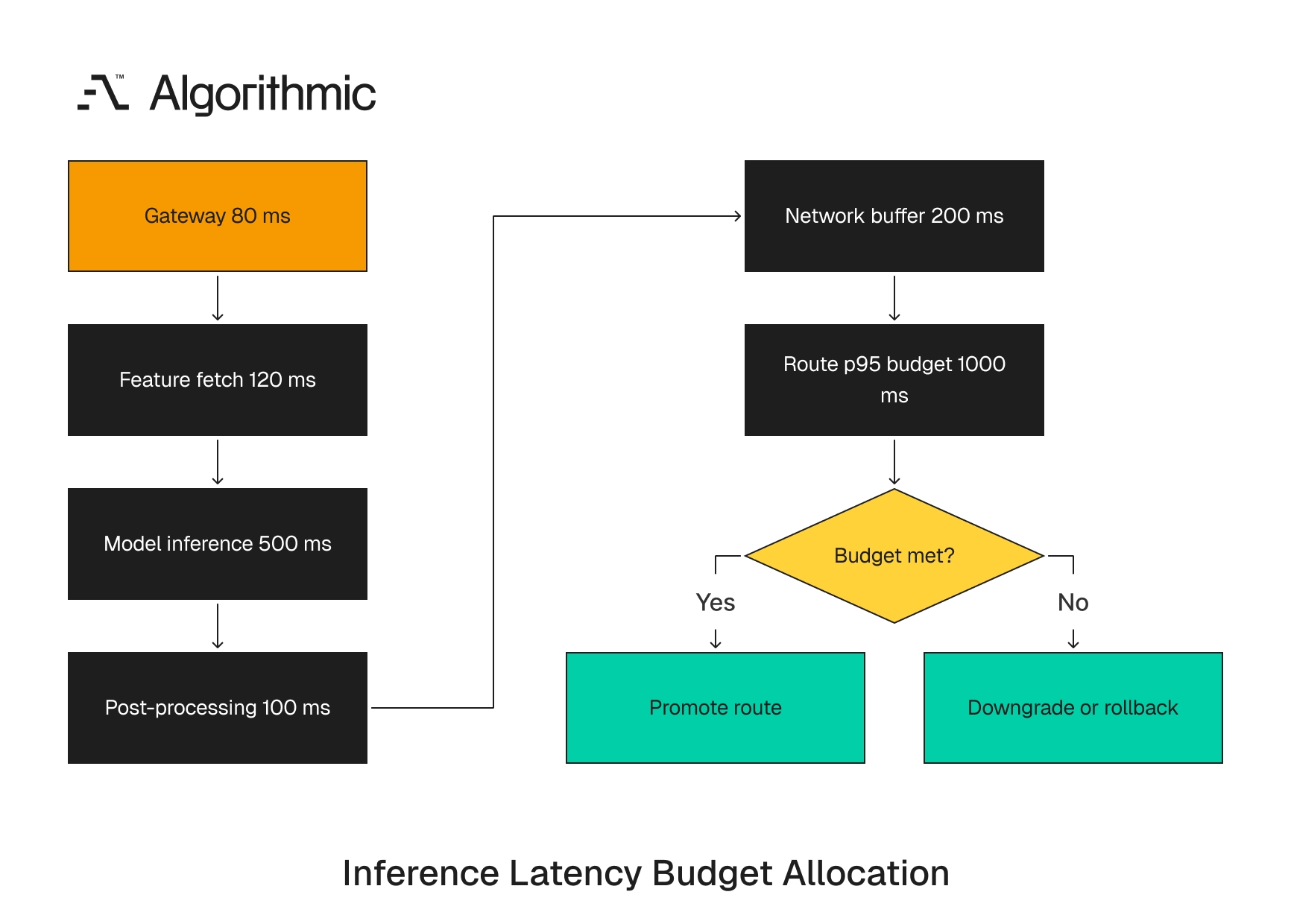
A latency target becomes useful when teams divide it across the serving path. A 1,000-millisecond p95 budget for an interactive ML feature cannot remain a single number, because a single target hides ownership. A practical allocation can reserve 80 milliseconds for authentication and request parsing, 120 milliseconds for feature fetches, 500 milliseconds for model inference, and 100 milliseconds for post-processing, with the remaining 200 milliseconds covering network overhead and queue tolerance.
 Click to expand
 Each component then has an owner and a measurement. The API platform team owns gateway time, the data platform team owns feature fetch time, the ML platform team owns model execution time and queue delay, product engineering owns post-processing and user response behavior, and SRE owns alert thresholds and escalation paths. Generative systems need a second budget for time to first token and a third for full completion, so a chat feature can target 700 milliseconds time to first token and 4 seconds for a 250-token answer, while a voice assistant needs sub-300-millisecond partial response behavior to feel responsive.
Latency also changes with input size. A classifier with fixed tensor dimensions behaves differently from an LLM endpoint receiving prompts from 200 to 12,000 tokens, so request shaping, truncation, retrieval limits, and prompt templates become runtime controls. A production team should publish maximum input sizes and enforce them at the gateway, so a 32,000-token request never enters the same route as a 600-token request unless the budget permits it. Token limits are product controls and cost controls, and inference performance depends on the runtime’s ability to manage variable computation under live constraints.
Latency budgets also need release gates. A model version that passes offline evaluation should fail promotion when it exceeds the route budget under load, a rule that prevents accuracy improvements from creating customer-facing latency regressions. The release gate should run against production-shaped traffic, since average QPS is not enough, so the test must include long prompts, cold cache paths, retries, tenant concentration, and dependency slowdown. A useful latency artifact is a route SLO ledger that records the budget, owner, current p95, current p99, error budget, and rollback trigger for each path, so executives can read it without parsing traces.
| Route | p95 budget | p99 budget | Owner | Rollback trigger | Current risk |
|---|---|---|---|---|---|
| Checkout fraud score | 150 ms | 300 ms | ML platform | p95 > 150 ms for 10 minutes | Feature store latency |
| Paid chat completion | 700 ms TTFT | 5,000 ms full | AI product | TTFT p95 > 900 ms | Long prompts |
| Support RAG answer | 1,200 ms | 3,000 ms | Search platform | fallback > 5% | Vector rerank cost |
| Image moderation | 400 ms | 900 ms | Trust engineering | queue > 100 ms | GPU warm pool |
This ledger forces tradeoffs into the open. A team can move milliseconds from retrieval to generation, and it can choose a smaller model when the path has no remaining budget. The ledger should include measurement windows, since a 10-minute violation calls for a different response than a single spike, so leaders need alert rules that match customer impact. It should also show service dependencies, because a route that depends on three external APIs carries a different risk profile than one served from local features, and that difference should influence timeout and fallback policy.
Cost ceilings must be engineered into the serving layer
A production inference system needs a cost ceiling per user action, not a cloud budget alone. The ceiling should tie to gross margin, customer tier, and expected conversion value, and finance should see the same unit economics that engineering sees. Consider a SaaS product with 2 million inference calls per month. If cost per call rises from $0.012 to $0.024 after launch, monthly inference spend increases by $24,000, and if that feature supports a $19 per month plan with thin gross margin, the model accuracy gain fails the commercial test.
Cost control comes from routing and runtime policy. Smaller models handle low-risk requests, larger models handle high-value or low-confidence cases, caches absorb repeated work, batch sizing raises GPU use, quantization reduces memory and compute, and token limits prevent unbounded generation. Hardware economics need the same rigor, since a single H100 instance can cost around $8 to $12 per hour in many cloud markets. At $10 per hour, a service running 24 hours daily costs about $7,300 per month before storage, networking, observability, engineering time, and redundancy. Two regions with warm standby can double that baseline, and a production system also needs headroom for deployments, failures, and traffic spikes, so a launch plan that prices only steady-state inference underestimates operating cost.
Unit cost should be reported by route, tenant, and model version, because average cost hides expensive outliers, and a small percentage of long prompts or high-resolution images can consume a large share of compute. Cost ceilings should become runtime rules, so a free-tier summarization route can cap responses at 300 tokens while an enterprise contract allows longer outputs, higher concurrency, and larger context windows because the pricing model supports it. The serving layer should emit a cost event for every successful response, and that event should include model version, hardware class, token count, cache status, route, tenant, and fallback state, so billing and margin analysis use the same record.
A practical cost review separates four numbers, cost per request, cost per successful response, cost per retained customer action, and cost per dollar of gross margin created. These four views prevent decisions based on a single cloud invoice line, and the distinction prevents false savings, since a cheaper route that reduces conversion can raise total acquisition cost while a more expensive second-stage model can pay for itself when it blocks high-value fraud. Cost controls also need alerting, so a route that exceeds its token budget for 30 minutes should page the runtime owner or trip a circuit breaker, because waiting for the monthly invoice turns a runtime issue into a finance surprise. Teams should test cost rules during load tests, since a test that measures latency alone misses runaway generation, repeated retrieval, and low-value retry storms, so cost must be a first-class release gate.
Runtime architecture should choose constraints before model size
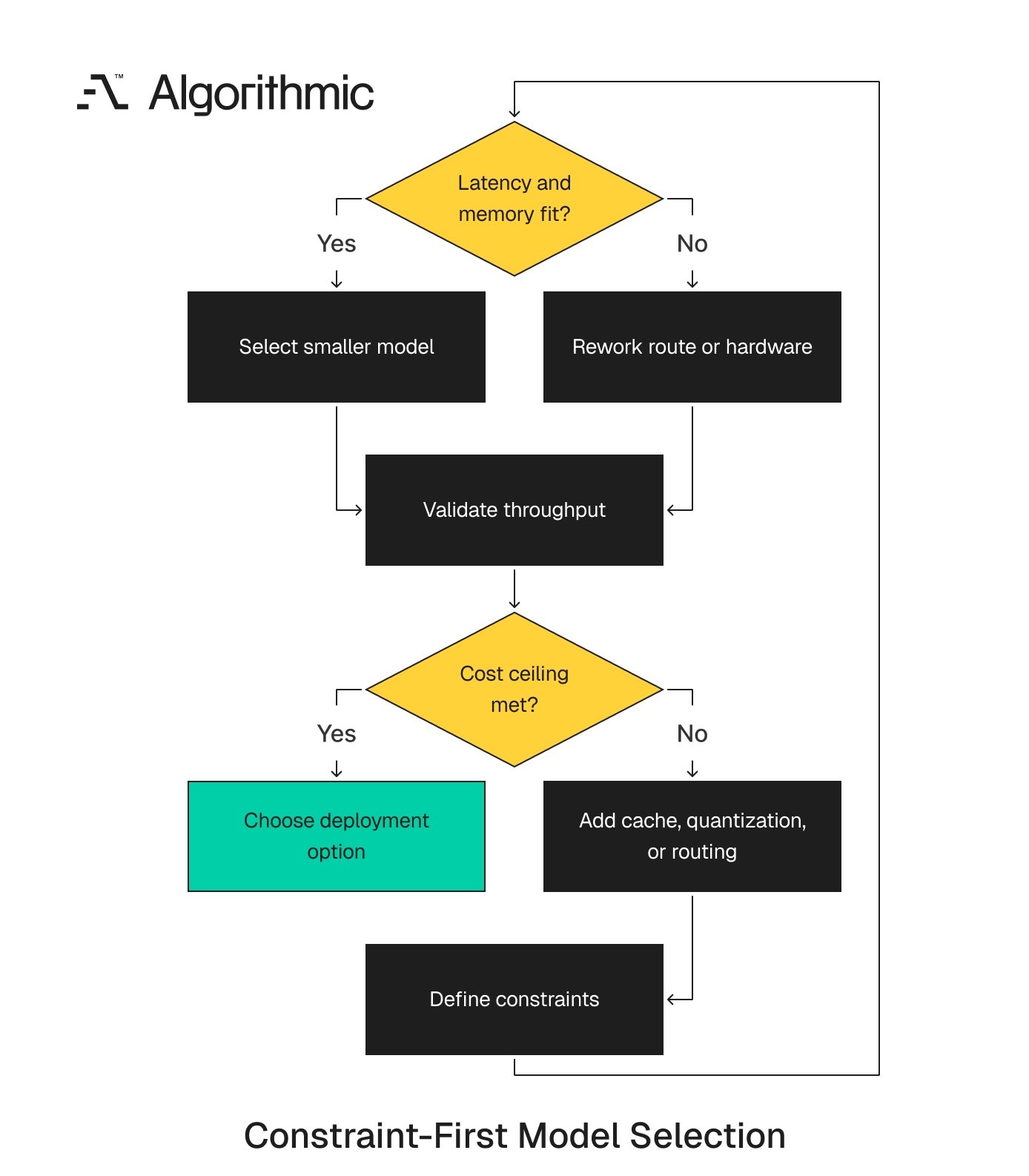
The best production choice starts with constraints, p95 latency, memory limit, throughput target, accuracy floor, data freshness, and integration surface. Model size then becomes an output of the architecture process, and this sequence produces more reliable launch decisions.
 Click to expand
 A team building real-time search ranking can choose a two-stage design, where a fast retrieval model returns 500 candidates and a heavier ranker scores the top 50. A team building image moderation can use a small on-device model for first-pass screening and move uncertain cases to a larger cloud model, so the cloud path then carries smaller volume and a clearer business case. A team building agentic workflow support can impose a maximum tool-call count, route high-risk actions through human review, and let low-risk actions complete automatically inside a defined time and cost budget.
The same reasoning applies to edge deployment. Runtimes such as ExecuTorch address local inference across mobile and embedded devices, where on-device execution reduces latency and network exposure while memory, battery, and hardware variation become primary design constraints. Uber’s traffic forecasting work gives a concrete example at scale, since its real-time forecasting system serves about 2 million segment-level predictions per second, reports a 6% improvement in long-trip arrival time accuracy, and drives an estimated $100 million in incremental annual revenue. The architecture used pre-aggregated spatiotemporal views and a fixed-size compute graph to keep inference predictable, with Apache Spark handling historical aggregates and Apache Flink updating features every few minutes.
The lesson for production machine learning engineering is specific. Predictable inference requires feature engineering, serving contracts, and model architecture to work together, so a model that cannot meet a fixed-time contract under load is unsuitable for a real-time product path. This constraint-led approach also improves procurement decisions, because teams can compare H100, L40S, A10G, Inferentia, and CPU inference options against the same latency and cost contract, which ties the deployment decision to customer behavior instead of hardware preference.
The architecture review should force one uncomfortable decision early. The team should define the largest model it can afford under the product contract, a boundary that prevents model selection from drifting toward accuracy gains the serving path cannot support. This also changes vendor evaluation, so a managed endpoint, self-hosted Kubernetes cluster, and dedicated GPU pool should be compared through the same route contract, including cold-start behavior, regional availability, cost attribution, audit logs, and rollback mechanics.
Constraint selection should include data movement, since a model that requires five feature reads across regions will struggle against a 150-millisecond target, so moving features closer to inference can beat replacing the model. It should also include model packaging, because container size, model load time, tokenizer cost, and runtime dependencies affect deploy safety, and these details belong in architecture review, not launch-week triage. The same constraint review applies to tool-using AI systems, since a route with a 4-second budget cannot allow ten sequential tool calls with 500-millisecond timeouts, so tool budgets should sit beside token budgets in the serving contract.
A runtime readiness matrix for ML deployment
Engineering leaders need a practical artifact before approving launch. The following matrix gives a concise review structure for real-time ML inference systems, and it turns launch readiness into observable conditions.
| Runtime dimension | Launch target | Failure signal | Engineering control |
|---|---|---|---|
| p95 latency | Defined per route, for example 800 ms | p95 misses target for 3 consecutive 5-minute windows | Route downgrade, queue cap, smaller model |
| p99 latency | Defined for paid and unpaid traffic | Tail latency exceeds p95 by more than 4x | Priority queues, warm pools, cache prefill |
| Throughput | Peak load plus 40% headroom | GPU queue depth grows during normal traffic | Continuous batching, scale-out policy, request shaping |
| Cost per call | Ceiling by product tier | Unit cost rises more than 15% week over week | Cost-aware routing, token limits, quantization |
| Cache performance | Hit-rate target by cache type | Repeated requests miss cache | Key design review, TTL tuning, prefix caching |
| Fallback behavior | Documented per failure class | Errors expose raw failures to users | Smaller model, cached result, asynchronous path |
| Observability | Metrics by tenant, model, route | Incident review lacks timing breakdown | Trace IDs, model spans, cost tags |
| Security and policy | Auth, rate limits, data controls | Prompt or token layer bypasses policy | Gateway checks, tenant isolation, audit logs |
This matrix should be reviewed before the model is promoted from staging to production, and it should also support technical due diligence for AI product work, since studio selection and internal platform approval use the same review structure. The matrix works best when teams attach evidence to each row, so a latency row links to a load-test report and a cost row links to per-route unit economics and projected traffic. Security and policy deserve the same treatment as latency, because prompt injection, tenant isolation, data retention, and audit logging create production risk, so these controls should be tested through red-team prompts, permission checks, and trace review before launch.
A stronger review adds a runtime bill of materials. This artifact lists every service in the inference path, its owner, its timeout, its retry policy, and its failure mode, and it records whether the service sits in the critical path for paid traffic.
| Runtime component | Owner | Timeout | Retry rule | Failure mode | Paid-path status |
|---|---|---|---|---|---|
| API gateway | Platform | 80 ms | No retry on 4xx | Reject with typed error | Critical path |
| Feature store | Data platform | 120 ms | One retry under 40 ms | Use stale feature set | Critical path |
| Vector database | Search platform | 250 ms | No retry during queue pressure | Use cached retrieval result | Critical path |
| Model server | ML platform | 500 ms | No internal retry | Downgrade route | Critical path |
| Billing event sink | Finance systems | 100 ms | Async retry | Queue cost event | Outside response path |
This bill of materials finds gaps that architecture diagrams miss, since a service with no timeout can consume the whole latency budget and a retry rule with no deadline can turn one failed dependency into a p99 incident. The matrix and bill of materials should live with the release record and update when a model version, route policy, cache key, or dependency changes, because stale launch artifacts create false confidence. The release record should also include test dates, since a load test from six months ago has limited value after three model versions and two schema changes, so evidence should match the version entering production.
The readiness matrix should identify unresolved risks by owner, because a risk with no owner remains a launch blocker, and an accepted risk should include the business approver and the planned mitigation date. For regulated workflows, the matrix should include audit controls, so teams prove who saw which data, which model produced which output, and which policy version applied, records that support incident review, customer assurance, and external audit requests.
The engineering work starts 30 to 60 days before launch
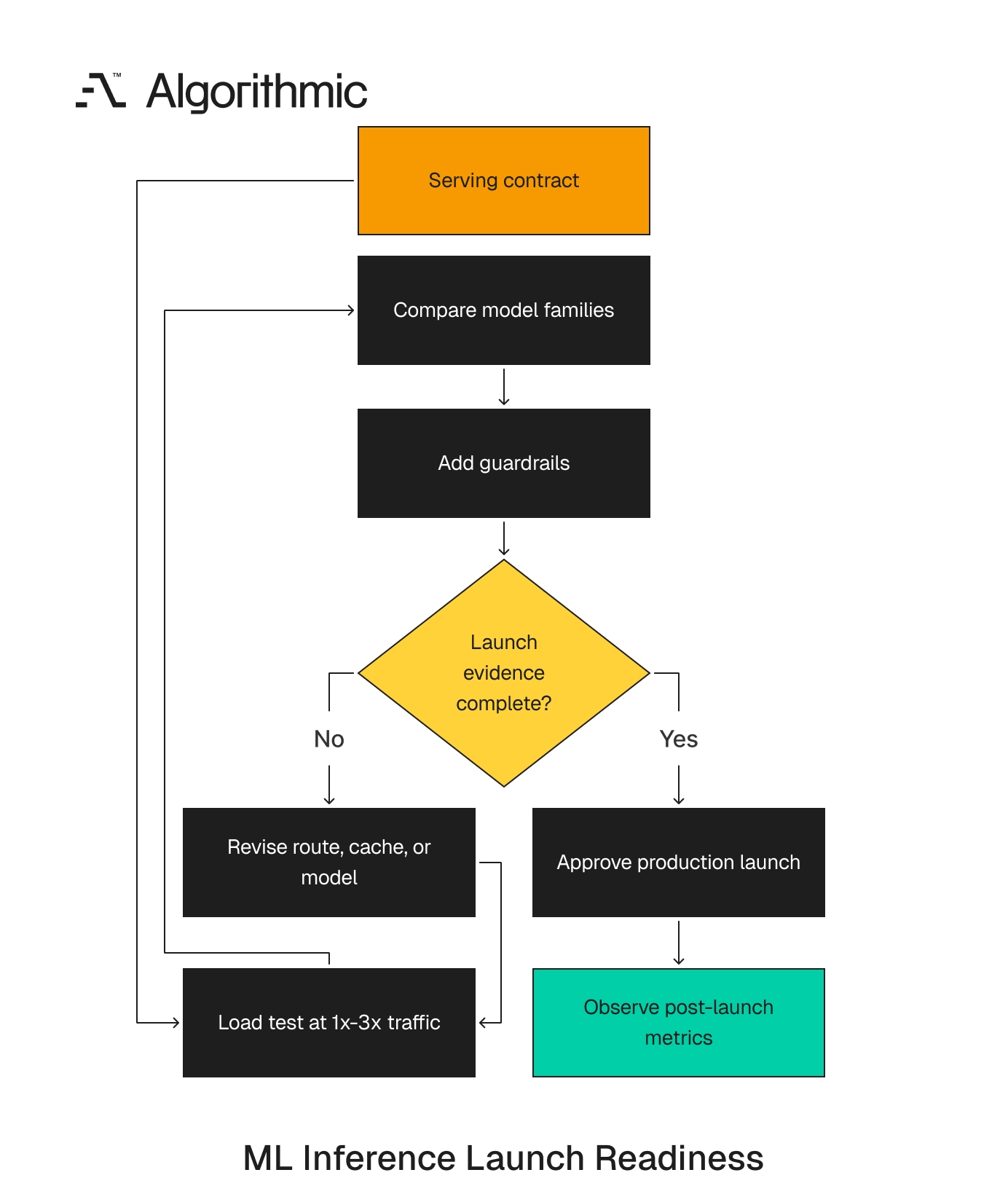
Runtime architecture cannot be added safely during a launch incident. Teams need time to load test, tune routing policy, compare model variants, and instrument cost, so the work should begin 30 to 60 days before customer traffic arrives. A practical pre-launch plan has four phases, and each phase produces a concrete artifact that leaders can review, so those artifacts become the operating record for launch approval.
 Click to expand
 The schedule should reflect the complexity of the serving path. A single classifier with local features may need 30 days, while a multi-region RAG system with paid tiers, audit controls, and tool calls should receive the full 60 days.
Phase 1 defines serving contracts
Write one serving contract per use case that includes maximum input size, required output format, p95 and p99 latency targets, fallback behavior, data retention rules, and cost ceiling, plus security requirements when the model handles regulated data or customer content. This contract should be owned by engineering and product together, where product defines the user-visible tolerance and engineering maps that tolerance to runtime budgets. A serving contract should also name excluded behavior, so the contract can reject prompts over 8,000 tokens, images over 5 MB, or tenants above a set concurrency limit, since explicit exclusions prevent ambiguous launch debates.
The contract should include a promotion rule, so a model version cannot advance when it violates latency, cost, safety, or schema requirements, and the rule should be enforced in CI/CD, not decided during a release meeting. The contract should define response semantics, because a fraud score, a moderation decision, and a generated answer carry different obligations, so each output should include schema, confidence fields, and error classes. It should also define data boundaries, so if a request can include customer content, the contract specifies retention, logging, redaction, and access rules, and these rules should live outside model code.
Phase 2 builds a production-like load test
Synthetic load tests should match request distribution, not peak QPS alone, so use real prompt length histograms, real image sizes, real feature lookup patterns, and tenant mix, and include failed requests, retries, and cache misses. Run tests at 1x, 2x, and 3x expected launch traffic, measure queue time separately from model time, and record cost per successful response. A useful load test also includes dependency degradation, so slow the vector database, expire the feature cache, and simulate a regional GPU shortage, since these tests verify whether fallback policy works under pressure.
The test should preserve raw request traces for review, because aggregates hide the long-tail paths that create incidents, and a sample of the 100 slowest requests usually finds the engineering work that matters. The load test should include deployment events, so roll a new model version during traffic and measure cold starts, memory pressure, route errors, and rollback time. It should also include tenant concentration, since ten large tenants can behave differently from 10,000 small tenants at the same QPS, so per-tenant queues and budgets should be tested under concentrated load.
Phase 3 compares model families under constraints
Evaluate smaller, quantized, distilled, and pruned models against the serving contract, include cache hit rates and fallback paths in the test, and measure accuracy, latency, throughput, memory use, and cost in the same run. For many product paths, a smaller model with predictable latency beats a larger model with higher offline accuracy and unstable p99 behavior. This is a product economics decision and an ML decision, since the winning model is the one that meets the user promise within the cost ceiling. Teams should also test release mechanics during this phase, because canary deployment, shadow traffic, and automatic rollback reduce risk when a new model version reaches production, and these controls need rehearsal before launch week.
The comparison should include calibration and confidence bands, since routing depends on knowing which cases deserve the expensive path, so a poorly calibrated model can send too much traffic to second-stage inference. It should include explainability needs where they affect product acceptance, because a regulated decisioning path may require reason codes, audit fields, or review queues, requirements that can eliminate otherwise attractive model choices. Teams should record the rejected options, so future teams know why a 13B model, INT8 quantization, or CPU route failed the contract, a record that prevents repeated experiments and procurement churn.
Phase 4 adds production guardrails
Set rate limits, per-tenant budgets, model version controls, and circuit breakers, define rollback steps for model releases and runtime configuration changes, and store runtime configuration in version control with review requirements. Incident response runbooks should include commands, dashboards, owners, and escalation paths, because a vague page that says check GPU usage will not help during a p99 latency event, so the runbook should name the dashboard, query, threshold, and rollback command. Guardrails should cover financial exposure, so a tenant-level daily spend cap can stop runaway usage and a route-level token cap can prevent one prompt pattern from consuming the monthly inference budget.
Guardrails should also cover policy exposure, since a route that handles customer content should enforce tenant isolation, prompt controls, retention rules, and audit logging at the gateway, and model code should never be the first policy boundary. The guardrail plan should include change management, because runtime configuration can alter latency, cost, and safety faster than model code, so changes to batch size, route policy, and token limits should require peer review. Guardrails should include kill switches by route, so a team can disable one problematic route without shutting down the entire inference platform, which reduces blast radius during incidents and security investigations.
What VPs of engineering should fund
Real-time ML inference systems need senior software engineers, ML engineers, and infrastructure engineers working as one team, so the funding model should reflect that, since model work and runtime work are part of the same launch. Budget for runtime engineering alongside model development, and for a production launch, allocate engineering time to serving infrastructure, CI/CD pipeline design, infrastructure as code, observability, monitoring, load testing, performance tuning, and security review. Treat these items as launch scope.
A serious ML model deployment plan should name the serving engine, GPU strategy, cache design, routing policy, cost model, telemetry schema, and rollback method, and it should define who owns each path after release, covering business hours, on-call response, and post-incident review. The team should also fund developer experience for model releases, since engineers need repeatable packaging, environment promotion, model registry controls, and configuration review, because without those foundations, production releases become manual operations with inconsistent results. Procurement needs the same discipline, since reserved GPU capacity, spot-market capacity, managed inference endpoints, and self-hosted Kubernetes clusters each create different cost and reliability profiles, so the right mix should follow the latency budget, traffic pattern, data policy, and support model.
VPs should also fund one role that many teams omit, a runtime owner who owns the serving contract, release gates, cost ledger, and incident runbooks. The role can sit in ML platform, product engineering, or infrastructure, but it needs explicit authority. The runtime owner should chair the launch review, where model owners present quality results and platform owners present latency, reliability, and cost evidence. This division prevents a familiar failure mode, where model teams celebrate offline gains, product teams assume the serving path will absorb them, and infrastructure teams then receive the incident after customers feel the regression. The organization pays through emergency work, margin leakage, and customer trust damage, so a funded runtime owner prevents that handoff. Our production readiness review walks through how to prove a system fails, recovers, and rolls back before real traffic does.
VPs should fund observability before feature expansion, because a team should never add a second model route before it can explain the first route’s latency and cost, since model count without runtime visibility creates operational debt. They should also fund test environments with realistic hardware, since a staging system on CPUs cannot predict H100 batching behavior and a one-GPU test cluster cannot validate multi-tenant scheduling policy. Training budgets should include incident practice, so teams rehearse vector database slowdown, cache invalidation failure, regional GPU loss, and runaway token generation, because rehearsal builds production muscle before revenue traffic depends on the system.
The launch standard
Across 35+ complex engagements, Algorithmic has seen the same pattern in production systems serving millions of users. Teams that design the runtime early make calmer model choices, ship smaller models, measure business value faster, and expand traffic with fewer incidents. The launch standard should be explicit. No production traffic without a serving contract, no launch approval without route-level p95, p99, fallback, and cost evidence, no model promotion without a load test that matches production-shaped traffic, no runtime configuration change without version control and rollback steps, and no paid route without owner-approved fallback behavior.
Run a runtime architecture review before approving the next ML launch. Use the readiness matrix, attach the runtime bill of materials, and test at 3x expected traffic, requiring latency, fallback behavior, policy controls, and cost per call to pass before customer traffic arrives. A model is ready for production when the serving system proves its behavior under load, and that proof comes from traces, load tests, cost records, and rehearsed failure paths. Everything else is a checkpoint waiting for an incident.
Algorithmic builds backend and inference infrastructure that turns a model checkpoint into a serving path with named owners, route budgets, and rehearsed fallbacks. Start a conversation if you are planning a real-time ML launch and want the runtime proven before customer traffic arrives.