

At 11:07 a.m. on a Tuesday, a senior engineer stops work on a billing migration to join a production incident call about duplicate invoices. The incident lasts 38 minutes, and the recovery takes longer. She returns to the migration with three browser tabs closed, a half-written SQL backfill open, and an unresolved Slack thread asking whether enterprise customers need a separate invoice sequence.
Before she writes another safe line of code, she reloads the migration order, failure cases, rollback path, and accounting rules. She checks the last database constraint she touched, then rereads the Stripe webhook handling path and the invoice retry logic. That hour rarely appears in a project estimate, yet across a six-month build those hours decide whether the release ships on time.
A 20% planning miss on a six-month build creates about five lost delivery weeks. For a startup spending $180,000 per month, that miss consumes $225,000 of runway, and that figure excludes delayed revenue, investor pressure, emergency staffing, late scope reductions, and the cost of leadership attention during the final month of recovery. The McKinsey and Oxford study of more than 5,400 IT projects found large projects run 45% over budget and deliver 56% less value than predicted, which is what an incomplete estimate produces at scale.
Software estimates fail because they price implementation tasks while the delivery calendar absorbs code review, QA, coordination, incident response, vendor dependencies, onboarding, and security review. It also absorbs the cost of keeping complex systems in working memory, a cost that is large in billing systems, permission models, data pipelines, and Machine Learning systems in production. Those costs are predictable, so they belong in the estimate before budget approval, board reporting, or customer commitment. Treating them as incidental work creates false precision and avoidable overruns, and it shifts a planning error into the engineering team’s weekly execution burden. Rigorous feasibility studies surface these costs before a number becomes a commitment.
Build effort is one part of delivery effort
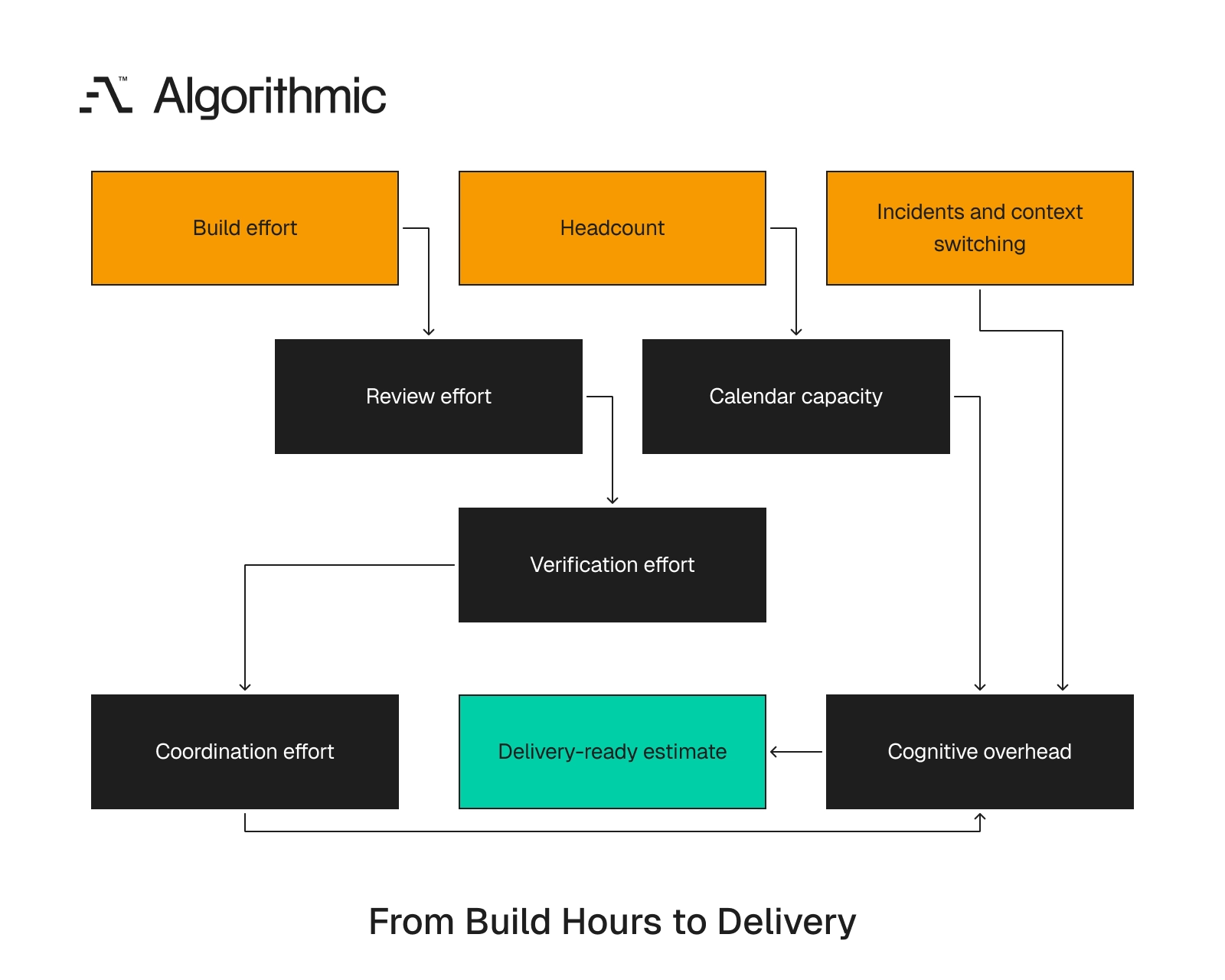
A credible estimate separates authoring work from verification work. Authoring work includes writing code, configuring infrastructure, adding tests, and connecting APIs. Verification work includes pull request review, regression testing, load testing, security review, product acceptance, deployment validation, and post-release monitoring, and these activities draw from different people and calendars.
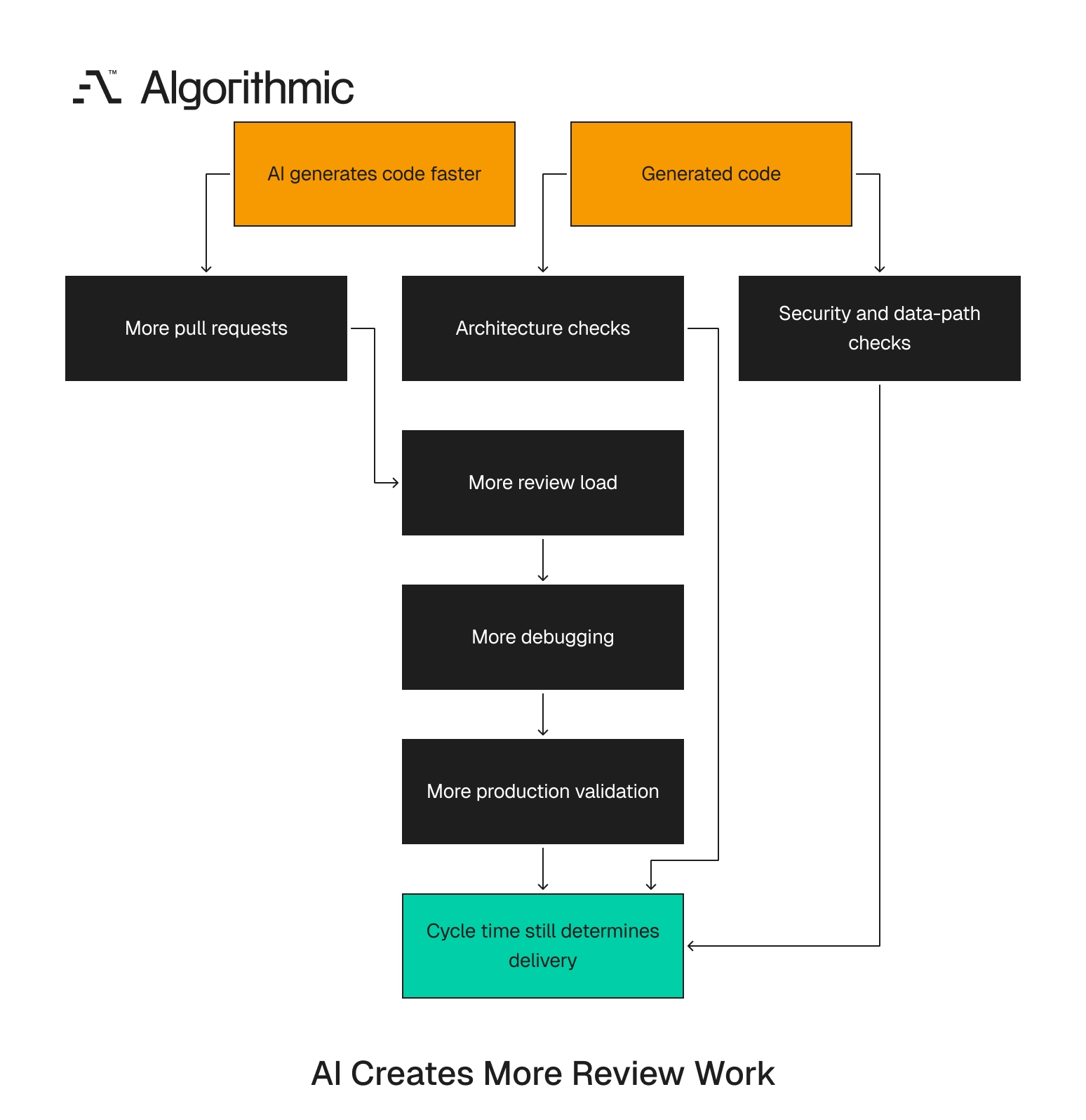
The distinction matters because modern tools changed the shape of software work. AI-assisted coding reduces typing time on defined tasks, but it increases the volume of code that needs review, debugging, and production validation, so a team can create more pull requests while shipping fewer accepted releases. Code generation increases throughput at one stage of the system, then review and validation carry more load, and the constraint moves to senior judgment, test depth, and production confidence.
The correct unit of measurement is cycle time from approved requirement to safe production. Commit count is an activity metric, while production acceptance is the delivery metric. A feature that sits in review for four days has consumed calendar time, even if authoring took two hours.
 Click to expand
 An estimate that stops at implementation hours gives leadership a partial cost picture. It tells finance what code creation costs, but it does not tell the business what a production release costs. That gap becomes visible when launch readiness depends on test cycles, stakeholder signoff, and rollback rehearsals.
Review load belongs in the estimate
Review cost should appear as a named line item. A senior engineer reviewing a payment workflow, tenant isolation rule, or model inference path performs production risk control, and that work consumes focused time from the most expensive people on the team while interrupting the work those people already carry.
Two metrics expose the cost, reviewer-hours per feature and defects found after merge. A team shipping 12 features per month with three reviewer-hours per feature spends 36 senior engineering hours on review, which at a fully loaded cost of $140 per hour is $5,040 per month. If review queues delay merge by two working days per feature, the calendar cost exceeds the payroll cost and the delivery date moves before the budget report shows a problem.
The review line should separate code review from architecture review. Code review checks correctness, maintainability, naming, tests, and local behavior. Architecture review checks service boundaries, data ownership, failure modes, authentication paths, and future migration cost, and it checks whether the change makes later work easier or more expensive. This distinction changes the staffing plan, because a staff engineer can review a React component and a database ownership change in the same week while the two reviews draw from different mental budgets. The database ownership review requires a full system map and a higher level of production risk judgment.
A production estimate should name who reviews each risk class. Payment flows need senior backend review and product acceptance, authentication and authorization changes need security review and failure-mode testing, and data deletion flows need privacy review, audit trail review, and backup recovery checks. The plan should also define review service levels, since a two-day review target means one staffing model and a same-day target means another, especially with senior engineers on production support. Same-day review requires protected reviewer capacity, not a hopeful calendar entry.
Review also needs batching discipline, since ten small pull requests can cost more review time than three well-structured changes. The estimate should account for the team’s review pattern, because a team using trunk-based development, feature flags, and short-lived branches has a different review profile than a team with weekly merge windows.
Verification cost rises with risk
A marketing landing page and a role-based access control change carry different verification loads, so an estimate that labels both as frontend work lacks delivery discipline. The same applies to billing logic, data deletion flows, audit trails, and permissions, where similar ticket labels can hide different production risk.
Production-ready software needs verification matched to risk, which includes unit tests, integration tests, migration tests, rollback paths, observability checks, and incident response runbooks. Each item requires time, ownership, and acceptance criteria, and each item also needs a decision about depth. For AI systems, verification adds model evaluation, drift monitoring, prompt regression tests, data quality checks, and human review loops. The Frontiers paper on LLM-aware software effort estimation explains why code-size models miss AI delivery costs, since the code is one artifact inside a production system that also includes data behavior, model behavior, monitoring, and escalation.
A chatbot release illustrates the point. The team must test retrieval quality, prompt injection resistance, latency under load, hallucination rates, fallback behavior, and escalation paths. None of that work appears in a function-point count or a story labeled build chat feature, so the estimate must state who accepts the answer quality and who owns failures after release. A billing release gives the same lesson in a more familiar form, where the team must test coupons, upgrades, downgrades, failed cards, invoice retries, tax handling, and webhook replay. Stripe integration code is only the visible surface, since the production system includes customer emails, account states, revenue recognition, and support workflows.
Verification also has sequencing cost. A load test cannot run before deployment automation works, a rollback rehearsal cannot run before migrations have a safe down path, and a security review cannot finish before authentication paths and data flows are documented. The estimate must reflect that order, because parallelizing every verification task on a spreadsheet creates a plan that looks efficient and fails in execution. Production readiness has dependencies that tickets do not show, and those dependencies turn into waiting time, rework, and release slippage.
Good verification planning also separates pre-merge checks from release readiness checks. Unit tests and integration tests protect code correctness before merge, while release readiness checks confirm that the system can operate under production conditions, including monitoring thresholds, alert routing, support runbooks, and customer communication paths. This is the same discipline covered in production readiness reviews, which prove how a system fails and recovers before real traffic does.
Cognitive overhead turns full-time staffing into partial delivery capacity
Project plans often assume that five engineers assigned to a project produce five engineers of focused delivery capacity, and that assumption fails when those engineers carry other duties. Those duties include production support, hiring interviews, planning meetings, stakeholder reviews, security questions, and cross-team dependencies, so staffing count and delivery capacity are different numbers.
Context switching has measurable delivery cost. The research on the cost of interrupted work from UC Irvine found that a single interruption forces workers to compensate with more speed and stress, and studies of programmers show a similar tax. The analysis of resumption after interrupted programming tasks across 10,000 recorded sessions found that developers rarely resume in under a minute and spend real time rebuilding mental state first. This matters most in backend architecture, data pipeline engineering, distributed systems, and Machine Learning systems in production, since these domains require stateful reasoning across many constraints.
A senior engineer working on a complex migration needs about 45 minutes to regain full context after an unrelated production incident, so four such interruptions per week remove three hours of deep work. Across six engineers, that is 18 hours per week, or about 10% of the team’s nominal capacity, and over 24 weeks that equals 432 hours before other overhead categories appear. That capacity loss compounds when the interrupted work involves stateful reasoning, such as database migration sequencing, access control redesign, event-driven workflow changes, and model deployment pipelines. The engineer must reload assumptions, constraints, edge cases, and prior decisions before writing safe code, and the reload time is work even when no ticket changes status.
A migration from PostgreSQL row-level permissions to application-managed authorization gives a concrete example. The engineer must remember which paths read directly from the database, which services cache permissions, and which jobs run outside request context, so a single interruption breaks the chain of reasoning. The same pattern appears in Data Engineering, where a warehouse schema change can affect dbt models, Looker dashboards, reverse ETL jobs, and customer exports. The work requires an accurate map of downstream users, not a single code change with a single test.
Cognitive overhead also appears during onboarding. A new engineer can close tickets in the first month, but a production system with custom deployment paths, undocumented data contracts, and legacy permissions requires longer ramp time. Senior engineers pay that onboarding cost through pairing, review, and explanation.
Sustained disruption needs an explicit overhead line
During organizational disruption, budget cognitive overhead as a separate delivery cost. This applies during fundraising, customer escalations, platform migrations, layoffs, executive changes, security incidents, or parallel product launches. These conditions reduce usable engineering capacity even when headcount remains stable, since the calendar shows assignment while the week contains fragmented attention.
A six-month project estimated at 4,000 engineering hours needs an added 800 to 1,200 hours in that environment, which at $140 per loaded hour is $112,000 to $168,000 of real cost. Finance should see that cost before approving the plan, because the amount is large enough to change runway, staffing, and scope decisions. Omitting that line moves the cost into schedule slippage, late scope cuts, deferred testing, and weekend recovery work, and those outcomes damage morale and release quality. They also create board-level reporting problems when milestones move without a clear explanation, so a preventable planning gap becomes an executive credibility problem.
A common example is a platform migration that runs beside a customer escalation. Engineers attend urgent account calls, explain incidents, patch production, and then return to migration work, so the calendar shows full assignment to the migration while the actual week contains fragmented delivery time. Another example appears during fundraising, when the CTO joins investor calls, prepares diligence materials, reviews security questionnaires, and produces architecture diagrams. The project plan still lists the CTO as a daily reviewer, which creates a false review capacity assumption.
The same problem appears during hiring pushes, when senior engineers conduct interviews, write scorecards, debrief candidates, and support onboarding. A plan that treats those engineers as fully assigned to delivery will miss, and the miss will show up as delayed review, thinner testing, or scope compression. Security incidents create the sharpest version of this problem, since a single incident can consume the same senior engineers needed for architecture review, release approval, and production validation. The estimate should state how the team will respond if an incident consumes more than a set threshold, for example a forecast review triggered after 40 unplanned incident hours.
Coordination cost grows with team size and dependency count
Coordination overhead grows with the number of people, systems, and approval paths involved. A two-person prototype can move through direct conversation, while a production SaaS effort with product, design, backend, frontend, data, security, legal, and customer success needs explicit coordination time. The work spans more than implementation and more than meetings, since teams write decision records, resolve conflicting requirements, clarify acceptance criteria, sequence migrations, handle release windows, and align stakeholder expectations. These tasks prevent rework, customer disruption, and production incidents, and they protect the project from late reversals.
A team with eight engineers and four non-engineering stakeholders can spend 15% to 20% of weekly capacity on coordination, so if the plan assumes full build capacity the estimate is inaccurate before the first ticket starts. The error grows when work spans multiple repositories, data stores, or external vendors, because every additional boundary creates more communication and waiting time. Production systems require human judgment around integration, review, governance, and risk, and that judgment is work that belongs in the plan and in the budget, since senior practitioners carry much of it.
Coordination cost also changes by organization size. A 12-person startup can approve a schema change in one conversation, while a 600-person company often needs security review, data governance approval, release management, customer communication, and audit documentation, so the same schema change moves through more gates. The project manager’s calendar does not contain all coordination cost, because engineers spend time resolving ambiguous requirements, reading design updates, and translating product goals into safe implementation choices. That time belongs in engineering capacity math, and it should appear as coordination load, not unexplained delivery variance.
A release with Salesforce, Stripe, Snowflake, and an external identity provider adds vendor coordination, since each vendor has response times, API limits, outage patterns, and environment constraints. Those dependencies create waiting time that a build-only estimate misses, and a single sandbox limitation can block end-to-end testing for a week. External approvals add another layer, where legal review for customer-facing terms can delay billing flows, security review for a new identity provider can delay authentication work, and finance review for invoice formatting can delay launch communication.
The cognitive overhead estimate model
Engineering leaders need a repeatable way to price omitted work. The model below turns delivery overhead into named categories that finance leaders can review, and it gives engineering teams a defensible basis for timeline discussions by separating work that often gets blended into a single implementation number.
| Estimate component | What it includes | Typical range | Measurement method |
|---|---|---|---|
| Build effort | Implementation, tests, infrastructure changes | 45-60% | Bottom-up task estimate |
| Review effort | Pull requests, architecture review, security review | 10-20% | Reviewer-hours per feature |
| Verification effort | QA, regression, load tests, deployment checks | 10-20% | Test cycle time and defect rate |
| Coordination effort | Planning, dependency management, stakeholder review | 10-20% | Meeting hours and blocked time |
| Cognitive overhead | Context switching, incidents, onboarding, disruption | 20-30% during disruption | Capacity adjustment against calendar time |
These ranges should be calibrated against delivery history. A team with mature CI/CD, stable environments, and clean database ownership will sit near the lower end, while a team working through inherited code or technical debt rescue will sit near the upper end, as will a team rebuilding release automation.
The data points vary by source, and the operating conclusion is consistent, estimates that omit verification, coordination, and organizational load are incomplete. Leaders should treat those omissions as planning defects and correct them before turning a forecast into a commitment. The model works best when teams review completed projects every month and compare estimated hours with actual hours by category. After three to five projects, the organization has its own delivery multipliers, and those multipliers carry more weight than generic benchmarks.
The monthly review should include finance. Engineering can explain where the hours went, and finance can connect those hours to runway, forecast updates, and board reporting, so the shared review reduces surprises at the executive level. A practical starting point is a one-page variance report that lists planned hours, actual hours, variance, and the reason for variance by category. Keep the report short enough for a 30-minute review, since the goal is better forecasting, not a reporting ritual.
A worked example of a six-month product build
Consider a full product build for a B2B SaaS platform. The team includes four engineers, one product lead, one designer, and a fractional technical architect, and the initial bottom-up build estimate is 3,600 engineering hours across six months covering implementation work only. That first estimate includes backend services, frontend workflows, authentication, billing, admin tools, analytics events, and deployment automation, and it excludes explicit review, verification, coordination, and disruption costs. That exclusion makes the number easier to approve and harder to deliver, and it pushes hidden cost into the final third of the schedule.
The product has standard SaaS risk areas. Authentication must support password reset, session management, invite flows, and audit trails, and billing must handle trials, upgrades, failed payments, refunds, and invoice reconciliation, where each scenario needs acceptance tests and customer support visibility. Admin tools add their own risk, since support teams need permission boundaries, impersonation controls, audit logs, and safe defaults, and a mistaken admin action can become a customer-facing incident that the estimate should price the controls to prevent.
Analytics also carries production risk. A missing event can break activation reporting and a wrong event can mislead the board during the first quarterly business review after launch, so event design and validation need time in the plan. Deployment automation adds another risk category, because a release script that works in staging can fail against production credentials, database size, or network policy. The team needs time for rehearsal, rollback, alert checks, and post-release monitoring, and those hours should appear before launch week.
Version 1 is the build-only estimate
The build-only model looks precise:
- 3,600 engineering hours.
- 24 calendar weeks.
- $140 loaded cost per engineering hour.
- $504,000 engineering cost.
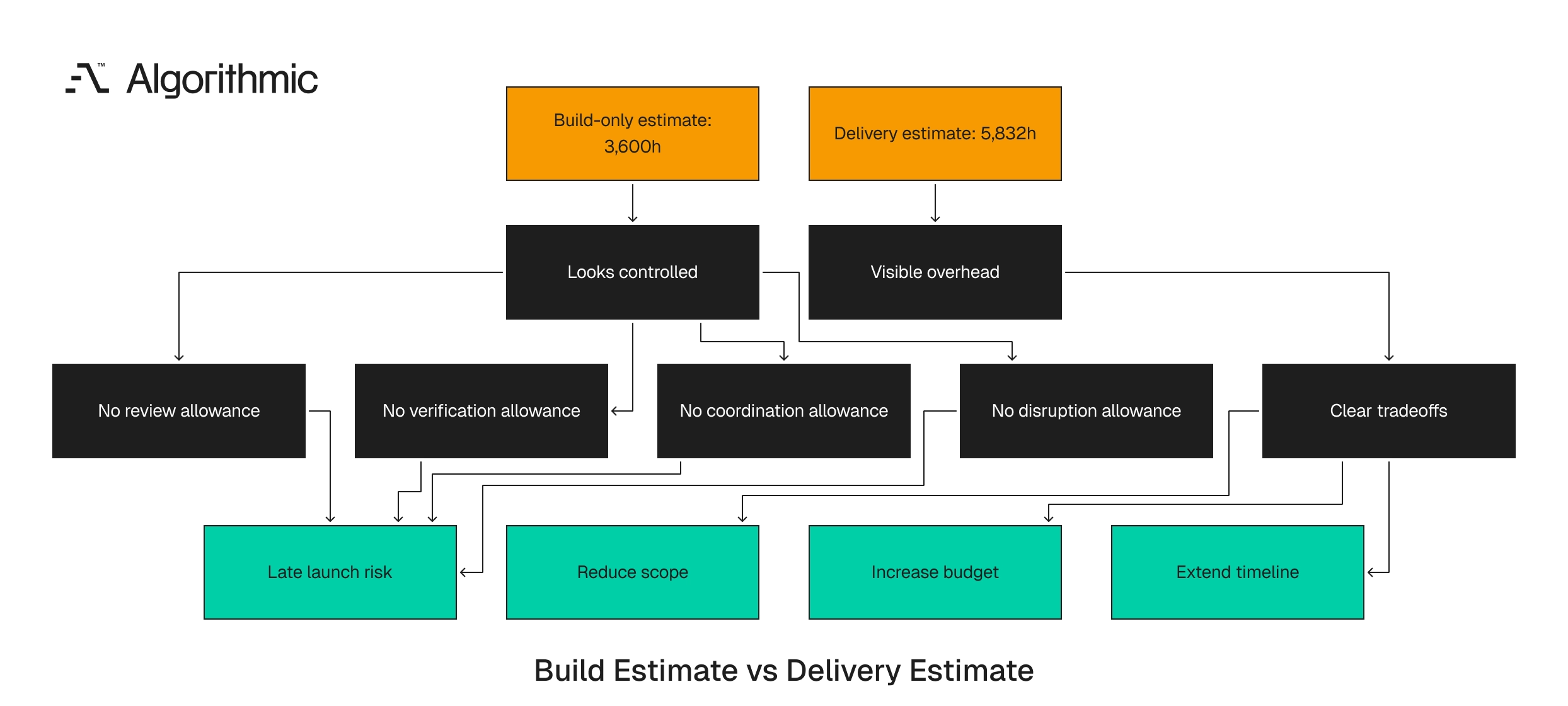
This estimate is easy to approve because it looks controlled, yet it assumes uninterrupted execution by a fully context-loaded team and treats production readiness as a byproduct of implementation. That assumption creates a delivery risk the spreadsheet hides. The plan has no named allowance for senior review, no separate test cycle budget, and no time for vendor delays, security questions, onboarding, or release rehearsals, and the missing categories will still consume time.
The plan also hides acceptance work from product and customer-facing teams, since someone must validate account setup, billing emails, cancellation flows, and admin permissions. If those hours are not named, they arrive as launch-week pressure, and customer-facing teams then absorb late defects and incomplete documentation. This version gives the board a single number and gives the delivery team an unrealistic contract, and the mismatch becomes visible after the project has consumed most of its runway, when leadership has fewer choices and less time.
A build-only estimate also distorts performance reviews, because engineering leaders appear to miss dates after the organization approved a plan that excluded real work. That pattern damages trust and makes the next estimate more political and less accurate.
Version 2 is the delivery estimate with visible overhead
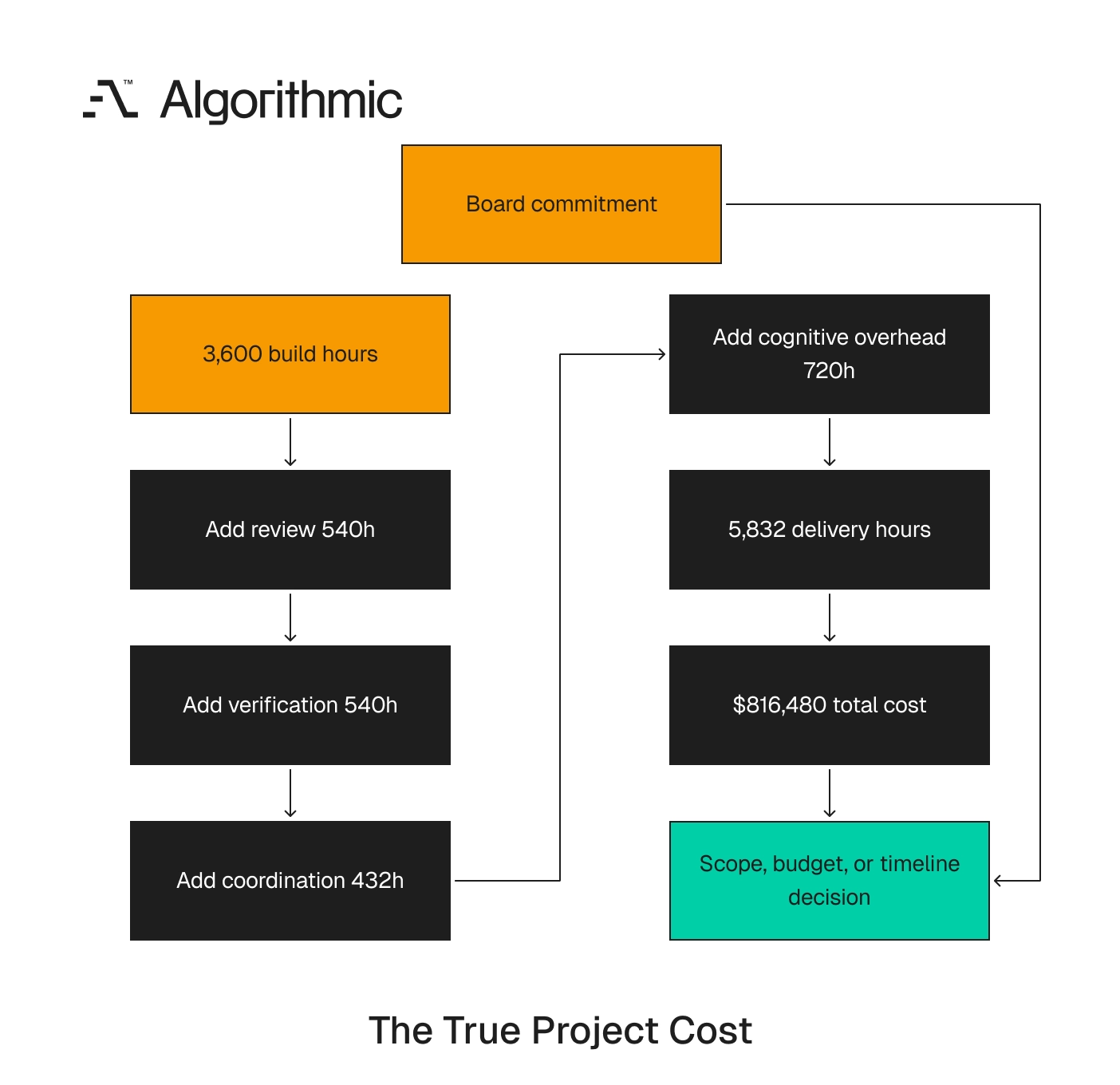
A production-ready estimate adds the omitted categories:
- Review effort at 15%, 540 hours.
- Verification effort at 15%, 540 hours.
- Coordination effort at 12%, 432 hours.
- Cognitive overhead at 20%, 720 hours.
The total becomes 5,832 hours, and at $140 per hour the cost becomes $816,480.
 Click to expand
 The delta is $312,480, which is the price of review, testing, coordination, and sustained attention. That number is uncomfortable during planning, and it becomes more uncomfortable after missed investor milestones, a compromised release, or a customer launch that requires emergency remediation. Early visibility gives leadership room to change the plan and gives finance time to revise cash forecasts.
The added cost also changes staffing. The company can add a QA engineer for the test cycle, assign a senior reviewer with protected time, or move nonessential scope out of the first release. The delivery estimate also gives finance better runway control, since a $312,480 delta equals nearly two months of burn for some early-stage companies, and leaders need that information before making public commitments, hiring, fundraising, or customer launch decisions.
This version supports better tradeoffs. If leadership rejects the added cost, the scope and timeline must change, and the team can then remove lower-priority work before implementation starts, which is cheaper than cutting scope after partial build, partial testing, and partial documentation.
The executive decision changes
The complete estimate gives leadership three clean choices, reduce scope before the project starts, increase budget and staffing with eyes open, or extend the timeline and protect release quality. Each choice is defensible when made before execution begins, while the build-only estimate delays the same decision until the final third of the project. Late decisions cost more because contracts, customer commitments, and investor expectations are already set, and engineering then pays the difference through compressed verification.
A scope reduction can remove analytics dashboards, advanced admin tools, or secondary integrations from the first release. A budget increase can add a QA engineer, a DevOps engineer, or a senior reviewer, and a timeline extension can protect security review, load testing, and production rehearsal. Each path has a different business cost, so a disciplined leadership team chooses one path explicitly rather than asking engineering to absorb the difference through unpaid risk.
 Click to expand
 The habit of absorbing the difference creates late nights, weak testing, and brittle releases, and it trains teams to hide uncertainty instead of pricing it. The decision should be recorded in the project brief, stating the scope removed, budget added, or timeline extended, and tied to release quality and runway math. Use the same decision record during midpoint review and board reporting. For example, a company can remove secondary Salesforce sync from the first release while retaining core billing, authentication, and admin controls, which protects launch quality, preserves a later integration path, and gives sales and customer success a clear external message.
The review burden created by AI-assisted delivery
AI changes estimation discipline because it separates code production from code confidence. A model can generate a service layer, test scaffold, Terraform module, or React component in minutes, yet the team still owns correctness, security, performance, maintainability, and production behavior, and those ownership duties do not shrink when code appears faster.
This creates a practical rule for engineering leaders, measure end-to-end cycle time, then measure review cost separately. Track AI-assisted tasks from requirement approval to production acceptance, compare that time with non-AI tasks in the same codebase, and use the same definition of done for both groups. If AI cuts authoring time by 40% and increases review and debugging time by 70%, the project is slower at the delivery level even while the dashboard shows more commits and pull requests.
 Click to expand
 The release calendar shows the truth, since shipping is the metric that finance, customers, and the board experience. For Machine Learning development, the same rule applies beyond code, because model training pipelines, feature engineering, evaluation datasets, and model monitoring all require review. An AI product team or MLOps team should include those costs in the delivery plan from day one, covering experiment tracking, data lineage, evaluation design, and rollback planning.
AI also increases the need for senior judgment in code review. Generated code often passes local tests while violating architecture conventions, data access rules, or error-handling standards, so the reviewer must inspect behavior across the system, including data paths and failure states, and that inspection takes time and context. Teams should track at least four AI delivery metrics, generated-code acceptance rate, reviewer-hours per AI-assisted pull request, defect rate after merge, and rollback frequency. These metrics show whether AI reduces delivery time or shifts work into validation, and they help leaders decide where AI belongs in the delivery process.
A practical example appears in Terraform, where AI can produce a module that passes plan validation and still violates tagging standards, network boundaries, or state management rules, so the error appears later as cost leakage, security exposure, or a failed deployment. The review must test the module against platform standards, not only syntax. Another example appears in Rails or Django service code, where generated code can create an N+1 query pattern that passes local tests with 20 records while production data with 2 million records exposes the failure, so the review needs performance fixtures or query inspection before merge. A third example appears in data transformations, where AI can write a dbt model that compiles and passes a sample test yet still duplicates customer rows, mis-handles null values, or breaks a downstream Looker dashboard, so acceptance must include data contracts and downstream checks.
Estimation methods must match uncertainty
Different estimation methods serve different planning needs. Bottom-up estimation works when requirements are stable and prior delivery data exists, PERT works when uncertainty is material because it forces leaders to state optimistic, likely, and pessimistic outcomes, and Monte Carlo analysis works for large programs where finance needs confidence intervals instead of a single date. Monte Carlo helps leadership understand date risk, staffing risk, and budget exposure, and it prevents a single spreadsheet total from becoming a false commitment, since a range supports better decisions than a precise unsupported date.
The practical risk comes from false precision. A spreadsheet with 240 line items can still omit 30% of the actual work, because detail does not equal accuracy when entire work categories are missing, and the estimate can look rigorous while excluding review, verification, and organizational load. Estimates remain necessary because organizations need coordination, budgeting, and sequencing, so the discipline is making them more accurate through explicit uncertainty and visible overhead, which means executive teams need ranges, assumptions, and decision points.
For AI-heavy projects, T-shirt sizing performs poorly because task decomposition and deterministic completion criteria are weaker. Five assumptions fail in LLM and multi-agent work, linear effort scaling, repeatability from prior experience, effort-duration fungibility, task decomposability, and deterministic completion criteria, and each failure adds planning risk. A multi-agent support workflow illustrates the sizing problem, since the team must test routing quality, tool permissions, escalation behavior, latency, traceability, and failure recovery, and a single large estimate hides too many unknowns for executive planning. Leaders need a range, a test plan, and a decision point for reducing scope.
The method should match the decision. Use a bottom-up estimate for known implementation work, scenario ranges for AI behavior, vendor risk, and production integration, and milestone gates when acceptance criteria depend on observed system behavior. A board does not need the same detail as an engineering lead, since the board needs cost range, date confidence, risk owners, and the decision points that trigger scope changes, while engineering needs task sequencing, review owners, test plans, and environment readiness. Both groups need the same assumptions. A good estimate states its confidence level, for example a plan with a 70% confidence date and a defined scope cut sequence, which is stronger than approving a single date with no visible uncertainty and gives the team a way to report risk without drama.
A checklist for reviewing delivery commitments
CTOs, founders, and finance leaders should require the following items before approving a delivery estimate. The checklist forces the plan to account for the work that turns code into production software, and it creates a common language between engineering and finance that matters when tradeoffs involve cash, scope, and customer commitments.
Estimate quality checklist
- The estimate separates build effort, review effort, verification effort, coordination effort, and cognitive overhead.
- Review cost is measured in reviewer-hours per feature.
- Verification cost includes regression testing, deployment validation, monitoring, and rollback work.
- AI-generated code has a named review and debugging allowance.
- Incident response and production support time are deducted from project capacity.
- Onboarding time is included for every engineer joining after project start.
- Cross-team dependencies have named owners and expected response times.
- Scope items have acceptance criteria tied to production behavior.
- Non-functional requirements include performance, security, privacy, and reliability targets.
- The plan includes a cognitive overhead line during sustained disruption.
- Finance sees both the build-only cost and the delivery-ready cost.
- The release plan includes the scope cut sequence before the project starts.
- Security review covers authentication, authorization, data retention, audit logging, and third-party integrations.
- The project plan names the owner for production readiness.
- The estimate states which environments, vendors, and approvals can delay release.
- The plan names the senior reviewers for high-risk domains.
- The forecast states how production incidents change capacity.
- The midpoint review has a scheduled date and named decision makers.
- The release plan includes rollback ownership and post-release monitoring.
- The budget includes test environments, load testing cost, and vendor sandbox access.
This checklist reduces avoidable software development cost overruns because it forces hard decisions early, and it protects engineering teams from being measured against plans that exclude real work. A plan that omits real work becomes a performance management problem by month four, when the team appears slow because the estimate was incomplete. Use the checklist during approval, midpoint review, and release readiness review, and at each stage compare planned overhead with actual overhead, adjusting the forecast before the remaining schedule becomes unrecoverable, since a two-week correction at midpoint costs less than a six-week recovery at launch.
The midpoint review deserves special attention, because by that point the team has enough data to see review queues, defect rates, and dependency delays. Leadership should change scope or budget while options remain open, since waiting turns forecast management into damage control. Release readiness should include a final overhead review that confirms deferred testing, unresolved incidents, and manual workarounds have named owners, because a release with unowned risk is an operational liability that surfaces through support tickets, customer escalations, or emergency patches. The checklist should live in the approval template, since a separate document gets skipped under deadline pressure, so make it part of the standard project brief where finance and engineering sign the same assumptions.
How to apply the model next week
Start with the current estimate and split the work into build, review, verification, coordination, and cognitive overhead. Assign hours to each line, use prior project data where it exists, and label assumptions where it does not. Then compare the model to the calendar, identify who carries production support, incident response, hiring, security review, and vendor management, and deduct those hours from project capacity before committing to a date. Use calendar capacity, not headcount, as the planning base.
Next, convert hours into dollars using fully loaded engineering cost, not salary alone, and include contractors, vendor fees, test environments, and cloud usage for load testing, since a realistic cost model prevents late budget requests. Review the largest assumptions with the leadership team, name the top five risks by calendar impact, and assign an owner and a decision date to each risk, because a risk without an owner will become a surprise.
Then choose one executive path, reduce scope, increase budget, extend the timeline, or change the delivery model, and make the choice before signing the plan so the decision appears in the project brief and the finance forecast. Changing the delivery model can mean several concrete actions, adding a dedicated QA engineer, protecting senior reviewer time, or moving production support to a rotation outside the project team. It can also mean reducing parallel work, because teams often miss dates when they run two major initiatives with the same senior engineers, where one project becomes the visible plan and the other consumes the review capacity, so leadership should choose which initiative receives the scarce senior attention.
A practical next-week exercise takes 90 minutes. Pull the current project estimate, the production support rota, and the last four weeks of incident data, list the named senior reviewers and their weekly capacity, and compare review demand with available review hours. If demand exceeds capacity, the release date already carries risk, and the team should either reduce scope, add review capacity, or extend the timeline.
What senior leaders should watch
Senior leaders should watch review queues before they watch commit volume, since a rising queue shows that delivery has moved from code writing to validation, which is where many AI-assisted teams lose time as more generated code creates more work for the same senior reviewers. They should also watch defect age, because a defect found during implementation costs less than a defect found during release rehearsal, and a defect found by a customer costs the most, consuming engineering time, support time, account management time, and leadership attention.
Blocked time deserves the same attention, since if a team waits five days for security review the schedule should show five days of dependency cost, and if the estimate ignores waiting time the date is fiction, because waiting time is part of the delivery system. Production support load also needs executive visibility, because a team handling active incidents cannot deliver the same plan as a team working in a stable system, so the headcount may match the spreadsheet while the available attention does not. Leaders should review incident load alongside milestone status.
Leaders should also watch the ratio between planned and unplanned work, because when unplanned work exceeds 15% of weekly engineering time dates begin to slide, and the project needs a forecast update, not reassurance, since delivery systems respond to capacity, sequencing, and risk control. Watch reviewer concentration as well, because if one staff engineer approves most high-risk changes that person has become a schedule constraint, so the plan should protect that person’s time or distribute review ownership, otherwise every incident, interview, or executive request will delay the release.
Watch release rehearsal outcomes, since a failed rehearsal is useful information, not a minor task failure. It shows where deployment automation, rollback planning, observability, or operational ownership is weak, and the estimate should absorb the correction before customer traffic moves.
What to do before approving the next estimate
Run the current estimate through the cognitive overhead estimate model before committing budget or timeline, adding explicit lines for review, verification, coordination, and sustained disruption. Convert the added hours into dollars and runway, and show the cash effect in the same format finance uses for hiring and vendor commitments. Present both numbers to the board or leadership team, showing the build-only cost and the delivery-ready cost, because the comparison makes the decision visible before the organization commits customers, investors, and employees to the date, and it shows which costs were previously hidden.
Then make one executive decision, reduce scope, increase budget, extend timeline, or change the delivery model, and make that decision before signing the plan. Late correction is always more expensive than honest estimation, because the organization has already spent time, money, and credibility. Software estimates fail when they treat thinking, review, and coordination as free, yet those activities are paid for through engineering hours, calendar time, and executive credibility, so put them in the plan before the project starts and the estimate will be harder to approve and far easier to deliver.
Algorithmic runs feasibility studies that price review, verification, coordination, and cognitive overhead alongside build effort before a number becomes a board commitment. Start a conversation if your next estimate needs to survive contact with production.