

A small feasibility experiment can prevent a six-month engineering build that should never start. Documentation quality rarely decides the outcome. The deciding factor is whether the study tests the assumption that can invalidate the investment. Many software feasibility studies still produce feature estimates, architecture sketches, and delivery timelines, and those artifacts have value only after the investment case has evidence. They carry limited value while data access, integration risk, user behavior, and unit economics remain untested.
A sound software feasibility study reduces uncertainty within weeks, while a weak one turns uncertainty into a longer requirements document. That distinction determines whether a sponsor funds an experiment or commits capital to an unproven build. Our feasibility studies treat this work with the same engineering discipline as production software. It needs hypotheses, test fixtures, measurement plans, acceptance thresholds, and decision records, and without those elements the study becomes a formatted opinion.
Buildability covers one dimension of feasibility
Technical teams can build many systems that should never receive funding, a fact that sits behind failed product launches, failed automation programs, and underused enterprise platforms. Buildability proves engineering possibility, while business value needs separate evidence. A marketplace can be engineered with a React frontend, a NestJS API, Stripe Connect, PostgreSQL, and OpenSearch, and that stack says little about supply liquidity, repeat transaction volume, seller acquisition cost, fraud exposure, or dispute handling.
An internal AI workflow tool can use retrieval augmented generation, LangChain, pgvector, role-based access control, and model monitoring, and that architecture says little about document quality. The required documents must be current, permissioned, structured, and accurate enough to support reliable answers. A custom analytics platform built on Snowflake, dbt, Fivetran, and a BI layer can still fail inside the executive meeting, since dashboard adoption stops when leaders distrust revenue, churn, margin, or active-customer definitions.
Larger software builds fail when teams validate buildability while leaving commercial and operational assumptions intact. For founders and enterprise sponsors, the practical question is direct. A feasibility study should identify the assumption that can stop the investment, and feature planning belongs after that assumption has been tested.
The distinction matters because buildable software still consumes capital after release. Cloud spend, incident response, support training, data repair, and change management continue long after the first production deploy, so feasibility work must test whether the system deserves that operating burden. Production software also creates organizational debt, because support teams need scripts, finance teams need reporting, security teams need access review, and operations teams need escalation paths. A feasibility study that ignores those obligations understates the true cost of ownership.
This problem appears often in internal automation programs. A workflow tool can pass every engineering review and still fail when employees keep the spreadsheet that management intended to replace, and the organization then pays for the new tool and the old process.
The four assumptions that decide the investment case
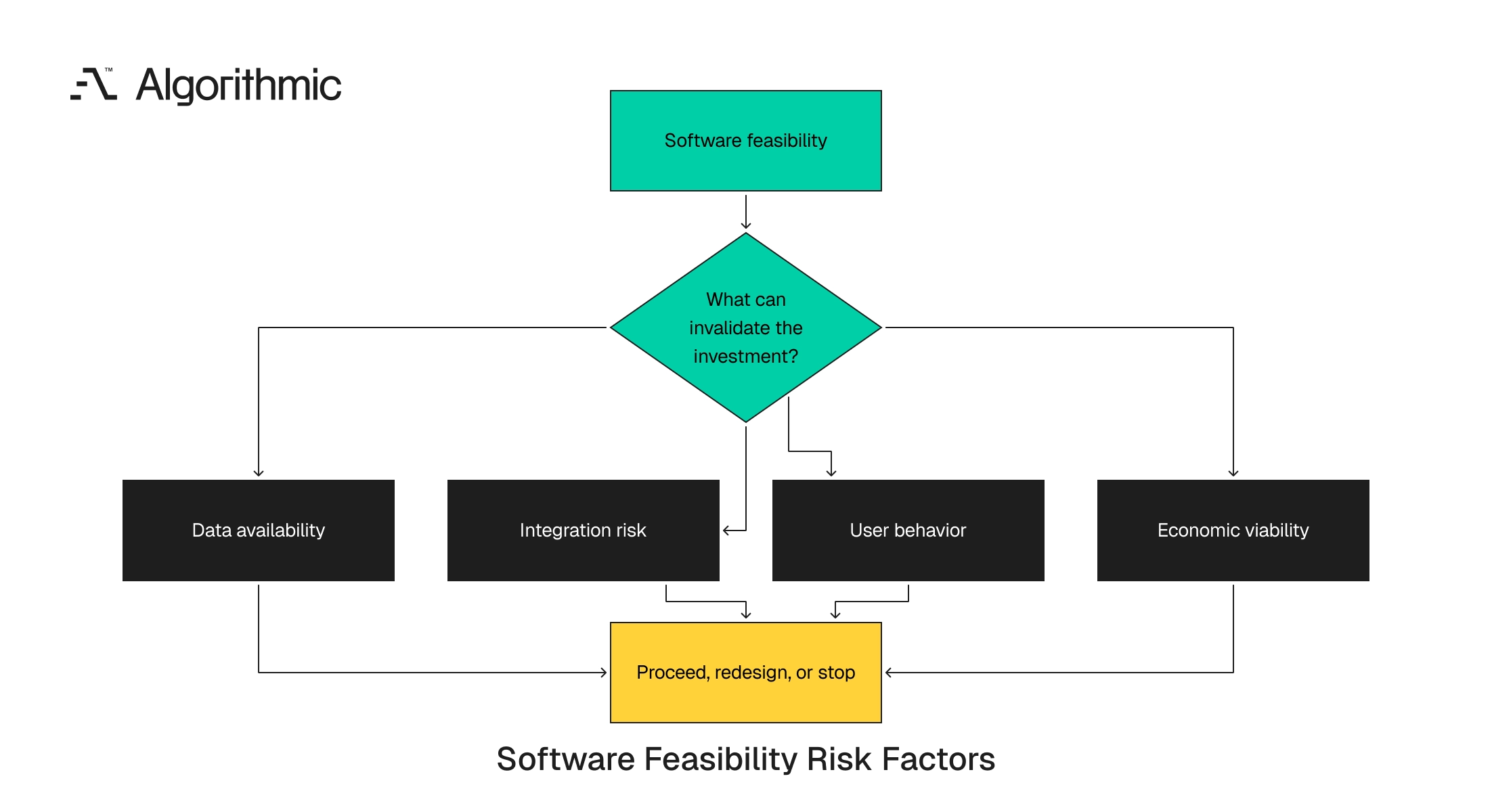
Every serious software feasibility study should test four assumption classes in parallel, because sequential discovery creates late surprises. Parallel testing exposes the largest risk before engineering spend passes fifty thousand dollars. The four classes are data availability, integration risk, user behavior, and economic viability, and each class can invalidate an investment on its own. A technically sound platform can fail because one class remained untested.
The classes also interact, since weak data raises integration cost, delays pilots, and damages the payback period. A study that tests one class at a time often finds the problem after the team has made architecture commitments. The practical consequence is capital allocation. A sponsor who sees all four risk classes in week three can make a controlled decision, while a sponsor who sees them in month five usually faces sunk cost, executive pressure, and delivery fatigue.
 Click to expand
 Data availability
Data feasibility covers access, quality, latency, rights, and meaning, and a database inventory alone does not prove data feasibility. The study must inspect production samples, source ownership, field definitions, and retention rules. A lending analytics product needs repayment history, borrower attributes, underwriting decisions, and delinquency outcomes, and if a large share of historical records lack a stable customer identifier, model performance and auditability degrade before production engineering starts. The issue will surface in validation, audit review, and customer reporting.
A healthcare operations platform needs scheduling, claims, and clinical data from three systems. If the EHR export arrives weekly, claims arrive monthly, and patient identifiers vary, real-time operations analytics becomes a different project, and the sponsor then faces identity resolution, consent review, and latency work. A logistics pricing system can face the same failure pattern, since shipment records often sit across TMS, WMS, carrier invoices, and fuel surcharge tables. If accessorial charges arrive 45 days late, same-week margin analytics becomes a forecast.
The minimum experiment is a data audit with production samples. Teams should inspect null rates, duplicate keys, timestamp consistency, join coverage, field definitions, retention rules, and legal constraints, and the audit should use the same entities the proposed system will depend on. A useful audit also traces data ownership, because a customer table owned by sales operations carries different change risk from a billing table owned by finance. The feasibility report should name who can approve access, schema changes, and downstream use.
For AI and analytics projects, meaning matters as much as completeness. Two teams can use the term “active customer” with different definitions, and if those definitions drive model labels or executive dashboards, the study must reconcile them before build funding. Data rights require the same scrutiny, since a field available in a warehouse may still be restricted by contract, regulation, or internal policy. The study should record allowed uses, retention windows, masking rules, and deletion obligations. Latency also needs direct measurement, because a nightly batch feed cannot support a same-session recommendation engine and a monthly claims file cannot support daily staffing decisions.
Data feasibility ends with a conclusion the delivery team can use. The conclusion should state which fields are production-ready, which fields need remediation, and which fields cannot be used, and it should also state the cost and owner for each remediation path.
Integration risk
Integration feasibility covers external services, legacy platforms, identity providers, payment processors, and internal networks. API documentation provides reference material, but feasibility requires a working path through authentication, permissions, limits, error handling, and monitoring. A B2B SaaS product may depend on Salesforce, HubSpot, NetSuite, and Okta, where one unsupported OAuth scope can change the onboarding model and one rate limit can force queueing, background sync, and new support procedures.
A fintech workflow can depend on Plaid, Stripe, a bank core, and an internal KYC system. A sandbox success means little when production access requires bank approval, firewall changes, and legal review, and those approval steps can add weeks before production data moves. The minimum experiment is a working integration test against the highest-risk system, moving data through the actual authentication path, error path, and retry path. Mock integrations help interface design, but they do not prove operating behavior.
The test should also record error classes, retry behavior, rate-limit responses, and latency under realistic payload sizes. A single successful API call proves little, while a complete read-write cycle with failure handling proves more. Integration work should include the production approval path, so the study should identify security owners, network owners, vendor contacts, and required legal review. A connector that works in a developer account can still fail the investment case if production approval takes 90 days.
Integration feasibility also includes observability, since teams need to know which logs, traces, alerts, and dashboards exist before production incidents occur. A system with no usable error trail transfers cost to support and engineering. Legacy systems deserve special attention, because a 15-year-old ERP instance can expose a SOAP endpoint and still reject the volume required for a modern workflow. Feasibility work should test payload size, concurrency, timeouts, and rollback behavior, and teams should examine contractual limits, since some vendors restrict bulk export, automated writes, derivative analytics, or downstream storage. Those restrictions can change the product design as much as a technical limit.
User behavior
User feasibility covers whether target users will change behavior, and this applies to consumer products, enterprise tools, marketplaces, and internal systems. A workflow that saves money on paper can still fail during daily work. A procurement automation tool can be technically sound and economically attractive, but if category managers approve purchases through email because the new workflow adds 90 seconds per request, adoption stalls and the cost model collapses because the old process remains active. A sales enablement platform can centralize account research, call summaries, and proposal drafts, yet if account executives keep notes in Salesforce free-text fields, the platform lacks current account context. Adoption depends on how the tool fits inside the sales day.
The minimum experiment is a behavioral test, not a preference survey. Use a concierge workflow, clickable prototype, paid pilot, shadow process, or limited release with telemetry, and measure task completion, repeat use, time-on-task, abandonment, and workarounds. User interviews still have a role, since they identify language, constraints, and decision criteria, but behavior under realistic conditions provides the evidence needed for funding. Running that contact well is a discipline in itself, and our guide to customer discovery for engineering teams shows how direct user contact shapes the architecture before the build.
The study should also test switching cost, because a tool can pass a usability test and still fail when users must change approvals, templates, browser tabs, or reporting habits. Feasibility evidence should show whether users complete the target task inside the proposed workflow without staff intervention. For internal software, managers often overestimate compliance, since employees keep spreadsheets, email threads, and personal work queues when new tools add friction. A serious study observes the workday instead of relying on meeting-room agreement.
The same principle applies to marketplaces. Buyers and sellers can praise a concept during interviews and then refuse to transact without liquidity, trust signals, or price transparency, so feasibility work should measure actual listings, offers, bookings, deposits, or repeat usage. For AI products, user behavior includes trust calibration, because users need to know when to accept an answer, when to verify it, and when to escalate. A model that impresses during a demo can fail when users face accountability for its output. Behavioral evidence should use a defined population, since five friendly users rarely tells a sponsor enough, and a better pilot names the role, workflow, frequency, incentive, and success threshold before the test starts.
Economic viability
Economic feasibility covers whether the system creates enough value to justify build cost, operating cost, sales effort, support burden, and maintenance. The model must connect system performance to cash flow, since engineering output alone does not establish that connection. For machine learning systems, this requires decision-level economics. A viability assessment should tie model performance to profit per decision rather than accuracy alone, because a model can score well and still fail to fund production operations.
A fraud model with 94% precision can fail economically if each false positive triggers an $18 manual review, and a 12% increase in support volume can erase the savings. The model’s cost profile includes inference, monitoring, analyst review, appeals, and customer retention effects. A recommendation engine can lift click-through rate by 6% and still miss the investment case, because incremental gross margin must cover inference, experimentation, merchandising effort, and engineering maintenance. A small lift on low-margin products rarely supports a complex personalization system.
A workflow automation system also needs transaction-level economics. If a task takes four minutes and occurs 1,200 times per month, the savings have a hard ceiling, and a feasibility study should calculate that ceiling before the team estimates a $300,000 build. The economic model should include adoption ramp and exception handling, since a workflow used by 40% of the target group creates a different return profile from one used by 85%. Manual exceptions, customer escalations, and quality checks often decide the actual payback period.
The model should separate one-time build cost from recurring cost, because cloud services, vendor licenses, model inference, data warehouse consumption, support staffing, and security review all recur. A project with a positive development case can still fail after operating costs are included. Economic feasibility should also include sales and onboarding cost for external products, since a SaaS feature that requires four hours of customer success time per account carries a different margin profile, and a founder should know that before committing to the build. For internal programs, the model should include management overhead, because training, policy changes, reporting changes, and exception review consume time that rarely appears in initial estimates. The strongest models use ranges tied to observed evidence, showing payback under low, base, and high adoption and which variable breaks the case fastest.
The feasibility study should be designed as falsification work
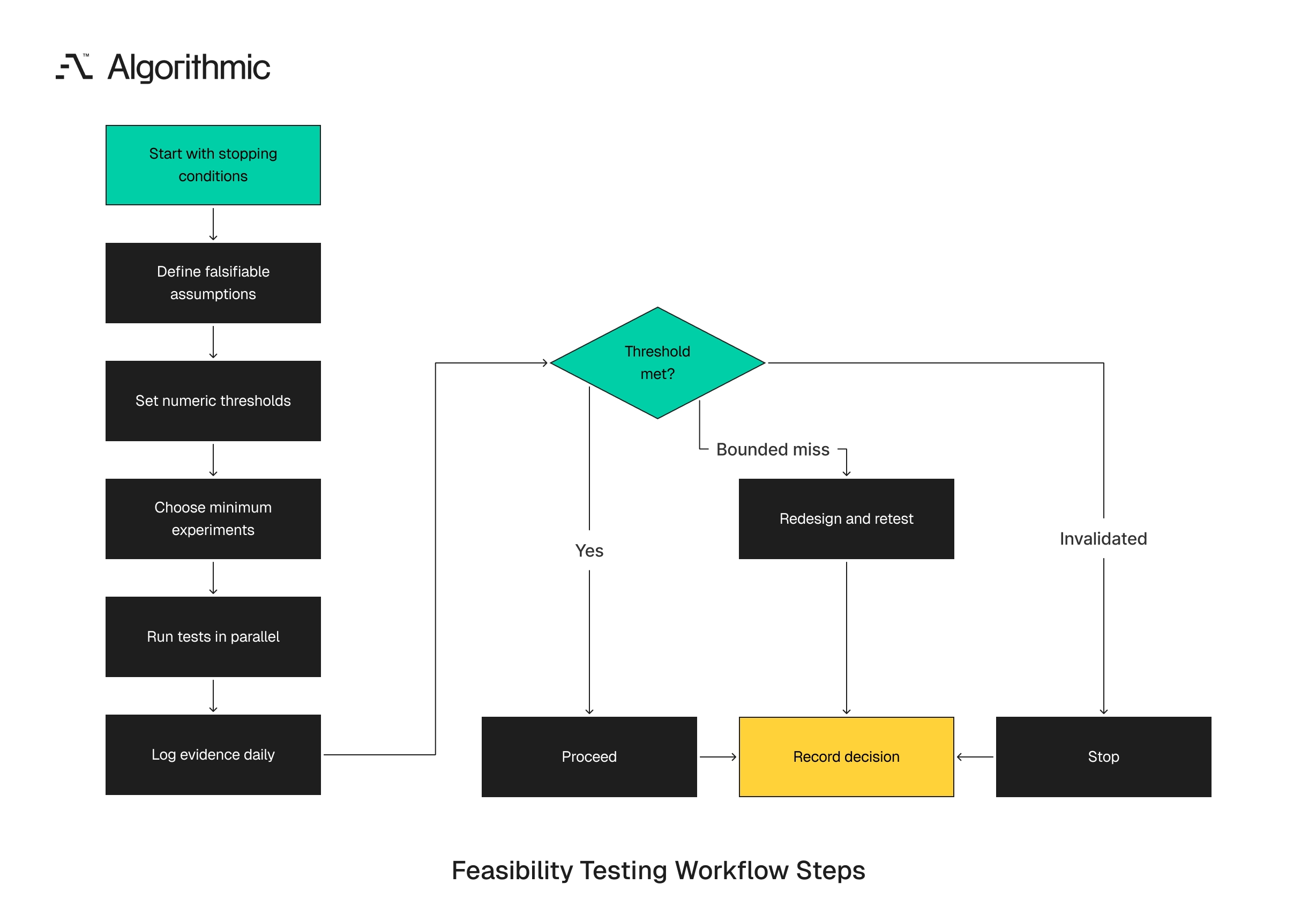
A useful feasibility study starts with the conditions that would stop the project, and each condition becomes a testable assumption with a threshold, method, time box, and decision rule. This framing turns feasibility from opinion gathering into evidence collection. The practice is well established in product discovery, where the four big product risks frame product decisions as value, usability, feasibility, and viability risks tested before production code is written. For major software builds, the discipline must be stricter because spending is higher and platform decisions last longer.
Across 35+ complex engagements, Algorithmic has seen one pattern repeatedly. Senior engineers name assumptions and failure modes before they estimate, while less experienced teams present plans as facts and then discover the hard constraints during delivery. Falsification also changes the sponsor conversation, because the team no longer asks whether the idea is attractive. It asks what evidence would justify the next dollar of funding.
This approach creates a cleaner governance model. Sponsors can approve a limited experiment without approving the platform, and engineering teams can report evidence without defending a preferred architecture. The result is a better funding sequence, where capital moves after evidence improves confidence and production planning starts after the organization understands the constraints.
 Click to expand
 The falsification standard
Each assumption needs a statement that can be proven wrong, and the statement should include a population, metric, threshold, time period, and measurement method. Without those elements, the team debates interpretations. The contrast is stark across four common cases.
A weak assumption reads “customers will use the dashboard”. A stronger version reads “at least 8 of 12 pilot users will use the dashboard three times per week for two consecutive weeks without prompting”. A weak assumption reads “the CRM integration is straightforward”. A stronger version reads “the Salesforce API can return account, opportunity, and activity data for 50,000 records within 15 minutes under current OAuth and rate-limit constraints”. A weak assumption reads “the model will improve routing”. A stronger version reads “the model must reduce average handling time by 11% at equal or lower escalation rate during a 14-day shadow test”. A weak assumption reads “the data warehouse will support executive reporting”. A stronger version reads “revenue, churn, and active-customer metrics must reconcile within 0.5% of finance reports for the prior two closed quarters”.
The language changes the work, because the team stops debating opinions and starts collecting evidence, and sponsors get a decision record instead of a narrative. A good assumption also names the measurement owner, so product analytics can measure usage, finance can validate payback, security can approve access boundaries, and engineering can verify integration behavior under load. A good assumption also states the decision rule. If the adoption threshold fails by a small margin, the team can redesign the workflow and retest, and if the economics fail by a wide margin, the sponsor should stop the build. The threshold should be strict enough to protect capital, since a weak threshold only proves that the idea survived a low bar while a serious threshold reflects the economics required for a production commitment.
The timing standard
A feasibility study should reduce the largest uncertainty within two to four weeks. Longer studies are justified when regulatory, procurement, or data access constraints require formal approval, and the study should still produce interim evidence during those approvals. The default sequence should run desirability, viability, and technical feasibility together, so a customer interview track, data audit, integration test, and economic model can run in parallel. A two-person technical team and one product lead can complete that work for many mid-sized initiatives.
The reason is practical, because a three-month requirements phase often preserves the weakest assumption until month four. By then, the organization has accumulated sunk cost, executive commitments, and vendor momentum. The study should spend time where failure is most expensive, so if the riskiest assumption is data access, the team should audit data before designing user screens, and if the riskiest assumption is behavior change, the team should test workflow adoption before selecting cloud services.
Time boxes protect the organization from open-ended analysis. A data audit can run for five business days and still reveal the largest defects, and a prototype can test one workflow path without modeling the full future platform. The time box should match the decision, since a board-level funding decision needs enough evidence to assess capital risk and a team-level build decision needs enough evidence to decide the next sprint. The study should also set a daily learning cadence, recording evidence as it arrives instead of saving all synthesis for the final week, which prevents one late finding from invalidating days of planning work.
A two-week study can produce meaningful evidence when the scope is tight. Week one can cover data access, integration probes, user interviews, and the first economic model, and week two can cover prototype testing, metric reconciliation, and decision preparation. A four-week study fits higher-stakes programs, giving teams time to run a pilot, validate permissions, inspect larger data samples, and pressure-test the operating model. The sponsor still needs decision gates at the end of each week.
A practical framework for assumption-first feasibility
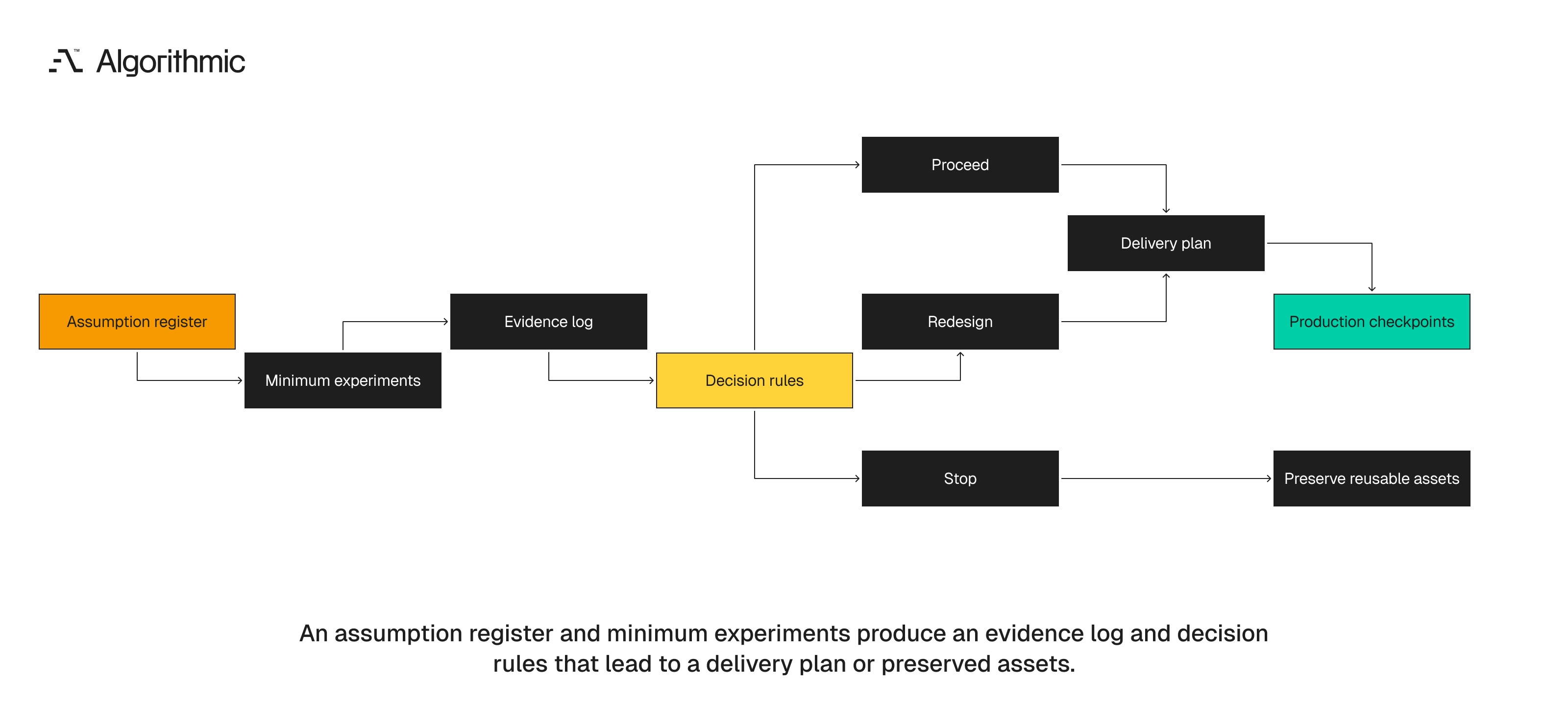
The following matrix converts a software feasibility study from analysis into evidence. It works for SaaS product development, data platform development, production machine learning engineering, and enterprise workflow automation, and the same structure also works during technical due diligence.
 Click to expand
 | Assumption class | Failure condition | Minimum experiment | Evidence threshold | Typical time box |
|---|---|---|---|---|
| Data availability | Required fields missing, stale, or legally restricted | Production data sample audit across source systems | ≥95% join coverage on key entities; latency within target window | 5-10 business days |
| Integration risk | API limits, auth constraints, or network rules block workflow | End-to-end test through the riskiest external system | Successful read/write cycle with error handling and retries | 5-15 business days |
| User behavior | Target users do not adopt the workflow | Concierge pilot or clickable prototype with telemetry | ≥60% completion rate on the target task without staff intervention | 10-20 business days |
| Economic viability | Value per transaction does not cover build and operating cost | Unit economics model tied to pilot data | Payback period under 12 months or margin lift above agreed threshold | 5-10 business days |
| Operational support | Internal teams cannot support the system after launch | Runbook simulation and support handoff test | Incident triage completed within SLA by assigned team | 3-7 business days |
| Security and access | Approval paths block production use | Security review dry run with data classification and access mapping | Required controls approved by security owner before build funding | 5-15 business days |
The thresholds are examples, not universal standards. A regulated financial platform may require 99.9% audit trail completeness, and a marketplace may require a liquidity threshold by geography and category. An AI agent may require a hallucination rate below 1% for specific answer classes and full citation traceability, a healthcare workflow may require HIPAA review, business associate agreements, and access logging before pilot use, and a manufacturing system may require plant-network approval before any device sends telemetry.
Every threshold should exist before the experiment starts, because moving the threshold after evidence arrives turns feasibility work into justification work. That is how organizations fund projects after the original investment case has failed. The matrix should also include ownership, since each row needs a business owner, a technical owner, and a decision owner. Without named owners, evidence remains interesting and fails to become a funding decision. Teams should store raw evidence with the matrix, because screenshots, query results, API logs, telemetry exports, and interview notes make the conclusion reviewable, and a conclusion without evidence forces future teams to repeat the study.
The matrix also prevents overinvestment in low-risk areas. If authentication is already proven and data quality is unknown, the team should spend more time on data, since equal effort across every row is rarely the right use of a feasibility budget. A mature sponsor will adjust thresholds by investment size, because a $60,000 internal tool can accept a shorter evidence trail than a $2 million data platform, though both still need thresholds, owners, and stop criteria. The matrix should travel into delivery, where rows that pass become architecture inputs and rows that remain open become delivery checkpoints with named owners and dates.
Common artifacts that create false confidence
Several common feasibility outputs look professional and still fail to reduce risk. They appear in technical due diligence, vendor selection, and software project estimation, and sponsors should treat them as supporting materials, not proof. These artifacts fail when they replace experiments, because a polished diagram, backlog, or schedule can make a team feel prepared. Preparation has value only when it addresses the assumption that can stop the investment.
Feature inventories
A feature inventory describes what the system may include, and it rarely proves that the system should exist. The artifact can distract executives by turning an investment question into a scope discussion. Feature lists also create anchoring, since once stakeholders see 40 proposed features, the discussion shifts toward prioritization, sequencing, and cost. The higher-value discussion concerns which assumption can stop the project before those features matter.
A feature inventory has a place after the main risks are tested, and before that point it should stay short, because ten untested assumptions matter more than 40 proposed screens. A useful inventory ties each feature to a tested assumption, so if a feature has no connection to adoption, revenue, cost reduction, risk reduction, or compliance, it should not drive feasibility. The best early feature list is a risk map, where each proposed feature states which assumption it tests or which operational constraint it handles. This discipline protects the team from decorative scope, because a dashboard, notification center, or admin panel can consume weeks before the core transaction has evidence. Feasibility should fund learning before breadth.
Architecture diagrams
Architecture diagrams are necessary for serious builds, but they also create premature confidence when teams draw them before testing risk, and a coherent diagram can mask operating cost, data latency, and audit constraints. A diagram showing AWS Lambda, API Gateway, DynamoDB, S3, and EventBridge can be technically coherent and still operationally unsuitable if batch volume requires predictable throughput or audit requirements need relational transaction history.
Architecture should follow the highest-risk evidence, so early diagrams should mark unknowns, constraints, and test points, and avoid false precision about services, queues, databases, and boundaries. The best early diagrams show where the study must learn, identifying systems of record, approval gates, latency targets, data contracts, and failure paths, which turns the diagram into a test plan instead of a sales artifact. Architecture diagrams should also show ownership boundaries, because a platform that crosses finance, security, operations, and customer support needs approval gates, support responsibilities, and data stewardship rather than boxes and arrows. A useful diagram labels unresolved risks directly on the drawing, with examples like “production OAuth scope unconfirmed”, “customer ID join coverage unknown”, and “manual exception queue owner unassigned”, which make uncertainty visible.
Gantt charts
A Gantt chart assumes the work is known, but in feasibility the work is to identify which parts of the plan are false, and a schedule built before evidence can make uncertainty look managed. A team that produces a 24-week delivery schedule before running a data audit has skipped the most useful step. The schedule may be well formatted and still detached from the risk profile, and its dates will change when the first material assumption fails.
A better schedule separates feasibility work from production delivery. The first phase should contain experiments, thresholds, and decision dates, and the delivery plan should start after the sponsor accepts the evidence. A feasibility schedule should show learning milestones, with examples like “Salesforce production auth verified”, “finance metric reconciliation complete”, and “pilot adoption threshold met”, which matter more than design review dates during the study phase. The schedule should also show decision meetings, where a weekly review compares evidence against thresholds and records the resulting decision, keeping the study from drifting into open-ended analysis. Production schedules become useful after feasibility, when the team knows which integration paths work, which data needs repair, and which workflows users accept, so the Gantt chart then reflects known work instead of assumed work.
Vendor questionnaires
Vendor questionnaires help procurement compare firms, but they rarely reveal whether a team can de-risk a complex build, and a 60-question form can miss the one assumption that matters. A better evaluation method asks each partner to name the riskiest assumption, design the minimum experiment, define the metric, and state what result would stop the project. That answer reveals engineering judgment. Teams that answer with telemetry plans, data-mining steps, and failure thresholds are better suited to $50,000+ initiatives, while teams that answer with feature timelines are selling delivery before they have earned the right to plan it.
Procurement should also ask for a sample assumption register from a prior engagement, because a strong register shows thresholds, owners, raw evidence, and decisions while a weak register reads like a list of open questions. The procurement process should score evidence discipline, since a partner that can explain how it killed a project before major spend has shown capital discipline, and that answer matters more than a generic delivery method. Sponsors should also ask who will run the experiments, because senior engineers should handle data audits, integration probes, and architecture risk. Junior teams can support the work, but judgment belongs with people who have shipped production systems.
A concrete scenario that is technically feasible but commercially unsound
Consider a mid-market software company planning an AI customer support assistant. The proposed system uses a knowledge base, ticket history, a vector database, and a large language model with retrieval augmented generation, and the sponsor expects lower tier-one support volume. The initial estimate is $420,000 over six months for MVP development through production release. The architecture is buildable, since the team can use OpenAI or Anthropic for inference, Pinecone or pgvector for retrieval, and Datadog for monitoring.
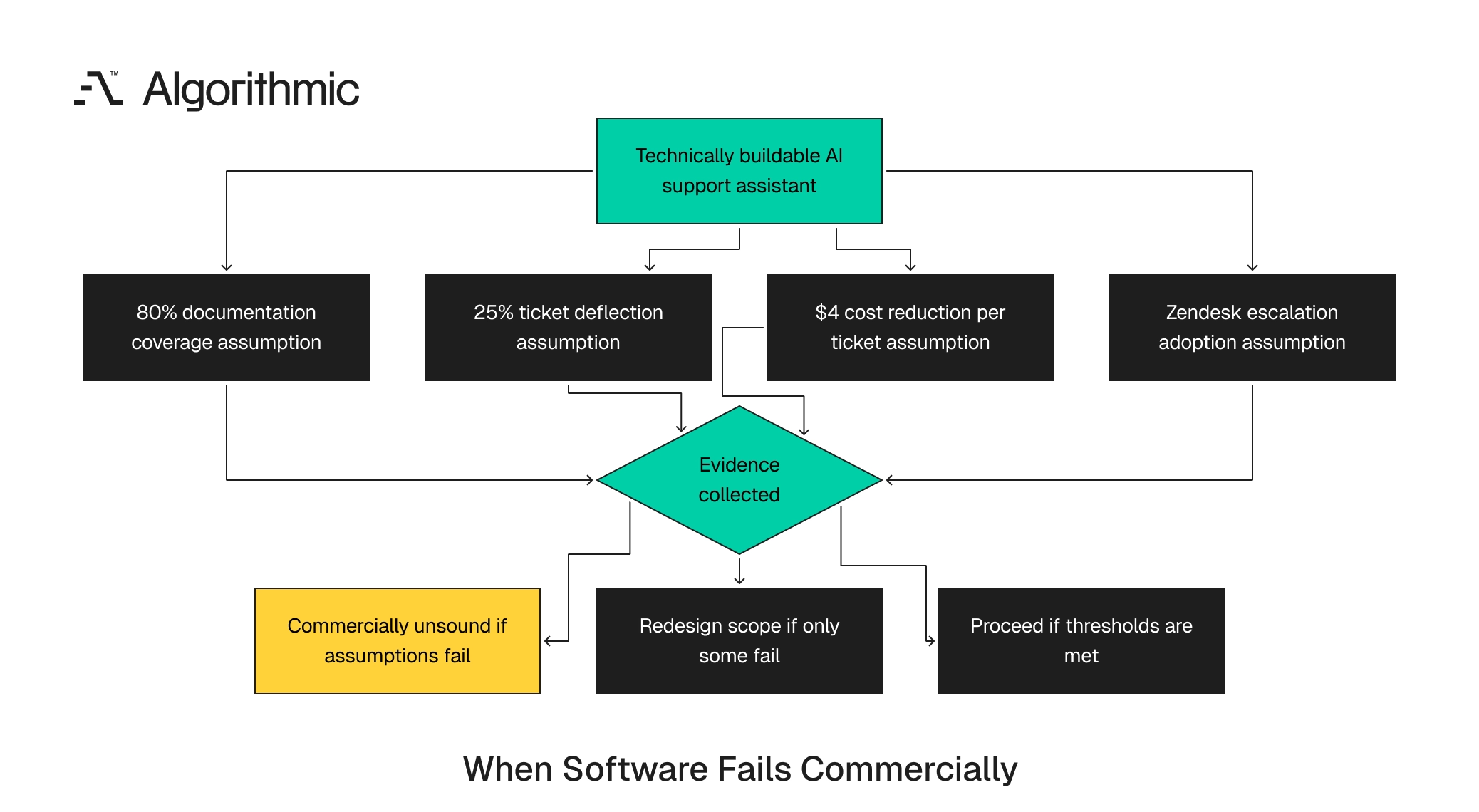
The investment case depends on four assumptions. Support articles must cover at least 80% of common requests, the assistant must resolve 25% of tier-one tickets without agent intervention, average cost per resolved ticket must fall by at least $4, and the support team must accept the escalation workflow inside Zendesk. Each assumption links directly to the financial case.
 Click to expand
 A three-week feasibility study can test those assumptions. Sample 10,000 historical tickets, map the top 50 intents to existing documentation, build a retrieval prototype against the actual knowledge base, run a shadow evaluation on 500 closed tickets, and test the escalation flow with five agents inside Zendesk. The study should also inspect permission boundaries, because some tickets include billing data, contract terms, or personally identifiable information, and those fields change retrieval design, redaction rules, and logging requirements.
The result may show that 62% of common requests lack accurate source material, and that 31% of historical tickets require account-specific data from a system with no approved API. The architecture remains buildable, but the planned product no longer has a sound economic case. The assistant would need manual content work, new account-data access, and support-process changes before release, and those additions change cost, timeline, and expected savings.
That is a successful feasibility study, because it prevents a build that would ship late, require manual workarounds, and miss its cost-reduction target. The sponsor can redirect funding toward documentation repair, API approval, or a narrower assistant. A narrower assistant can still work, handling password resets, plan questions, and invoice-copy requests while excluding contract disputes and account-specific billing issues, and that revised scope reduces model risk and content work while preserving measurable savings.
The same scenario applies outside AI. A claims automation platform can be buildable and still fail if adjusters reject the workflow, and a pricing engine can be buildable and still fail if margin data arrives too late. The feasibility package should quantify the revised path, so documentation repair may take six weeks and require two support operations staff, and API approval may need security review, vendor approval, and a new audit log. The sponsor then has a grounded choice, funding content repair first, approving integration work, narrowing the assistant, or stopping the initiative, and each option has a cost, owner, and evidence base. This is the standard feasibility should meet, changing the next decision with evidence that leaders can inspect. If the study leaves every original assumption untouched, it has failed.
Feasibility work needs decision rules before evidence arrives
Decision rules protect the organization from momentum, defining what happens when evidence confirms, weakens, or invalidates an assumption, and the rules should be written before the team reviews results. The simplest model has three outcomes.
- Proceed when evidence meets the threshold. The project moves into architecture, delivery planning, and production engineering.
- Redesign when evidence misses the threshold in a bounded way. The scope, workflow, business model, or architecture changes, and the revised assumption is tested.
- Stop when evidence invalidates the investment case. The organization ends the build before major engineering spend begins.
This structure also helps software architecture review and build-vs-buy decisions. If integration risk dominates, buying a product with proven connectors can be rational, and if differentiated workflow drives the value case, custom software development can create defensible value. Harvard Business School research on early project evaluation finds that even the biggest ideas benefit from a reality check at the outset, and that principle applies directly to software. Feasibility assessment should expose false positives before teams spend months proving a product can be built. The classic guidance on realistic criteria for judging new ventures makes the same point, since execution assumptions like schedules, approvals, cost behavior, and sequencing are often treated as stable. Software feasibility studies should test those assumptions through access checks, procurement timelines, security review paths, and support ownership.
A decision rule should name the person who can accept the result, so a product lead can accept a prototype metric, a CISO may need to accept a security constraint, and a CFO may need to accept a payback calculation. Without named owners, evidence can circulate without a decision, which is another way feasibility studies become documentation projects. The study should end with a funded next step, a redesigned experiment, or a stopped initiative. The decision rule should also define what evidence is inadmissible, since anecdotal enthusiasm, executive preference, and vendor assurance should not override failed thresholds. If the threshold changes, the sponsor should record the reason and the new risk accepted.
A disciplined stop decision preserves future options, because the organization can retain code samples, data profiles, research notes, and vendor findings, and those assets can support a later project when access, economics, or workflow conditions improve. Decision rules also protect delivery teams, since engineers should not inherit a build that has already failed its economics or access requirements, and clear stop criteria prevent political momentum from becoming technical debt. A strong governance process records the decision in writing, including the threshold, evidence, owner, outcome, and funding implication, which creates an audit trail for later investment reviews.
The sponsor’s checklist for a serious software feasibility study
Technical founders and enterprise sponsors can assess a proposed feasibility study using seven questions. These questions test whether the work will reduce uncertainty, and they also reveal whether a partner has production judgment.
- What assumption would invalidate the investment? The answer should be specific enough to test within weeks, naming the user, system, metric, and threshold.
- Which evidence source will test it? Acceptable sources include production data samples, live API tests, paid pilots, telemetry, shadow tests, and unit economics models.
- What threshold defines failure? The threshold must be numeric where possible, covering adoption rate, join coverage, latency, payback period, error rate, or support cost.
- What decision follows each result? Proceed, redesign, and stop criteria should be written before evidence collection starts.
- Which assumptions run in parallel? Data, integration, user behavior, and economics should move together unless access constraints force sequencing.
- Who owns operational support after launch? A production-ready software development plan needs incident response runbooks, monitoring, access control, and maintenance ownership.
- What artifact will survive the study? Strong outputs include tested assumptions, evidence logs, architecture decision records, risk registers, prototype telemetry, and a revised investment case.
If a proposed partner cannot answer these questions, the organization is buying estimation instead of feasibility. Estimation has a place after the evidence is known, but before that point precise estimates can create false comfort. Sponsors should also ask how the team will handle failed evidence, because a serious partner can say what result stops the work, and that answer protects the client’s capital. The checklist should be used before contracting, not after kickoff, since a partner that resists numeric thresholds during sales will resist them during delivery. The response reveals whether the team sells certainty or earns it through evidence.
The same checklist helps internal teams, where product, engineering, finance, security, and operations should agree on the riskiest assumptions before funding moves. That agreement reduces late-stage escalation and protects delivery teams from unclear mandates. The checklist also helps compare build partners, because two firms can quote the same four-week study and mean different things. One may plan stakeholder interviews and a deck, another may plan production data audits, integration probes, and telemetry-backed pilots, and the difference appears in the first working session. A serious team asks for data samples, API access, decision owners, and failure thresholds, while a delivery-first team asks for a feature list. Sponsors should treat reluctance as evidence, since a partner that avoids stop criteria has an incentive to keep the build alive, and feasibility work requires a partner willing to recommend stopping.
What the final feasibility package should contain
A feasibility study should leave the organization with artifacts that survive the meeting, because a slide deck alone is insufficient. The sponsor needs evidence that can be reviewed, challenged, and reused during architecture and delivery. The first artifact is an assumption register, listing each assumption, owner, threshold, experiment, evidence source, result, and decision, which becomes the bridge from feasibility to production planning. The second artifact is an evidence log, including data profiles, API responses, prototype telemetry, user-test recordings, model evaluation outputs, and economic calculations, so a future engineering team can inspect the evidence without interviewing the original study team.
The third artifact is an architecture decision record set, where each record explains a technical choice, the evidence that informed it, and the trade-offs accepted, which prevents the delivery team from reopening settled decisions without cause. The fourth artifact is a revised investment case, updating cost, timeline, operating model, expected value, and remaining risks using feasibility evidence instead of the assumptions in the original business case. The final artifact is a next-step plan. If the project proceeds, the plan should identify the first production sprint, remaining experiments, and governance checkpoints, and if the project stops, it should identify reusable assets and the conditions required for reconsideration.
A strong package also includes open risks, because feasibility does not remove every uncertainty, and it should state which risks remain, who owns them, and when the team will test them. The package should be written for future readers, so six months later a new engineer, CFO, or security lead can understand why the sponsor funded, redesigned, or stopped the work, which is the standard for decision-grade documentation. The package should also include raw files where possible, since CSV extracts, SQL queries, API logs, redacted recordings, and model evaluation notebooks give future teams a verifiable trail that screenshots alone rarely meet. A good package separates facts from recommendations, where facts include measured latency, observed completion rates, join coverage, and cost calculations while recommendations state the proposed decision and the risk accepted. For regulated environments, the package should support audit review, identifying data categories, access decisions, retention assumptions, and security approvals, which can shorten later review cycles.
A stronger feasibility study changes the next decision
A strong software feasibility study produces a decision supported by evidence, telling the sponsor whether to fund, redesign, or stop the build. Anything less leaves the organization exposed to avoidable engineering spend. For a full product build from scratch, the study should identify the smallest version worth building and list the assumptions that remain open, and those assumptions should become the first checkpoints in the delivery plan. This is the same trap behind the false economy of the quick MVP, where a rushed build ships before the riskiest assumption has any evidence.
For production machine learning engineering, the study should tie model quality to profit-per-decision, monitoring cost, and operating workflow, defining how false positives, false negatives, latency, and human review affect unit economics, and specifying who responds when model performance drifts. For data engineering services, the study should prove source quality, lineage, query patterns, and dashboard trust before warehouse architecture hardens, reconcile business definitions with finance and operations, and test whether the proposed platform can answer the questions executives will ask.
The practical standard is strict. Within two to four weeks, the study should increase confidence enough to fund the build, redesign the concept around evidence, or stop the project, and a study that produces only documentation has failed that standard. Engineering leaders should require every feasibility proposal to include an assumption register, minimum experiments, numeric thresholds, and stop criteria. Fund the experiment before funding the platform, because a small falsification budget is often the highest-return decision in the entire software investment.
This discipline changes how organizations spend technical capital, moving funding from confidence theater to measured learning and giving sponsors a way to say yes, no, or revise with evidence instead of instinct. The strongest teams welcome that standard, since they know a stopped project can be a successful engagement when it protects six months of engineering time, and a funded project starts stronger when the largest risks have already been tested.
Algorithmic runs feasibility studies that test the assumptions capable of stopping an investment before engineering spend grows. Start a conversation if you are weighing a build and want the riskiest assumption tested first.