

A single malformed LLM output can update 10,000 CRM records before an operations team detects the pattern. These incidents start when product workflows accept probabilistic text as typed application state, so the model stays online, the API returns 200, and the application writes incorrect data with full permission. This risk now appears across AI agents, NLP system development, support automation, sales operations, and internal knowledge tools, where the model classifies an inbound email, extracts fields, selects a workflow, drafts a response, or calls a tool, and the surrounding system then treats the result as an instruction.
The architectural error is direct, because free-form text is driving deterministic systems. Production workflows need schemas, validation, typed intermediate formats, and explicit failure paths before any model output changes state, and teams that skip this boundary carry model variance into CRM, billing, support, identity, and customer messaging systems.
LLM risk enters product logic at the interface
Large language models need black-box treatment at the product boundary. Their internal representations are opaque, non-contractual, and provider-dependent, so their outputs need a deterministic interface before they enter product logic. That interface has four responsibilities, since it constrains input, validates output, records provenance, and routes failures, and without that layer product code becomes an informal parser for natural language.
Informal parsers fail under small wording changes, prompt revisions, model upgrades, and edge-case inputs. A support classifier that works on 500 hand-picked examples fails when a customer forwards a 14-message email thread, and a lead-routing prompt that works in English fails when a German prospect includes a translated procurement note. Temperature settings do not solve this risk class, because the belief that temperature=0 creates reproducible behavior is incomplete, since provider infrastructure, model revisions, token tie-breaking, batching behavior, and tool-call ordering still introduce variation.
The non-determinism tax in production LLM systems is a real operating cost, because deterministic workflows built on probabilistic infrastructure inherit variance unless the boundary absorbs it, so that boundary must be engineered as product infrastructure, with tests, owners, and release controls. In production machine learning engineering, the correct design stance is conservative, so the LLM can interpret, summarize, classify, and propose, while the application owns state transitions, permissions, retries, audit logs, and irreversible actions.
This division matters most when the system writes to operational records. Updating Salesforce, Zendesk, Stripe, NetSuite, or an internal entitlement service changes what employees and customers see, so the model can recommend a change while application services decide whether the change is allowed. The same principle applies to internal tools, because a knowledge assistant that mislabels a policy has one cost profile, while an assistant that changes an account flag, closes a ticket, or sends an email carries materially higher risk.
The interface also defines who can investigate an incident. With a typed contract, an engineer can inspect a failed field, schema version, source record, and rule result. With raw text, the team reads transcripts and reconstructs intent from incomplete logs.
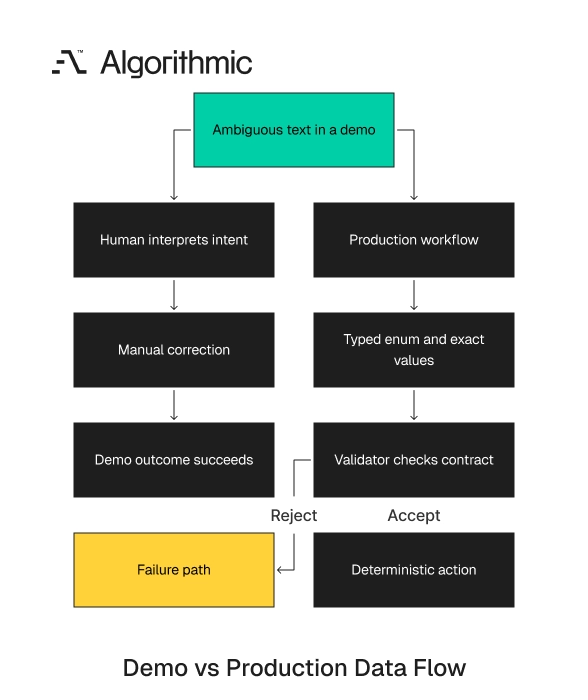
Demos tolerate ambiguous text because humans complete the workflow
Demos accept ambiguity because a human operator supplies interpretation. A sales operations demo can tolerate the model returning “This looks like a high-priority enterprise lead, likely for the healthcare segment”, because a person understands the intent and moves the demo forward. A production CRM workflow instead needs exact values such as priority = P1, segment = healthcare, company_size = enterprise, confidence = 0.91, source_message_id = msg_84921, and recommended_action = create_salesforce_task, and those values need a schema, a validator, and a business rule check, along with provenance that links the decision to a prompt version and source record.
Ambiguity creates operational cost because software must choose one path. A task is created, a queue is assigned, a notification is sent, or a record is updated, and once that write occurs the error becomes part of the operating system for the business. A human reviewer can interpret “high-priority” from context, while a queue router needs a fixed enum, a confidence threshold, and a failure path, and this distinction separates a demonstration from a production workflow.
 Click to expand
 Ambiguous output also hides responsibility. If the model says “likely enterprise”, sales operations treats the phrase as judgment, while if the object says company_size = enterprise, the workflow treats the field as product state. That difference matters during cleanup, because a transcript requires human interpretation, while a typed field can be queried, counted, reverted, and blocked in the next release.
Format drift breaks parsers
Format drift occurs when the model returns the right idea in the wrong shape. A prompt asks for JSON, then receives Markdown with a JSON block, so a parser accepts the first block, misses a trailing explanation, and passes incomplete data downstream. This failure class is common because early LLM integrations rely on json.loads() against raw model output, when the stronger pattern is a validated object, because JSON syntax alone is insufficient for production control.
The system also needs type checks, enum constraints, bounds checks, nullable-field rules, and versioned schemas. A field named priority must accept P0, P1, P2, or P3, and the same field must reject urgent, high priority, ASAP, and empty strings. Format drift also appears after prompt edits, so a product manager adds “explain your reasoning” to a prompt, the model starts appending prose after the JSON object, and the integration passes staging because the sample size is 20 records, then fails under 30,000 production records.
A second pattern appears when the model changes field order, nests an object, or returns a list instead of a scalar. These changes look harmless in a chat transcript, yet they break parsers, metrics, dashboards, and downstream jobs that expect a stable contract. A third pattern appears when the model returns syntactically valid JSON with inconsistent types, so confidence arrives as "high" instead of 0.82, and evidence arrives as one string instead of an array.
These failures require typed validation before any workflow step proceeds. A permissive parser moves the defect downstream. A strict validator stops the workflow at the boundary and records the exact contract violation.
Semantic drift creates valid records with wrong meaning
Semantic drift is more dangerous because validation passes. The model returns a valid enum with the wrong business meaning, so a customer writes “We are waiting on procurement approval before we can renew the revised terms”, and the model classifies the account as renewal_intent = positive. The CRM record is valid but the workflow is wrong, so a sales task is created, an automated email is sent, and the customer receives a message that ignores the procurement blocker.
Semantic drift needs domain validation. Examples include checking account stage, renewal date, open support tickets, contract status, payment history, and prior communication history before the workflow advances, and a renewal classification should also check for an unsigned order form, an open legal review, or an unresolved security questionnaire. This validation belongs outside the model, so the system should compare the candidate classification against authoritative records in Salesforce, Stripe, Zendesk, Ironclad, or the internal customer database, and a classification that conflicts with those records should enter review.
The domain check should produce a specific reason, so conflicts_with_open_legal_review gives operations teams a clear queue, while model_low_confidence tells the team far less about the business conflict. Semantic drift also appears in support automation, so a customer says “We cannot access the admin page after SSO changes”, and the model classifies the case as password_reset because the message contains “access”.
The enum passes validation, but the business workflow fails because SSO incidents need identity logs, tenant configuration, and an engineering escalation, and a domain rule can block the classification when the account has an active SAML configuration change.
Partial truth causes downstream inconsistency
Partial truth occurs when the model extracts one correct field and one unsupported field. A support message says the customer is locked out of the admin panel, so the model correctly assigns issue_type = access_failure, then invents affected_plan = enterprise. If the workflow routes enterprise accounts to a priority queue, the support system now carries false operational state, and one case has a small cost, but at 2,000 tickets per week a 3% unsupported-field rate creates 60 misrouted cases every week.
That error rate compounds across queues, SLAs, and reporting. A support director sees enterprise backlog increasing and assigns more agents to the wrong queue, and finance sees inflated enterprise support volume and uses that number in renewal planning. Partial truth also damages auditability, because the extracted issue type came from the source message while the plan value came from the model’s inference, so a production interface must distinguish quoted evidence, retrieved facts, and inferred fields.
A strong contract stores those differences explicitly. The object should mark issue_type as source-supported and affected_plan as system-derived or unavailable, and the workflow should reject inferred operational fields unless a business rule allows them. This distinction matters in regulated and contractual settings, because a plan tier, refund status, entitlement flag, or diagnosis code should come from an authoritative system, so the model can point to evidence while the application decides whether that evidence meets the standard.
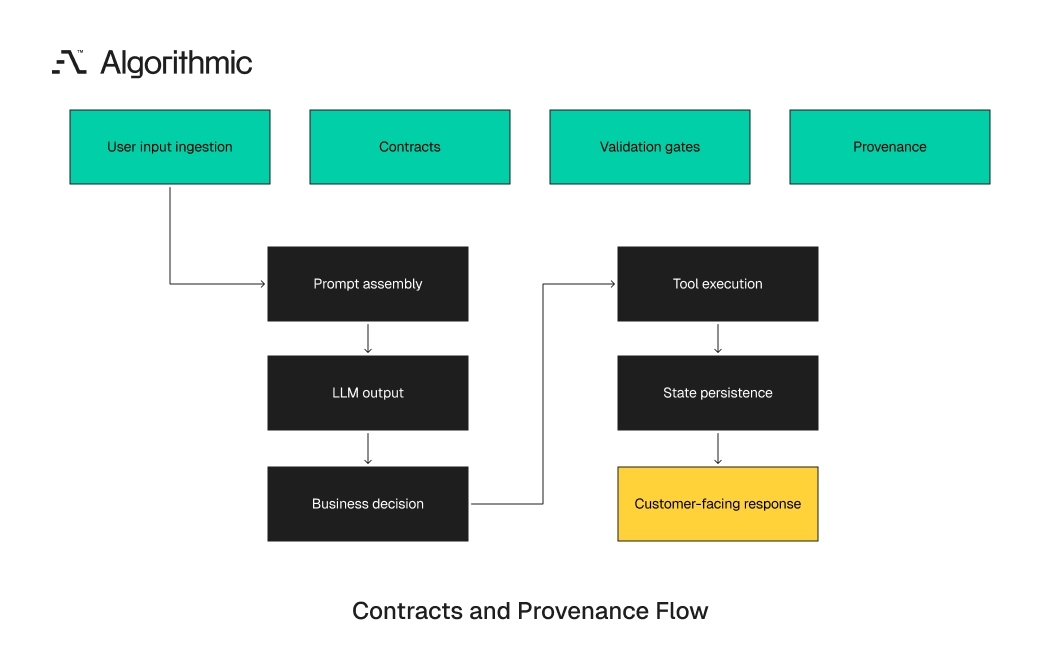
The contract-gated LLM interface
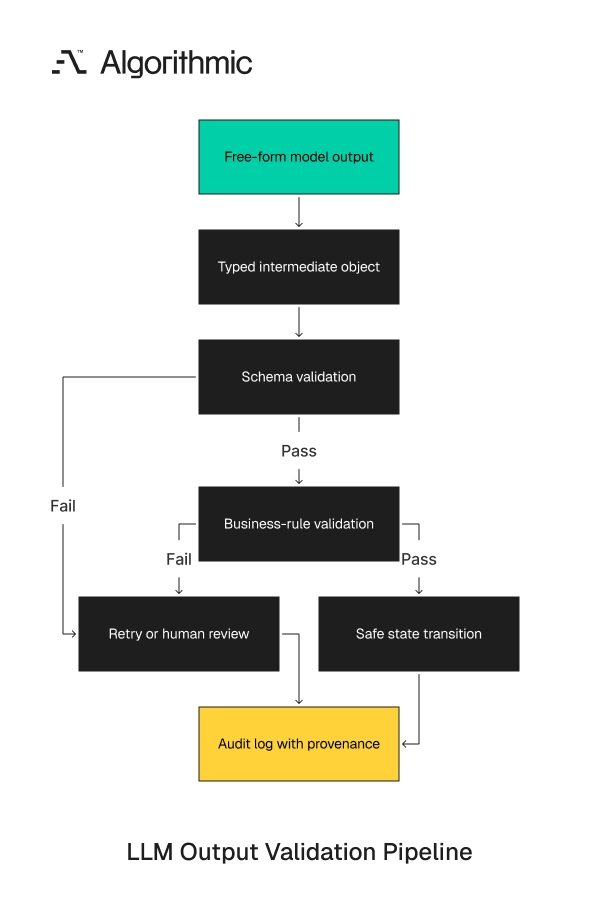
A deterministic interface turns model output into governed product state. The pattern is simple to describe and demanding to engineer. Each gate removes one failure class before the system writes data or calls a tool.
 Click to expand
 Place the interface in the product architecture. Prompts can request structure, but application code must verify structure, apply business policy, and decide the next state. The interface should be owned like other production infrastructure, so it needs tests, release notes, dashboards, incident thresholds, and named engineers, because a prompt hidden in configuration cannot carry that responsibility alone.
 Click to expand
 1. Validate inputs before model execution
The system should reject malformed requests before sending them to the model. Input validation includes tenant ID, user permissions, source record status, content length, language, attachment type, and data classification, and these checks belong in application code. For example, an internal support assistant should reject a customer message if the tenant ID is missing, and it should reject a request when the user lacks permission to view the account, because the model should never infer authorization.
Input validation also controls cost and latency. A 120,000-token email thread should not enter a model call designed for 8,000-token messages, so the system should summarize, chunk, or reject the request through a designed path. Data classification matters as well, because a workflow that handles payment disputes should detect card numbers, Social Security numbers, bank details, and medical content before prompt assembly, since that check determines which model, region, retention setting, and logging policy applies.
Validation should also run before retrieval, because a user without permission to view an account should not receive account documents in the prompt context, since access control after generation arrives too late. The same rule applies to tenant boundaries, so a retrieval query should include tenant ID, permission scope, and record type before it reaches the vector store, because post-generation filtering cannot repair leaked context.
It also protects the model from malformed work. Empty bodies, duplicate attachments, unsupported file types, and encoded binary content should stop at the boundary. These defects are ordinary application defects, and ordinary application controls should handle them.
2. Use typed intermediate formats
The LLM should emit a typed intermediate object instead of prose. Suitable formats include JSON Schema, Pydantic models, Zod schemas, Protocol Buffers, or TypeScript discriminated unions, and the format should be machine-checkable and versioned. A lead-routing system should not ask the model to “decide what to do next”, so it should request an object with fields such as:
{
  "lead_id": "string",
  "classification": "inbound_demo_request | partnership | support | spam | unknown",
  "priority": "P0 | P1 | P2 | P3",
  "confidence": "number",
  "evidence": ["string"],
  "recommended_action": "create_task | request_human_review | no_action"
}
Each field needs validation, so confidence must be between 0 and 1, classification must match an approved enum, and evidence must quote or reference source text. recommended_action must be allowed for the authenticated user and tenant, so a contractor account should not create executive escalation tasks, and a sandbox tenant should not trigger production customer outreach.
Typed formats also support regression testing. Engineers can store 1,000 anonymized production examples and test every prompt change against the same schema, so a release that drops first-pass contract adherence from 98% to 91% should fail before deployment. Typed objects also make observability possible, because a dashboard can group failures by enum, missing field, confidence band, or schema version, while free-form text gives operations teams a transcript, not a measurable system boundary.
The typed object should avoid ambiguous fields, so priority_reason = "customer is upset" carries less control value than priority_reason_code = security_incident, and enumerated reasons support routing, staffing, reporting, and audit review. Schema design also needs backward compatibility rules, because additive changes are safer than field removal, so renaming priority to urgency should require downstream test coverage and owner approval.
3. Validate business rules after model execution
Schema validation confirms shape while business validation confirms admissibility, and both are required, because a syntactically valid response can still violate policy, customer state, or financial controls. A model can return recommended_action = refund_customer with valid syntax, so the product still needs to check refund amount, account standing, fraud flags, policy limits, and approval thresholds, and a $25 refund can be automatic while a $2,500 refund should enter an approval queue with full provenance.
Business rules should use authoritative systems. A subscription downgrade should check entitlements, contract terms, invoice status, and admin permissions, and a support escalation should check SLA tier, customer segment, open incidents, and engineering ownership. The rule engine should record the exact rejection reason, so policy_limit_exceeded, missing_admin_permission, and conflicting_account_state give operations teams useful queues, while a generic validation_failed error hides the reason and increases manual review time.
Validation should also protect state machines, so a case cannot move from new to closed if required investigation fields are empty, and a renewal cannot move to committed if procurement status remains blocked. A state machine should also reject skipped stages, because a fraud review cannot move from opened to resolved without an analyst decision, and a billing dispute cannot move to credit_issued without ledger reconciliation.
It should also check rate limits and blast radius. A workflow that changes 2 customer records has one risk profile. A workflow that changes 20,000 records requires batch controls, dry-run output, and rollback planning.
4. Route failures through explicit paths
Every failed validation should map to a product path. Common paths include retry with a constrained prompt, retry with smaller context, ask a clarifying question, send to a human queue, or stop the workflow and record the failure, and each path needs metrics and ownership. Silent repair is dangerous, so if the model returns priority = urgent and the allowed enum is P0 | P1 | P2 | P3, the application should not guess, and a mapping layer can translate values only when the mapping is explicit, tested, and versioned.
Retry logic also needs limits. One constrained retry is reasonable for malformed JSON, while five retries create latency, cost, and duplicate side-effect risk, so a workflow that fails after one repair attempt should move to review with the raw output, validation error, and source record attached. Failure routing should be visible in operations dashboards, so teams need counts by schema version, prompt version, model version, tenant, and workflow, and a spike in schema_invalid after a deployment should page the owning engineering team.
Each failure path should have an owner, so product owns customer-facing refusals and clarification messages, while engineering owns malformed output, tool failures, and regression thresholds. Failure paths should also include service-level targets, so a needs_human_review queue for sales leads can tolerate same-day review, while a policy_blocked queue for account access can need a 30-minute response target.
The product should define customer-visible language for each blocked path. A vague failure message increases support volume. A precise message reduces ticket handling time and gives customers a clear next step.
A deterministic interface decision matrix
The following matrix gives CTOs and MLOps engineering teams a practical way to place contracts and validation gates. It also clarifies ownership across product, engineering, security, legal, and operations teams. The model produces candidates, and the software decides which candidates become product state.
| Workflow stage | Required contract | Validation gate | Failure path |
|---|---|---|---|
| User input ingestion | Tenant ID, source ID, permission scope, content type | Auth check, size limit, PII policy, language detection | Reject request or request corrected input |
| Model prompt assembly | Prompt version, tool list, context IDs, retrieval source IDs | Prompt registry check, context length check, data access check | Stop execution and log configuration error |
| LLM output | JSON Schema, enum values, confidence score, evidence references | Parser, schema validator, bounds checks, required-field checks | Retry once, then route to review |
| Business decision | Approved action list, policy thresholds, state transition rules | Domain rule engine, database constraint check | Create review task or return safe refusal |
| Tool execution | Tool schema, idempotency key, timeout, permission scope | API contract test, dry-run mode for high-risk actions | Cancel action, alert operator |
| State persistence | Versioned record schema, provenance fields, audit log ID | Transaction boundary, foreign-key checks, signed log write | Roll back transaction and open incident |
| Customer-facing response | Approved template, source citations, risk label | Content policy, legal terms check, personalization bounds | Send human-drafted response |
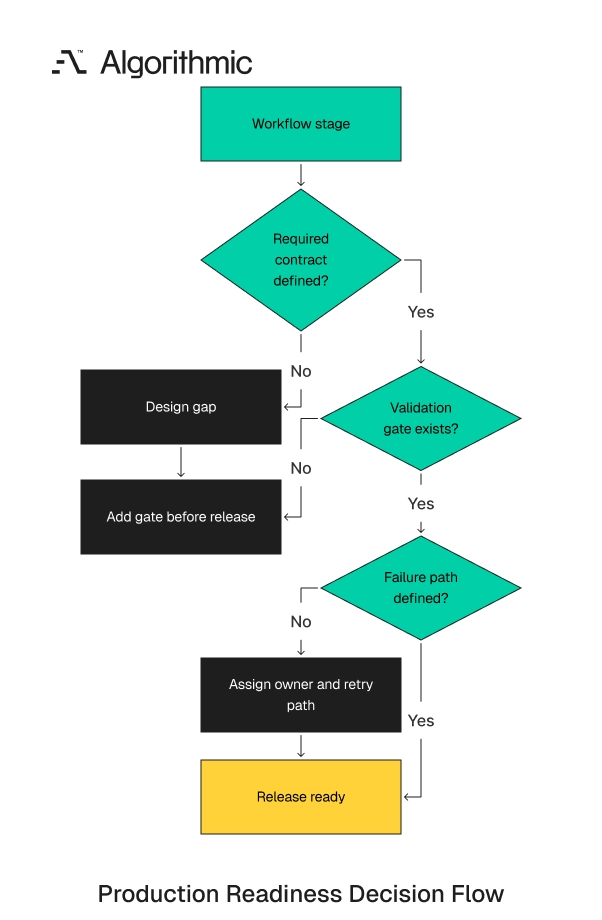
This matrix is a production checklist in compact form. It forces each stage to answer three questions, which are what contract applies, who validates it, and where the workflow goes when validation fails. A mature team assigns owners to each row, so security owns permission scope and data classification, product owns policy thresholds and customer-facing templates, and engineering owns transaction boundaries, idempotency keys, and audit logging.
The matrix also exposes gaps during design reviews. If no team owns prompt registry checks, a model change can enter production through configuration. If no owner controls idempotency, retries can create duplicate side effects.
 Click to expand
 The matrix should sit inside the architecture review, not in a post-incident document. Each row maps to a design decision that engineers can test before release. That testability is the difference between governance language and production control.
Tool-calling agents need stricter boundaries than chat interfaces
Tool use raises the risk level because the LLM can trigger side effects. Reading from a knowledge base has one risk profile, while updating Salesforce, issuing refunds, changing subscription status, or sending customer emails has another. Research on tool-using agents shows that complex tool outputs remain difficult for models to process reliably, and the EACL paper How Good Are LLMs at Processing Tool Outputs? studies realistic tasks where agents call tools and then reason over structured JSON responses. This matters because production workflows require chained interpretation, where the agent retrieves account data, inspects invoices, classifies intent, selects a policy, then executes an action.
Each tool call should have a typed request, a typed response, and an idempotency key. Idempotency is essential for retries, so if a network timeout occurs after a tool executes, the retry should not create a duplicate refund, duplicate task, or second customer email. Tool definitions should also specify permission scope and side-effect class, because a read-only account lookup tool needs different controls than a refund tool, and a customer email tool should require template ID, recipient ID, source citations, unsubscribe handling, and approval state.
Generated code needs a separate boundary. If the LLM writes SQL, Python, JavaScript, or workflow definitions, execution should occur in a sandbox with resource limits, read-only defaults, and an allowlist of operations, and the output should be reviewed as an artifact before it gains write access to production systems. A SQL-generating assistant should start with read-only database credentials, block DROP, DELETE, UPDATE, INSERT, external network calls, and unbounded queries, and run query execution with a row limit, timeout, and query plan inspection for large tables.
Shopify’s work on flow generation through natural language is instructive because it frames natural language as an interface to structured automation. That direction is correct for serious product engineering, because natural language can create or modify a workflow while typed workflow semantics govern execution. The same principle applies to Zapier-style automations, internal runbooks, and no-code workflow builders, so the model can draft a flow, but the platform must validate triggers, actions, permissions, secrets, retry behavior, and rollback paths before activation.
High-risk tools also need dry-run mode, so a refund tool should return the proposed ledger entry before posting it, and a CRM update tool should show the exact fields that will change before commit. Tools should also define allowed failure modes, so a timeout, partial response, rate limit, and permission denial should produce distinct states, because collapsing every tool failure into error removes the information operations teams need.
Tool access should follow least privilege. A lead-classification agent should never receive credentials that can modify billing records. A support-routing agent should never receive a send-email tool unless the workflow requires outbound communication.
Reliability measurement must test repeated execution, perturbation, and failure
Single-run demo success is a weak metric. Production systems need reliability under repeated execution, input variation, and infrastructure faults, and a demo that succeeds once under supervision says little about unattended performance across 50,000 monthly actions. ReliabilityBench, published in January 2025, proposes evaluating LLM agents across repeated runs, task perturbations, and infrastructure failures through a reliability surface R(k, ε, λ), and that framing is useful for product teams because it reflects operational reality, since customers rephrase requests, APIs time out, and retrieval returns different document sets as content changes.
Replayability also matters for regulated domains. The 2026 determinism-faithfulness study reports 4,700+ agentic runs across 7 models, 4 providers, and 3 benchmarks at T=0.0, and it found that decision determinism and task accuracy were not detectably correlated, with r = -0.11, 95% CI [-0.49, 0.31], and p = 0.63. That result carries architectural weight, because a system can repeat the same decision and still be wrong, and a system can be accurate on average and still fail audit replay.
Product leaders need to measure both accuracy and replay behavior. The former tells the team whether decisions are useful. The latter tells the team whether decisions can be reconstructed, explained, and governed after the fact.
For an AI product development studio or internal ML systems team, minimum reliability tests should include:
- Contract adherence rate: percentage of outputs that pass schema validation on the first attempt.
- Business-rule pass rate: percentage of schema-valid outputs that satisfy domain constraints.
- Retry recovery rate: percentage of failed outputs corrected by one constrained retry.
- Human escalation rate: percentage of cases routed to review.
- Side-effect defect rate: number of incorrect writes, sends, refunds, or workflow triggers per 1,000 executions.
- Replay variance: percentage of identical inputs that produce materially different decisions across repeated runs.
- Audit completeness: percentage of decisions with prompt version, model version, input hashes, tool responses, and final state transition recorded.
- Evidence support rate: percentage of accepted fields backed by quoted source text or authoritative system records.
- Policy block accuracy: percentage of blocked actions that match documented business policy.
- Time-to-detection: median time between a model-related defect and operations visibility.
For many customer operations workflows, a 95% task success rate is inadequate if the remaining cases create public errors or manual cleanup. At 50,000 automated actions per month a 5% defect rate creates 2,500 exceptions, and if each exception takes 8 minutes to review, the team spends 333 hours per month on remediation. The cost model should include customer impact as well, because a wrong refund email consumes support time, finance review, and customer trust, and a wrong entitlement change can block production access for an account with a six-figure annual contract.
Reliability testing should run before each prompt, schema, retrieval, model, or tool change. The test set should include common cases, adversarial cases, malformed inputs, long threads, multilingual content, and records with conflicting system state, and production data should be redacted, sampled, and retained under the same access controls as other customer data. The test suite should also cover known outage modes, including tool timeouts, partial retrieval failure, stale index results, rate limits, and provider failover, because these cases reveal duplicate writes, unhandled retries, and incomplete audit records.
Reliability tests should also include permission drift, so a user who loses account access should lose access to model-generated actions tied to that account, and a cached prompt context should expire when permissions change. Teams should also test repeated execution under fixed inputs, so run the same 500 cases five times across the target model and provider path, and measure changes in classification, evidence, tool selection, and recommended action.
Market adoption increases the cost of weak interfaces
NLP adoption has moved from experimentation into operations. Most enterprises now run language models in customer-facing workflows, and the market keeps expanding, so that shift makes the model boundary a production concern, not a research detail. Adoption at that scale changes the engineering standard, because a prototype can rely on prompt discipline and manual review, while a product workflow connected to CRM, billing, support, compliance, or customer messaging needs deterministic control points.
Software architecture now matters more than prompt wording. Prompt changes should be treated like code changes that are versioned, reviewed, tested against regression suites, and tied to release records, and model provider changes should pass contract tests before production traffic moves. A senior software development team should also separate model evaluation from product validation, because model evaluation asks whether the LLM gives useful answers, while product validation asks whether the system accepts only safe, typed, authorized, and traceable outputs.
This separation prevents a common governance failure. A team celebrates improved benchmark scores, then ships a model that violates a downstream enum or changes tool-call order, so the model evaluation improved while the product contract failed. Procurement and security reviews should also ask different questions, because vendor accuracy claims do not prove production readiness, so the team needs retention settings, regional processing controls, incident response terms, rate limits, audit logging, model version policy, and support for structured outputs.
Buyers should request evidence from production-like tests. A vendor should show contract adherence rates, side-effect defect rates, audit fields, and failure routing for workflows similar to the buyer’s environment, because general benchmark results do not answer those questions. The vendor review should include failure examples, so ask for malformed-output handling, policy-block routing, and audit trails from test runs, because a vendor that cannot show those artifacts has not proven operational control.
Internal teams need the same discipline. A prototype notebook, Slack bot, or service ticket automation becomes production software when it changes customer-visible state. The engineering standard should change at that boundary.
Build guidance for CTOs creating LLM-driven workflows
The safest path is incremental. Start with one workflow, one schema, one failure path, and one audit trail, then expand after the interface proves stable under real traffic. A good first workflow has high volume, clear rules, and low side-effect risk, such as support ticket classification, knowledge-base article recommendation, lead enrichment, or internal case summarization, while refunds, entitlement changes, medical advice, credit decisions, and legal communications should wait until the contract pattern is proven.
The first production release should have a narrow blast radius. Limit tenants, record types, tool calls, and automated actions, and increase coverage only after dashboards show stable contract adherence and low manual cleanup. Choose a workflow with measurable ground truth, so support routing can be compared against agent corrections, and lead classification can be compared against sales acceptance and downstream conversion.
Avoid starting with workflows that require judgment across policy, law, or contract terms. Those workflows need stronger review loops and longer test periods. They also need named business owners for every decision rule.
Use schemas as product contracts
Define schemas in the same repository as application code, version them, generate validators from them, and add regression tests with real examples from production logs after removing private data. OpenAI structured outputs, Anthropic tool use, JSON Schema, Pydantic, Zod, and Protobuf all serve this purpose, and the technology choice is secondary to the discipline, because every model output that drives product logic must pass a machine-checkable contract.
Schema versions should follow release rules. A new enum value should require a migration plan, a dashboard update, and a test case, while removing a field should require downstream owner approval. Schemas should also encode evidence requirements, so if the model extracts renewal_blocker = procurement, the object should include a source quote or reference, and if the field comes from a retrieved system record, the object should include the record ID and timestamp.
A schema should also define nullable fields with care, so null should mean unknown, unavailable, or intentionally withheld only when the schema states that meaning, because loose null handling hides evidence gaps. Schema names should match business language, so if operations uses P1, the schema should not introduce high, and if legal uses pending_review, the workflow should not invent legal_hold.
Schema design should include deprecation windows. Downstream systems need time to read two versions during migration. A forced cutover across CRM, analytics, and support queues creates avoidable incident risk.
Put provenance in every state transition
Each accepted model output should carry provenance fields. Required fields include model name, provider, prompt version, schema version, source record IDs, retrieval document IDs, tool response IDs, timestamp, and validation result, and these fields turn a model decision into an auditable product event. For high-risk workflows, logs should be signed or stored in append-only infrastructure such as AWS CloudTrail, Datadog audit events, OpenTelemetry traces, and database-level audit tables, so that every customer-facing action has a traceable chain.
Provenance should also capture rejected decisions, because rejections reveal schema drift, prompt regressions, and policy conflicts, and a queue of failed outputs often gives engineering teams the fastest path to improving the interface. Retention rules need explicit design, because some source content should not be stored in logs, so in those cases the system can store hashes, record IDs, redacted snippets, and validation outcomes while preserving audit value.
Provenance also reduces incident response time, because an engineer should find the prompt, model, source records, tool responses, and final write from a single audit event, and without that chain teams reconstruct incidents from chat logs and database diffs. Provenance should include the human actor when review occurs, so if an analyst approves a proposed refund, the audit record should contain analyst ID, approval time, and policy basis, and that record protects customers, employees, and the company during disputes.
Hashing also matters for replay. Store hashes of prompt inputs, retrieved documents, and tool responses when full text retention is restricted. Hashes let investigators verify that the original evidence set changed or remained stable.
Separate recommendation from execution
A model recommendation should be stored as a proposed action. Execution should occur through application services that already enforce permissions, state transitions, rate limits, and idempotency, and this pattern protects existing product controls. This separation is essential for refunds, account changes, outbound communication, legal review, medical workflows, financial workflows, and anything that affects customer entitlements, so human approval should be a product path with SLA tracking, not improvised exception handling in Slack or email.
For example, a support agent assistant can propose refund_customer with amount, reason, evidence, and confidence, and the billing service should apply refund limits, payment status checks, fraud rules, and approval thresholds, so the final write comes from the billing service, not the model integration layer. The same rule applies to outbound communication, because the model can draft a response and cite sources, while the messaging service checks template policy, recipient status, legal language, unsubscribe rules, and send permissions.
This pattern also supports gradual automation, so a workflow can start with human approval for every proposed action, and after 10,000 reviewed cases and stable defect metrics, the team can automate narrow actions under fixed thresholds. The proposed-action record should expire, because a recommendation based on a customer record from Monday should not execute Friday after the account status changes, so expiration windows prevent stale model output from becoming late operational state.
Execution services should also re-check state at commit time. A proposed refund can pass review and still fail because the invoice was voided. The service should block the write and record state_changed_before_commit.
Treat failures as designed states
A failed LLM response should not become an application error by default. It should become a designed state such as needs_clarification, needs_human_review, policy_blocked, schema_invalid, or insufficient_evidence, and those states should be part of the product model. These states should appear in dashboards, because operations teams need counts, queues, aging, owners, and reasons, while engineering teams need traces, payload samples, and release correlations.
Designed failure states also improve customer experience, so if evidence is insufficient, the product can ask a specific follow-up question, and if policy blocks an action, the product can return an approved explanation. Teams should measure these states as part of system health, because a rising needs_human_review rate after a prompt release signals a regression, and a rising policy_blocked rate after a pricing change signals a policy mismatch or training gap.
Failure states should also feed planning, so if one workflow sends 18% of cases to review, automation scope is too broad or policy data is missing, and the right response is a product and data fix, not a larger prompt. Failure states also need staffing plans, because a human-review queue without ownership becomes delayed work, and delayed work becomes missed SLAs, stale customer records, and reporting noise.
The product should also distinguish recoverable and terminal failures. schema_invalid can support one retry. missing_permission should stop execution and produce a security event.
Add release controls around prompts and models
Prompt changes should move through pull requests, code review, test runs, and deployment records. The prompt registry should record owner, purpose, schema version, model version, allowed tools, and rollback target, and a prompt without an owner should not ship. Model upgrades need the same release discipline, so a move from GPT-4.1 to GPT-5, Claude 3.5 to Claude 4, or one hosted model snapshot to another should run against the regression suite, and the team should compare contract adherence, business-rule pass rate, side-effect defects, latency, and cost.
Release controls should include canary traffic. Send 1% of eligible cases through the new model or prompt, compare metrics, then increase traffic in stages, and roll back when schema failures, business-rule failures, or review queues exceed thresholds. Prompt release notes should state what changed in operational terms, because “Shortened instructions by 30%” is less useful than “removed renewal blocker examples and changed confidence threshold guidance”, and operations teams need that detail when queues move.
Rollbacks should be tested before launch, because a rollback that requires manual configuration across three services creates incident delay, so the release plan should include a one-command rollback or a tested feature flag. Prompt owners should review production metrics after release, because a passing test suite does not end ownership, since the first 24 hours of traffic often reveal tenant-specific records, long threads, and unusual policy states.
The production standard for LLM product logic
Across 35+ complex engagements at Algorithmic, including platforms serving millions of users, the same pattern holds, because production systems succeed when probabilistic components are enclosed by deterministic interfaces. Senior architects write the contracts, validation gates, failure paths, and audit trails before connecting models to customer-facing operations. The production standard is clear, so treat the LLM as an interpreter and treat product logic as governed software.
Require typed intermediate formats, schema validation, business-rule validation, explicit failure paths, idempotent tools, sandboxed execution, and signed provenance for every decision that changes state. Connect those controls to dashboards, release records, and incident response, and measure the system under repeated execution, varied inputs, and infrastructure faults. CTOs building AI agents or NLP system development into operational workflows should audit one live workflow this week, trace the path from raw model output to customer-facing action, and identify every untyped boundary to add a contract gate before the next release.
Start with the workflow that writes to the most important operational system. In most companies, that is CRM, billing, support, identity, or customer messaging. One well-designed contract gate in that path reduces incident volume, audit exposure, and manual cleanup within the first release cycle.
Algorithmic builds LLM systems and automation behind typed contracts, validation gates, and explicit failure paths. Talk to us about your model boundary before free-form output reaches production data.