
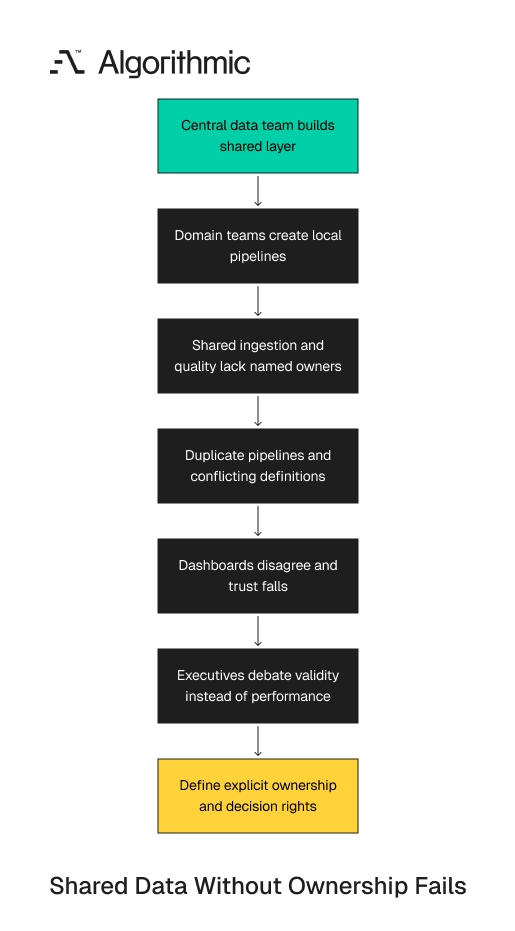
Enterprises spend an average of $29.3 million per year on data programs, according to Fivetran’s 2026 enterprise data infrastructure benchmark, and the same benchmark reports $2.2 million spent each year to keep data pipelines running. That level of spend will not produce trusted analytics, production ML systems, or board-ready dashboards while ownership boundaries remain unclear. The failure pattern is consistent, so a central data team builds ingestion from Salesforce, Stripe, Segment, Snowflake, and product databases, and domain teams then create pipelines, dbt transformations, metrics, and reverse ETL jobs for local reporting needs.
Six months later, revenue has three definitions, customer status has four, and no team accepts ownership, so the product dashboard disagrees with finance, and the weekly executive meeting becomes a debate about data validity instead of operating performance. This is a data platform operating model failure, because the tools can be sound, since Snowflake, BigQuery, Databricks, dbt, Airflow, Dagster, Fivetran, Kafka, and Monte Carlo all work inside the right architecture.
The platform fails when every team can create production data assets without shared rules. Shared ingestion, tracking, schemas, quality contracts, and incident response need named owners, because production data systems degrade when those owners exist only in Slack threads and meeting notes. The cost compounds quickly, because one duplicate Salesforce ingestion job adds connector spend, warehouse storage, dbt compute, and reconciliation labor, and five duplicate source systems create a permanent tax on analytics engineering capacity.
That tax rarely shows up as one line item. It surfaces as delayed month-end close, analysts reconciling dashboards, ML engineers rebuilding feature tables, and executives discounting reports. By the time leaders see the pattern, the platform has already encoded the ownership gap into production workflows.
Decentralized execution needs explicit platform ownership
Data platform development often starts with a central constraint. One team receives every analytics request, data pipeline request, and metrics change, so delivery slows, business teams lose confidence, and engineering leaders move toward decentralization. That response is rational, because domain teams understand source systems, customer journeys, pricing rules, and product events better than a central platform group, and data mesh architecture formalizes this by treating data as a product owned by business domains, so data ownership should follow business structure.
The common mistake is decentralizing execution before defining the shared layer. Domain teams receive permission to create pipelines, publish tables, and define metrics, while the platform team retains nominal responsibility for the warehouse, orchestration, and access control. That nominal responsibility has limited value without decision rights, because the platform team needs authority over schema standards, source ingestion, naming, lineage, and quality gates, and without that authority it becomes the group paged for failures it did not approve.
 Click to expand
 A federated model works when the boundary is explicit. The platform team owns shared infrastructure and cross-domain contracts, while domain teams own domain-specific models, data products, and metrics. Governance defines how those two layers meet, specifying who approves a breaking change, who handles a failed freshness test, and who accepts the on-call page, and that precision turns decentralization from a staffing model into a production operating model.
This distinction matters during budget planning. A company can fund five embedded analytics engineers and still leave source ingestion unowned, because headcount placement solves delivery pressure only when decision rights and service boundaries are defined. The same issue appears during reorgs, where a vice president moves analytics engineers into product squads and expects faster delivery, so delivery improves for local dashboards, then shared revenue reporting weakens because no group owns the common definitions.
Leaders need to separate execution rights from production ownership. A domain team can build a model for its sales funnel. The shared platform still needs one owner for ingestion, naming, security, lineage, and release rules.
Four ownership gaps create most platform failures
Ambiguous ownership shows up in four places, and each creates a different operating failure, so together they explain why data platforms degrade after the first wave of adoption. The pattern appears across industries, since subscription software firms see it in ARR reporting, and retailers see it in customer identity, inventory, and promotion analytics.
Financial services firms see it in risk reporting and customer eligibility models, and healthcare organizations see it in patient attribution, claims ingestion, and care management dashboards, so the symptoms differ by domain while the ownership gaps stay consistent. These gaps also compound, because duplicate ingestion weakens schemas, weak schemas produce quality alerts, and unowned alerts teach teams to bypass the platform.
 Click to expand
 Shared ingestion becomes duplicated
Duplicate ingestion is the earliest warning sign. Marketing creates a HubSpot pipeline through Fivetran, and sales creates a second HubSpot pipeline through Airbyte, while finance exports CSVs into S3 because neither pipeline includes historical owner reassignment, and customer success then builds a Python job to reconcile lifecycle stage changes, so four pipelines now represent one source system.
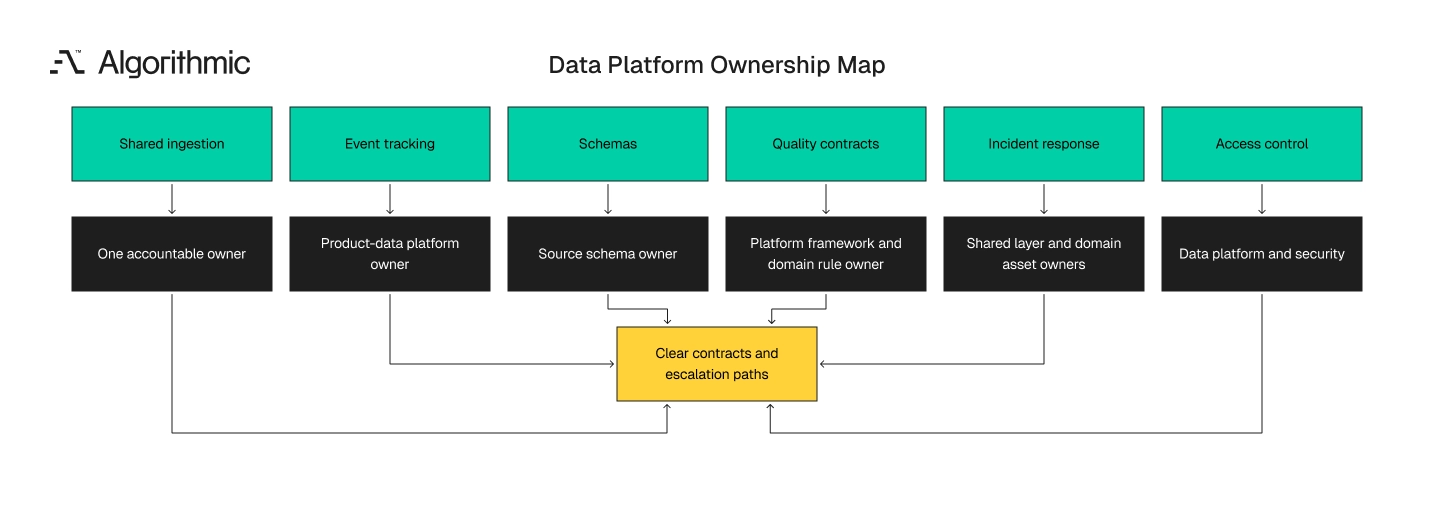
Each pipeline has a rational origin and solves a local problem, yet the combined result is duplicate spend, inconsistent refresh cycles, and divergent source-of-truth tables. Shared ingestion needs one accountable owner, who controls connector configuration, raw zone conventions, incremental sync policy, schema drift handling, and backfill procedures, while domain teams request fields and define use cases.
Domain teams should create parallel ingestion for the same enterprise source system only through a recorded exception. A formal exception should name the owner, business reason, expiration date, and reconciliation plan, because without those fields the exception becomes permanent architecture. The exception process must be lightweight and recorded, so a one-page decision record in GitHub or Confluence is enough for most teams, and the record should state whether the parallel pipeline ends after a backfill, audit, or migration.
Ingestion ownership also affects security and audit evidence. Two Salesforce connectors can apply different field-level permissions, masking rules, and retention settings, and that difference becomes an audit problem when one pipeline contains PII that the approved pipeline excludes. A strong ingestion owner maintains a source-system register that lists each approved connector, sync frequency, target schema, credential owner, and downstream consumer group, and also records the last backfill date and the procedure for replaying source history.
The register should include cost fields, because connector fees, warehouse storage, compute cost, and monthly row volume make duplication visible, so a duplicate NetSuite or Salesforce pipeline can cost more than the connector invoice once reconciliation labor is included. The owner also needs authority over credentials, because a source system should not have five production service accounts created by separate teams, since credential sprawl weakens audit control and makes incident response slower during source outages.
Backfill ownership requires special attention. Historical loads often bypass normal validation because teams see them as one-time work, so a backfill can overwrite months of revenue history if it lacks row-count checks, date-range controls, and approval evidence. The ingestion owner should define raw-zone immutability rules, so teams can build derived tables from raw data but should not rewrite raw history without a migration record, validation query, and rollback plan.
Tracking standards drift across product teams
Product analytics suffers when event tracking has no single accountable owner. One team records trial_started, another records free_trial_created, and a mobile team sends Trial Start with different casing and no plan identifier, so the warehouse receives three events for the same customer action, and analysts then spend hours mapping event names before they can answer basic conversion questions.
This produces a downstream analytics system that requires interpretation before leaders can trust it, because customer analytics, recommendation systems, and churn models inherit inconsistent event semantics, so the model training pipeline reflects the tracking drift. Tracking ownership should sit with a small product-data platform function with domain input, so that team owns the event registry, naming standards, required properties, versioning rules, and deprecation policy, while product teams own correct instrumentation inside their applications.
This split gives product teams speed while preserving semantic consistency. A product squad can ship a new onboarding flow, and the event registry verifies that trial_started, plan_selected, and payment_method_added carry the same identifiers across web, iOS, and Android. The registry should define required properties before engineering starts, so for a trial event required fields usually include customer_id, account_id, plan_id, workspace_id, source_channel, and event timestamp, while optional fields can include experiment assignment, campaign identifier, and UI surface.
Versioning rules matter when applications change. If plan_id changes from an integer to a string, downstream models need notice before the release, and if a new mobile flow omits workspace_id, the tracking review should block release until instrumentation is complete. A strong tracking process includes automated tests, so Segment Protocols, Snowplow contracts, or custom CI checks can reject events that miss required fields, which prevents invalid events from reaching the warehouse and becoming accepted reporting inputs.
Ownership should also cover event retirement. Product teams often stop using flows while the old events remain in dashboards and notebooks, so the registry should mark deprecated events, list replacement events, and define the final collection date. Experimentation raises the standard further, because if product teams run A/B tests, assignment events need stable user identifiers, experiment IDs, variant IDs, and exposure timestamps, and missing fields turn statistically valid experiments into manual investigations.
Tracking decisions affect revenue teams as well. A lifecycle campaign in Braze or Salesforce can depend on payment_method_added or trial_expired, so if those events drift across platforms, customer outreach becomes inconsistent. The product-data platform function should publish examples, because engineers need sample payloads, approved property names, casing rules, and validation failures, and a clear example prevents dozens of small interpretation errors during sprint work.
Schemas change without compatibility rules
Schema change is where governance failures become production incidents. A source team renames account_id to customer_account_id, a dbt model fails, a Looker dashboard goes stale, and a reverse ETL job sends incomplete segments to Braze or Salesforce, so a customer success team then calls accounts with outdated renewal risk scores.
The incident then enters an unowned dispute. The source team argues that its database change was valid, the analytics team argues that no one communicated the change, and the platform team argues that it owns infrastructure, not application schemas. That argument exposes the gap, because production data assets need compatibility rules that bind source teams and downstream consumers.
A production-ready data platform needs published compatibility rules. Schema owners must publish change windows, deprecation periods, and backward-compatibility requirements, and for high-use tables a 30-day deprecation window is a practical minimum. Regulated or finance-critical data often needs 60 to 90 days, because the longer window gives finance, risk, and compliance teams time to validate reports, and it also gives downstream engineering teams time to update tests and reverse ETL jobs.
Compatibility rules should define the exact change class. Removing a column, changing a field type from integer to string, changing the grain of a table, and changing business logic inside a metric are all breaking, while adding a nullable column is usually safe when downstream tools tolerate additional fields.
The rules need enforcement in the delivery path. Source teams can publish schema changes through pull requests, migration files, or event contract updates, and data platform tooling should compare proposed changes against registered downstream dependencies. Lineage data makes the review concrete, so if account_id feeds 18 dbt models, 7 Looker dashboards, and 2 reverse ETL syncs, the change requires a scheduled window, because without lineage teams discover the dependency during the outage.
Schema ownership should include domain context. A platform engineer can detect a renamed field, while a domain owner must confirm whether the business meaning changed. Table grain deserves explicit documentation, because one row per customer, one row per subscription, and one row per workspace create different analytical results, and a grain change can damage metrics even when every column name remains stable.
Compatibility rules should cover source APIs and event streams, because Kafka topics, webhook payloads, and SaaS API responses can break downstream systems like database schemas, so a renamed JSON field can disable a production feature table within one batch run. The review path should include emergency handling, because a security fix or source-system outage may require immediate schema change, so the incident record should state the downstream impact, mitigation plan, and follow-up work.
Quality contracts have no accountable maintainer
Data quality monitoring fails when alerts go to shared channels without named owners. A freshness test fails in dbt, a null-rate test fails in Great Expectations, and a volume anomaly appears in Monte Carlo, so twenty people see the alert, no one owns resolution, and it remains unresolved until a business stakeholder reports a broken dashboard.
Quality contracts need owners at two levels. The platform team owns the test framework, alert routing, severity policy, and incident workflow, while domain teams own the correctness of the business rules inside their data products. This split prevents operational drift, because platform engineers should not decide the valid states of an insurance policy or the correct definition of active subscriber, and domain teams should not maintain orchestration retry logic or warehouse permission design.
A useful quality contract names the rule, threshold, owner, severity, and response target. For example, a revenue table can require less than 0.5% nulls in invoice_id and four-hour freshness, and the contract should route failures to the revenue data owner, not a general analytics channel. Quality ownership should cover alert fatigue as well, because a test that fails daily and receives no action trains teams to ignore the channel, so every recurring alert needs retirement, threshold adjustment, or a named remediation plan.
Severity design needs business context. A 90-minute delay in a weekly product dashboard is a low-severity defect, while a 90-minute delay in payment failure segments can affect customer outreach and revenue recovery. Good quality contracts include validation data, so a revenue owner can define acceptable variance against Stripe, NetSuite, or the general ledger, and a customer owner can define acceptable record counts against Salesforce or the CRM master account table.
Quality rules should also define sampling and lookback windows, because a daily null-rate test on new invoices has different behavior than a 90-day rolling completeness test, so the contract should state which population the test covers. Ownership must include remediation authority, because an alert owner who cannot change source logic, dbt models, or orchestration settings can only report failures, so the assigned owner needs either direct write access or a clear path to the engineering team that can fix the defect.
Quality contracts should separate detection from decision-making. Automated tools can identify late data, duplicate rows, and invalid values, while domain owners decide whether a variance is acceptable for a specific business process. Incident reviews should feed new tests, so if a board dashboard fails because deleted accounts were included, the next release should add a test for account status rules, because quality improves when every incident leaves a control behind.
A practical ownership map for data platform development
A clear ownership map is the first artifact CTOs should request before approving a central, federated, or data mesh architecture. Tool selection can wait until this map exists. A $400,000 migration plan has weak foundations if no one can name the owner of the top 25 tables.
| Platform area | Accountable owner | Domain team role | Required contract |
|---|---|---|---|
| Source ingestion | Data platform team | Request fields, validate source meaning | Connector policy, backfill process, refresh SLA |
| Raw and staging schemas | Data platform team | Review field semantics | Naming standard, schema drift policy |
| Product event tracking | Product-data platform team | Instrument events in applications | Event registry, version policy, required properties |
| Domain models | Domain data team | Primary owner | dbt model contract, test coverage, documentation |
| Shared metrics | Metrics council or analytics engineering | Propose and maintain metric logic | Metric definition, owner, approval path |
| Data quality framework | Data platform team | Own domain-specific rules | Severity levels, alert routing, response SLA |
| Access control | Data platform and security | Request access patterns | RBAC policy, audit logging, approval workflow |
| Incident response | Data platform for shared layer; domains for domain assets | Resolve owned failures | Runbook, escalation path, post-incident review |
This table is deliberately operational, because it names who accepts a page at 02:00 and who approves a schema change. It also separates infrastructure from business semantics, so platform teams own common machinery, while domain teams own the business meaning embedded in the data. Without this artifact, the operating model relies on individual judgment, which works with 5 engineers and 20 dashboards but fails with 50 engineers, 400 dashboards, and production ML features that depend on the warehouse.
The map should also include deputies, because a named owner without backup coverage creates a single point of failure, so a mature platform records primary owner, secondary owner, escalation manager, and review cadence for each shared asset. Ownership maps should live where engineers work, because a static slide deck becomes stale within one release cycle, while a catalog entry, YAML file, or Git-backed registry keeps ownership close to code and review workflows.
The map should identify business owners as well as technical owners, because a technical owner can fix a failed dbt model, while a business owner must approve the definition of active customer, net revenue retention, or qualified pipeline. Review cadence matters too, so monthly review works during stabilization, while quarterly review works once ownership metadata reaches high coverage and incident volume declines. The map should include asset criticality, because board reporting tables, payment failure segments, regulatory extracts, and customer-facing ML features need higher review standards, while a low-use exploration table should not carry the same process burden.
Ownership metadata needs tests as much as data does. A CI check can reject a production dbt model without an owner, description, freshness target, and severity class, which converts policy into engineering practice. The map should also include consumer groups, because a table used only by one analyst has different risk than a table used by finance, customer success, and marketing automation, so consumer visibility helps teams schedule changes without broad disruption. A useful ownership map answers five questions within one minute, covering who owns the asset, what it promises, who consumes it, what happens when it fails, and who approves change.
The operating model needs contracts, change windows, and SLAs
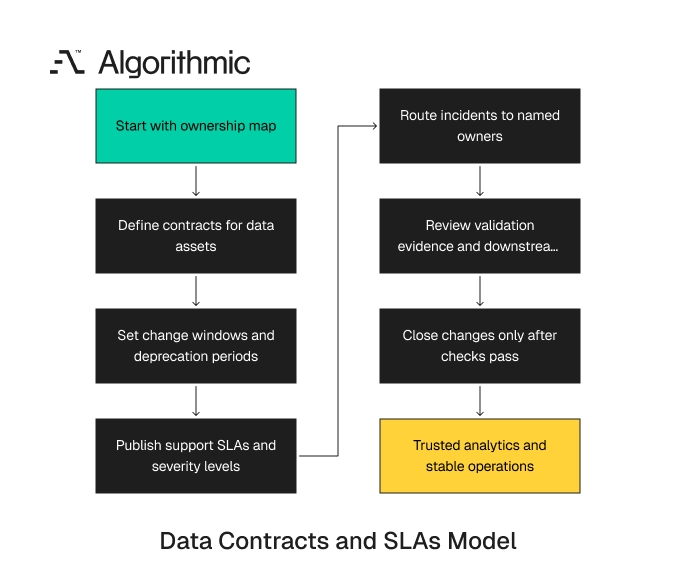
Strong data platform development treats shared data infrastructure as a product. Component teams that serve many internal customers need documented API contracts, a versioned roadmap, and service-level agreements. The same logic applies to ingestion jobs, tracking registries, shared dimensions, metric layers, and orchestration frameworks.
 Click to expand
 These artifacts reduce interpretation during incidents, and they also protect platform teams from unbounded support demand, because a contract turns a vague Slack request into a request with owner, scope, priority, and acceptance criteria. Operating discipline should be visible to business leaders, so finance does not need to read every dbt contract, but finance does need to know which table governs board reporting and which owner approves metric changes.
This operating model should fit existing engineering workflows. Teams should review contracts through pull requests, publish decisions through Git-backed records, and route incidents through the same paging system used for applications. Separate governance rituals fail because engineers avoid duplicate process.
Published contracts reduce interpretation
A contract is a written agreement about behavior. For data platforms, contracts should cover schema, freshness, completeness, allowed values, ownership, and downstream use, and they should live in the same workflow as code. Practical storage options include GitHub, GitLab, dbt contracts, OpenAPI specifications, and a data catalog with version control, and the storage location matters less than review discipline, so every production contract should require pull request review or an equivalent approval path.
A useful table contract includes five fields, which are owner, grain, primary key, freshness target, and breaking-change policy. A customer dimension, for example, can define one row per customer account, and it can also specify customer_id as primary key, 4-hour freshness, and a 60-day deprecation period. The contract should also state what the table excludes, so if a table excludes deleted accounts or test tenants, that exclusion must be explicit, because analytics incidents often come from unstated exclusions.
Metric contracts need the same discipline. Annual recurring revenue should define currency conversion, discount treatment, refund handling, and timing rules, because without those fields sales, finance, and product will each produce a defensible version of the same metric. Contract review should include downstream consumers, because a table owner who changes grain from account-level to workspace-level affects dashboards, ML features, and reverse ETL jobs, so the review process should surface those consumers before approval.
Contracts also need retirement rules. Data platforms accumulate abandoned tables with valid names and invalid business meaning, so owners should mark deprecated assets, publish replacement paths, and set removal dates. A complete contract has operational fields as well as semantic fields, so it should define the runbook link, alert destination, escalation manager, and expected recovery action, because during an incident those fields reduce time spent searching for context.
Contracts should contain examples, so a customer table contract can show one valid row, one invalid row, and one edge case such as a merged account, because examples clarify business meaning faster than abstract definitions. The contract should record validation sources, so a revenue contract can reference Stripe invoices, NetSuite journal entries, and the general ledger close process, while a product activation contract can reference application events and account state.
Ownership transfer needs a contract path. When a domain team reorganizes, assets should not inherit an abandoned owner field, so a transfer record should name the old owner, new owner, acceptance date, and open defects. Contract quality should become a release criterion, so production data assets without contracts should remain experimental until the owner documents behavior, tests, and support, which prevents undocumented assets from entering executive reporting through convenience.
Change windows protect downstream systems
Shared data assets need release discipline. A schema change that lands during quarter-end close can stop finance reporting, and an event rename during an A/B test can invalidate experiment analysis. Change windows solve this, so high-use shared assets should have defined release windows, such as Tuesdays and Thursdays between 10:00 and 14:00 local time, while emergency changes route through an incident commander.
This is standard software release practice applied to data infrastructure. Application teams already use release freezes, backward compatibility, and incident commanders, and production data deserves the same operating rigor because dashboards, reverse ETL, and ML features now drive customer workflows. A compatibility policy should define breaking changes, so removing a field, changing a field type, altering grain, or changing metric logic should trigger review, while adding a nullable field can qualify as non-breaking.
The policy should include notification rules, so owners can require 10 business days of notice for low-risk changes and 30 days for shared dimensions, and finance-critical tables can require sign-off from finance systems, analytics engineering, and data platform leads. Change windows need a calendar and an exception path, where the calendar prevents teams from releasing sensitive data changes during quarter close, board reporting, pricing launches, or major experiments, and the exception path gives incident commanders authority during production failures.
The change process should capture validation evidence. For a schema migration, evidence can include dbt test results, row-count comparisons, and dashboard smoke tests, while for a metric change evidence should include before-and-after results for a defined reporting period. Backward-compatible design reduces coordination cost, so teams can add a new column, run both fields for 30 days, update downstream assets, and then remove the old field, which prevents single-release failures across multiple teams.
Release windows should include time zone clarity, because a global company with finance teams in London and San Francisco needs one calendar of record, since local interpretations create avoidable incidents during close and board reporting. Change records should be searchable, so six months after a metric change finance can find the approval, validation evidence, and owner decision without asking five teams, which reduces institutional memory risk.
A freeze policy should cover business events. Quarter close, annual planning, pricing launches, and major experiments should block non-emergency changes to critical tables, and the policy should list asset classes and freeze dates. Post-release checks also need ownership, because a release is complete only after downstream tests pass, dashboards refresh, and high-risk syncs validate, so the change owner should record those checks before closing the release.
Support SLAs create accountability
Data platform teams often carry informal support load through Slack, email, and recurring meetings. This creates queue ambiguity and masks capacity constraints, so a support SLA makes demand visible. A practical SLA has three severity levels, where Severity 1 covers production reporting, regulatory reporting, payments, or customer-facing ML features, with a 30-minute acknowledgement target and same-day mitigation.
Severity 2 covers business-critical dashboards or pipeline failures with a 4-hour acknowledgement target, while Severity 3 covers enhancement requests and non-urgent defects with a 3-business-day response target, and each severity level should define what mitigation means. The SLA should include intake rules, so requests need an owner, business reason, affected assets, deadline, and validation criteria, because without those fields platform teams become triage coordinators for unclear work.
Support data should be reviewed monthly. Leaders should inspect ticket volume, median response time, recurring incident classes, and domains with repeated defects, because the review converts support demand into staffing and architecture decisions. The SLA should state what falls outside platform support, so a platform team supports connector failures, orchestration defects, access issues, and shared schema incidents, while domain teams support metric logic, business-rule defects, and domain model correctness.
Service data also informs hiring, because if Severity 2 incidents cluster around event tracking, the company needs product analytics engineering capacity, and if access tickets dominate the queue, the company needs better RBAC automation and clearer approval rules. SLAs should connect to incident reviews, so a missed acknowledgement target requires a reason, such as unclear routing, missing owner metadata, or insufficient coverage, and the review should produce a specific fix and a named owner.
A good SLA also defines operating hours, so finance reporting during quarter close may need weekend coverage, while a weekly product dashboard rarely needs 24-hour support. Escalation paths should name roles and people, because a channel name does not accept accountability, so the SLA should list the primary responder, secondary responder, escalation manager, and business owner.
The platform team should publish a monthly service report. The report should include incident count, open defects, SLA misses, top request categories, and aging tickets, so executives can then fund the platform based on measured demand. The service report should also identify preventable work, because repeated access requests point to RBAC design gaps, and repeated freshness incidents point to orchestration capacity or source-system reliability.
Tool replacement does not repair unclear accountability
Many data platform failures are misdiagnosed as tool problems. The warehouse is blamed for slow dashboards, the orchestrator is blamed for failed pipelines, the BI tool is blamed for metric disputes, the catalog is blamed for poor documentation, and the feature store is blamed when model training data differs from online inference data.
Tool failures do exist, so query plans can be inefficient, Airflow deployments can suffer from poor DAG design, a BI semantic layer can restrict advanced modeling, Kafka topics can lack retention settings that match replay requirements, and Databricks jobs can fail because cluster policy and cost controls were designed after adoption. Unclear accountability creates failures across every tool stack, so data platforms fail as systems, not tools, and dashboard latency, metric conflict, an untrusted feature store, and CSV exports all signal operating-model failure.
Another critique argues that many shared platforms become collections of pipelines, permissions, conventions, and manual work instead of true internal products, and the practical test is direct. Internal teams should understand the contract, request a change, see the roadmap, and know the support path, so if they cannot do those four things, the platform is a shared technical asset with unclear service boundaries, and the same condition will reappear after the next tooling migration.
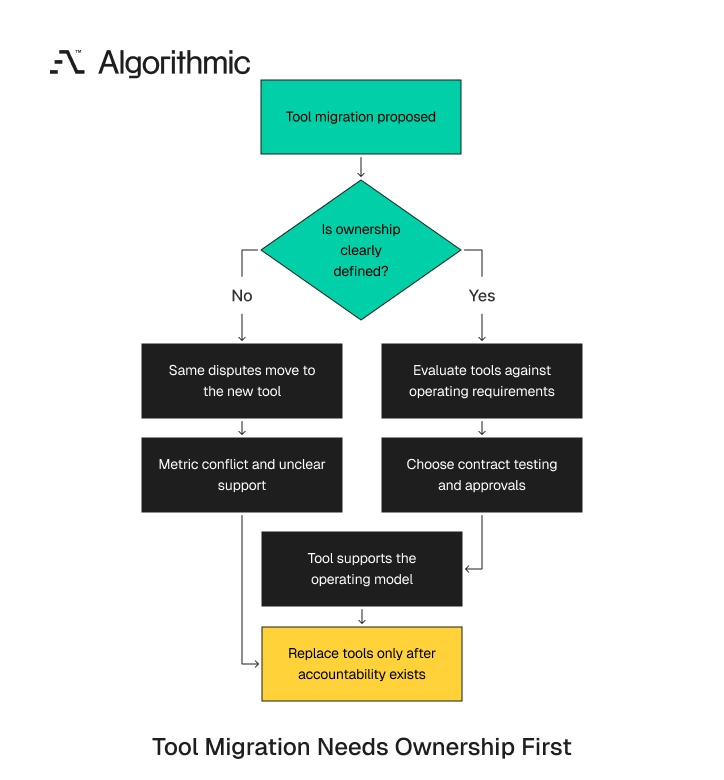
Replacing Looker with Power BI, Airflow with Dagster, or Snowflake with Databricks will not define ownership. A migration can reduce cost or improve performance, and it will also reproduce the same disputes if shared ingestion, schema ownership, and metric approval remain undefined.
 Click to expand
 The right sequence is operating model before tooling change, so define ownership, contracts, change windows, SLAs, and decision rights, then select tools that support those decisions. This sequence protects capital allocation, because a warehouse migration can consume six months of engineering time and a seven-figure services budget in a large enterprise, so that program should start after leaders know which teams own the data assets being migrated.
Tool selection should test operating requirements. If the organization needs domain-owned contracts, choose tooling that supports contract testing in CI, and if finance needs strict change windows, choose orchestration and catalog tooling that records approvals and lineage. A tool decision made before ownership design hides the harder problem, because vendors can show faster query performance and better interfaces but cannot decide who owns customer status, revenue recognition logic, or incident response.
The same discipline applies to AI and ML platforms. A feature store cannot fix inconsistent definitions of active customer or qualified opportunity, and model monitoring will detect drift, then teams still need an owner to decide whether the data is valid. Catalog deployments expose the same pattern, because a catalog can store ownership metadata, lineage, and definitions but cannot create accountable owners where the organization has refused to assign them.
The procurement process should include an operating-model review. Before signing a tooling contract, leaders should confirm owners, service boundaries, and migration decision rights, which protects the project from becoming a technical replacement for an organizational decision. A useful migration plan starts with asset ownership, so the plan should list critical tables, dashboards, ML features, reverse ETL syncs, owners, and validation criteria, because without that inventory migration teams will discover ownership gaps during testing.
Centralized, federated, and data mesh models require different boundaries
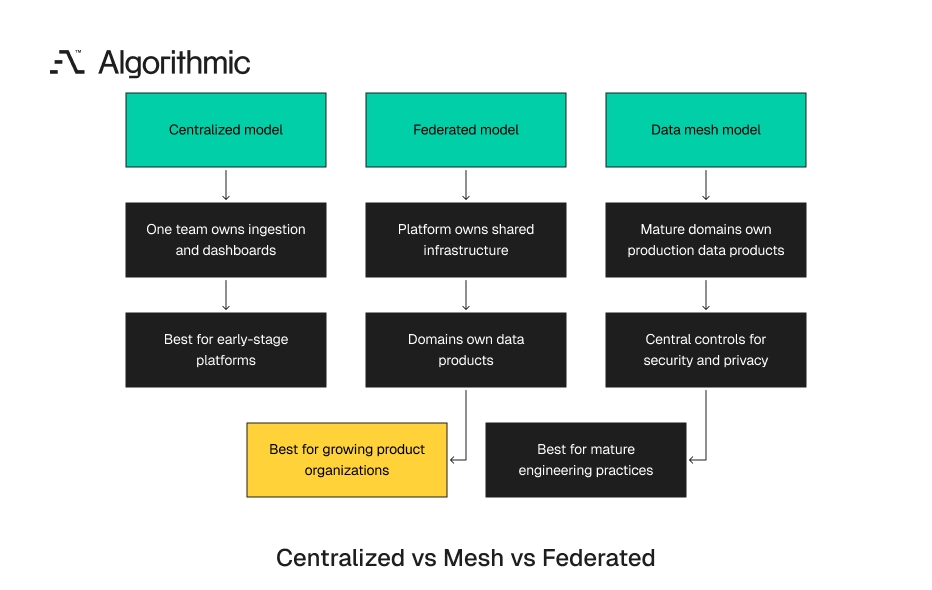
CTOs and heads of data usually face three operating choices, which are to centralize, federate, or adopt data mesh architecture. Each model works under defined conditions and fails when ownership is implied. The correct choice depends on the number of domains, source systems, data producers, and production data consumers, and on engineering maturity inside each domain, so a model that works for 6 producers and 40 dashboards will break under 40 producers and 600 dashboards.
Model selection should begin with facts. Count source systems, producers, downstream consumers, production dashboards, reverse ETL syncs, and ML features, then compare those numbers with the staff and operating maturity available in each domain. The choice should also reflect regulatory pressure, because a bank, insurer, or healthcare organization carries audit obligations that shape ownership design, so shared controls, evidence retention, and approval records need stronger discipline in those settings.
 Click to expand
 Centralized data teams suit early-stage platforms
A centralized data team fits companies with fewer than 10 data producers, a limited number of source systems, and early analytics demand. The team owns ingestion, transformation, dashboards, and quality, and decision paths are short. The constraint is domain knowledge, because as product lines, geographies, or business units grow, a central team becomes a translation layer for every business rule, so delivery queues lengthen and local teams create parallel pipelines.
Centralization should include a path to federation. The first version of the platform should establish standards that domain teams can later adopt, including naming conventions, model templates, ownership metadata, and incident workflows. A centralized model also needs intake discipline, so if one team owns all requests, leaders should measure cycle time by request type, because ingestion requests, metric changes, dashboard defects, and access changes should not compete in one undifferentiated queue.
Central teams should maintain a public backlog. Business leaders need to see which requests are queued, which are blocked, and which require source-system decisions, because this visibility reduces escalation and makes trade-offs explicit. The central model should also define graduation criteria, so a domain can receive more ownership after it has trained staff, working tests, documentation, and on-call coverage, because without criteria federation becomes a political negotiation instead of an operating decision.
Centralized teams should protect standards from the start. Early shortcuts become platform law when dashboards and workflows depend on them, so naming, grain, owner fields, and runbooks should exist before adoption grows. This model also needs executive backing for priority decisions, because a single central team cannot satisfy every request from finance, sales, product, and marketing at once, so leaders should approve the queue based on business value and production risk.
A small team can still act with production discipline. A five-person data team can publish contracts, track incidents, and assign ownership for shared tables. Process weight should match scale, while accountability should exist from the first production asset.
Federated models suit growing product organizations
A federated model fits organizations with multiple product or business domains and a shared data platform team, where the platform team owns common infrastructure while domain teams own domain data products. This model works well when there are 3 to 8 domains and each has at least one analytics engineer or data engineer, and it fails when domain teams receive ownership without staff, budget, or production obligations, because ownership without time allocation is a label.
Federation needs an architecture review forum. This forum approves shared metric changes, schema-breaking changes, new source ingestion, and cross-domain dependencies, and it should meet weekly and publish decisions as architecture decision records. The forum should include data platform, analytics engineering, security, and domain representatives, and a standing 45-minute weekly meeting is enough for most organizations, where the output is decisions, owners, and deadlines, not meeting minutes without commitments.
The forum also needs scope control, so it should review shared assets, breaking changes, access patterns, and high-risk metric definitions, but not approve every dashboard, local model, or low-risk domain change. Federation succeeds when the platform team has authority to reject work that violates standards, because a domain should not publish a shared table without an owner, tests, documentation, and a support path, since platform standards without enforcement create inconsistent production assets.
Funding should match the model. If domains own data products, domain budgets must include engineering time for maintenance, incidents, and documentation, because a federated model funded as a central support desk will fail under production load. Federation also needs shared tooling discipline, so domains should use approved templates for dbt projects, orchestration jobs, event contracts, and alert routing, which prevents local freedom from becoming production fragmentation.
Metrics need special treatment in a federated model. Domain teams can own local metrics, while shared executive metrics require a review body, so revenue, active customer, churn, and qualified pipeline need one approved definition. Federated ownership should appear in performance expectations, because if domain leaders own data products, their teams should be measured on freshness, quality, documentation, and incident response, since ownership without management accountability decays.
The platform team should provide reusable patterns. Templates, CI checks, catalog registration, and runbook examples reduce the burden on domain teams. Strong patterns let domains move faster while meeting production standards.
Data mesh suits domains with mature engineering practices
Data mesh architecture requires more than distributed table ownership. Domains need engineering maturity, CI/CD pipeline design, data quality systems, documentation discipline, and on-call practices, because without those practices mesh becomes pipeline sprawl. A mesh model fits organizations where domains already own APIs, services, and product outcomes, so data products then extend existing accountability, but if domains lack engineers who can maintain production data assets, start with federation.
Dresner Advisory Services reported in its 2026 Data Engineering Market Study that 82% of respondents view data engineering as important, and at least 33% identify it as important for every initiative, so the demand is broad and the operating model must match the organization’s engineering depth. A mesh rollout should start with two or three mature domains, where each domain publishes one production data product with an owner, contract, freshness target, quality tests, and support path, because expanding before that proof point increases coordination cost without improving trust.
Mesh also needs a platform product team with authority, because domains should not each choose their own orchestration framework, catalog pattern, contract format, and alerting method, since shared standards keep domain autonomy from becoming operational fragmentation. Self-service should mean governed service consumption, so a domain can create a data product through approved templates, CI checks, naming standards, and catalog registration, which is different from unreviewed table creation in a shared warehouse.
The first mesh scorecard should be small. Measure contract coverage, freshness compliance, incident response time, documentation completeness, and consumer adoption for the first data products, and expand only after those measures show stable production behavior. Mesh governance should include product management discipline, because data products need consumers, roadmaps, deprecation plans, and support expectations, so a table with no consumers and no contract is inventory, not a product.
Domains also need financial accountability, because if a domain publishes expensive transformations or high-frequency syncs, the cost should appear in its budget review, since cost visibility changes behavior faster than broad platform guidance. A mature mesh model still needs central controls, so security policy, privacy rules, audit evidence, and cross-domain identity resolution require shared ownership, and domain autonomy should operate inside those controls.
Mesh adoption should proceed through explicit readiness gates. A domain should show test coverage, ownership metadata, incident history, and on-call coverage before receiving broader publishing rights. Readiness gates prevent enthusiasm from outrunning operating maturity.
The 30-day ownership audit
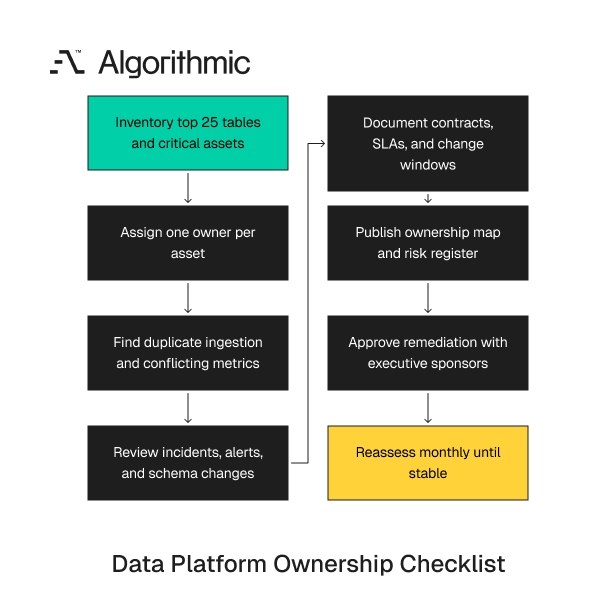
A CTO can identify ownership risk in 30 days without pausing platform delivery. The audit should inspect production assets, incident history, and decision rights. It should produce an ownership map, a risk register, and a prioritized remediation plan.
Use this checklist:
- List the top 25 consumed tables by query volume and dashboard dependency.
- Assign one accountable owner to each table, not a team alias.
- Identify duplicate ingestion for the top 10 source systems.
- Document freshness targets for all executive and finance dashboards.
- Review the last 20 data incidents and record which team resolved each one.
- Check whether shared schemas have a breaking-change policy.
- Confirm that product events have a registry, owner, and version history.
- Identify metrics with more than one definition across BI tools.
- Review data quality alerts and verify owner routing for each alert class.
- Publish a platform ownership map and review it monthly for one quarter.
 Click to expand
 The audit will reveal one of three conditions. The first is clear ownership with weak documentation, and the second is partial ownership with informal escalation. The third is unresolved shared-layer accountability, which requires executive intervention, because data platform ownership is an organization design decision, not a backlog item.
A head of data can propose the model. The CTO, CFO, and product leadership must agree on decision rights for shared metrics, source-system changes, and reporting commitments, and finance must know which revenue number governs board reporting. Product leadership must know which events support experiment analysis, engineering must know which source-system changes require notice, and security must know which team owns access review and audit evidence.
The audit should end with decisions, not findings alone. Assign owners for the highest-use tables, remove duplicate ingestion or approve exceptions with expiration dates, publish breaking-change rules for shared schemas, route quality alerts to named owners, and establish a monthly review until ownership data is complete and stable. The audit team should include data platform, analytics engineering, finance systems, product analytics, security, and one senior domain engineer, so six to eight participants is enough, because larger groups slow decision-making and shift the work toward status reporting.
Week one should gather evidence. Pull warehouse query logs, BI dependency reports, orchestration failures, incident tickets, and catalog ownership fields, because the output is a ranked asset list, not a narrative assessment.
The second week should validate ownership. Interview current owners and downstream consumers for the top assets, and record mismatches between perceived ownership and actual incident responsibility. The third week should define remediation, so typical actions include assigning owners, closing duplicate pipelines, adding tests, publishing contracts, and defining change windows, and each action needs a date, owner, and executive sponsor when cross-team authority is required.
Week four should publish the operating decision. Leaders should review the ownership map, approve unresolved decision rights, and fund remediation work, because the audit has value only when it changes how production data is owned. The audit should include cost evidence, because duplicate pipelines, high-compute transformations, unused dashboards, and repeated incidents show the financial cost of unclear ownership, and cost data helps executives prioritize remediation.
The risk register should classify each gap. Use categories such as ingestion duplication, schema instability, metric conflict, quality alert routing, access control, and incident response, because this keeps remediation work organized and measurable. Each risk should have one owner and one target date, because shared ownership creates the same ambiguity the audit is designed to remove, so if two teams are involved, one team still needs decision authority.
During evidence collection, the audit should avoid tool debates. Teams often shift quickly to catalog features, orchestration choices, or BI limitations, yet the first question remains ownership of production assets. Executives should expect some uncomfortable findings, so a revenue dashboard may depend on a model maintained by one analyst with no backup, and a customer health score may use a pipeline no current engineer understands. Those findings are useful, because they give leaders a ranked list of production risks before the next outage, and they also make funding decisions concrete.
Build the platform operating model before the next tooling decision
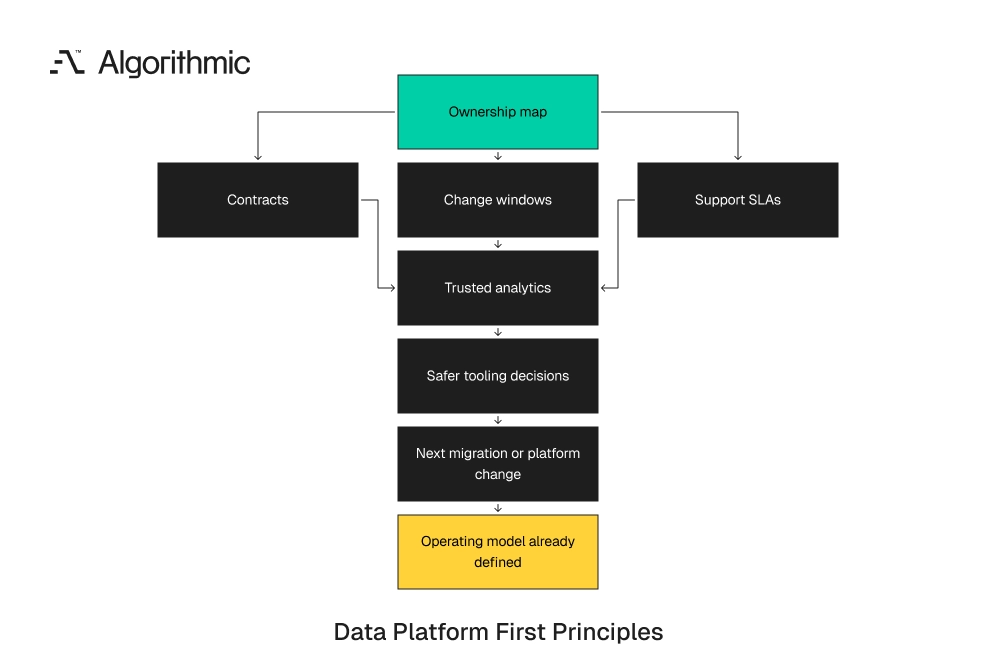
Data platforms fail when ownership boundaries are vague because production systems need accountable owners. Shared ingestion, tracking, schemas, and quality contracts cannot be left to informal coordination across domain teams, so the cost appears as duplicate pipelines, failing dashboards, disputed metrics, and degraded trust. Before approving another warehouse migration, orchestration change, feature store build, or business intelligence engineering program, publish the platform ownership map and name both the shared-layer owner and the domain owners.
Define contracts, change windows, and support SLAs. Record decision rights for ingestion, schemas, metrics, data quality, access control, and incident response, and treat those decisions as architecture, because they shape every production data asset. Start with the 30-day ownership audit, then convert its findings into an operating model that engineering, data, finance, and product leaders sign, because the tooling roadmap should follow that operating model instead of replacing it.
 Click to expand
 The work is practical and finite. Leaders need an ownership map, a contract standard, a change policy, a service model, and an incident review path, and those artifacts create the conditions for trusted analytics and production data systems. A platform with clear ownership can adopt new tools with less risk, while a platform without clear ownership will carry the same disputes into the next warehouse, orchestrator, catalog, or BI layer, and the difference shows up in every executive dashboard and every customer-facing data product.
Algorithmic builds data platforms and pipelines with named owners, contracts, and SLAs so a metric has one definition instead of four. Bring us in to map your data ownership before the next tool migration.