

A hosted model API can move an AI product from prototype to paid pilot in 14 days, yet the same provider decision can later stall a $250,000 enterprise contract, because enterprise buyers now ask for EU data residency, private inference, audit log export, and contractual control over model changes. Founders and CTOs should treat hosted model APIs as external production dependencies, because they carry uptime profiles, pricing exposure, model retirement schedules, data handling terms, and behavior drift, so a model endpoint belongs inside the product architecture, with the same discipline applied to PostgreSQL, Kafka, Redis, Stripe, and Snowflake.
The risk has moved from planning concern to material exposure. According to Presenc AI, 78 percent of Global 2000 companies had at least one AI workload in production in Q1 2026, up from 41 percent in Q1 2024. Enterprise buyers ask harder questions because AI now runs regulated workflows, customer-facing automation, and operational decision support, so a buyer will accept a hosted model for a limited pilot while blocking production access if inference, traces, and logs cross prohibited boundaries.
The architecture should use staged adoption. Hosted APIs remain the fastest path to early delivery, so the failure pattern comes from adopting a provider with no export path, no observability boundary, no governance model, and no route to private deployment. A migration path is a product design decision, because it affects data models, release process, incident response, gross margin, and sales motion, and teams that defer it usually pay during the first serious enterprise procurement cycle.
Hosted model APIs buy speed with defined tradeoffs
Hosted endpoints compress the first build cycle. A small team can call OpenAI, Anthropic, Google Gemini, Mistral, Cohere, or an inference vendor serving Llama, Qwen, and Mixtral, and the team avoids hiring a five-person MLOps group before it has confirmed customer demand. The provider manages model serving, capacity, safety updates, patching, and deployment infrastructure, and that operating burden matters during the first 90 days, so a founder can validate summarization, classification, retrieval augmented generation, code generation, and agent workflows before buying GPU capacity.
The tradeoffs appear across five dimensions, which are data control, latency, reliability, unit economics, and provider change risk. Each dimension becomes more expensive after customers depend on the workflow, and the cost compounds when prompts, outputs, and model-specific assumptions spread through application code. Early teams often accept these tradeoffs for sound reasons, because a two-engineer product team can ship a working claims intake assistant in three weeks with a hosted endpoint, while the same team would spend eight to twelve weeks standing up private inference, monitoring, rate limits, deployment automation, and fallback behavior.
That speed has a price. The team must know which parts of the product belong to the provider contract. It must also know which parts remain under its direct control.
Data control
Hosted APIs place customer data inside a third-party service boundary. Zero-retention modes reduce exposure, subject to the contract language, but enterprise buyers still review data processing agreements, subprocessors, retention terms, region controls, and support access paths. Healthcare, financial services, defense, and public sector buyers require stricter control, so a sales team can pass technical diligence with a hosted endpoint for an internal pilot, while the same endpoint can fail procurement for production deployment across 5,000 employees.
The failure mode is predictable. A product team sends prompts containing customer records to a US-hosted endpoint, and six months later a German insurer requires inference and logs to remain inside AWS eu-central-1. At that point the team discovers which artifacts cross boundaries, because prompts, embeddings, support traces, cached completions, and vendor incident logs all matter, and a contract that covers prompts alone leaves the buyer with unresolved risk.
Data control also extends to derived artifacts, because an embedding built from a customer document can expose sensitive meaning even when the original file remains in the customer account, and a vector index, feedback label, or moderation decision can carry customer information under most enterprise security reviews. The same issue appears in support operations, so if vendor support staff can inspect traces during a production incident, the buyer will ask who approved access, where the access record lives, and how long it is retained.
Latency and reliability
A hosted model call adds network distance, provider queueing, throttling behavior, and response variance. A user-facing workflow can feel acceptable at 2.5 seconds during pilot testing, yet it fails when P95 latency rises above 6 seconds during peak traffic. Open-weight models served through hosted APIs add another layer, and a May 2026 measurement study, When Is the Same Model Not the Same Service?, found that production users consume provider-specific service objects that differ by model variant, protocol behavior, context capacity, price, latency distribution, throughput, reliability, and task feasibility.
The same named model behaves differently across providers, so a team running Llama through two hosted inference vendors should test both as separate services, because token limits, JSON stability, refusal rates, and throughput ceilings differ under load. Latency also affects product design, since a workflow with three sequential model calls carries three separate queueing events, so a 1.8-second average call becomes a 7-second user experience once retrieval, parsing, retries, and UI rendering are included.
Reliability must be measured at the workflow level, because a provider can report 99.9 percent API availability while a customer sees repeated failures in a specific document path, so timeout behavior, retry policy, and parser rejection rates decide the user experience. Rate limits create a separate reliability class, since a sales campaign, batch import, or month-end close can increase traffic by 10x in a single hour, so if the provider queues requests or returns throttling errors, the product must decide which tenants get priority.
Unit economics
Hosted pricing works well at low volume, yet it becomes a board-level issue when token volume grows faster than revenue, and a usage curve that looks acceptable in month two can consume gross margin by month nine. Consider a support automation product processing 2 million customer messages per month, where the team can absorb model spend during early pilots, but at 40 million messages per month finance will compare hosted inference against private deployment, smaller task-specific models, prompt compression, caching, and routing by task complexity.
Fixed-price contracts sharpen the problem. A $60,000 annual contract with variable inference cost creates gross margin risk, and a 15 percent increase in average prompt length can erase the margin the sales model assumed. The arithmetic also changes when workflows add retrieved context, so a 900-token classification prompt can become a 6,000-token reasoning prompt after product adds policy excerpts, and the buyer sees the same feature while the vendor sees a different cost base.
Teams also underestimate retry cost, because a 3 percent timeout rate can produce 6 percent extra token spend when the application retries full prompts, and the effect grows when prompts include long retrieved context and tool definitions. Cost attribution needs tenant-level precision, so a customer paying $5,000 per month can consume $4,200 in inference if the workflow expands unchecked, and without per-tenant cost records finance finds the problem after margin has already moved.
Provider change risk
Model providers retire models, change safety behavior, adjust rate limits, modify pricing, and release new API semantics. InformationWeek has framed the AI vendor as a single point of failure, which is accurate for products with direct provider coupling. This risk is operational, and Tianpan’s analysis of provider retirements cites a deprecation wave where OpenAI retired 33 models, and notes that Anthropic commits to a minimum of 60 days’ notice for some retirements.
A production application with hard-coded prompts, parsing logic, and task routing can consume most of that window in regression testing. A 60-day notice period leaves little time for legal review, customer communication, load testing, and security approval, and the migration window shrinks further when the product supports multiple regions and regulated tenants. Provider changes also reach support and account teams, because a model that becomes more conservative can increase unresolved tickets, and a model that changes JSON behavior can create downstream workflow failures that look like product defects.
Change risk also includes silent behavior drift, because a provider can update inference infrastructure, safety layers, or routing without changing the public model name, so the product team still owns the customer outcome when the same prompt produces different output. The remedy starts with evidence, since teams need traces, replay tools, and evaluation sets that show the effect of a provider change, because vendor status pages rarely provide enough detail for enterprise incident records.
Enterprise procurement exposes the architecture
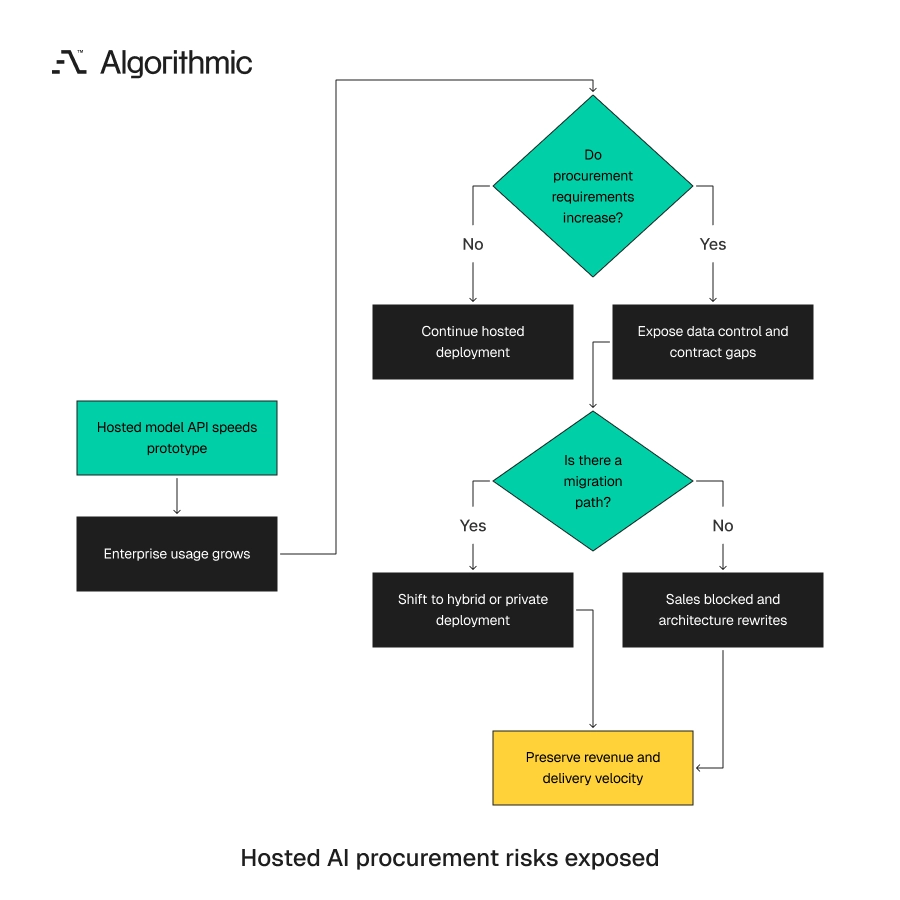
The migration problem usually arrives after product-market signal. The first 10 customers accept a hosted model because the product solves an urgent problem. Customer 11 is a bank, insurer, hospital network, or public company with a security questionnaire that changes the conversation.
 Click to expand
 That buyer asks for data residency, subprocessor review, breach notification terms, audit logs, access controls, and reproducible output for dispute review, procurement asks whether the vendor can run in a private cloud, customer VPC, or dedicated tenant, and legal asks whether prompts and outputs are retained, inspected, or used for training. Early architecture choices surface at this stage, so a company with 18 engineers and a growing AI workflow product recently faced this pattern, where its initial product used a hosted LLM for document extraction and classification.
The first enterprise buyer required all inference to run in-region within AWS eu-central-1, and it also asked for 12 months of audit logs tied to every model invocation, covering prompts, retrieved context, model identifier, output, parser result, reviewer action, and timestamp. The product team had stored outputs, yet it had not stored prompts, it had no trace identifiers across retrieval, prompt assembly, model call, parser, and human review, and it had provider-specific prompt formats embedded in business logic across 27 code paths.
The migration estimate moved from 4 weeks to 6 months, so the sales team lost the procurement window, because the hosted API decision created speed while the architecture lacked a migration design. This pattern repeats in B2B AI products, where a vendor ships quickly, wins pilots, and then treats enterprise controls as sales paperwork, so by the time procurement asks for private inference, the hosted provider has become part of the internal data model.
A clean design would have changed that outcome. The team needed a model gateway, trace schema, prompt registry, evaluation corpus, tenant routing policy, and export checklist, and those artifacts would have reduced the migration from a product rewrite to a controlled release program. Procurement teams ask these questions because they have seen technology risk move into contract risk, so a single AI workflow can touch customer records, regulated decisions, and employee productivity, and that combination places model usage inside security, legal, privacy, and finance review.
The practical lesson is direct. Enterprise readiness starts in the codebase before it surfaces in the data room. A clean architecture gives the sales team evidence instead of promises.
Model migration is a systems migration
Changing model providers requires more than replacing an endpoint URL. A model call touches prompts, retrieval, context packing, safety filters, structured output parsing, evaluation sets, latency budgets, monitoring, contracts, and customer commitments, and each touchpoint needs an owner before the provider becomes central to production. Model deprecation is a systems migration, not a configuration change, so consider a healthcare triage assistant moved after a retirement notice, where the new model produced unsolicited diagnostic opinions, 5x token usage, prompt breakage, and JSON parsing failures.
Those are product failures, because a clinician-facing assistant with altered refusal behavior changes the user experience, and a 5x token increase changes the margin model and creates latency pressure. A serious AI product needs migration seams in four places, and the seams should exist before the second enterprise account, because they require architectural discipline, not a large platform team.
Migration also changes team coordination. Product, engineering, security, legal, finance, and customer success all own part of the change. The technical plan fails when one group learns about the migration after customers have already been notified.
1. Invocation boundary
All model calls should pass through a model gateway or internal service boundary. The application should call a stable internal interface, and provider SDKs should stay out of controllers, background jobs, and customer-specific workflow code. That boundary should capture provider name, model version, prompt template version, retrieval context hash, latency, token counts, output schema, safety flags, and customer tenant, and it should also support request replay against alternative providers, because replay turns migration from opinion into measurement.
A gateway can start as a small Python or TypeScript module. It can later become a service with queues, policy rules, and provider routing, and the early version prevents the expensive mistake of embedding provider behavior across the product. A practical interface exposes task methods, not raw chat calls, such as classify_document, extract_claim_fields, summarize_case, and draft_customer_reply, while the adapter handles provider syntax, retries, timeouts, and response normalization.
The invocation boundary should also define failure behavior, so a timeout, refusal, invalid JSON response, or rate-limit event should produce a typed error, because typed errors allow the product to retry, fall back, escalate, or ask for human review. This design gives operations teams a clear dashboard, where they can see failure rate by task, tenant, provider, and model version, and that view supports incident response and procurement evidence.
2. Evaluation corpus
A migration needs a fixed evaluation corpus. For an extraction product, that corpus can include 1,000 labelled documents with expected fields, confidence thresholds, and reviewer overrides, and for a code assistant it can include unit test pass rates, repository-level task completion, and regression cases. Without a measured corpus, a migration becomes manual inspection, which misses edge cases and underestimates output drift, so a reviewer can approve ten examples and still miss a 3 percent parser failure rate across long-tail formats.
The corpus should measure task success, schema validity, refusal behavior, latency, token count, and cost, running against the current model and each candidate model, with results stored by model version, prompt version, and dataset version. The first corpus can start with 200 production-like examples, including high-volume cases, high-value accounts, known failures, long-context inputs, adversarial inputs, and each supported language, and the corpus should grow after every incident.
A strong corpus includes negative cases, so for a legal assistant that means privileged content, incomplete facts, conflicting documents, and requests outside the allowed task scope, and for a claims workflow that means scanned forms, missing fields, duplicate records, and handwritten notes. The scoring method should match the business workflow, because exact match works for structured extraction, while rubric scoring, human review, and downstream acceptance rates work better for drafting and summarization.
3. Prompt and schema versioning
Prompts are production artifacts that need version control, release notes, rollback paths, and named owners, so a prompt change should carry the same release discipline as a database migration. Structured output contracts need the same discipline, because if a downstream workflow expects strict JSON with 14 fields, the parser should validate every response and record failure modes by model, prompt version, tenant, and workflow.
Provider-specific formatting should remain inside adapters. Anthropic system message conventions, OpenAI tool definitions, and Gemini response configuration should stay out of business logic, because that separation reduces migration time when the provider changes an API surface. Prompt versioning also supports customer support, so when an account disputes an output the team can reconstruct the exact prompt, retrieval context, model version, parser version, and reviewer action, which matters in regulated workflows.
Versioning also reduces internal confusion, because support, product, and engineering teams can point to the same release record when behavior changes, which matters when a customer compares an output from last month with an output from today. Schema versioning needs explicit compatibility rules, because a new optional field can be safe, while a renamed field can break billing, workflow routing, or compliance reporting.
4. Data and configuration export
A provider exit plan needs bulk export for identities, API keys, tenant configuration, fine-tuning files, embeddings, vector indexes, audit logs, feedback labels, moderation decisions, and billing metadata. This requirement applies to free tiers and paid contracts, because early convenience should never create hidden lock-in. Free plans that support early traction can create false confidence, so a free vendor can serve as a launch platform but should never become a permanent foundation by accident.
Export should be tested before the first major renewal. A team should know how long it takes to export 12 months of traces, 50 million embeddings, and tenant policy settings, because a backup plan that has never run is an assumption. The export test should produce an artifact, so store the command, elapsed time, record counts, failed records, checksum method, and destination location, because that file becomes evidence during diligence.
Export also needs a restoration target, because a team that can download embeddings still needs to load them into Pinecone, Weaviate, pgvector, OpenSearch, or a private vector store, so the runbook should show both export and restore. Configuration export matters as much as data export, because tenant routing, retention mode, region policy, and audit settings define customer commitments, and losing those records during migration creates contract exposure.
The artifact-led architecture we use in delivery work
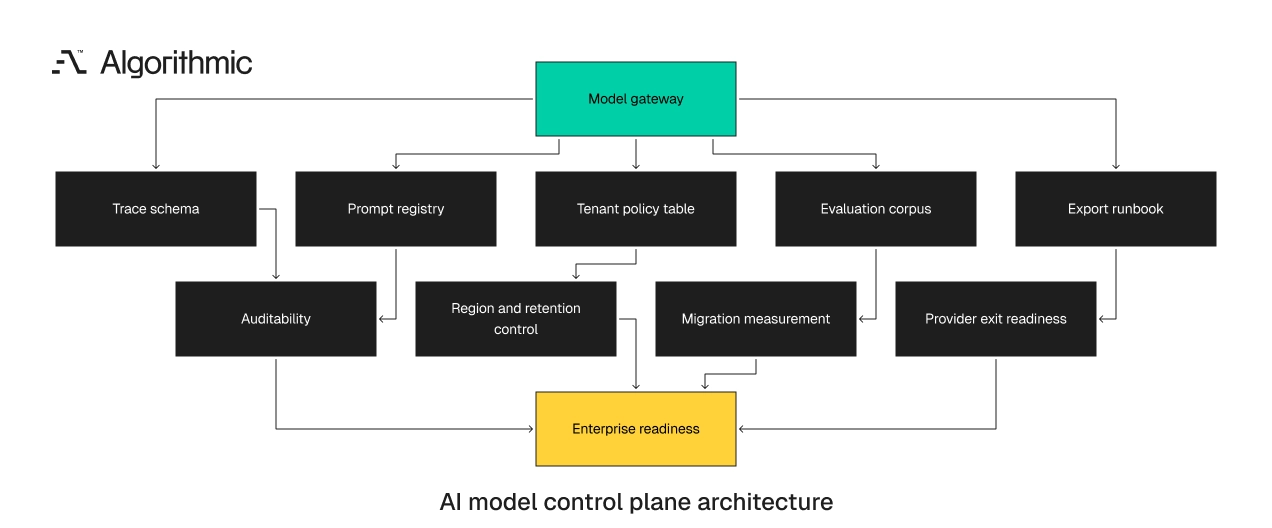
The most reliable approach is a small control plane around model usage. It consists of six artifacts, which are a model gateway, trace schema, prompt registry, evaluation corpus, tenant policy table, and export runbook, and each artifact has a clear owner and a release path. This pattern fits early-stage teams because it starts small, so a four-person engineering team can ship the first version in two sprints, and the design also grows into enterprise requirements without a rewrite.
The gateway controls how the product calls models, the trace schema records what happened, and the prompt registry controls what was asked. The evaluation corpus measures whether a change works, the tenant policy table controls where and how inference runs, and the export runbook describes how the company leaves the provider.
 Click to expand
 These artifacts convert model choice from vendor preference into managed infrastructure, and they also give sales and security teams concrete evidence, because procurement conversations improve when the vendor can show records, policies, and tested procedures. The artifacts also create decision discipline, so a provider change becomes a release with inputs, thresholds, owners, and rollback rules, and that structure protects customers from uncontrolled model behavior changes.
A lean control plane costs far less than a late migration. Two sprints of early work can prevent months of emergency rework after a strategic customer asks for private inference. The time trade is favorable for any company selling above $50,000 annual contract value.
Reference implementation
A lean implementation starts with a single service named model_gateway. It exposes task-level endpoints and owns all provider adapters, and application services never import openai, anthropic, google-genai, or provider-specific SDKs directly. The gateway writes every request to an append-only trace table, sensitive fields use field-level encryption and retention rules by tenant, and production support access requires the same approval path used for customer data.
The prompt registry stores template name, version, owner, release date, task type, approved models, and rollback version. Templates can live in Git, a database table, or a configuration service, and the key requirement is a stable version identifier in every trace. The evaluation corpus lives in a controlled repository or labelled database, where each case includes input, expected behavior, scoring method, allowed variance, and business owner, and a nightly job runs the current production model against the corpus.
The tenant policy table stores provider, model family, region, retention mode, logging mode, and private deployment requirement. The gateway reads that table at runtime, so a German healthcare tenant and a US startup tenant can take different inference paths through the same product. The export runbook lists every provider-held artifact, including export commands, contract clauses, destination buckets, recovery contacts, and verification steps, and it also records the last successful export test.
A first implementation can use Postgres for traces, S3 for stored payloads, Git for prompts, and a scheduled GitHub Actions job for evaluations. The architecture does not require a separate platform team, but it does require clear ownership and disciplined release rules. Security review should happen during this build, because the trace table will contain sensitive fields unless the team redacts or encrypts them, so access policies should be defined before production traces accumulate.
A practical decision matrix for hosted, private, and hybrid deployment
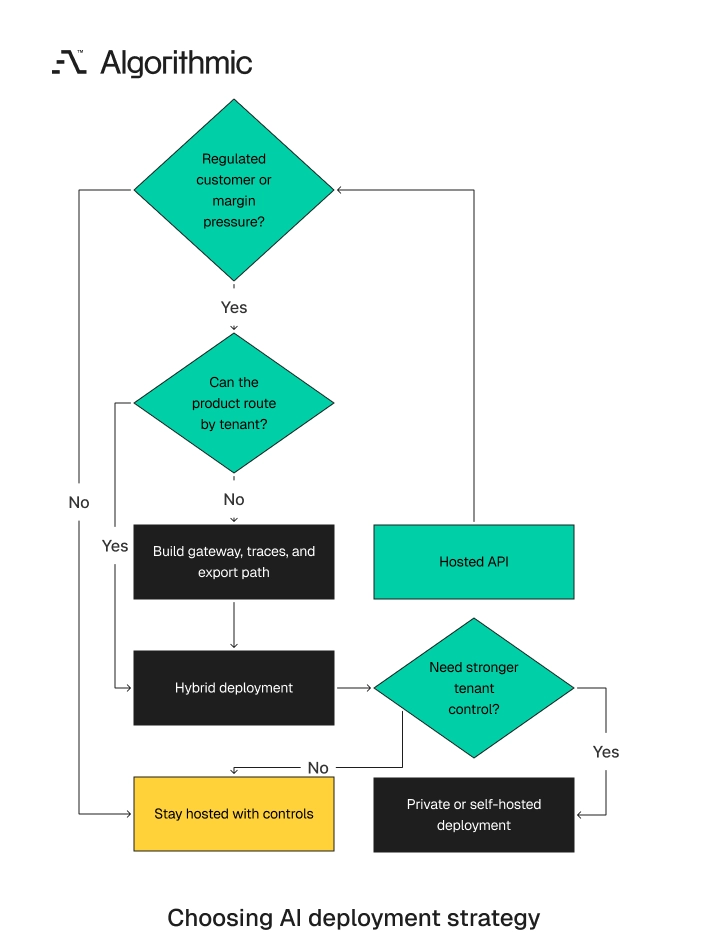
The decision should follow business constraints. Hosted APIs, private deployment, and hybrid architectures each fit different stages. The right choice depends on customer segment, data class, latency budget, gross margin target, and contract exposure.
 Click to expand
 | Decision factor | Hosted model API | Private or self-hosted model | Hybrid model routing |
|---|---|---|---|
| Time to first production release | 2 to 6 weeks | 8 to 20 weeks | 6 to 12 weeks |
| Initial infrastructure cost | Low | Medium to high | Medium |
| Data control | Provider-dependent | Strong tenant control | Configurable by workload |
| Latency control | Limited | Strong under dedicated capacity | Strong for selected paths |
| Model quality access | Strong frontier access | Depends on model class and tuning | Best-fit model per task |
| Compliance fit | Works for many pilots | Better for regulated production | Strong for mixed customers |
| Operating burden | Provider carries serving burden | Team carries model serving and MLOps | Shared burden |
| Exit flexibility | Weak without planning | Strong if artifacts are owned | Strongest with routing layer |
A consumer AI product with low regulatory exposure can start hosted and remain hosted for years, while a B2B SaaS product selling into regulated enterprises should design for private or alternative deployment from the first production release, and the design cost stays small when it starts with the first architecture review. The same practical distinction holds across managed-versus-self-hosted comparisons, because managed APIs buy speed and lower operating burden, while self-hosting adds infrastructure work in exchange for control over data, latency, cost, and model versioning.
The strongest architecture for many companies is hybrid, so use hosted frontier models for high-value reasoning tasks, and use smaller open-weight models for extraction, classification, routing, and high-volume tasks. Routing should reflect customer tier, region, data class, latency budget, and cost ceiling, so a German healthcare tenant can route to an EU private endpoint, while a startup tenant can use the default hosted provider.
Hybrid routing also improves margin control, because high-volume classification can run on a smaller private model while complex exception handling uses a frontier model, and the product experience stays consistent because the gateway normalizes the response contract. The decision matrix should be reviewed after every pricing change, model release, and major customer segment shift, because a company selling to startups has one risk profile, while the same product selling to hospitals has another.
Private deployment also carries real cost. GPU capacity, model serving, monitoring, failover, security patching, and on-call coverage become the vendor’s responsibility. A CTO should approve that operating burden with finance, not in an isolated engineering discussion.
The minimum migration architecture for an AI product
Teams do not need a full platform before the first customer. They need a minimum set of controls that preserve future choice, and the control set is small enough for a two-sprint investment. The goal is not to build an internal model platform before revenue, but to prevent irreversible coupling, because each control gives the team an option when enterprise requirements arrive.
1. Centralize all model calls
Create a single internal model gateway. It can be a small service, a module, or a thin API layer in the first release, and the gateway should become the only approved path for model calls. The gateway should abstract provider SDKs, request format, retry policy, timeout policy, rate-limit handling, and response normalization, expose stable task-level methods such as classify_document, summarize_case, or generate_response, and keep raw chat completion calls inside the adapter layer.
This design gives engineering leaders a clear inventory, so they can count calls by workflow, tenant, provider, and model, and add a second provider without searching the codebase for scattered SDK use. A gateway also gives security teams one control point, where they enforce retention policy, region policy, logging policy, and access policy in one place, which matters when enterprise contracts differ by tenant.
The first gateway release should include a strict rule, which is no direct provider SDK imports in application code, so a lightweight lint check can block openai, anthropic, and google-genai imports outside the adapter package, and this small rule prevents architectural drift. The gateway should also own retries and timeouts, because application teams should not invent separate retry logic for each workflow, since central handling reduces duplicate cost and prevents retry storms during provider incidents.
2. Record production traces
Every invocation should produce a trace. The trace should include tenant ID, permitted user ID, model provider, model version, prompt template version, retrieval source IDs, latency, input tokens, output tokens, cost estimate, parser status, and error type, and regulated products should also record retention policy and region. This data supports debugging, cost control, customer reporting, and migration testing, and it also gives sales teams evidence for enterprise diligence, because a buyer’s security team will ask for this evidence before production approval.
Trace data needs access control, because prompts and outputs can contain customer records, trade secrets, or personal data, so store traces with the same access model used for production customer data. A useful trace also includes correlation identifiers, so the team should connect retrieval, prompt assembly, model invocation, parser validation, human review, and final output, because without that chain incident analysis becomes guesswork.
Trace retention should follow customer commitments, so some tenants require 30-day retention for prompts and outputs, while others require 12 months of audit logs with redacted payloads. The schema should separate metadata from sensitive content, because metadata can support operational dashboards without exposing customer data, while payload access should require approval, logging, and a stated support reason.
3. Separate business logic from prompts
Prompt templates should sit outside core application logic. They should have names, versions, owners, test cases, and release history, so a prompt should be deployable, reversible, and measurable. This separation matters during migration because each model family responds differently to instruction order, examples, system messages, tool definitions, and output constraints, so provider-specific formatting should stay inside adapters while business rules remain in application code.
A practical pattern is straightforward, so store prompts in a versioned repository or configuration table, and link each production trace to the exact prompt version that generated the output. Prompt ownership should be explicit, so a senior engineer or product owner should approve changes to prompts used in paid workflows, and release notes should identify expected behavior changes and test coverage.
Prompt reviews should include security questions, so the reviewer should check for unnecessary customer data, prompt injection exposure, hidden business rules, and unsupported output claims, because these checks prevent defects that unit tests rarely catch. Prompts should also carry task boundaries, so a healthcare assistant should state what it can classify, summarize, or route, and it should not produce clinical determinations unless the product, contract, and safety review permit that behavior.
4. Build an evaluation corpus by week 8
A useful evaluation corpus starts small. For many products 200 to 500 representative cases catch regressions in format, tone, completeness, refusal behavior, and cost, and the first set should include real customer inputs with sensitive data removed or protected. By week 12, production products should have a larger benchmark tied to real usage, including failed cases, high-value accounts, long-context inputs, adversarial inputs, and examples from every supported language or region, with cases added after every customer incident.
The evaluation corpus should have acceptance thresholds, so an extraction workflow can require 98 percent schema validity and 95 percent field-level accuracy on priority fields, while a support workflow can require a maximum refusal rate and a P95 latency ceiling. The corpus should run during provider evaluation, prompt changes, model upgrades, and incident recovery, and results should become part of release approval, because a model change without measured results should never reach a regulated tenant.
The evaluation job should store raw scores and decision notes, because a future audit will ask why a model change was approved, so the answer should exist in a release record, not in a Slack thread. Evaluation also needs business ownership, because engineers can measure valid JSON and latency, while product owners and domain reviewers should define correctness for tone, risk, completeness, and workflow acceptance.
5. Keep tenant-level deployment flags
Enterprise products need per-tenant policy control. A customer in Germany can require EU-hosted inference, a healthcare customer can require private deployment, and a startup customer can accept the default hosted model, so these differences should be represented in product configuration, not account manager notes, and the gateway should enforce them at runtime. Deployment flags should control provider, model family, retention policy, routing policy, logging policy, and region, because hard-coding one global model decision creates avoidable sales constraints and forces engineering teams to choose between delaying a strategic customer and taking architectural debt.
These flags should live in a policy layer, not scattered environment variables, because sales, security, and engineering need one source of record for tenant deployment commitments, so the product should reject requests that violate those commitments. Policy changes should require approval and audit records, because a mistaken switch from private EU inference to a US-hosted endpoint can create a reportable contract breach, so the system should make that failure difficult.
The policy table should also support staged rollout. A new model can be enabled for internal tenants, then pilot tenants, then lower-risk production tenants. Regulated tenants should move only after evaluation and approval.
6. Treat model incidents as production incidents
Model failures should enter the same incident process as database outages and payment failures, because a parsing regression can block customer workflows, and a refusal behavior change can alter clinical, legal, or financial user experience. The incident record should include model version, provider status, prompt version, affected tenants, trace samples, customer impact, and rollback decision, and it should also record whether the provider changed behavior, because that record supports contract enforcement and customer communication.
A mature process separates provider incidents from product incidents, because provider incidents need escalation and alternate routing, while product incidents need release rollback, parser fixes, or prompt changes. Incident severity should reflect customer impact, so invalid JSON in a nightly batch job has one severity, while incorrect classification in a regulated approval workflow has another.
Post-incident review should update the evaluation corpus. Each production failure should become a regression case. That practice turns incidents into permanent protection against repeat failures.
Contract terms that protect the migration path
The technical design remains incomplete without contract language. Model providers and platform vendors should be evaluated through exit rights and operational transparency. Engineering, legal, finance, and security should review these terms together.
Founders should request the following terms before the provider becomes central to the product:
- Bulk export of prompts, outputs, logs, configuration, embeddings, fine-tuning data, audit records, and tenant metadata.
- Written retention terms for prompts, files, outputs, traces, and support access.
- Region commitments for data processing and storage.
- Notice periods for model retirement, price changes, rate-limit changes, and API changes.
- The right to run evaluation traffic across new model versions before forced migration.
- Subprocessor disclosure and notification.
- Enterprise support response times for production incidents.
- Clear terms for customer data use in training, evaluation, abuse monitoring, and product improvement.
- Contractual access to historical invoices, usage records, and rate-limit events.
- Defined support escalation paths during provider outages and model regressions.
A procurement team will ask for these controls once the product enters larger accounts. Engineering leaders should ask earlier, because contract rights are cheaper to negotiate before monthly inference spend reaches six figures. Contract terms should also map to technical controls, so if the agreement grants export rights, the product should test export, and if the provider commits to regional processing, traces should record the region used for each invocation.
Finance should join the review before the first large renewal, because rate-limit changes, context window pricing, batch pricing, and volume discounts affect gross margin, and a model provider contract has become part of the unit economics model. Legal terms need operational owners, because a 90-day retirement notice helps only when engineering has a migration runbook and evaluation corpus, and a region commitment helps only when traces record the actual processing region.
Support terms also require specificity. A production incident response time should state hours, escalation channel, account owner, and severity definitions. Generic support language rarely satisfies enterprise buyers during a live outage.
The 30-day hosted model exit plan
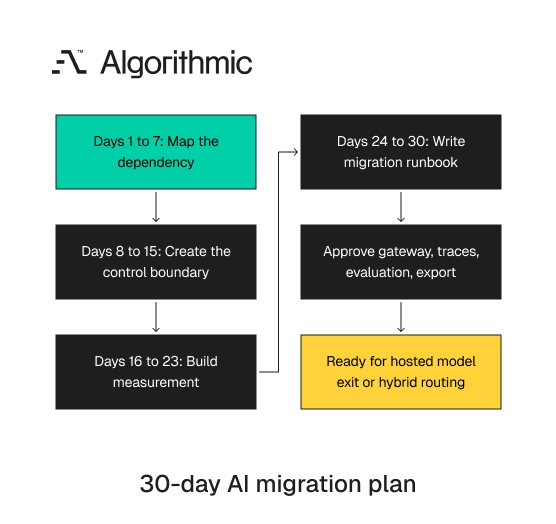
A migration path can be built without slowing early delivery. The work fits into 30 days when treated as engineering infrastructure instead of future cleanup, and a four-person team can complete the first version while product development continues. The work should produce artifacts, not slideware, so each week should leave the team with code, records, tests, or a runbook, because those artifacts support enterprise diligence and reduce future rework.
 Click to expand
 Days 1 to 7 map the dependency
List every model call by product workflow. Record provider, model, prompt template, expected output, downstream consumers, latency budget, token volume, and customer data class, and include background jobs, admin tools, evaluation scripts, and support utilities. Identify hard dependencies on provider-specific features, such as tool calling semantics, JSON mode, file search, safety categories, batch APIs, fine-tuning endpoints, and embedding dimensions, because these dependencies determine the migration work.
The output should be a single model dependency register that names an owner for each workflow and shows which customers use each model path in production. A strong register includes cost and risk fields, so add monthly token volume, average prompt size, P95 latency, failure rate, and contract exposure, because that turns the register into a management tool instead of a static inventory.
The register should also identify data classification, because a product can send public help center content through a different path than patient records or loan documents, and that distinction drives routing and contract review. End the first week with an architecture review, where the CTO learns where provider coupling exists, which workflows carry revenue risk, and which accounts depend on each model path, because that review sets the work order for the next three weeks.
Days 8 to 15 create the control boundary
Move model calls behind a gateway. Add provider adapters for the current provider and one credible alternative, because the second adapter forces the team to confront hidden assumptions. The second adapter does not need full production readiness, only enough coverage to prove that the architecture can route traffic away from the primary provider, so a smoke test across 25 representative requests is enough for the first milestone.
This work will expose prompt formatting and response parsing issues, so capture those issues in the migration backlog and fix the ones that block routing, replay, and measurement. The team should also remove direct SDK imports from product code, so add a lint rule or code review checklist that blocks new direct provider calls, because governance works when it is built into delivery flow.
Add basic policy enforcement during this window, so the gateway reads tenant, region, and retention flags before making a model call, and rejects a request that violates a tenant commitment. The team should also define standard error types, so timeouts, rate limits, invalid schemas, safety refusals, and provider outages produce distinct records, because those records make incident analysis faster.
Days 16 to 23 build measurement
Add tracing, cost attribution, parser validation, and task-level success metrics. Create a replay tool that can run saved requests against another model, and store replay results by provider, model version, prompt version, and dataset version. Start with 100 production-like cases, expand the set weekly, and select cases from real workflows, high-value customers, failed outputs, and long-context requests.
Measurement should cover business outcomes, not only technical metrics, so for a document extraction product track field accuracy and reviewer correction rate, and for a support agent track answer acceptance, escalation rate, refusal rate, and average handling time. The team should define release thresholds during this window, such as 98 percent valid JSON, less than 2 percent refusal variance, and P95 latency under 4 seconds, because these thresholds make provider selection measurable.
Cost measurement should use the same unit finance uses, so track cost per document, cost per ticket, cost per claim, or cost per generated report, because token-level metrics matter only when they connect to margin. Replay should run against the current production model and the alternative provider, because the comparison will expose output drift, cost changes, and parser failures, and it will also identify which workflows are ready for alternate routing.
Days 24 to 30 write the migration runbook
Document the migration sequence, including evaluation thresholds, rollback rules, customer communication, security review steps, contract triggers, and owner names, and state who approves each step. The runbook should define a viable private deployment path, so for some teams that means vLLM or Text Generation Inference on AWS, Azure, or GCP GPUs, while for others it means a dedicated tenant from a model provider or an inference vendor with region-specific hosting.
Include a cost model that estimates GPU hours, engineering time, storage, monitoring, incident response, and vendor support, because a migration plan without cost numbers will fail during executive review. The final artifact should fit on ten pages, because executives need the route, cost, risk, and decision points, while engineers need owners, commands, thresholds, and rollback steps.
The runbook should include a customer communication template, because enterprise customers need advance notice for changes that affect data processing, regions, or output behavior, and account teams should not write that message during an incident. Close the 30-day plan with an approval meeting, where the CTO, head of product, security lead, finance owner, and enterprise sales lead approve the path, because that meeting turns the plan into operating policy.
What founders and CTOs should approve before scaling usage
Before committing a hosted model to a core workflow, approve four artifacts. These approvals should happen before token volume, customer promises, and procurement obligations harden around one provider, and the review can fit into a single architecture meeting if the team has prepared evidence. First, approve a provider decision record that states why the provider was chosen, which risks were accepted, which alternatives were tested, and which business events trigger review, where triggers include regulated customer demand, gross margin pressure, provider retirement notice, region requirements, and outage patterns.
Second, approve the observability schema, because if the team cannot measure latency, cost, quality, and failure by tenant and model version, the product is not ready for enterprise scale, so board reporting should include inference cost per tenant and failure rate by workflow. Third, approve the export checklist, because the organization must know how to leave the provider before usage reaches the point where leaving becomes expensive, so the checklist should include data artifacts, configuration, evaluation assets, contracts, access credentials, and customer-facing records.
Fourth, approve the private deployment path, which can remain a design during the first release, provided it is technically credible, costed, and assigned to an owner who reviews the plan every quarter as model quality, GPU pricing, and customer requirements change. These approvals create a management cadence around AI infrastructure, and they also give sales teams a stronger answer during enterprise diligence, because the buyer sees a vendor with operational control, not a team improvising around a model API.
The approvals should be revisited after each material event, such as a new regulated customer, a 25 percent inference cost increase, a provider retirement notice, or a production incident, because AI infrastructure changes too quickly for annual review alone. Board updates should include the same operating facts, so report inference spend, gross margin exposure, top provider dependencies, incident count, and private deployment readiness, because that information helps directors assess risk before a contract or outage forces the issue.
The executive decision
Hosted models are useful accelerators. They become liabilities when teams treat provider choice as permanent infrastructure without exit design, and the problem shows up when procurement asks for region control, audit evidence, fixed pricing, and private inference. The remedy is concrete, so build the model gateway, trace every invocation, version prompts, maintain an evaluation corpus, store tenant deployment policy, and test export, because these six artifacts give the product a controlled migration path.
Before the next enterprise sales push, run a 30-day model dependency review. Produce the dependency register, gateway plan, trace schema, evaluation corpus, export checklist, and private deployment path, and approve them as production architecture, not future cleanup. This work protects revenue and engineering focus, because a team with a migration path can negotiate with providers, serve regulated customers, and change models without turning a sales opportunity into a six-month rewrite.
Algorithmic runs AI readiness assessments that put a model gateway and evaluation corpus in place so a provider switch stays predictable. Talk to us about your LLM exit plan before procurement asks for one.