
A $250,000 software engagement usually fails in the first 30 days for reasons visible before signature. The warning signs are specific: no design records, no reproducible development environment, no CI history, no rollback plan, and no named owner for production incidents.
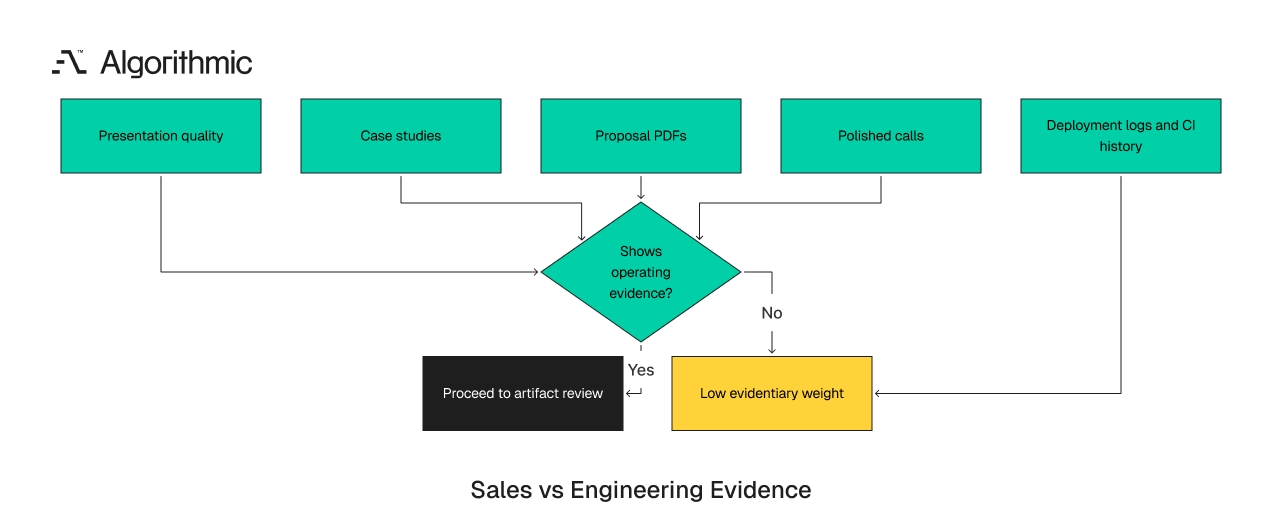
The common evaluation error is treating sales evidence as engineering evidence. Polished calls, commercial timelines, reference logos, and case studies show communication skill. They do not prove that a team designs, ships, monitors, and repairs production software with discipline.
For a $50K to $500K engagement, the cost of incomplete diligence appears after signature. Onboarding takes 3 weeks instead of 3 days. The first milestone slips because local setup fails on two developer machines.
Accountability becomes unclear because decisions live in calls instead of written records. Technical partner evaluation should start with operational artifacts. Buyers should inspect the records a team produces during normal engineering work.
Those records reveal delivery risk before the statement of work becomes binding. They also create a factual basis for price comparison. A lower rate has limited value when the buyer pays for setup failures, release defects, and undocumented handoff work.
Presentation quality has low evidentiary weight
Most partner evaluations overvalue materials created for buyers. These include pitch decks, proposal PDFs, commercial timelines, curated demos, and sanitized case studies. Each has a place in procurement, and none proves operating discipline.
A senior software development team leaves a trail. Architecture decision records, pull request discussions, deployment logs, test reports, incident notes, and runbooks show daily operating behavior. These artifacts expose the habits that determine delivery quality after the kickoff call.
 Click to expand
 This distinction matters because complex software work fails through operational gaps. A custom software development company can describe an impressive delivery model and lack records required to run production software for 12 months. The gap appears when the first database migration fails or a release blocks a paying customer.
Launch Day Advisors describes technology partner evaluation across team quality, technical depth, delivery discipline, financial stability, and commercial behavior in its guide on how to evaluate a technology partner. That structure is useful. Artifact inspection adds the evidence layer.
The buyer should request evidence produced during normal work. If the partner needs 5 business days to assemble basic engineering artifacts, those artifacts are absent from daily execution. A mature team can open recent records during a live session and explain the decisions behind them.
Artifact inspection also reduces dependence on personal chemistry. A confident technical lead can carry a call and still run a weak delivery system. A quiet team with disciplined records often presents stronger delivery evidence than a polished account team.
Presentation quality also distorts risk scoring. A buyer may remember the clearest speaker and forget that no one showed a deployment log. Written artifacts correct that bias because each bidder must meet the same evidence standard.
The operating artifacts that predict delivery quality
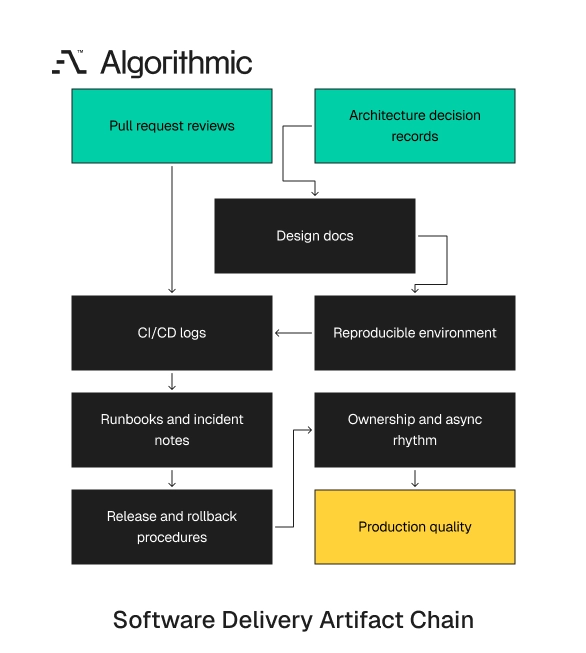
Artifact review should cover six areas: system design, development setup, delivery flow, quality gates, production operations, and accountability. These areas are mutually distinct. Together, they cover the path from first commit to production incident.
The review should use the same standard across all bidders. Each partner should provide comparable evidence, with client names and secrets removed. This prevents polished sales teams from outperforming disciplined engineering teams during selection.
The buyer should also define the review window. Recent artifacts from the last 90 days carry more weight than examples from a flagship project completed 3 years earlier. Current records show how the partner operates now.
A bidder can redact client names, customer IDs, secrets, and commercial terms. Redaction should preserve timestamps, authorship, decision history, and technical context. Without those elements, the buyer receives a sample document instead of operational evidence.
 Click to expand
 1. Design documents and architecture decision records
A design document should define the problem, constraints, proposed architecture, rejected options, data model, APIs, failure modes, and rollout plan. A strong document names tradeoffs. It records why the team selected one path and rejected another.
Architecture decision records should be short and dated. They should state the decision, context, alternatives, and consequences. For example, PostgreSQL with JSONB carries different long-term costs than DynamoDB with event streams.
Review at least 2 prior design artifacts. Remove client-identifying details when needed. The structure still reveals whether engineers reason in systems or tasks.
Good design artifacts show operational awareness. They discuss migration safety, latency budgets, data ownership, observability, and recovery paths. They also identify constraints such as regulatory rules, vendor limits, and team experience with the selected stack.
Weak design artifacts read like implementation notes. They list endpoints, screens, and tickets without explaining system behavior. That format leaves the buyer dependent on oral history when the original engineer leaves the project.
Design review should include one decision that aged poorly. A serious team can explain the original constraint, the later cost, and the correction. That discussion reveals judgment better than a perfect retrospective story.
The buyer should also inspect how design documents connect to tickets and code. A decision record should reference pull requests, migration plans, and release notes. Detached architecture documents often become shelfware within 30 days.
A mature design artifact states what the team will measure after release. Examples include p95 latency, queue depth, job failure rate, model accuracy, or payment authorization errors. Metrics turn a design assumption into a production check.
2. Reproducible development environments
A partner should show a new engineer starting the project from a fresh machine. The expected artifact set includes a README, .env.example, Docker Compose or Dev Containers configuration, seed data, database migrations, and one command that runs the test suite.
For a remote-heavy team, this is engineering infrastructure. It determines onboarding speed and reduces hidden dependence on one engineer’s laptop. It also shows whether the partner can add staff without damaging delivery quality.
A healthy setup target is under 2 hours from repository access to a passing local test suite. Anything beyond 1 business day needs a written explanation. Manual setup steps should be rare, documented, and tied to a specific reason.
The buyer should ask the partner to describe the last onboarding event. How long did setup take? Which step failed during the process? Which document changed afterward?
The answer shows whether the team learns from friction or accepts it as normal. A team that fixes onboarding defects protects the delivery schedule. A team that normalizes setup failures burns client budget before feature work starts.
A reproducible environment also protects the client after handoff. If the client hires an internal engineer 6 months later, that engineer should run the system without private instructions from the vendor. This matters when the original vendor changes staff or the client brings production support in-house.
The review should include operating system assumptions. A setup that works only on one engineer’s MacBook creates preventable risk. Docker, Dev Containers, and documented dependency versions reduce that risk.
The buyer should ask for dependency versions, database versions, and third-party service mocks. A project that requires live access to Stripe, Salesforce, or a production data warehouse for local tests has weak isolation. Local development should use test credentials, seeded fixtures, and documented service stubs.
A strong setup also includes data safety rules. Developers should know whether they can use production data locally, who approves exports, and how data is masked. These rules matter for healthcare, financial services, marketplaces, and any system with customer records.
3. CI/CD logs and quality gates
CI logs show whether quality is enforced by systems or remembered by individuals. Ask for recent logs from GitHub Actions, GitLab CI, CircleCI, Buildkite, or Jenkins. Look for unit tests, integration tests, linting, type checks, security scans, build artifacts, and deployment promotion steps.
A production-ready software development partner should also show failure history. Perfect green dashboards over 90 days usually indicate a narrow pipeline or selective disclosure. Normal engineering teams have failed builds, repaired tests, and visible remediation.
The key question is sequence. Code should be reviewed, tested, built, scanned, and released through a defined path. Each step should leave a timestamped record.
A healthy CI/CD record includes failed tests with follow-up commits. It shows which checks block merge and which checks produce warnings. It also shows whether emergency releases bypass the normal path.
Ask for one failed build from the last 30 days. Then ask who fixed it, how long it remained broken, and whether the failure changed a test or release rule. This gives the buyer evidence of engineering discipline under routine pressure.
The buyer should also inspect what the pipeline ignores. A CI path that runs unit tests and skips migrations, dependency checks, or integration tests gives incomplete protection. The missing checks often explain defects found after release.
Quality gates should match the system’s risk profile. A marketing site needs a different path than a payments platform or clinical workflow application. A production commerce system should test checkout, tax calculation, authorization, refund paths, and idempotency.
The buyer should inspect pull requests alongside CI logs. Review comments should address design, failure modes, data safety, test gaps, and security. Reviews limited to formatting comments or approval stamps provide weak evidence.
Security checks also belong in this category. Dependabot, Snyk, Trivy, Semgrep, CodeQL, or GitHub Advanced Security can detect routine defects before release. The tool name matters less than evidence that findings are reviewed and closed.
4. Runbooks and incident response records
Runbooks show how a team behaves under pressure. A useful runbook identifies symptoms, dashboards, log queries, escalation paths, rollback steps, customer communication owners, and post-incident review steps.
For a SaaS product development engagement, request at least one runbook for a database failure, one for degraded API latency, and one for deployment rollback. For data platform development, request a runbook for failed ingestion, schema drift, and late-arriving data.
The artifact should be operationally usable at 2 a.m. A paragraph of general guidance does not meet that bar. The runbook should name systems, dashboards, commands, contacts, thresholds, and decision authority.
Incident records matter as much as runbooks. Ask for one sanitized incident note from the last 6 months. It should include timeline, detection method, customer effect, resolution, root cause, and follow-up work.
The best incident records are plain and specific. They state what happened, who acted, which alert fired, how long service was degraded, and which change reduced recurrence risk. Blame language and vague corrective actions signal immature operations.
The buyer should inspect how incident actions close. A post-incident note that lists 8 follow-up items without owners and dates is weak evidence. A production team assigns each action, tracks completion, and changes the operating system.
Runbooks should connect to the monitoring stack. A runbook that references Datadog, Grafana, CloudWatch, Sentry, PagerDuty, or Opsgenie should include exact dashboard names and alert IDs. Generic instructions force engineers to search during an incident.
The buyer should ask who communicates with customers during an outage. Technical diagnosis and customer communication are separate tasks. A production incident becomes worse when engineers must debug the system and draft customer updates at the same time.
5. Release and rollback procedures
A partner should explain how code reaches production and how it is reversed. This includes versioned releases, deployment approvals, feature flags, database migration strategy, backward compatibility rules, and rollback decision authority.
Rollback is a technical and organizational procedure. The team needs a defined threshold: for example, roll back when p95 latency exceeds 800 milliseconds for 10 minutes after release. Another valid threshold is a 2% error rate on a customer-facing endpoint.
A partner that cannot describe rollback cannot safely own production changes. The risk increases when releases include schema migrations, payment flows, authentication changes, or customer data movement.
The buyer should ask for the last production release record. The record should identify the version, commits, approver, deployment time, validation checks, monitoring window, and rollback option. A release conducted through chat messages and memory creates avoidable production risk.
Database rollback deserves special attention. Many teams can redeploy application code in minutes and still lack a safe path for data migrations. The partner should explain forward-only migrations, backups, migration tests, and compatibility windows.
Rollback rehearsal is stronger evidence than rollback documentation alone. Ask when the team last practiced a rollback in staging or production. A partner should know the time required, the owner, and the validation checks after reversal.
Feature flags should also be reviewed. LaunchDarkly, Unleash, Split, or a well-tested internal flag system can reduce release risk. The buyer should inspect flag ownership, default states, cleanup practices, and audit history.
Release records should include post-deployment validation. A mature team checks logs, traces, metrics, and critical user paths after production change. The record should show who performed those checks and when the monitoring window ended.
6. Ownership model and async operating rhythm
Complex work needs written ownership. Ask for examples of weekly status notes, engineering plans, risk registers, decision logs, and handoff records. These artifacts show whether the partner can operate without constant synchronous calls.
A strong async rhythm includes named owners, dates, open risks, decisions needed from the client, and dependencies. It also includes closed-loop communication. Every raised risk has a resolution path or an explicit acceptance decision.
For CTOs comparing a software studio for startups with a larger vendor, this category often separates senior operating discipline from account management volume. More meetings do not create clearer ownership. Written decisions and named accountable people create clearer ownership.
The buyer should inspect one status note from a difficult week. A useful note lists missed work, cause, recovery plan, and decision requests. Weak notes report activity without naming risk.
Ownership artifacts also protect budget. When scope changes, the record should show the decision, cost effect, timeline effect, and approving owner. Without that record, commercial conflict moves into the final month of delivery.
The review should also identify who speaks for production risk. Account managers can coordinate communication, although engineering authority must be explicit. A named technical owner should accept or reject release risk in writing.
Status artifacts should distinguish activity from progress. “Built authentication screens” has less value than “Password reset shipped to staging with audit logging pending.” The second statement tells the buyer what works and what remains open.
The buyer should also inspect handoff records. A handoff should include repository access, deployment access, environment variables, infrastructure diagrams, runbooks, open risks, and known defects. A project without a handoff record is difficult to operate after the vendor exits.
The operational artifact review matrix
Use the following matrix during technical partner evaluation. It is intentionally artifact-based. A buyer can complete it in a 90-minute technical diligence session before contract signature.
| Area | Artifact to request | What to inspect | Disqualifying signal |
|---|---|---|---|
| Architecture | Design doc and 2 architecture decision records | Tradeoffs, constraints, failure modes, rejected options | Only diagrams and sales narrative |
| Onboarding | Reproducible local setup | Fresh setup time, seed data, migration path, test command | Manual setup requiring one named engineer |
| Delivery | CI/CD logs from last 30 days | Test path, failed builds, release promotion | No visible build history or manual deploys only |
| Quality | Pull requests and review comments | Depth of review, test expectations, security checks | Reviews limited to formatting or approvals without comments |
| Operations | Runbooks and incident notes | Alert source, owner, escalation, rollback steps | No runbooks for production failure classes |
| Accountability | Weekly status note and risk log | Named owners, dates, dependencies, open decisions | Status reported only through calls |
This matrix is a practical software development quality checklist. It is also a filter for software development company red flags. A partner that cannot produce these artifacts before signature will not become more disciplined after signing.
Rational Partners makes a related point in its technology due diligence checklist: useful diligence inspects how systems are built and operated. Generic questionnaire answers do not provide the same evidence. The same principle applies to vendor selection.
The matrix also creates a shared language for procurement and engineering. Procurement can compare vendors on documented evidence. Engineering can identify delivery risk before it becomes a change request.
A scored matrix prevents vague evaluation notes from driving a six-figure decision. “Strong team” is not a usable procurement record. “CI/CD score 1 because deployments require manual SSH access” is specific enough to act on.
The matrix should become part of the vendor file. When a dispute appears later, the buyer can compare delivery problems against the risk record. This creates continuity between selection, contracting, and governance.
The matrix should also record evidence location. Include links to repositories, documents, ticket systems, deployment logs, and monitoring dashboards. A diligence score without source material becomes hard to defend 6 months later.
For larger programs, assign one owner for each category. The architecture reviewer should inspect design records. The production reviewer should inspect runbooks, alerts, and rollback procedures. This division keeps the review concrete and avoids blended impressions.
AI and ML partners require a higher artifact standard
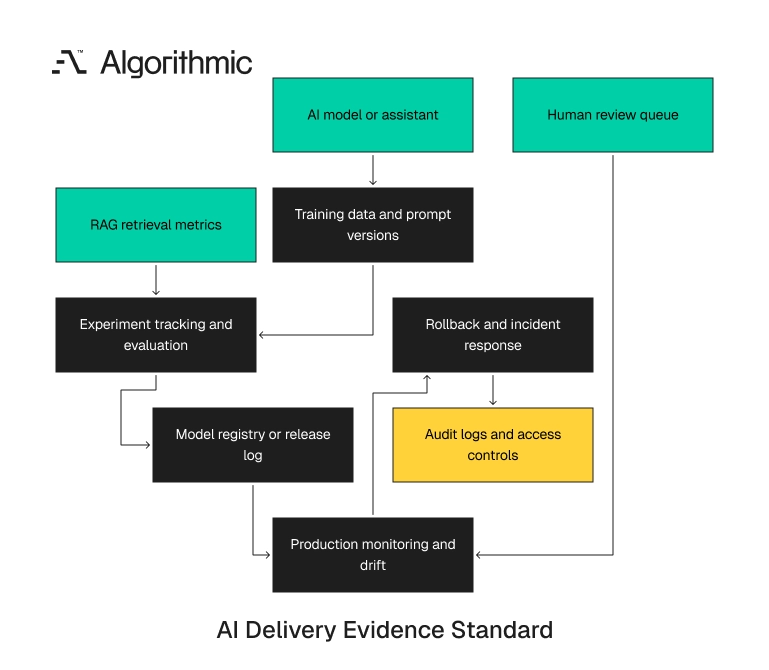
AI product development and production machine learning engineering require additional evidence. A notebook stack does not constitute an operating model. Production AI systems need records that connect data, models, prompts, evaluations, releases, monitoring, and rollback.
For ML systems in production, request experiment tracking, a model registry, training pipeline records, deployment history, model monitoring, drift detection, and rollback procedures. Tools may include MLflow, Weights & Biases, Neptune, SageMaker Model Registry, Vertex AI Model Registry, Evidently, or Arize.
The specific tool matters less than the operating chain. The team should show how a model version moves from experiment to validation, approval, deployment, monitoring, and rollback. Each step should have an owner, timestamp, and acceptance criterion.
For retrieval augmented generation systems, artifact review should include prompt versioning, evaluation datasets, vector database schema, retrieval quality metrics, latency budgets, and logs for failed responses. For AI assistants, request service-level objectives, runbooks, audit logs, release notes, and escalation paths.
 Click to expand
 Beyke Workflows argues for evidence-first AI buying in Demand Real Evidence. That standard is correct for AI systems because demos hide production failure modes. These include data drift, prompt regressions, missing audit trails, and nondeterministic outputs.
A credible MLOps engineering team should answer four questions with artifacts:
- Which model version is running in production now?
- Which dataset and feature set trained it?
- Which metrics trigger investigation or rollback?
- Who receives the alert when performance degrades?
If those answers live in memory, the partner is not ready for production responsibility. A production team should answer them from MLflow, a model registry, a deployment log, or an incident record.
AI evaluation records deserve direct inspection. Ask for a test set, scoring method, baseline result, release threshold, and regression history. For a customer support assistant, that could include 500 labeled conversations and measured containment accuracy by intent.
Security and audit artifacts also matter for AI systems. The partner should show access controls, data retention rules, prompt change history, and human review paths for high-risk outputs. This evidence becomes essential in regulated workflows and enterprise deployments.
The buyer should ask how the AI system fails. A partner should name expected failure classes, such as hallucinated citations, stale retrieval, unsafe tool calls, or low-confidence classification. Each failure class should map to a test, monitor, alert, or human review path.
Cost records also belong in AI diligence. Token usage, embedding refresh cost, vector database storage, GPU training cost, and inference latency can change the operating budget. A partner should show cost per request, cost per workflow, or cost per 1,000 resolved cases.
AI diligence should also inspect data lineage. The partner should show where training data came from, who approved its use, and how deleted records propagate. This matters when customer contracts restrict secondary use of data.
Prompt changes should follow the same discipline as code changes. A prompt release should include version history, reviewer, evaluation result, expected behavior, and rollback path. Without those records, an assistant can regress without a clear cause.
For RAG systems, retrieval evaluation needs separate treatment from answer evaluation. The team should measure whether the retriever found the right documents before judging the final response. Otherwise, a strong language model can hide weak retrieval during demos.
Human review records also matter. High-risk AI workflows need defined review queues, escalation paths, sampling rates, and approval authority. A partner should show how reviewers correct outputs and how those corrections feed future evaluations.
How to run artifact diligence before contract signature
Artifact diligence should be a structured working session, not a procurement form. The buyer should invite the proposed technical lead, one senior engineer, and the delivery owner. Sales staff can attend, although they should not answer engineering questions.
The session should be practical and time-boxed. A 90-minute meeting is enough for a $50K to $250K engagement. A $500K program should use two sessions: one for engineering artifacts and one for production operations.
Send the artifact request before legal negotiation starts. Once commercial momentum builds, teams often explain away missing evidence. Early diligence preserves decision quality.
The review should use real artifacts instead of slide summaries. The buyer should see timestamps, authors, linked commits, and open issues. Those details separate normal engineering records from materials assembled for procurement.
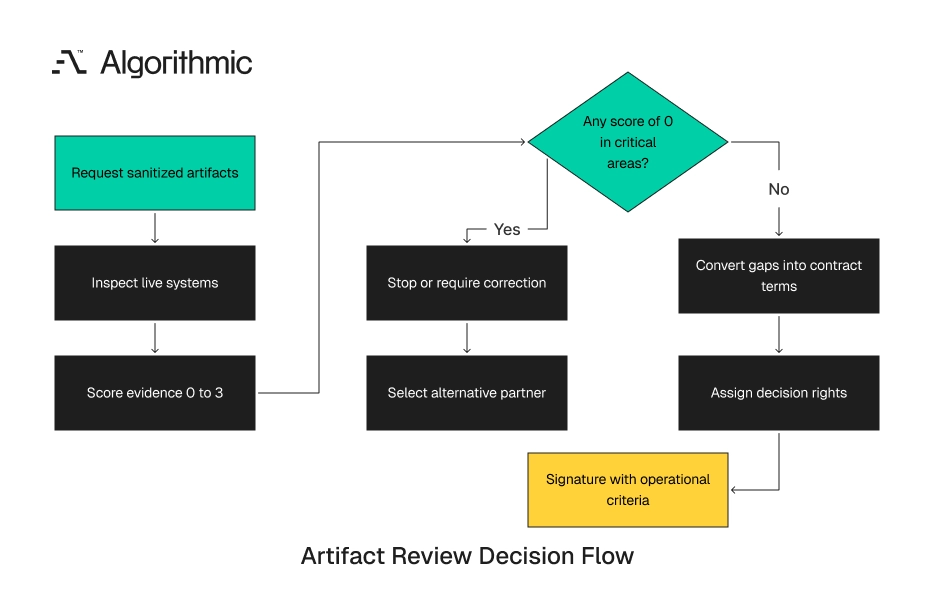 Click to expand
 Step 1 request artifacts 72 hours before the session
Send a written request for 8 to 10 artifacts. Ask for sanitized examples from recent work. The partner can redact client names, secrets, commercial information, and proprietary algorithms.
Set a firm deadline for delivery. A senior team should have these materials available because they use them during delivery. The request should ask for existing artifacts, not newly prepared summaries.
A practical request includes one design document, two architecture decision records, CI logs, one pull request, one runbook, one incident note, and one status report. For AI work, add evaluation records and model release history. For data engineering, add pipeline monitoring and data quality records.
The request should state that screenshots are insufficient for several categories. Screenshots can hide history, authorship, and timestamps. Live repository or system views provide stronger evidence.
The buyer should define acceptable redaction. Secret values, client names, and proprietary business logic can be removed. Timestamps, review comments, status changes, and decision history should remain visible.
A written request should also name the review format. For example, ask the partner to screen share from GitHub, Jira, Datadog, MLflow, or the deployment system. This keeps the discussion tied to records instead of prepared narratives.
Step 2 inspect the artifacts live
Use the session to inspect real files and logs. Ask the engineer to open a design doc, walk through a CI failure, show a rollback path, and explain how a new team member joins the project.
Avoid hypothetical questions when an artifact can answer the same point. “Show the last failed build and the fix” produces stronger evidence than “How do you handle quality?” The engineer’s screen should show repository history, CI output, and documentation records.
The buyer should ask follow-up questions tied to evidence. Who approved this release? Which test would have caught the incident earlier? Why did the team reject the alternate architecture?
A serious partner will answer from records. If every answer depends on memory, the buyer should score the category lower. Memory does not scale across staff changes, time zones, or production incidents.
The buyer should watch who answers. If the delivery owner answers every engineering question while the engineer stays silent, the operating model needs more review. Production delivery depends on the people who make and repair the system.
The buyer should also watch how the team handles gaps. A credible team can say which artifact is missing, why it is missing, and when it will be created. Evasive answers create more risk than a disclosed gap.
Live inspection should include one uncomfortable artifact. A failed build, missed milestone, incident note, or rejected design option reveals how the team operates under constraint. Perfect examples alone do not show routine production behavior.
Step 3 score evidence not confidence
Use a 0 to 3 score for each artifact category.
| Score | Meaning | Buyer action |
|---|---|---|
| 0 | Artifact absent | Treat as a high delivery risk |
| 1 | Artifact exists but is incomplete | Require correction before signature |
| 2 | Artifact is usable and current | Accept with normal governance |
| 3 | Artifact shows mature operating discipline | Weight positively in selection |
A partner should average at least 2 across the six core areas before taking on a complex build. For production machine learning, data engineering services, or regulated workflows, any score of 0 in operations or rollback should stop the process.
The buyer should record evidence, score, risk, and required correction for each category. This creates a clear basis for selection. It also gives the partner a fair path to address gaps before contract signature.
Scoring should involve at least one technical reviewer who has operated production systems. Procurement can manage the process, although engineering must assess engineering evidence. For larger programs, include the person who will accept the final production handoff.
Score variance deserves discussion. If procurement scores a partner highly because the commercial proposal is clear, engineering still needs separate authority over technical readiness. The final decision should preserve both views without blending them into a vague average.
The score should tie to specific evidence. “Operations score 1” is incomplete. “Operations score 1 because the team has runbooks for deploy rollback and lacks runbooks for database failure” is useful.
The buyer should also record remediation cost. Some gaps require 8 hours of documentation work. Others require 4 weeks of pipeline, monitoring, and release process work. The cost difference should affect vendor comparison.
Step 4 convert gaps into contract terms
Diligence findings should change the statement of work. If CI is incomplete, the first milestone should include pipeline setup. If runbooks are absent, production launch should require runbook approval.
The contract should define acceptance criteria for operational artifacts and product features. For example: “Production release is accepted when deployment logs, rollback procedure, monitoring dashboards, and incident response runbook are approved by the client technical owner.”
This removes ambiguity from the acceptance terms. It also prevents the common pattern where feature delivery consumes the budget and operational readiness becomes unpaid follow-up work. Contract terms should name the artifact, reviewer, approval standard, and deadline.
Payment milestones should reflect operational readiness. A build milestone can require passing CI, documented release steps, and updated architecture decisions. A launch milestone can require monitoring dashboards, rollback rehearsal, and an incident response contact list.
The contract should also define artifact ownership. The client should receive repository access, deployment records, runbooks, decision logs, and environment documentation. These records are part of the system and belong in the handoff package.
The statement of work should also define update cadence. Architecture records, runbooks, and release notes decay unless the team updates them during delivery. A monthly artifact review keeps documentation tied to the system being built.
Acceptance criteria should be testable. “Documentation complete” is weak. “A new engineer can start the service locally from the README and run the test suite within 2 hours” is testable.
The contract should include access rights. The buyer needs repository access, CI visibility, deployment logs, monitoring views, and issue tracking visibility. Without access, the buyer cannot verify delivery evidence during the engagement.
Step 5 assign decision rights before the first sprint
The buyer should decide who can approve architecture changes, release risk, scope changes, and production exceptions. These decision rights should be named before implementation begins. Ambiguity creates delay when tradeoffs appear.
For a startup, the approving owner may be the founder or fractional CTO. For an enterprise, the approving owner may be an engineering director, security lead, or platform owner. The named person should have enough authority to make timely decisions.
The partner should also name its internal owners. One person should own architecture integrity. Another should own delivery coordination. A third may own production operations for larger engagements.
Decision rights matter because artifacts reveal options, not automatic answers. A design record can show two paths with different cost and risk profiles. The buyer still needs a qualified owner to choose one path in writing.
Decision rights should include response-time expectations. A release approval that waits 5 business days can stall a weekly delivery cadence. A production exception without an owner can leave engineers guessing during an incident.
The buyer should publish the decision map in the project workspace. It should name decision type, client owner, partner owner, backup owner, and expected response time. This document should be reviewed whenever staffing changes.
What incomplete artifacts reveal about the delivery model
Incomplete artifacts are rarely isolated. They usually reveal how the partner staffs, manages, and prices work. They also show whether the partner sells capacity or production responsibility.
A team without design documents often relies on senior practitioners making oral decisions and junior engineers executing fragments. A team without reproducible environments often loses days during onboarding and handoff. A team without rollback procedures treats production launch as the finish line.
For a founder evaluating MVP development to production, these gaps can be expensive. The first version may ship, then the second and third release cycles slow as undocumented decisions compound. Each new engineer spends paid time reconstructing context.
For an enterprise buyer, the risk appears in governance. Procurement sees milestone progress, while engineering sees fragile ownership boundaries. The first production issue then exposes gaps that the evaluation process failed to test.
Engipulse’s 2026 outsourcing framework cites Gartner figures stating that 72% of enterprises engage external development partners for part of their software portfolio. The same source states that only 38% of technology leaders rate those relationships as highly effective. The spread matches what technical leaders see in practice: buying capacity is easier than buying operating discipline.
The artifact standard closes that gap. It tests the work system before the buyer funds the work. It also gives strong partners a fair way to prove delivery quality before commercial negotiation dominates the process.
Incomplete artifacts also affect price interpretation. A lower day rate loses value when the client pays for setup friction, production defects, and undocumented handoff work. A higher day rate earns consideration when the partner can show repeatable delivery records.
The clearest commercial risk is rework. A $150 hourly rate looks attractive until 80 hours disappear into environment repair, unclear requirements, and manual release correction. At that point, the lower rate has purchased uncertainty.
Incomplete artifacts also reveal staff structure. If only one senior engineer can explain the architecture, the partner has a key-person dependency. If junior engineers cannot point to written decisions, they will ask the client the same questions repeatedly.
They also reveal delivery governance. A partner without risk logs may manage problems through private conversations. That pattern hides risk from the buyer until timeline or budget pressure becomes visible.
The buyer should interpret artifact gaps as operating costs. Missing CI means the client pays for defect detection later. Missing runbooks mean the client pays during incidents when response time matters most.
Artifact gaps also affect retention of knowledge. When an engineer leaves, undocumented architecture choices leave with that person. The next engineer must recover context through code reading, meetings, and trial deployments.
Red flags that should stop selection
Some gaps require correction. Others should end the evaluation. The distinction matters because every vendor has some imperfection, while some operating patterns create predictable failure.
A partner should not pass technical diligence with no CI history. Manual testing and manual deployments can work for a prototype, although they provide weak evidence for a production system. For any product handling customer accounts, payments, regulated data, or revenue workflows, a visible release path is a minimum bar.
A partner should also fail the review if it cannot name a production incident owner. “The team handles it” is not an ownership model. During an outage, one person must coordinate diagnosis, rollback, communication, and follow-up.
No rollback path is another stop signal for production work. This applies even when the engagement starts with feature development. Feature teams eventually change production systems, and rollback discipline must exist before the risky release.
Refusal to show sanitized artifacts is also material. Legitimate confidentiality concerns can be solved through redaction, screen sharing, or examples from internal systems. A blanket refusal leaves the buyer with sales claims and no engineering evidence.
The strongest buyers apply these stop rules consistently. Exceptions made for a favored partner weaken the diligence process. Production systems do not care which vendor had the best commercial meeting.
Another stop signal is uncontrolled production access. If multiple engineers deploy from local machines or shared credentials, the buyer lacks traceability. Production access should use named accounts, role-based permissions, and audit logs.
A partner should also fail diligence if it cannot explain data handling rules. Customer data, production database exports, and AI training data require written controls. Verbal assurances do not protect the buyer during a breach, audit, or customer dispute.
Repeated blaming of prior clients is another warning. A partner can describe client-side constraints with professionalism. A pattern of blaming buyers for failed delivery often means the partner lacks governance records and escalation discipline.
How strong partners can prepare
Strong partners should maintain a diligence packet before buyers ask for one. The packet should contain sanitized artifacts from current work, not reconstructed examples. It should be updated every quarter.
A practical packet includes a design document, architecture decision records, CI/CD history, release notes, one runbook, one incident record, a sample status note, and a handoff checklist. AI partners should add evaluation records, model registry evidence, and monitoring examples.
This preparation reduces sales cycle friction. It also protects the partner from being compared only on price. Buyers can see the operating system behind the proposal.
The packet should avoid theatrical polish. Buyers do not need a 40-slide presentation about delivery values. They need enough real evidence to judge whether the partner can run the work.
Partners should also train sales teams to bring engineers into diligence early. A sales-led process that hides engineering until after signature creates suspicion. A record-led process builds confidence before commercial terms harden.
The diligence packet should include a short index. Each artifact should state the source system, date range, redaction type, and review purpose. This helps buyers inspect records quickly without turning diligence into a document search.
Partners should rotate examples each quarter. Current artifacts show current practice, staffing, and tool usage. A packet built from a 2-year-old flagship engagement proves little about today’s delivery system.
Strong partners should also prepare their engineers for evidence-based conversations. Engineers should know which artifacts they can share, what they can redact, and how to explain tradeoffs. This keeps diligence accurate and prevents sales teams from overpromising.
The preparation also improves the partner’s internal discipline. A team that maintains clean runbooks, release notes, and decision records sells better because it operates better. The sales benefit follows the production behavior.
The decision rule for CTOs, founders, and procurement leaders
A strong partner can explain their process. A stronger partner can show the files, logs, and operating records created by that process. The second standard is harder to fake and easier to verify.
For a $50K engagement, artifact review can be lightweight: 6 artifacts, 60 minutes, one technical reviewer. For a $500K engagement, it should be formal: 10 to 15 artifacts, 2 technical reviewers, a scored matrix, and contract terms tied to operating readiness.
The buyer should make three decisions before signature:
- Which artifacts are required before selection?
- Which artifacts become milestone acceptance criteria?
- Which missing artifacts disqualify the partner?
This is the practical answer to how to evaluate technical partners. Start with evidence of how they operate. Then assess team seniority, price, timeline, references, and fit.
Request the artifact set before the next vendor call. Score it with the matrix above. Advance only the partners that can show how they design, ship, monitor, and recover production systems. The same delivery evidence that vets a new partner also diagnoses a failing one, and our guide to rescuing a software project with raw delivery signals shows how those records name the constraint once a build is already in trouble.
Algorithmic runs technical due diligence that reads a partner’s design records, CI history, and rollback plans the way an engineer would, not the way a sales call presents them. Ask us to review your shortlist before you sign the statement of work.