

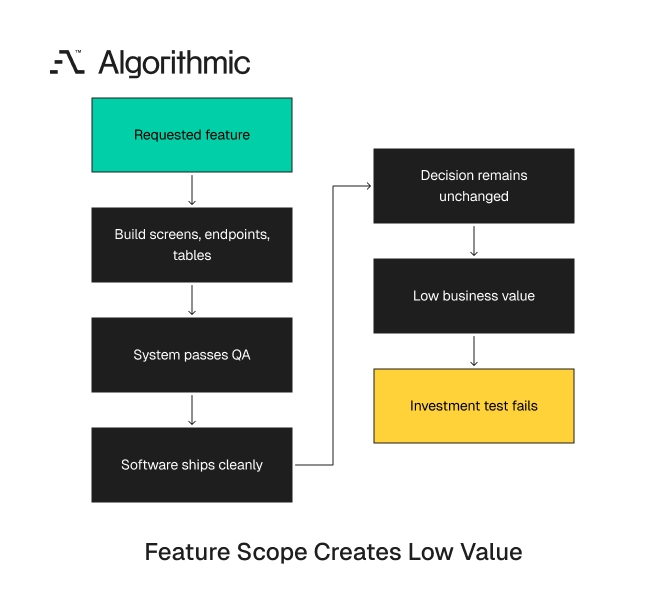
A 12-week software build can consume $180,000 before a team learns that eight requested dashboards support decisions made twice per quarter. The product can pass QA, deploy cleanly, and match every approved specification, and it still fails the investment test. Software scope often begins with requested features such as workflows, dashboards, automations, integrations, AI copilots, and reporting views. That structure feels concrete because engineering teams can estimate screens, endpoints, tables, and tickets, but it also hides the economic question that determines whether the product deserves funding.
A decision inventory lists the decisions a system must improve before the team defines features, and each decision receives an actor, frequency, input data, decision latency, error cost, intervention path, and business value. Like appetite-based planning in Shape Up, this shifts scope from a feature catalogue to an investment thesis. The method applies to venture-backed product builds, internal operations platforms, data products, and AI systems, and it gives executives and engineers the same unit of analysis, which is a decision that changes revenue, retention, risk, cost, or cycle time.
The inventory also creates discipline during budget approval. A CTO can compare a $40,000 routing workflow against a $90,000 dashboard using the same measurement basis, so the discussion moves from stakeholder preference to expected business change. The discipline matters because engineering capacity is finite, and a six-person product team has about 240 engineering hours per week before meetings, support, and production incidents, so spending that capacity on low-frequency decisions delays work tied to revenue, retention, and risk.
Feature-led scope creates technically complete low-value software
Feature-led scoping asks what the system should do, while decision-led scoping asks which decisions should change after the system ships, and these questions produce different build plans, estimates, and acceptance criteria. A founder requests an executive dashboard for customer success that contains renewal risk, product usage, support volume, NPS, and account notes, so the engineering team builds it in React, connects Salesforce and Snowflake, and sets role-based access.
The missed scoping question concerns the account manager’s renewal decision. The team needs to know who reviews the account, how often, and under which trigger, and which intervention improves retention. Absent that map, the dashboard becomes a read-only surface that informs people who already follow the account and leaves the renewal path, escalation timing, and commercial outcome unchanged.
This pattern appears in AI product development. A product leader asks for an AI assistant that summarizes user activity, when the right starting point is the decision the summary changes. That decision can take several forms, since it can determine which customer receives outreach today, which lead enters a sales sequence, which claim needs human review, or which SKU receives inventory before the next purchase cycle.
The same point applies from an execution angle. A system can be implemented correctly and still support the wrong decision, much like building features you will not need, and that is a scope failure. The issue appears late because the code looks finished, the UI matches the mockups, the API returns valid data, and the permissions model passes tests, yet the business result remains weak because the system never changed a high-value decision.
The same failure occurs in internal operations tools. A finance team asks for a vendor dashboard that displays invoice aging, approval status, and department owner, when the expensive decision is which invoices require exception review before payment. If the system does not assign exception work, the dashboard adds another monitoring surface, analysts still review too many low-risk invoices, and payment risk remains in the same manual path.
A technically complete product can still be economically incomplete. The build may contain the approved screens, all tested endpoints, and the requested integrations. The missing element is the operating decision the software was supposed to improve.
 Click to expand
 A decision inventory defines the economic unit of scope
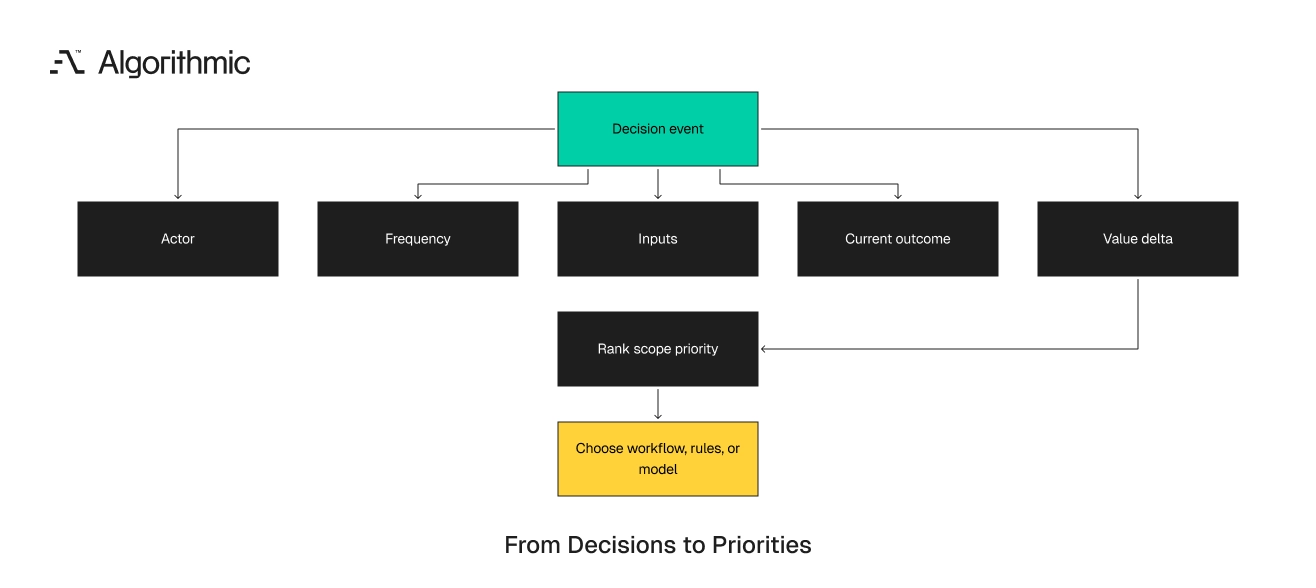
A decision inventory is a structured register of business decisions that software can improve. It applies to custom software development, AI systems, data platforms, and internal tools, and it gives leaders a disciplined way to compare work that otherwise looks unrelated. The unit of analysis is a decision event, which has an actor, a trigger, a frequency, inputs, a current outcome, and a value delta if improved, and this language lets founders, CTOs, and product leaders compare a dashboard, workflow, automation, and machine learning model.
The inventory also exposes the cost of delay. A daily decision with a $40 error cost creates $14,600 of annual exposure per actor, while a weekly decision with a $25,000 error cost deserves a different funding discussion. The decision event gives scope a financial grain size, so teams stop estimating a broad “customer success platform” as one object and instead estimate the renewal-risk decision, expansion-priority decision, and escalation decision separately.
That separation matters for sequencing. One decision can ship with rules, another requires a data model, and a third needs a workflow redesign, so treating them as one build hides risk and inflates estimates. It also improves accountability, because a decision event has a specific owner and a measurable outcome while a feature request often has neither.
 Click to expand
 The decision inventory ledger
Use a ledger before writing user stories. It should fit on one page for a first pass. The first version should name decisions in plain operating language.
| Decision | Actor | Frequency | Current input | Current failure mode | Value if improved | Candidate system support |
|---|---|---|---|---|---|---|
| Which trial accounts should sales contact today? | Sales rep | Daily | Product events, CRM notes | Reps contact low-intent accounts | $45,000 ARR per 1-point conversion lift | Lead score, ranked queue, CRM task creation |
| Which support tickets need escalation? | Support lead | Hourly | Ticket text, customer tier, SLA clock | Enterprise tickets breach SLA | $18,000 monthly churn risk reduction | Triage model, SLA alert, routing rule |
| Which customers are renewal risks this month? | CSM | Weekly | Usage, tickets, contract date | Outreach starts late | $120,000 quarterly retention exposure | Risk model, playbook workflow, renewal board |
| Which invoices require manual review? | Finance analyst | Daily | Invoice amount, vendor, PO match | Analysts review low-risk invoices | 30 hours monthly analyst time | Rules engine, anomaly score, audit queue |
| Which warehouse orders need exception handling? | Operations lead | Daily | Order age, carrier status, SKU priority | Late orders receive equal treatment | $22,000 monthly penalty and refund exposure | Exception queue, carrier feed, priority rule |
| Which patients need follow-up scheduling? | Care coordinator | Daily | Visit notes, diagnosis code, missed appointments | High-risk patients wait too long | 12% reduction in missed follow-ups | Risk flags, scheduling queue, call script |
This table changes the scoping conversation. The team compares value per decision event, and it stops debating personal feature preferences without a shared economic model. A dashboard that supports a quarterly decision with a $10,000 value ceiling should lose priority to a workflow tied to churn, fraud, or margin, a machine learning feature tied to a low-frequency decision should start as an experiment, and a production machine learning engineering program needs proof that decision volume and value justify the operating burden.
The ledger also clarifies ownership. Each row has one actor who makes or owns the decision, because shared ownership creates weak systems where no one accepts the recommendation, closes the loop, or measures the outcome. A strong ledger names the trigger as well, so “Contract renewal enters 90-day window” is stronger than “renewal risk review”, and the trigger tells engineering when the system should act.
The ledger should also record current latency. A support lead who notices an SLA breach after four hours needs different software than one who needs routing in five minutes, so latency determines architecture, alerting, and staffing design. The first ledger should include current tooling, because a decision made in Salesforce, Slack, and a spreadsheet carries different risk than one made inside a single product database, and tool fragmentation often explains slow adoption after launch.
It should also list the current feedback loop. If no one records whether the decision worked, the first release must capture outcomes. Measurement cannot be added after six months of untracked activity.
The four attributes that decide build priority
Every meaningful decision should be scored across four attributes. These attributes cover the economics of software scope without overlap, and they give finance, product, engineering, and operations a common scorecard. The scoring process does not replace judgment but makes it visible, so a team can argue about a 3 versus a 4 on value with evidence from revenue, churn, or operating cost.
The four attributes are actor, frequency, information gap, and value delta. Together they show who acts, how often, what data is missing, and what improvement is worth. That structure is enough to rank most early software scope decisions.
Actor
The actor is the person or machine that makes the decision. Actors include sales reps, account managers, underwriters, clinicians, dispatchers, finance analysts, support leads, and automated services, and each one needs a different form of support. Actor clarity prevents generic workflow design, since a VP needs trend visibility, variance, and accountability while a front-line operator needs a ranked queue, a next action, and enough context to trust the recommendation.
Machine actors need a different design. An automated routing service needs thresholds, fallback rules, logging, and human override paths, while a human manager needs context, escalation history, and financial exposure. Actor definition also sets the interface boundary, so a dispatcher working from a mobile device needs a different queue than a finance analyst in NetSuite, and a clinician reviewing patient follow-ups needs audit history, clinical context, and sign-off.
The actor should own the outcome measure. If sales operations owns the model and account managers own renewals, the workflow needs a clear acceptance path where the operator trusts the recommendation enough to act. Actor definition also controls training and rollout, because a tool used by 12 analysts can launch with direct coaching and office hours, while a feature used by 4,000 customers needs onboarding, instrumentation, support scripts, and product analytics from day one.
The actor may be a team instead of a single person. In that case, the inventory should name the accountable role and the handoff points. A support lead can own triage even when agents execute the responses.
Frequency
Frequency measures how often the decision occurs. Daily and hourly decisions compound, while quarterly decisions need higher value per event to justify custom software. For example, removing 20 seconds from a decision made 40,000 times per month saves 222 hours monthly, and at a loaded labor cost of $65 per hour that equals about $173,000 annually, a figure that excludes error reduction, faster response, and higher throughput.
A board-level allocation decision made four times per year needs a different business case. The value per event must cover research, implementation, training, and change management, so the scope should reflect that arithmetic. Frequency also affects measurement speed, because a checkout decision with 100,000 monthly events can produce statistical evidence within days, while a renewal decision across 60 enterprise accounts needs stronger qualitative review and longer measurement windows.
Teams should count events instead of users. Ten analysts making 500 decisions per month produce more automation value than 200 executives reading a quarterly report, so decision volume gives engineering a cleaner basis for backlog order. Frequency should also include seasonality, since a tax workflow may run heavily for eight weeks and remain idle for ten months, and a retail allocation decision may spike during holiday inventory planning.
Seasonality changes staffing, load testing, and release timing. A system that supports peak-volume decisions must be stable before the peak arrives. Late delivery can erase the annual value case.
Information gap
The information gap is the difference between available data and the data required for a better decision. It can require ETL pipeline development, a new event schema, a warehouse model, a CRM integration, or a labeling process, and it can also require data ownership changes across teams. This attribute separates a user interface project from a data infrastructure project, because a team asking for an AI assistant often needs data quality systems first, since dirty events, inconsistent labels, and unclear access rules produce unreliable recommendations.
The information gap also changes sequencing. A renewal risk model needs usage events, support history, contract metadata, and account ownership, so if those sources sit in four systems with conflicting account IDs, the first release should fund identity resolution. Information gaps often hide inside familiar tools, since Salesforce may contain account owners, Snowflake may contain product events, and Zendesk may contain support signals, and the decision still fails if account IDs do not match across those systems.
Data freshness belongs in the score. A warehouse table refreshed every 24 hours cannot support a five-minute support triage decision, while a daily refresh can support weekly account planning with lower production risk. Data definitions belong in the score as well, because “Active user” can mean login, session, meaningful event, or paid seat, and if teams use different definitions the system will create arguments instead of decisions.
The inventory should expose these definition conflicts before estimation. A two-week dashboard can become a six-week analytics engineering project when core metrics lack agreement. Naming the gap early protects budget and credibility.
Value delta
The value delta is the measured change if the decision improves. It should connect to revenue, retention, risk reduction, operating cost, or cycle time, because a scope item without a value delta is a preference. A 2% lift in trial-to-paid conversion has different value across two products, so in a product with 500 trials per month and $900 annual contract value it creates $108,000 of annual contract value, while in a product with 20,000 trials per month and $6,000 annual contract value it creates $28.8 million.
Scope should reflect that arithmetic. The same lead scoring feature deserves different engineering budgets in those two companies, and the ledger makes that difference visible before the build starts. Value delta should include downside protection, because fraud, clinical risk, security incidents, and compliance breaches do not behave like conversion improvements, so their expected value combines event probability, loss size, detection latency, and recovery cost.
The value estimate should be conservative enough for funding. Use existing conversion rates, churn amounts, refund records, claim loss data, or analyst time records, and avoid business cases built on aspiration without operating evidence. Value also has timing, so a retention workflow that saves revenue this quarter funds differently from a data foundation that pays back next year, and the ledger should show both annual value and expected payback window.
This timing helps executives sequence work. A company with 14 months of runway should prefer faster proof points. A profitable enterprise can fund longer data foundations when the value case is measured.
Decision inventory prevents three common scoping errors
Traditional guides on how to scope a software project often cover requirements, stakeholders, timelines, and specifications. Those tools have value once the target decisions are known, but they are insufficient as the starting point for high-stakes builds. Decision inventory changes the order of operations, so the team names the decision, measures its value, checks data readiness, and then chooses the system design, and that sequence prevents three recurring errors.
The errors share one trait. They fund a visible artifact before the team understands the operating decision. The result is software that ships cleanly and changes little.
Building dashboards where a queue is required
Dashboards summarize information while queues direct work, and the distinction matters because the system’s purpose changes. A revenue team with 30 account managers does not need another executive chart when the commercial decision is account intervention before renewal, because that decision needs account ranking, owner assignment, intervention history, renewal timing, outcome tracking, and a weekly operating cadence.
The dashboard can remain in scope, where it supports the operating path and shows which interventions happened, which owners acted, and which accounts moved out of risk. A typical failure pattern is easy to spot, since the dashboard shows 47 accounts at risk and no workflow assigns the next action, so two weeks later the same accounts remain visible and no one can say which action changed.
A queue creates a different management system. Each account receives an owner, a recommended action, a due date, and a status, so the team can measure touch rate, response rate, and renewal outcome. The queue also changes accountability, because a VP can see that 18 high-risk accounts received no outreach in seven days, and that evidence supports management action instead of another reporting request.
The engineering consequences are different as well. A dashboard may require data modeling, charting, and permissions, while a queue requires state management, assignment logic, notifications, audit records, and workflow analytics. That difference affects cost and timeline, so a team estimating only charts will underprice the system if the business needs an intervention engine, and the decision inventory exposes the gap before contract signature.
Building AI where a rule or default is enough
AI features carry real costs, including model evaluation, inference latency, monitoring, drift detection, data privacy review, and incident response runbooks. A rules engine or server-side default often changes the decision at lower cost, so the scope should compare these options before model selection. A product team should quantify user step cost against engineering cost by counting the micro-decisions users make each month, then estimate the behavior lift from removing them and compare that value with build effort.
If 80% of users choose the same configuration, a default can outperform a recommendation model for the first release, and the model should follow when variance, volume, and value justify it, which protects the team from funding model infrastructure before proving behavior change. Consider a B2B SaaS onboarding flow with 12 configuration fields where event data shows that 83% of users select the same three options, so a server-side default and a short confirmation screen can remove nine clicks without a model.
The first release can measure completion rate, time to activation, and support tickets. If activation improves, the team has evidence for the workflow change, and if user segments diverge, the second release can test rules or a model. This approach also reduces production risk, because rules and defaults are easier to inspect, roll back, and explain to support teams, and a model earns its place when simpler decision support stops improving the metric.
The same principle applies to internal operations. A claims team may request a classification model for every incoming case, but if 70% of cases follow a stable policy rule, rules can remove most manual routing. The model effort should then focus on the residual set, since ambiguous cases, high-loss cases, and edge patterns deserve more advanced support, and that design concentrates engineering effort where judgment and uncertainty create value.
Automating low-value work while high-value judgment remains unsupported
Automation saves time when the automated step has volume and cost, and it destroys value when it accelerates a path that needs redesign, so decision inventory exposes that distinction early. In one software feasibility study for a B2B marketplace, the requested scope centered on automating vendor onboarding emails, but the decision inventory showed that onboarding speed was not the constraint, and the higher-value decision was which vendors should receive manual qualification because a small subset drove most order disputes.
The first release changed from email automation to a risk-ranked review workflow. Engineering effort moved from templated notifications to data modeling, dispute history, and operator review tools, and the team funded a decision that reduced downstream dispute cost. This pattern appears in finance operations as well, since a team asks to automate invoice reminders because analysts spend hours chasing approvals, when the inventory shows that the expensive decision is which invoices require exception review before payment.
The right workflow sends low-risk invoices through standard approval and routes exceptions to trained analysts, recording the reason for review, the decision, and the downstream payment result so that data improves future thresholds. Automation should follow process redesign, because if the old path sends every invoice, ticket, or vendor through the same treatment, faster execution preserves the waste, and decision inventory identifies the points where judgment creates value.
A second-order benefit appears after launch. Once the system records decisions and outcomes, the team can tighten thresholds. The workflow becomes a measurement asset, not only an execution tool.
AI scope requires decision inventory before model selection
AI product development raises the cost of poor scope. A non-AI workflow can be removed or changed with limited production risk, while an ML system in production adds training data, model versioning, evaluation sets, inference infrastructure, monitoring, and fallback behavior. Before selecting GPT-4.1, Claude, Gemini, a fine-tuned model, or an embedding-based retrieval augmented generation design, the team should map the decision, because the model class and the evaluation plan both follow from the decision shape.
A support triage decision needs classification accuracy, latency bounds, and escalation safeguards, a renewal risk decision needs calibration, explanation quality, and integration into account planning, and a document search decision needs retrieval precision, citation quality, and access controls. A claims review decision needs false-negative control because missed fraud has direct cost, a sales prioritization decision needs lift measurement against a holdout group, and a clinical scheduling decision needs audit trails and human sign-off.
The same logic drives AI scoping, where the practical step is the inventory, so the team names the decision, scores it, and funds the smallest experiment that proves value. This discipline also prevents model-centered scope without operating change, because a chatbot attached to poor data creates a refined interface to weak operations, while a ranked queue tied to verified events, owner assignment, and outcome tracking changes behavior more directly.
AI evaluation should start with the decision’s error profile, because a false positive in sales prioritization wastes rep time, while a false negative in fraud review can create direct financial loss. The acceptance criteria should reflect those costs, so a support classifier should report precision, recall, latency, override rate, and breach reduction, and a retrieval system should report answer citation accuracy and permission failures.
Human review belongs in scope when risk is material. The workflow should show confidence, source evidence, and escalation history so operators have enough context to accept, override, or correct the recommendation. The system also needs a production owner, because model performance decays when products, policies, or customer behavior change, so someone must review drift, error reports, overrides, and business outcomes on a defined cadence.
AI scope should include fallback behavior. If a model fails, times out, or returns low confidence, the workflow still needs a safe path that routes work to a human queue, applies a conservative rule, or defers the action. The fallback design is part of the business case, since a high-volume workflow with frequent human fallback may save less labor than expected, so the inventory should estimate that rate before the team funds infrastructure.
The 4-gate scope filter
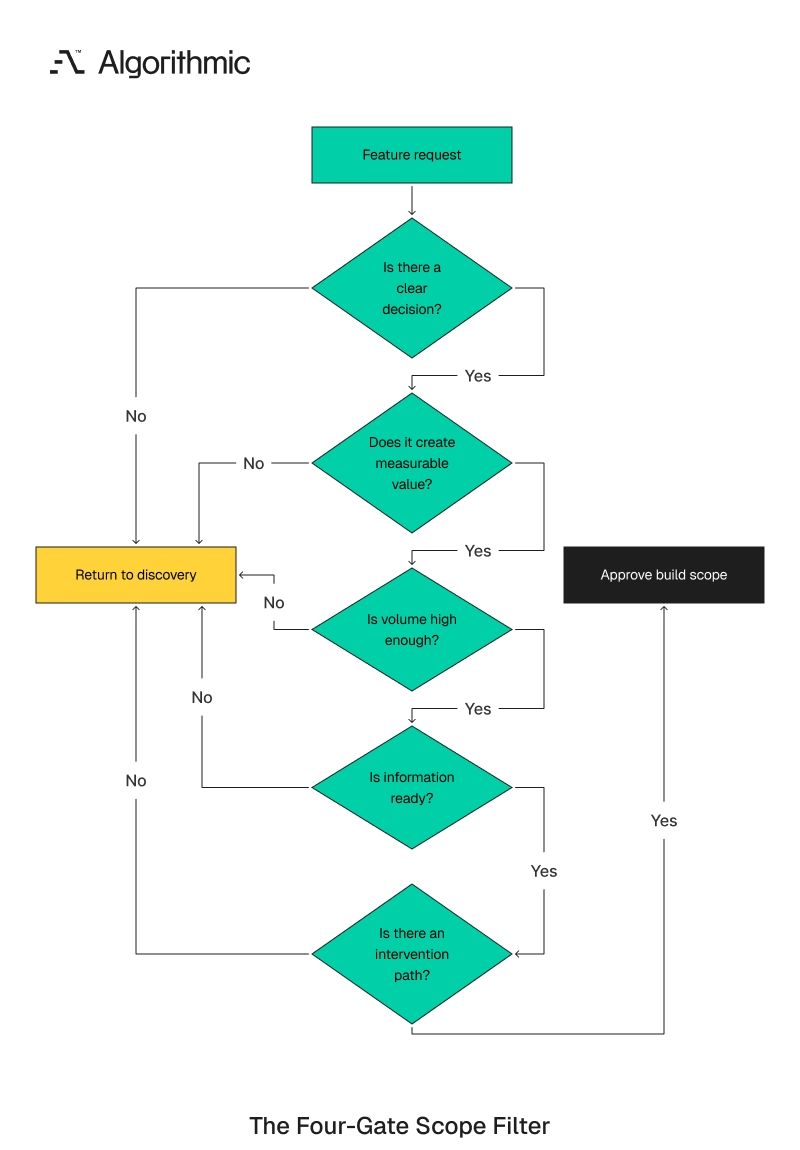
Use this filter before committing to production-ready software development. It works for SaaS product development, internal tools, data platform development, and AI features, and each gate removes work that lacks economic support. The filter should run before procurement and vendor selection, and it also applies to internal engineering roadmaps, so a feature that fails the gates should return to discovery or remain manual.
The four gates are decision value, decision volume, information readiness, and intervention path. A feature needs evidence across all four. Missing evidence is a discovery task, not a build task.
 Click to expand
 Gate 1 is decision value
The decision must connect to one of five value lines, which are revenue, retention, risk, operating cost, or cycle time. If the team cannot state the value line, the feature stays out of scope, because a value line anchors the work to the P&L or operating model. A useful threshold for a seed-stage or Series A company is $50,000 of annual value per major workflow, so below that level the team should use manual process, no-code tools, or a smaller experiment, and larger companies should raise the threshold because coordination cost increases with headcount.
That threshold should include engineering, product, data, training, and support time. A $35,000 workflow that consumes six weeks from three engineers rarely deserves custom development, while a $500,000 churn exposure tied to a weekly decision deserves deeper analysis. Decision value should include maintenance burden, since a workflow that touches billing, security, or customer data creates ongoing review cost, so the funding case should cover the first build and the production run cost.
The value gate should also name the payer inside the business. Sales, support, finance, compliance, and operations may all benefit from the same system, so one executive should own the funding case and the metric. A shared benefit without one accountable owner often stalls during delivery, because engineering receives conflicting requirements and adoption becomes optional, and the value gate should close that gap before build approval.
Gate 2 is decision volume
The decision must occur often enough to compound. Daily decisions deserve more engineering attention than quarterly decisions unless the quarterly decision has high value per event, because frequency gives the investment time to pay back. For internal tools, start by counting monthly decision events, and for customer-facing products, count user sessions, conversion steps, and failure points using production logs, CRM activity, ticket systems, billing records, and analytics events.
Volume also determines measurement design. A decision made 10,000 times per month can be tested with cohort analysis, while a decision made 12 times per year needs stronger upfront judgment and post-decision review. Low-volume decisions still deserve support when the value per event is high, so M&A screening, credit approval, clinical review, and enterprise renewal planning can meet that threshold, and their scope should emphasize evidence quality and auditability.
The volume gate should separate eligible events from total events. A support desk may receive 50,000 tickets per month while only 3,000 need escalation logic, so estimating against total volume overstates value and infrastructure demand. It should also account for adoption, because a workflow used in only half of eligible events delivers half the expected value, and the scope should include the operating cadence needed to drive usage.
Gate 3 is information readiness
The system must have access to the data needed for the decision. If the data is incomplete, stale, or inconsistent, the first scope item is data pipeline engineering or instrumentation, because a feature built on weak data creates operational noise. This is where many AI scopes change, since a proposed model becomes an event taxonomy, warehouse table, labeling process, or analytics engineering sprint, and the team moves from prototype excitement to production readiness.
Information readiness includes permissions and lineage. A support model that reads ticket text and customer tier data needs access control, retention rules, and audit records, while a finance workflow that touches vendor data needs approval history and segregation of duties. Readiness also includes ownership, because every source needs a named owner who can resolve defects and approve changes, and a model trained on orphaned data becomes fragile after the first schema change.
The data contract should specify refresh rate, field definitions, acceptable null rates, and retention policy. Those details belong in scope because they determine whether the system remains reliable after launch. Information readiness should also include test data, since engineering teams need representative records to validate routing, scoring, permissions, and edge cases, and synthetic records can support early development while production validation needs real patterns.
This gate should also include write permissions. Many decision systems must create tasks, update statuses, or record outcomes. Read-only access limits the system to observation and weakens adoption.
Gate 4 is intervention path
The system must define what happens after the decision. A risk score without an owner, deadline, and playbook is incomplete scope, because the path converts a finding into operational action. The intervention path includes assignment, notification, workflow state, audit trail, feedback capture, and measurement, along with exception handling when the recommendation is wrong, and these mechanics determine whether the system changes behavior.
A renewal risk score needs a CSM owner, a due date, a call plan, and a status field, along with a closed-loop result such as saved, expanded, downgraded, or churned, because without that loop the model cannot improve and the team cannot measure value. The intervention path should define service levels, so a high-priority ticket needs action within five minutes while a renewal-risk account may need action within five business days, and latency shapes alerting, staffing, and escalation rules.
Feedback capture should be mandatory for high-value workflows. Operators should record accepted, rejected, overridden, and completed states, and that record becomes the training and measurement base for later releases. The intervention path should also define escalation failure, because if the assigned owner takes no action the system needs a second path that notifies a manager, reassigns the item, or marks the case for review.
These details appear operational, yet they drive economic value. A score that no one acts on has no return. A workflow with measured follow-through can improve with each release.
Decision inventory shortens discovery and improves estimates
Discovery phases often run for 2 to 4 weeks because teams gather requirements without an economic ranking method. A decision inventory gives that phase a sharper mandate, because it defines what the team must learn before estimates have meaning. SoftwareFinder’s 2026 survey of 502 U.S. software buyers reported that 92% experienced research fatigue and the average software decision took 4 months, and that fatigue appears in custom builds as well, where every stakeholder adds features because no shared value model exists.
Structured scoping reduces expensive rework in complex projects by placing discovery at the center of schedule control, and decision inventory makes that discovery concrete by ranking decisions before screens, epics, and estimates. At Algorithmic, across 35 complex engagements, we have seen senior teams cut 20% to 40% of requested scope after the first decision inventory review, and the removed work is rarely useless, only lower value than the decisions that determine revenue, retention, risk, or cost.
The estimate improves because the unit of work becomes clearer. Engineering can distinguish a workflow change from a data platform change, and product can separate a reporting need from an intervention need. This also changes executive review, since leaders can approve a $90,000 build tied to a $600,000 annual churn exposure and reject a $60,000 dashboard tied to one quarterly meeting and no intervention owner.
Decision inventory also improves vendor comparisons. Two proposals with the same price can carry different economic value, and the better proposal maps engineering work to decision volume, data readiness, and intervention design. It also reduces change orders, because teams find missing integrations, unclear ownership, and data quality risks before contract signature, and that timing protects budget and prevents mid-build scope expansion.
A better estimate also improves technical planning. Architects can choose batch, event-driven, or synchronous patterns based on decision latency, and data teams can estimate identity resolution, data contracts, and monitoring before the UI plan hardens. The method also gives procurement a clearer basis for selection, since a vendor that prices five dashboards cheaply may still ignore the decision path, while a vendor that maps workflows to measurable outcomes may produce a smaller proposal with greater value.
Discovery should end with ranked decisions, not a long list of requested features. The ranked list makes tradeoffs explicit. It also gives executives a clean record for budget approval.
A practical one-week decision inventory process
A decision inventory does not require a long consulting exercise. A focused team can complete the first version in five working days, and the output should be a ranked ledger, a shortlist of experiments, and a draft production path. The process works best with a small team that includes the CTO, product lead, finance owner, data lead, and three to five operators, because operators supply the decision detail that executives and software teams often miss.
The week should produce evidence, not presentation volume. Each day should add a specific part of the ledger, so by Friday the team knows which decision deserves funding first. Use one shared document and one decision ledger, because long slide decks slow the process and invite abstraction, and the working artifact should contain decisions, owners, data sources, value assumptions, and open risks.
 Click to expand
 Day 1 lists decision events
Interview 6 to 10 people who make or influence the target decisions. Ask what they decide, how often they decide it, what information they use, and what happens when they choose poorly, and capture the trigger that starts each decision. Do not ask for feature requests during this step, but capture the operating reality, and write each decision as a sentence that starts with “which”, “whether”, “when”, or “how much”.
Good examples include “which tickets need escalation”, “whether this claim needs review”, and “when this account should receive outreach”, while weak examples include “customer dashboard”, “AI assistant”, and “better reporting”, which are solution shapes instead of decision events. Ask operators to show recent examples, so a support lead opens tickets instead of describing an abstract process, and a finance analyst walks through actual invoices, approvals, and exceptions.
Those artifacts expose hidden steps. They show spreadsheet workarounds, Slack approvals, manual lookups, and data copied between systems, and those details often determine the first release. The interviewer should capture the actor’s language, so if operators say “red accounts”, record what makes an account red, and if finance says “exception invoice”, record the exact exception rules.
By the end of Day 1, the team should have 15 to 30 decision candidates. More than that usually means the team has captured tasks instead of decisions. Combine duplicates before the second day begins.
Day 2 quantifies frequency and cost
Attach monthly volume and error cost to each decision. Use actual system data where available, including CRM records, ticket counts, renewal dates, invoice volume, clickstream events, claims, orders, or dispatch records, and pull counts from production systems instead of meeting estimates. Where exact cost is unavailable, use bounded estimates, since a range of $20,000 to $40,000 is better than a feature with no stated economic value, and record the assumptions so finance can refine them later.
For example, a support team can estimate SLA breach cost from refunds, churned accounts, and service credits, a sales team can estimate lead prioritization value from conversion lift and annual contract value, and a finance team can estimate review cost from analyst hours and payment error rates. The cost estimate should separate labor, delay, and error, because labor savings alone often understate the value of better decisions, and a 30-minute delay can cost little in wages and still create churn risk.
Use conservative assumptions for the first pass. If a range spans too wide, mark the decision for follow-up instead of forcing precision, because the goal is ranking instead of a final finance model. Day 2 should also record the current baseline, so if the team wants to reduce SLA breaches, record the current breach rate, and if the team wants to improve conversion, record the current conversion rate.
A baseline prevents false success after launch. A workflow that feels faster may still leave the business metric unchanged. The baseline turns adoption and outcome measurement into part of scope.
Day 3 maps information and system gaps
Identify the data sources, integrations, and workflow states required to improve each decision. This step often exposes missing instrumentation, weak database schema design, absent data lineage tracking, or unclear ownership, and it also shows which teams must participate. The result should separate interface work from data engineering services and ML model deployment services, because a queue with clean source data is a different build from a queue that needs identity resolution first, and the difference affects timeline, budget, and risk.
Document the current data path. Include source system, refresh rate, owner, key fields, permissions, and known quality issues, because this record prevents a common estimate failure, which is assuming data exists in usable form. Map the write-back path as well, since if a recommendation appears in Salesforce the outcome may need to return to Snowflake or the product database, and closed-loop learning requires both read and write design.
Security should enter the discussion on this day. A workflow that touches patient notes, vendor bank data, or customer contracts needs access rules from the start, because retrofitting permissions late creates rework. Day 3 should also identify manual data dependencies, since many workflows rely on fields that operators do not complete consistently, and a model or queue built on those fields will inherit the defect.
The team should decide whether to improve instrumentation before product work. If the decision depends on clean event data, instrumentation may be the first release. That work is engineering scope, even when no new screen ships.
Day 4 scores and selects
Score each decision from 1 to 5 on value, frequency, information readiness, and intervention clarity, multiply value and frequency, then subtract delivery risk for weak data or unclear intervention. Select the top three decisions for deeper scope and fund one production path or two experiments, because a broad feature set dilutes engineering effort before the team proves which decision creates value.
The scoring does not need false precision. A 5-point scale is enough for the first pass, because the purpose is comparative judgment instead of a finance-grade valuation model. The selected decision should have an owner before the day ends, and that owner should accept the operating metric and the adoption target, because engineering cannot compensate for missing business ownership.
Record rejected items with reasons. A postponed dashboard may return later after the workflow proves value, and the record prevents the same debate from restarting in the next planning meeting. Day 4 should produce a visible tradeoff, so if a team selects a lower-value decision because data is ready, record the rationale, and if it selects a high-value decision with weak data, record the added foundation work.
This decision record protects the team during delivery. When new feature requests appear, the team can compare them against the approved decision basis. That discipline keeps scope tied to value.
Day 5 converts decisions into scope
Write scope as decision support. A strong scope item reads like “Reduce enterprise ticket SLA breaches by routing high-risk tickets within 5 minutes of creation”, which names the decision, actor, latency, and target outcome. The engineering scope then becomes specific, including ticket ingestion, customer tier lookup, classifier evaluation, routing queue, escalation audit, and breach-rate dashboard, and each item exists because it supports the decision path.
Acceptance criteria should follow the same structure. Measure routing time, escalation accuracy, breach rate, override rate, and operator adoption, and do not stop at screen completion or API response success. The production path should include release sequencing, so a first release can use rules and manual review while a second release tests model support, and the sequence should match evidence and risk.
End the week with a one-page scope brief. It should list the top decision, value line, actor, frequency, data sources, intervention path, acceptance criteria, and open risks, and that document is enough to support an estimate conversation. The brief should also list what remains out of scope, because exclusions should be explicit since executive sponsors often remember early requests as commitments, and a written boundary prevents rework and protects the investment case.
The final output should support an engineering estimate within days. It gives architects the latency, data, workflow, and risk details they need. It gives executives a clear reason to fund or reject the build.
What founders and CTOs should change now
Start every software project with a decision inventory. Require each proposed workflow, dashboard, integration, or AI feature to identify the actor, frequency, information gap, intervention path, and value delta, and apply this rule before design, estimation, and vendor selection. Use the 4-Gate Scope Filter before approving build budget, remove features that do not pass the gates, and convert the highest-value decisions into experiments, production workflows, or data foundations based on value and readiness.
For the next project planning session, replace the feature backlog review with a 90-minute decision inventory workshop. Bring the CTO, product lead, finance owner, and the operators who make the decisions daily, then fund the decisions that move revenue, retention, risk, or operating cost and let the software scope follow. A practical agenda is enough, so spend 20 minutes listing decision events, 25 minutes assigning frequency and value, 25 minutes checking data readiness, and 20 minutes selecting the first build path, and end the meeting with a ranked decision ledger instead of a larger backlog.
The discipline changes the nature of scope. Teams stop treating software as a list of requested artifacts and instead fund systems that improve specific decisions, at measurable frequency, with clear economic value. The first inventory will feel more demanding than a feature workshop, because it forces the team to name value, ownership, and operating change, and that pressure is productive because it surfaces before engineering spend begins.
For founders, this method protects runway. A six-person engineering team can lose a quarter to software that satisfies stakeholders and misses the business case, so a decision inventory reduces that risk before the first sprint. For CTOs, it improves technical judgment, because architecture decisions become easier when the team knows latency, volume, data quality, and intervention requirements, so the system design follows the decision and the budget follows the value.
Algorithmic runs feasibility studies that scope a build around the decisions it must change, not a feature list. Bring us in before you lock scope if your roadmap is filling up with dashboards.