

At 9:03 a.m., a support agent misreads a refund policy, approves the incorrect exception, updates Salesforce, closes the Zendesk ticket, and posts a customer note. At 9:23 a.m., the same loop has repeated across 400 accounts. A single AI agent with write access to Salesforce, Zendesk, Jira, and Stripe can create that failure pattern in one short operating window, and the failure rate is realistic when an action loop runs without containment. The agent needs no malicious intent, hostile prompt, or model outage. It needs broad permissions, inadequate policy checks, no stop condition, and no tested reversal path.
The risk grows when teams expand permissions without service levels, audit logs, rollback paths, cost caps, and human escalation. Model quality matters, but operating control decides whether an agent belongs in production. Enterprise leaders are moving agents from pilots into revenue-linked workflows, and Gartner forecasts that 40% of enterprise applications will embed task-specific AI agents by the end of 2026, up from less than 5% in 2025. That shift changes the management problem. An agent that reads documents is a tool, and an agent that changes account status is an internal service.
An agent that approves refunds, routes legal clauses, updates production data, or opens access requests changes business state. It needs the same operating discipline as payment systems, identity services, internal APIs, and data pipelines, so the minimum standard is a service-level agreement that defines success, containment, logging, rollback, and ownership. Most agent programs start with a product question, which is whether the agent can complete the task. Production programs need an operating question, which is whether the organization can absorb the agent’s failure. That second question should govern permission design, release approval, and executive sign-off.
Autonomy expands the failure model
Traditional software fails inside defined paths. A payment service declines a card, retries a request, or returns a 500 error, and the failure path is narrow enough for monitoring, alerting, and rollback. Teams can usually identify the affected service, transaction, customer, and recovery step, because the logs identify the API call, request payload, response code, and downstream write. The incident has a boundary.
AI agents fail across reasoning, tool use, policy interpretation, and external state. A support agent can misclassify a customer, select the incorrect policy, trigger a refund, update the CRM, and send an email, so one flawed decision creates separate evidence trails in five systems. The failure spans model traces, tool logs, workflow events, database writes, and customer communications, and a standard application dashboard cannot explain the full event chain. The operating team needs a run-level record that links every decision and action.
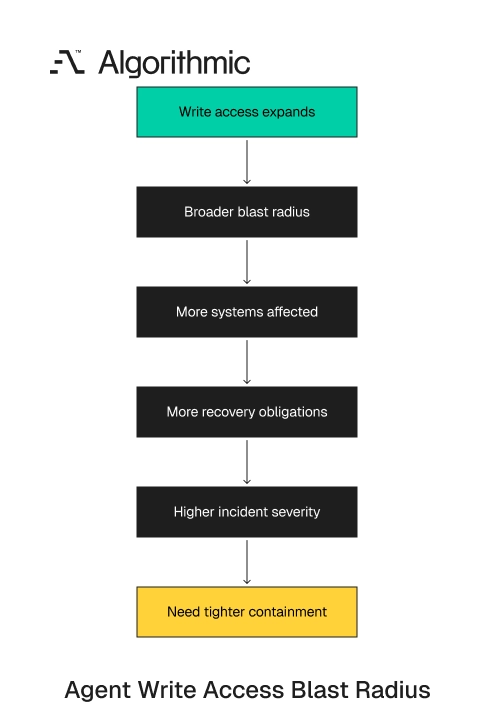
Autonomy should be treated as a change in risk class. Each new permission expands the blast radius. Each connected system adds a recovery obligation.
 Click to expand
 A Level 2 support agent with refund authority creates financial exposure, a Level 2 legal operations agent creates contract exposure, and a Level 2 data agent creates reporting and compliance exposure. The risk profile changes again when the agent runs on a schedule, because a human-triggered run creates one incident window while a scheduled agent that runs every 15 minutes creates 96 opportunities per day to repeat the same fault.
A scheduled workflow also changes incident timing. The first incorrect run can occur before support, finance, or legal teams notice the issue, and by the time a dashboard shows an anomaly the agent has often completed several more batches. Batch size matters as much as schedule frequency, since a 25-record batch creates a different recovery problem from a 2,500-record batch. The SLA should state both limits in the release record.
Research is moving in the same direction. The ReliabilityBench paper, “Evaluating LLM Agent Reliability Under Production-Like Stress Conditions,” argues that single-run success rates are inadequate for production agents, a finding that matches what engineering teams see after pilots move into live workflows. The paper evaluates consistency across repeated execution, strength under task changes, and fault tolerance during infrastructure failures, and those measures match how production systems fail under load. Week-three behavior matters more than a controlled demo path.
Production-grade agents need reliability measures across repeated runs, input variation, tool failures, latency, and partial outages. A single green demo tells leadership little about behavior during retries, stale retrieval data, queue backlog, or a third-party API timeout. Production readiness requires evidence across the failure modes the organization will face.
The same issue appears in internal software engineering agents. A coding agent can pass a demo by fixing one ticket in a prepared repository, yet production work exposes dependency drift, incomplete tests, ambiguous requirements, and permission boundaries across GitHub, Jira, CI, and deployment systems. Support agents face a different variation problem, because a refund policy that works for retail customers can fail for enterprise accounts, chargeback disputes, regional tax rules, or account-credit arrangements. The SLA should measure each high-risk category separately.
Legal operations agents carry another failure mode. A clause-routing agent can classify a limitation-of-liability term correctly in a standard agreement and fail on a customer paper with modified definitions, and contract exposure often appears several weeks after the agent’s decision when commercial teams depend on the output. Data agents add lineage risk, since an agent that updates dbt models, Looker fields, or warehouse tables can alter executive reporting without triggering a customer-facing alert. The incident then appears as a finance dispute, planning error, or board-pack correction.
These are production failure modes. They require operating controls, ownership, and recovery paths. Model selection alone does not solve them.
An agent SLA must define more than uptime
For deterministic services, an SLA often starts with availability and latency. For agents, availability only covers the infrastructure path, and the material risk sits at the action layer. A support refund agent can be up 99.9% of the month and approve incorrect refunds, a procurement agent can respond in two seconds and route a vendor contract outside policy, and a coding agent can complete a ticket and introduce an authorization flaw.
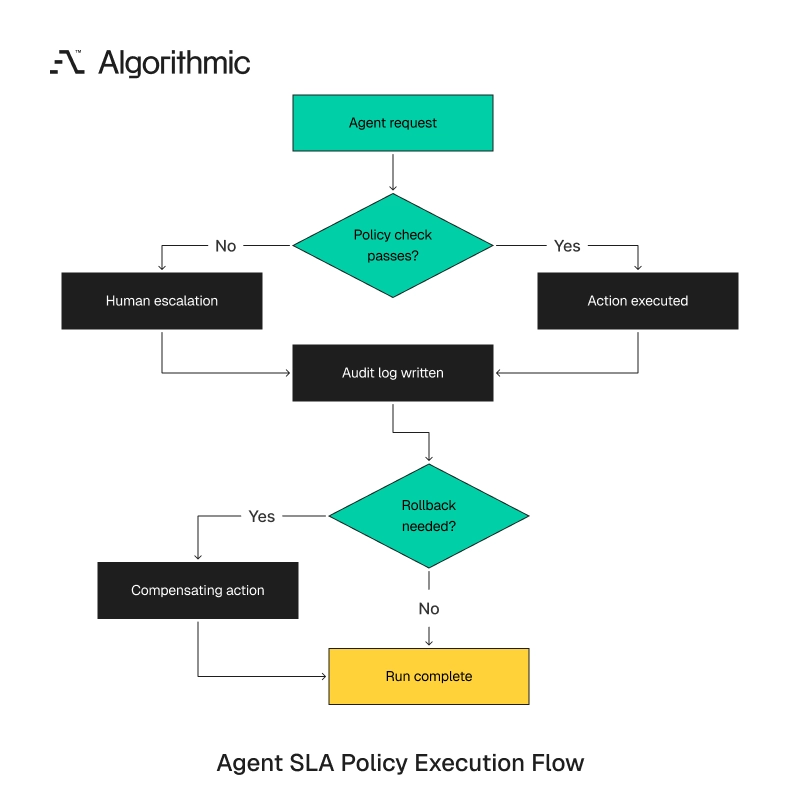
The contract needs four operating facts. It states what the agent can do, how success is measured, how failures are detected, and how the business returns to a known-good state. Those facts should be written before the agent receives write access.
 Click to expand
 The Agentic AI SLAs framework makes a similar point. Legacy guarantees often ask for measures a vendor cannot sign, such as undefined correctness, and they also ask for measures a customer cannot verify. Verification fails when the platform does not expose action-level data, trace IDs, tool calls, or policy decisions, so a vendor dashboard that reports “tasks completed” does not support incident review. Production teams need evidence at the level of decisions, tools, and records changed.
A production SLA should define the unit of work, which can be a ticket, invoice, refund, pull request, access request, clause review, customer response, or database change. Without that definition, the team cannot calculate error rate, containment, recovery time, or cost per task. A production SLA should also define exclusion rules, so a support agent’s SLA can exclude tickets that lack required account identifiers, route those tickets to humans, and record the exclusion reason.
The SLA should separate system availability from action quality. Availability answers whether the agent service was reachable. Action quality answers whether the agent’s business decision met policy.
Action quality
Action quality measures whether the agent took the correct action under policy, context, and business rules, and this measure must be tied to the workflow. Generic accuracy does not tell a support leader whether refunds, ticket routing, and customer replies met policy. For a customer operations agent, action quality includes correct queue routing, refunds within policy, and customer messages requiring correction. For a finance agent it includes coding accuracy, approval compliance, and exception handling, and for a legal operations agent it includes clause identification, fallback selection, and escalation accuracy.
A practical SLO uses task-level measures, such as “The agent must route 98.5% of Tier 1 support cases to the correct queue, measured against a weekly human audit of 300 randomly sampled cases”. That statement gives the team a threshold, a sample, and a cadence, and the metric also needs a sampling method, an owner, and a review cadence. Without those items quality measurement becomes an anecdote after incidents, so the owner should have authority to pause the agent when performance drops below the agreed threshold.
Sampling also needs stratification for high-risk categories. A support team should sample enterprise accounts, refund requests, regulated requests, and angry-customer cases separately, because a single average hides the failure modes that create customer and compliance exposure. A finance sampling plan should separate new vendors, changed bank details, duplicate invoices, missing purchase orders, and international payments, since those cases carry different fraud and compliance risks and the quality score should show each group.
A legal sampling plan should separate standard customer paper, non-standard customer paper, public-sector agreements, regulated-industry contracts, and renewals, because clause risk differs across those categories and the escalation threshold should reflect that difference. Action quality also needs severity tiers, since a misspelled customer name differs from an unauthorized refund and a routing error differs from a regulated disclosure failure. The SLA should state which defects count as P1, P2, and P3, and which defects trigger an automatic pause, because severity definitions keep incident response from becoming a negotiation during customer impact.
Containment
Containment defines the maximum damage from a failed run. It converts broad operating risk into a bounded event, so the system should limit both action volume and business value at risk. This includes per-run cost limits, maximum records changed, daily transaction limits, tenant-level caps, and automatic stop conditions, and a production agent needs those hard limits enforced outside the model because prompt instructions do not provide operating control.
A safe support agent can update 25 tickets per run, issue no refund above $100 without approval, and stop after three consecutive policy exceptions. These constraints belong in code, permissions, queues, and workflow engines, so the model can recommend an action while the control plane decides whether that action is allowed.
Containment also needs a pause mechanism. The system should disable write permissions when error rates, costs, or policy exceptions cross the SLA threshold, and that pause should occur before the agent continues work on the next batch. A finance example makes the point concrete, since an invoice agent with a $1,000 approval threshold should fail closed when the vendor, purchase order, or bank account does not match the source system, and it should route the exception to accounts payable instead of creating a reconciliation path.
A security example is equally direct. An access-request agent should never grant production database access when manager approval, ticket classification, or identity group membership is missing, so the workflow should fail closed and page the access owner. Containment should include tenant isolation for multi-customer products, because a fault in one tenant should not affect another tenant’s records, cost budget, or workflow queue, and tenant-level caps limit both customer impact and incident scope.
Containment should also include a time limit. A scheduled agent should stop after a defined run duration, especially when tool calls slow down, because long-running loops often create duplicate writes and expensive retries. Cost containment belongs in the SLA because token spend and tool spend are operating risks, and a retrieval-heavy agent can generate a large bill during a retry loop while a tool-enabled agent can trigger paid third-party actions at machine speed.
Recovery
Recovery defines the path back to a known-good state. Every state-changing action needs a reversal or compensation plan that names the source system, recovery owner, and restoration time objective. An agent that changes data needs idempotent operations, transaction logs, compensating actions, and rollback points, and a runbook must state who owns recovery and who can approve partial recovery when full reversal creates customer or legal risk.
The source of truth differs by workflow. A support workflow may use Zendesk as the operating record and Salesforce as the account record, while a billing workflow may treat Stripe as the payment record and NetSuite as the finance record. Recovery requirements vary across support, billing, access management, legal approvals, and data operations, so an incorrect ticket tag can be fixed through a batch update while an incorrect payment action requires finance approval, customer communication, and audit evidence.
For high-risk workflows, recovery needs a tested rollback drill, because an untested rollback path is documentation and operating control requires proof that the team can execute the recovery procedure under time pressure. A practical drill uses production-like data and a time limit, so the team restores 100 incorrect ticket assignments within 30 minutes from the audit log, and the drill should record elapsed time, failure points, missing permissions, and manual steps.
Recovery should also define customer communication, because a refund reversal, access correction, or legal routing error often needs external messaging and the runbook should include approved language before the incident occurs. Recovery should also preserve evidence, so teams should not overwrite the only record of the incorrect action while fixing the state. The audit trail should show original state, agent action, correction action, owner, timestamp, and customer impact.
The 6-part agent autonomy SLA
The following artifact is the minimum standard we use when assessing whether a workflow is ready for autonomous execution. It applies to AI product development, internal automation, data engineering services, and production ML systems. The release record should contain this artifact.
| SLA component | Required definition | Example threshold |
|---|---|---|
| Success measure | Task-level business outcome | 98.5% correct ticket routing over weekly 300-case audit |
| Permission boundary | Systems, actions, and data classes available to the agent | Read CRM; write ticket tags; no payment actions |
| Cost cap | Maximum spend per run, per day, and per tenant | $2 per run; $500 daily cap; stop at 80% budget |
| Audit log | Complete record of inputs, outputs, tool calls, and policy decisions | 100% of runs traceable by run ID within 5 minutes |
| Rollback path | Method to reverse or compensate each state-changing action | Restore tags and queues within 30 minutes |
| Human escalation | Trigger, owner, response time, and authority | P1 alert to operations lead within 10 minutes |
This table forces the correct discussion before permissions expand. It gives product, engineering, security, and operations a shared contract, and it gives finance and legal teams language they can approve. The target is bounded failure, complete logging, and fast recovery, so a team can operate a system that fails predictably and recovers inside a stated time window. That is the same operating principle used for payments, identity, and data platform services.
A team cannot operate an agent when failure modes are unbounded. In that condition every incident becomes forensic research during customer impact, and the organization spends the incident window finding facts that should have been captured during each run. The SLA should be stored with the agent record and reviewed during every permission change, because a support tagging agent does not need the same contract as a refund agent, which needs written thresholds, logs, recovery, and named ownership before it changes customer money.
The SLA should also state the evidence required for approval, including sandbox results, production shadow-mode results, audit samples, failure tests, and rollback drill results, and each artifact should have an owner and date. The contract should be short enough for executives to read, precise enough for engineers to build, and durable enough for audit, security, and incident review. A weak SLA uses broad phrases such as “high accuracy” or “human oversight”, while a production SLA states the sample size, threshold, alert path, recovery target, and permission boundary. The difference appears during the first incident.
Workflow readiness should decide autonomy level
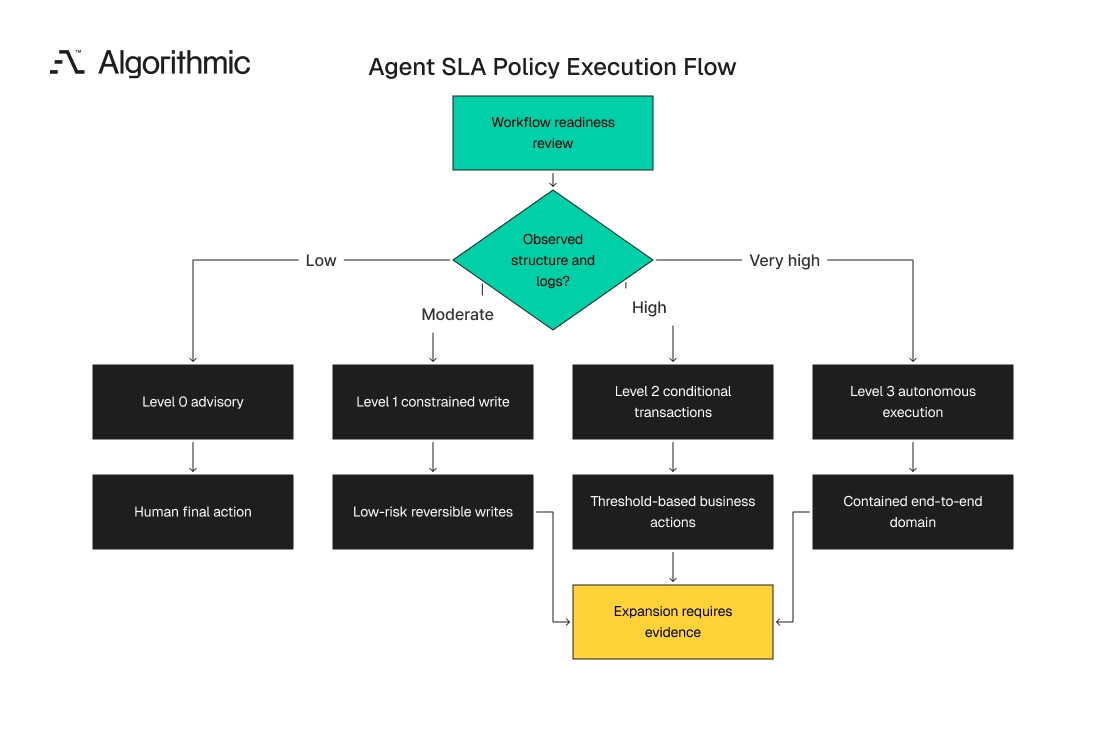
Autonomy should increase only when the workflow has enough structure, observability, and recovery coverage. A demo completion rate is an inadequate basis for production access, so the decision starts with business absorption capacity. Leaders need to know whether the organization can detect, contain, and reverse a failed run, and how many customers, records, dollars, or regulated fields one run can affect. Those numbers define the permission boundary.
Autonomy levels provide a practical control model. They also help business owners compare workflows without debating model internals. The question that matters is the business action the agent can take.
 Click to expand
 Level 0 is advisory only
The agent drafts, summarizes, classifies, or recommends while a human takes the final action, so this level gives teams the productivity benefit without direct write access. It fits legal review summaries, sales call notes, software architecture review drafts, and executive dashboard explanations, and the agent reduces cycle time while a person remains responsible for the business action and provides the control point.
The SLA still needs quality sampling and data handling rules. Full rollback mechanics are unnecessary because the agent does not change business state, but the team still needs retention rules for prompts, retrieved content, and generated output. A Level 0 legal agent can summarize a 40-page master services agreement while counsel remains responsible for the clause decision and customer response, so the measured outcome should be review time saved and summary correction rate.
A Level 0 data agent can explain metric changes in a Looker dashboard while a finance analyst still approves the narrative before it reaches executives, and the SLA should measure factual correction rate and source citation accuracy. A Level 0 engineering agent can propose a code review summary while a senior engineer still approves the merge, and the SLA should measure missed risk items, incorrect references, and time saved per pull request. Level 0 is the right starting point for workflows with ambiguous policies, unstable data, or high business exposure, because it creates production evidence without granting write authority and the organization learns how the agent behaves against real work.
Level 1 gives constrained write access
The agent can update low-risk fields or internal metadata, and these actions should be reversible and low cost with a clear audit trail and a manual correction path. Examples include tagging support tickets, updating Jira labels, drafting CRM notes, or assigning document categories, and these actions matter operationally even though they do not move money, change access, or create binding commitments. They still require limits because low-risk actions become expensive at volume.
This level needs audit logs, per-run limits, and daily sampling. Teams should require two to four weeks of production data before expanding the permission set, and that period should include normal traffic, exceptions, and at least one release cycle. The approval gate should include measured error rates and incident history, so a team that cannot quantify Level 1 quality should not request Level 2 authority, and the review should verify that all Level 1 permissions still map to the active workflow.
Level 1 also needs duplicate-action protection, because a ticket-tagging agent should not apply conflicting tags after a retry and a CRM-note agent should not create three identical notes after a timeout. A Level 1 agent should also have a clear manual correction path, so operations staff can filter all records touched by a run ID and reverse labels, notes, and categories through a controlled batch action.
The cost profile should remain bounded. A metadata update may look low risk until the agent touches 100,000 records. Per-run and daily limits keep that failure inside an acceptable recovery window.
Level 2 grants conditional transaction authority
The agent can take business actions within explicit thresholds that a policy engine enforces outside the model, and this level introduces direct financial, customer, operational, or compliance exposure. Examples include approving refunds below $50, sending customer responses from approved templates, routing invoices under $1,000, or opening internal access requests, and exceptions require human approval through an exception path that is measured as part of the SLA.
This level needs human approval gates for exceptions, rollback drills, and incident response runbooks. The organization should track false approvals, false declines, escalation rate, and customer correction rate, because those measures show whether the agent reduces work or transfers hidden work to operations. The thresholds should map to financial and compliance exposure, so a $50 refund rule differs from a $5,000 vendor payment rule in evidence, approval, and monitoring requirements, and a healthcare data workflow requires stricter logging than an internal ticket-routing workflow.
Level 2 also needs pre-approved customer communication language. If the agent sends the incorrect message, operations should have templates for correction, apology, refund reversal, and escalation, because drafting that language during an incident wastes the recovery window. A Level 2 support agent should record the policy section used for each refund decision, along with customer tier, purchase history, exception reason, and approval status, and that evidence reduces dispute time during a customer complaint.
A Level 2 finance agent should record purchase order match, vendor identity check, invoice amount, approver, and exception status, and it should fail closed when any required field is missing so payment systems reject the transaction before funds move. A Level 2 access agent should record identity, group membership, manager approval, business justification, requested duration, and expiry date, so temporary access expires automatically while permanent access requires a separate approval path.
Level 3 allows autonomous execution in contained domains
The agent can complete end-to-end work inside a bounded process, and the domain must have stable rules, complete logs, and clear recovery paths with known inputs, accepted outputs, and tested exceptions. Examples include resolving low-value support tickets, processing standard vendor onboarding, or maintaining internal knowledge base records, and these workflows also need a business owner who can stop the workflow when policy changes.
This level needs on-call ownership. The agent has a release process, versioned prompts, model version records, regression tests, and a pager path, because production autonomy without a support rotation creates an orphaned service. A Level 3 agent should appear in the same operating inventory as customer-facing services with an owner, a support rotation, and change records, and security should know which systems the agent can read and write during an incident.
Level 3 autonomy should also have scheduled recertification, because business policies, vendor APIs, data schemas, and model behavior change over time, so a quarterly review should confirm that the agent still matches the workflow it was approved to run. Level 3 requires service management instead of project management, so the agent should have runbooks, incident history, release history, and access review records, and the owner should report SLA performance in the same cadence as other production services.
A Level 3 support agent should begin with a narrow domain, so it can resolve password-reset tickets for accounts that meet identity checks and have no fraud flags while routing all other tickets to humans with a recorded reason. A Level 3 procurement agent should process standard vendor onboarding only when tax forms, sanctions checks, purchase thresholds, and approver records match, so missing evidence stops the process and human review receives the full run record.
A Level 3 procurement agent should process standard vendor onboarding only when tax forms, sanctions checks, purchase thresholds, and approver records match. Missing evidence should stop the process. Human review should receive the full run record.
Permission growth must run through change control
Permission growth is one of the main sources of unbounded agent risk. Access is granted during pilots, expanded during demos, and left in place after scope changes, and that pattern creates authorization debt. Six months later the agent retains access to systems outside the current workflow, so a support assistant still reads Stripe after refunds moved to a separate queue and a sales operations agent still writes CRM fields after territory logic changed.
The AI Agent Permission Creep analysis describes the drift clearly. Agents accumulate production access that no longer matches active work, and the drift is easy to miss because agent access often spans application users, service accounts, API tokens, and workflow credentials. The security failure is often administrative, and no attacker is required when an agent has the excessive agency and weak containment that OWASP names among the top risks for LLM applications. A flawed run can do the damage without a breach.
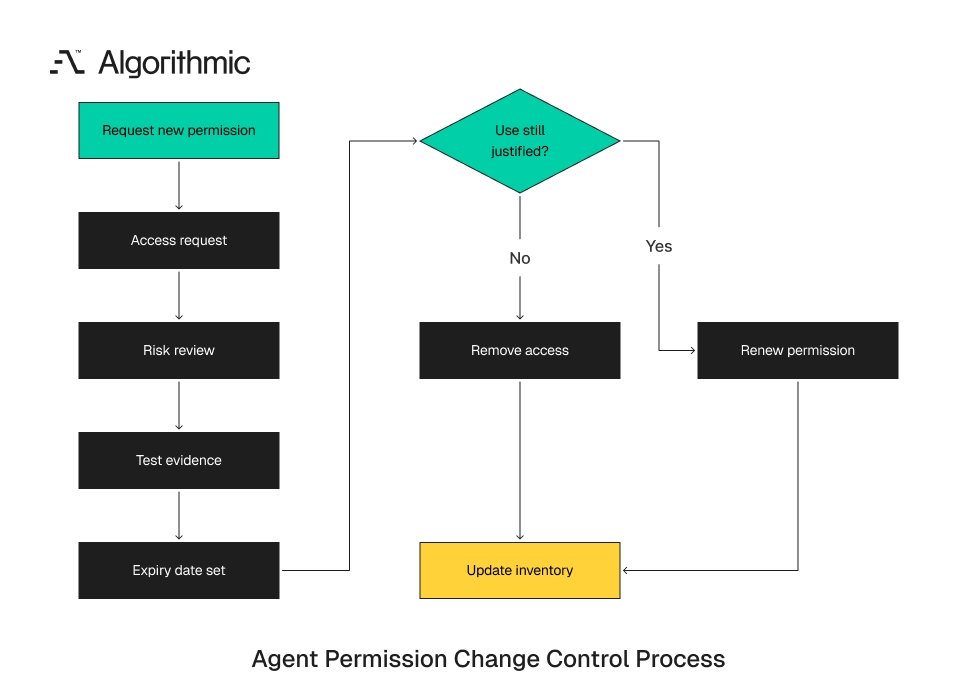
Change control for agents should include four gates.
- Access request: name the system, action, data class, and business reason.
- Risk review: classify customer, financial, compliance, and operational exposure.
- Test evidence: provide sandbox runs, regression results, and failure cases.
- Expiry date: set automatic review or removal after 30, 60, or 90 days.
 Click to expand
 Re-permissioning should run quarterly for Level 1 agents and monthly for Level 2 and Level 3 agents, and the review should verify active use, current business need, and current incident history. High-risk systems need shorter review cycles, so payment actions, regulated data access, account closure, and identity changes deserve explicit executive visibility, and those permissions should expire automatically unless the owner renews them with evidence.
The Read-Only Ratchet pattern is a practical default, so a workflow starts with read access and adds write access only after it proves measured quality, bounded cost, traceable execution, and tested recovery. Each new permission should have an owner and an expiry date, and the owner should be a business or engineering leader with authority to accept the risk, because a shared mailbox or vendor contact is inadequate ownership for production authority.
Permission records should include service accounts, OAuth grants, API keys, workflow credentials, and application roles, because many incidents start when one of those paths escapes review, so the inventory should show every credential the agent can use. The permission review should also check inherited access, since an agent that can write Jira comments may still disclose sensitive information through connected Slack workflows, and an agent that can read Salesforce may expose contract terms through a downstream summary tool.
Approval should expire by default, because a 90-day expiry date forces review while the business memory remains current, and permanent access should require a documented exception and executive owner. Change control also applies to data access, since retrieval sources added to an agent can change business decisions as much as write permissions, so a new policy folder, customer repository, or contract archive should pass the same review.
Operational artifacts separate demos from production agents
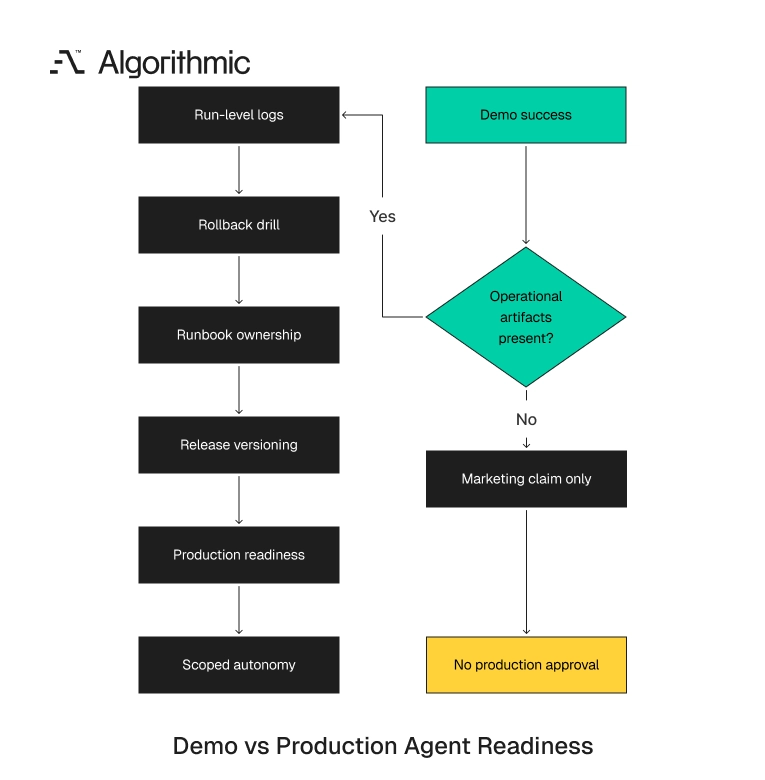
A demo shows that an agent can complete a path. Production readiness shows that the organization can operate the agent during variance, failure, and scale. The artifacts make the difference visible.
We use a skeptical autonomy checklist when reviewing vendor claims about autonomous software engineers, autonomous support agents, or autonomous operations assistants. The checklist is direct, covering success definition, reproducible sandbox testing, cost caps, auditability, rollback mechanics, and human approval gates, and it also asks who receives the page at 2:00 a.m.
 Click to expand
 If one item is missing, the claim remains marketing until proven in the target environment, and the burden of proof belongs with the team requesting production authority, so procurement should not finalize rollout scope until the operating model is documented. The review should happen before procurement finalizes the rollout plan, because vendor demonstrations rarely expose permission boundaries, rollback mechanics, incident workflows, or audit export limits, and the contract should require those controls in the production architecture.
Procurement should request sample audit exports during evaluation. The sample should include run IDs, model versions, tool calls, policy checks, approvals, and downstream record changes, because a screenshot of a dashboard is not sufficient evidence. Security should review identity design before the vendor receives production access, since shared credentials, broad service accounts, and unclear impersonation models create incident risk, and each agent action should tie back to a service identity, initiator, and approval context.
Legal should review data retention and audit access before rollout. Customer data, employee data, financial records, and contract text carry different retention rules. The agent platform should support the strictest rule required by the workflow.
Logs must support forensic review
Agent logs need more detail than application logs. A standard request log cannot explain why an agent changed business state, so the log must connect the reasoning path to the tool call and the downstream write. Each run should capture run ID, user or system initiator, model name, model version, prompt version, prompt hash, and tool calls, along with retrieved documents, input references, output references, policy checks, approvals, latency, cost, and final action status, and that record should be queryable by engineering, security, and operations.
The log must answer three questions within minutes. What did the agent see, why did it act, and which systems changed? If the answer takes hours, the logging model failed the production requirement, and the answer should not require a data engineer to reconstruct events from five systems. A run ID should connect the model trace, tool invocation, workflow event, and downstream record change, and it should also appear in customer-facing systems when the agent changes a record.
Logs also need retention rules, because finance, legal, healthcare, and security workflows often require longer retention than ordinary product telemetry, so the retention period should match the risk class and the governing record policy. Audit export matters during vendor selection, since a platform that cannot export run-level evidence in a usable format leaves the customer with forensic risk, and CSV exports produced after a support ticket do not meet production incident needs.
Logs should distinguish recommendation from execution. The record should show whether the model proposed an action, a policy engine approved it, and a tool executed it, because that distinction matters when assigning ownership during an incident. Logs should also record failed and blocked actions, since a blocked payment, denied access request, or rejected tool call often reveals policy pressure, and repeated blocked actions show where prompt design, policy rules, or workflow routing need correction.
Sensitive data handling belongs in the logging design. Logs should preserve evidence without exposing secrets, credentials, or unnecessary personal data. Redaction rules should be tested before production release.
Runbooks must assign ownership
A runbook describes the operating response when the agent fails. It needs severity levels, alert triggers, owners, escalation paths, rollback steps, and communication templates, and it should be tested before the agent receives expanded access. For example, a P1 incident can mean more than 50 customer records changed incorrectly, any unauthorized payment action, or any regulated data sent to an unauthorized destination, so the severity definition should include customer count, financial value, data class, and regulatory exposure.
The runbook should page the service owner within 10 minutes and disable the agent’s write permissions automatically, and the owner should have authority to pause the workflow, start rollback, and notify customer-facing teams. This is production ML engineering applied to autonomous systems, so agents need release gates for prompt, tool, policy, model, and retrieval changes, and incident ownership equal to internal APIs that change customer or finance records.
Runbooks should be tested during working hours before the agent receives expanded access, because a tabletop exercise is insufficient for workflows that move money, permissions, or regulated data, so the team should run the rollback process against a production-like dataset and record the time to recovery. A strong drill includes a malformed input, an API timeout, a policy conflict, and a downstream write failure, since those cases expose gaps that do not appear in standard-path testing, and the drill should end with a signed record showing what passed, what failed, and who owns the remediation.
The runbook should include communication paths for internal teams, because customer success, finance, legal, security, and support need different information during an incident, so the runbook should specify who receives which update and when. The runbook should also state the reactivation rule, since an agent paused for a P1 incident should not resume because the queue is growing, and reactivation should require incident review, fix evidence, owner approval, and a reduced-volume restart.
A reduced-volume restart is a control, not a courtesy. After a P1 incident, the agent should process a limited sample and produce audit evidence before returning to full volume. The rollout should have automatic stop conditions.
Releases must be versioned
Agents change through prompts, tools, policies, retrieval data, model versions, and workflow code. Treating only application code as releasable leaves most of the agent surface unmanaged, because a prompt change can alter production behavior as much as a code deployment. A release record should include prompt diff, policy diff, tool schema changes, test set results, approval record, deployment time, and rollback target, and regression tests should include known edge cases, adversarial inputs, tool timeout scenarios, and policy boundary cases, with all test results stored alongside the release record.
For regulated workflows, the approval record should be durable, because internal audit, legal, and security teams need a consistent source of truth that shows who approved the change, what evidence they reviewed, and what rollback target was available. Release records also protect engineering teams, since a model provider that updates behavior leaves the team needing evidence of which version produced which decision, and without that record the incident review turns into speculation.
The same discipline applies to retrieval data, because a policy document added to a vector store can change agent behavior as much as a code change, so the release process should track document additions, removals, timestamps, owners, and embedding version. Tool schemas also need version control, since a CRM API that changes a required field or a billing tool that changes a status code can make the agent issue invalid calls or misread responses, and the test suite should include these contract changes before deployment.
Model versioning should include provider, model name, model version, region, and configuration, and temperature, tool-use settings, output schema, and system prompt changes belong in the record because small configuration changes often produce material behavior changes. Prompt versioning should include the reviewer and approval reason, because a prompt update that changes escalation language affects customer experience and compliance, so it should receive the same care as a customer-facing copy change.
Retrieval releases should include document provenance. A vector store that contains outdated policy documents creates a predictable failure path. Each source should have an owner, refresh cadence, and retirement rule.
A board-level test for agent autonomy
Enterprise leaders need a decision rule that separates safe automation from premature autonomy. The following test works across customer support, finance, legal operations, sales operations, software engineering, and data platform development. It is short enough for an executive review and specific enough for engineering sign-off.
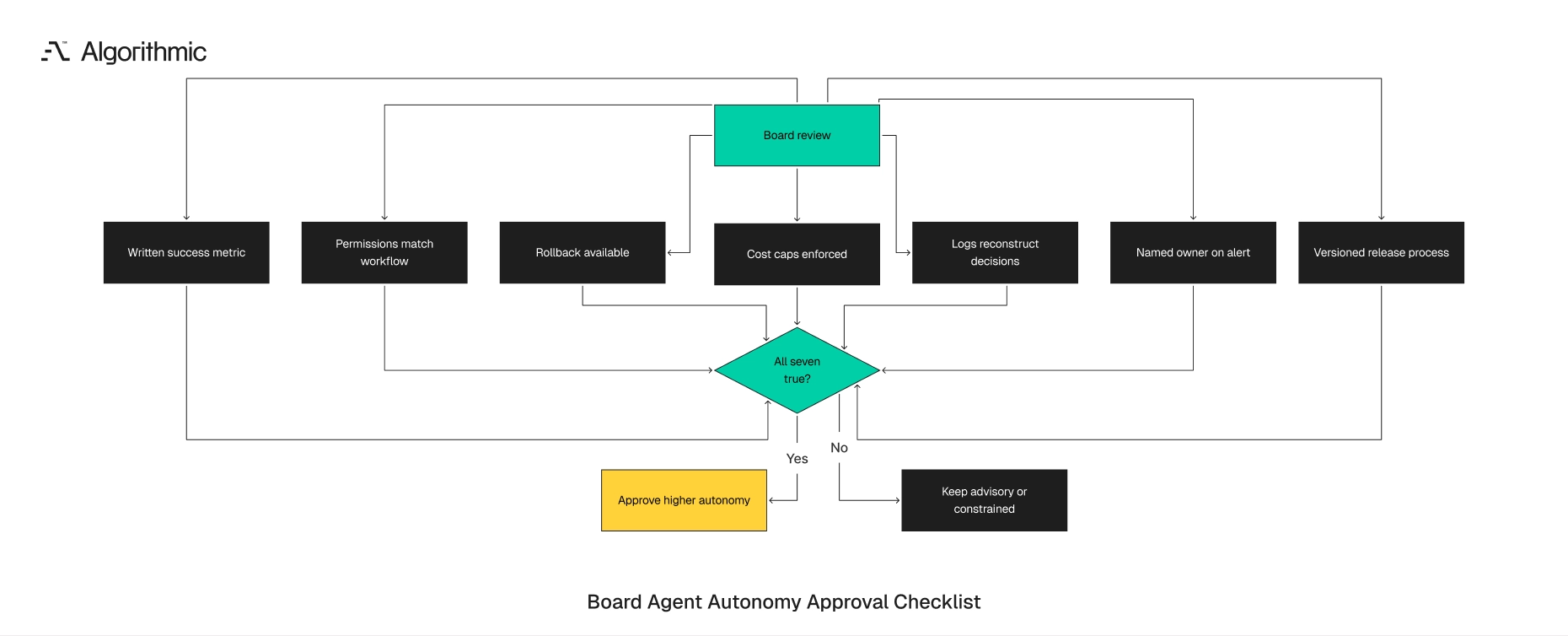
Approve higher autonomy only when all seven statements are true:
- The workflow has a written success metric measured weekly.
- The agent’s permissions map to the current workflow only.
- Every state-changing action has a rollback or compensating action.
- The system enforces per-run, per-day, and per-tenant cost caps.
- Logs can reconstruct every decision and tool call.
- A human owner receives alerts inside a defined response window.
- The release process records prompt, model, tool, and policy versions.
 Click to expand
 A workflow that fails this test should remain advisory or constrained. The organization can still gain value through drafts, classifications, summaries, recommendations, and human-in-the-loop routing, and those use cases reduce cycle time while preserving business control. This is often the right commercial choice, because moving a finance agent from advisory status to autonomous approvals without rollback and audit coverage increases compliance exposure faster than it reduces operating cost. The saving is visible on a staffing line, while the exposure appears during an incident.
The board discussion should focus on exposure per run, detection time, recovery time, and accountable owner, because those four facts matter more than a vendor’s stated autonomy level and give directors a concrete basis for approving or rejecting expanded permissions. A $500 daily cap, a 10-minute alert window, and a 30-minute rollback target give directors concrete governance inputs that vague claims about intelligent automation do not, so the board should ask for the SLA, the rollback drill result, and the owner’s name.
Directors should also ask for the highest-risk workflow in the program, because average program risk hides the agent that changes money, access, contracts, or regulated data, and one high-risk workflow can define the enterprise exposure. The board should review exception volume, since a high escalation rate shows that policy boundaries are unclear or input data is poor, and expanding autonomy under those conditions moves unresolved work into production.
The board should require an inventory of agents with write access. That inventory should include owners, systems, permissions, autonomy level, review date, and last incident. Without that inventory, governance depends on informal reporting.
The operating model for agent programs
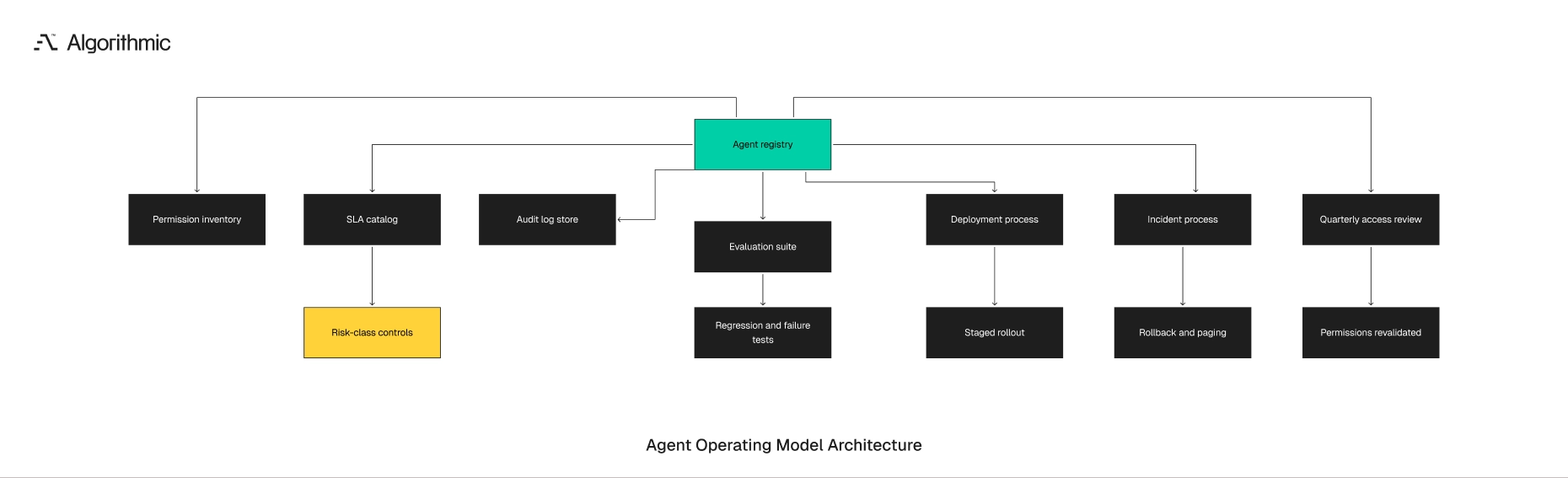
AI agent programs need shared infrastructure across pilots. Separate teams should not rebuild governance for every agent, because a consistent control plane reduces engineering work and gives security one inventory. A mature program has an agent registry, permission inventory, SLA catalog, audit log store, evaluation suite, deployment process, incident process, and quarterly access review, and these assets let teams add new agents with the same operating model while executives compare risk across workflows.
 Click to expand
 The agent registry should name each agent, owner, workflow, systems accessed, permissions granted, autonomy level, and review date. Security teams need that inventory during incidents and audits, and finance and legal teams need it when agents touch contracts, payments, or regulated data. The SLA catalog should define standard thresholds by risk class, because a support tagging agent, a procurement agent, and a finance approval agent should not use the same controls, so the catalog should map risk class to sampling rate, retention period, cost cap, escalation window, and rollback target.
An audit log store should preserve run-level evidence in a queryable format. Engineering, security, and operations should be able to search by customer, run ID, model version, tool, and incident, and the log store should also support export for audit and regulatory review. This is where experienced engineering matters, because a senior software development team will design agents as production services, and that design starts with identity, permissions, event flow, and failure isolation.
The design includes access control, event logs, queues, retries, idempotency, observability, monitoring, CI/CD pipeline design, and incident response runbooks, along with budget controls and tenant-level containment, and these controls reduce the cost of adding agents because each new workflow inherits the same foundation. The evaluation suite should include golden datasets, policy boundary cases, regression cases, and failure injections, run before releases and after material model changes, and it should report task quality, tool failure rate, policy exception rate, latency, and cost per completed task.
A deployment process should separate development, sandbox, staged production, and full production. A staged rollout can start with 5% of eligible traffic, then 25%, then full volume after quality and incident thresholds pass, and the rollout plan should include automatic rollback when thresholds fail. An agent platform should also include policy-as-code, so refund limits, access rules, routing criteria, and escalation triggers run outside the model while the model proposes actions inside constraints that the platform enforces.
Identity design should be explicit. The agent should use narrowly scoped service identities and record the human or system that initiated the run, and it should never rely on a broad administrator account for convenience. Event architecture matters just as much, because queues, idempotency keys, retry limits, and dead-letter handling prevent duplicate writes during failures, and these standard production patterns are needed from the first write-enabled release.
Monitoring should combine technical and business signals. Technical signals include latency, tool failures, token spend, queue depth, and error rates, while business signals include refund volume, escalation rate, customer correction rate, and policy exception rate. Cost reporting should be visible to engineering and finance, so token costs, retrieval costs, tool costs, and vendor transaction costs roll up by agent, workflow, tenant, and run, because a budget overrun is an operating incident when the agent runs autonomously.
Access review should be tied to incident history. An agent with repeated exceptions should have reduced permissions until the owner provides remediation evidence, and review meetings should produce decisions instead of status updates. Training and operating knowledge matter as well, because support, finance, legal, and security teams should know what the agent can do and how to stop it, and a pause mechanism hidden inside an engineering console slows incident response.
Across complex engagements, we have seen the same pattern. Teams that define operating boundaries before expanding permissions recover faster, spend less time in engineering triage, and face fewer customer-facing defects, and they make better vendor decisions because they ask for operating evidence early. The sequence is direct, since teams define the SLA, prove the runbook, test rollback, and then expand autonomy, while teams that reverse that sequence spend production time discovering their control gaps.
Before granting any agent new write access this quarter, require the 6-part Agent Autonomy SLA. Require a tested rollback path. Require a named human owner for failure response. Require the evidence before the permission change reaches production.
Algorithmic builds AI agents and automation with the SLAs, containment, and rollback that production write access demands. Ask us to review your agent’s blast radius before you widen its permissions.