
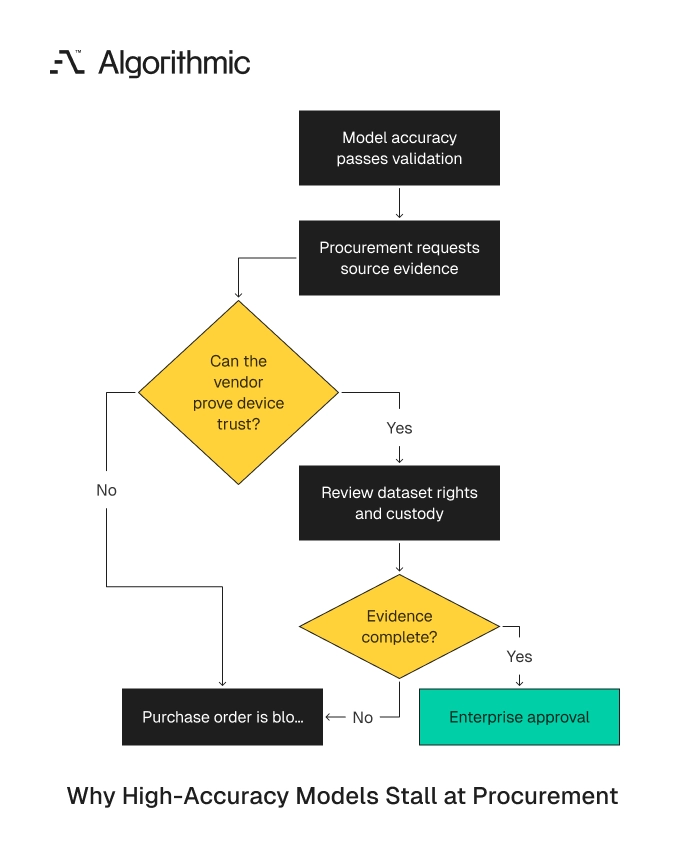
An enterprise computer vision model can reach 97% validation accuracy and fail procurement because the camera fleet cannot prove firmware origin, image custody, or dataset rights.
That failure pattern now appears in manufacturing, healthcare, insurance, logistics, defense-adjacent markets, and public-sector deployments. Computer vision product development depends on a broad input chain: cameras, sensors, edge devices, generated media, annotation vendors, pretrained models, third-party datasets, firmware packages, cloud inference services, and downstream analytics.
Enterprise buyers require accuracy and source evidence. A model with strong validation performance still faces rejection when the buyer cannot verify origin, custody, and permitted use for visual inputs.
Roboflow’s 2026 Visual AI Trends report analyzed more than 200,000 open-source vision projects. The report cites 55 billion predictions per year, 1 billion images in training datasets, and 250,000 fine-tuned models across its sample. Datature’s Enterprise Vision AI Adoption Report states that the global computer vision market has crossed $20 billion, with edge inference representing more than 50% of new model deployments.
Those figures explain why procurement teams now ask direct questions about source evidence. A vision product enters the physical world through devices. Those devices have manufacturers, firmware, ownership structures, network behavior, service contracts, and security histories.
The source-side record determines whether the product can be trusted, sold, insured, audited, and defended. In regulated and high-liability markets, that record carries the same commercial weight as model performance. Procurement teams treat weak source records as product risk, security risk, and legal risk.
A procurement file now needs more than a model card and a security questionnaire. It needs evidence that the visual input chain has been engineered with the same discipline as the model. That evidence must survive customer review, incident response, legal discovery, and renewal discussions.
Accuracy testing misses the enterprise procurement failure point
Most computer vision product reviews over-index on model metrics. Teams compare mean average precision, false positive rates, recall at threshold, latency on NVIDIA Jetson or Apple Neural Engine, and GPU cost per 1,000 inferences. Those metrics matter during model selection. A bank, hospital network, industrial manufacturer, or government buyer asks a wider set of questions before approval.
Enterprise procurement examines where visual evidence came from, whether the data was lawfully acquired, and whether source devices can be trusted. It also examines whether the vendor can produce a complete audit trail during an incident. A model that identifies defects correctly has limited commercial value if the defect images came from a supplier dataset with ambiguous rights.
A common failure pattern appears in quality inspection systems. A team trains on images from three factories, augments the dataset with generated defect examples, adds public images from Kaggle or GitHub, and buys cameras from the lowest-cost hardware vendor. The prototype performs well in the lab and during the first plant demonstration. The engineering team presents precision, recall, confusion matrices, sample detections, and latency results on the target edge device.
The procurement review then asks for dataset licenses, camera firmware origin, device security attestations, supplier ownership disclosures, and proof that production images cannot be exfiltrated. The team has model cards and confusion matrices. It lacks admissible evidence for the input chain. That gap delays commercial approval. Security teams add hardware review. Legal teams request license remediation.
Data governance teams ask for image-level lineage. Operations teams question whether the camera fleet can be replaced without reengineering mounts, calibration, and network rules. The result is a procurement failure caused by product architecture. The model passes validation. The surrounding evidence system fails enterprise review.
 Click to expand
 This failure is preventable during design. The product team must treat input evidence as a first-class architecture requirement. Accuracy targets, device trust, dataset rights, and custody records belong in the same release plan. The failure also appears earlier than many founders expect. A pilot sponsor signs a letter of intent, the technical team approves the detection results, and procurement blocks the purchase order. At that point, the vendor has customer demand, engineering proof, and no acceptable evidence file.
This pattern creates a specific schedule risk. A 60-day pilot turns into a 120-day review cycle because legal, security, and data governance teams need answers from different owners. The sales team cannot close the contract while engineering reconstructs records from Slack threads, spreadsheets, and object storage paths. The practical lesson is direct. A computer vision product must prove the trustworthiness of its inputs before the buyer accepts the trustworthiness of its outputs. The proof must be built into the device, ingestion path, dataset registry, and model release process.
Source-side provenance has four separate layers
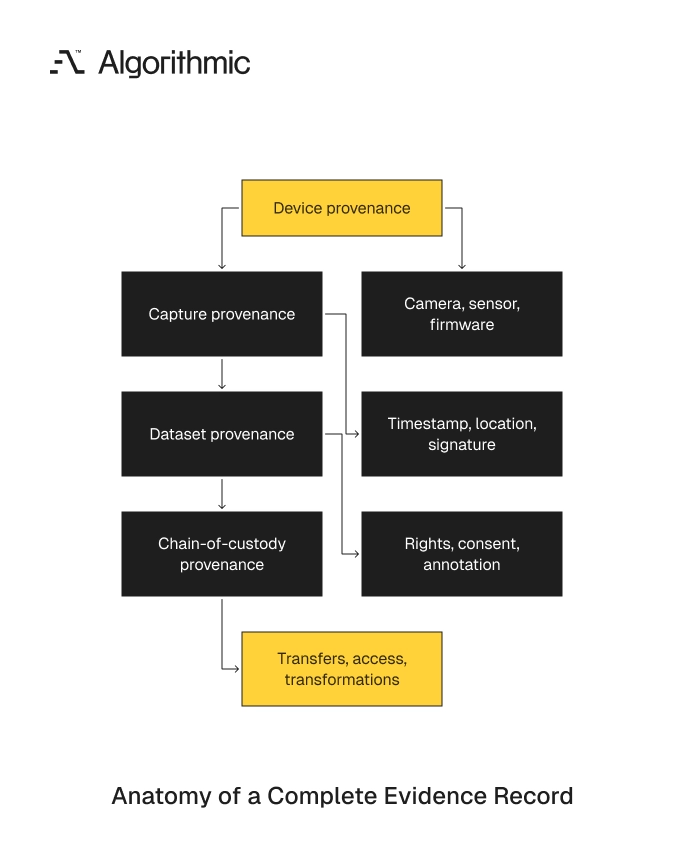
Source-side provenance is the verifiable record of where visual inputs came from, how they were captured, who handled them, and which rights attach to them. Engineering leaders should evaluate four layers separately: device provenance, capture provenance, dataset provenance, and chain-of-custody provenance. Each layer answers a different procurement question. Device provenance establishes whether the camera or sensor can be trusted. Capture provenance records facts at the moment media was created.
Dataset provenance proves permitted use. Chain-of-custody provenance records every transfer, access event, and transformation after capture. Together, the four layers create the evidence record behind the model.
 Click to expand
 These layers should be reviewed separately because each has different owners and controls. Security owns device trust and firmware evidence. Data engineering owns custody records and retention controls. Product, legal, and commercial teams own the rights model. MLOps owns the link between datasets, training code, model versions, evaluation runs, and production releases.
Device provenance
Device provenance covers the camera, sensor, embedded system, secure element, firmware, boot chain, and network behavior. It answers a direct question: can this device capture and transmit visual data without unauthorized alteration or exfiltration? For enterprise systems, this requires secure boot, signed firmware, hardware-backed device identity, remote attestation, and a documented firmware update process. TPM 2.0, Secure Enclave, ARM TrustZone, and platform certificates all matter when a device becomes part of an evidence chain.
Device provenance also includes vendor ownership and geopolitical risk. Camera and sensor suppliers should be screened for sanctions exposure, entity-list exposure, forced data access obligations, and firmware provenance.
If a vendor cannot provide contractual guarantees, the product architecture should allow supplier replacement within 30 to 60 days. That replacement window gives engineering teams time to requalify hardware before a procurement review blocks deployment. That timeline matters in industrial programs. A delayed camera substitution can require new mounts, calibration routines, network rules, certificates, operator training, and factory acceptance testing.
The cost appears late because hardware risk receives review after the model is trained. By that point, the camera choice has already shaped data collection, image preprocessing, field installation, and service procedures. Device provenance should also include a device inventory that security teams can audit. Each camera should have a serial number, certificate identity, firmware version, installation site, assigned network segment, and owner. The inventory should reconcile against telemetry from the field, procurement records, and certificate authority logs.
Unmanaged devices create a direct evidentiary gap. If the fleet inventory lists 420 cameras and the network sees 437 devices, the vendor cannot prove which devices produced production evidence. That mismatch will stop audits in healthcare, insurance, and public-sector deployments.
Capture provenance
Capture provenance records facts at the moment an image or video is created. It includes device identity, timestamp, location source, sensor configuration, firmware version, operator identity where applicable, and cryptographic signature. The strongest pattern is signing media at capture. A camera or trusted edge device signs a manifest that binds the media hash to device identity and capture metadata.
Downstream services verify the signature before the image enters labeling, training, inference, or storage. Failed verification should stop the file from entering production datasets or customer-facing decisions. The C2PA standard has advanced the industry discussion on content credentials, especially for generated and edited media. Guides such as the Institute of Product Management’s overview of C2PA and SynthID for AI content provenance explain the output-side disclosure direction.
Enterprise computer vision teams need the same discipline at the input side. The system must preserve the original source record before annotation, augmentation, inference, or export. A signed capture record also limits disputes after deployment. If a defect image leads to a supplier chargeback or insurance claim, the buyer needs proof that the file came from an approved device.
That proof must include the stated time, stated site, and stated firmware version. EXIF metadata alone does not meet that standard because common tools can rewrite it.
Capture provenance should record time quality, not only time value. A device synchronized against a trusted NTP source produces stronger evidence than a local clock last checked six months earlier. A drifted clock can undermine a sequence of inspection events during a claim review. Location evidence also needs structure. A GPS coordinate has value in logistics and field service. A manufacturing line, station number, or clean-room zone has more value inside a factory.
For medical and industrial deployments, capture metadata should avoid excessive personal data. The manifest should record the minimum facts needed for audit and product operation. Privacy reviews become easier when the capture record separates evidentiary facts from unnecessary personal identifiers.
Dataset provenance
Dataset provenance covers image rights, consent, source contracts, annotation records, synthetic generation prompts, augmentation history, retention rules, and allowed use cases. It answers whether a model can be trained, evaluated, and sold in a target market using those images. A dataset record should trace each image to an origin class. Common classes include first-party capture, customer-provided data, licensed commercial datasets, open-source datasets, synthetic generation, simulation output, and vendor-supplied collections.
Each class needs different rights documentation. A first-party factory image needs internal data-use approval. A customer-provided image needs contract terms that cover training, testing, retention, and cross-customer reuse. A licensed commercial dataset needs the license text, order form, version, and usage restrictions. An open-source dataset needs license terms at the file or source level, because public availability does not equal commercial training rights.
Training data also needs transformation history. Cropping, blurring, super-resolution, generative completion, class balancing, and synthetic defect insertion alter the record. The model registry should link each trained model to dataset versions, labeling policy versions, augmentation code commits, and container digests. That linkage lets the team answer which source images influenced a specific production model.
This record should exist at the image level, not at the dataset level alone. A single dataset can contain images with different licenses, retention terms, geographies, and permitted uses. Enterprise buyers will ask which images trained the model deployed in their environment.
Dataset provenance also protects evaluation claims. A model trained on one license class and tested on another should show that separation in the release record. If a customer prohibits cross-customer training, the registry should block that data from shared model builds.
Annotation records belong in the same evidence file. The record should show who labeled the image, which policy applied, which quality checks passed, and whether a second reviewer resolved conflicts. A defect taxonomy that changes between versions can alter measured performance. Versioning matters because labels become part of the product claim. If version 3.1 of a labeling policy merges two defect classes, the validation report must reference that policy. Otherwise, a buyer cannot compare results across releases.
Chain-of-custody provenance
Chain-of-custody provenance covers every transfer after capture. It records which service received the file, which identity accessed it, which pipeline modified it, which model consumed it, and which output was produced.
This layer requires append-only logs, signed manifests, immutable object storage settings, and trace IDs. Those trace IDs connect capture, processing, inference, review, and export. Amazon S3 Object Lock, Azure Immutable Blob Storage, Google Cloud Audit Logs, Sigstore, Rekor, and in-house hash registries can all support parts of this design. The specific stack matters less than the retained evidence and access controls.
For sensitive use cases, the chain should survive legal discovery. A timestamped JSON log in an application database is weak evidence if administrators can modify it without a retained audit record. Buyers in insurance, healthcare, and public-sector programs will test this point during security review. They will ask who can edit logs, who can delete media, and how long audit records remain available.
A mature chain-of-custody design also records negative evidence. It should show that a file was rejected because the signature failed, the device certificate expired, or the firmware version fell outside the approved set. Rejection records prove that the control operates in production. They also show auditors that the system blocks untrusted inputs before those inputs affect model behavior.
Custody records also need a clear identity model. Human access should map to named users, groups, approvals, and session logs. Service access should map to workload identity, role, build version, and deployment environment. A file should not move through anonymous batch jobs. If a preprocessing container transforms 50,000 images, the custody record should name the container digest, job ID, input dataset version, output dataset version, and operator approval.
This level of detail changes incident response. When a customer asks why one inference changed, the team can reconstruct the record from capture through model output. Without it, the team must search logs across multiple systems and accept gaps.
Generated media raises the procurement threshold
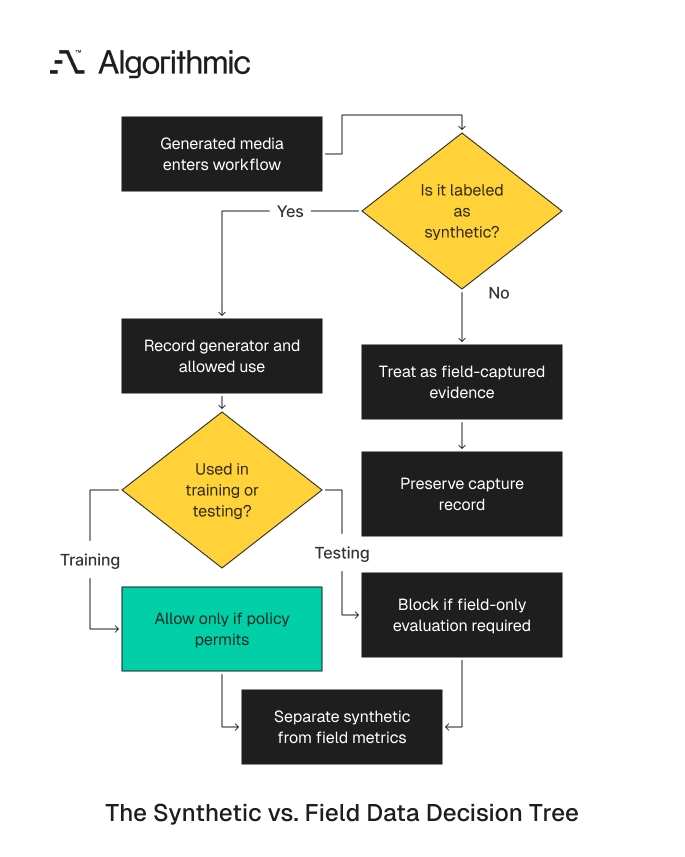
Synthetic media now sits inside many computer vision workflows. Teams use generated images to increase rare-class coverage, simulate lighting conditions, add defect variations, and test edge cases. That practice is defensible when documented. It becomes a procurement issue when synthetic inputs enter training or evaluation without labels, rights records, or separation from field-captured evidence.
Recent research on camera authenticity when generative AI alters images shows why source records must distinguish direct sensor capture from AI-assisted capture. A device that modifies an image before export changes the evidence model.
The receiving system must know which pixels came from the sensor and which pixels came from an onboard generative process. That distinction matters for inspection findings, medical images, insurance evidence, and public-sector records.
Media integrity research is also moving beyond binary real-or-fake detection. Microsoft’s January 2026 paper on media integrity and authentication evaluates cryptographically secured provenance, imperceptible watermarking, and fingerprinting across capture, editing, distribution, and verification workflows.
ACM work on Video Provenance Network reported high-recall retrieval across a corpus of 100,000 videos by matching transformed clips against trusted records. These techniques support downstream attribution. They do not replace source-side controls. A product that starts with signed capture, device attestation, and dataset rights enters enterprise review with a stronger position than one that reconstructs provenance after distribution.
Generated media also changes evaluation claims. If synthetic defects represent 35% of rare-class examples, the evaluation report should state that fact and separate field performance from simulation performance.
Procurement teams will ask whether the model detects defects seen in production or artifacts produced by the generator. They will also ask whether synthetic images entered validation or test sets. Synthetic data should carry generation prompts, generator model versions, seed values where available, policy constraints, and permitted uses. The dataset record should identify whether generated images were used for training, validation, testing, or demonstration.
 Click to expand
 Mixing those roles without a record weakens the evaluation. A model that trains and tests on similar generated defects can report strong metrics without proving field performance.
The same concern applies to simulation data. A warehouse robot model trained on simulated pallets, lighting, and aisle geometry needs a record that separates simulation coverage from real operating conditions. The record should also identify generator ownership and license terms. Some image generators restrict commercial use, biometric use, medical use, or resale inside customer products. Those terms must be visible before generated samples enter a production training set.
Synthetic data controls should be enforced in the pipeline. A dataset tag that says “synthetic” has limited value if training code can ignore it. The build system should block synthetic images from test sets when the evaluation protocol requires field-only evidence. Generated media also affects customer communication. A buyer reviewing a 94% defect detection claim needs to know the source mix behind that number. The claim should separate field-captured defects, generated rare defects, and simulated operating conditions.
This separation protects the vendor during renewal and incident review. If the field environment changes, the team can identify which coverage came from deployed devices and which coverage came from simulation. The remediation plan becomes smaller and more credible.
The source-side provenance readiness matrix
CTOs should treat provenance as a product architecture requirement. It belongs in vendor selection, data platform design, MLOps, security architecture, and commercial contracting. The following matrix gives engineering leaders a practical assessment tool. Apply it before an enterprise pilot, before a hardware purchase order, and before training data becomes part of a production model.
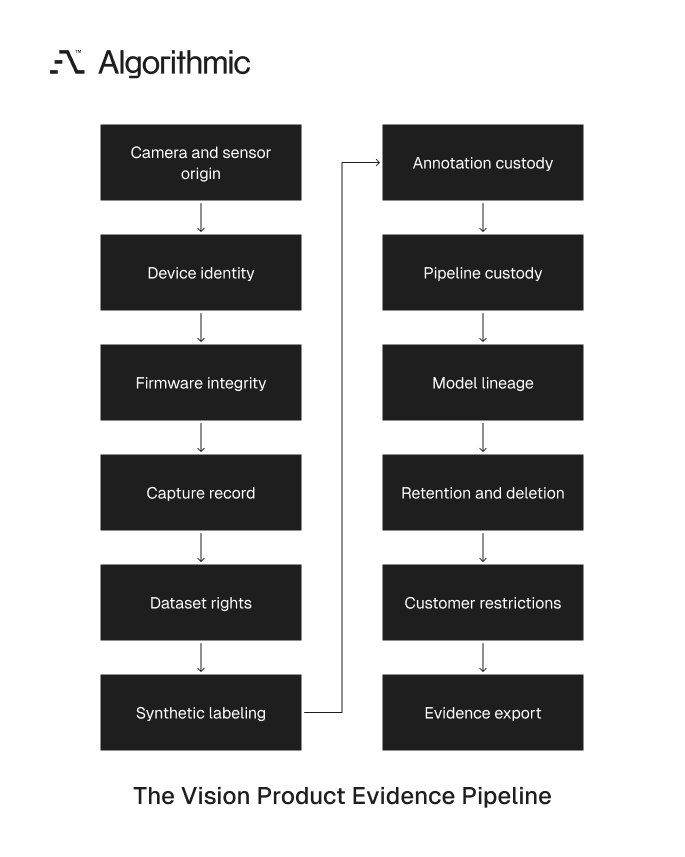 Click to expand
 | Provenance layer | Required evidence | Acceptable design | Procurement risk if absent |
|---|---|---|---|
| Camera and sensor origin | Manufacturer, ownership, country of manufacture, chipset, firmware supplier | Vendor security dossier, firmware SBOM when available, contractual disclosure | Supplier replacement during enterprise review |
| Device identity | Proof that each camera or edge device is known and unique | Hardware-backed keys, TPM 2.0, secure element, X.509 certificates | Spoofed devices can inject untrusted media |
| Firmware integrity | Proof that devices run approved firmware | Secure boot, signed firmware, remote attestation, controlled update channel | Unapproved firmware can alter or exfiltrate images |
| Capture record | Proof of when, where, and how media was created | Signed capture manifest with timestamp, device ID, sensor settings, media hash | Images cannot support audits, claims, or regulated workflows |
| Dataset rights | Proof that training and test data can be used commercially | License records, customer data agreements, consent records, retention terms | Product cannot be sold in target markets |
| Synthetic data labeling | Separation of generated media from sensor-captured media | Dataset tags, generation prompts, model version, usage limits | Evaluation results become difficult to defend |
| Annotation custody | Proof of who labeled data and under which policy | Annotation vendor contracts, workforce controls, QA records, label policy versions | Label quality and privacy claims weaken |
| Pipeline custody | Proof of every transformation and access event | Immutable logs, object versioning, signed manifests, trace IDs | Incident review cannot reconstruct events |
| Model lineage | Proof linking a model to its data and code | MLflow, Weights & Biases, DVC, Git commit hashes, container digests | Model behavior cannot be traced to source material |
| Retention and deletion | Proof that media and derived artifacts follow policy | Dependency graph, retention jobs, deletion receipts, audit logs | Customer deletion obligations become manual and incomplete |
| Customer restrictions | Proof that customer terms control data use | Contract flags tied to dataset access and model builds | Cross-customer reuse creates contract risk |
| Evidence export | Proof that records can be shared during review | PDF and JSON evidence packs tied to retained records | Procurement teams cannot verify claims efficiently |
This matrix should be applied before an enterprise pilot. Retrofitting after launch can require retraining, relabeling, supplier replacement, or withdrawal from a regulated segment. Teams should assign an owner to each row. Security often owns device identity and firmware integrity. Data engineering owns pipeline custody.
Product and legal own dataset rights. MLOps owns model lineage. Commercial leadership should own the customer-facing evidence pack because procurement will judge the entire product. The matrix also supports budget decisions. A product that needs signed capture and immutable storage will require edge engineering, certificate operations, storage controls, and audit tooling.
Those costs should appear in the initial plan, not in a late procurement remediation budget. A credible plan names the tools, team owners, milestones, and release gates tied to each row. A readiness review should also include a red-team exercise. The reviewer should inject an unsigned image, expire a device certificate, alter a dataset license flag, and attempt to train a model from blocked data.
The expected result is a failed pipeline, a retained rejection record, and an alert routed to the owning team. That test proves the controls operate before a customer security team asks for evidence. A readiness score should have release consequences. A product that lacks device attestation should not enter a regulated pilot. A dataset without image-level rights should not support public accuracy claims.
Teams can use a simple gating model. Red blocks release, amber requires executive risk acceptance, and green means the evidence exists and has been tested. The decision should be recorded with the same discipline as a security exception.
The matrix also improves board reporting. Executives can see which risks sit in hardware, data rights, custody, model lineage, or customer export. That view prevents provenance from becoming an undefined engineering concern.
Vendor selection must include geopolitical and firmware diligence
Camera, sensor, and ML vendors are no longer only technical suppliers. They are part of the risk boundary of the product. A serious vendor review should include ownership, sanctions exposure, entity-list exposure, firmware provenance, data residency, remote administration paths, and contractual guarantees against unauthorized data access. It should also test whether the vendor can sign media at capture and provide downstream proofs of provenance.
A supplier that cannot show cryptographic chain-of-custody and device attestation is selling trust by assertion. That approach does not satisfy enterprise security review. This is a design issue and a legal issue. The product should isolate device-specific code behind a hardware abstraction layer, avoid proprietary media formats where practical, and maintain a certified replacement path for at least one alternate camera or sensor vendor.
For industrial deployments, that means qualifying two device families during development. Waiting until a procurement rejection forces a supplier change increases schedule risk, field cost, and customer frustration. A 42-station manufacturing inspection rollout illustrates the cost. If each station uses two cameras and one edge inference device, a supplier change affects 84 cameras and 42 edge devices.
It also affects mounting hardware, calibration routines, firmware images, device certificates, and factory acceptance testing. A replacement plan built at the start costs weeks. A replacement forced after production can cost a quarter.
Vendor diligence should also include firmware update mechanics. Engineering teams should know who signs firmware, how keys are stored, how revocation works, and how emergency updates reach disconnected sites. A camera fleet with unclear update control becomes an unmanaged production dependency. It also weakens the incident response plan because the team cannot prove which devices received which firmware version.
Contract terms need technical specificity. The agreement should require disclosure of firmware suppliers, remote access paths, telemetry destinations, data retention practices, and subcontractors with access to visual data. It should also give the buyer audit rights for security controls. Those rights should cover device identity, firmware signing, remote administration, storage, and incident response records.
For defense-adjacent and public-sector deployments, ownership and country-of-origin review should start before prototype hardware is selected. Hardware selected during a proof of concept often becomes embedded in mounting designs, calibration files, and field procedures.
Replacing it after a security objection creates avoidable cost. The better practice is to screen suppliers before the first field capture campaign and before the first mechanical design freeze.
Vendor scoring should include a provenance section. A 100-point vendor scorecard can reserve 20 points for device trust, 15 for firmware process, 15 for contractual disclosure, and 10 for replacement path. That structure forces tradeoffs into the open. A lower-cost camera with weak attestation becomes a visible commercial risk, not an engineering shortcut buried inside the bill of materials.
The review should include the vendor’s own supply chain. A camera brand can rely on a third-party image sensor, firmware contractor, cloud telemetry service, and remote support provider. Each party can affect evidence integrity. Procurement should require written answers, not slideware. The vendor should identify signing authorities, firmware build processes, update approval workflows, and access paths used during support. Security should test a sample device before purchase orders are issued.
The strongest vendor relationships include incident procedures in the contract. The vendor should commit to notification windows, firmware revocation support, forensic cooperation, and replacement support. These terms matter when a device vulnerability appears after deployment.
Product architecture should preserve evidence by default
Source-side provenance changes system design. It adds requirements to the edge device, ingestion service, data lake, model training pipeline, inference service, and customer-facing audit tools. These requirements should appear in the first architecture review. If the team waits until procurement asks for evidence, the product will lack signed inputs, immutable records, and clean lineage between data and model versions.
The architecture should make evidence preservation the default path. Engineers should not need a special workflow to retain source records, device identity, and transformation history. Architecture diagrams should show evidence flow, not only data flow. Each arrow should identify what record is created, which identity signs it, where it is stored, and how long it remains available.
Release gates should test evidence behavior. A new ingestion service should fail unsigned files. A new training pipeline should refuse blocked datasets. A new customer export should reference retained records, hash values, and validation status.
Edge architecture
The edge device should verify camera identity, record firmware versions, sign capture manifests, and reject unsigned or unexpected media sources. Network egress should be restricted to approved endpoints, with certificate pinning where the hardware and protocol support it. For high-risk deployments, raw media and derived media should be separated. Raw capture can be stored in immutable form.
Derived crops, masks, embeddings, and inference artifacts can move through normal product workflows. The raw record remains available for audit, dispute review, retraining, and incident response. The edge device should also record time source quality. A timestamp from a trusted NTP source carries more evidentiary weight than a local clock with no synchronization record.
Where location matters, the device should record GPS source, facility zone, or line identifier according to the deployment model. A warehouse system needs aisle and dock door identifiers. A hospital system needs device location, department, and room class.
Certificate operations need production discipline. Devices need enrollment, rotation, revocation, and replacement procedures. A lost or stolen edge unit should be removed from the trust set before it can submit media. The revocation event should appear in the same audit system that records accepted and rejected media.
Edge teams should also define offline behavior. A disconnected site should cache signed manifests and media according to retention policy, then sync through an authenticated channel when connectivity returns. If the device cannot verify time or certificate status, it should mark captures with degraded trust status. That status should follow the file through labeling, training, inference, and evidence export.
Edge architecture should also separate operator controls from trust controls. An operator can start or stop a capture workflow. The operator should not bypass signing, certificate checks, or firmware validation. Physical security belongs in the edge design. Tamper-evident seals, locked enclosures, controlled USB ports, and maintenance logs support device provenance. A camera mounted above a production line is part of the evidence chain.
Data platform architecture
The data platform should store images, manifests, labels, and transformations as linked records. A trace ID should connect the raw file, signed capture manifest, dataset version, annotation job, augmentation step, model version, inference result, and user-facing decision. This structure fits modern data platform development. Object storage holds the media. A relational metadata store holds provenance facts.
A data catalog tracks dataset lineage. MLOps tools track model lineage. Audit logs retain access and transformation events. The storage design should separate mutable working data from retained evidence. Data scientists need workspaces for experiments. The production record needs controlled writes, versioning, retention policies, and administrative audit logs.
A practical pattern uses object storage for media, PostgreSQL or another relational store for provenance facts, and MLflow or Weights & Biases for experiment lineage. DVC can track dataset versions. Sigstore and Rekor can add signed software and artifact records. Container digests should bind training code, preprocessing code, and inference code to specific model versions.
Access control should follow the evidence model. A labeling vendor should access assigned images and label tasks. It should not gain broad access to raw customer datasets.
A training pipeline should read approved dataset versions. It should fail if a dataset contains expired licenses, blocked geography flags, or synthetic records assigned to the wrong split.
Retention rules should be machine-enforced. If customer data must be deleted after 180 days, the provenance store should expose every derived artifact that depends on that data. That list should include crops, embeddings, labels, generated variants, trained models, validation reports, and exported evidence packs. Without dependency tracking, deletion becomes manual and unreliable.
The platform should also record data quality state. Blurred images, sensor occlusions, missing calibration files, and failed signature checks should become structured records. These records help teams separate model errors from source failures. Batch processes need the same custody discipline as real-time inference. A nightly job that regenerates embeddings should write its input dataset version, code version, container digest, output path, and approval status. Silent overwrites should be prohibited in production records.
Customer-facing audit architecture
Enterprise buyers need reports they can use. A dashboard that shows accuracy, latency, and uptime does not answer provenance questions. The product should produce exportable evidence packs. Each pack should include device identity, capture timestamp, media hash, model version, dataset lineage, inference result, human review record if present, and access log summary.
For insurance, healthcare, industrial safety, and public-sector buyers, this evidence can determine whether the product passes procurement. It also supports claim review, incident response, and internal audit. Evidence packs should be readable by security, legal, and operations teams. A JSON export supports machine review. A PDF summary supports procurement committees and incident review boards.
Both formats should point to the same retained records. The export should include record IDs, hash values, timestamps, and validation status for each evidence object. Audit tooling also reduces support cost after deployment. When a customer disputes an inference, support staff should retrieve the source device, firmware version, capture record, model version, and reviewer activity within minutes.
Without that tooling, every dispute becomes a custom investigation. Custom investigations consume engineering time, delay customer responses, and weaken trust during renewal discussions. Customer-facing audit tools should also separate customer-visible facts from internal security details. A buyer needs proof that a device was trusted. It does not need private signing keys, internal network diagrams, or unrelated customer records.
The evidence pack should present enough detail for review without exposing sensitive architecture. That balance should be designed before the first enterprise pilot. Audit exports should support two time horizons. Procurement teams need sample evidence before signing. Incident teams need complete evidence for specific events months or years later.
The export should also identify evidence gaps directly. If a capture has degraded time status or an expired certificate warning, the pack should show that state. Concealing gaps creates larger risk during incident review.
The cost of retrofitting provenance after deployment
Retrofitting source-side provenance is expensive because the missing record often cannot be recreated. A team can add logs for future captures. It cannot prove the origin of historical images that were ingested without signatures, rights records, or custody history. That gap affects every model, report, and customer decision built from those images.
The remediation paths are predictable. Dataset rights gaps require image removal, relicensing, retraining, and revalidation. Device provenance gaps require supplier review, firmware validation, and sometimes hardware replacement. Chain-of-custody gaps require ingestion redesign, immutable logging, access control changes, and evidence export tooling.
A dataset rights gap creates model-level uncertainty. If 18% of a defect dataset came from an annotation vendor with unclear rights, every model trained on that dataset becomes suspect. Remediation includes finding the affected images, removing them from training and evaluation sets, retraining affected models, and repeating validation. The work also includes updating customer claims that referenced the old validation results.
A device provenance gap reaches the field. For edge inference systems deployed across 100 locations, travel, installation, recalibration, and acceptance testing can exceed the original software remediation cost. A camera replacement can also require new lighting tests, fixture changes, and operator retraining. The affected customer sees site disruption, revised maintenance windows, and delayed expansion plans. A chain-of-custody gap leaves historical decisions exposed. New ingestion architecture can protect future captures.
Past decisions remain weak unless trusted raw inputs exist and can be reprocessed through the approved pipeline. If the raw record is missing, the team can only document the gap and narrow future claims. The commercial cost is larger than the engineering cost. Sensitive markets will pause procurement until the evidence record is complete.
Existing customers will ask whether past outputs were produced from trusted inputs. Sales teams will need new security answers, revised pilot timelines, and narrower use-case commitments. This is where provenance becomes an executive issue. A delayed enterprise rollout can affect revenue recognition, contract renewal timing, and sales capacity.
A quarter spent rebuilding evidence controls is a quarter not spent expanding deployments. It also consumes senior engineering attention that should be directed toward product depth and customer adoption. The financing effect is direct for growth-stage companies. A six-month enterprise delay can shift annual recurring revenue into the next fiscal year. It can also weaken references needed for the next regulated-market sale.
The operating effect is direct for established companies. Support, legal, security, and engineering teams all spend time reconstructing evidence after the fact. That work rarely creates new product value. Retrofitting also creates governance friction inside the customer account. Security asks for new controls, legal asks for revised terms, and operations asks for new maintenance windows. The original business sponsor loses momentum.
The remediation plan should be explicit when retrofitting becomes unavoidable. Name the affected datasets, models, customers, devices, and claims. Then identify which records can be recreated and which records must be disclosed as unavailable. A disciplined remediation plan reduces damage. It should freeze affected model releases, preserve current evidence, block new untrusted inputs, and publish revised evaluation results after retraining. It should also retire old claims from sales material.
Teams that treat provenance as a sprint-one requirement avoid this cost entirely. A feasibility study that covers device trust, dataset rights, and custody architecture before the first camera purchase eliminates the most common retrofit triggers.
The executive checklist before funding a computer vision build
Use this checklist before approving a computer vision product development budget, vendor contract, or enterprise pilot.
- Name every visual source: List each camera, sensor, dataset, synthetic generator, annotation vendor, pretrained model, and customer data feed.
- Require device attestation: Confirm that production devices support secure boot, signed firmware, hardware-backed identity, and remote attestation.
- Require signed capture where evidence matters: Bind media hashes to device identity, timestamp, firmware version, and sensor settings at capture.
- Classify every dataset by rights: Separate first-party, customer-provided, licensed, open-source, synthetic, and vendor-supplied images.
- Track transformations as product records: Record crops, redactions, augmentations, generated completions, label changes, and export events.
- Design for supplier replacement: Abstract hardware integrations and qualify an alternate camera or sensor vendor before the first enterprise rollout.
- Produce an evidence pack: Give procurement and security teams a sample audit export before the pilot starts.
- Assign ownership: Make provenance a named responsibility across product, engineering, security, legal, and data teams.
- Budget for certificate operations: Include device enrollment, key rotation, certificate revocation, and hardware replacement in the operating model.
- Test the rejection path: Verify that unsigned media, expired certificates, unapproved firmware, and unlicensed datasets fail before production release.
- Separate synthetic and field evidence: Report synthetic data share, generator versions, prompts, and permitted uses in training and evaluation records.
- Run a procurement rehearsal: Ask security, legal, and a target customer sponsor to review the evidence pack before sales commits to a pilot date.
- Set retention rules before capture: Define how long raw media, derived media, labels, embeddings, logs, and evidence packs remain available.
- Record customer-specific restrictions: Track whether a customer permits training, benchmarking, cross-customer reuse, or only single-tenant inference.
- Bind model claims to evidence: Connect every accuracy claim, safety claim, and coverage claim to the dataset version and evaluation record behind it.
- Score vendors on provenance: Assign points for device trust, firmware process, contractual disclosure, data residency, and replacement path.
- Freeze evidence requirements before pilots: Put signed capture, dataset rights, custody records, and audit exports into the pilot entry criteria.
- Review physical deployment constraints: Confirm mounts, lighting, calibration, network segmentation, and replacement hardware before factory acceptance testing.
- Document degraded trust states: Define what happens when time sync fails, certificates expire, firmware changes, or a device operates offline.
- Retire unsupported claims: Remove any accuracy, safety, or coverage claim that cannot be tied to retained evidence.
Computer vision product development should start with the provenance model, device trust model, and dataset rights model alongside accuracy targets. Treat source-side provenance as a release gate for enterprise markets.
Before the next pilot, ask vendors for signed media at capture and verifiable provenance downstream. If they cannot produce both, redesign the supply chain before production deployment. Algorithmic builds computer vision systems with device trust, provenance architecture, and procurement-ready evidence packs from the first sprint. Start a conversation if your team is approaching an enterprise pilot.