
The audit clock starts before the audit letter arrives. A six-month lineage remediation program can consume two to four senior data engineers, and it can still miss consent, ownership, transformation history, and model provenance. That work delays enterprise procurement, slows roadmap delivery, and often fails to produce audit-grade proof, and the cost appears after the system has already reached production.
A regulator asks how a reported number was produced, a Fortune 500 customer asks for evidence during procurement, and an internal audit asks which source tables fed a model output used in credit, insurance, healthcare, or employment. The team now has a trust problem under deadline, because engineering must reconstruct decisions that production systems never recorded.
Data lineage records the path of data from origin through ingestion, movement, transformation, storage, serving, and consumption. In regulated and enterprise systems, lineage also records ownership, consent basis, processing purpose, transformation logic, model version, feature provenance, and output receipts. Lineage belongs in the original data platform plan, so treat it as an architecture constraint during system design, backlog planning, procurement readiness, and production review.
The senior architectural lesson is direct, because lineage is event capture, and a catalog entry created after production launch cannot prove what a pipeline failed to record at runtime.
A static diagram helps explain architecture. Audit evidence comes from events, identifiers, tests, receipts, and policy records produced by the running system.
 Click to expand
 Compliance pressure exposes known engineering gaps
Most data teams know where lineage gaps sit. They know which Airflow DAGs lack ownership metadata, which dbt models have incomplete column descriptions, and which analytics tables were built during an investor reporting cycle and never formalized, so the issue becomes visible when a third party asks for proof. In banking, lineage has been tied to risk reporting since BCBS 239, and EY’s discussion of sustaining the value of data lineage frames lineage as part of accurate risk data aggregation, regulatory reporting, and durable governance.
The same pattern now applies to insurance, healthcare, enterprise SaaS, AI products, and marketplaces handling sensitive user data, so a healthtech platform that stores clinical notes, claims data, and product telemetry faces the same evidence burden during hospital procurement.
Procurement has changed, so enterprise customers now ask vendors to prove how customer data moves through analytics, AI features, dashboards, and operational APIs. A team selling into financial services or healthcare will see lineage questions in security reviews, and the same questions appear in data protection impact assessments, AI governance questionnaires, renewal audits, and subprocessor reviews.
A missing lineage answer can delay a $250,000 annual contract as effectively as an unresolved penetration test finding, and in larger enterprise deals the delay can push revenue into the next quarter and trigger executive escalation. The issue reaches beyond compliance teams, because sales, security, legal, data engineering, product, and executive leadership all depend on the same lineage evidence during enterprise review.
The first procurement signal often arrives as a simple questionnaire item, “Describe how customer data flows into analytics and AI features”, and teams with designed lineage attach evidence. Teams without designed lineage start interviews instead, asking engineers to inspect SQL, product managers to explain feature use, and security teams to review old vendor lists. That process produces inconsistent answers, and it also exposes a deeper operating issue, which is that the organization cannot prove how production data behaves.
Retrofitted lineage fails because the original facts were never recorded
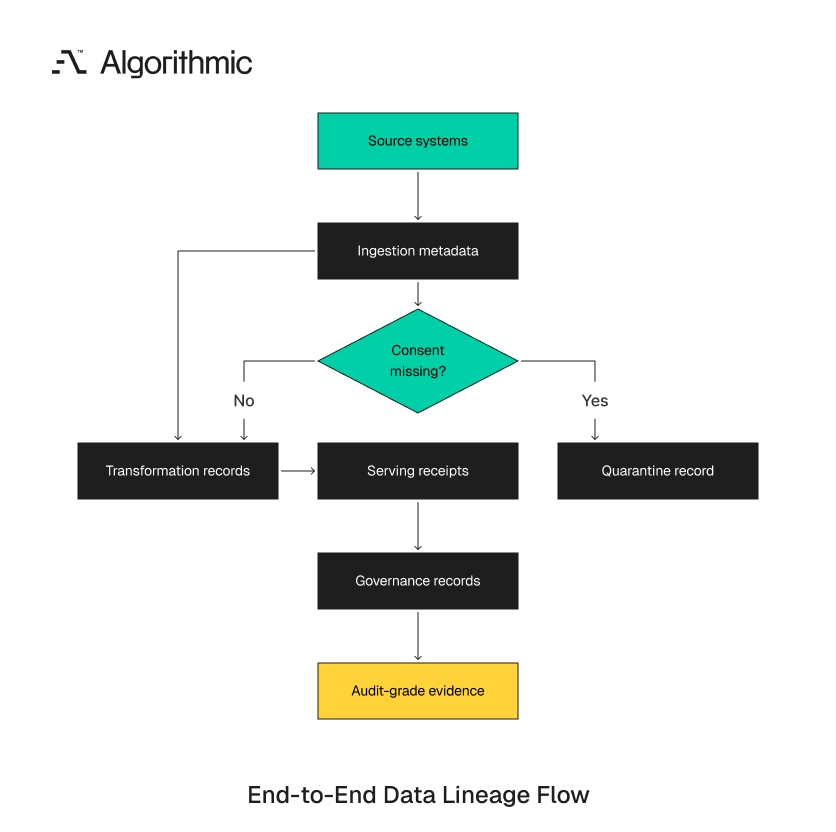
Lineage remediation is expensive because teams reconstruct history from incomplete evidence. Git commits, warehouse logs, orchestration metadata, BI exports, and Slack threads provide partial clues, yet those artifacts rarely prove consent basis, business ownership, transformation intent, and model input provenance, because they show activity without creating audit-grade proof. A production data system creates lineage facts at four points, which are ingestion, transformation, training or aggregation, and serving, so if those facts are missing when the event occurs, later reconstruction depends on inference.
Inference fails during regulatory review, and it also fails when an enterprise customer asks whether its data entered a model training set.
The architectural failure is subtle, because teams treat lineage as a diagram while production systems generate lineage facts as events. The durable record must be captured at the moment each event occurs, and that includes the source, actor, timestamp, version, policy state, and downstream target. A warehouse query log proves that a table was read, but it does not prove that the table contained only records approved for model training.
That distinction matters during privacy review, customer audit, and litigation hold, because the same table can contain fields with different consent bases, retention rules, and contractual restrictions. A customer table illustrates the problem, since billing address, support email, product usage, marketing attribution, and account health score can sit in one warehouse model, and each field carries a different origin and permitted use, so a single table-level label cannot represent those differences with audit precision.
Ingestion lineage must record the legal and operational source
The ingestion layer should record source system, extraction timestamp, schema version, data owner, consent flag, processing purpose, and retention class, and for API-based ingestion it should also record endpoint version, request scope, account context, and authentication method. For example, a customer analytics platform ingesting Salesforce, Stripe, Segment, and product telemetry should preserve source-level metadata before records enter the warehouse, because a later audit must distinguish a user’s billing address from a marketing attribution field.
Both fields can land in the same customer dimension table, yet their permitted uses are different, and their lineage records must show that difference. This is where consent becomes operational, because a field without consent context becomes risky when it is used for targeting, scoring, personalization, or model training.
The same rule applies to customer support transcripts and call recordings, because a support transcript collected for service quality cannot be treated as unrestricted training data without a recorded legal basis. Teams also need to record source contracts, since a Salesforce field loaded through Fivetran and a custom API field copied from a partner system carry different obligations, so the ingestion record should make that difference visible and identify the contract, data processing addendum, or partner restriction that controls the field.
Source metadata must survive schema changes, so if a field changes from phone_number to primary_contact_number, the consent and retention record must travel with it.
The ingestion process should fail closed for governed data. When consent metadata is missing, the pipeline should quarantine the record, raise an alert, and block restricted downstream use.
Transformation lineage must reach column level
Dataset-level lineage is adequate for a high-level architecture diagram, but it is inadequate for regulated analytics system development. A board metric, risk score, or model feature usually depends on specific columns and transformations, so column-level lineage shows that net_revenue_usd came from invoice_amount, refund_amount, currency_rate, and a transformation rule in dbt model version v42. That record must also show the code commit, test result, model owner, approval date, and downstream consumers, because without those details the team can explain a metric verbally while failing to prove its production path.
Automated capture matters because hand-maintained diagrams decay, and Atlan’s guide to documenting data lineage for regulatory audits emphasizes scope, accountability, and traceability from source systems to reports. Those properties require metadata from pipelines, transformation tools, catalogs, and workflow systems, because slide decks become stale after the next schema change.
Column-level lineage also reveals policy drift, because a column created for billing can flow into churn modeling, customer health scoring, sales prioritization, and AI enrichment, and each new use creates a separate governance question. The system must identify the column, its origin, the applied transformation, and the approved purpose, and the record must follow the column through renames, joins, aggregations, and derived features, so if customer_email becomes user_contact_hash, the policy obligation travels with it. Hashing changes the identifier form, but it does not erase the origin, contractual restriction, or privacy obligation attached to the source field.
Transformation lineage should also record validation. A revenue metric without reconciliation tests against Stripe or NetSuite lacks financial control.
Serving lineage must attach receipts to outputs
Dashboards, APIs, AI agents, and model endpoints need output receipts, where a receipt records the dataset version, model version, feature set, source document version, timestamp, and serving path used to generate a result. For retrieval-augmented generation systems, every answer should carry source URL, crawl timestamp, document version, embedding model, vector index version, and retrieval query metadata, because that habit lets teams correct or roll back answers when legal guidance, product documentation, or clinical content changes.
For ML systems in production, the same principle applies to predictions, because a model output without archived training artifacts, feature provenance, and model explanation endpoints is difficult to defend under audit. Serving receipts also help engineering teams debug production incidents, so if a customer disputes an answer, the team can inspect the exact documents, prompts, model settings, and tool calls involved.
Receipts should be designed as product infrastructure, so they belong beside application logs, trace IDs, and audit logs, and they should never depend on a support engineer copying screenshots into a ticket, because screenshots prove what a user saw while rarely proving what the system used. This distinction becomes material after a customer dispute, because a receipt can show that answer A-10982 used policy document version 2025-04-12, embedding model text-embedding-3-large, and vector index build idx-7841.
A receipt can also show the tenant filter, access policy, prompt template, model identifier, and response timestamp, and those details determine whether the company can defend the output.
Serving lineage is also required for deletion and correction. If a customer asks to remove content, the company must identify where that content was served, cached, embedded, and exported.
Enterprise customers now treat lineage as procurement evidence
Lineage used to be discussed mainly inside data governance teams, and it now appears in vendor due diligence. A CISO evaluating a SaaS platform wants to know which subprocessors receive customer data, and the same review asks which analytics tables include personal data and which AI features use customer content.
A data governance leader wants proof that deletion requests propagate across warehouses, feature stores, vector indexes, caches, and exported dashboards, and a legal team wants evidence that consent restrictions survive downstream transformation. A CTO buying an AI product asks whether the vendor can reproduce a model output from 90 days ago, which requires archived training artifacts, model versioning, feature-store snapshots, prompt templates, retrieval receipts, and inference logs.
Research and Markets estimates the data lineage tools market will grow from $1.72 billion in 2025 to $2.1 billion in 2026, and its 2030 forecast reaches $4.73 billion, driven by AI-assisted lineage automation, real-time governance demand, hybrid data environments, and stricter audit requirements. The same firm estimates the data lineage market for LLM training will grow from $1.78 billion in 2025 to $2.19 billion in 2026, and that growth reflects a change in buyer expectations, because AI provenance is now part of enterprise risk review.
The practical consequence is direct, because a vendor with data lineage, consent flags, and reproducible model pipelines can answer security questionnaires in days, while a vendor without those records starts a remediation project during the sales cycle that competes with roadmap work, customer commitments, security engineering, and incident response work. This affects valuation as well as sales timing, because during technical diligence buyers ask for proof that revenue metrics, customer analytics, and AI features rest on controlled data flows, so a weak answer creates a discount conversation, and an acquirer will price remediation, audit exposure, integration risk, and customer renewal exposure into the deal.
Lineage evidence also affects renewal conversations, because large customers now ask whether new AI features changed data processing, retention, or subprocessor exposure, so a vendor that can trace source data to feature behavior can answer with records, while a vendor that relies on interviews creates risk for the customer’s own governance team. The same discipline applies when you sit on the buyer side, where you should test vendor integrations with connector maps and round-trip proof before you sign, so hidden data risk surfaces during diligence rather than production.
The lineage-by-design framework
Lineage should be designed across five layers, which are source, movement, transformation, serving, and governance. Each layer creates a different type of proof.
| Layer | Required lineage record | Typical technology touchpoints | Audit question answered |
|---|---|---|---|
| Source | System of record, owner, consent flag, processing purpose, schema version | Salesforce, Stripe, Fivetran, custom APIs, CDC logs | Where did this data originate, and was it permitted for this use |
| Movement | Extraction timestamp, job version, actor, retry history, destination | Airflow, Dagster, Kafka, Debezium, S3, GCS | When did the data move, and which process moved it |
| Transformation | Column mapping, transformation rule, code version, test result | dbt, Spark, SQL, Snowflake, BigQuery, Databricks | How was this number calculated |
| Serving | Dashboard, API, model endpoint, feature set, output receipt | Looker, Tableau, FastAPI, feature stores, vector databases | Who consumed the data, and what version did they see |
| Governance | Steward, retention rule, deletion status, access policy | Data catalog, IAM, policy engine, ticketing system | Who owns this data, and which controls apply |
This framework prevents a common failure mode, which is treating lineage as a catalog feature, because a catalog can display metadata but cannot recover lineage facts that pipelines never produced. The framework also gives engineering teams a clear ownership model, so platform teams own movement events, analytics engineers own transformation records, and application teams own serving receipts.
Governance teams define retention, access, and deletion rules, and security teams validate access controls, subprocessor exposure, and privileged access paths. Each layer should write evidence in a machine-readable form, so JSON events, table metadata, artifact registry records, policy mappings, and signed audit logs all work when they share stable identifiers.
Stable identifiers matter more than attractive diagrams, because a source field, pipeline run, dbt model, feature definition, model version, and output receipt must connect through durable IDs. Those IDs should appear in logs, warehouse metadata, ticket records, and catalog entries, which makes evidence retrieval repeatable during audit and procurement.
A practical identifier scheme can start small. Use source_system_id, dataset_id, lineage_run_id, model_version_id, policy_id, and output_receipt_id across systems.
Source records make consent testable
Consent must travel with the data, because a boolean field named marketing_consent in an application database is insufficient once the record enters a warehouse, a feature store, and a third-party activation tool. A stronger pattern attaches consent metadata at ingestion and carries it through transformations as a first-class attribute, including consent source, consent timestamp, lawful basis, geographic scope, and withdrawal status.
This adds design work during ETL pipeline development, but it prevents weeks of manual tracing during a GDPR, CCPA, HIPAA, or customer audit request. The design should include failure behavior, so if consent metadata is missing, the pipeline should quarantine the record or block its use in restricted downstream jobs.
Consent should also support time travel, because a user can give consent in January, withdraw it in March, and appear in an April reporting table. The system must answer which state applied to each use, and that requires dated consent records instead of a single overwritten flag. Slowly changing dimensions, event-sourced consent tables, and policy tags can all support this pattern, and the selected design must preserve history, withdrawal, and downstream use.
Consent records also need ownership, because legal defines the policy basis, product defines collection context, and engineering records it in production systems.
A consent model without a named owner decays quickly. New fields enter the warehouse, and no team updates the policy mapping.
Transformation records make metrics defensible
Executives often discover lineage gaps through metric disputes, where finance reports one revenue number, product analytics reports another, and customer success exports a third number from a BI tool, and the technical issue is usually transformation drift. Two teams used different filters, refund treatments, timezone assumptions, or account hierarchies, and those differences become business disputes during board reporting, fundraising, or customer renewal reviews.
Column-level lineage and versioned metric definitions reduce that risk, so a governed metric should point to source columns, transformation code, validation tests, owner, approval history, and downstream consumers.
For example, annual recurring revenue should specify contract status, refund treatment, currency conversion date, excluded account types, and account hierarchy rules, and the lineage record should show every table and transformation used to produce that metric. The same standard applies to risk scores and product usage metrics, so a customer health score should show feature inputs, weighting logic, exclusion rules, review date, and approval history.
Metric lineage should live with code, so dbt models, semantic layers, and metric stores should reference the same governed definitions used in board decks and customer dashboards. The approval record must identify the decision maker, because a metric approved by the VP of Finance carries different authority than a metric created for exploratory analysis.
Tests should run with every governed transformation. Reconciliation against billing systems, row-count checks, accepted-value tests, and null checks should attach to the lineage record.
Serving records make AI outputs auditable
AI systems increase lineage requirements because outputs are probabilistic and often generated from multiple source types, so a customer-facing answer can depend on vector search, a prompt template, a system instruction, a policy document, and a model version. A production AI product needs receipts for each output, and these receipts should record retrieved documents, document versions, embedding model, vector database index, prompt version, model identifier, temperature setting, tool calls, and response timestamp.
OpenReview’s 2025 paper on Schema Lineage Extraction at Scale reports a 1,700-sample benchmark for schema lineage extraction, and it states that 32B open-source models can match GPT performance on that task. That research is useful for automation, but it does not remove the need to design provenance into the system while data is created and transformed.
AI lineage also requires retention choices, because if a company stores prompts, retrieval results, and generated answers, it must classify those records and apply access controls. The retention decision should be explicit before launch, since a support agent product, a clinical summarization tool, and a legal research product carry different storage obligations. Teams should define which prompts are retained, which fields are redacted, and which receipts remain after customer deletion, and that design must align with privacy policy, customer contracts, and incident response.
AI receipt storage also needs access control, because prompts can include personal data, confidential customer content, internal policy details, and regulated records.
The receipt schema should separate operational metadata from sensitive content. Engineers can debug most incidents with identifiers, versions, hashes, and timestamps before reviewing raw content.
Retrofitting lineage consumes engineering capacity at the worst time
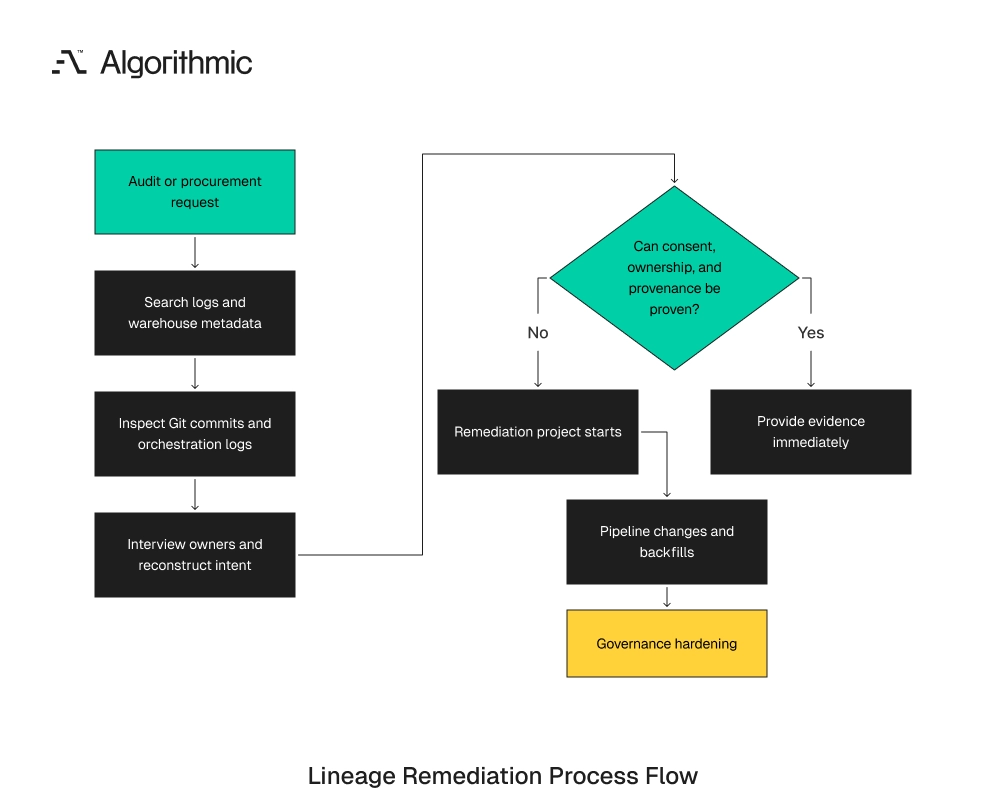
A later remediation program has three cost categories, which are discovery, repair, and governance hardening. Discovery requires engineers to inspect pipelines, warehouse queries, orchestration logs, BI reports, model training scripts, and data exports, and in a mid-market SaaS company with 80 production tables, 20 dbt models, 12 dashboards, and three ML pipelines, discovery can take four to six weeks. That period often produces limited visible progress, because the team is reading SQL, reviewing DAGs, matching reports to tables, and interviewing owners who remember design decisions from prior quarters.
Repair requires pipeline changes, so teams add metadata columns, rebuild DAG ownership, backfill history, correct data catalog entries, and write tests for high-risk flows. This often consumes another six to 10 weeks because production pipelines require regression testing, and a change to a revenue model, risk table, or customer-facing API needs validation before release. Governance hardening adds operating process, so teams define data owners, approval paths, access rules, deletion propagation, lineage review cadence, and incident response runbooks.
 Click to expand
 The total program can reach three to five months, and during that period roadmap work slows, procurement answers remain incomplete, and auditors keep asking for evidence. The cheaper path is to define lineage requirements during data warehouse architecture, ML system design, and API design, where the incremental cost is usually a small percentage of the original build. The team is already touching ingestion jobs, transformation code, and serving interfaces, so adding provenance fields, tests, and receipts during that work costs less than reconstructing history later.
The timing creates additional damage, because remediation often starts when a contract, audit, or renewal creates executive pressure, and that pressure reduces engineering judgment, so under deadline teams create partial mappings and manual exceptions. Those records satisfy one questionnaire and become another maintenance burden, and they also create inconsistent evidence across sales, security, legal, and engineering. The cost also reaches product delivery, because senior engineers spend weeks reading old SQL instead of shipping customer-facing work or improving platform reliability, which is why lineage deserves architecture review before launch, since the cost curve changes sharply after production traffic, customer data, and contract obligations accumulate.
Lineage architecture patterns that work in production
Tool selection matters after the metadata model is defined, and Snowflake, BigQuery, Databricks, dbt, Airflow, Dagster, Kafka, OpenLineage, Marquez, DataHub, Collibra, and Atlan can all support parts of the lineage picture. The architecture should make lineage capture automatic wherever the system can emit metadata, while manual entry covers judgment-based records such as owner, policy, classification, and business definition.
A production design needs three properties, so it must capture events at runtime, connect those events to business context, and preserve them for audit review. The strongest designs treat lineage as part of observability, because pipeline runs, data quality tests, model deployments, and API responses all produce operational telemetry.
Lineage records should join that same telemetry flow, because engineers trust records generated by the systems that perform the work. That approach avoids a separate governance database that nobody trusts, and it also reduces duplicate entry across catalogs, tickets, dashboards, and warehouse metadata. The architecture should define a system of record for each lineage fact, so orchestration owns job runs, dbt owns transformation metadata, registries own model artifacts, and applications own output receipts.
Catalogs remain useful when they display facts from production systems, and they become weak when they depend on manual updates for operational truth.
Use OpenLineage or equivalent instrumentation for pipeline events
OpenLineage provides a standard model for job, dataset, and run metadata, and it integrates with tools such as Airflow, Spark, dbt, and Marquez. For teams using Dagster, assets and materializations can serve a similar role, and the key requirement is run-level metadata that records inputs, outputs, code version, timestamp, and execution status.
Manual lineage entry should be reserved for business ownership, classification, and policy context, while pipeline facts should be emitted by the systems that run the pipelines. The instrumentation should be part of the platform template, so new Airflow DAGs, Dagster jobs, Spark jobs, and dbt runs should emit lineage metadata by default.
A platform template should also define required metadata fields, such as data_owner, source_system, processing_purpose, retention_class, schema_version, and lineage_run_id. These fields should fail validation when missing on governed datasets, because optional metadata becomes empty metadata under delivery pressure. The instrumentation should write to a durable store, since a short-lived log stream is insufficient for audits that arrive six months after an event, and retention periods should match contractual and regulatory obligations, because revenue metrics, model decisions, and deletion receipts often need longer retention than routine operational logs.
Treat dbt tests as lineage control points
dbt is often the best place to connect transformation logic with data quality monitoring, because model dependencies, source definitions, tests, exposures, and documentation provide a practical foundation for analytics lineage. Teams should require tests on governed models, such as non-null checks on primary keys, accepted values for status fields, relationship tests across dimensions, and reconciliation checks for financial measures.
A lineage graph without test results shows movement, while a lineage graph with test results shows whether the movement produced trusted data. The review process should treat failed tests as governance events, so if a governed model fails, downstream dashboards and exports should show warning status or stop refreshes.
This is where data quality and lineage meet, because a metric trace has limited value if the source path is known and the tests failed. For board metrics, test history should be retained with the lineage record, so the evidence package shows the model version, source tables, test results, and approval date. dbt exposures should identify dashboards, notebooks, and downstream applications that consume governed models, which makes blast-radius analysis faster during an incident, so when a source schema changes, the team can identify affected metrics and customers, reducing incident response time and preventing silent dashboard drift.
Archive model artifacts for reproducibility
ML lineage requires more than dataset lineage, because teams need training data snapshot identifiers, feature definitions, code version, hyperparameters, model binary, evaluation metrics, experiment run ID, and deployment record. MLflow, Weights & Biases, SageMaker Model Registry, Vertex AI Model Registry, and custom artifact stores can record these facts, and feature stores such as Feast or Tecton can help preserve per-feature provenance and training-serving consistency.
A model that cannot be reproduced becomes a liability in credit scoring, clinical triage, insurance pricing, fraud detection, and regulated employment workflows. Reproducibility also protects product teams during customer disputes, because if a customer challenges an output, the company can show the model, features, data snapshot, and decision path used at that time.
The archive should include rejected models as well as approved models, because audit questions often concern why a model was selected and which alternatives were considered. Evaluation records should include fairness tests, calibration reports, drift checks, and approval notes for high-risk systems, and these artifacts turn model governance from a meeting record into production evidence.
Deployment records should link model versions to endpoints, so the record shows when the model was promoted, who approved it, and which traffic segment received it. Rollback history also matters, so if a model was removed after a drift alert, the lineage record should show the trigger, decision, replacement version, and customer exposure.
Preserve vector index and retrieval metadata
AI products need lineage for vector indexes as well as relational tables, because a vector index has source documents, chunking logic, embedding model, index build time, access policy, and deletion state. Teams should record these fields for every index build, and also store which index version served each answer. This matters when documents change, so if a policy page is updated on Tuesday, a Monday answer must remain tied to the prior document version. Deletion propagation requires the same discipline, because if a customer removes content, the system must trace that content through raw storage, embeddings, indexes, caches, logs, and exported answers.
Vector index lineage should include chunk identifiers, because a single PDF can produce 400 chunks, and one restricted paragraph can contaminate many downstream results. Teams should also record retrieval filters, so if an answer was limited to documents from one customer tenant, the receipt must prove that boundary was applied. Chunking strategy should be versioned, because a change from 500-token chunks to 1,200-token chunks can change retrieval behavior and answer quality, and embedding model changes require the same record, since a migration from one embedding model to another creates a new index lineage path and a new deletion propagation surface.
A practical checklist for CTOs and data governance leaders
Use this checklist before launching a regulated analytics product, enterprise SaaS data feature, or production AI system.
Minimum lineage controls before production
- Every source table has an owner, system of record, schema version, and data classification.
- Every ingestion job records extraction time, source version, destination, actor, and consent context.
- Every governed transformation has column-level mapping, code version, test results, and approval history.
- Every dashboard, API, and model endpoint records downstream consumption and output version.
- Every ML training run stores dataset snapshot, feature definitions, model artifact, evaluation result, and deployment status.
- Every AI-generated answer carries source references, document versions, retrieval metadata, prompt version, and model identifier.
- Every deletion request can be traced across warehouse tables, feature stores, vector indexes, exports, and downstream tools.
- Every high-risk dataset has a named steward and an incident response path.
- Every production pipeline emits metadata automatically through orchestration, transformation, or catalog integration.
- Every quarterly governance review tests lineage against live examples instead of static diagrams.
This checklist is operational by design, so it can be converted into engineering tickets, acceptance criteria, procurement answers, and technical diligence questions. A CTO can assign the first three controls to the data platform team, while product engineering owns serving receipts and AI output metadata, security and legal review deletion tracing, access policy, subprocessor records, and retention classes, and data governance owns quarterly review, steward assignments, and exception handling.
The checklist also works during vendor review, because buyers can ask vendors to provide one sample lineage trace from source record to dashboard, API response, or model output. The sample should be current and drawn from production systems, so ask for one live customer record, one governed metric, one AI response, and one deletion request, because a mature vendor can produce that evidence from systems while a vendor relying on manual diagrams will need days of staff coordination. The evidence package should include timestamps, identifiers, owners, tests, and policy records, because narrative answers alone are weak procurement evidence, and CTOs should also ask how exceptions are handled, since every mature lineage program has exceptions and the record must show approval, expiration, and compensating controls.
Where to start when lineage is already incomplete
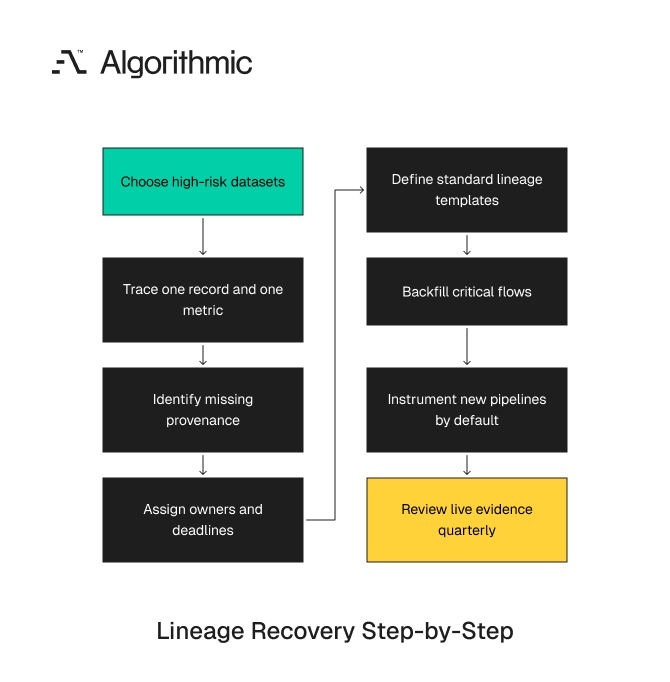
Teams with live pipelines should start with business risk, and catalog coverage comes later. Pick the 10 datasets that support regulated reporting, customer-facing analytics, AI outputs, billing, risk scoring, or executive dashboards, because these datasets create the highest exposure during audit and procurement. For each dataset, trace one record and one metric back to source, capturing origin, consent, transformations, owners, tests, downstream consumers, and serving interfaces. Gaps found in this exercise usually expose the highest-risk engineering work, and they also show which teams own the missing controls.
Ethyca’s guide to end-to-end data lineage for privacy reporting is useful because it connects lineage with privacy operations, and privacy reporting creates the same operational demand as enterprise procurement, which is proof of where personal data moved and how it was used. After the first set of high-risk datasets, set metadata requirements for every new pipeline and freeze further untracked expansion. Backfill lineage for existing high-risk flows while all new data work follows the new standard, because this is how organizations stop adding to the remediation queue.
The first remediation wave should produce reusable templates, so create standard ingestion metadata fields, dbt documentation requirements, model registry fields, and output receipt formats. That template work prevents each team from inventing its own lineage model, and it also gives legal, security, and governance teams one evidence format to review. The sequence matters too, so start with evidence that supports revenue, regulated workflows, and customer commitments, then expand to lower-risk analytics assets.
A 30-day first wave should finish with three artifacts, so the team should produce a risk-ranked dataset list, a tested lineage template, and a backlog of missing controls. The backlog should distinguish missing evidence from weak process, because missing evidence requires engineering work, while weak process requires ownership, review cadence, and approval rules.
A practical first wave often identifies 20 to 40 remediation tickets. Examples include missing source owners, absent dbt tests, untracked dashboards, orphaned exports, and AI responses without receipts.
 Click to expand
 Prioritize items that block revenue, audit response, deletion compliance, and regulated decisions. Lower-risk internal analytics can follow after high-exposure flows are controlled.
Operating model for who owns lineage after launch
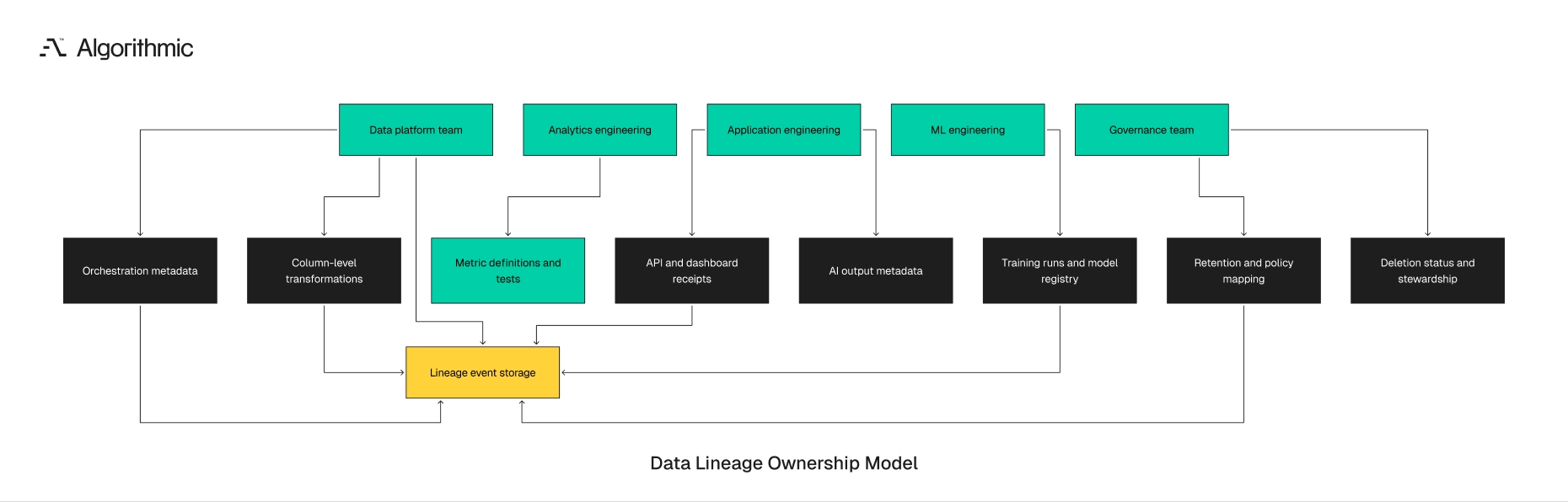
Lineage fails when every team assumes another team owns the record, so production systems need named owners for each layer. Data platform teams own orchestration metadata, pipeline instrumentation, and storage of lineage events, and they also maintain integrations with OpenLineage, catalogs, warehouses, and workflow engines. Analytics engineering owns column-level transformation records, metric definitions, dbt tests, and exposure documentation, and this team should control governed metric changes through code review. Application engineering owns serving receipts for APIs, customer-facing dashboards, and AI product features, and they must record which data and model versions generated each output.
ML engineering owns training runs, feature provenance, evaluation artifacts, model registry entries, and deployment records. Governance teams own stewardship, retention, deletion status, and policy mapping.
 Click to expand
 This division keeps accountability clear, and it also prevents governance from becoming a document exercise detached from production systems. Ownership should appear in engineering systems, so tickets, code owners, catalog records, and incident runbooks should identify the accountable team. Quarterly review should test live evidence, sampling current production outputs instead of last quarter’s architecture diagram, and a strong review selects one customer record, one governed metric, one model output, and one deletion request, then traces each item across source, movement, transformation, serving, and governance records.
Exceptions should expire, because a lineage exception without an expiration date becomes permanent technical debt, so leadership should review open exceptions monthly for high-risk systems, and that review should include engineering, security, legal, product, and data governance. Incident response should include lineage questions, so when a dashboard error, model drift event, or data exposure occurs, the team should identify affected records, outputs, customers, and controls. This operating model turns lineage into production discipline, and it also gives executives a reliable answer during audits, procurement reviews, and board discussions.
Build provenance before the audit clock starts
Data lineage becomes expensive when the organization needs proof that the system was never designed to record. CTOs, CISOs, and data governance leaders should set lineage requirements before production work begins, and require source provenance, consent propagation, column-level transformation records, output receipts, reproducible ML pipelines, and archived artifacts as part of architecture review. Start with the highest-risk datasets this week, so assign owners, document lineage gaps, and convert each missing record into an engineering task with a deadline. The first review should inspect live evidence, so pick one customer record, one governed metric, one AI answer, and one deletion request.
Trace each item through source, movement, transformation, serving, and governance records, and the gaps found in that exercise should become the next sprint’s risk reduction work. The strongest teams build proof while the system is still under design control, so they capture lineage facts at runtime, connect them through stable identifiers, and preserve them for audit review.
Do not wait for the questionnaire, audit notice, or customer escalation. Build the proof before the audit clock becomes visible.
Algorithmic builds data infrastructure and integration systems where lineage, consent propagation, and output receipts are captured at runtime instead of reconstructed under audit pressure. Ask us to trace one of your high-risk datasets before procurement does.