

A production AI system can fail with 94% model accuracy, because failure starts when no executive owns data quality, model updates, customer SLAs, incident response, and audit evidence. This pattern sits behind stalled AI portfolios. The company has access to frontier models, data scientists, enterprise data platforms, and pilots across sales, support, risk, and operations. Three demos impress the board, yet none reach production because no executive accepts operating accountability after launch.
An honest AI readiness assessment starts with tools, data, and use cases, and those categories matter. In regulated and customer-facing environments, governance readiness sets the production ceiling, and the NIST AI Risk Management Framework puts that same accountability at the center of its Govern function.
The production boundary exposes governance gaps
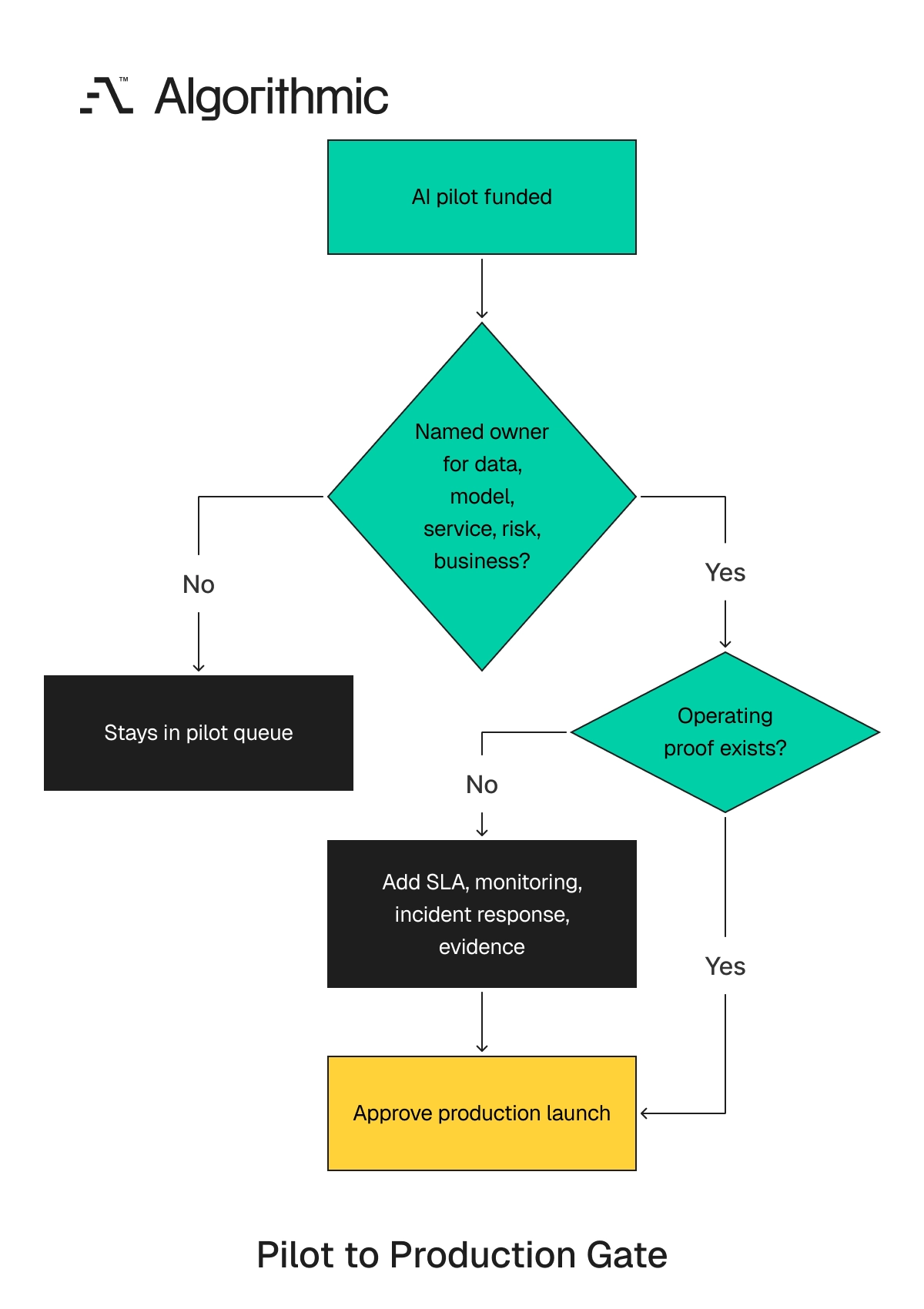
A pilot can run with informal ownership for a short period, but a production service requires named accountability from the first release. During experimentation, a product manager approves a data extract, a data scientist tunes prompts, and an engineering team wraps the model in an internal interface. The risk profile stays contained because the service has no customer-visible decisions, does not affect contractual service levels, and creates no audit obligations inside production workflows.
Production changes the accountability model. The AI service now has users, failure modes, audit needs, access rights, release cycles, and cost exposure, so it becomes part of the operating model. The failure sequence is predictable.
- A business unit funds a pilot with a clear commercial hypothesis.
- A data science team builds a working prototype in 6 to 10 weeks.
- Legal, risk, security, and engineering review the launch plan.
- No team owns data freshness, model drift, incident response, or audit evidence.
- The pilot remains in review for another 2 to 3 quarters.
This sequence creates a portfolio of demonstrations that cannot be operated, audited, or expanded across business units. The organization counts pilots as progress, while the production queue tells a different story.
 Click to expand
 The cost is direct. A 10-person AI team can spend more than $1 million in six months, and that figure includes salary, cloud compute, vendor licenses, legal review, security review, and management time. That expense earns a return when pilots become operating services, and becomes waste when governance questions appear after the build. The team has working code, a trained model, and a demo script, but it lacks the owners required to run the service under pressure, and that gap blocks launch more often than model performance.
We saw this pattern at a claims organization with 4,200 employees and three AI pilots in flight. The strongest model reached high accuracy on historical claims notes, yet launch stopped for 11 weeks because no executive owned field-level corrections in the source claims system. The remediation artifact was one page that named the data owner, model owner, service owner, risk owner, business owner, SLA, rollback path, audit log, and 90-day success metric.
The service moved to production six weeks after those names were funded and recorded. The one-page brief did more than assign responsibility, since it changed the review conversation from abstract risk to named work. Each launch risk had an owner, a control, and a date, so legal could review evidence, engineering could plan release windows, and operations could sign the support path.
Governance readiness means operating proof
AI governance often becomes policy documentation, yet production readiness requires operating proof. It means the organization can answer five operating questions before a model reaches customers, employees, or regulated workflows.
- Who owns the input data and approves its use?
- Who maintains the model, prompts, retrieval corpus, or rules after launch?
- Who responds when outputs breach accuracy, safety, latency, or cost thresholds?
- Who signs off on customer-facing SLAs and internal service targets?
- Who produces evidence for auditors, regulators, customers, and internal risk teams?
These questions require named owners. Committee ownership fails during incidents because no committee joins the pager rotation at 2 a.m. The practical test is narrow, since the organization must run one AI service for 12 months with clear accountability across data, model, product, engineering, legal, and support. If the answer is uncertain, new model access increases exposure faster than value, more pilots add unresolved decisions, and more vendor tools create more operating paths without owners.
Governance also sets production pace. A team with named owners can approve changes through a defined release path, while a team with ambiguous ownership reopens the same approval debate at every milestone. Readiness work must start with operating design, because the model is one component, and the production service includes data contracts, monitoring, release controls, support rules, evidence records, and commercial ownership.
A board should ask for these records before it approves production funding. The absence of records is a decision signal that the organization is still experimenting, and that signal matters for capital allocation. A $600,000 pilot budget should create production learning, reusable controls, or a retired use case, not another queue item waiting for an owner.
The five ownership gates for production AI
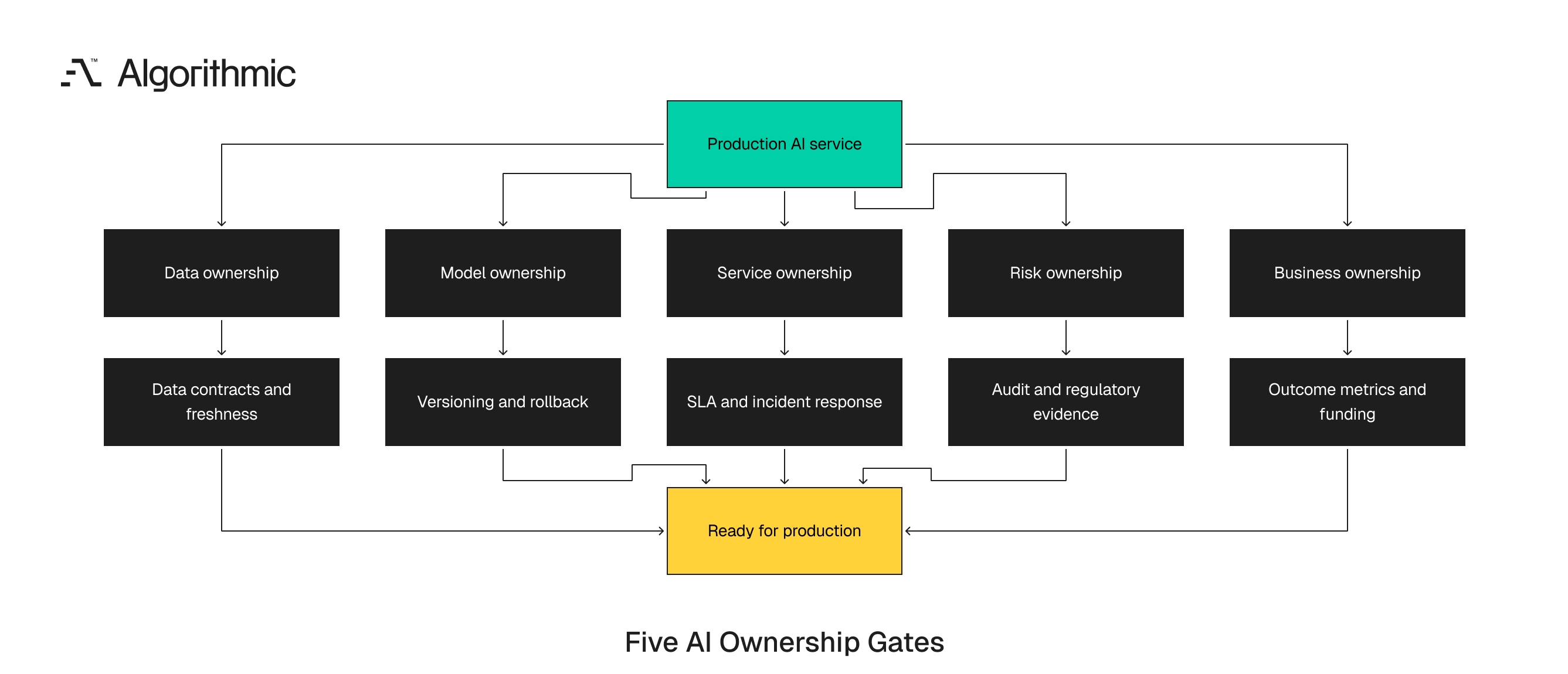
A useful AI readiness assessment tests ownership boundaries before recommending tools. The following gates set the minimum operating standard for production machine learning, retrieval augmented generation, agentic workflows, and AI-assisted decisions.
 Click to expand
 | Gate | Required decision | Evidence required before production |
|---|---|---|
| Data ownership | Named owner for each input dataset, feature set, document source, or event stream | Data contract, freshness target, lineage record, access approval, quality checks |
| Model ownership | Named owner for model versioning, prompt changes, retrieval settings, and evaluation suites | Model card, evaluation report, release process, rollback plan |
| Service ownership | Named owner for runtime reliability, latency, cost, and customer-facing behavior | SLA or internal SLO, on-call rota, incident response runbook, monitoring dashboard |
| Risk ownership | Named owner for legal, security, privacy, and regulatory evidence | DPIA or risk assessment, access control record, audit log retention policy |
| Business ownership | Named owner for outcome measurement and continued funding | Success metric, adoption target, cost threshold, quarterly review cadence |
A service that fails one gate can run as a controlled pilot, and it should stay outside production until the gap has an owner, a date, and a funded remediation plan. The gates also prevent accountability gaps. Engineering should receive responsibility for model behavior only with authority over training data, retrieval sources, acceptance thresholds, and release timing. Legal should define evidence needs before build, because late legal review creates redesign work, weak audit records, and launch delays.
Product should promise customer outcomes after operating teams sign the SLA. A support automation service that answers customer tickets within 800 milliseconds needs owners for latency, content accuracy, escalation, and cost, and those decisions belong in the launch plan, since they cannot be reconstructed from Slack threads after a customer complaint. The same rule applies to internal AI services, so a finance copilot that drafts variance explanations still needs source ownership, model release rules, and audit records because internal users make decisions from those outputs.
Production AI is a service ownership problem, and treating it as a model selection problem creates avoidable risk. The ownership gates make that risk visible before spend increases, and they create a common language for executives, where a CFO can see cost ownership, a general counsel can see evidence ownership, and a CTO can see release control.
The failure modes appear before launch
Governance gaps leave early signals, and senior leaders can detect them before committing production funding.
Pilots without internal customers
A model with no internal customer has no operating contract. The customer can be a claims operations team, a customer support director, a fraud analyst group, or a sales enablement function, and the name matters because it defines acceptable performance. A support summarization model needs latency, coverage, tone, and escalation targets, and the support director should sign those targets before production funding, otherwise the model team defines service quality without authority over the workflow.
A risk triage model needs precision, recall, false negative review, and override rules, and a document classification model needs confidence thresholds, manual review queues, and error correction paths. A coding assistant needs usage limits, security review, and rules for generated code entering repositories, so the policy should state whether generated code can enter a payment service without senior engineer review.
An MLOps engineering team should name the internal customer before production funding and show a lightweight SLA, since a one-page agreement is enough at the start. That agreement should define inputs, outputs, users, uptime, review cadence, and the person who accepts production risk, and it should include the shutdown condition, because a service with no stop rule becomes permanent by neglect.
Data sources without field-level owners
AI systems fail when a dataset has a system owner and no field-level owner. A customer registry may belong to IT, while the “employment status” field may be updated by operations, sales, or an external vendor. If that field drives eligibility, risk, personalization, or routing, the model inherits the field’s governance problem. The owner must have authority to fix invalid entries at the source, since a dashboard showing stale data is not ownership, and a weekly quality report with no remediation path is documentation without control.
Field-level ownership also matters for retrieval augmented generation. A policy document in Confluence can have a page owner, while the pricing table inside it belongs to finance, so if the model answers customers using that table, finance owns the accuracy of that field. This boundary becomes visible during incidents. If a support assistant quotes the wrong enterprise discount, the source record must be corrected, and the team needs to know who approved the content source and who signs the correction.
Data ownership must reach the level that affects model output, because dataset names alone do not provide enough control. Production services need source-level accountability for the fields, tables, documents, and rules that shape decisions. The same issue appears in feature stores, where a fraud feature named “account_age_days” can depend on registration date, activation date, and account reactivation rules, and each field needs a source owner when the feature affects a customer decision.
Model updates without release discipline
AI systems change after launch as prompts, embedding models, retrieval corpora, and vendor APIs change. Business rules also change, so a credit policy update, a product return rule, or a new claims exclusion can alter outputs, and the model owner needs a release process that catches those changes before customers see them. A production AI service needs release discipline similar to software, which includes version control, test suites, approval rules, rollback steps, and monitoring. For generative AI, evaluation sets should include known edge cases, prohibited outputs, privacy-sensitive prompts, and domain failure examples drawn from the workflow, not from generic prompt libraries.
The CircleCI 2026 State of Software Delivery report analyzed more than 28 million CI workflows and found the largest jump in development activity in its history as AI-assisted development spread. More throughput raises the value of release control, so teams shipping faster need stronger checks around quality, cost, and incident response. Release discipline also controls vendor risk, because a hosted model API can change behavior after a provider update, and the service owner needs regression tests that detect output drift before the change affects a regulated workflow.
The test suite should run against representative prompts, documents, and edge cases, and it should fail the release when outputs breach defined thresholds, otherwise production users become the test environment. A release gate should include cost checks as well, since a prompt change that improves response quality and doubles token use changes the business case, and the business owner should approve that tradeoff before deployment.
Regulatory evidence assembled after build
Evidence created during design costs less than evidence assembled after launch review. For regulated workflows, audit logs, model version history, data lineage, access records, human review steps, and decision rationale need to exist by design, because retroactive evidence gathering delays launch and weakens trust with risk teams. Regulatory readiness also affects commercial work, since enterprise customers ask how an AI service handles data retention, access control, human review, and model changes, and a sales team cannot answer those questions with a policy PDF alone.
The strongest evidence systems produce records during normal operation, where each request records the model version, data sources, user identity, output, review step, and policy basis, so the service creates its own audit trail. This design reduces rework during customer security reviews and reduces dispute cost when a customer challenges an AI-supported decision, because the organization can show what happened without reconstructing events from chat logs and screenshots. Evidence design should start with the highest-risk workflow, so a lending decision needs a stronger record than an internal meeting summary, and the evidence owner should classify each workflow before build.
Agentic AI raises the governance standard
Agentic systems increase the cost of weak ownership because they take actions across tools, systems, and permissions. A recommendation model may rank content, while an agent may read customer records, create tickets, draft refunds, trigger workflow steps, or call internal APIs, so governance must cover identity, permissions, tool access, human approval, memory, logs, and revocation. This is where AI agent governance and SLAs turn write access into an owned service instead of a loose tool.
The Cloud Security Alliance found that only 26% of organizations report complete AI security governance policies. A companion CSA survey with Strata Identity on autonomous agents found that 84% doubted they could pass a compliance audit focused on agent behavior or access controls. Those numbers match technical due diligence findings, since teams can demo an agent in a sandbox yet often cannot show which identity the agent uses, who approved tool permissions, how actions are logged, or who can disable access during an incident.
Agentic AI readiness should include four additional controls.
- A unique agent identity for each deployed agent.
- Least-privilege access to each tool and data source.
- Human approval for irreversible or financially material actions.
- Tamper-resistant logs for prompts, tool calls, decisions, and outputs.
Without those controls, the agent becomes an unowned operator inside the company that moves faster than the control environment around it, and that mismatch creates operational and regulatory exposure. A claims agent illustrates the point, because if the agent can read claim notes, recommend payment, and trigger a workflow in Guidewire or Salesforce, its permissions need review, and the approval path must show which employee authorized payment and which model version produced the recommendation.
A service-desk agent creates a different risk. If it can reset credentials, access identity systems, or close tickets, security owns part of the operating model, and the service owner needs logs that connect each tool call to a user request, an agent identity, and an approval rule. The agent also needs a kill switch, so the service owner should be able to suspend tool access within minutes during an incident, and security should test that path before launch.
Memory requires the same discipline. If an agent stores user preferences, case details, or customer instructions, retention rules must be explicit, and the owner must define what is stored, where it is stored, who can read it, and when it is deleted. Tool access needs the same review pattern as employee access, so a procurement agent that can create purchase orders needs approval limits, vendor restrictions, and segregation of duties, and finance and security should sign those rules before the first production transaction.
Model selection follows operating constraints
Model selection should occur after the organization defines the operating constraints. A team choosing between GPT-4.1, Claude, Gemini, Llama, or a domain-specific model needs the latency budget, cost ceiling, data residency requirements, logging rules, output thresholds, and human review model first, since those constraints shape architecture. The same applies to classical machine learning, where a fraud model with 200 millisecond latency requirements needs a different architecture from a nightly batch scoring model, and a medical coding assistant needs a different evidence model from an automated claims decision engine. Production model readiness has four parts.
Evaluation readiness
Evaluation readiness means the team has test data, thresholds, and failure categories before launch. For an NLP service, that can include 1,000 labeled examples across intent classes, privacy-sensitive inputs, adversarial prompts, and domain terms, while a recommendation service can include offline precision metrics, business guardrails, and an A/B testing plan. For a computer vision product, it can include image quality thresholds, class imbalance analysis, and review workflows for low-confidence outputs, so a warehouse inspection model should test poor lighting, occlusion, camera angle, and damaged packaging.
Evaluation sets need owners and maintenance cycles, because a support model trained on last year’s product catalogue will miss new products, retired SKUs, and revised escalation rules, and the business owner should approve evaluation categories because those categories define acceptable production behavior. Evaluation also needs negative examples, so a banking assistant should include prompts that ask for prohibited advice, account data from another customer, and unsupported fee waivers, and the service should reject those requests in testing before it meets users. The evaluation record should show pass rates by failure category, since a single aggregate score hides high-risk weaknesses, and a model can perform well overall and still fail on the 30 cases that matter most.
Runtime readiness
Runtime readiness means the service can meet latency, cost, uptime, and monitoring targets in production. This includes inference infrastructure, autoscaling rules, queue behavior, timeout handling, fallback paths, and observability, and a production service should track latency percentiles, error rates, token spend, model response distribution, drift indicators, and user feedback. Runtime design also needs a failure plan, so if the model API times out, the service can route to a human queue, return a constrained response, or use a cached answer, and the product owner should approve that behavior before launch.
Cost controls belong in runtime readiness, because a customer assistant that burns $0.18 per exchange needs transaction forecasts, alert thresholds, and monthly owner review, otherwise usage growth becomes a budget incident. Runtime readiness should also include load testing, since a service that handles 50 requests during a demo may fail at 5,000 requests during a product launch, and the service owner should test expected peak volume and a defined surge scenario.
Change readiness
Change readiness means the organization can update the model safely. For LLM applications, this includes prompt versioning, retrieval corpus updates, embedding model changes, evaluation runs, deployment approvals, and rollback, while predictive models add training pipelines, feature controls, experiment tracking, and model monitoring. Change readiness also covers dependency changes, so a new CRM field, a revised policy document, or a vendor model update can alter outputs, and the release path should define who tests the change, who approves it, and who monitors it after deployment.
The release record should be readable by engineering, risk, and business owners, and it should show what changed, why it changed, which tests passed, and how rollback works, because a release note that only the model team understands will fail during an incident. Change readiness should define emergency procedures as well, since a defective retrieval document may require removal within hours, and the team needs authority, access, and a tested path to remove it safely.
Evidence readiness
Evidence readiness means the service can produce proof of what happened. The record should show which model version ran, which data sources were used, which user triggered the request, and what output was produced, and it should show what human review occurred and which policy applied, which separates a credible production service from undocumented automation. Evidence needs retention rules, so a customer support assistant may retain logs for 90 days, while a regulated credit decision workflow may require retention for years depending on jurisdiction and product type.
Retention must align with privacy rules and business needs, because storing every prompt forever creates its own risk, and the evidence owner should define retention by workflow, data class, and regulatory obligation. Evidence also needs retrieval standards, so during an audit the team should find records by customer ID, model version, request ID, date range, and release, since slow retrieval turns normal review into a crisis.
A practical AI governance readiness checklist
CIOs, CTOs, and business unit leaders can use the following checklist before approving any AI service beyond pilot funding.
Ownership
- Each dataset has a named owner with authority to correct source issues.
- Each model, prompt chain, or retrieval corpus has a named technical owner.
- Each production service has an accountable engineering owner.
- Each customer-facing workflow has a business owner.
- Each legal, privacy, and security review has an accountable approver.
Ownership records should sit in the same system used for production service catalogues. A spreadsheet works during assessment, but a production organization needs ownership linked to incidents, releases, access approvals, and architecture reviews. The record should include deputies, because production services fail at inconvenient times, and a named owner on holiday is not an operating model. It should also include decision rights, where the data owner can approve source use, the service owner can pause the service, and the business owner can accept or reject cost increases.
Operating controls
- The service has an SLA or internal SLO for latency, uptime, accuracy, and support.
- The system monitors model quality, cost, latency, errors, and drift.
- The team has an incident response runbook with escalation paths.
- The release process includes evaluation gates and rollback steps.
- Human review rules are documented for high-risk decisions.
Operating controls should be tested before launch. A tabletop incident test can reveal missing escalation paths in one hour, and a rollback rehearsal can show whether the team can restore the prior model version under pressure. The test should include business and risk owners, because engineering can restore the service, while the business owner decides how to communicate with users and whether to suspend the workflow. Incident tests should use realistic scenarios such as a model producing prohibited advice, a retrieval source going stale, a vendor API changing behavior, and token cost exceeding the monthly threshold.
Evidence
- The service logs inputs, outputs, model versions, retrieval sources, and tool calls.
- Access approvals are documented and reviewed on a fixed cadence.
- Data lineage is traceable from source to model input.
- Audit records are retained for the required period.
- Regulatory evidence is generated during normal operation.
Evidence should be generated as part of the workflow, because manual evidence assembly creates delay and error, and the best production systems make audit trails a normal byproduct of service operation. The evidence record should be searchable by incident, customer, model version, and release date, which reduces response time during audits and customer disputes and gives risk teams the proof they need without interrupting engineering work. The audit trail should record human decisions as well as model outputs, since in many workflows the decisive control is the reviewer’s approval, override, or rejection, and that action needs the same evidence standard as the model response.
Commercial control
- The internal customer has signed an operating agreement.
- The success metric is measurable within 90 days of launch.
- The cost ceiling is defined per transaction, user, or workflow.
- The funding model covers maintenance, monitoring, and retraining.
- The product owner can end or expand the service based on measured results.
Commercial control prevents abandoned production services. A model that costs $0.18 per transaction needs a business case tied to transaction volume, labor savings, revenue protection, or risk reduction, and the owner should review those numbers after the first operating quarter. The review should lead to one of three decisions, expand, hold, or retire, where expansion requires funding and operating capacity, and retirement requires data retention, access removal, and customer communication where needed.
A service that passes this checklist is ready for a production architecture review, while a service that fails several items needs governance work before model work, and the decision should be recorded with an owner and a date. Commercial control should include a named budget owner for run costs, because cloud spend, vendor fees, labeling work, and monitoring tools continue after launch, and a production AI service without maintenance funding becomes technical debt.
How leaders should sequence AI readiness work
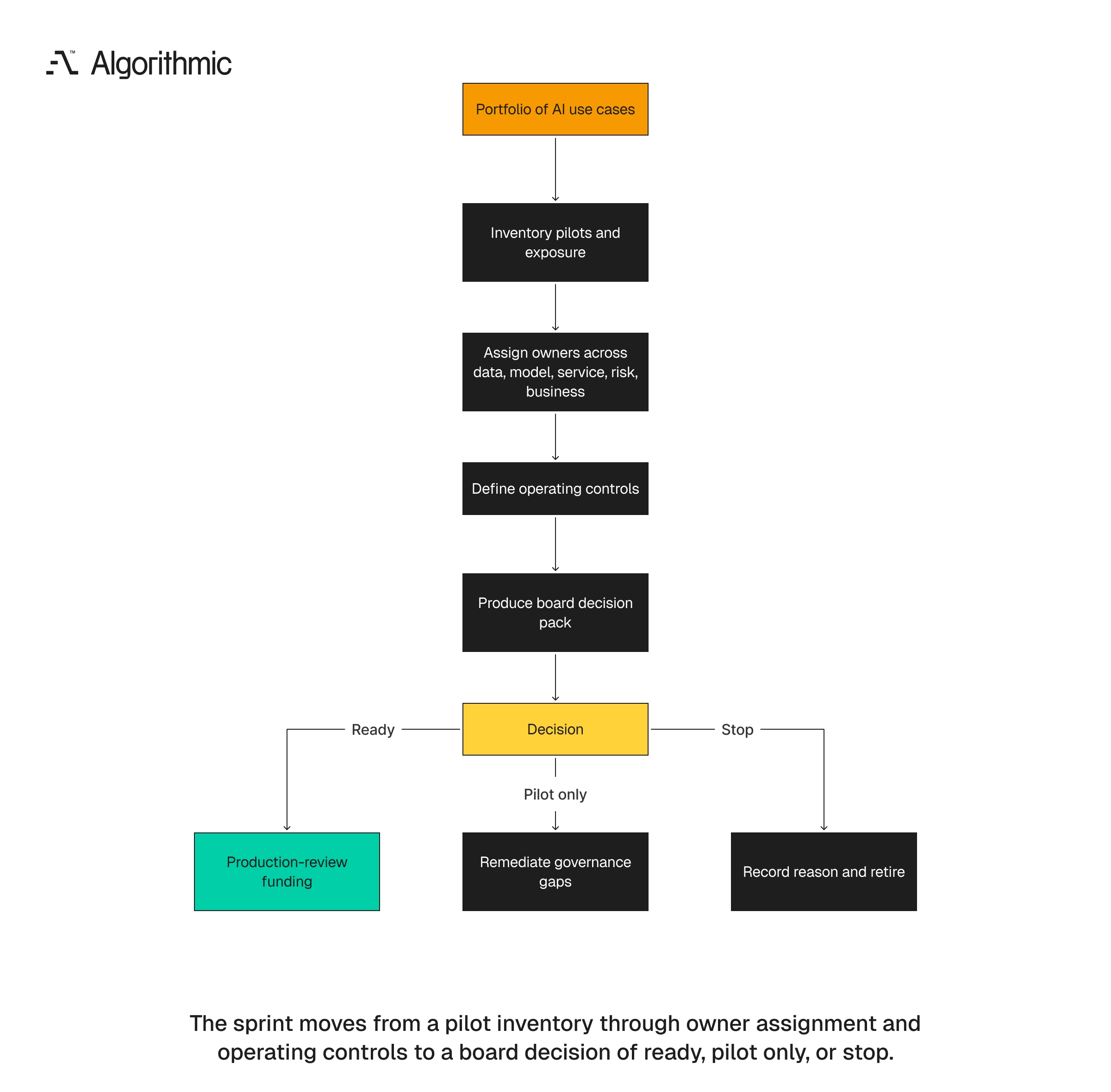
The sequence matters, because starting with models creates enthusiasm and later conflict, while starting with governance creates a path from experiment to production. A 30-day readiness sprint is enough to classify an AI portfolio in most mid-sized enterprises. Week 1 should map all active pilots, planned use cases, data sources, model types, user groups, and regulatory exposure into a single inventory, and most enterprises discover duplicate pilots during this step. Week 2 should assign ownership across data, model, service, risk, and business outcomes, with gaps named in writing, since ambiguous ownership should block production funding.
Week 3 should define operating controls for the top 3 to 5 use cases, including SLAs, monitoring, incident response, release rules, and evidence needs, with engineering, security, legal, support, and the business owner in the room. Week 4 should produce a board-level decision pack, where each use case receives one of three classifications, production-ready after architecture review, pilot-only pending governance remediation, or stop due to unresolved accountability or risk.
 Click to expand
 This is where an AI readiness assessment should land. The output should be a production decision for each service, not a generic maturity score, and a board can fund that decision because it connects spend, ownership, risk, and timing. The decision pack should fit in 10 pages for a portfolio of 10 to 15 use cases, where page one shows the full inventory, and the remaining pages list each candidate, its owner map, its top risks, and its recommended funding decision. This format works because executives can see the tradeoffs, so they can fund two services, hold three pilots, and stop the rest, and see which executive owns each decision after the meeting ends.
The sprint should end with funding instructions. Each approved service needs a budget line for build, controls, evidence, support, and post-launch monitoring, and each deferred service needs a named remediation owner and due date. A stopped use case also needs documentation that states the reason, such as missing data rights, unresolved regulatory exposure, weak commercial case, or absent operating owner, which prevents the same use case from returning unchanged six months later.
The executive decision rule
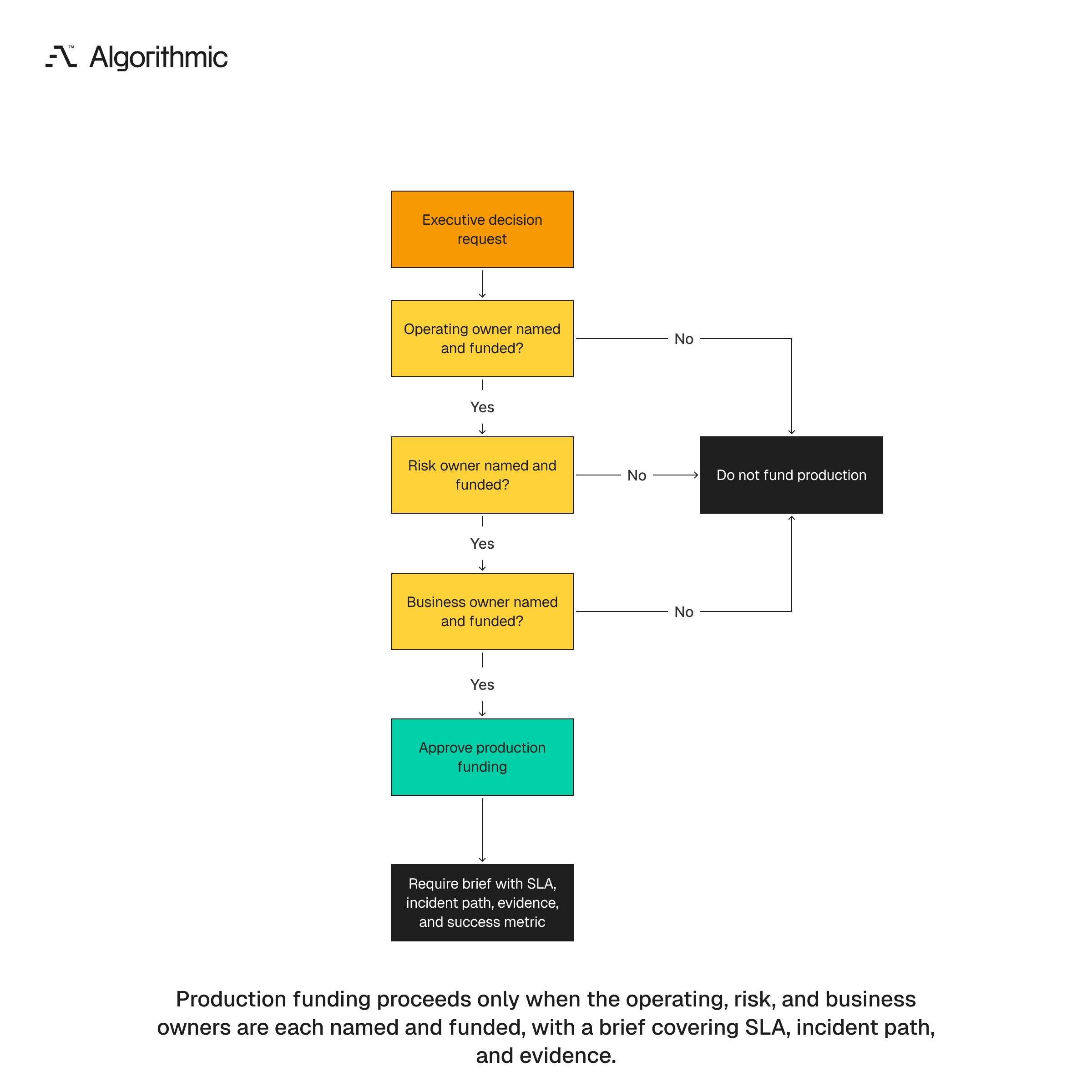
Executives should approve AI production funding when the operating owner, risk owner, and business owner are named and funded. Model access is procurement, a hiring plan for data scientists is staffing, and a successful demo is evidence of technical promise, none of which prove the organization can run the service.
 Click to expand
 The readiness signal is the organization’s ability to run the service under customer, regulatory, financial, and operational pressure, and that signal appears in ownership records, release paths, monitoring, incident response, evidence trails, and commercial controls. Across 35 complex engagements, we have seen the same pattern in production-ready software and ML systems, where systems succeed when ownership is designed before launch and stall when ownership is negotiated after the demo.
Before approving the next AI pilot, require a one-page production governance brief that names the data owner, model owner, service owner, risk owner, business owner, SLA, incident path, update cadence, evidence record, and 90-day success metric. If those fields are blank, stop the model work, fund the ownership, controls, and evidence path first, then build.
Algorithmic runs AI readiness assessments that turn a pilot portfolio into named owners, operating controls, and a board-ready production decision. Start a conversation if your AI demos impress the room but stall at the production gate.