

A model with 91% benchmark accuracy can still miss a 1.5-second p95 latency target, exceed a $0.02 cost-per-call ceiling, and fail rollback testing inside the target application stack. That system is unfit for production release regardless of its leaderboard position, because the release decision belongs to the complete runtime, so model, data, orchestration, infrastructure, controls, and economics all count. This is the core of any real AI readiness assessment, and it is the error that sits behind most of them. Teams approve a model after a controlled demo, a notebook evaluation, or a vendor benchmark, then find production risk after integration, once correction costs have climbed.
The pattern is consistent across enterprise builds. Token costs rise under normal traffic, a Rust client behaves differently from the Python sample, and drift monitoring arrives after launch instead of before it. Failure states then reach customers without containment, so a support assistant invents a policy citation, an AI coding feature blocks on repository context, and a contract review tool produces schema-invalid JSON that downstream services reject. Production readiness is a runtime property, and teams must measure it inside the workflow, infrastructure, data distribution, and commercial model where the AI system will run. Accuracy stays useful, and it cannot carry the release decision alone.
Accuracy measures model performance under narrow conditions
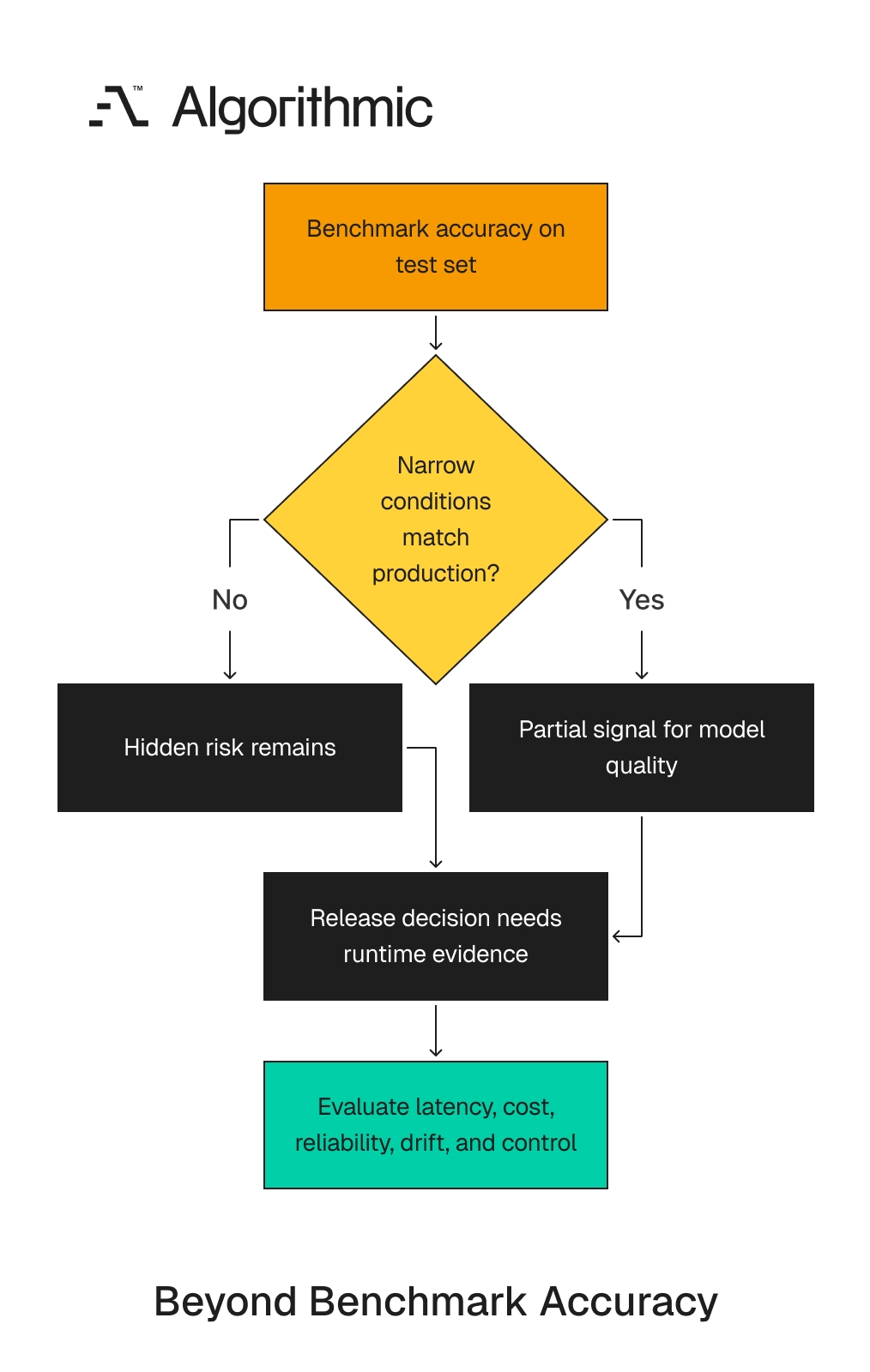
Benchmark accuracy answers one narrow question, how often the model produced the expected answer on a defined test set under defined conditions. That measure helps with model comparison, and it is inadequate for release approval, because a release decision needs evidence from the application path customers will use and from the failure modes the business cannot absorb. A classification model with 94% offline accuracy can still create unacceptable user harm when the remaining 6% clusters around high-value accounts, regulated cases, or escalation workflows. In that setting aggregate accuracy conceals the highest-risk errors.
A retrieval augmented generation system can score well on an internal evaluation set and fail when production documents exceed the chunking assumptions used during testing. A 12-page policy memo and a 480-page claims manual create different retrieval behavior, and we see this failure most often when teams test against clean source material. The model answers five curated policy questions during a demo, then in production the same feature receives superseded PDFs, missing appendices, duplicate titles, and access-controlled folders. Document structure changes the retrieval problem, so a single policy PDF may contain page headers, footers, tables, appendices, and scanned signatures, and chunking rules that work on clean Markdown often fail on those files.
The distinction is not new. The original Model Cards for Model Reporting work argued that a single aggregate score hides performance differences across conditions and subgroups, and that models should be reported with benchmarked evaluation across the contexts where they run. Single-attempt benchmark success also fails to describe reliability across long task chains, and that gap matters for deployed systems. A support agent that answers one question correctly can fail after six tool calls, and a coding assistant that passes one unit test can degrade during repository-wide refactoring. Long tasks expose compounding error, since retrieval selects one weak document, the model forms a partial answer, and a tool call executes against the partial state and creates a downstream failure. The operating lesson is direct, accuracy is one input to the decision, and release approval also requires latency, cost, reliability, drift, and control evidence.
 Click to expand
 The AI system is the production unit
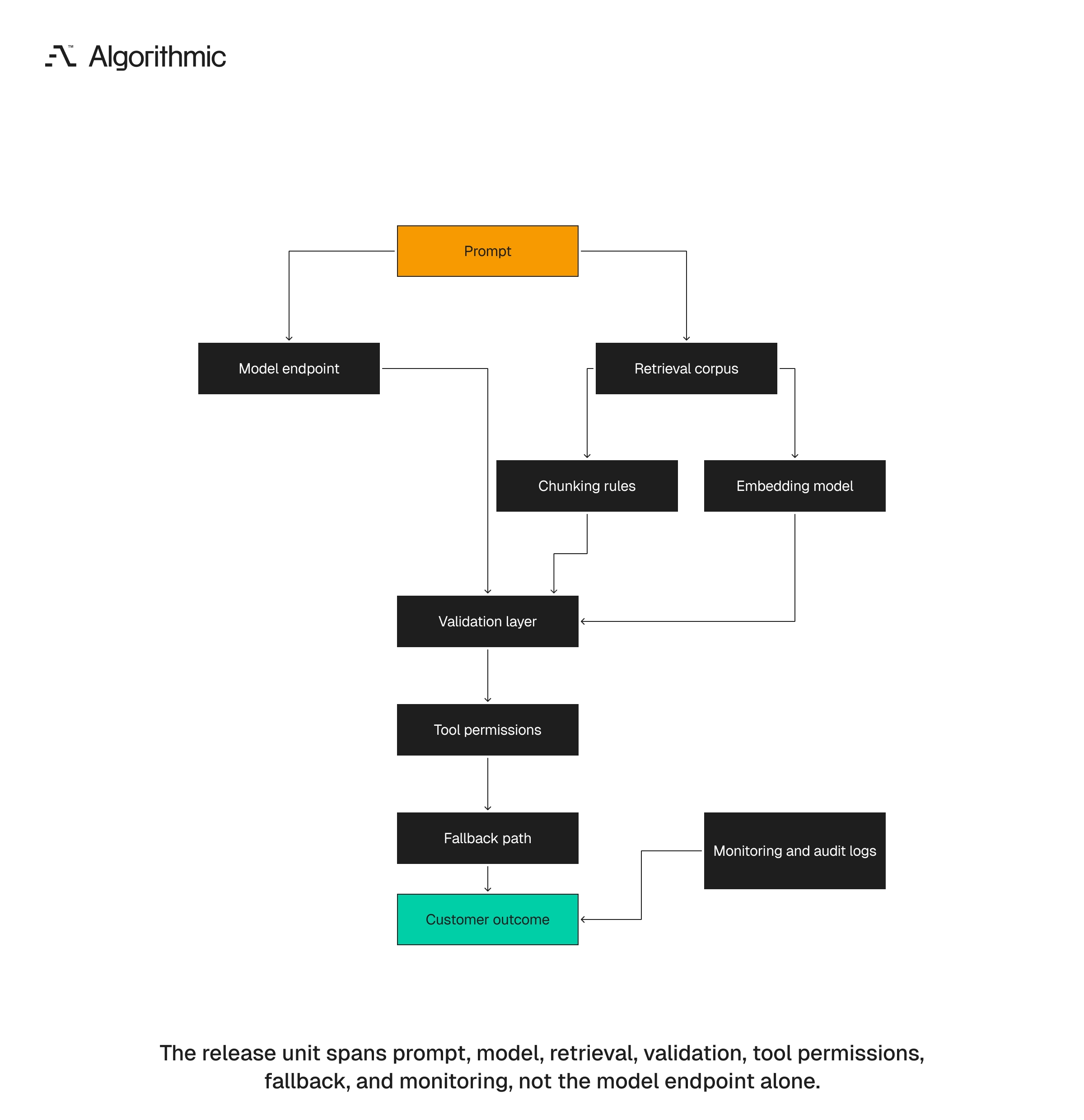
A deployed AI feature is a compound system. It includes prompts, retrieval logic, embedding models, vector database behavior, feature stores, cache policy, rate limits, API clients, post-processing, monitoring, and human review paths. Two systems using the same foundation model can produce different production outcomes, since one uses deterministic validation, bounded tool access, and defined fallback logic while the other sends raw user input to a model endpoint and accepts free-form output. Their benchmark accuracy can match while their production risk profile differs by orders of magnitude, and the difference comes from system design, runtime controls, and failure containment.
The same pattern shows up in code generation. A model card can report strong code-generation accuracy while a real codebase evaluation produces much lower task success, because the gap comes from context shape, repository conventions, dependency structure, and runtime integration. A benchmark problem may fit in one prompt, while a production task requires reading four files, respecting local patterns, and passing a CI suite. Enterprise AI systems inherit the same shape, so a vendor demo answers clean questions against curated documents while the production system must handle incomplete metadata, conflicting policy versions, missing permissions, and stale embeddings.
User behavior adds another layer. Employees ask the same question in 40 different forms, and customers paste screenshots, truncated logs, and contradictory instructions into the same conversation. The system must handle that variance without exposing private data or inventing answers, and it must produce evidence that engineering, product, security, and operations leaders trust, which comes from instrumented execution rather than a leaderboard. Consider a customer service copilot for billing disputes, where the foundation model answers billing policy questions well in isolation but the deployed feature still depends on account status, invoice history, entitlements, regional policy, and CRM write permissions. One missing entitlement check changes the risk profile, one stale policy document changes the answer, and one unbounded tool call changes the workflow from drafting a response to modifying a customer record.
This is why the release unit must be the complete system. Teams should version the prompt, model, retrieval corpus, chunking rules, reranker, validation code, tool permissions, and fallback path, because a model version alone does not describe the production asset. The same discipline applies to managed AI services, so a hosted model endpoint removes server management yet leaves workflow correctness, cost control, routing, logging, and rollback with the buyer. A release candidate should therefore carry an artifact trail that identifies the model endpoint, prompt hash, corpus snapshot, embedding version, infrastructure region, and policy configuration, since without that record a later incident becomes difficult to reproduce.
 Click to expand
 Six production metrics belong in every AI release gate
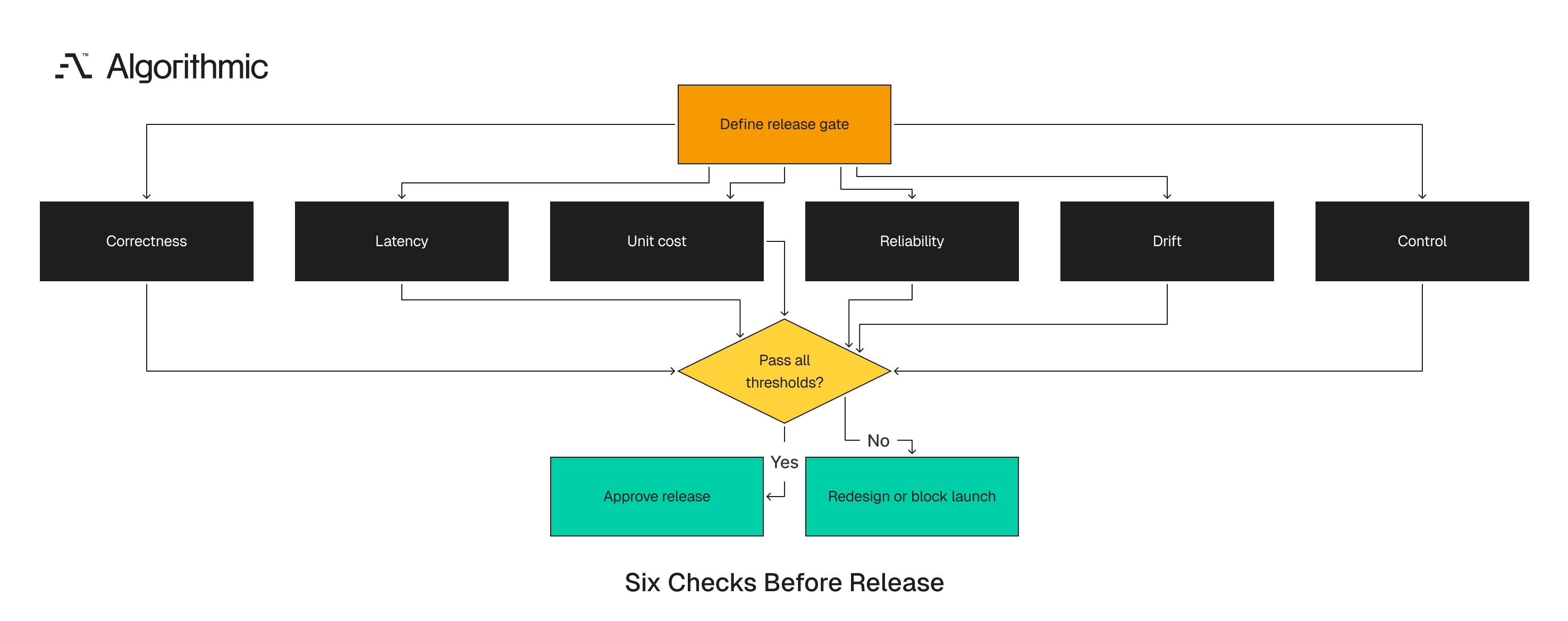
A production AI evaluation should use a release gate with pass or fail thresholds set before model selection. The thresholds define the system being built and prevent benchmark theater.
The AI production readiness gate
| Dimension | Production question | Example threshold | Measurement method |
|---|---|---|---|
| Correctness | Does the system produce acceptable outputs on target tasks? | ≥ 88% task success on 500 workflow-specific cases | Human-reviewed eval set and automated regression tests |
| Latency | Does the feature meet the user workflow SLA? | p95 ≤ 1.5 seconds, p99 ≤ 3.0 seconds | Load test in the target runtime |
| Unit cost | Does cost fit the business model? | ≤ $0.02 per completed user action | Token, GPU, retrieval, and orchestration cost tracking |
| Reliability | Does performance hold across repeated calls and task lengths? | ≤ 2% unrecoverable failures over 10,000 invocations | Soak test and long-horizon task suite |
| Drift | Does quality degrade as data changes? | Alert at 5-point drop in weekly task success | Production monitoring with labeled samples |
| Control | Can the team contain failures? | Rollback in ≤ 10 minutes, fallback path tested weekly | Runbook drill and CI/CD deployment test |
These measures are distinct enough for most production machine learning engineering reviews, since they cover user value, workflow fit, commercial viability, operating stability, data change, and recovery, and they give leaders a common release language.
 Click to expand
 The exact numbers vary by domain. A customer support assistant can tolerate different latency and error rates than a fraud decision system, while the structure stays constant. A fraud model used during card authorization may need a response inside 300 milliseconds, and a contract review assistant used by legal operations may tolerate five seconds, yet both systems still need explicit thresholds before vendor selection. The gate also prevents late-stage negotiation by anecdote, because without thresholds one executive remembers the best demo answer and another remembers the worst, while with thresholds the team compares measured results against the release standard. It creates useful conflict early too, since product may want broader coverage, finance may set a lower cost ceiling, and security may require stricter controls, and those trade-offs belong before architecture lock-in.
Correctness measured on real workflow tasks
Generic benchmarks rarely match production data. For an insurance claims assistant the evaluation set should include scanned PDFs, policy riders, missing pages, inconsistent dates, and jurisdiction-specific language. For a SaaS recommendation engine the set should include cold-start accounts, power users, seasonal usage spikes, and churn-risk segments, because a release gate built only on median users will miss revenue-critical cases, and the cases should reflect the accounts that drive retention and support cost. A sound evaluation set has at least 300 to 1,000 cases for a meaningful first gate, spanning normal cases, boundary cases, and known failure modes from support tickets or analyst review, and regulated workflows should also include adversarial and audit-sensitive cases.
The scoring rubric must be specific, since “good answer” is too loose for release approval. Use labels such as correct, partially correct with safe caveat, incorrect recoverable, incorrect harmful, refusal correct, and refusal incorrect, and map each label to a release decision, so incorrect harmful outputs may block release at one incident while incorrect recoverable outputs may pass within a defined ceiling. Refusal errors need separate tracking because excessive refusals damage workflow adoption, so in a support workflow over-refusal sends tickets back to agents and weakens the productivity case, and in a compliance workflow under-refusal creates audit exposure.
Human review should be structured, so two reviewers score a sample independently and then resolve disagreements through a written rubric, and a 15-minute calibration session often removes ambiguity from labels before the full review starts. Correctness also needs segment reporting, because overall task success can hide poor performance for one product line, region, tenant size, or document type, and a 90% total score carries less value when regulated cases score 62%. A strong rubric includes source requirements, so if the answer depends on a policy, contract, or medical record, the system should cite the supporting source, and the reviewer should score both the conclusion and the source linkage.
Latency measured in the deployment stack
Notebook latency does not predict production latency. SDK choice, serialization, network path, tokenization, retries, database calls, vector search, and application thread pools all change response time, and these components sit outside most model benchmarks. We have seen models perform well in Python experiments and fail latency targets in Rust services because the client library, streaming behavior, and retry policy differed, which was a runtime measurement failure. A production test should run through the same API gateway, identity layer, observability stack, vector database, cache, and model provider path customers will use, and it should measure p50, p95, and p99, since average latency is insufficient for user-facing AI.
Tail latency matters because customers experience the slowest calls, and Google’s tail at scale analysis shows that rare slow responses come to dominate service performance at scale, so the 99th percentile, not the average, is the number that describes user experience. A workflow with 700-millisecond p50 latency and 8-second p99 latency will still generate support tickets, and the long tail often comes from retries, cold caches, provider throttling, or slow retrieval calls. The load pattern matters as well, because a test with one user in staging gives a false signal, so the test should reflect expected concurrency, burst behavior, and provider rate limits. For a production support assistant the peak hour matters more than the quiet hour, so if 35% of daily traffic arrives between 9:00 and 11:00 a.m. the load test should mirror that shape, since a flat traffic model understates queueing and retry behavior.
Latency budgets should be allocated by component. A 1.5-second p95 budget may assign 250 milliseconds to retrieval, 900 milliseconds to generation, and 150 milliseconds to validation, with the remaining time covering network overhead and application code. Streaming needs separate measurement, because time to first token affects perceived responsiveness while time to final answer affects workflow completion, so a chat assistant and a background document reviewer need different latency scorecards.
Cost tied to the completed business action
Cost per model call is an incomplete measure. A user action can involve classification, retrieval, reranking, generation, validation, tool calls, and retries, and the business pays for the full chain. Consider a product with two million AI-assisted actions per month, where a design that costs $0.018 per completed action creates $36,000 in monthly inference and retrieval expense while a design at $0.004 creates $8,000. That annual difference of roughly $336,000 lands before engineering support, observability, and vendor minimums, and it can erase the margin on a feature priced at $10 per account per month and change the payback period for the AI program.
Accuracy alone will not surface that delta, so AI product development teams need cost-per-completed-action dashboards before launch that separate prompt tokens, completion tokens, embedding calls, vector search, reranking, tool calls, and retries. Cost should also be segmented, because enterprise tenants with large document sets may cost several times more than small accounts, and averages hide the accounts that turn a profitable feature into a loss. Controls should include hard ceilings, so teams set maximum tokens, maximum retrieved chunks, retry budgets, and tool-call limits, which turn unit economics into engineering constraints.
A finance review should use completed actions instead of raw invocations, so if one user request triggers four calls and one retry the denominator remains one business action, which exposes the true cost of the experience customers buy. Cost analysis should include waste too, because failed validation, repeated retrieval, abandoned conversations, and timeout retries consume budget without creating customer value, so those categories need labels in traces before launch. Provider pricing changes also need a test plan, since a model tier change, context window expansion, or embedding migration can change unit cost overnight, and teams should model those changes before signing annual commitments.
Reliability tested across repeated calls and long tasks
Reliability measures whether the system holds performance over repeated use. A feature can pass a 50-case demo and fail across 10,000 production invocations, and soak tests expose memory growth, queue pressure, rate-limit behavior, and retry storms. Long-horizon tests matter for agents and copilots, because a five-step workflow has more failure surfaces than a single answer, so each retrieval, validation, tool call, and state update adds another chance for error. A long task suite should include expected intermediate states and verify that the agent selects the right tool, passes the right arguments, and updates state correctly, since final-answer grading alone misses these failures.
Reliability also includes idempotency, so if a tool call times out after writing to a CRM the retry should not create a duplicate note or duplicate refund, and AI agents that call business systems need the same controls as other production integrations. The release gate should separate recoverable and unrecoverable failures, where a recoverable failure may route to a human, request clarification, or retry within budget, while an unrecoverable failure creates wrong output, unauthorized action, or customer-visible disruption.
Drift monitored after release
AI quality changes when source data, user behavior, and model endpoints change. A release decision made in March may degrade by June after policies, product names, and customer language shift, and drift monitoring turns that change into an operating signal. The monitoring plan should sample production outputs for review and track task success, refusal rate, citation quality, retrieval hit rate, latency, cost, and escalation rate, since weekly review often detects decay before support volume rises. Drift signals need owners, so product owns workflow coverage and acceptance labels, engineering owns trace quality and alert routing, and security owns access-control and prompt-injection signals.
The system should also monitor data freshness, because a RAG system that indexes policies nightly can still serve stale answers when a connector fails, so index age, failed crawl counts, and document deletion events belong on the same dashboard as model quality. Model-provider changes need extra attention, since some hosted providers update model behavior behind a stable endpoint name, so teams should pin versions where possible and run regression tests before accepting endpoint changes.
Control that proves the team can contain failure
Control means the team can stop damage after detection, and it covers rollback, feature flags, fallback workflows, audit logs, and human review, because a system without control places too much trust in prevention. The release gate should test control under time pressure, so the team receives a simulated alert, identifies the decision owner, changes routing, and verifies recovery, and the drill should produce timestamps and evidence. Control also includes communication, so support teams need the customer message, account teams need the enterprise buyer explanation, and security and compliance teams need the incident record. A good control test covers partial failure too, since the team may need to disable tool calls while keeping answer drafting active, or move regulated accounts to manual review while consumer accounts remain active.
Runtime-specific benchmarking prevents vendor selection errors
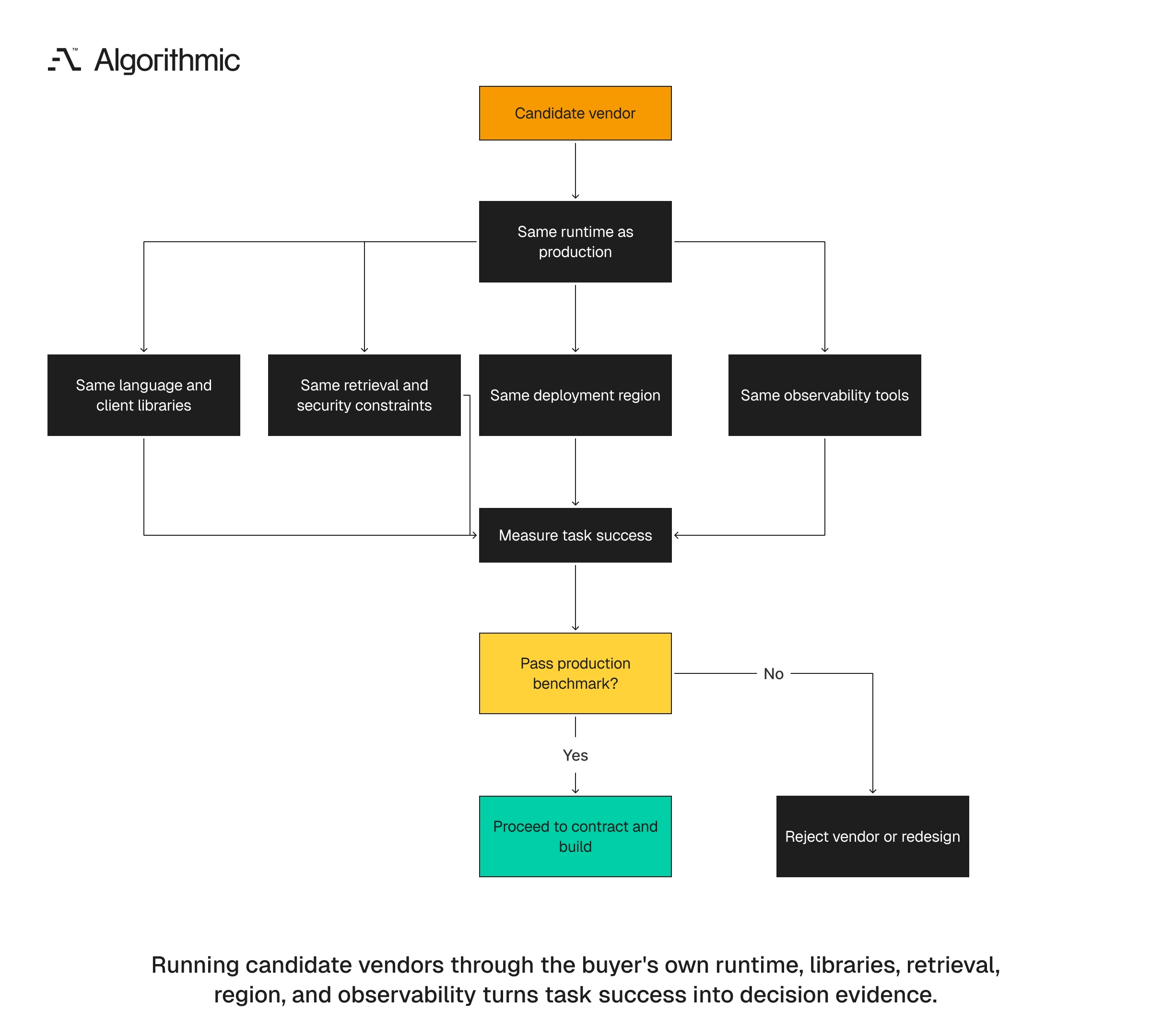
AI vendor selection often overweights demonstration quality, because a vendor controls the demo data, prompt design, latency conditions, and failure visibility while the buyer inherits the production burden after integration. A stronger process benchmarks candidate models and vendors inside the buyer’s own runtime, so the same programming language, client libraries, retrieval layer, security constraints, deployment region, observability tools, and failure-handling code all apply.
 Click to expand
 This diligence matters for CTOs and enterprise AI sponsors because vendor switching costs rise after integration, since prompt templates, evaluation sets, monitoring dashboards, security review, and workflow training become tied to the selected system, so replacing the provider then requires engineering time, procurement review, and user retraining. The buyer’s task is to translate that principle into procurement gates, where a vendor passes the production readiness gate before contract expansion, and the gate precedes architecture lock-in, workflow training, and user-facing commitments. A practical vendor benchmark should include at least two failure scenarios, one that tests provider degradation such as elevated latency or partial outage, and one that tests data ambiguity such as missing documents or conflicting records.
Security review should run in parallel, so the benchmark verifies tenant isolation, logging behavior, data retention terms, and model training settings, because these controls affect production approval as much as task success. A procurement team should also test contractual claims against runtime behavior, so if the vendor advertises regional data residency the logs should show the actual region used during evaluation, and if the vendor promises no training on customer data the contract and admin settings should match that claim. The benchmark should produce an engineering artifact rather than a presentation, one that includes trace exports, prompt versions, model versions, configuration files, failure labels, and cost data, since future teams need this record when the provider changes a model endpoint or pricing tier.
The artifact should include negative results too, because failed prompts, slow traces, malformed outputs, and high-cost paths are useful engineering evidence, and removing them from the record weakens the decision. Vendor comparisons should use identical traffic, since if Vendor A receives 500 easy cases and Vendor B receives 500 mixed cases the benchmark has no decision value, so randomized ordering and shared test sets remove that bias. Contract terms should reflect the measured operating model, because rate limits, data retention, audit rights, support response times, and price protections belong in the commercial discussion, and a model score cannot compensate for weak operating terms.
Failure modes need named tests before launch
Production AI systems fail in repeatable ways, so the release process should name those failures and test them, because unnamed failures become customer incidents. Common failure modes include hallucinated citations, unsafe tool calls, stale retrieval results, prompt injection, schema-invalid output, timeout cascades, over-refusal, under-refusal, tenant data leakage, and confidence miscalibration. Each failure mode needs a test case, an owner, a severity level, and a containment path, which turns vague concern into engineering work. This is also where production readiness reviews earn their place, since they prove how a system fails, recovers, and rolls back before real traffic does.
For a RAG system, hallucinated citations require tests where the correct answer is absent from the corpus, and the expected behavior should be a grounded refusal or a request for more information rather than citing unrelated documents to satisfy the user. For an AI agent with tool access, unsafe tool calls require tests with ambiguous user instructions, conflicting permissions, and malformed tool responses, and the agent should stop, request clarification, or route to human review. Schema-invalid output needs separate tests, because many AI features pass text evaluations and then fail when downstream services expect strict JSON, so output validation should reject malformed fields, unknown enum values, and missing required attributes. Timeout cascades also need testing, since a slow model response can occupy worker threads, exhaust connection pools, and degrade unrelated application paths, so the release gate should test concurrency under provider slowdown.
Tenant data leakage deserves its own test suite, so a multi-tenant application should send requests that reference another tenant’s document names, IDs, and user emails, and the system should reject access and record the event for audit review. Prompt injection also requires realistic payloads, because attack strings buried in PDFs, support tickets, and HTML tables behave differently from direct chat prompts, and the retrieval layer should preserve enough provenance for security teams to diagnose the path. The OWASP Top 10 for LLM applications ranks prompt injection as the top risk precisely because models process instructions and data on the same channel, so untrusted content can override developer intent, and defense in depth with input validation, output filtering, and privilege limits is the recommended response.
The strongest teams treat these tests as regression assets, so every prompt change, model upgrade, embedding migration, and retrieval adjustment runs through the same suite, and a regression failure blocks release until the owner fixes the cause. Confidence miscalibration needs measurement as well, since a system that gives a high-confidence answer with weak evidence increases user trust in wrong output, so the rubric should compare confidence statements against source quality and reviewer labels. Stale retrieval needs a separate test pattern, where the team places an outdated policy and a current policy in the corpus with similar titles and confirms the system retrieves the current version and cites the effective date.
Access-control tests should include realistic identifiers such as tenant names, account numbers, document IDs, and email addresses that resemble production data, because synthetic placeholders often miss parsing and permission-path failures. Failure severity should be explicit too, since a formatting error in an internal draft has a different severity than an unauthorized refund or a false compliance statement, and severity levels guide release decisions and incident response. The test owner should be a named person rather than a group, because “platform team” is too vague during a release week, while a named engineer, product owner, or security lead can close the defect.
Rollback and fallback paths are release requirements
A production AI release needs a rollback path with the same seriousness as a database migration. The team should know how to disable the AI feature, revert to the prior model, route traffic to a rules-based fallback, or require human review. Rollback planning should define four items:
- Trigger: the metric that starts rollback, such as p95 latency above 3 seconds for 15 minutes or harmful output rate above 0.5%.
- Decision owner: the person authorized to stop traffic or revert a model.
- Technical path: the feature flag, deployment command, routing rule, or provider switch.
- User experience: the message, fallback workflow, or escalation path customers will see.
Rollback must be tested, because a runbook that has never been executed is documentation, and operational control requires a successful drill under realistic conditions. This is where AI readiness assessments often expose gaps, since the model is approved, the demo is compelling, and the business sponsor is aligned, yet the system has no tested failure containment path. Fallback paths should match the user workflow, so a support assistant can route to a queue with a clear response-time expectation while a loan decision workflow may need manual review before any customer-facing decision is shown. Teams should also test partial rollback, where a feature stays active for low-risk accounts while regulated segments move to manual review, which requires routing logic, audit logs, and segment-level monitoring.
A mature rollback drill has a stopwatch, so the team starts from a real alert, identifies the owner, executes the change, verifies traffic movement, records customer impact, and ends when monitoring confirms recovery. The drill should include business communication, so customer support has the message customers will hear and account teams have a short explanation for enterprise buyers, especially when the feature affects regulated workflows. Rollback design should cover data side effects too, because if an agent wrote notes, changed a status, or triggered an email, rollback of the model does not reverse those actions, so tool calls need audit records and compensating steps.
Feature flags should be granular, since a single on-off switch is too blunt for a large product, so teams often need separate controls for answer drafting, citation display, tool execution, and automated send. Fallback capacity must be real as well, because routing all failed AI cases to a manual queue does not work if the queue has two analysts and 4,000 daily cases, so the fallback plan should include staffing, response times, and escalation rules. Retry and backoff behavior belongs in the same design, and OpenAI’s production best practices recommend routing every request through your backend, retrying with exponential backoff, validating model output, and logging token and cost data before launch.
A 30-day production readiness assessment before build commitment
A practical AI readiness assessment does not need six months. A focused 30-day process can identify the main production risks before the organization commits to a full build, and it should produce a release decision, not a slide deck. The assessment should have one named workflow, one release gate, one evaluation set, and one runtime benchmark, and it should produce a defect list that engineering can estimate, because scope control makes the work useful. It works because it narrows the decision, so the team does not evaluate every AI use case in the company, only enough evidence to approve, reject, or redesign one production candidate. The assessment should include the people who will own production, so product, engineering, security, operations, finance, and the business sponsor review the same evidence, since separate reviews create conflicting release narratives.
Week 1 defines workflow and success thresholds
The team selects one target workflow and writes pass or fail thresholds for correctness, latency, cost, reliability, drift monitoring, and rollback, including business constraints such as monthly traffic, expected concurrency, gross margin limits, and service-level agreements. The output is a one-page release gate that becomes the basis for vendor selection and architecture decisions, and every later trade-off should trace back to this document. The workflow must be specific, since “customer support automation” is too broad for a 30-day assessment while “draft first response for Tier 1 billing tickets in English for U.S. customers” is a testable workflow. The first week should also identify excluded use cases, so Tier 2 disputes, non-English requests, refunds above a defined dollar limit, and legal threats may move to human review, which protects the evaluation from uncontrolled scope growth.
The thresholds should use business language and engineering language together, so “reduce average handling time by 20%” connects to task success, latency, escalation rate, and cost per completed action, which prevents a model metric from replacing the business case. The team should also define the minimum viable release, so the first release may draft responses without sending them automatically, which reduces risk while preserving measurable productivity value.
Week 2 builds the evaluation set and instrumentation
The team assembles 300 to 1,000 target cases from production-like data, and each case receives expected outcomes, acceptable alternatives, and severity tags, with sensitive data masked or handled under the same controls planned for production. Instrumentation is added before model comparison, including trace IDs, token counts, retrieval timing, model timing, cache hits, tool-call logs, output validation results, and user feedback capture, since without these signals the team cannot explain failures. The evaluation set should include cases from the last 30 to 90 days, because older data may miss current product behavior, policy changes, or customer language, and a small sample should also come from known escalations.
The evaluation data should have ownership, so product owns workflow coverage, engineering owns trace completeness, security owns data handling, and operations owns runbook evidence, which prevents a model score from replacing release diligence. The team should store evaluation cases in a versioned repository, where each case has an ID, source reference, expected outcome, severity, and segment tags, so version control lets the team compare results after prompt and model changes. Instrumentation should use the same trace shape planned for production, so if production will use OpenTelemetry the assessment should emit compatible traces, since assessment-only logging often leaves teams with no path to operate the feature.
Week 3 benchmarks in the target runtime
Candidate models run through the same service path the product will use, so if the product is a TypeScript web application backed by a Go service and Postgres with pgvector, the benchmark should run through that path, since a Python notebook is useful for exploration and inadequate for release evidence. This step often changes the ranking, because a larger model may lead on task success and lose on latency or cost, while a smaller model with quantization, caching, or better retrieval may meet the release gate with lower operating risk. The benchmark should record full traces, so a failed answer shows retrieved documents, prompt version, model version, latency by component, validation result, and final response, which is the evidence engineering teams need to fix the system.
The team should also compare at least one non-LLM baseline, so a rules-based path, search-only workflow, or existing manual queue gives the business a reference point, and the AI system should beat the baseline on the metrics that matter. Benchmark traffic should include concurrency, because a sequence of single-threaded calls misses queueing, connection reuse, rate limits, and cache contention, so the target runtime should see the traffic shape expected at launch. The benchmark should include repeated runs too, since model responses can vary across calls even at low temperature, and repetition reveals variance that a single pass cannot measure.
Week 4 tests failure containment and operating controls
The team runs timeout tests, provider degradation tests, malformed input tests, prompt-injection tests, and rollback drills, and monitoring dashboards are reviewed with engineering, product, security, and the business sponsor, so each group approves the same release evidence. The final output is a go, no-go, or redesign decision that includes cost per completed action, p95 and p99 latency, task success by segment, top five failure modes, and rollback test results, and it should name the next engineering changes. A no-go decision is a useful result when it prevents a failed launch, because the organization can reduce scope, change vendors, adjust retrieval, add human review, or redesign the workflow, and that decision costs less before customer exposure.
The decision record should be short and specific, stating the workflow, thresholds, measured results, release decision, open risks, and owner for each next step, and a four-page record is usually enough for executive review. The final week should include a production support review, so the team confirms alert routes, on-call ownership, customer support scripts, and escalation thresholds, since AI incidents require the same operating discipline as payment or identity incidents. The assessment should end with an engineering backlog, where each defect includes severity, reproduction steps, trace links, and an owner, which turns assessment results into build work.
Senior sponsors should demand production evidence
For CTOs and enterprise AI sponsors, the diligence question is specific. Can this AI system meet business SLAs, unit economics, and operating controls inside the target runtime? The answer requires measured evidence, and benchmark accuracy alone cannot provide it, because the release decision requires production metrics measured against production-like data, using production infrastructure and real workflow constraints. This is engineering diligence, not model selection theater, and technical due diligence already reflects this standard. Material technical risk turns up in a large share of software acquisition reviews, and AI initiatives deserve the same discipline before capital and customer trust are committed, since a failed AI rollout creates product risk, compliance risk, and board-level credibility risk.
The standard should be higher for AI systems that touch regulated decisions, customer money, personal data, or production operations, because in those settings one impressive demo has little evidentiary value, so the system must prove its behavior under the operating conditions it will face. Senior sponsors should ask for the release gate before approving pilot expansion, along with the evaluation set, runtime traces, cost model, failure test results, and rollback drill evidence, so a slide with benchmark accuracy does not pass that review. The governance model should assign ownership by metric, where engineering owns latency, reliability, trace quality, and rollback mechanics, product owns task fit, user adoption, and workflow scope, finance owns unit economics, and security owns data handling and access controls.
At Algorithmic, our production machine learning engineering work uses this standard because senior architects write and operate the code. Across 35+ complex engagements, including platforms serving millions of end users, the pattern is clear, so release confidence comes from measured system behavior. Model reputation is supporting context, production evidence is the approval basis, and the difference becomes visible when teams test the full system under the conditions customers will experience.
Algorithmic runs AI readiness assessments that put a candidate system through a target-runtime gate covering correctness, latency, cost, reliability, drift, and control. Start a conversation if you are about to approve an AI model, vendor, or pilot expansion and want measured production evidence before you commit. Treat the gate as a release control, funded and owned like any other production engineering requirement.