

A 500 GB vector layer is a database. A 30 million document corpus with 768-dimensional float32 embeddings consumes about 92 GB before index overhead, metadata, replicas, logs, and snapshots, and with HNSW, payload storage, and two replicas, the working set often exceeds 500 GB before production traffic arrives. That number changes the engineering problem, because FAISS, ScaNN, HNSWlib, and DiskANN can prove semantic retrieval quality in a week, while production proof requires continuous embedding refreshes, tenant isolation, reindexing, recovery, and a p95 latency SLO of 150 milliseconds under concurrent traffic.
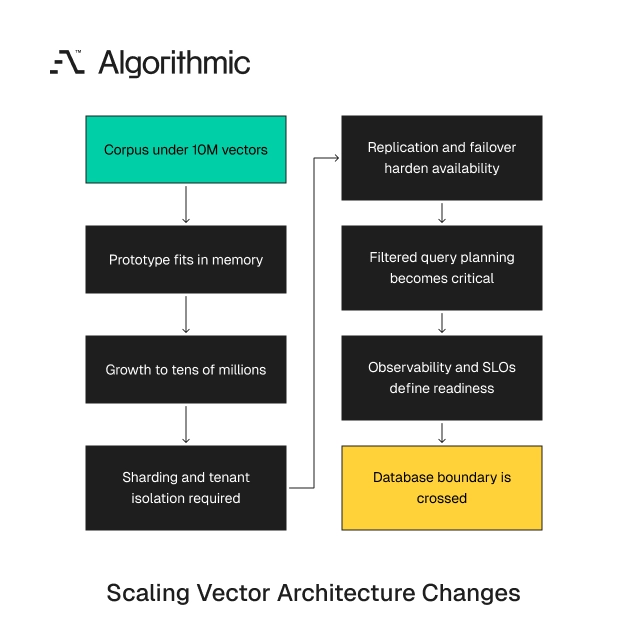
Technical founders building retrieval augmented generation, semantic search, recommendations, or agent memory should treat vector search as stateful infrastructure. Approximate nearest-neighbor search handles the retrieval math, while production architecture keeps the system serving correct results as corpus size, tenant count, and update rate increase. The boundary appears when the first large customer imports data, because a 200,000-document pilot behaves like an index library, while a 40 million chunk corpus behaves like a database with storage pressure, failure modes, permissions, queues, and migration paths.
The failure pattern is consistent across product teams. The prototype works during demos, the first enterprise import stresses ingestion, and the first embedding model migration exposes every missing operating decision. The team then learns that retrieval quality and database reliability were separate workstreams from the start, because search relevance proves that the model can find useful candidates, while database architecture proves that the system can keep finding authorized, current, and recoverable candidates under load.
ANN search handles retrieval math
Approximate nearest-neighbor search reduces the cost of finding vectors close to a query vector, and the main index families are familiar. HNSW supports graph-based search, IVF-PQ supports clustered and compressed search, ScaNN supports partitioned search with quantization, and DiskANN supports large indexes backed by SSDs. Index structures cover ingestion, storage, metadata filters, and distributed search, so benchmarking an index means weighing recall, latency, and memory tradeoffs across HNSW, IVF-PQ, ScaNN, and DiskANN.
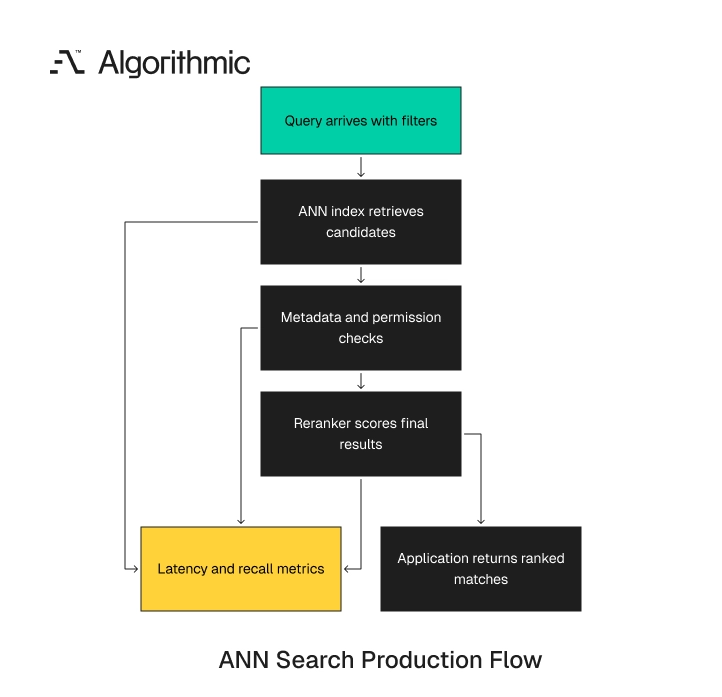
Those tradeoffs still matter, because teams need to understand graph degree, quantization error, probe count, SSD access patterns, and recall curves before choosing an index, and the index choice sets the cost structure for memory, CPU, disk reads, and rebuild time. ANN work stops at candidate retrieval, so a production vector layer must persist writes, replay logs, compact storage, isolate tenants, support deletes, expose query metrics, and recover from node loss, and it must serve queries during index rebuilds, embedding model upgrades, and metadata schema changes.
 Click to expand
 The prototype hides these requirements because the corpus stays static. Production changes the corpus every hour, and each document import, permission change, and embedding model upgrade adds pressure to the architecture. Engineering leaders need a sharper standard, so a vector layer has reached production readiness when the team can explain how a write becomes durable, searchable, authorized, observable, recoverable, and removable, and ANN benchmarks answer only one of those questions.
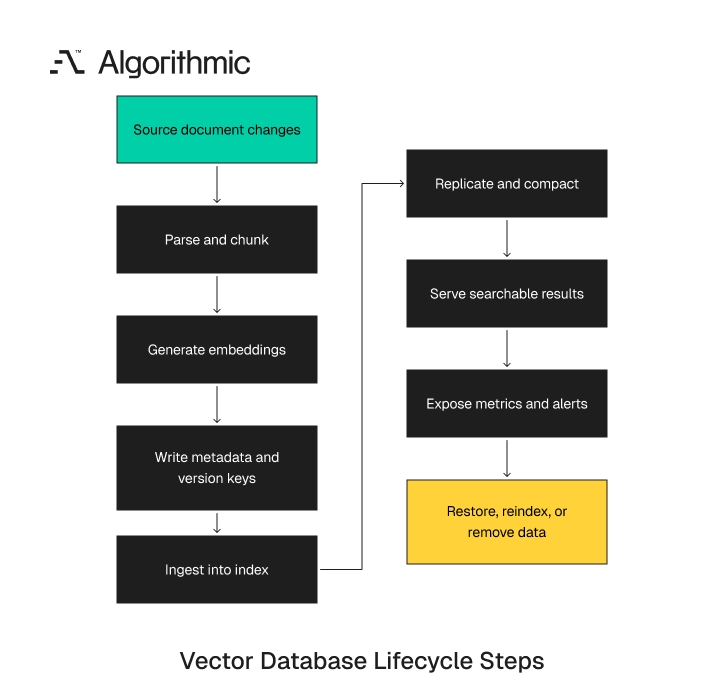
A useful review starts with a single document update. The team should trace the source change through parsing, chunking, embedding, metadata write, index ingestion, replication, and query serving, and if any stage lacks a durable record or an owner, production readiness remains incomplete. This standard applies to managed services as well, because a vendor API can hide index operations from the application team, yet it cannot remove the product team’s responsibility for freshness, permissions, tenant isolation, and customer-facing behavior during failure.
The six architecture responsibilities outside ANN
 Click to expand
 Persistence and crash recovery
Vector data needs durable storage. A prototype can load vectors from local files at startup, while a production system needs write-ahead logging, snapshots, compaction, backup verification, and restore testing. The restore path matters, because a 500 GB index that takes 9 hours to rebuild from object storage violates most search SLOs after a node failure, so recovery time objective should be measured during load tests, using the same instance types, network paths, and storage classes planned for production.
Persistence also affects correctness, because if embeddings, metadata, and source document versions live in separate stores without a shared version key, the system can return mismatched records, so a query can retrieve a vector from one contract revision and metadata from another. That defect is hard to detect with aggregate recall metrics, since the recall score can remain stable while the application shows outdated titles, incorrect permissions, or stale document snippets, so the storage model needs versioned writes across the document, embedding, metadata, and index layers.
A practical design records a source document ID, source version, embedding model ID, chunk ID, and metadata version with every vector. Recovery tests should verify that these fields remain aligned after snapshot restore and log replay, and this verification belongs in automated tests, not incident response. A stronger design treats each vector as a derived record with lineage, so the system shows which source document, parser version, chunking rule, embedding model, and metadata policy produced that vector, because without lineage recovery restores bytes while product correctness remains unproven.
Teams also need a clear record of partial writes. If a 50,000-document import fails after 31,000 chunks, the system should identify committed chunks, failed chunks, queued chunks, and retried chunks, because reprocessing the entire import creates duplicate vectors unless the write path is idempotent. Idempotency requires stable keys, so a key composed from source document ID, source version, chunk ordinal, and embedding model ID prevents duplicate writes during retry, and it also gives operators a direct way to compare the source system with the vector store.
Backup tests need more than a successful restore command. They need validation queries that confirm tenant filters, document metadata, and sample vector scores after recovery, because a restored shard that serves stale permissions has failed even if the process exited with status code zero. Teams should time three separate recovery paths, which are log replay after a process crash, shard restore after disk loss, and regional rebuild after loss of a full cluster or cloud zone.
Each path has a different customer impact. Log replay measured in minutes protects routine restarts. Regional rebuild measured in hours defines what the company can promise after a major infrastructure event.
Incremental updates and deletes
RAG systems rarely have static corpora. Product catalogs change hourly, support articles change daily, and contract repositories receive thousands of document updates after a bulk import. Deletes are harder than inserts in many ANN structures, because HNSW can mark nodes as deleted and those tombstones accumulate until compaction or rebuild, so as the tombstone ratio rises the system spends more work on candidates that cannot be returned.
IVF indexes can accept inserts, then need retraining or repartitioning as the vector distribution shifts. A catalog that adds a new product category can distort the original clusters, so search quality then declines for the new category while latency remains within target. A production design needs a clear update model, and common patterns include append-only segments with background compaction, delta indexes merged with base indexes, and blue-green index builds for embedding model changes, each creating different limits for freshness, cost, and operational risk.
The update model should define maximum queue depth, maximum index age, and maximum delete tombstone ratio, along with the operational action for each threshold, so a tombstone ratio above 20% can trigger compaction during a low-traffic window. Teams should test mixed workloads before launch, so a useful test runs 500 concurrent users, deletes 1% of the corpus, updates 2% of documents, and builds a new segment in the background, and the result should report recall, p95 latency, queue depth, and index freshness.
Update semantics must match the product contract. A legal search product cannot show a deleted document for 24 hours because compaction runs overnight, and a shopping search product cannot rank discontinued inventory because vector refresh lags the product catalog. The write path also needs backpressure, because if embedding generation outruns index ingestion, queues grow and freshness fails, and if indexing outruns metadata writes, queries return vectors that fail document lookup, so the system needs separate metrics for each stage.
Freshness should be measured from source change to searchable result. A timestamp from the indexing job alone hides parser backlog, embedding provider throttling, and metadata write delays, so product SLOs should use the source-system event time. Deletes need a two-layer policy, where the serving path stops returning deleted documents within the freshness SLO, while the storage path removes or compacts the underlying vector according to retention, audit, and cost requirements.
This distinction matters for regulated data. A customer deletion request can require immediate serving suppression and later physical removal after audit logging, so the architecture should record both events and expose their status to operators. High-update systems also need capacity reserved for maintenance, because if live writes consume every indexing worker, compaction never catches up, and after several weeks tombstones, small segments, and stale partitions increase tail latency.
A practical capacity rule reserves a fixed share of indexing throughput for background maintenance. For example, a marketplace with 10 million daily vector updates can reserve 20% of indexing workers for compaction and segment merge. The exact number should come from load tests, not from default cluster settings.
Sharding and tenant isolation
At tens of millions of vectors, one node becomes a risk boundary. Sharding spreads storage and query load across machines, and the shard key determines both performance and operational complexity. Tenant-based sharding works well when tenants are large and isolated, because it limits query fan-out and reduces the blast radius of heavy customer imports, yet it also creates imbalance when the largest tenant has 100 times the documents of the median tenant.
Hash-based sharding gives even distribution, although it requires fan-out queries across shards, so a query must reach every participating shard, merge candidates, apply filters, and return a ranked result, and fan-out increases tail latency because the slowest shard controls the response. Semantic or category-based sharding can reduce query scope, but it also damages recall when query intent crosses categories, since a support search for “refund after delayed shipment” can touch billing, logistics, and customer policy content in one query.
Multi-tenant systems need quota enforcement. A single tenant that triggers a 10 million vector reindex should not consume all indexing workers or cache space, so quotas should cover write throughput, background indexing capacity, storage, and query concurrency. Tenant isolation also includes permissions, so the query planner must apply access-control filters before returning results to the application, because a result from the wrong workspace is a security defect even when the vector score is high.
A mature sharding plan also defines tenant movement. A customer can grow from 50,000 chunks to 20 million chunks after one data warehouse or document management import, so the system needs a way to split, move, or dedicate shards without breaking document IDs and permissions. Noisy-neighbor tests should be part of launch readiness, so run a 5 million vector import for one tenant while ten smaller tenants execute normal searches, and the result should show whether p99 latency, indexing freshness, and error rate remain within each tenant’s contract.
Shard maps need version control. The query service should know which shard owns each tenant or partition and record when that mapping changed, because during incident response operators need to answer which customers lived on the affected shard at the affected time. Tenant movement also needs a dual-write or catch-up strategy, because when a tenant moves from shared shards to dedicated shards new writes arrive during the copy, so the migration plan must reconcile those writes before traffic shifts.
Large tenants deserve separate capacity reviews. A customer with 40 million chunks, strict permissions, and heavy daily imports has different economics from 400 customers with 100,000 chunks each, so pricing, SLOs, and shard placement should reflect that difference. Engineering teams should avoid treating tenant isolation as an application-only concern, because the vector layer, metadata store, cache, queue, and embedding pipeline all need tenant boundaries, and one missing boundary can turn a single customer migration into a platform incident.
Replication and serving continuity
Replication supports availability and read throughput, and it also creates consistency decisions. Synchronous replication gives stronger write durability with higher write latency, while asynchronous replication improves write speed but lets stale replicas return outdated retrieval results, so for many RAG products a 30-second freshness delay is acceptable when the product contract states that boundary. Fraud detection and compliance search need stricter freshness, because a newly added restricted document should be searchable under the correct permission model within the stated SLO, and a deleted document should stop appearing in retrieval results within the same boundary.
The replication model should be explicit. Teams should define read-after-write expectations, replica lag limits, and the exact behavior when one shard replica falls behind, and these decisions should appear in product requirements and operational runbooks. A mature design separates durability, visibility, and serving, so a write can be durable in the log, visible in the metadata store, and searchable after index ingestion completes, and each stage needs metrics because each stage can fail independently.
Failover also needs testing under traffic. Kill a replica during a mixed read-write benchmark and measure p95, p99, error rate, and recall, because a failover plan that works only during maintenance windows does not protect production users. Serving continuity includes degraded modes, so if one shard is unavailable the system should define whether it returns partial results, fails closed, retries, or routes to a stale replica, and each choice affects trust, cost, and security differently.
The product team should own those choices. Engineers can implement failover behavior, while product leaders must decide how the user experience behaves under loss, because search infrastructure decisions become customer-facing decisions during incidents. Replication also affects cost in less visible ways, since two replicas can double storage, indexing work, and background compaction, and during a blue-green migration overlap between old and new indexes can raise temporary capacity by four times.
The team should plan that temporary capacity before the migration begins. If the cluster runs at 70% memory before reindexing, a second index can trigger paging or eviction, and those events show up as p99 latency spikes during customer traffic. Replica lag metrics should be tenant-aware, because a global lag number can look healthy while one large tenant remains minutes behind after a bulk import, so customer support needs per-tenant freshness when responding to search complaints.
Serving continuity should include read-only modes. During an embedding provider outage, the system can keep serving the last good index while delaying new writes. This mode needs clear product messaging and a queue limit that prevents uncontrolled backlog.
Query planning with filters
Production semantic search rarely asks for nearest vectors across the full corpus. It asks for nearest vectors within tenant A, document type B, permission group C, and timestamp range D. Filtered ANN search is a distinct systems problem, because pre-filtering can reduce recall when the candidate set becomes too small, while post-filtering can waste compute when most candidates fail metadata checks.
Hybrid query planners choose between exact search, filtered ANN, and partition pruning based on selectivity. A tenant filter that selects 80% of the corpus needs a different plan from a permission filter that selects 0.2%, so the planner should use statistics instead of hard-coded assumptions. Metadata cardinality drives this choice, because a boolean flag has different performance behavior from a user permission list with millions of possible values, and timestamp filters also change query shape, especially when users search recent documents.
The research literature is moving quickly here. Filtered Approximate Nearest Neighbor Search in Vector Databases provides useful system design material for compound filters and performance analysis, so teams building regulated search should read this class of work before committing to an index plan. Production tests should include the filters customers use, because a benchmark that searches the full corpus without permissions gives a false latency number, so access-control filtering belongs in every retrieval benchmark for multi-tenant applications.
Query planning also needs statistics refresh. If a customer uploads 2 million documents into one workspace, yesterday’s selectivity estimates become stale, and the planner can choose an expensive fan-out path when a partitioned plan would have met the SLO. The safest benchmark includes hostile filters, so test common tenants, large tenants, small tenants, empty permission groups, large permission groups, recent timestamp windows, and broad timestamp windows, because these combinations expose the tail latency that average-case benchmarks hide.
Access-control models need special treatment. Workspace membership, document ACLs, group inheritance, and time-limited sharing produce different filter shapes, so the query planner should represent those shapes directly instead of forcing all permissions into one metadata field. A permission list with 5 values behaves differently from a list with 50,000 values, because large lists increase serialization cost and planner complexity before the vector search begins, so teams should measure filter construction time, not only index query time.
Filter correctness needs adversarial tests. Create two users with overlapping group memberships, remove one permission, and run identical searches before and after the change, and the removed user should receive zero restricted results within the freshness SLO. Caching adds another failure mode, because cached query results must include permission state, tenant ID, metadata version, and index version in the cache key, since a cache that ignores any of those fields can return unauthorized or stale results.
Observability and latency SLOs
A vector database needs more than CPU, memory, and disk charts. It needs recall sampling, index freshness, queue depth, shard fan-out, filter selectivity, replica lag, tombstone ratio, and p50/p95/p99 latency by tenant. Latency must be split by stage, covering embedding call, query planning, shard search, metadata fetch, reranking, and response serialization, because a 900 millisecond RAG retrieval path can hide a 40 millisecond vector search issue behind a 600 millisecond LLM call during early tests, and that masking disappears when the product adds concurrency.
Stage-level tracing gives engineers a reliable operating picture. A p95 spike from metadata fetch needs a different fix from a p95 spike caused by shard fan-out, and aggregate latency hides the queue or shard that needs work. Recall monitoring also needs structure, so sample 10,000 representative queries, compare results with brute-force search on a controlled subset, and track recall@10 after each index change, because this practice catches quality regressions before customers report weaker search results.
Dashboards should include tenant-level cuts. A system can meet global p95 while one large tenant experiences repeated p99 spikes, so executive reporting should show global health and the worst affected tenant cohort. Observability should also include correctness checks, because permission leakage tests, deleted-document probes, stale-version probes, and empty-result probes catch failures that latency dashboards miss, since a search system that responds in 80 milliseconds with unauthorized content has failed.
Runbooks need the same structure as dashboards. For each alert, the team should know the likely cause, first check, rollback path, and customer impact, and if the runbook says “investigate”, the production gate has not been met. Metrics should carry index version and embedding model ID, because without those fields quality changes become hard to connect to model deployments or index parameter changes, so a recall drop after a quantization change should show up in the same dashboard as deployment history.
Logs should include source IDs and chunk IDs for sampled queries. This record allows support and engineering teams to reproduce customer complaints, and it also helps the team distinguish poor retrieval from poor answer generation in RAG products. Cost metrics belong beside performance metrics, so track cost per 1,000 searches, cost per million stored vectors, and cost per million embedded chunks, because these numbers expose architecture choices that look acceptable in latency dashboards and fail in gross margin analysis.
Production failures start during refresh, reindexing, and tenant growth
The prototype usually fails at a predictable point, when embeddings need to be refreshed while queries keep running. Consider a SaaS company with 12,000 customer workspaces and 40 million document chunks, where the first embedding model produced 768-dimensional vectors, and six months later the team moves to a 1,024-dimensional model for better retrieval quality.
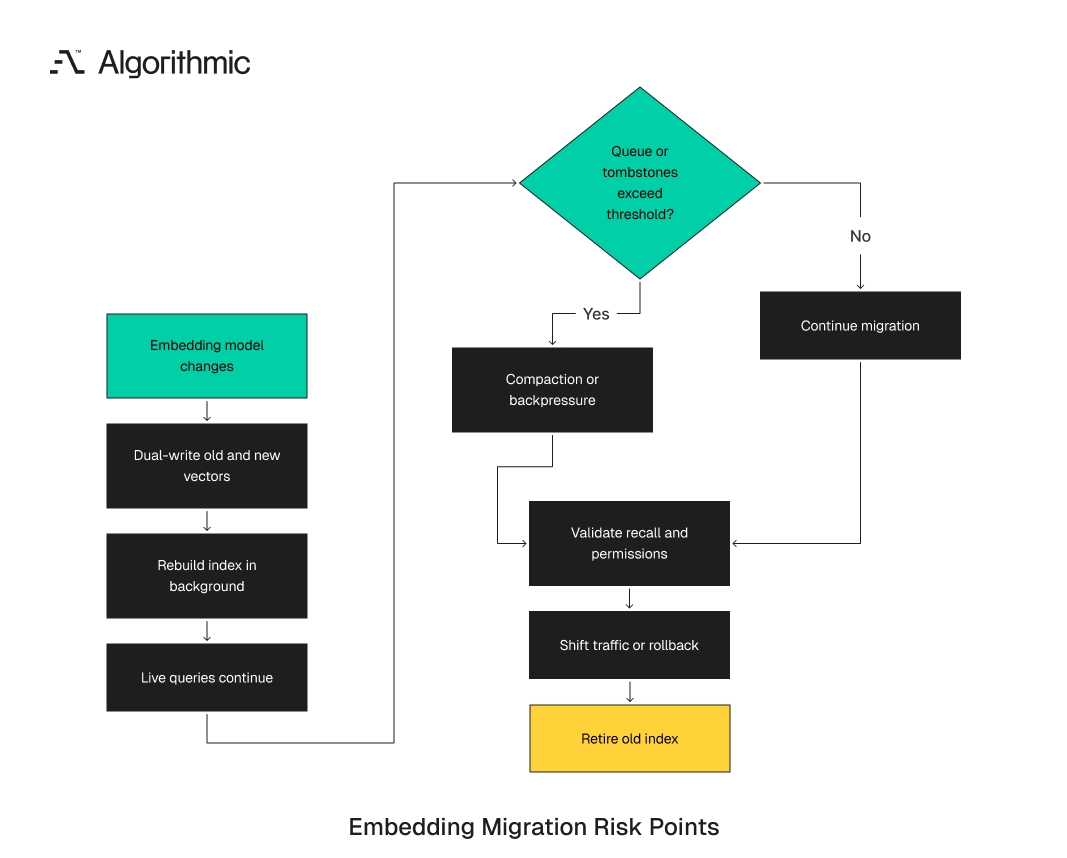
The migration requires re-embedding 40 million chunks, writing a new index, validating recall, and switching traffic without losing access-control correctness, and it also requires enough capacity to absorb live document changes during the migration. At 150 embeddings per second the refresh takes more than 74 hours before indexing, and at 1,500 embeddings per second it still takes more than 7 hours and can saturate downstream storage, so if the indexing queue shares resources with live writes, customer document updates fall behind.
Relevance drift appears next, because new documents use the new embedding model while old documents remain on the old one, so similarity scores lose meaning across the mixed vector space. Rerankers can mask part of the issue for top results, yet ranking quality still declines until the corpus uses one consistent embedding model, so a mixed-space index should have a planned lifetime measured in hours.
Infrastructure cost then becomes difficult to unwind. A high-memory graph index can meet a 50 millisecond p95 SLO on 5 million vectors, while at 100 million vectors the same design can require dozens of memory-heavy nodes. A disk-based design, quantization, or hybrid lexical-vector retrieval would have changed the cost curve earlier, and the migration becomes harder after application code assumes one index type, one score interpretation, and one query path, so the lowest-cost time to make the architecture decision is before the corpus crosses the first large import.
The same pattern appears with tenant growth. A single enterprise customer can add more vectors than all pilot customers combined, so if the shard plan, quotas, and ingestion queues were built for pilots, the first enterprise import becomes an incident. The migration plan should exist before the model change starts, and it should state which tenants move first, how recall will be measured, how traffic shifts, how rollback works, and how long mixed embedding versions can coexist, because without that plan the team turns a model upgrade into a production reliability event.
 Click to expand
 A sound migration also sets an intake freeze policy. Some products can pause bulk imports for 24 hours during reindexing, while other products must accept live imports and mirror them into both old and new indexes. This decision belongs in the product plan, so if enterprise customers expect continuous ingestion, the platform must support catch-up queues and dual writes, and if the company accepts a scheduled maintenance window, customer success needs exact timing and customer-level impact.
The team should also budget evaluation time. Re-embedding 40 million chunks is only the first step, because the team still needs to compare recall, score distributions, latency, cost, and permission correctness before traffic moves. Score distribution changes deserve special attention, since a threshold that worked with cosine similarity on 768-dimensional vectors can fail after moving to another model, so any application rule tied to vector scores should be retested during migration.
Architecture choices that matter at tens of millions of vectors
 Click to expand
 Use zero-copy APIs and columnar execution where data movement dominates
At production scale, data movement becomes a first-order cost, because systems that serialize large vector batches through repeated protocol hops add latency and operational failure points. During vendor or partner evaluation, engineering leaders should inspect the data path, since zero-copy or memory-sharing APIs reduce serialization overhead, and columnar and vectorized execution help batch distance calculations, metadata filtering, and reranking.
Apache Arrow, Parquet, DuckDB-style vectorized execution, and columnar storage patterns reduce transformation work, and they also give teams a cleaner boundary between analytical data, embeddings, and serving indexes, which matters during migrations and incident response. A recommended path that depends on exporting CSVs, loading side files, or moving embeddings across three services before search is a warning sign, because fewer copies between document store, embedding pipeline, index builder, and query path make the system easier to operate.
The inspection should include failure behavior. If an embedding batch fails halfway through a transfer, the system should identify the committed records, retry the failed records, and preserve version alignment, because partial ingestion failures are routine in production pipelines. Data movement also affects cost accounting, since copying vectors between object storage, queue systems, compute workers, and serving nodes can turn a model refresh into a storage and network event that rarely appears in a narrow ANN benchmark.
A strong architecture minimizes format conversion. Source text, chunk metadata, embedding arrays, index files, and evaluation datasets should have named owners and stable contracts, because each extra conversion step adds another place for version drift. Columnar storage also improves auditability, so teams can sample vectors, metadata, and source IDs without running the serving path, and during an incident this separation helps engineers determine whether the issue sits in source ingestion, embedding generation, indexing, or query serving.
Batch boundaries should be explicit. A batch of 10,000 chunks should have a batch ID, input count, output count, failure count, and commit status, because those fields turn ingestion from a black box into an auditable pipeline. The same rule applies to evaluation data, since if the benchmark dataset lives as an unversioned script output, later index changes become difficult to compare, so store evaluation queries, expected sources, and corpus snapshots with stable identifiers.
Benchmark compound queries instead of isolated nearest-neighbor calls
Single-query ANN benchmarks give a narrow view. BigVectorBench argues that heterogeneous data embeddings and compound queries are essential for evaluating vector databases, because production workloads combine vector similarity with structured constraints. A realistic benchmark should include tenant filters, access-control filters, time filters, deletes, inserts, and concurrent background indexing, and it should also measure recall under those conditions using production-like metadata skew instead of uniform synthetic labels.
The benchmark needs a fixed SLO, such as p95 under 150 milliseconds, p99 under 400 milliseconds, recall@10 above 0.92 against an exact-search sample, 500 concurrent users, 2% of corpus updated daily, and replica lag under 60 seconds. The test should run long enough to expose compaction and queue behavior, because a 10-minute benchmark mostly measures warm-cache query performance, while a 12-hour run shows index freshness, segment growth, tombstones, and tail latency during background work.
Teams should record cost during the same benchmark. Report node type, memory, SSD class, replica count, storage cost, and cost per 1,000 searches, because a latency result without cost context does not support an architecture decision. The benchmark should also report failure behavior, so restart a node, inject replica lag, pause one indexing worker, and run a permission-heavy query set, because these tests show whether the architecture degrades in a controlled way.
Vendor evaluations need the same discipline. Ask for benchmark output against your query mix, metadata distribution, corpus size, and update pattern, because a public leaderboard result on a static corpus does not answer production readiness questions. Benchmark design should include warm-up rules, so declare how many queries run before measurement, which caches remain warm, and which caches are cleared between runs, because hidden cache assumptions often explain why a lab result fails under customer traffic.
The query set should include long-tail cases. Rare product codes, customer-specific terminology, legal clause names, and misspellings expose different retrieval behavior from broad semantic queries, so a benchmark composed of common questions overstates production quality. The output should be a decision record, not a slide, so store raw measurements, configuration files, index parameters, corpus snapshot IDs, and test scripts, because six months later that record becomes the reference point for model migration or vendor comparison.
Select index structures from workload shape
HNSW is a strong default for low-latency in-memory search with high recall, but it can become expensive when memory grows faster than revenue, and the graph overhead also affects rebuild time and operational recovery. IVF-PQ reduces memory through clustering and product quantization, yet it introduces training steps and accuracy tradeoffs that must be tested against real queries, and query distribution drift can force retraining when the corpus changes materially.
DiskANN-style designs reduce RAM pressure by using SSDs, but they require careful attention to I/O patterns, prefetching, and tail latency, and SSD performance varies by instance family, cloud provider, and background write pressure. The index choice should follow corpus size, update rate, metadata filter selectivity, recall target, and cost per 1,000 searches, because popularity is a weak selection rule, and a team serving 5 million mostly static documents has a different problem from a marketplace updating 10 million product vectors daily.
Hybrid retrieval deserves early consideration. BM25 or SPLADE-style lexical retrieval can handle exact terms, codes, product names, and rare entities, vector retrieval can handle semantic similarity and paraphrase, and a reranker can merge these signals into a stronger final ranking. Index choice also affects organizational work, because HNSW-heavy designs demand memory planning and rebuild discipline, quantized designs demand evaluation discipline since compression changes recall, and disk-backed designs demand I/O engineering and p99 latency analysis.
A serious selection process includes rollback cost. If the application assumes one score range, one index API, and one metadata filtering model, switching index types becomes a product migration, so abstracting the query layer early gives the team room to change the serving engine later. Teams should test index behavior under deletes, because some index structures handle insertion well and accumulate deletion debt, so a search product with daily churn needs measured tombstone growth, compaction time, and post-compaction recall.
They should also test index behavior under skew. A support corpus can contain many near-duplicate articles, while a product catalog contains many short descriptions, and these distributions affect graph construction, quantization error, and reranker load. The right index choice usually changes with scale, because a memory-heavy HNSW design can be correct for the first 5 million vectors and too expensive at 100 million, so architecture reviews at volume milestones keep that shift visible before it becomes a crisis.
A production readiness matrix for vector database architecture
| Dimension | Prototype threshold | Production threshold | Evidence to request |
|---|---|---|---|
| Corpus size | 50,000 to 1 million vectors | 10 million to 1 billion vectors | Load test with full metadata and replicas |
| Update rate | Manual reloads | Continuous inserts, updates, deletes | Queue depth, compaction time, delete handling |
| Freshness | Batch refresh | Defined freshness SLO, such as under 60 seconds | Replica lag and index freshness metrics |
| Tenancy | Single tenant or shared demo data | Hard tenant isolation and quotas | Shard plan, access-control tests, noisy-neighbor tests |
| Latency | Average response time | p95 and p99 under concurrency | Stage-level tracing and percentile dashboards |
| Recovery | Restart from local files | Tested restore and failover | Recovery time objective and recovery point objective results |
| Reindexing | Offline rebuild | Online rebuild with traffic shift | Blue-green index runbook and rollback test |
| Cost | Developer machine | Cost per 1,000 searches and per 1 million vectors | Node sizing, storage class, replica count |
Complete this matrix before the system becomes customer-facing. Gaps in the right column represent architecture work, and treating them as tuning tasks creates production risk. The matrix gives executives a clear review format, where each row needs evidence from a test, metric, runbook, or cost model, so a verbal assurance from the engineering team should not satisfy a production gate.
For a seed-stage product, the threshold can be lower if customer data volume stays small, but the decision should still be explicit, so a team can accept a 4-hour restore time for a pilot as long as the customer contract and incident plan reflect that limit. The matrix also prevents category errors during planning, because a recall experiment, a cost model, and a failover test answer different questions, and teams create risk when they use one successful benchmark to justify every production decision.
The strongest teams keep this matrix current after launch. Review it after each large customer import, embedding model change, index parameter change, and vendor upgrade, because vector infrastructure shifts as data volume and product contracts change. The matrix should have named owners, so engineering owns the evidence, product owns the customer-facing tradeoffs, finance owns unit cost assumptions, and security owns permission tests and data retention requirements.
A missing owner is a launch risk. If no team owns reindexing, the first embedding migration will become an emergency project, and if no team owns cost per search, gross margin erosion will surface after invoices arrive. The matrix also supports board-level reporting, so a CTO can show which rows have passed, which rows carry accepted risk, and which rows block launch, which turns search readiness into an operating decision instead of a technical debate.
Build, buy, or harden as the decision framework
A managed vector database is appropriate when the team needs production search within 30 to 60 days, has standard tenancy needs, and can accept vendor-specific APIs. Pinecone, Weaviate Cloud, Zilliz Cloud for Milvus, Qdrant Cloud, and managed PostgreSQL with pgvector each fit different workload sizes and operating models. Managed services reduce the burden of replication, upgrades, backups, and operational monitoring, yet they still require architecture ownership from the product team, which remains accountable for data modeling, permissions, query quality, cost control, and application-level SLOs.
Self-hosted open-source infrastructure is appropriate when data residency, cost control, or deployment topology requires direct ownership. Milvus, Qdrant, Weaviate, Vespa, OpenSearch vector search, and pgvector all require staff who can operate storage, compute, upgrades, monitoring, and incident response. Self-hosting also changes the hiring plan, because the team needs engineers who understand distributed storage, observability, on-call response, and performance testing, and a single backend engineer maintaining a vector cluster while shipping application features becomes a bottleneck.
A custom vector layer is justified when retrieval is part of the product’s technical differentiation. Examples include real-time recommendation systems, high-volume marketplace search, regulated document retrieval with complex permissions, and low-latency retrieval embedded inside a larger ML inference path. Custom systems need a longer investment horizon, because the team must fund index design, data migration, benchmarking, SRE practices, and internal tooling, and the payoff comes from lower unit cost, specialized query behavior, or tighter integration with the product’s inference path.
Across 35+ complex engineering engagements, the decisive factor has been operational ownership. A team with two backend engineers and no production search experience should not build distributed vector storage from scratch, while a team with senior distributed systems engineers, clear cost pressure, and specialized query patterns can justify deeper ownership. The decision should be revisited at volume milestones, so review the architecture at 1 million, 10 million, and 100 million vectors, because each milestone changes memory pressure, reindexing time, backup size, and tail-latency behavior.
Managed service contracts also deserve technical review. Confirm export paths, backup access, tenant isolation model, filter semantics, index parameter control, and failure reporting, because a service that hides every operating detail can also hide the cause of a customer incident. Self-hosted and custom paths need named ownership before launch, so the owner controls the roadmap for capacity planning, upgrades, testing, and incident response, because vector storage without an owner becomes shared infrastructure that no team has time to improve.
The decision should include exit cost. Managed services reduce operational work at launch, and they can increase migration work later, so export tests, API abstraction, and source-of-truth ownership keep the company from depending on a single serving engine. Self-hosted systems require a realistic on-call model, because if the team cannot provide 24-hour incident response for search, it should not promise search as a critical customer path, since a weekend outage in retrieval can stop a RAG product as completely as an application database outage.
Custom builds require product-level justification. Engineering pride does not justify a custom vector database. Lower unit cost, strict latency, specialized filtering, or regulated deployment requirements can.
A 30-day hardening plan before production traffic
Days 1 to 7 define SLOs and failure modes
Set explicit targets for p95 latency, p99 latency, recall@k, freshness, recovery time, and recovery point, tie each target to a product scenario, and do this work before expanding the corpus. A RAG assistant for internal policy search can accept 2-minute freshness and 300 millisecond retrieval latency, while a customer-facing marketplace search product can require sub-100 millisecond retrieval and near-real-time inventory updates.
Define failure modes in the same week. Include node loss, index corruption, embedding provider outage, permission filter failure, slow metadata fetch, and delayed background indexing, and each failure mode needs a detection signal and an owner. The team should also define correctness boundaries, because retrieval quality, permission enforcement, document version alignment, and deletion behavior belong in the same production plan, since search that returns restricted or stale content creates product and legal risk.
The output of week one should be a written SLO and failure-mode document. It should include alert thresholds, escalation paths, and customer-visible behavior, and this document becomes the contract for benchmark design in week two. The document should include accepted risk, so a pilot customer can accept a 4-hour restore time if the contract says so, while an enterprise compliance search product should not accept that same recovery profile.
SLOs should distinguish retrieval latency from full answer latency. A RAG assistant can spend 150 milliseconds on retrieval and 2 seconds on generation, and combining those numbers hides the component that needs engineering work. Failure modes should include external dependencies, because embedding APIs, object storage, identity providers, and metadata databases can all stop retrieval from serving correct results, so the vector layer’s runbook should name each dependency and its fallback behavior.
Days 8 to 15 benchmark with production-like data
Use real document lengths, real metadata filters, and real tenant distributions, because synthetic uniform data hides the skew that drives production incidents, since customer data rarely distributes evenly across tenants, document types, and permission groups. Run tests with concurrent reads, continuous writes, deletes, and background reindexing, track recall against a brute-force sample for at least 10,000 representative queries, and include common queries, rare-entity queries, and long-tail permission combinations.
Measure both cold and warm behavior. Restart a node, clear caches where appropriate, and record the first 30 minutes of service behavior, because customers experience those windows after failures and deployments. The benchmark should produce a decision record that includes configuration, index parameters, hardware, corpus size, query mix, latency percentiles, recall, cost, and failure notes, because future migrations will need that baseline.
The decision record should include rejected options. If the team chooses HNSW over IVF-PQ, record the memory cost, recall result, rebuild time, and expected growth limit, because six months later that record will explain why the architecture reached its next constraint. Benchmarks should also cover permission-heavy queries, so use users with one permission group, 50 groups, and thousands of document-level grants, because these cases stress both filter construction and index search.
The benchmark should model tenant imports. Run a bulk import while existing tenants search, update, and delete documents, and measure the import tenant and the unaffected tenants separately. Teams should store benchmark data for comparison, so keep the corpus snapshot ID, source documents, generated embeddings, and query set, because without repeatability each benchmark becomes a one-time argument.
Days 16 to 23 prove recovery and migration paths
Kill nodes during query load, restore from snapshots, rebuild one shard, and run a blue-green index migration with two embedding versions. Document the runbooks, so an incident response runbook includes owner, detection signal, customer impact, rollback step, and verification query, along with the command or dashboard link used for each step.
Test restore from a clean environment, not the same machine that created the snapshot. A backup plan that depends on local state fails during real infrastructure loss, so recovery should prove that logs, object storage, metadata, and index files can rebuild a serving shard. Run one permission-focused migration test, reindex a subset of restricted documents, shift traffic to the new index, and verify that unauthorized users receive zero restricted results, because this test catches integration gaps between the index and access-control system.
Migration tests should include live writes. During the blue-green build, create, update, and delete documents in the source system, and the cutover plan must explain how those changes reach the new index without duplicates or gaps. Rollback needs the same proof as cutover, so if the new index loses recall or violates latency, the team shifts traffic back and verifies document freshness, because a rollback plan that has never been executed is an assumption.
Recovery tests should record elapsed time and lost writes. RTO and RPO should come from measured runs, not from architecture diagrams, and the run should include the largest shard size planned for launch. Migration tests should also include score-threshold validation, so if the product filters results below a score threshold, compare acceptance rates between the old and new embedding models, because a threshold mismatch can remove useful results or admit poor ones.
The team should rehearse customer communication. If search freshness falls behind during migration, support should know which customers are affected and which dashboard proves recovery. Technical recovery and customer trust move together during incidents.
Days 24 to 30 instrument cost and correctness
Add dashboards for query latency by stage, index freshness, queue depth, tombstone ratio, shard errors, replica lag, and cost per 1,000 searches, and add offline evaluation for retrieval quality after each model or index change. Correctness checks should include permission leakage tests, because a vector result that violates access control is a security defect regardless of recall score, and deletion tests should verify that removed documents disappear from both vector results and metadata fetches within the freshness SLO.
Cost instrumentation should separate indexing and serving. Background embedding refreshes, compaction jobs, and blue-green builds can double infrastructure use during migrations, so finance and engineering should see that cost before the migration begins. End the 30 days with a production gate that lists open risks, accepted risks, launch blockers, and the next review date, because search infrastructure should enter production with the same discipline applied to payments, authentication, and customer data storage.
The production gate should have authority. If restore has not been tested, if permissions have not been benchmarked, or if p99 latency is unknown, launch should wait, because a search feature that cannot be operated will become a customer trust problem. After launch, keep the same operating cadence, so review dashboards weekly for the first month, then after every material corpus or model change, because vector infrastructure requires active stewardship as the data distribution keeps changing.
Cost dashboards should show temporary migration cost. A blue-green index build can double serving storage, increase embedding spend, and raise network transfer charges, so those costs should be approved before the run starts. Correctness dashboards should show failing examples, not only counts, because engineers need source ID, tenant ID, user ID, index version, and permission version for each failed probe, since a count of three permission failures is insufficient for response.
The final gate should include a named production owner. That person owns capacity reviews, incident response, vendor communication, and reindex planning. Shared responsibility without a named owner fails during urgent migrations.
Vendor evaluation questions that expose production risk
Vendor selection should start with operating questions, not feature lists. Ask how writes become durable, how deletes leave the index, how replicas fall behind, and how restores work, because a strong vendor can answer with diagrams, metrics, and failure-mode examples. Ask for filter behavior under your access-control model, because role-based access, workspace membership, document ACLs, and time-bound permissions create different query plans, so the vendor should explain whether filters are applied before ANN, during candidate generation, after candidate generation, or through partition pruning.
Ask how index rebuilds work during traffic. The answer should cover build isolation, validation, traffic shifting, rollback, and cost during overlap, because if a model migration doubles storage and compute for 48 hours, that expense belongs in the launch plan. Ask for export guarantees as well, so your team knows how to retrieve vectors, metadata, source IDs, and index files if you leave the service, because vendor lock-in is manageable when exit paths are tested and documented.
Request tenant isolation details. The service should define quotas, noisy-neighbor protections, per-tenant metrics, and support boundaries for large imports, because a shared cluster without tenant controls turns one customer’s migration into another customer’s outage. Ask for incident data too, since mature providers can describe common failure modes, recovery time ranges, and mitigation steps, and marketing claims matter less than the provider’s ability to explain what happens at 2 a.m. during replica loss.
Ask how support works during a customer incident. The answer should name escalation paths, severity levels, expected response times, and the telemetry shared with your team, because search incidents need evidence, not status-page language. Ask what metrics are available by tenant, because per-tenant latency, freshness, queue depth, and storage use help your team manage enterprise accounts, while global metrics alone hide customer-specific failures.
Confirm how index parameters are controlled. Some services expose graph degree, efSearch, quantization settings, and compaction controls, while others abstract them away, and both models can work if the team understands the tradeoff. Ask how the vendor handles regulated data, because data residency, encryption, backup retention, audit logs, and deletion certification matter for legal and healthcare customers, so these questions should be answered before procurement, not during security review.
Engineering standards for application teams
Application teams also need discipline around the vector layer. Retrieval code should not scatter index-specific assumptions across handlers, jobs, and prompts, so a query service boundary should own retrieval parameters, filters, score normalization, and result shaping. The application should store source IDs and version IDs separately from vector IDs, because vector IDs change during reindexing and model migrations, while source identity should remain stable across index implementations.
Prompt construction should include document version and permission context where appropriate. This gives downstream logs enough information to investigate stale or unauthorized answers, and RAG debugging becomes much faster when every answer can be traced to exact retrieved chunks. Evaluation datasets should live next to product requirements, because a collection of 200 handpicked questions is useful for early development yet too small for production change control, so a serious retrieval gate needs thousands of queries across tenants, document types, and permission groups.
Application teams should treat score thresholds with caution. A threshold tuned for one embedding model does not transfer cleanly to a new model or quantized index, so store retrieval decisions in configuration and test them during every model migration. The product should expose safe failure behavior, so if retrieval freshness exceeds the SLO the assistant can say that documents are still indexing, and if permissions cannot be verified the system should fail closed, because silent failure creates more risk than an explicit service state.
The query service should own reranking as well. Reranker model changes alter latency, cost, and result order, so those changes need the same evaluation discipline as index changes. Application logs should connect user answers to retrieval events, so store query ID, retrieved source IDs, chunk versions, index version, and reranker version for sampled requests, because this record supports debugging, audit, and customer support.
Teams should avoid embedding business rules inside prompts. Permission checks, tenant filters, and deletion rules belong in the retrieval layer and metadata store, because a prompt cannot provide a security boundary. Feature teams should treat vector search as a dependency with contracts, so the contract defines latency, freshness, error behavior, result shape, and versioning, which keeps product code stable when the underlying serving engine changes.
Treat the vector layer as a database before growth forces the decision
Vector database architecture becomes expensive to change after embeddings, metadata, permissions, and query code spread across the application, so decide on persistence, sharding, replication, monitoring, and reindexing before the first large customer import. Run the production readiness matrix against the current vector layer this week, and if more than two production thresholds lack evidence, schedule a hardening sprint before adding corpus volume, tenants, or a new embedding model.
The hardening work will feel slower than adding another retrieval feature. It protects the product from the failure modes that appear after customers depend on search, and a vector layer that persists, recovers, isolates tenants, and tracks quality gives the team room to grow the corpus without rewriting the foundation. Treat this as an executive decision, not a background engineering task, so assign an owner, set the SLOs, run the failure tests, and require evidence before launch, because if the vector layer cannot be restored, reindexed, measured, and secured under load, it is not ready for production traffic.
The practical next step is small and concrete. Select one large tenant scenario, one model migration scenario, and one restore scenario, then run those three tests against the current architecture and record the results. Those tests will reveal the operating gap, so a team can then decide to buy a managed service, harden the current system, or invest in deeper ownership, and the decision should follow measured evidence, customer commitments, and unit economics.
Algorithmic builds data infrastructure that treats a vector database as production database engineering, not just ANN search. Ask us to pressure-test your retrieval layer before it scales.