

A single supervised fine-tune on 18,000 customer support conversations can improve ticket deflection by 12%. The same release can reduce contract analysis accuracy by 6% when one model serves both workflows, and that trade occurs when teams fine-tune shared large language models without release controls. Fine-tuning changes model behavior at the weight or adapter level, so a fine-tune resembles a new production service more than a prompt template edit, and the release process needs training lineage, versioned artifacts, canary exposure, monitoring, and a tested rollback path.
Across more than 35 complex software and ML engagements, we have seen the same failure pattern. The model improves on the approval benchmark, then regresses on a product surface excluded from evaluation, and the team then spends 2 to 4 weeks finding whether the defect came from training data, prompts, retrieval, model weights, tool calling, or downstream integration. That delay is avoidable, because teams that treat fine-tuned models as governed production assets prevent it, and the control standard should match the risk created by persistent behavioral change.
A shared fine-tuned model creates a release boundary. It needs the same rigor as a new payment classifier, recommendation service, or customer-facing workflow engine. Production confidence comes from traceability, measured exposure, and restoration that works during an incident.
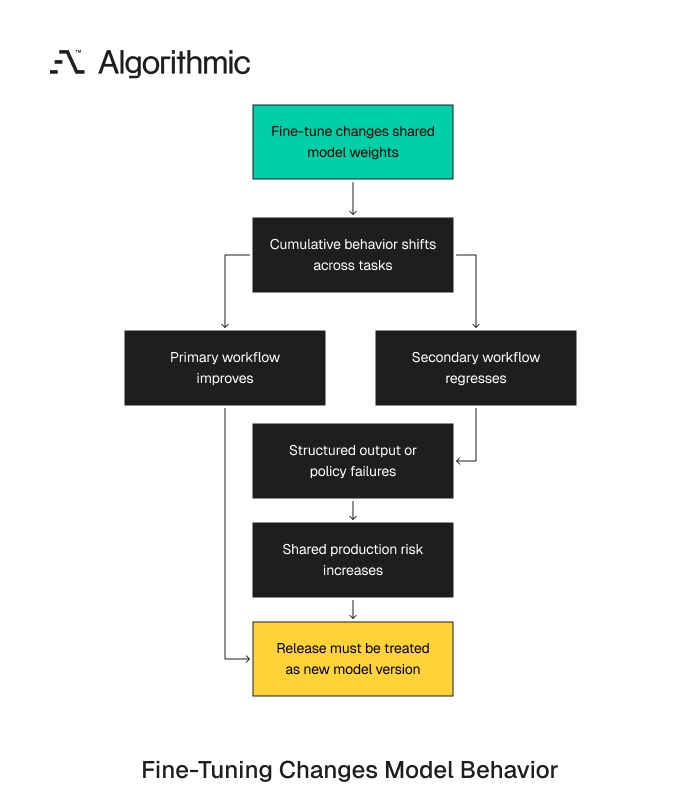
Fine-tuning creates cumulative behavioral change
A prompt change can be reviewed, diffed, and reverted in Git. A retrieval change can be traced to a document set, embedding model, chunking method, and vector index, while a fine-tune modifies learned behavior across tasks, including tasks absent from the training set. Each training run starts from a prior checkpoint and changes shared parameters or adapter weights, so the change is cumulative, and no clean inverse operation removes one training episode while preserving every other learned behavior.
This matters because supervised fine-tuning often improves local performance. A sales assistant fine-tuned on 6,000 high-performing emails can produce stronger outreach copy, yet the same model can become more verbose in support replies, less consistent in JSON output, or more likely to ignore retrieval instructions. Research reflects the same risk, and a 2025 LLM Security Workshop paper, Fine-Tuning Lowers Safety and Disrupts Evaluation Consistency, reports that fine-tuning can reduce safety alignment when the training data contains no harmful content, a finding that matters for teams using one model across regulated or customer-facing workflows.
Recent work on reversible supervised fine-tuning behaviors points to a practical constraint, since reversibility remains an active research topic, so engineering leaders should plan releases on the assumption that behavioral change persists unless the prior artifact is restored. A simple example shows the operational problem, because a model fine-tuned for short customer-service answers can learn a compressed response style, and if the same model writes legal summaries, that shorter style can remove caveats, citations, or exception language reviewers expect.
The issue grows when teams use adapters as release shortcuts. A LoRA adapter can appear lightweight because it stores fewer parameters than a full checkpoint, yet it still changes runtime behavior for every request routed through it. Parameter-efficient fine-tuning reduces storage and training cost while keeping the need for release discipline intact, so adapter activation, merge behavior, rank selection, and target modules become part of the production artifact.
A merged adapter also changes the rollback problem. If the team overwrites the served checkpoint after merge, restoration requires a preserved prior checkpoint, and if the team loads adapters dynamically, restoration requires correct adapter routing and version pinning. The training configuration also matters, because a LoRA rank of 8 on attention projections has a different behavioral footprint than rank 64 across attention and MLP modules, and those choices belong in the release record because they affect regression analysis.
Small data choices can create broad behavior change. Removing long conversations from training can teach brevity, and filtering out escalations can weaken escalation behavior in production. Fine-tuning also interacts with system prompts, since a model trained on helpful support transcripts can follow user requests more aggressively, which can weaken refusal boundaries when the system prompt requires policy enforcement.
Structured-output systems carry another risk. Fine-tuning on natural-language answers can reduce adherence to strict schemas, so a model that improved answer tone can produce invalid enums, missing fields, or extra prose around JSON. These effects are predictable enough to control and broad enough to require production release discipline, so treat every fine-tune as a new model version with its own failure modes.
 Click to expand
 Shared models create shared failure domains
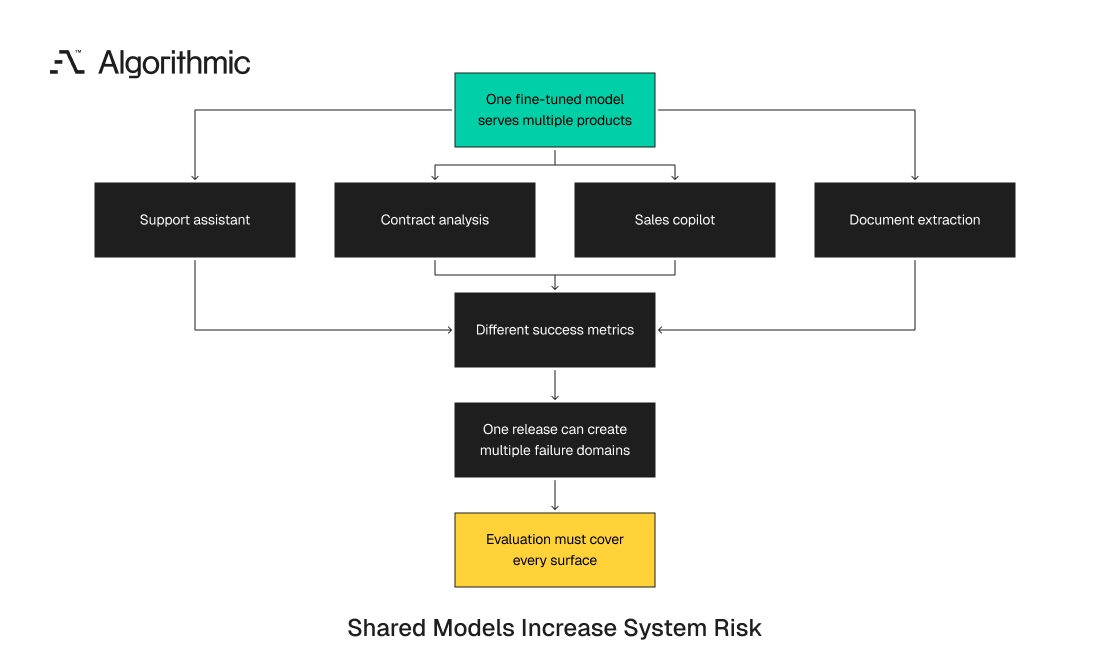
A model used by one workflow has a narrow blast radius, while a model used by five product surfaces becomes shared infrastructure, and the inference endpoint becomes a dependency for multiple teams, metrics, and customer commitments. A common production pattern uses one fine-tuned model for customer support, internal knowledge search, sales assistance, document extraction, and moderation triage, and the model can sit behind separate prompts, retrieval augmented generation pipelines, and tool-call policies, yet the release still changes the shared inference layer.
 Click to expand
 This creates one release decision with several risk profiles. Support teams measure deflection and customer satisfaction, legal operations teams measure extraction accuracy and citation fidelity, sales teams measure response quality and tone fit, platform teams measure latency, GPU use, and incident rate, and security teams measure policy compliance and protected-data exposure. A shared model turns a local improvement into an enterprise release event, so the team funding the fine-tune owns one business metric while the platform team owns the production risk across every caller.
The failure domain also includes batch workflows. A nightly contract extraction job can use the same model as an interactive support assistant, so a daytime canary can miss failures that appear when the batch job runs at 01:00 UTC. Shared models also create dependency timing issues, because one team can promote a prompt that assumes the old model behavior while another team promotes a fine-tune that changes instruction-following patterns the same week.
The approval benchmark is usually incomplete
A team can approve a fine-tune because it raises support answer quality from 78% to 86% on a 500-prompt evaluation set. That result is useful, but it does not prove stability across other surfaces. The contract analysis workflow can rely on terse extraction, stable citations, and strict JSON, the sales workflow can reward tone adaptation and longer generation, and the support workflow can reward empathetic explanation.
One fine-tune can move the model toward one behavior profile and away from another. The defect appears when the approval benchmark covers only the workflow that funded training, so shared infrastructure needs evaluation across every product surface that calls the model. A strong approval set includes the primary use case and the dependent use cases, because for a shared model 500 support prompts alone are insufficient, and a better suite adds contract clauses, sales responses, moderation examples, and internal search queries.
The evaluation suite also needs negative examples. A support model should reject refund requests outside policy, preserve escalation rules, and respect tenant boundaries, because these tests catch regressions that pass answer-quality scoring. Evaluation should also include adversarial examples drawn from production, so for support that includes angry customers, mixed-language messages, policy edge cases, and missing account context, and for document extraction it includes scanned PDFs, amended clauses, and malformed tables.
The suite should also preserve prior failures. If a model once fabricated a cancellation policy, that exact scenario belongs in regression tests, because incident-derived tests produce higher value than generic prompt collections. Benchmarks need clear scoring rules, so human reviewers should use a rubric with pass, fail, and severity labels, and free-form reviewer comments help triage while numeric release gates need consistent labels.
Regressions become ambiguous without lineage
When a defect appears, the investigation branches quickly. The cause can be a new training sample, a changed tokenizer, a LoRA adapter mismatch, or a prompt edit, and it can also be a retrieval index rebuild, reranker change, API gateway update, or downstream parser change. Without lineage, the team works from timestamps, Slack messages, and incomplete deployment notes, engineers compare log fragments and object storage paths, and product owners debate whether users changed behavior during the same week.
That is incident response without evidence. A production model needs the same traceability expected from a payment service, recommendation service, or customer data pipeline, so the team should identify the exact release artifact before the first incident review meeting ends. Ambiguity also increases customer exposure, because if the team cannot isolate the changed artifact it delays restoration while engineers test multiple theories, and during that period users continue receiving degraded answers or invalid structured output.
A well-kept release record narrows the search path. It tells the team which model ran, which adapter loaded, which prompt version executed, and which retrieval index supplied context, so that evidence turns a broad investigation into a focused rollback or fix. The absence of lineage also creates internal friction, since applied scientists defend the training set while platform engineers inspect routing, and product teams lose hours reproducing examples instead of restoring service.
Lineage reduces the number of plausible causes and protects the post-incident review from speculation, so the review can compare artifacts, configurations, and metrics instead of reconstructing a week of engineering activity. The same record helps security and compliance teams, because if a tenant reports protected-data exposure, investigators need the model version, prompt, retrieval source, and tool policy, and a complete trace shortens evidence collection from days to hours.
The minimum release record for every fine-tune
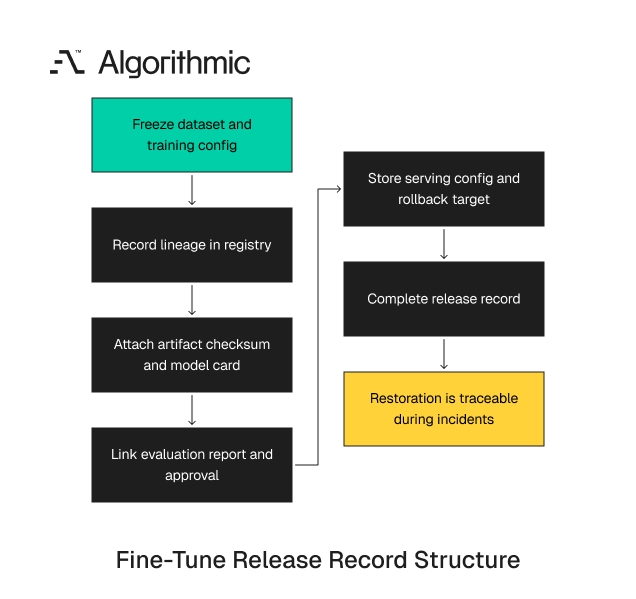
A fine-tuned model needs a release record that binds model behavior to exact inputs and artifacts. This is the model equivalent of a software bill of materials and deployment manifest, and it should connect training, evaluation, approval, serving, and rollback. The record should be created before training starts, because if the team reconstructs it after an incident the process has already failed, and reconstruction consumes senior engineering time during the period when customers need recovery.
The release record also creates continuity across personnel changes. A model trained by one applied scientist in March can still serve traffic in November, so the operating team needs a durable record after the original author changes roles. The record should also separate experiment metadata from production metadata, because experiment notes describe learning progress and trial results, while production records describe the artifact approved for traffic and the restore path.
A release record is useful only when it is immutable after approval. Corrections can be appended with a timestamp and owner. Approved fields should not be edited silently after deployment.
 Click to expand
 Required lineage fields
Every fine-tune release should record the following fields:
| Category | Required record | Production purpose |
|---|---|---|
| Base model | Provider, model name, model version, context length, tokenizer revision | Identifies the starting point for behavior |
| Training data | Dataset ID, source tables, snapshot timestamp, row count, deduplication method, exclusion rules | Ties output behavior to exact data |
| Training code | Git SHA, container image digest, dependency lockfile, training framework version | Recreates the training run |
| Training configuration | Learning rate, epochs, batch size, scheduler, seed, LoRA rank, target modules | Explains parameter movement |
| Artifacts | Full checkpoint or adapter path, checksum, model card, evaluation report | Supports restore and audit |
| Approval | Owner, reviewer, risk classification, release ticket | Creates accountable ownership |
| Serving configuration | Inference image, quantization method, prompt versions, retrieval index ID, tool policy | Connects model behavior to runtime behavior |
This record belongs in a model registry. MLflow Model Registry, SageMaker Model Registry, Weights & Biases Artifacts, and Vertex AI Model Registry all support parts of this workflow, and the tool matters less than immutability, ownership, and consistent use. Model versioning, rollback, and drift control are well understood in principle, yet the gap in many internal systems is clear, because models are logged as experiment outputs, then used as production assets without production controls.
The registry should also store decision context. A release ticket should explain which metric justified the fine-tune, which risks were accepted, and which surfaces were tested, so six months later that record prevents a team from repeating the same regression. A strong registry record includes retention policy, because the team should know how long the prior model remains available after promotion and which artifacts qualify for deletion after audit windows close.
For customer-facing systems, keep the last two production versions available. That gives the team a fallback if the prior version has a separate defect, and for regulated workflows retention should match audit, contract, and incident review requirements. The registry should store sample requests used for release validation, since a five-request smoke test can confirm model ID, response shape, refusal behavior, tool calling, and citation format, and these samples help operators validate restoration after a rollback.
Ownership fields should identify both business and technical owners. The business owner accepts workflow risk, while the technical owner controls deployment, monitoring, and restoration. Access control belongs in the record, so only approved roles should promote aliases, mark artifacts as production, or retire prior versions, and a production fine-tune should never be promoted through a personal notebook token.
Cost metadata also belongs in the record. Token limits, batch settings, GPU type, and quantization choice affect unit economics. A release that changes average output length can alter monthly inference spend within one billing cycle.
Rollback discipline starts before training
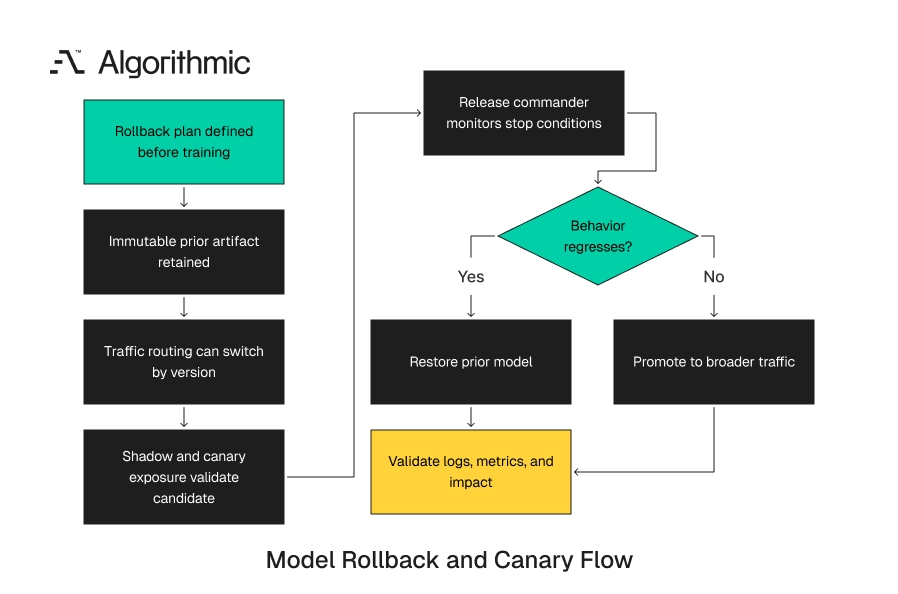
Rollback is a release design requirement, not an incident tactic reserved for a failed launch, so the restore path should be known before training consumes the first GPU hour. A team should know the exact restore path before exposing a fine-tuned model to 1% of production traffic, because if rollback requires manual object storage lookup, undocumented Terraform edits, or a vendor support ticket, the release is not ready, and the same standard should apply to hosted fine-tunes and open-weight deployments.
Planning should also cover partial restoration. A team can restore the model while leaving the new prompt active, and that partial rollback often leaves the system in an untested state. The release plan should define restoration scope, so for a shared model rollback usually means model artifact, adapter state, tokenizer, prompt versions, retrieval index, and serving parameters, and each item needs an owner and a known deployment path.
 Click to expand
 Rollback design should cover warm capacity. If the prior model requires different GPU memory, the serving layer needs ready capacity or a tested cold-start path, because a rollback blocked by capacity planning is a release design failure. Hosted fine-tunes need the same thinking, since a provider model ID can remain available while the account lacks quota for immediate traffic restoration, so release teams should verify quota and rate limits before production exposure.
Artifact immutability
The prior production model must remain available as an immutable artifact. That includes the base model reference, adapter weights, tokenizer, inference container, quantization settings, and serving configuration, because a rollback target with missing runtime settings is an incomplete restore target. For open-weight models, store artifacts in versioned object storage with checksums using S3 Versioning, Google Cloud Storage object versioning, or Azure Blob immutable storage policies, and record SHA-256 checksums for model weights, adapters, tokenizer files, and inference images.
For hosted fine-tunes, pin the provider model ID and record the API version. Store the provider response payload that created the fine-tune, and if the provider supports model aliases, treat alias movement as a release event. For retrieval augmented generation systems, record the embedding model and vector index version, because a model rollback without retrieval rollback can leave behavior changed, so the response style can return to the old model while cited content still comes from a new index.
Quantization settings deserve the same discipline. A model restored with a different quantization method can produce different latency, memory use, and edge-case behavior, so record AWQ, GPTQ, bitsandbytes, TensorRT-LLM, or vLLM settings with the artifact. Tokenizer drift also creates production defects, since a tokenizer file mismatch can change truncation, special tokens, and tool-call formatting, so the tokenizer should be stored and checksummed with the model version.
Model cards should accompany artifacts. A useful model card names intended workflows, known exclusions, evaluation results, safety limits, and owner contacts, and it should also state the prior production version and rollback target. Retention rules should be explicit, because a prior model should not disappear when a lifecycle policy deletes an S3 prefix after 30 days, and storage cost for two model versions is small compared with a multi-week incident.
Immutability also applies to training data snapshots. If the dataset is recreated from mutable tables, the same dataset ID can produce different rows. Store the snapshot or store immutable source references with row-level hashes.
Traffic routing
The serving layer should support traffic switching by model version. This can be done through a feature flag service, inference gateway, Kubernetes service routing, or model server configuration, and the key requirement is controlled routing without code changes. The target rollback time should be measured, so for customer-facing systems a 15-minute rollback objective is a practical minimum, while for regulated workflows or high-volume support automation 5 minutes is a stronger standard.
Model rollback velocity is the metric that matters. The time between detecting wrong behavior and fully restoring the old model is the incident measure to track, because detection without fast restoration still leaves customers exposed. Routing also needs auditability, so logs should include model version, prompt version, retrieval index ID, tenant ID, and product surface, and during an incident those fields separate model regressions from prompt, retrieval, and integration changes.
The routing layer should support tenant-level and surface-level controls. A financial services tenant can require slower exposure than an internal employee workflow, and a document extraction workflow can remain pinned while support traffic advances. Model aliases need strict change control, so an alias such as production-support-llm should move only through the deployment pipeline, because manual alias edits create untracked releases.
Traffic routing should also support shadow execution. The candidate model can receive the same request as production without returning an answer to the user, and shadow logs help compare behavior before the candidate receives live traffic. The gateway should record routing decisions, so a later investigation shows why request abc-123 reached model version support-ft-2026-04-18, and that proof matters when only a subset of tenants received the candidate. Caching also needs explicit handling, because if the application caches generated responses or tool outputs, rollback must invalidate candidate-version entries, otherwise users can see candidate outputs after traffic returns to the prior model.
Runbooks and ownership
A rollback plan needs a named owner, command sequence, validation steps, and communication path. It should state who approves rollback during business hours and who approves rollback at 02:00 UTC. The runbook should include exact checks after restore, including model ID in logs, sample inference result, p95 latency, error rate, task success rate, and customer-visible status, because a rollback that restores the artifact while leaving stale cache, wrong routing, or incompatible parser logic is incomplete.
The owner should run the procedure before production exposure. A staging rehearsal catches missing permissions, stale credentials, and dashboard gaps, and these failures are inexpensive in staging but costly during a customer incident. The runbook should also define communication thresholds, so a 5-minute internal rollback needs a Slack update and release ticket entry, while a customer-visible incident needs status-page language, account team notice, and post-incident review.
Ownership should sit with the operating team, not the model author alone. Applied scientists understand training choices, while platform engineers control routing, observability, and restoration. The runbook should use commands that operators can copy without interpretation, so include kubectl, Terraform, feature flag, or provider CLI commands where those tools control routing, and screenshots are useful only when paired with command-level instructions.
Validation should include business behavior, not infrastructure health alone. A 200 response from the inference endpoint proves service availability, but it does not prove the restored model follows refund policy or emits valid JSON. The on-call rotation should know the rollback authority, because if approval requires a product director who is offline, the system has an organizational single point of failure, so high-risk releases need pre-approved rollback authority.
Canary releases expose behavioral regressions early
Offline evaluation is necessary but cannot represent all production behavior, because real users send longer prompts, mixed languages, malformed files, and domain terms absent from the evaluation set. A mature fine-tune release uses staged exposure, so the canary should begin with internal traffic or shadow traffic, then advance to small production cohorts, and a common schedule is 1%, 5%, 25%, and 50% over 24 to 72 hours, with explicit stop conditions at each stage.
The schedule should reflect traffic volume and workflow risk. A support assistant with 40,000 daily conversations can produce meaningful canary data in hours, while a contract review workflow with 80 weekly documents needs longer observation and stronger offline testing. Canaries also need clean change windows, because if a team changes prompts, retrieval, and model weights during the same day, attribution becomes slow, so the canary window should freeze unrelated changes unless a production incident requires action.
A canary should test the same integration path used by production. Testing a model in a notebook bypasses authentication, retrieval, tool execution, caching, and parsers, and production regressions often appear in those integration layers. The canary should also include rollback checkpoints, so after the 1% stage the release commander confirms the restore command still points to the prior artifact, which prevents stale rollback instructions from surviving into later stages.
Metrics must cover behavior, safety, and operations
The canary scorecard should include at least 3 metric classes. Behavior metrics measure task performance, with examples including exact-match extraction accuracy, human-rated answer quality, citation correctness, tool-call precision, and JSON-validity rate. Safety metrics measure refusal behavior, policy compliance, toxic output rate, protected-data leakage, and unsafe instruction following, and the 2025 LLM Security Workshop finding on reduced safety alignment after benign fine-tuning makes this class mandatory for externally exposed systems, so teams should test safety even when the training set contains routine business data.
Operational metrics measure p50 and p95 latency, token usage, timeout rate, retry rate, GPU memory use, and cost per successful task. A fine-tune that raises task quality by 4% and increases inference cost by 38% needs business review before full rollout, so the release decision should account for unit economics, not model quality alone. Each metric needs an owner and threshold, so JSON validity can require 99.5% on document extraction, while citation correctness can require 95% human-reviewed acceptance before exposure expands.
The metric design should distinguish leading and lagging signals. JSON validity and latency appear within minutes, while customer satisfaction and legal-review acceptance can take days. Human review should be sampled by surface, because a 100-response sample from support does not validate contract extraction, so each dependent workflow needs enough reviewed examples to support a release decision.
Metrics should include distribution shifts, not averages alone. Output length, refusal rate, citation count, and tool-call frequency can reveal behavior movement before task success drops, and a 30% increase in tool calls can also increase latency and vendor spend. The scorecard should separate severity levels, because a minor tone issue in a support reply differs from a fabricated contract clause, so release gates should block on severity-one defects even when aggregate scores remain green.
Cost metrics need workload context. More output tokens can be acceptable for sales emails and unacceptable for high-volume support automation. The scorecard should tie spend changes to product margins and service commitments.
Canary cohorts should map to product surfaces
Traffic percentages alone are insufficient. A 5% canary concentrated in one workflow will miss regressions elsewhere, so the canary plan should allocate traffic across every surface that depends on the shared model. Segment the canary by product surface, covering support assistant, internal search, sales copilot, document extraction, and moderation triage, and give each surface its own acceptance threshold, because shared models require surface-level gates where aggregate metrics hide local damage.
A 25% aggregate canary can look healthy while one low-volume workflow fails. For example, support can improve across 10,000 conversations while contract extraction fails on 40 documents, so surface-level gates keep that failure visible. Cohorts should also account for tenant risk, because enterprise customers with negotiated service terms should not receive early traffic by accident, so internal users, synthetic shadow traffic, and low-risk tenants make better initial cohorts.
For multilingual systems, language distribution needs explicit coverage. A fine-tune trained mostly on English support conversations can degrade Spanish or German responses, so the canary should measure language-specific performance before broad rollout. Cohorts should also reflect document and request complexity, because a canary made of short support questions will not validate long-context behavior, so include long transcripts, multi-attachment cases, and requests near context-window limits.
Tenant segmentation should be deterministic. If the same tenant moves in and out of a canary, user experience becomes inconsistent, and stable routing also makes incident analysis easier. The canary should exclude accounts under active escalation unless leadership approves inclusion, because these customers often have open support commitments and higher sensitivity to changes, so safer cohorts reduce business risk while still producing production data.
A practical gate model for fine-tune releases
Engineering leaders need a release process that protects production and remains light enough for weekly use. The following 5-gate model works for AI product development studios, enterprise MLOps engineering teams, and internal platform groups, and it gives auditors a clear trail from data to deployment. The model is intentionally operational, so it does not require a new governance committee for every adapter, but it does require evidence before training, before staging, before production exposure, and before full rollout.
The gates should be built into the deployment workflow. A checklist in a wiki will be skipped when a launch date is under pressure, while a pipeline that requires fields, approvals, and artifacts changes behavior. Each gate should have one accountable owner, because shared ownership often means no owner during an incident, so the release ticket should name the person who can approve progression or order rollback.
Gate 1 is training readiness
Training starts only after the dataset is frozen and registered. The dataset record must include source, row count, filtering rules, known exclusions, and data owner, and it should identify any customer, region, or product line excluded from training. A 10,000-row training set with no exclusion record creates audit exposure, while a 2,000-row set with clear source lineage, deduplication, and evaluation separation is safer, because smaller governed data beats larger undocumented data in production releases.
The readiness gate should also check data leakage. Evaluation examples must be separated from training examples before fine-tuning starts, because duplicate prompts across train and evaluation sets inflate quality scores and hide weak generalization. Data rights also belong in this gate, since customer support transcripts can include contractual use limits, personal data, and region-specific retention rules, so the dataset owner should confirm allowed use before training begins.
Filtering rules should be reproducible. A notebook cell that removes rows manually is not a release-grade filter, so store the query, script, or data pipeline version that produced the training snapshot. The dataset should also include quality labels, because low-quality examples teach low-quality behavior, especially in supervised fine-tuning, so labeling should mark escalations, policy exceptions, unsafe requests, and incomplete conversations.
Data balance should be checked before training. If 90% of examples come from one product line, the model can overfit that language and policy set, so the release record should show distribution by product, region, language, and tenant class. Privacy review should be practical and specific, so the team should know whether names, emails, account IDs, payment data, or health data appear in the training set, and redaction logic should be versioned with the dataset.
Gate 2 is offline evaluation
Run the candidate against a fixed evaluation suite before any production exposure. The suite should include 500 to 2,000 prompts across all product surfaces served by the model, and the size should reflect workflow count, risk, and prompt diversity. Evaluation must include regression tests for previous incidents, so if the support assistant once hallucinated refund policies, those prompts remain in the suite permanently, because incident-derived tests are among the highest-return assets in an LLM program.
The evaluation report should compare candidate and current production model side by side. It should show pass rates, failure categories, cost, latency, and representative examples, because averages alone do not expose severe errors in low-volume workflows. The suite should include structured-output tests, so for JSON workflows measure schema validity, required fields, enum values, and parser success, and for citation workflows measure source match, page reference, and unsupported claim rate.
Evaluation should also test refusal boundaries. A fine-tuned assistant can become more compliant with user requests after exposure to helpful support transcripts, so boundary tests confirm that safety instructions still hold. Evaluation should include tool-use scenarios, where the model calls the correct tool, passes valid arguments, and stops when the tool returns policy limits, because tool-call regressions often appear as valid language with invalid actions.
The report should separate automated and human-judged results. Automated checks work well for schemas, citations, and exact extraction, while human review remains necessary for tone, reasoning quality, and policy judgment. The evaluation set should remain stable between releases, so teams can add new tests after incidents or new workflows, but they should not remove difficult examples to pass a candidate.
Gate 3 is the release manifest
No model enters staging without a release manifest. The manifest binds the model artifact, training lineage, serving configuration, evaluation report, and rollback target, and it should be stored with the release ticket and model registry entry. This file should be machine-readable, and YAML or JSON is sufficient, because the purpose is repeatable deployment with traceable inputs.
A minimal manifest includes model_version, base_model, artifact_uri, checksum, dataset_id, eval_report_uri, serving_config_id, rollback_version, and approver. The deployment pipeline should reject releases with missing fields, and manual exceptions should require written approval from the accountable owner. The manifest should also identify dependent surfaces, so a shared model serving five workflows lists each workflow and its gate owner, which prevents silent adoption by teams that never reviewed the release.
Include expected runtime cost in the manifest. Token budget, GPU type, batch size, and quantization method affect the production bill, so finance teams and product owners need that data before full rollout. The manifest should also name the canary cohorts, so tenant IDs, traffic percentages, language segments, and product surfaces are explicit, because a vague rollout description creates avoidable confusion during incident response.
The manifest should also name the rollback command or pipeline job. Operators should not search a runbook while customers receive degraded output, so the release ticket should link directly to the restoration action. For hosted models, the manifest should record provider limits, including rate limits, region, data retention settings, and model alias behavior, because these fields matter when traffic shifts under pressure.
Gate 4 is canary exposure
Start with shadow traffic when possible. Compare candidate outputs against the current model without exposing users, because shadow evaluation helps identify severe regressions before customer impact. Then move to controlled production traffic and freeze unrelated prompt, retrieval, and integration changes during the canary window, since concurrent changes make attribution difficult and slow rollback decisions.
The canary should include stop conditions before traffic shifts. Examples include a 2-point drop in task success, a 1-point rise in unsafe output rate, or a 20% cost increase, and stop conditions turn release review from debate into execution. The canary window should have a named release commander who tracks metrics, approves stage movement, and orders rollback when thresholds fail, because distributed ownership slows decisions during incidents.
Canary dashboards should refresh fast enough for the traffic stage. A 1% stage that lasts two hours needs near-real-time operational metrics, while a weekly legal-review canary can use daily human review. The release commander should document every stage movement, showing time, cohort, metrics, decision, and approver, because this creates an audit trail and improves later incident review.
Canary analysis should include examples, not scores alone. Reviewers need representative failures from each surface, because a single severe example can justify rollback even when the aggregate metric passes. The canary should end with an explicit promotion decision, since if the team leaves a candidate at 50% for two weeks, production now has two active behaviors, and long-running split states increase support burden and analysis complexity.
Gate 5 is the rollback drill
Run a rollback drill before full rollout for high-risk releases. The drill should restore the prior model in staging and prove that logs, dashboards, and routing reflect the old version. A team that has never practiced rollback will improvise during the first high-pressure incident, which is an avoidable operational risk, and a 30-minute drill often exposes missing access, wrong aliases, stale dashboards, and undocumented cache behavior.
For regulated workflows, record the rollback drill result in the release ticket. Include start time, end time, operator, validation evidence, and defects found, because that record turns rollback from a claim into an exercised control. The drill should include at least one failed validation step, so leave a cache key on the candidate version in staging, which tests whether the operator detects partial rollback.
The team should measure elapsed time from rollback decision to validated restoration. That number becomes the baseline for future releases, so if the drill takes 28 minutes, a 5-minute production target is not credible. The drill should include communication steps, where operators notify the release channel, update the ticket, and record the validation result, because during a real incident communication errors compound technical errors.
Drills should be repeated after infrastructure changes. A new gateway, model server, or feature flag tool can invalidate the previous procedure, and rollback confidence decays when the serving path changes. High-risk releases should also test forward recovery, so after rollback the team knows how to re-enter the canary with a corrected artifact, otherwise the incident can stall the release for weeks.
Governance requirements are moving faster than release habits
Fine-tuning creates ownership obligations, because the model is no longer only a vendor artifact once the organization modifies behavior with proprietary data, so the organization has changed the system and owns the release consequences. AWS makes this point in its guidance on EU AI Act requirements for LLM fine-tuning on Amazon SageMaker AI, and the regulatory framing will vary by jurisdiction, use case, and model class, while the engineering control remains consistent, which is to record what changed, who approved it, and how production can be restored.
Named ownership matters, so every production model should have an accountable owner, operating team, registry entry, drift alerts, and deprecation path, and ownership should attach to a role and team, not a departing individual. Models left in Jupyter notebooks do not become production systems by being called from an API, but by having release controls, monitoring, and incident procedures comparable to other critical services, because the API boundary changes access, not governance status.
Drift monitoring also belongs in the governance model. Fine-tuned models can degrade as customers change language, products change policy, or retrieval content changes, so monitoring should compare current production behavior against the approved release baseline. Governance should also address deprecation, because old fine-tunes create security, cost, and audit burden when teams leave them online without owners, so a model registry should show which versions serve traffic and which versions are retired.
Deprecation needs evidence, so before removing a prior model, confirm that no tenant, batch job, evaluation framework, or fallback path still calls it, because a registry entry with zero traffic over 30 days gives better evidence than a calendar guess. Governance also needs incident taxonomy, so teams should label failures as training-data defects, model-behavior regressions, prompt defects, retrieval defects, tool defects, or integration defects, because consistent labels help leaders fund the right platform work.
Regulated workflows need stronger evidence retention. A bank using a fine-tuned assistant for loan operations should retain artifacts, approvals, evaluations, and incident records for the audit period, and the same applies to healthcare, insurance, and employment workflows. Vendor management belongs in the same control set, because hosted fine-tunes can depend on provider model versions, API behavior, regional processing, and retention settings, so procurement language should require notice and controls for provider-side changes that affect fine-tuned models.
Security review should include training data and serving behavior. A model can memorize rare strings, expose tenant data through retrieval, or follow unsafe instructions after fine-tuning, so governance should connect data review, safety testing, and monitoring. The governance goal is operational clarity, so leaders know which models exist, which teams own them, which customers receive them, and how each model can be restored, and that information should be visible without interviewing individual engineers.
The release checklist for fine-tuned LLMs
Use this checklist before approving the next fine-tune. It is written for shared production models, where one release affects several workflows. Single-workflow models can use the same list with fewer product-surface gates.
- The base model, tokenizer, and provider version are recorded.
- The training dataset is frozen, versioned, and tied to source snapshots.
- The training code, container, dependencies, seed, and hyperparameters are recorded.
- The candidate artifact has a checksum and immutable storage location.
- The evaluation suite covers every product surface that uses the model.
- The evaluation report includes behavioral, safety, and operational metrics.
- The prior production model remains available as a complete restore target.
- The serving layer can route traffic by model version.
- The canary plan includes traffic stages, cohort definitions, and stop conditions.
- The rollback runbook has an owner, commands, validation checks, and target time.
- Prompt, retrieval, and integration changes are frozen during the canary.
- Monitoring dashboards show model version, prompt version, retrieval index, latency, cost, and task outcome.
- Logs can tie each response to tenant, product surface, and release version.
- The release ticket records the approving owner and accepted risks.
- The deprecation plan states when the old model can be retired.
A team missing more than 2 of these controls should not ship a fine-tune to broad production traffic. The short-term speed gain is outweighed by the cost of ambiguous regressions, because a 2-week incident investigation costs more than a 1-day release gate. The checklist should live in the deployment workflow, because if it remains in a wiki teams will skip it under schedule pressure, so the deployment pipeline should verify required fields before traffic moves.
The checklist also creates a management view of release maturity. A CTO can review skipped controls by team, model, and quarter, and patterns in skipped controls often identify underfunded platform work. For example, repeated missing rollback drills usually point to weak routing infrastructure, while repeated missing evaluation coverage points to underbuilt test data operations, so these patterns are budget signals, not isolated process defects.
It should also feed quarterly risk review. A leadership team can see which models lack surface-level evaluations, rollback drills, or named owners, and that view turns model governance into engineering management instead of paperwork. Teams should score releases consistently, so a low-risk internal summarization model can pass with fewer gates than a customer-facing contract analysis model, and the risk classification should be recorded before evaluation starts.
The checklist should include evidence links. Each item should point to a registry entry, evaluation report, manifest, dashboard, runbook, or ticket. A checked box without evidence creates false confidence.
Treat fine-tunes as production releases
Fine-tuning large language models is a proven method for domain adaptation, structured output, and workflow-specific performance. It also creates persistent behavioral change in a shared asset, and that combination demands release discipline. The safe operating model is clear, so register the model, version every artifact, preserve lineage, canary by product surface, measure rollback time, and practice restore before the first incident.
Before the next fine-tune leaves staging, require a release manifest and a tested rollback runbook. If those artifacts do not exist, pause the release and build them, because production confidence comes from traceability, measured exposure, and a restore path that works under pressure. The practical test is simple, so ask the release team to name the exact prior artifact, switch traffic back, and prove restoration in logs, and if that answer takes more than 15 minutes, the fine-tune is not ready for broad production traffic.
This standard protects speed as much as safety. Teams that can restore quickly take smaller, more frequent releases with lower customer exposure, while teams without rollback discipline turn every fine-tune into a high-stakes change. The strongest organizations make release evidence normal, so model registry entries, manifests, canary dashboards, and rollback drills become part of weekly delivery, and fine-tuning then becomes an engineering practice that can scale across products, tenants, and regulated workflows.
Algorithmic builds production machine learning systems with the canary releases, evaluation gates, and rollback paths fine-tuning needs. Talk to us about your model release process before the next fine-tune ships.