
[ Case Study ]
NBA Betting Engine
Predictive ROI from real-time NBA data and inference on the fly.
Read time: 6 minutes
[ Overview ]
The NBA is fast, fluid, and full of volatility, from last-minute trades to back-to-back fatigue. For bettors, keeping up requires more than instinct. It demands precision. We built a data-driven betting platform that transforms over 3,000 unique data points into real-time, actionable intelligence. Our models deliver 8–15% ROI across moneylines, point spreads, and over/unders, giving users a powerful edge in a league defined by constant change.
[ Client ]
Professional Sports Betting Company, California, USA
[ Sector ]
Sports Betting, Predictive Analytics, Real-Time Decision Systems
[ Platforms ]
Web Dashboard, API, AWS Infrastructure
[ Budget ]
Confidential
[ Timeline ]
Ongoing
[ Launch ]
June 2025
The Challenge Addressed
NBA betting operates at high velocity. Lineups shift, injuries emerge, and cross-country fatigue alters outcomes. Amid this volatility, skilled bettors seek signal in the noise. Most prediction systems fall short - reactive, overfit to historical data, and disconnected from on-court dynamics.
Our objective was to develop a dynamic platform capable of tracking, adapting to, and capitalizing on the NBA’s evolving landscape, a system designed to thrive amid volatility and convert narrative shifts into actionable, market-beating insights.
Methodology
We engineered an end-to-end betting intelligence platform optimised for accuracy, speed, and return. Purpose-built to support the following:
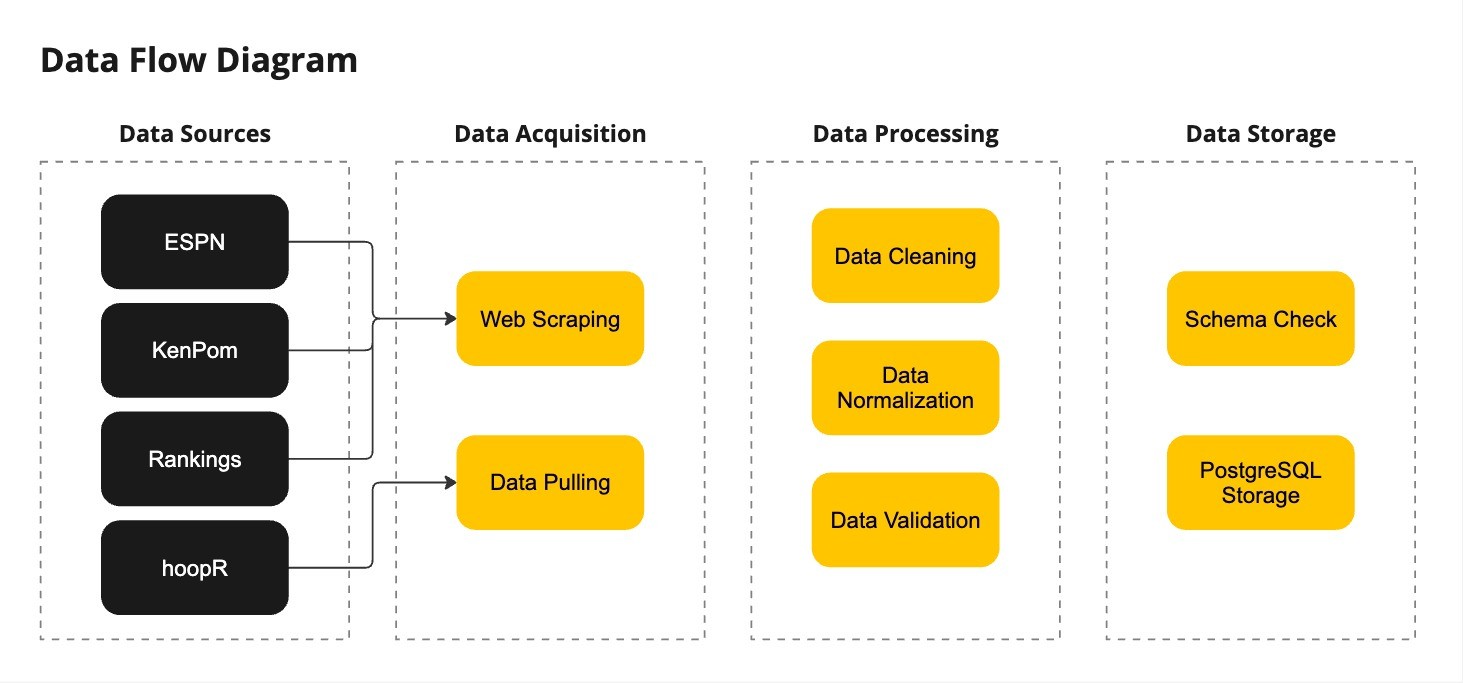
Real-time ingestion pipelines from official NBA feeds and premium analytics vendors.
Automated QA layers to catch data issues before they poison downstream features.
Modular, containerised compute for continual retraining and inference at scale.
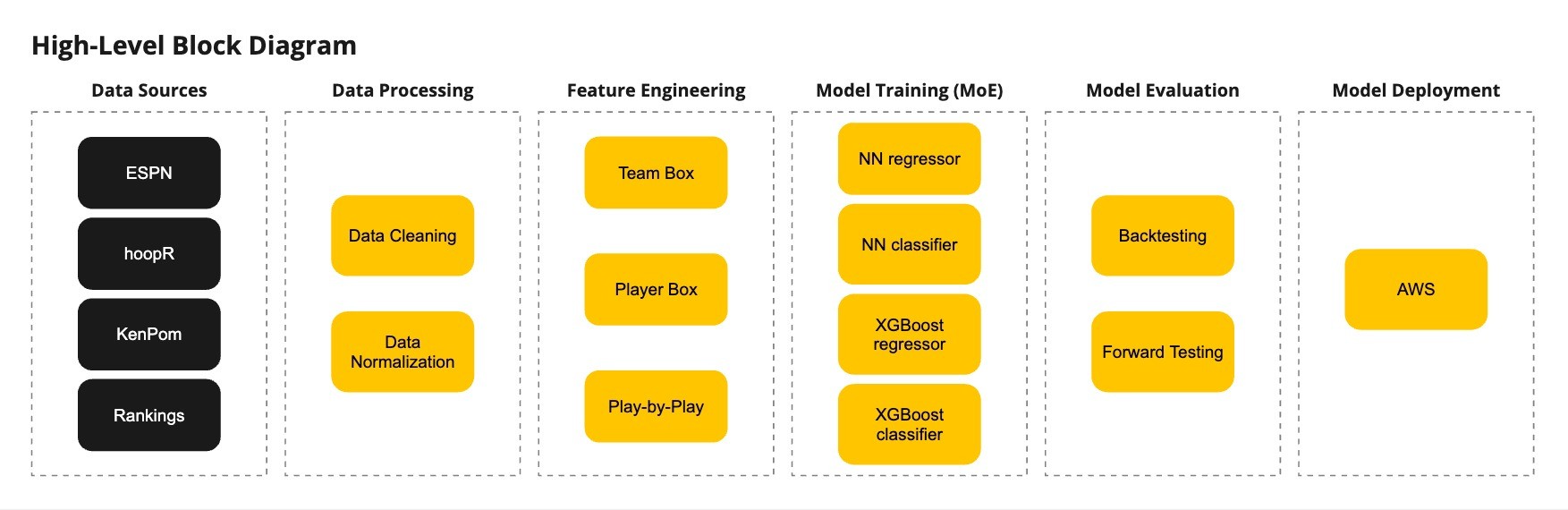
Under the hood, our models fuse over 3,000 engineered features, spanning everything from player synergy maps to fatigue indices, and deliver predictions tailored to:
Moneyline
Spread
Over/Under (Totals)
Custom strategies are also supported, enabling tailored betting models on demand.
The following diagram illustrates the system architecture we adopt.
Game-Informed Feature Engineering
NBA performance is shaped by context, travel schedules, roster changes, lineup rotations. Our models reflect this complexity:
Shot-level analytics fused with player pairing data reveal real-time chemistry shifts.
Fatigue index tracks back-to-backs, coast-to-coast flights, and compressed travel weeks.
Rolling efficiency metrics spotlight team momentum, before win-loss records catch up.
These features were engineered from first principles, neither scraped nor generic, but defined to reflect the sport’s core dynamics.
The following diagram outlines our data processing pipeline designed for high-throughput parallel data processing.
An Advanced Modelling Stack
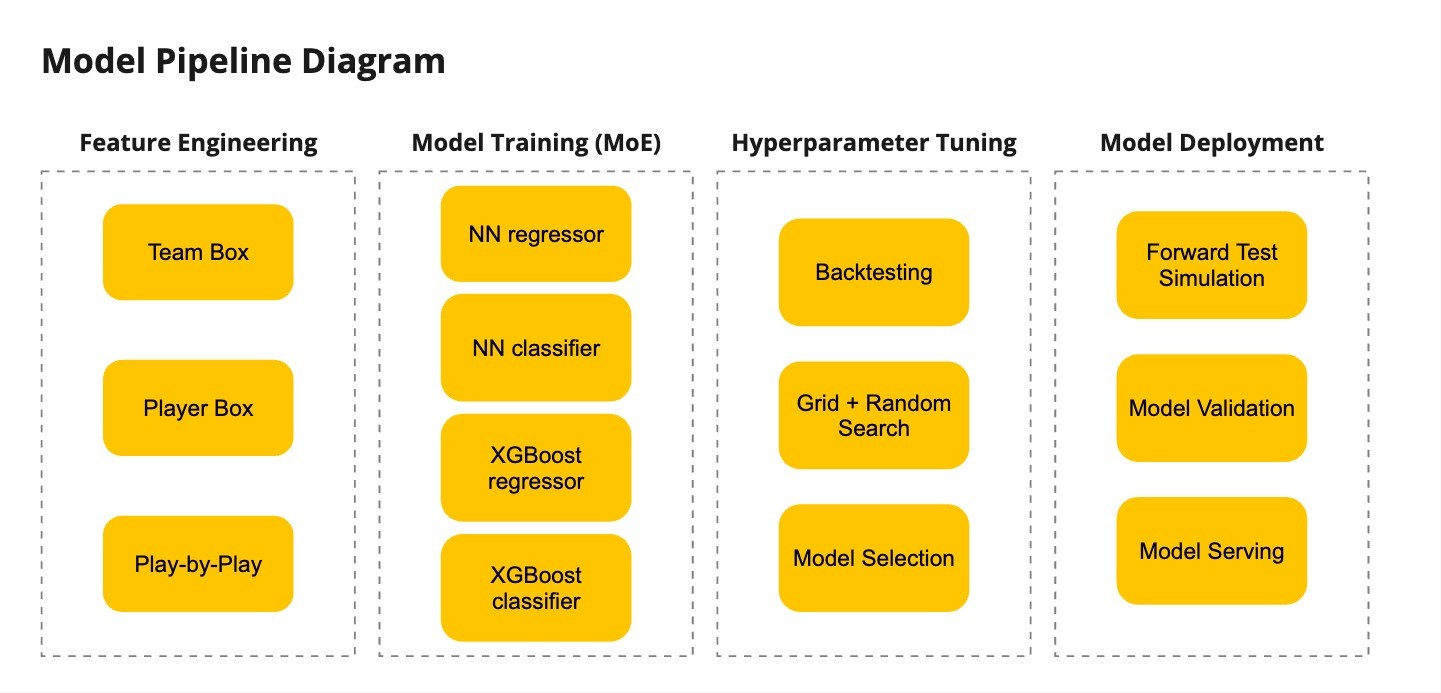
We mix foundational ML techniques, XGBoost, random forests, and ensemble stacks, with forward-looking approaches like:
Mixture of Experts (MoE) to combine model perspectives on outcome probabilities.
Neural feature learners to capture nonlinear interactions between context and outcome.
GPU-distributed hyperparameter tuning to rapidly identify high-performing model variants.
With each season, new data reshapes the landscape. Our models adapt accordingly, underperformers are retired, and high-performers are rigorously validated. Nothing is static.
The following presents our model pipeline, designed for efficient, scalable machine learning workflows.
Profit-Driven Performance Metrics
Model precision matters, but profit matters more. Our live dashboards translate predictions into P&L:
Real-time ROI tracking segmented by bet type, team, and time horizon.
Custom thresholds and alerts flag dips in performance before they affect the bankroll.
Granular reporting provides stakeholders with visibility into model decisions, daily profitability, and performance breakdowns.
Operational Stability and Deployment Agility
Speed and interpretability are baked into our stack:
Cloud-native, containerised infrastructure ensures modularity and allows pushing updates without downtime.
Dashboard UIs surface both top-line metrics and granular views (e.g. travel-adjusted performance shifts).
Explainability is built in: every prediction carries context, rationale, and historical precedent.
Users maintain full visibility, every prediction includes contextual explanations, rationale, and historical precedent.
Cross-Domain Applicability
Though built for the NBA, the architecture supports any real-time, context-heavy domain:
Soccer or MLB predictions
Consumer demand forecasting
Real-time risk analytics in finance
At the core lies a system designed to integrate diverse data sources, adapt in real time, and deliver high-confidence decisions at the point of action.
Measured Outcomes
+8 to 15% ROI across tracked bet types
>3,000 contextual features, engineered from raw NBA feeds
Sub-minute model refresh rates, thanks to high-speed pipelines and auto-tuned compute
Explainable outputs and live dashboards used by professional bettors
We worked to improve the way betting intelligence is built and deployed, focusing on practical gains in accuracy, transparency, and usability to better support decision-making.