
[ Insights - Product Development ]
Escaping the quadrant of death in enterprise software
The reasons behind the stagnation of enterprise software, as well as the four-variable framework CTOs and founders use to realign product development, market approach, and commercial strategy.
Read time: 11 minutes
Every enterprise software company lives inside a 2×2 matrix defined by two variables:
How long does it take to close a deal (Sales cycle length)
How much revenue each deal generates (Average Contract Value, or ACV).
You can survive in three of the four quadrants. A long sales cycle works when the eventual contract is worth millions - think Palantir selling to government agencies. A low ACV works when adoption is fast and frictionless - think Slack spreading through teams via self-serve signups. Each model has its own operational logic and can sustain a business.
The fourth quadrant is where software initiatives go to die. A long sales cycle paired with a low ACV creates a commercial structure where the math never works. Customer acquisition costs eat through revenue. Every deal requires months of enterprise selling - demos, procurement reviews, security questionnaires - and the contract that emerges barely covers the cost of winning it.
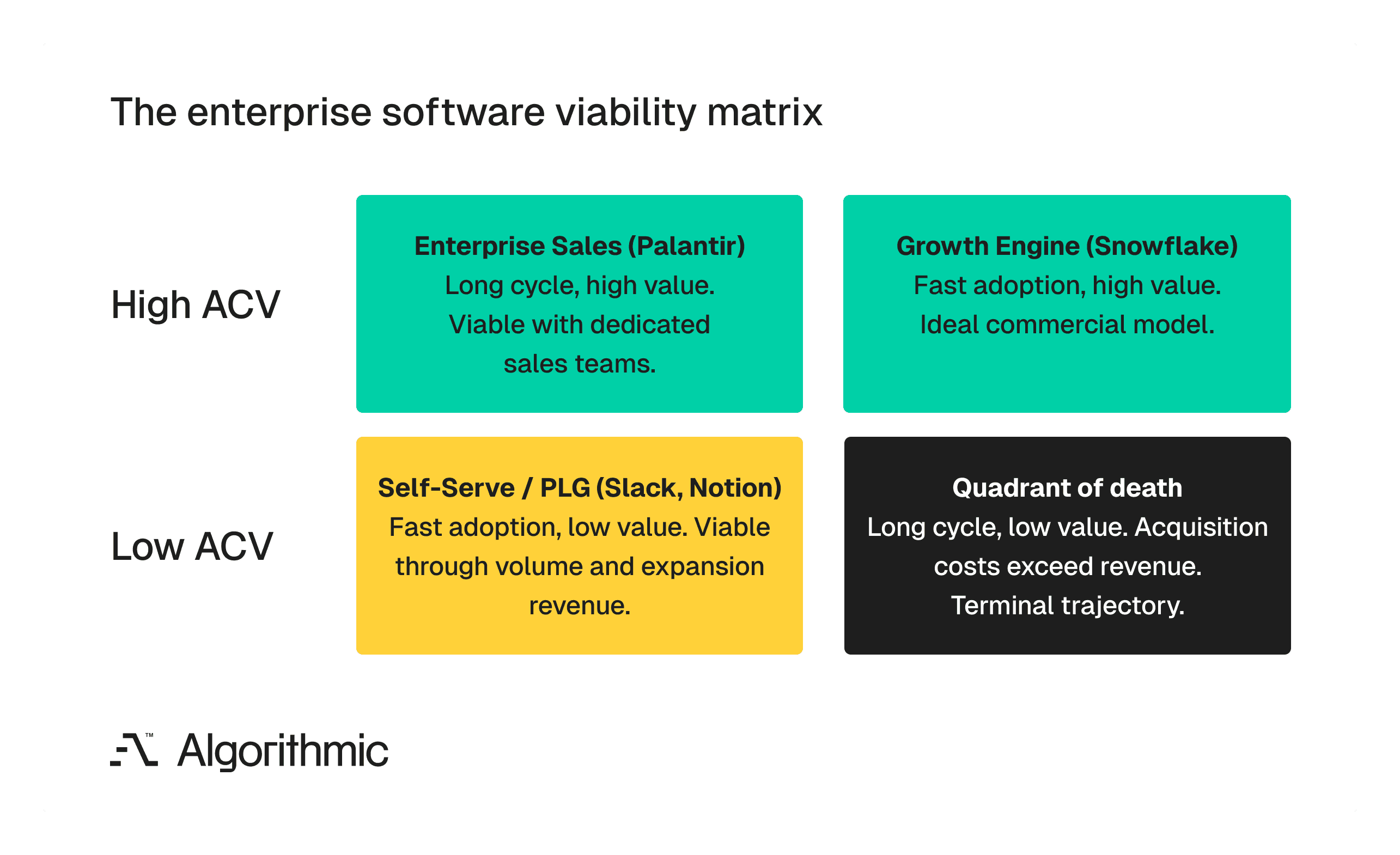
This is the quadrant of death.
How you end up here
No founder sets out to build a product with punishing unit economics. The quadrant of death is almost always the result of drift and not design. One common pattern is for a technically strong team to build software that solves a real problem, launch it, and land a handful of early customers through personal networks.
These initial successes serve as validation, prompting the team to allocate additional resources to engineering. Subsequently, they recruit sales personnel, which introduces challenges, as extended sales cycles emerge when prospects request custom features before signing. Moreover, deals require executive approval for contracts of modest value. While the sales pipeline expands, the actual revenue closed remains stagnant.
The most definitive diagnostic indicator is the marginal cost associated with acquiring each new customer. In a robust commercial framework, each subsequent customer should be easier to secure than the preceding one. Factors such as repeatable processes, word of mouth, and product maturity cumulatively support this trend. Conversely, in the quadrant of death, every customer acquisition resembles the initial effort (arduous and resource-intensive) with minimal returns.
According to Bain & Company's research on B2B pricing, pricing power is directly tied to measurable value delivery. When a product sits in the quadrant of death, the value delivery is either unclear, unquantified, or aimed at the wrong buyer. No amount of discounting or feature bundling fixes that.
The misdiagnosis that keeps you trapped
Most technical leaders often misdiagnose the problem at hand. They observe sluggish sales cycles and low contract values, prematurely concluding that the product lacks maturity. The default response is to revert to the engineering roadmap: deploying the next release, implementing an integration requested by a prospect, or redesigning the dashboard. This approach appears to be productive as it keeps the engineering team engaged and provides the sales team with new elements for demonstrations.
However, this tendency is almost invariably misguided. The friction within the quadrant of death results from a misalignment between the product's capabilities and the market's urgent willingness to pay. While features may address symptoms, the underlying issue lies within the commercial structure, which constitutes the true disease.
The deeper trap is psychological. When a team has spent twelve months architecting a complex backend - deploying sophisticated data models, building robust infrastructure, writing thousands of tests - admitting that the core commercial premise is flawed feels like admitting that the work was wasted. It is emotionally easier to keep iterating than to confront the possibility that the architecture needs to serve a different market entirely.
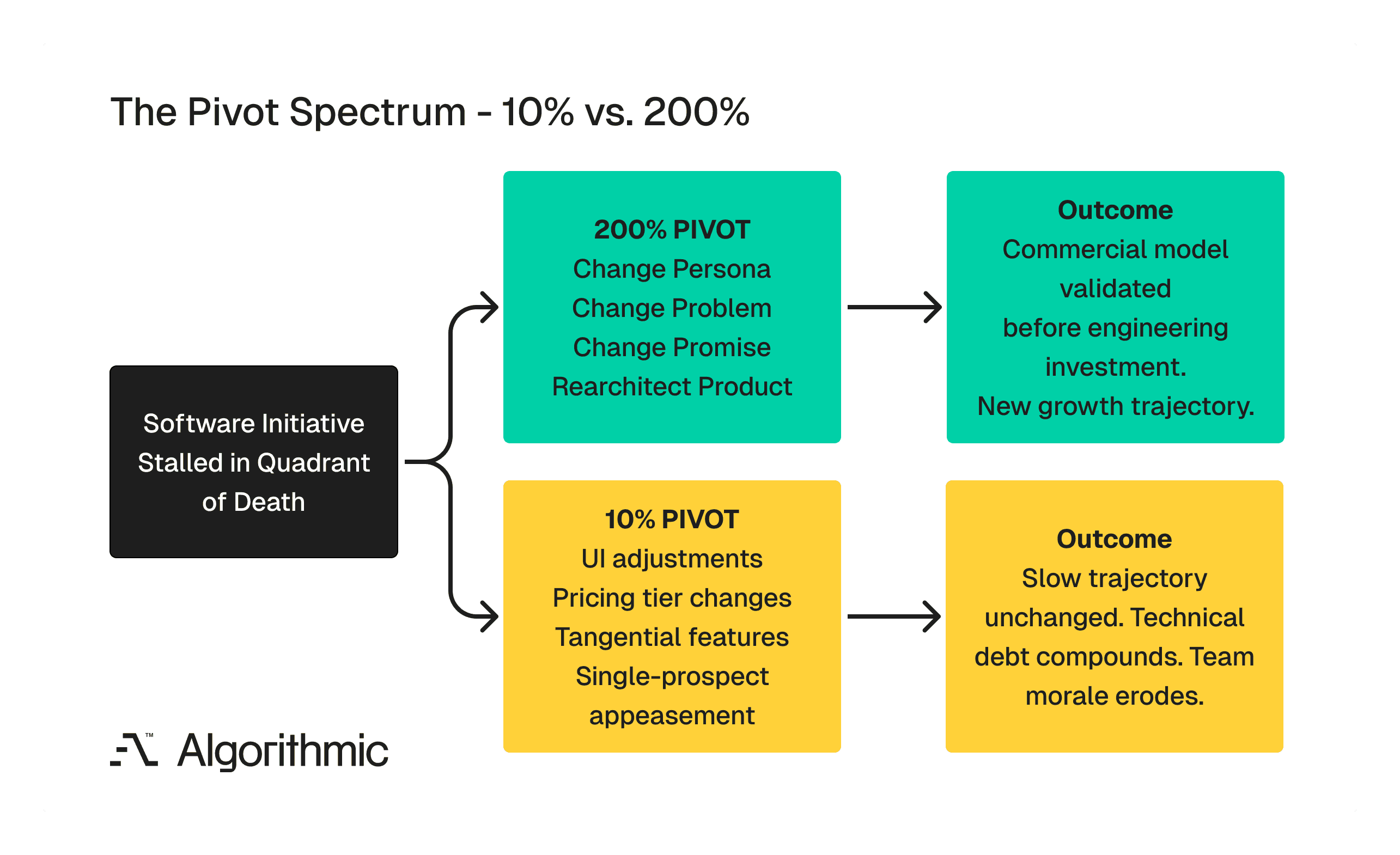
Jack Altman, CEO of Lattice, described this dynamic well. Teams facing existential commercial problems execute what he calls a "10% pivot" - minor UI adjustments, a new pricing tier, a tangential feature bolted on to appease a vocal prospect. The 10% pivot is emotionally manageable and organizationally safe since it changes nothing about the trajectory.
What survival demands is a 200% pivot where a fundamental realignment of who you sell to, what problem you solve, and how you frame the value. The psychological barrier to this kind of move is the realisation that significant portions of the technical architecture may need to be deprecated or rewritten. As Martin Fowler has written extensively, delaying necessary architectural restructuring compounds technical debt and operational paralysis with each passing sprint.
Four Ps - A framework for diagnosing and escaping the quadrant of death
Escaping the quadrant of death requires decoupling your emotional attachment to the codebase from the business's commercial reality.
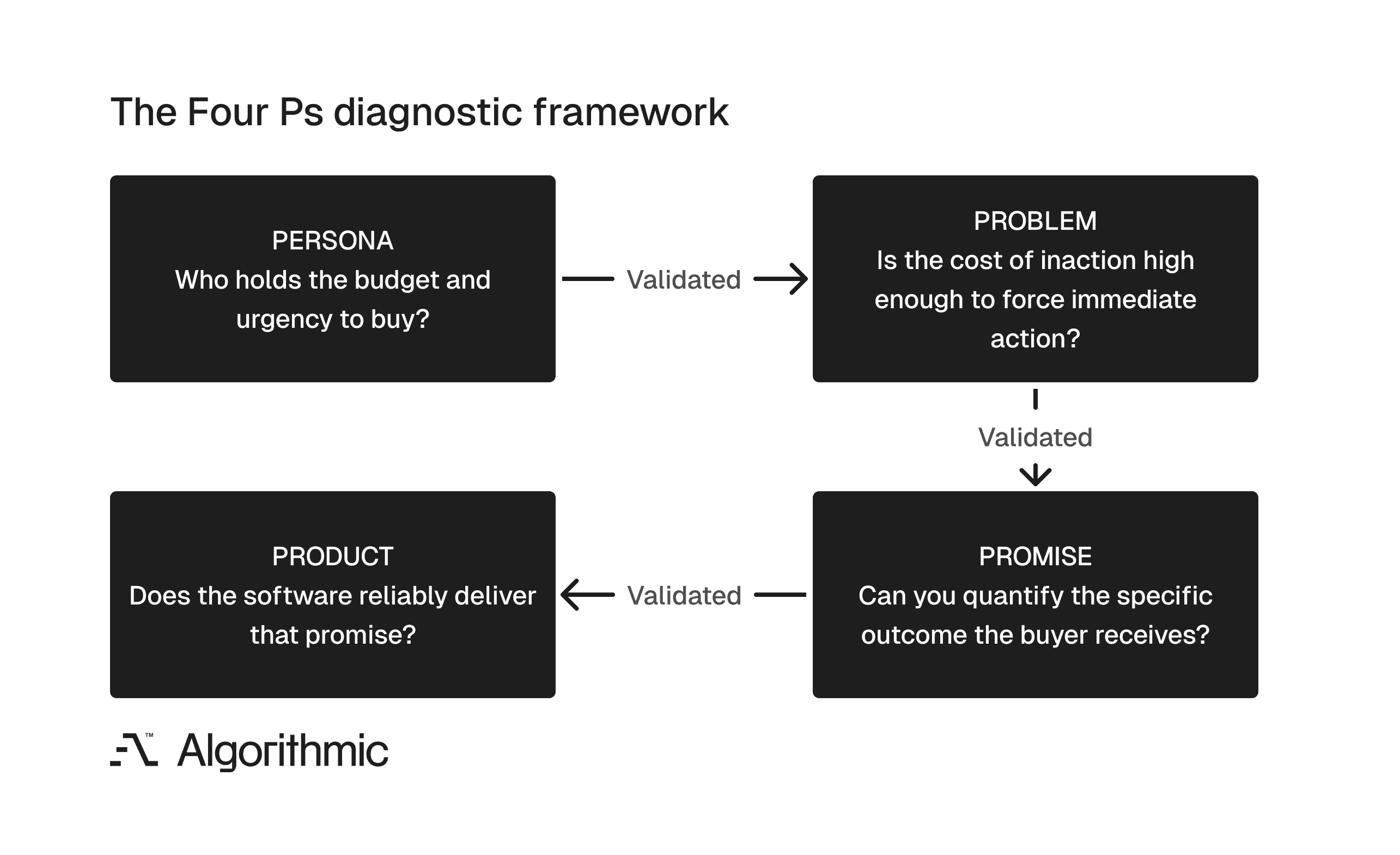
The diagnostic tool for this is the Four Ps framework and these four dimensions must interlock with precision. A weakness in any one of them breaks the entire commercial model. They are as below:
Persona - Who, specifically, holds the budget and possesses the urgency to buy? Selling to a mid-level manager without purchasing authority stalls every deal. Selling to a buyer with an annual budget cycle guarantees a long sales cycle regardless of product quality. The right persona has three attributes:
Decision-making authority
An allocated budget
An active pain point.
Problem - Is the friction you are solving a mild inconvenience or a business-critical threat? Products that solve "nice-to-have" problems command low ACVs and long sales cycles because there is no urgency to act. Products that address high-cost-of-inaction problems - regulatory risk, revenue leakage, operational failure - command premium pricing and compress decision timelines.
Promise - How are you framing the value? The promise is the specific, quantified outcome that justifies the ACV and forces the prospect to act now. A vague promise ("improve efficiency") invites comparison shopping and price negotiation. A precise promise ("reduce SOC 2 audit preparation from 120 hours to 12") creates urgency and defensible pricing.
Product - Does the software reliably and systematically fulfil the promise for the defined persona? This is the engineering question, and it comes last intentionally. The product is a vehicle for delivering a promise to a persona about a problem. If the first three Ps are wrong, engineering excellence in the product is irrelevant.
When an enterprise software initiative stalls, the instinct is to fix the Product, add features, improve performance, or redesign the interface. The Four Ps framework forces a different discipline where you first audit all four variables systematically, starting from the left. You cannot fix a Persona misalignment by writing more code, just as you cannot fix a vague Promise by refactoring your database schema.
Examples of three companies and their pivots
The power of the Four Ps framework becomes clear when you examine how successful companies used it - often unconsciously - to escape their own versions of the quadrant of death.
Lattice - Same persona, new problem
Lattice launched as an OKR (Objectives and Key Results) tracking tool, selling to HR leaders. The product worked. Companies adopted it. Engagement was shallow. Teams would use the tool for a single quarter, experience friction during the next planning cycle, and abandon the platform.
The Four Ps diagnosis: the Persona was right (HR leaders), but the Problem was wrong. OKR tracking was a low-urgency, low-cost-of-inaction category. HR leaders cared about it in theory but deprioritised it in practice.
The team executed a 200% pivot. They kept the Persona (HR leaders) and completely changed the Problem (performance management), the Promise (continuous employee development tied to retention outcomes), and the Product. Before writing thousands of lines of new code, they verified the new Promise by selling the concept using mockups alone. They established commercial certainty before committing engineering resources.
Plaid - Same product, new persona
Plaid launched as a consumer-facing budgeting application. The consumer product struggled to gain traction, with slow adoption and inconsistent engagement. The engineering team, though, had solved an immensely complex technical challenge: building reliable infrastructure to connect to thousands of disparate bank accounts. The underlying technology was sound. The commercial application was flawed.
The 200% pivot for Plaid involved keeping the core Product (the bank integration infrastructure) and changing everything else. They shifted the Persona from consumers to fintech developers. They reframed the Problem from personal budgeting to programmatic banking connectivity, and they restructured the Promise from "manage your money better" to "connect to any bank account via a single API".
Vanta - Everything changed
Vanta represents the most extreme version of the pivot. The company started as a B2B smart speaker concept. When that failed to gain traction, the team did not iterate on speaker hardware or voice interfaces. They stepped back to first principles.
The pivot changed all four Ps. They moved to a new Persona (startup CTOs and security teams), a new Problem (SOC 2 compliance is manual, expensive, and time-consuming), a new Promise (automated compliance that saves hundreds of hours), and a new Product (a compliance automation platform). Before building the platform, they executed the compliance process manually using spreadsheets - validating the problem and the promise before investing in engineering.
The Diagnostic Sequence
If your enterprise software initiative shows symptoms of the quadrant of death - slow sales cycles, low contract values, high acquisition costs, shallow engagement - run this diagnostic:
Step 1 - Validate the Persona: Map every deal in your pipeline by buyer title, budget authority, and purchasing timeline. If you are consistently selling to buyers without budget authority or buyers whose budget cycles do not match your sales expectations, the Persona is the failure point.
Step 2 - Stress-test the Problem: For each target account, answer one question: What happens to this company if they do nothing about this problem for the next twelve months? If the honest answer is "nothing catastrophic," the problem lacks the urgency to command a premium ACV or compress a sales cycle.
Step 3 - Sharpen the Promise: Can your sales team articulate, in one sentence, the specific, quantified outcome your product delivers? Test this by asking three different salespeople to state the value proposition independently. If you get three different answers, the Promise is undefined.
Step 4 - Audit the Product: Only after validating the first three Ps should you assess whether the product reliably delivers on its promise. This is where engineering investment should be directed - toward fulfilling a validated promise for a validated persona with a validated problem.
What this means for your organisation
For enterprise leaders, CTOs, and founders dealing with stagnant software initiatives, the directive is to stop treating commercial failure as an engineering problem. If your product suffers from slow sales cycles and low contract values, the answer is rarely more features.
Conduct the Four Ps audit and pose the challenging questions. Establish whether the target persona is accurate, if the problem justifies premium pricing, and whether the promise is both specific and measurable.
If any of these responses reveal a gap, halt development activities. Redirect resources towards validating the amended hypothesis (using mockups, manual processes, or concept sales) prior to dedicating engineering efforts to implementation.
True engineering excellence is measured by the accuracy with which code solves a high-value commercial problem. The discipline to execute a 200% pivot - to deprecate work, redefine the market, and rebuild with commercial certainty - separates organisations that survive from those that exhaust themselves iterating inside the quadrant of death.
One must build for depth as well as certainty, and commit engineering resources only when the Persona, Problem, Promise, and Product are locked together. This is the operating principle behind Algorithmic, and we partner with with founders and enterprise teams to take products from validated concept through production-grade deployment. Our core areas of focus include end-to-end product development, applied machine learning & AI, and data analytics & infrastructure.
If you’d like to follow our research, perspectives, and case insights, connect with us on LinkedIn, Instagram, Facebook, X or simply write to us at info@algorithmic.co